


 |
市場調查報告書
商品編碼
2099300
人工智慧驅動的光纖骨幹網路:市場佔有率分析、產業趨勢與統計數據及成長預測(2026-2031 年)AI-Driven Fiber Backbone Network - Market Share Analysis, Industry Trends & Statistics, Growth Forecasts (2026 - 2031) |
||||||

※ 本網頁內容可能與最新版本有所差異。詳細情況請與我們聯繫。
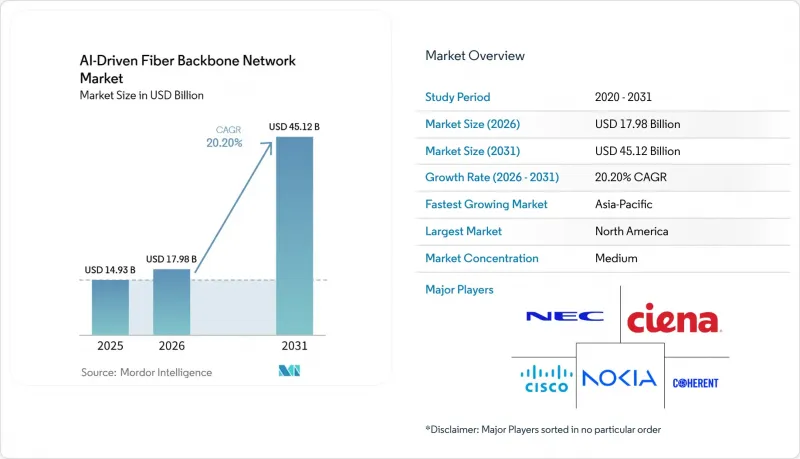
根據 Mordor Intelligence 預測,人工智慧驅動的光纖骨幹網路市場規模預計將從 2025 年的 149.3 億美元成長到 2026 年的 179.8 億美元,然後從 2026 年到 2031 年以 20.20% 的複合年成長率成長,到 2031 年達到 20312 億美元。
本報告按組件(電纜、收發器、交換器等)、網路類型(有線、無線)、部署模式(遠端通訊等)、應用程式(人工智慧訓練、雲端資料中心基礎設施、政府機構等)、最終用戶(通訊服務供應商、企業等)和地區(北美、亞太等)進行細分。市場預測以美元計價。
全球人工智慧驅動的光纖骨幹網路市場趨勢與洞察
以延遲關鍵型人工智慧工作負載的AI驅動型流量工程
人工智慧驅動的光纖骨幹網路市場正受到與傳統通訊流截然不同的流量模式的驅動。人工智慧訓練叢集會產生高度突發的全連接流量,可能在極短時間內填滿 400G 鏈路,這就要求通訊業者的路由選擇能夠更精確地處理延遲、擁塞和隊列深度。這正在將網路控制從靜態規劃轉向軟體定義流量工程,路由策略被視為直接影響人工智慧基礎設施效能的因素。 2026 年 6 月,諾基亞發布了自主網路代理庫,該庫具備基於代理的人工智慧功能,無需人工干預即可執行基於意圖的路由更新。這表明通訊業者正在為原生人工智慧光控做好準備。發表在《光通訊與網路雜誌》上的一項 2026 年現場試驗表明,利用大規模語言模型 (LLM) 的人工智慧代理在 440 公里的測試平台上,不到一分鐘即可完成波長分配、故障管理和光功率最佳化。因此,在人工智慧驅動的光纖骨幹網路市場中,網路工程決策越來越與 GPU 利用率、服務可靠性和叢集啟動速度相關。
超大規模校園間光纖擴展
人工智慧驅動的光纖骨幹網路市場也受益於圍繞新型運算走廊的園區區間光纖網路的擴展。隨著人工智慧設施為了尋求電力、土地和可擴展性而向內陸和次市場遷移,建設活動正從傳統的都市區中心向外擴散。這使得暗纖不再只是延遲最佳化工具,而是成為人工智慧基礎設施的核心組成部分,提升了其對管理策略路由的通訊業者的價值。 2026年1月,康寧公司和Meta公司簽署了一份價值高達60億美元的多年期光纖和連接解決方案契約,康寧公司還擴建了其位於北卡羅來納州希科里的工廠以滿足需求。 2026年2月,Fiberlight公司投資3.5億美元在德克薩斯州西部建設了一個1400英里長的網路,這表明人工智慧走廊的建設正在迅速擴展到新的骨幹網區域。這種擴張趨勢正在為整個人工智慧主導的光纖骨幹網路的電纜製造商、網路建造者和路由所有者創造一個不斷成長的市場。
光纖骨幹網路升級需要大量資金投入
在人工智慧主導的光骨幹網路市場,高資本密集度仍是一個主要阻礙因素。這是因為國家和區域層面的骨幹網路升級需要大量投資才能完全顯現收益。專案通常包括高密度波長升級、連貫放大器更換和路由器更新周期,導致投資回收期遠遠超出短期。超大規模資料中心業者可以透過長期、大規模的採購協議確保優先獲得容量和組件供應,這進一步加劇了小型營運商的壓力。康寧公司與Meta公司於2026年1月簽署的協議(價值高達60億美元)表明,大型買家能夠獲得供應並影響生產分配的規模之大。中型通訊業者通常需要在進行大規模骨幹網路建設之前簽署錨定協議,這導致在人工智慧主導的光纖骨幹網路市場中,那些不受超大規模資料中心業者資料中心需求支援的部分部署速度較慢。隨著電路系統向1.6T時代設計邁進,重新設計光基礎設施的成本也在上升,進一步擴大了資金雄厚的建造者和容量租賃者之間的差距。
細分市場分析
在人工智慧主導的光纖骨幹網路市場中,光收發器是成長最快的組件領域,預計到2031年將以21.33%的複合年成長率成長。同時,到2025年,光纖電纜在人工智慧主導的光纖骨幹網路市場規模中佔據25.77%的佔有率。這個組合意義重大,因為市場同時需要更高的實體路由容量和高速主動光通訊技術,兩者相輔相成,互不取代。隨著超大規模資料中心業者資料中心從400G向800G過渡,並開始提前部署用於園區鏈路和分散式資料中心路由的1.6T模組,光收發器的需求正在加速成長。 Marvell將於2026年開始向客戶提供其COLORZ 1600 1.6T ZR和ZR+插件模組的樣品,目標鏈路長度可達園區間12英里,分散式路由長度可達621英里。這將縮短人工智慧驅動的光纖骨幹網路市場的升級週期。這使得通訊業者能夠為更高密度的 AI 工作負載做好準備,而無需等待涉及高延遲的架構更新周期。
光纖電纜仍然是部署基礎。這是因為長期的暗纖合約和骨幹線路建設是決定未來設備需求的沉沒性投資。康寧和Meta之間的多年供應合約表明,電纜需求不再局限於網路擴展和企業接入需求,而是與人工智慧資料中心的建設直接相關。光交換器、路由器和擴大機也在重新設計,以適應更高密度的多軌人工智慧互連,Ciena的超軌光電平台及其對降低功耗的重視就證明了這一點。隨著人工智慧主導的光纖骨幹網路市場將光技術與運算平台緊密結合,包括被動元件和共封裝光元件在內的其他元件也變得越來越重要。換句話說,組件之間的競爭不再局限於單一硬體的出貨量,還取決於每一層與高密度人工智慧網路架構的契合度。
預計到2025年,有線骨幹網路將佔據人工智慧主導的光纖骨幹網路市場78.88%的佔有率,並在2031年之前以22.12%的複合年成長率成長。這種雙重地位反映了一個結構性現實:人工智慧訓練流量需要確定性、低延遲的性能、極低的抖動以及無線系統在大規模同步叢集中無法達到的吞吐量水準。 GPU的集體處理依賴可重複的時序,因此光纖在對效能要求較高的傳輸設計中仍然至關重要。 2026年3月,NTT東日本完成了其「IOWN全光電網路」在東京和福岡之間分散式人工智慧推理的展示實驗,在超過1000公里的距離上實現了與本地資料中心環境相當的性能。因此,在人工智慧主導的光纖骨幹網路市場中,有線傳輸不再是眾多選擇之一,而是高負載人工智慧工作負載的預設骨幹網路。
在光纖經濟效益不高或部署條件艱苦的地區,無線骨幹網路仍扮演重要角色。其主要機會不在於訓練叢集的核心互連層,而在於5G回程傳輸的密集化、移動邊緣AI推理以及最後一公里聚合。這凸顯了在不改變AI主導的光纖骨幹網路基本結構的前提下,無線技術在農村、離島和人口稀少的市場中持續成長的重要性。兩者的實際分工很明確:光纖負責AI的關鍵同步層,而無線則支援互補的存取和聚合功能。這種分工支撐了對兩種網路類型的穩定需求,但AI主導的光纖骨幹網路市場成長的核心仍然牢牢紮根於有線基礎設施。
區域分析
預計到2025年,北美將成為最大的區域市場,佔據人工智慧驅動型光纖骨幹網路市場佔有率的30.12%。該地區受益於超大規模資料中心業者中心園區的高度集中,以及骨幹網路投資從傳統城域核心網路向人工智慧走廊的明顯轉變。 2026年1月,康寧公司和Meta公司簽署了價值高達60億美元的多年協議,擴大了美國製造業對人工智慧資料中心和光纖部署需求的支援。 2026年2月,Fiberlight公司在西德德克薩斯州投資3.5億美元用於新建基礎設施,凸顯了骨幹網路建設越來越傾向選擇電力資源豐富的內陸地區。同樣在2025年,Zayo公司完成了對Crown Castle光纖解決方案業務的收購,從而獲得了一個關鍵客戶,負責建造一條長達8000英里的全新人工智慧走廊。這顯示資產整合正在推動人工智慧主導光纖骨幹網路市場的區域擴張。
預計到2031年,亞太地區將以21.77%的複合年成長率成長,成為人工智慧主導的光骨幹網路市場成長最快的區域。該地區的需求主要受政府主導的骨幹網路規劃、新建資料中心以及對低延遲城際人工智慧傳輸日益成長的需求所驅動。 2026年3月,NTT完成了其「IOWN全光電網路」在東京和福岡之間的分散式人工智慧推理現場測試,展示了其在長距離光基礎設施上實現本地資料中心層級的效能。 2026年6月,KDDI開始商業營運其叢集路由器,作為其「數位帶」計畫的一部分,該計畫將資料中心資產、海底光纜和邊緣節點整合到一個低延遲的全國性運算架構中。
歐洲在人工智慧主導的光纖骨幹網路市場佔據顯著佔有率,雲端運算的擴張和數據主權要求持續推動主要經濟體對骨幹網路的投資。 BT在2025年進一步鞏固了其市場地位,成為英國首家為受國家資料居住要求約束的受監管工作負載提供全面資料主權服務組合的供應商。隨著近岸外包和區域人工智慧基礎設施項目的推進,南美洲正在崛起成為需求中心,對更強大的跨境和內陸光纖線路的需求日益成長。儘管中東和非洲仍處於發展初期,但海灣國家的自主人工智慧計畫以及南非和埃及對陸基骨幹(連接至陸地基地台)的需求,正在凸顯其在人工智慧主導的光纖骨幹網路市場中的長期地位。
其他好處:
- Excel格式的市場預測(ME)表
- 3個月的分析師支持
目錄
第1章:引言
- 研究假設和市場定義
- 調查範圍
第2章:調查方法
第3章執行摘要
第4章 市場狀況
- 市場概覽
- 市場促進因素
- 以延遲敏感型人工智慧工作負載的人工智慧驅動型流量工程
- 擴展連接校園的超大規模光纖網路
- 向連貫光學技術過渡並提高線速率
- 具備自動故障預測和自癒能力的主幹網路營運。
- 對節能型跨站點人工智慧互連的需求日益成長。
- 為主權人工智慧和資料居住網路開發光纖網路
- 市場限制因素
- 升級光纖骨幹網路需要投入大量資金
- 舊有系統中多供應商整合的複雜性
- 光纖供應瓶頸和專用組件的前置作業時間
- 核心路由層和光纖傳輸層的網路安全風險
- 供應鏈分析
- 監理情勢
- 技術展望
- 連貫可插拔和從 800G 到 1.6T 的過渡
- 開放式光纖網路系統
- 人工智慧驅動的網路保障和意圖自動化
- 波特五力分析
第5章 市場規模與成長預測
- 按組件
- 光纖電纜
- 光收發器
- 光交換器和路由器
- 光放大器
- 其他規則
- 依網路類型
- 有線骨幹網路
- 無線骨幹網
- 部署模式
- 長途骨幹網
- 地鐵骨幹網
- 園區與資料中心之間的互聯
- 透過使用
- AI訓練集群的互聯
- 雲端和超大規模資料中心之間的互連
- 通訊核心和傳輸
- 政府和主權網路
- 企業廣域網路骨幹網路
- 最終用戶
- 電信服務供應商
- 雲端和託管服務供應商
- 公司
- 政府/國防
- 研究與教育網路
- 按地區
- 北美洲
- 美國
- 加拿大
- 墨西哥
- 南美洲
- 巴西
- 阿根廷
- 其他南美國家
- 歐洲
- 英國
- 德國
- 法國
- 義大利
- 其他歐洲國家
- 亞太地區
- 中國
- 日本
- 印度
- 韓國
- 其他亞太國家
- 中東和非洲
- 中東
- 沙烏地阿拉伯
- 阿拉伯聯合大公國
- 其他中東國家
- 非洲
- 南非
- 埃及
- 其他非洲國家
- 中東
- 北美洲
第6章 競爭情勢
- 市場集中度
- 策略趨勢
- 市佔率分析
- 公司簡介
- Ciena Corporation
- Nokia Corporation
- Cisco Systems, Inc.
- Huawei Technologies Co., Ltd.
- Juniper Networks, Inc.
- Fujitsu Limited
- NEC Corporation
- Ericsson
- Coherent Corp.
- Lumentum Holdings Inc.
- ADTRAN Holdings, Inc.
- Ribbon Communications Inc.
- Sterlite Technologies Limited
- Arelion
- AT and T Inc.
- Lumen Technologies, Inc.
- China Telecom Corporation Limited
- China Unicom(Hong Kong)Limited
- KDDI Corporation
- Equinix, Inc.
第7章 市場機會與未來展望
According to Mordor Intelligence, the AI-driven fiber backbone network market size is expected to grow from USD 14.93 billion in 2025 to USD 17.98 billion in 2026 and is forecast to reach USD 45.12 billion by 2031 at 20.20% CAGR over 2026-2031.
This report is Segmented by Component (Cables, Transceivers, Switches, and More), Network Type (Wired, and Wireless), Deployment Mode (Long Haul, and More), Application (AI Training, Cloud DCI, Government, and More), End User (Telecom Service Providers, Enterprises, and More), and Geography (North America, Asia-Pacific, and More). The Market Forecasts are Provided in Terms of Value (USD).
Global AI-Driven Fiber Backbone Network Market Trends and Insights
AI-Driven Traffic Engineering for Latency-Critical AI Workloads
The AI-driven fiber backbone network market is being driven by traffic patterns that differ significantly from legacy telecom flows. AI training clusters generate bursty, all-to-all exchanges that can fill a 400G link in very little time, so operators need path selection that responds to latency, congestion, and queue depth with far more precision. That is moving network control away from static planning and toward software-defined traffic engineering, treating routing policy as a direct part of AI infrastructure performance. In June 2026, Nokia introduced an Autonomous Networks Agent Library with agentic AI capabilities for intent-based routing updates without human intervention, which showed how operators are preparing for AI-native optical control.A 2026 field trial published in the Journal of Optical Communications and Networking demonstrated an LLM-powered AI agent that handled wavelength provisioning, failure management, and optical power optimization on a 440 km testbed in under 1 minute. As a result, the AI-driven fiber backbone network market is increasingly linking network engineering decisions to GPU utilization, service reliability, and the speed of cluster activation.
Hyperscale Campus-To-Campus Fiber Expansion
The AI-driven fiber backbone network market is also being lifted by campus-to-campus fiber expansion around new compute corridors. Build activity is moving beyond traditional urban hubs as AI facilities are following power availability, land availability, and expansion capacity into inland regions and secondary markets. This is turning dark fiber into a core input for AI infrastructure rather than a simple latency upgrade, raising the value of operators that control strategic routes. In January 2026, Corning and Meta signed a multiyear agreement worth up to USD 6 billion for optical fiber and connectivity solutions, and Corning expanded its Hickory, North Carolina, facility to support that demand. In February 2026, FiberLight committed USD 350 million to 1,400 route miles in West Texas, demonstrating how quickly AI corridor construction is moving into new backbone geographies. This expansion pattern is widening the addressable market for cable makers, network builders, and route owners across the AI-driven fiber backbone network.
High Capital Intensity of Fiber Backbone Upgrades
High capital intensity remains a major restraint on the AI-driven fiber backbone network market, as national and regional backbone upgrades require substantial commitments before revenue becomes fully visible. Projects often involve dense wavelength upgrades, coherent amplifier replacement, and router refresh cycles that stretch payback periods well past the near term. Smaller carriers are under added pressure because hyperscalers can secure capacity and priority for components through longer, larger purchase agreements. The January 2026 Corning and Meta agreement, worth up to USD 6 billion, showed the scale at which top buyers can lock in supply and shape manufacturing allocation. Mid-tier operators often need anchor contracts before they can move ahead with major backbone builds, which slows rollout in parts of the AI-driven fiber backbone network market that are not backed by hyperscaler demand. As line systems move toward 1.6T-era designs, the cost of redesigning optical infrastructure is also rising, which is widening the gap between well-capitalized builders and capacity lessors.
Other drivers and restraints analyzed in the detailed report include:
- Shift Toward Coherent Optics and Higher Line Rates
- Automated Fault Prediction and Self-Healing Backbone Operations
- Legacy Multivendor Integration Complexity
For complete list of drivers and restraints, kindly check the Table Of Contents.
Segment Analysis
Optical transceivers are the fastest-growing component segment in the AI-driven fiber backbone network market, with a 21.33% CAGR through 2031, while fiber optic cables held 25.77% share of the AI-driven fiber backbone network market size in 2025. This pairing matters because the market needs both more physical route capacity and faster active optics simultaneously, rather than one replacing the other. Transceivers are gaining momentum as hyperscalers move from 400G to 800G and begin early adoption of 1.6T modules for campus links and distributed data center routes. Marvell began customer sampling of its COLORZ 1600 1.6T ZR and ZR+ pluggable in 2026, targeting links from campus distances up to 12 miles and distributed routes up to 621 miles. That shortens upgrade cycles in the AI-driven fiber backbone network market, as operators can prepare for denser AI workloads without waiting for slower architectural refresh cycles.
Fiber optic cables still anchor the installed base because long-term dark fiber agreements and backbone route construction are sunk investments that shape future equipment demand. Corning's multiyear supply agreement with Meta showed that cable demand is now directly tied to AI data center buildouts rather than only telecom expansion or enterprise access needs. Optical switches, routers, and amplifiers are also being redesigned for denser multi-rail AI interconnects, as shown by Ciena's hyper-rail photonics platform and its strong emphasis on power reduction. The remaining component pool, including passive elements and co-packaged optical approaches, is becoming more relevant as the AI-driven fiber backbone network market pushes optics closer to compute platforms. That means component competition is no longer only about standalone hardware volume; it is also about how well each layer fits dense AI networking architectures.
Wired backbone networks held 78.88% of the AI-driven fiber backbone network market share in 2025 and are projected to grow at a 22.12% CAGR through 2031. That dual position reflects a structural reality: AI training traffic requires deterministic, low-latency performance, very low jitter, and throughput levels that wireless systems cannot match across large, synchronized clusters. Collective GPU operations depend on repeatable timing, which keeps fiber at the center of performance-sensitive transport design. In March 2026, NTT East Japan completed an IOWN All-Photonics Network trial for distributed AI inference between Tokyo and Fukuoka, achieving performance equivalent to a local data center environment over more than 1,000 km. The AI-driven fiber backbone network market, therefore, continues to treat wired transport not as one option among many, but as the default backbone for high-intensity AI workloads.
Wireless backbone networks still play a useful role in regions where fiber economics are weaker or deployment conditions are more challenging. Their main opportunities are in 5G backhaul densification, mobile edge AI inference, and last-mile aggregation, rather than in the core interconnect layer for training clusters. This keeps wireless growth relevant in rural, island, and lower-density markets without altering the basic structure of the AI-driven fiber backbone network. The practical split is clear: fiber carries the AI-critical synchronization layer, while wireless supports complementary access and aggregation functions. That separation supports stable demand for both network types, but it keeps the growth center of the AI-driven fiber backbone network market firmly on wired infrastructure.
Complete Report Scope:
- By Component
- Fiber Optic Cables
- Optical Transceivers
- Optical Switches and Routers
- Optical Amplifiers
- Other Components
- By Network Type
- Wired Backbone Network
- Wireless Backbone Network
- By Deployment Mode
- Long Haul Backbone
- Metro Backbone
- Campus and Data Center Interconnect
- By Application
- AI Training Cluster Interconnect
- Cloud and Hyperscale Data Center Interconnect
- Telecom Core and Transport
- Government and Sovereign Networks
- Enterprise Wide Area Backbones
- By End User
- Telecom Service Providers
- Cloud and Colocation Providers
- Enterprises
- Government and Defense
- Research and Education Networks
- By Geography
- North America
- United States
- Canada
- Mexico
- South America
- Brazil
- Argentina
- Rest of South America
- Europe
- United Kingdom
- Germany
- France
- Italy
- Rest of Europe
- Asia-Pacific
- China
- Japan
- India
- South Korea
- Rest of Asia-Pacific
- Middle East and Africa
- Middle East
- Saudi Arabia
- United Arab Emirates
- Rest of Middle East
- Africa
- South Africa
- Egypt
- Rest of Africa
- Middle East
- North America
Geography Analysis
North America accounted for 30.12% of the AI-driven fiber backbone network market share in 2025, making it the largest regional market. The region benefits from the highest concentration of hyperscaler campuses and a visible shift in backbone investment toward AI corridors rather than legacy metro cores. In January 2026, Corning and Meta signed a multiyear agreement worth up to USD 6 billion, which expanded US manufacturing support for AI data center and fiber deployment needs. In February 2026, FiberLight committed USD 350 million to new West Texas infrastructure, underscoring how inland, power-rich locations are becoming backbone priorities. Zayo also completed the acquisition of Crown Castle's Fiber Solutions business in 2025 and later secured an anchor customer for 8,000 route miles of new AI-corridor builds, which showed how asset consolidation is supporting regional scale in the AI-driven fiber backbone network market.
Asia-Pacific is projected to grow at a 21.77% CAGR through 2031, which makes it the fastest-growing regional block in the AI-driven fiber backbone network market. Regional demand is being supported by state-backed backbone planning, new data center development, and stronger interest in low-latency intercity AI transport. In March 2026, NTT completed a field trial of its IOWN All-Photonics Network for distributed AI inference between Tokyo and Fukuoka, which demonstrated local-data-center-like performance over long-distance optical infrastructure. In June 2026, KDDI launched commercial cluster router operations as part of its Digital Belt vision, which linked data center assets, submarine cables, and edge nodes into a lower-latency national compute fabric.
Europe holds a significant share of the AI-driven fiber backbone network market, as cloud expansion and sovereign data requirements continue to drive backbone spending across major economies. BT strengthened that position in 2025, becoming the first UK provider to offer a full sovereign service portfolio for regulated workloads requiring domestic data residency. South America is emerging as a demand center as nearshoring and regional AI infrastructure plans raise the need for stronger cross-border and inland fiber routes. The Middle East and Africa remain earlier in their development curve, but sovereign AI programs in the Gulf and landing-station-linked terrestrial backbone demand in South Africa and Egypt are creating a clearer long-term role in the AI-driven fiber backbone network market.
- Ciena Corporation
- Nokia Corporation
- Cisco Systems, Inc.
- Huawei Technologies Co., Ltd.
- Juniper Networks, Inc.
- Fujitsu Limited
- NEC Corporation
- Ericsson
- Coherent Corp.
- Lumentum Holdings Inc.
- ADTRAN Holdings, Inc.
- Ribbon Communications Inc.
- Sterlite Technologies Limited
- Arelion
- AT and T Inc.
- Lumen Technologies, Inc.
- China Telecom Corporation Limited
- China Unicom (Hong Kong) Limited
- KDDI Corporation
- Equinix, Inc.
Additional Benefits:
- The market estimate (ME) sheet in Excel format
- 3 months of analyst support
TABLE OF CONTENTS
1 INTRODUCTION
- 1.1 Study Assumptions and Market Definition
- 1.2 Scope of the Study
2 RESEARCH METHODOLOGY
3 EXECUTIVE SUMMARY
4 MARKET LANDSCAPE
- 4.1 Market Overview
- 4.2 Market Drivers
- 4.2.1 AI-Driven Traffic Engineering for Latency-Critical AI Workloads
- 4.2.2 Hyperscale Campus-to-Campus Fiber Expansion
- 4.2.3 Shift Toward Coherent Optics and Higher Line Rates
- 4.2.4 Automated Fault Prediction and Self-Healing Backbone Operations
- 4.2.5 Rising Need for Power-Efficient Cross-Site AI Interconnects
- 4.2.6 Fiber Buildouts for Sovereign AI and Data Residency Networks
- 4.3 Market Restraints
- 4.3.1 High Capital Intensity of Fiber Backbone Upgrades
- 4.3.2 Legacy Multivendor Integration Complexity
- 4.3.3 Fiber Supply Bottlenecks and Specialized Component Lead Times
- 4.3.4 Cybersecurity Exposure Across Core Routing and Optical Layers
- 4.4 Supply Chain Analysis
- 4.5 Regulatory Landscape
- 4.6 Technological Outlook
- 4.6.1 Coherent Pluggables and 800G to 1.6T Migration
- 4.6.2 Open Optical Line Systems
- 4.6.3 AI-Based Network Assurance and Intent Automation
- 4.7 Porter's Five Forces Analysis
- 4.7.1 Bargaining Power of Suppliers
- 4.7.2 Bargaining Power of Buyers
- 4.7.3 Threat of New Entrants
- 4.7.4 Threat of Substitutes
- 4.7.5 Competitive Rivalry
5 MARKET SIZE AND GROWTH FORECASTS (VALUE)
- 5.1 By Component
- 5.1.1 Fiber Optic Cables
- 5.1.2 Optical Transceivers
- 5.1.3 Optical Switches and Routers
- 5.1.4 Optical Amplifiers
- 5.1.5 Other Components
- 5.2 By Network Type
- 5.2.1 Wired Backbone Network
- 5.2.2 Wireless Backbone Network
- 5.3 By Deployment Mode
- 5.3.1 Long Haul Backbone
- 5.3.2 Metro Backbone
- 5.3.3 Campus and Data Center Interconnect
- 5.4 By Application
- 5.4.1 AI Training Cluster Interconnect
- 5.4.2 Cloud and Hyperscale Data Center Interconnect
- 5.4.3 Telecom Core and Transport
- 5.4.4 Government and Sovereign Networks
- 5.4.5 Enterprise Wide Area Backbones
- 5.5 By End User
- 5.5.1 Telecom Service Providers
- 5.5.2 Cloud and Colocation Providers
- 5.5.3 Enterprises
- 5.5.4 Government and Defense
- 5.5.5 Research and Education Networks
- 5.6 By Geography
- 5.6.1 North America
- 5.6.1.1 United States
- 5.6.1.2 Canada
- 5.6.1.3 Mexico
- 5.6.2 South America
- 5.6.2.1 Brazil
- 5.6.2.2 Argentina
- 5.6.2.3 Rest of South America
- 5.6.3 Europe
- 5.6.3.1 United Kingdom
- 5.6.3.2 Germany
- 5.6.3.3 France
- 5.6.3.4 Italy
- 5.6.3.5 Rest of Europe
- 5.6.4 Asia-Pacific
- 5.6.4.1 China
- 5.6.4.2 Japan
- 5.6.4.3 India
- 5.6.4.4 South Korea
- 5.6.4.5 Rest of Asia-Pacific
- 5.6.5 Middle East and Africa
- 5.6.5.1 Middle East
- 5.6.5.1.1 Saudi Arabia
- 5.6.5.1.2 United Arab Emirates
- 5.6.5.1.3 Rest of Middle East
- 5.6.5.2 Africa
- 5.6.5.2.1 South Africa
- 5.6.5.2.2 Egypt
- 5.6.5.2.3 Rest of Africa
- 5.6.5.1 Middle East
- 5.6.1 North America
6 COMPETITIVE LANDSCAPE
- 6.1 Market Concentration
- 6.2 Strategic Moves
- 6.3 Market Share Analysis
- 6.4 Company Profiles (includes Global Level Overview, Market Level Overview, Core Segments, Financials as available, Strategic Information, Market Rank/Share, Products and Services, Recent Developments)
- 6.4.1 Ciena Corporation
- 6.4.2 Nokia Corporation
- 6.4.3 Cisco Systems, Inc.
- 6.4.4 Huawei Technologies Co., Ltd.
- 6.4.5 Juniper Networks, Inc.
- 6.4.6 Fujitsu Limited
- 6.4.7 NEC Corporation
- 6.4.8 Ericsson
- 6.4.9 Coherent Corp.
- 6.4.10 Lumentum Holdings Inc.
- 6.4.11 ADTRAN Holdings, Inc.
- 6.4.12 Ribbon Communications Inc.
- 6.4.13 Sterlite Technologies Limited
- 6.4.14 Arelion
- 6.4.15 AT and T Inc.
- 6.4.16 Lumen Technologies, Inc.
- 6.4.17 China Telecom Corporation Limited
- 6.4.18 China Unicom (Hong Kong) Limited
- 6.4.19 KDDI Corporation
- 6.4.20 Equinix, Inc.
7 MARKET OPPORTUNITIES AND FUTURE OUTLOOK
- 7.1 White-Space and Unmet-Need Assessment

 全球光衛星鏈路(OISL)系統市場規模、佔有率、趨勢和成長分析報告(2026-2034年)
 無源光纖網路市場:2026-2032年全球市場預測(依服務產品、技術、部署類型、專案類型、安裝環境、應用和產業分類)
 同步光纖網路市場:依技術、組件、產業、國家及地區分類-全球產業分析、市場規模、市場佔有率及2026年至2033年預測
 星間光鏈路系統市場商機、成長要素、產業趨勢分析及2026-2035年預測。
 全球主動光纖網路市場-產業規模、佔有率、趨勢、機會、預測:按協議、連接器、最終用戶應用、地區和競爭對手分類,2021-2031年光纖網路市場:依組件、技術、部署、資料傳輸速率、傳輸距離、安裝方式及應用分類-2026-2032年全球市場預測
 2026年全球光非揮發性記憶體高速介面(NVMe)連結市場報告2026年全球白盒光終端市場報告2026年全球光纖到府(FTTR)市場報告2026年全球工業無源光纖網路(PON)市場報告