


 |
市場調查報告書
商品編碼
2099257
GPU租賃:市佔率分析、產業趨勢與統計、成長預測(2026-2031年)GPU Rental - Market Share Analysis, Industry Trends & Statistics, Growth Forecasts (2026 - 2031) |
||||||

※ 本網頁內容可能與最新版本有所差異。詳細情況請與我們聯繫。
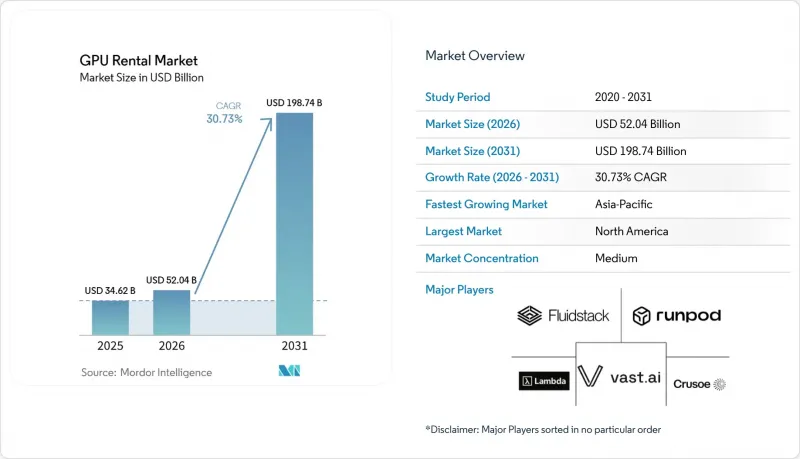
根據 Mordor Intelligence 預測,GPU 租賃市場預計將從 2025 年的 346.2 億美元成長到 2026 年的 520.4 億美元,到 2031 年達到 1987.4 億美元,2026 年至 2031 年的複合年成長率預計為 30.73%。
本報告按部署類型(例如,共用公共GPU雲端)、服務模式(例如,GPU基礎設施即服務)、應用領域(例如,高效能運算和科學運算)、企業規模(例如,新創公司和中小企業)、最終用戶(例如,醫療保健和生命科學、銀行、金融服務和保險)以及地區進行細分。市場預測以價值(美元)表示。
全球GPU租賃市場趨勢及洞察
對生成式人工智慧和LLM訓練的需求日益成長
隨著生成式人工智慧從試點階段走向更多團隊和產品的常規生產環境,對GPU租賃的潛在需求也日益強勁。 RunPod在2026年6月宣布,其平台的用戶數量已達100萬,顯示使用租賃GPU的運算用戶群十分廣泛。 KDDI於2026年4月推出了NVIDIA GB200 NVL72系統的隨選存取服務,Softbank Corporation也於2026年3月推出了NVIDIA GB200 NVL72的測試版租賃服務。這表明供應商正在擴展新的容量以滿足當前的人工智慧開發需求。同樣在2026年3月,NVIDIA向Nebius投資20億美元,承諾透過此合作,到2030年提供超過5吉瓦的NVIDIA運算資源。這顯示市場對下游基礎設施的持續需求充滿信心。這些趨勢至關重要,因為當推理、微調和模型配置需要持續存取而非臨時尖峰需求時,GPU租賃市場將從中受益。因此,隨著生成式人工智慧的進一步普及,那些及早建立供應關係的供應商將更有利於維持運轉率。
從資本支出 (CapEx) 過渡到計量收費的GPU 訪問
GPU租賃市場持續蓬勃發展,吸引那些希望在無需大量前期硬體投資的情況下獲取運算資源的用戶。 KDDI表示,其GPU雲端平台無需任何前期投資即可上線,這直接印證了按需存取比本地部署基礎設施更適合許多工作負載的觀點。這種模式非常適合那些在上線後流量、模型規模和商業化時間可能快速變化的專案。對於用戶而言,它提供了一種便捷的方式,無需等待現有資產被充分利用或退役即可遷移到新系統。 RunPod用戶突破100萬大關,也印證了GPU租賃市場的大部分用戶是那些更傾向於彈性存取而非固定採購週期的團隊。即使大型企業日後建置了專用環境,租賃通常仍然是其營運模式的一部分,用於測試、應對需求激增和部署新應用。
HBM 和先進封裝的供應限制
GPU租賃市場仍然依賴最新系統部署到服務的速度。 KDDI於2026年4月開始提供NVIDIA GB200 NVL72顯示卡租賃服務,而Softbank Corporation於2026年3月推出了GB200 NVL72的測試版租賃服務。 Nebius也與NVIDIA合作制定了未來運算平台的多年擴展計劃,這表明市場成長與硬體的及時供應密切相關。當多家業者同時瞄準同一代系統時,採購能力就成為競爭的關鍵因素。這往往有利於那些與供應商關係密切、擁有雄厚財力或能夠提前預訂的供應商。小規模的平台雖然也能參與競爭,但隨著現有硬體供應趨緊,其擴張速度可能會放緩。在GPU租賃市場,這不會完全抑制需求,但會減緩產能擴張速度,並拉大大型供應商與其他業者之間的差距。
細分市場分析
到 2025 年,共用公用 GPU 雲端將佔據 GPU 租賃市場 48.13% 的佔有率,憑藉其覆蓋範圍廣、容量集中以及易於應對突發需求等優勢,成為最大的部署模式。私有或自主託管的 GPU 雲端預計到 2031 年將以 31.58% 的複合年成長率成長,這反映出尋求專用資源和更嚴格資料位置控制的買家需求不斷成長。在 GPU 租賃市場,共用環境仍然是標準配置,因為它們將基礎設施分配給眾多用戶,從而減輕了內部容量規劃的負擔。對於需要快速配置資源並能根據測試和部署模型靈活擴展或縮減使用量的開發團隊而言,這一優勢仍然至關重要。
然而,隨著主權雲和私有雲模式的運作日趨現實化,成長模式正在改變。根據 Canonical 預測,NVIDIA 將於 2026 年向 CNCF 捐贈 GPU DRA 驅動程序,從而在私人 Kubernetes叢集使用更標準化的 GPU 調度和分配方法。 IBM 研究院也持續研究針對多租戶雲端服務的透明且有彈性的資源配置,以協助更好地利用專用環境,同時又不至於過度犧牲營運效率。 KDDI 在日本推出的服務以及德國電信在德國推出的工業 AI 雲端表明,國內通訊業者正在建立根據本地企業和公共部門需求量身定做的託管 GPU 環境。這意味著 GPU 租賃市場不再僅僅由公共雲端的規模決定,而是由那些能夠提供託管存取並承擔本地課責的供應商所主導。
預計到 2025 年,GPU 基礎設施即服務 (IaaS) 將佔服務模式收入的 58.32%,這表明直接存取運算資源仍然是許多工程團隊的首選方案。無伺服器和容器化 GPU 服務預計到 2031 年將以 32.17% 的複合年成長率成長,反映出市場對更簡單的部署路徑和更低的架構管理負擔的需求。這種轉變意義重大,因為現在越來越多的用戶希望專注於應用程式邏輯、模型服務和工作流程效能,而不是叢集設定。在 GPU 租賃市場,這降低了技能門檻,並將目標客戶群擴展到包括小規模的開發團隊和產品系列。
服務模式的整合速度也遠超過以往的雲端運算週期。 RunPod 開發者用戶突破百萬大關,顯示開發者平台在 GPU 租賃市場已運作相當可觀的規模。 Vast.ai 在 2026 年 6 月的產品更新中新增了 NVIDIA B200 和 B300 Blackwell Ultra GPU,這表明平台提供者正在將更便捷的存取模式與最新一代硬體相結合,而非將高級系統限制於大規模合約。雖然託管環境仍對需要更個人化支援的用戶開放,但發展方向已然明確。隨著服務日益抽象化,GPU 租賃行業的更多公司不僅能夠在硬體存取方面競爭,還能在開發者體驗和快速上線生產環境方面競爭。
區域分析
到2025年,北美將佔據GPU租賃市場51.25%的佔有率,成為供需兩端最大的區域中心。該地區受益於許多超大規模資料中心業者、人工智慧實驗室和開發者平台的集中,這些機構已在商業人工智慧領域運作。 RunPod的存在——預計到2026年6月,其開發者數量將超過100萬——進一步印證了北美GPU租賃市場與充滿活力的產品開發和應用社群緊密相連的觀點。加拿大透過其“主權人工智慧運算戰略”,承諾投資高達17億美元用於計算接入和公共基礎設施建設,從而進一步提升了該地區的需求。
儘管歐洲在GPU租賃市場中的地位僅次於北美,但隨著合規性和資料居住在採購決策中變得日益重要,歐洲在該市場中的角色也愈發重要。歐盟人工智慧立法正在推動對本地管理基礎設施的需求,因為它提高了某些人工智慧應用領域對文件化管治和本地監管的需求。德國電信於2026年初在慕尼黑推出了德國首個工業級人工智慧雲端平台。此雲端平台配備了約1萬塊NVIDIA Blackwell GPU,運算能力高達0.5 exaflops,體現了歐洲致力於建構切實有效的本土能力,而非僅依賴外部供應商。這進一步增強了歐洲GPU租賃市場的主權和企業合規性,尤其對於那些尋求本地課責和區域服務覆蓋的用戶而言更是如此。
預計到2031年,亞太地區將以32.54%的複合年成長率成長,成為GPU租賃市場規模成長最快的地區。在日本,這一成長動能已透過直接服務的推出而顯現。 KDDI於2026年4月開始提供NVIDIA GB200 NVL72的GPU雲端容量,而Softbank Corporation於2026年3月推出了NVIDIA GB200 NVL72的測試版租賃服務。這兩項服務均基於日本本土的基礎設施。這些舉措表明,本土可用性、本地支援以及符合監管行業標準正成為全部區域主要的購買考量。因此,在對商業人工智慧的需求以及對區域運算控制日益成長的興趣的推動下,亞太地區預計將實現更快的成長。南美洲和中東及非洲的GPU租賃市場仍處於起步階段,但類似的自主性和在地化概念可能會推動這些地區下一階段的容量擴張。
其他好處:
- Excel格式的市場預測(ME)表
- 3個月的分析師支持
目錄
第1章:引言
- 研究假設和市場定義
- 調查範圍
第2章:調查方法
第3章執行摘要
第4章 市場狀況
- 市場概覽
- 市場促進因素
- 對生成式人工智慧和LLM培訓的需求日益成長
- 從資本支出 (CapEx) 過渡到計量收費的GPU 訪問
- GPU分割區編配與多租用戶調度
- 部署自主人工智慧和受監管工作負載
- 雲端遊戲和即時渲染擴展
- 推出水冷式高密度GPU艙
- 市場限制因素
- HBM 和先進封裝的供應限制
- 數據主權和跨境合規風險
- 電力價格壓力和碳排放報告的負擔
- GPU現貨供應波動及利潤率承壓
- 產業價值鏈分析
- 技術展望
- 宏觀經濟因素對市場的影響
- 波特五力分析
第5章 市場規模與成長預測
- 依部署類型
- 共用公用 GPU 雲
- 專用/裸機 GPU 雲
- 私有或自主託管的GPU雲
- 按服務模式
- GPU基礎設施即服務
- 託管式 GPU 平台即服務
- 無伺服器/容器 GPU 服務
- 透過使用
- 人工智慧和機器學習
- 高效能運算和科學運算
- 渲染、視覺特效、雲端遊戲、3D視覺化
- 其他用途
- 按公司規模
- 新創企業和小型企業
- 大公司
- 政府、學術和研究機構
- 按最終用戶行業分類
- IT、雲端運算、通訊
- BFSI
- 汽車與出行
- 醫療保健和生命科學
- 媒體與娛樂
- 政府、國防、教育和研究
- 其他終端用戶產業
- 按地區
- 北美洲
- 美國
- 加拿大
- 墨西哥
- 歐洲
- 德國
- 英國
- 法國
- 義大利
- 其他歐洲國家
- 亞太地區
- 中國
- 日本
- 韓國
- 印度
- 東南亞
- 其他亞太國家
- 南美洲
- 中東和非洲
- 北美洲
第6章 競爭情勢
- 市場集中度
- 策略趨勢
- Vendor Positioning Analysis
- 公司簡介
- Lambda, Inc.
- Runpod Inc.
- Vast.ai, Inc.
- Crusoe Energy Systems LLC
- Fluidstack Ltd.
- Nebius BV
- Scaleway SAS
- OVH Groupe SA
- Akamai Technologies, Inc.
- DigitalOcean, LLC
- Oracle Corporation
- Alibaba Cloud Computing Co., Ltd.
- Google LLC
- Microsoft Corporation
- Amazon Web Services, Inc.
- IBM Corporation
第7章 市場機會與未來展望
According to Mordor Intelligence, the GPU rental market size is expected to increase from USD 34.62 billion in 2025 to USD 52.04 billion in 2026 and reach USD 198.74 billion by 2031, growing at a CAGR of 30.73% over 2026-2031.
This report is Segmented by Deployment Type (Shared Public GPU Cloud, More), Service Model (GPU Infrastructure As A Service, and More), Application (High-Performance Computing and Scientific Computing, and More), Enterprise Size (Start-Ups and Small and Medium Enterprises, and More), End-User (Healthcare and Life Sciences, BFSI, and More), and Geography. The Market Forecasts are Provided in Terms of Value (USD).
Global GPU Rental Market Trends and Insights
Rising Generative AI And LLM Training Demand
The GPU rental market is seeing stronger baseline demand as generative AI moves from pilot work into regular production use across more teams and products. RunPod said in June 2026 that its platform had reached 1 million developers, indicating how broad the base of compute users has become for rented GPU access. KDDI launched on-demand access to NVIDIA GB200 NVL72 systems in April 2026, and SoftBank added NVIDIA GB200 NVL72 beta rental in March 2026, which shows that providers are adding new capacity around current AI development needs. NVIDIA also invested USD 2 billion in Nebius in March 2026 and tied that partnership to more than 5 GW of NVIDIA computing by 2030, which signals confidence in sustained downstream infrastructure demand. These developments matter because the GPU rental market benefits when inference, fine-tuning, and model deployment all require ongoing access instead of one-time bursts. Providers that secured supply relationships early are therefore in a stronger position to hold utilization as generative AI adoption scales further.
Shift From CapEx to Pay-Per-Use GPU Access
The GPU rental market continues to benefit from users who want compute without a large upfront hardware commitment. KDDI stated that its GPU cloud launched with no upfront investment requirement, which directly supports the case for on-demand access over owned infrastructure for many workloads. This model suits projects where traffic, model size, and commercial timing can change quickly after launch. It also gives users a practical way to move to newer systems without waiting for owned assets to be fully utilized or retired. RunPod's 1 million developer milestone reinforces that a large share of the GPU rental market now includes teams that prefer flexible access over fixed procurement cycles. Even when larger firms later build dedicated environments, rental often remains part of the operating model for testing, overflow demand, and new application rollout.
HBM and Advanced Packaging Supply Constraints
The GPU rental market still depends on the pace at which the newest systems can be brought into service. KDDI launched NVIDIA GB200 NVL72 access in April 2026, SoftBank added GB200 NVL72 beta rental in March 2026, and Nebius mapped a multi-year buildout with NVIDIA across future computing platforms, which shows how growth is tied to timely hardware availability. When several operators target the same generation of systems simultaneously, procurement strength becomes a competitive filter. That tends to favor providers with deeper supplier ties, stronger financing, or earlier reservation windows. Smaller platforms can still compete, but they may expand more slowly when access to current hardware tightens. In the GPU rental market, this does not stop demand, but it can delay capacity additions and widen the gap between the largest providers and the rest of the field.
Other drivers and restraints analyzed in the detailed report include:
- Fractional GPU Orchestration and Multi-Tenant Scheduling
- Sovereign AI And Regulated Workload Adoption
- Data Sovereignty and Cross-Border Compliance Risk
For complete list of drivers and restraints, kindly check the Table Of Contents.
Segment Analysis
Shared public GPU cloud held 48.13% of the GPU rental market share in 2025, making it the largest deployment mode because it offers broad reach, pooled capacity, and easier handling of burst demand. Private or sovereign-hosted GPU cloud is projected to expand at a 31.58% CAGR through 2031, reflecting stronger demand from buyers that want dedicated resources and tighter control over data location. In the GPU rental market, shared environments still set the baseline because they spread infrastructure across many users and reduce the burden of internal capacity planning. That advantage remains important for development teams that need quick provisioning and the flexibility to scale usage up or down as models move through testing and deployment.
The growth pattern is shifting, though, because sovereign and private models are becoming more practical to operate. In 2026, Canonical said NVIDIA donated the GPU DRA driver to CNCF, which helps private Kubernetes clusters use more standardized GPU scheduling and allocation methods. IBM Research also continued work on transparent, elastic provisioning for multi-tenant cloud services, which supports better use of dedicated environments without sacrificing as much operational efficiency. KDDI's launch in Japan and Deutsche Telekom's industrial AI cloud in Germany show that domestic operators are building controlled GPU environments around local enterprise and public requirements. This means the GPU rental market is no longer defined only by public cloud scale, it is also being shaped by who can provide controlled access with local accountability.
GPU Infrastructure as a Service accounted for 58.32% of service model revenue in 2025, indicating that direct access to compute remained the preferred route for many engineering teams. Serverless and container GPU services are projected to grow at a 32.17% CAGR through 2031, which reflects demand for simpler deployment paths and less hands-on infrastructure work. This shift matters because more users now want to focus on application logic, model serving, and workflow performance rather than cluster setup. In the GPU rental market, this lowers the skills barrier and broadens the addressable customer base to smaller development teams and product groups.
The service model stack is also tightening faster than it did in earlier cloud cycles. RunPod's 1 million developer milestone suggests that developer-focused platforms are already operating at meaningful scale inside the GPU rental market. Vast.ai's June 2026 product update added NVIDIA B200 and B300 Blackwell Ultra GPUs, indicating that platform operators are pairing easier access models with newer hardware generations rather than limiting advanced systems to larger contracts. Managed environments still serve users who need more support, but the direction of travel is clear. As service abstraction improves, more of the GPU rental industry can compete on developer experience and speed to production rather than solely on raw hardware access.
Complete Report Scope:
- By Deployment Type
- Shared Public GPU Cloud
- Dedicated / Bare-Metal GPU Cloud
- Private or Sovereign Hosted GPU Cloud
- By Service Model
- GPU Infrastructure as a Service
- Managed GPU Platform as a Service
- Serverless / Container GPU Services
- By Application
- Artificial Intelligence and Machine Learning
- High-Performance Computing and Scientific Computing
- Rendering, VFX, Cloud Gaming, and 3D Visualization
- Other Applications
- By Enterprise Size
- Start-ups and Small and Medium Enterprises
- Large Enterprises
- Government, Academic, and Research Institutions
- By End-User Industry
- IT, Cloud, and Communications
- BFSI
- Automotive and Mobility
- Healthcare and Life Sciences
- Media and Entertainment
- Government, Defense, Education, and Research
- Other End-User Industries
- By Geography
- North America
- United States
- Canada
- Mexico
- Europe
- Germany
- United Kingdom
- France
- Italy
- Rest of Europe
- Asia-Pacific
- China
- Japan
- South Korea
- India
- Southeast Asia
- Rest of Asia-Pacific
- South America
- Middle East and Africa
- North America
Geography Analysis
North America held 51.25% of the GPU rental market share in 2025, making it the largest regional base for both demand and supply. The region benefits from the concentration of hyperscalers, AI labs, and developer platforms that already operate at meaningful scale in commercial AI. RunPod in June 2026, which had passed 1 million developers, supports the view that the North American GPU rental market remains deeply tied to active product development and deployment communities. Canada added a second layer of regional demand through its Sovereign AI Compute Strategy, which committed up to USD 1.7 billion across compute access and public infrastructure.
Europe is ranked behind North America, but its role in the GPU rental market is becoming more strategic as compliance and data residency carry greater weight in procurement decisions. The EU AI Act increased the need for documented governance and local oversight in certain AI uses, which supports demand for regionally controlled infrastructure. Deutsche Telekom launched Germany's first industrial AI cloud in Munich in early 2026, featuring nearly 10,000 NVIDIA Blackwell GPUs and up to 0.5 ExaFLOPS of compute, demonstrating that Europe is building meaningful domestic capacity rather than relying solely on external providers. This gives the European GPU rental market a stronger sovereign and enterprise compliance profile, especially for users that want local accountability and regional service coverage.
Asia-Pacific is projected to grow at a 32.54% CAGR through 2031, which makes it the fastest-growing region in the GPU rental market size. Japan is already showing that momentum through direct service launches. KDDI launched GPU cloud capacity in April 2026 with NVIDIA GB200 NVL72 access, and SoftBank added NVIDIA GB200 NVL72 beta rental in March 2026, both on Japan-hosted infrastructure. These moves suggest that domestic availability, local support, and regulated sector alignment are becoming central buying factors across the region. Asia-Pacific therefore appears positioned for faster expansion because it combines commercial AI demand with rising national interest in local compute control. South America and the Middle East and Africa remain earlier-stage parts of the GPU rental market, but the same sovereign and localization themes could support their next phase of capacity buildout.
- Lambda, Inc.
- Runpod Inc.
- Vast.ai, Inc.
- Crusoe Energy Systems LLC
- Fluidstack Ltd.
- Nebius B.V.
- Scaleway SAS
- OVH Groupe SA
- Akamai Technologies, Inc.
- DigitalOcean, LLC
- Oracle Corporation
- Alibaba Cloud Computing Co., Ltd.
- Google LLC
- Microsoft Corporation
- Amazon Web Services, Inc.
- IBM Corporation
Additional Benefits:
- The market estimate (ME) sheet in Excel format
- 3 months of analyst support
TABLE OF CONTENTS
1 INTRODUCTION
- 1.1 Study Assumptions and Market Definition
- 1.2 Scope of the Study
2 RESEARCH METHODOLOGY
3 EXECUTIVE SUMMARY
4 MARKET LANDSCAPE
- 4.1 Market Overview
- 4.2 Market Drivers
- 4.2.1 Rising Generative AI and LLM Training Demand
- 4.2.2 Shift From CapEx to Pay-Per-Use GPU Access
- 4.2.3 Fractional GPU Orchestration and Multi-Tenant Scheduling
- 4.2.4 Sovereign AI and Regulated Workload Adoption
- 4.2.5 Cloud Gaming and Real-Time Rendering Expansion
- 4.2.6 Liquid-Cooled High-Density GPU Pod Deployment
- 4.3 Market Restraints
- 4.3.1 HBM and Advanced Packaging Supply Constraints
- 4.3.2 Data Sovereignty and Cross-Border Compliance Risk
- 4.3.3 Power Tariff Pressure and Carbon Reporting Burden
- 4.3.4 GPU Spot Capacity Volatility and Margin Compression
- 4.4 Industry Value Chain Analysis
- 4.5 Technological Outlook
- 4.6 Impact of Macroeconomic Factors on the Market
- 4.7 Porter's Five Forces Analysis
- 4.7.1 Bargaining Power of Suppliers
- 4.7.2 Bargaining Power of Buyers
- 4.7.3 Threat of New Entrants
- 4.7.4 Threat of Substitutes
- 4.7.5 Industry Rivalry
5 MARKET SIZE AND GROWTH FORECASTS (VALUE)
- 5.1 By Deployment Type
- 5.1.1 Shared Public GPU Cloud
- 5.1.2 Dedicated / Bare-Metal GPU Cloud
- 5.1.3 Private or Sovereign Hosted GPU Cloud
- 5.2 By Service Model
- 5.2.1 GPU Infrastructure as a Service
- 5.2.2 Managed GPU Platform as a Service
- 5.2.3 Serverless / Container GPU Services
- 5.3 By Application
- 5.3.1 Artificial Intelligence and Machine Learning
- 5.3.2 High-Performance Computing and Scientific Computing
- 5.3.3 Rendering, VFX, Cloud Gaming, and 3D Visualization
- 5.3.4 Other Applications
- 5.4 By Enterprise Size
- 5.4.1 Start-ups and Small and Medium Enterprises
- 5.4.2 Large Enterprises
- 5.4.3 Government, Academic, and Research Institutions
- 5.5 By End-User Industry
- 5.5.1 IT, Cloud, and Communications
- 5.5.2 BFSI
- 5.5.3 Automotive and Mobility
- 5.5.4 Healthcare and Life Sciences
- 5.5.5 Media and Entertainment
- 5.5.6 Government, Defense, Education, and Research
- 5.5.7 Other End-User Industries
- 5.6 By Geography
- 5.6.1 North America
- 5.6.1.1 United States
- 5.6.1.2 Canada
- 5.6.1.3 Mexico
- 5.6.2 Europe
- 5.6.2.1 Germany
- 5.6.2.2 United Kingdom
- 5.6.2.3 France
- 5.6.2.4 Italy
- 5.6.2.5 Rest of Europe
- 5.6.3 Asia-Pacific
- 5.6.3.1 China
- 5.6.3.2 Japan
- 5.6.3.3 South Korea
- 5.6.3.4 India
- 5.6.3.5 Southeast Asia
- 5.6.3.6 Rest of Asia-Pacific
- 5.6.4 South America
- 5.6.5 Middle East and Africa
- 5.6.1 North America
6 COMPETITIVE LANDSCAPE
- 6.1 Market Concentration
- 6.2 Strategic Moves
- 6.3 Vendor Positioning Analysis
- 6.4 Company Profiles (includes Global Level Overview, Market Level Overview, Core Segments, Financials as available, Strategic Information, Market Rank/Share, Products and Services, Recent Developments)
- 6.4.1 Lambda, Inc.
- 6.4.2 Runpod Inc.
- 6.4.3 Vast.ai, Inc.
- 6.4.4 Crusoe Energy Systems LLC
- 6.4.5 Fluidstack Ltd.
- 6.4.6 Nebius B.V.
- 6.4.7 Scaleway SAS
- 6.4.8 OVH Groupe SA
- 6.4.9 Akamai Technologies, Inc.
- 6.4.10 DigitalOcean, LLC
- 6.4.11 Oracle Corporation
- 6.4.12 Alibaba Cloud Computing Co., Ltd.
- 6.4.13 Google LLC
- 6.4.14 Microsoft Corporation
- 6.4.15 Amazon Web Services, Inc.
- 6.4.16 IBM Corporation
7 MARKET OPPORTUNITIES AND FUTURE OUTLOOK
- 7.1 White-Space and Unmet-Need Assessment

 GPU即服務市場規模、佔有率和趨勢分析報告:按組件、定價模式、組織規模、產業、地區和細分市場預測(2026-2033年)
 全球GPUaaS(GPU即服務)市場規模、佔有率、趨勢和成長分析報告,2026-2034年
 全球GPU即服務(GPUaaS)市場:預測(至2034年)-按元件、部署方式、服務類型、組織規模、應用程式、最終用戶和地區進行分析
 GPUaaS(GPU即服務):市佔率分析、產業趨勢與統計、成長預測(2026-2031)
 GPU即服務(GPUaaS)市場規模、佔有率和成長分析(按組件、定價模式、組織規模和地區分類)-2026-2033年產業預測
 GPU即服務市場-全球產業規模、佔有率、趨勢、機會及預測(依部署模式、企業類型、最終用戶、地區及競爭格局分類,2020-2030年預測)
 GPU·即服務(GPUaaS)的全球市場:預測(2025年~2030年)
 GPU-as-a-service(GPUaaS):通訊業者的案例研究與分析
 GPU 即服務的全球市場
 GPUaaS(GPU as a Service)的全球市場:定價模式,部署模型,各組織規模,各終端用戶產業,各地區,機會,預測,2018年~2032年