


 |
市場調查報告書
商品編碼
2099100
老年人家具:市場佔有率分析、產業趨勢與統計及成長預測(2026-2031)Furniture For The Aging Population - Market Share Analysis, Industry Trends & Statistics, Growth Forecasts (2026 - 2031) |
||||||

※ 本網頁內容可能與最新版本有所差異。詳細情況請與我們聯繫。
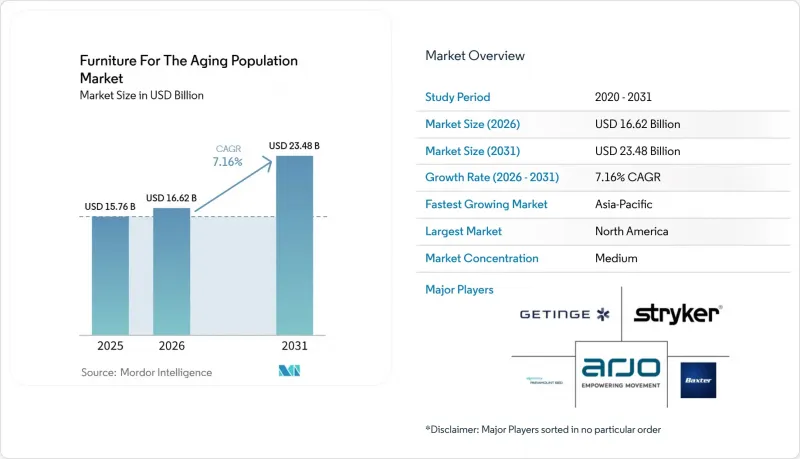
根據 Mordor Intelligence 預測,老年人家具市場規模預計將在 2025 年達到 157.6 億美元,2026 年達到 166.2 億美元,到 2031 年達到 234.8 億美元,2026 年至 2031 年的複合年成長率為 7.16%。
本報告按產品類型(床和助眠用品、椅子和躺椅、桌子和桌面、儲物家具、浴室安全家具)、最終用戶(住宅、輔助住宅設施、療養院、醫院、老年住宅)、配銷通路(B2C/零售管道、B2B/直銷)和地區進行細分。市場預測以美元計價。
全球老年人家具市場趨勢及洞察。
旨在「居家養老」(老年時期在家生活)的房屋改造需求日益成長。
老年家具市場受到「居家養老」理念日益成長的推動。這是因為家庭更傾向於繼續居住在熟悉的環境中,而不是搬進安養機構。根據美國退休人員協會(AARP)統計,87%的65歲及以上成年人希望即使年老也繼續住在目前的家中,這使得提升無障礙設施成為老年家具購買決策的關鍵因素。如果住宅在設計之初就考慮到了老年人的需求,這個趨勢或許不會如此顯著。然而,根據美國人口普查局的數據,美國祇有10%的住宅在設計時就考慮到了老年人的需求,這一巨大的維修缺口持續支撐著對輔助椅、高度可調式床和浴室安全設備的需求。因此,老年家具市場不僅與醫療需求相關,還與房屋翻新週期、護理計劃和出院準備密切相關。這意味著購買群體不再局限於老年人本身,還包括他們的家人、治療師和住宅專業人士等,促使供應商改變產品定位和銷售管道管理方式。
擴大輔助住宅和長期照護設施的容量。
養老家具市場也受到輔助生活設施和長期照護機構營運壓力的推動。這些機構的高入住率迫使業主改善住戶的生活空間,而不是推遲維修。根據NIC的一份報告,第一季,住宅機構的入住率將達到89.5%,而正在建設的單元數量將降至16,400套,僅佔現有庫存的2.3%。這種情況清楚地表明,養老家具市場為何受益於供應緊張和人口成長。 NIC也指出,雖然在調查市場中,已入住的輔助生活和失智症護理機構的庫存量從2021年第三季度到2025年第三季度成長了21%,但2026年3月輔助生活設施的租金要價同比成長了7.2%,這使得運營商有更多空間投資於有助於員工招聘和留任的家具。在此背景下,老年家具市場更受「價值」而非低成本更換的驅動。這是因為,如果更好的床、椅子和公共區域能夠提升住戶的體驗,營運商便有理由為此投入資金。因此,隨著養老機構的競標要求日益嚴格,能夠將家具選擇與舒適度、員工安全和護理效果掛鉤的供應商將擁有顯著優勢。
與傳統家具相比,價格昂貴
老年人家具市場仍面臨著巨大的價格障礙。這是因為專用家具的設計、測試和材料要求與一般家用家具截然不同。此外,合規標準也日趨嚴格,例如EN ISO 20342-4和2026等標準對組織保護產品的耐久性測試提出了更高的要求。這可能會增加整個老年人家具市場供應商的研發和檢驗成本。在住宅環境和價格敏感地區,這種成本壓力更難負擔,因為專用家具往往要與價格更低、看似可接受的傳統家具競爭。雖然在有報銷機制和公共護理項目支持採購的環境中,老年人家具市場在一定程度上得到了保障,但當產品介於普通家用家具和受監管的醫療設備之間時,仍然存在保障缺口。這導致市場部分區域的普及程度不均衡,更換週期也更長,而這些區域原本應該發展得更快。
細分市場分析
到2025年,椅子和躺椅將佔據老年家具市場34.15%的佔有率,憑藉其在家庭和養老機構的廣泛應用,繼續保持主導地位。升降躺椅、人體工學扶手椅和助行器仍然是許多買家最容易入手的選擇,因為它們無需對房間進行全面整修,即可滿足舒適性、轉移輔助和日常使用需求。該細分市場也受益於柔軟性的銷售管道,曾經主要透過醫療用品批發商分銷的產品現在可以透過專業零售商和電商平台以各種價位銷售。助行器和人體工學扶手椅在耐用性、承重能力、清潔便利性和布料選擇方面展開競爭。同時,機構採購比私人住宅更換更注重符合國際座椅標準。
預計2026年至2031年間,包括床和睡眠支撐系統在內的老年家具市場將以7.75%的複合年成長率成長,成為成長最快的產品系列。推動這一成長的因素包括壓力分佈測量、跌倒檢測和基於感測器的監測等功能,這些功能使床在居民護理和看護者工作流程中發揮越來越重要的作用。此外,EN ISO 20342-4:2026標準的實施提高了床墊和床罩等組織保護產品的技術標準,從而促進了更換具有更強效和更耐用性的新系統的需求。可調式床和轉移支撐床正受到越來越多的關注,因為醫療保健機構正在尋找能夠同時降低跌倒風險和減輕看護者負擔的產品。壓力分佈床墊也是推動市場成長的因素之一,因為它們將臨床表現與自動化相結合,使從醫院到家庭護理的過渡更加便捷。
區域分析
到2025年,北美將佔據老年家具市場35.15%的佔有率,成為領先的區域市場。該地區受益於龐大的老齡人口、部分醫療保健系統提供的慷慨的保險報銷支持,以及蓬勃發展的「居家養老」環境,這些因素共同支撐著各個收入階層對住宅維修的需求。 2026年4月,美國人口普查局宣布,到2025年,所有嬰兒潮世代的年齡都將在61歲至79歲之間。這將推動與行動能力、舒適度和住宅安全相關的家具的首次購買和後續購買的大幅成長。此外,醫療機構出院計劃與居家護理需求之間的緊密聯繫也使北美受益,這促進了床、輔助椅和便於轉移的家具的跨管道分銷。
歐洲在老年家具市場仍處於成熟階段,機構採購、嚴格的監管以及人口老化共同構成了穩定的需求基礎。根據世界衛生組織歐洲區域辦事處統計,該地區65歲及以上成年人口數量超過兒童及青少年,預計到2050年,60歲及以上人口比例將達到32.2%。這支撐了老年家具市場的長期需求成長。對於在護理床、轉移輔助系統和壓瘡預防產品方面具有優勢的供應商而言,這種市場環境十分有利,尤其是在競標過程中重視產品耐用性和性能的情況下。南美洲在老年家具市場中所佔佔有率仍然相對較小,但草案顯示,巴西正在推動區域發展,正規零售和機構管道正在不斷建立。
預計2026年至2031年,亞太地區老年家具市場將以7.82%的複合年成長率成長,成為所有區域市場中成長最快的地區。這一成長主要受成熟老化經濟體人口壓力、中國和印度大規模的市場機會以及東南亞醫院和養老機構擴張帶來的供給能力提升所驅動。亞太地區老年家具市場的在地化進程也正在加速。例如,Wellell於2025年4月與泰國idsMED集團建立銷售合作夥伴關係,Linet於2026年2月透過idsMED越南公司向越南白梅醫院二院區交付高階電動床。儘管中東和非洲的市場佔有率仍然較小,但對醫療保健領域的投資和政策實施正在為護理支援產品的長期發展奠定基礎。世界衛生組織(世衛組織)於2026年6月報告稱,伊朗已採納「老年人綜合照護」架構。這表明政策可能會發生更廣泛的轉變,從而加強該地區部分地區未來的護理基礎設施和產品需求。
其他好處:
- Excel格式的市場預測(ME)表
- 3個月的分析師支持
目錄
第1章:引言
- 研究假設和市場定義
- 調查範圍
第2章:調查方法
第3章執行摘要
第4章 市場狀況
- 市場概覽
- 市場促進因素
- 人們越來越需要進行房屋翻新,以便能夠在自己熟悉的家中度過退休生活。
- 擴大輔助住宅和長期照護設施的容量。
- 利用助行家具將護理從醫院過渡到家庭
- 通用設計在主流家具市場的普及
- 對洩壓和防傾倒功能的需求日益成長。
- 將智慧監控技術融入老年人住宅家具中
- 市場限制因素
- 與傳統家具相比,價格昂貴
- 人們對老年人友善設計的好處認知不足。
- 不同護理管道和住宅設施的標準有差異
- 為滿足多樣化的出行需求而進行的客製化工作十分複雜
- 產業價值鏈分析
- 波特五力分析
- 洞察最新產業趨勢與創新
- 近期產業趨勢分析(新產品發布、策略性舉措、投資、合作、合資、業務擴張、併購等)
第5章 市場規模與成長預測
- 依產品類型
- 床和睡眠支撐系統
- 可調式床
- 醫院床位
- 減壓床墊
- 轉移和站立輔助床
- 椅子和躺椅
- 升降躺椅
- 符合人體工學設計的扶手椅
- 行動輔助椅
- 桌子和表面
- 可調整高度的床邊桌
- 高度可調式餐桌
- 床頭櫃
- 收納和輔助家具
- 無障礙衣櫃
- GrabAid 家具單元
- 便捷的收納單元
- 浴室安全家具
- 淋浴設備椅
- 高架馬桶支撐系統
- 浴室行動輔助設備
- 床和睡眠支撐系統
- 最終用戶
- 住宅
- 輔助住宅
- 療養院
- 醫院及復健中心
- 高齡住家周邊設施
- 透過分銷管道
- B2C/零售通路
- 家具專賣店
- 醫療用品商店
- 家居建材商店
- 線上
- 其他分銷管道
- B2B/廠商直銷
- B2C/零售通路
- 按地區
- 北美洲
- 加拿大
- 美國
- 墨西哥
- 南美洲
- 巴西
- 秘魯
- 智利
- 阿根廷
- 其他南美國家
- 歐洲
- 英國
- 德國
- 法國
- 西班牙
- 義大利
- 比荷盧經濟聯盟(比利時、荷蘭、盧森堡)
- 北歐國家(丹麥、芬蘭、冰島、挪威、瑞典)
- 其他歐洲國家
- 亞太地區
- 印度
- 中國
- 日本
- 澳洲
- 韓國
- 東南亞(新加坡、馬來西亞、泰國、印尼、越南、菲律賓)
- 其他亞太國家
- 中東和非洲
- 阿拉伯聯合大公國
- 沙烏地阿拉伯
- 南非
- 奈及利亞
- 其他中東和非洲國家
- 北美洲
第6章 競爭情勢
- 市場集中度
- 策略趨勢
- 市佔率分析
- 公司簡介
- Stryker
- Getinge AB
- Invacare Corporation
- Drive DeVilbiss Healthcare
- Hillrom, now part of Baxter International Inc.
- Arjo
- Joerns Healthcare LLC
- GF Health Products, Inc.
- Paramount Bed Co., Ltd.
- Linet spol. s ro
- Stiegelmeyer GmbH and Co. KG
- Direct Healthcare Group
- Permobil AB
- K Care Healthcare Equipment
- Medline Industries, LP
- CHEROKEE FURNITURE LTD
- Wellell Inc.
- Merivaara Corp.
- BraunAbility
- Invicta Health and Social Care Products Ltd.
第7章 市場機會與未來展望
According to Mordor Intelligence, the furniture market for the aging population is projected to be USD 15.76 billion in 2025, USD 16.62 billion in 2026, and USD 23.48 billion by 2031, growing at a CAGR of 7.16% from 2026 to 2031.
This report is Segmented by Product Type (Beds and Sleep Support, Chairs and Recliners, Tables and Surfaces, Storage, Bathroom Safety Furniture), End-User (Residential, Assisted Living, Nursing Homes, Hospitals, Senior Living), Distribution Channel (B2C/Retail Channels, B2B/Direct), and Geography. The Market Forecasts are Provided in Terms of Value (USD).
Global Furniture For The Aging Population Market Trends and Insights
Rising Aging-In-Place Renovation Demand
The furniture for the aging population market is seeing strong support from aging-in-place preferences, as households prefer to stay in familiar settings rather than move into institutions. AARP states that 87% of adults aged 65 and older prefer to remain in their current homes as they age, which keeps accessibility upgrades close to the center of purchase decisions for the furniture for the aging population market. That preference would matter less if homes were already prepared, yet the United States Census Bureau states that only 10% of U.S. homes are adequately designed for aging populations, leaving a large retrofit gap that continues to feed demand for supportive seating, adjustable beds, and bathroom safety items. The result is that furniture for the aging population market is not tied solely to medical needs; it also aligns with renovation cycles, caregiver planning, and discharge preparation. This widens the buyer base beyond older residents and brings family members, therapists, and housing professionals into the same decision-making chain, which changes how suppliers position products and manage channels.
Growth of Assisted Living and Long-Term Care Capacity
The furniture market for the aging population is also being boosted by operating pressure in assisted living and long-term care properties, where high occupancy is pushing owners to improve resident spaces rather than delay upgrades. NIC reports that senior housing occupancy reached 89.5% in Q1 2026 and that units under construction fell to 16,400, or only 2.3% of existing inventory, underscoring why the furniture for the aging population market is benefiting from supply tightness and demographic growth. NIC also states that occupied assisted living and memory care inventory in tracked markets grew 21% between Q3 2021 and Q3 2025, while assisted living asking rent increased 7.2% year over year in March 2026, giving operators more room to invest in furnishings that support recruitment and retention. In this setting, the furniture for the aging population market is shaped less by low-cost replacement and more by value, since operators can justify spending when better beds, chairs, and common areas strengthen the resident experience. Suppliers that can link furniture choices to comfort, staff safety, and care outcomes are therefore better positioned as institutional tenders become more selective.
Higher Cost Versus Conventional Furniture
The furniture for the aging population market still faces a clear pricing barrier because purpose-built products entail engineering, testing, and material requirements that ordinary household furniture does not. Compliance benchmarks are also becoming more demanding, with standards such as EN ISO 20342-4:2026 raising expectations for durability testing of tissue-integrity products, which can add development and validation costs for suppliers across the furniture market serving the aging population. This cost pressure is harder to absorb in residential settings and in price-sensitive regions, where specialized furniture often competes against cheaper conventional substitutes that appear acceptable at first purchase. The furniture market for the aging population is somewhat protected in settings where reimbursement or formal care programs support procurement, but coverage gaps remain when products fall between consumer furniture and regulated medical equipment. That keeps adoption uneven and stretches replacement cycles in parts of the market that would otherwise expand more quickly.
Other drivers and restraints analyzed in the detailed report include:
- Hospital-To-Home Care Shift for Mobility-Supportive Furniture
- Universal Design Adoption in Mainstream Home Furnishings
- Limited Awareness of Age-Friendly Design Benefits
For complete list of drivers and restraints, kindly check the Table Of Contents.
Segment Analysis
Chairs and recliners accounted for 34.15% of the furniture market share for the aging population in 2025, maintaining their leading position because they are widely used in both homes and care settings. Lift recliners, ergonomic armchairs, and mobility-support seating remain the most familiar entry point for many buyers, since they address comfort, transfer support, and everyday usability without requiring a full room redesign. The segment also benefits from channel flexibility, because products that once moved mainly through medical supply distributors are now sold through specialist retailers and e-commerce platforms at several price points. Mobility-support chairs and ergonomic armchairs compete on durability, weight capacity, cleanability, and upholstery options. At the same time, compliance with non-domestic seating standards matters more in institutional purchases than in ordinary household replacements.
The furniture market for the aging population, including beds and sleep support systems, is projected to expand at a 7.75% CAGR from 2026 to 2031, making this the fastest-growing product group. Growth is being supported by pressure mapping, fall-detection functions, and sensor-enabled monitoring that are making beds more central to both resident care and caregiver workflow. EN ISO 20342-4:2026 is also raising the technical bar for tissue-integrity products such as mattresses and overlays, which supports replacement demand for newer systems with stronger validation and durability claims. Adjustable beds and transfer-assistance beds are gaining traction because providers want products that reduce fall risk and caregiver strain simultaneously. Pressure-relief mattresses add another layer of growth, as they tie clinical performance to automation and can now be moved more easily from hospitals into home recovery settings.
Complete Report Scope:
- By Product Type
- Beds and Sleep Support Systems
- Adjustable Beds
- Hospital-Grade Beds
- Pressure-Relief Mattresses
- Transfer and Rise Assistance Beds
- Chairs and Recliners
- Lift Recliners
- Ergonomic Armchairs
- Mobility-Support Chairs
- Tables and Surfaces
- Adjustable Overbed Tables
- Height-Adjustable Dining Tables
- Bedside Tables
- Storage and Support Furniture
- Accessible Wardrobes
- Grab-Aid Furniture Units
- Low-Threshold Storage Units
- Bathroom Safety Furniture
- Shower Chairs
- Raised Toilet Support Systems
- Bathroom Transfer Aids
- Beds and Sleep Support Systems
- By End-User
- Residential Households
- Assisted Living Facilities
- Nursing Homes
- Hospitals and Rehabilitation Centers
- Senior Living Communities
- By Distribution Channel
- B2C/Retail Channels
- Specialty Furniture Stores
- Medical Supply Stores
- Home Improvement Stores
- Online
- Other Distribution Channels
- B2B/Direct from the Manufacturers
- B2C/Retail Channels
- By Geography
- North America
- Canada
- United States
- Mexico
- South America
- Brazil
- Peru
- Chile
- Argentina
- Rest of South America
- Europe
- United Kingdom
- Germany
- France
- Spain
- Italy
- BENELUX (Belgium, Netherlands, and Luxembourg)
- NORDICS (Denmark, Finland, Iceland, Norway, and Sweden)
- Rest of Europe
- Asia-Pacific
- India
- China
- Japan
- Australia
- South Korea
- South East Asia (Singapore, Malaysia, Thailand, Indonesia, Vietnam, and the Philippines)
- Rest of Asia-Pacific
- Middle East and Africa
- United Arab Emirates
- Saudi Arabia
- South Africa
- Nigeria
- Rest of the Middle East and Africa
- North America
Geography Analysis
North America held 35.15% of the furniture market share for the aging population in 2025, making it the leading regional market. The region benefits from a large older population, stronger reimbursement support in parts of the care delivery system, and an active aging-in-place environment that keeps home adaptation relevant across multiple income tiers. The U.S. Census Bureau stated in April 2026 that all baby boomers had reached ages 61 to 79 in 2025, which supports a large wave of first-time and follow-on purchase activity tied to mobility, comfort, and home safety needs. North America also gains from the link between healthcare discharge planning and residential recovery needs, which supports more cross-channel movement of beds, supportive seating, and transfer-focused furniture.
Europe remains a mature region in the furniture for the aging population market, with institutional procurement, regulatory discipline, and an aging population providing a stable demand base. WHO Europe states that adults aged 65 and above have now outnumbered children and adolescents in the region, and it also notes that the share of people aged 60 and older is expected to reach 32.2% by 2050, which supports a long demand runway for furniture for the aging population market. This environment favors suppliers that are strong in care beds, transfer systems, and pressure-relief products, especially when tender processes reward durability and documented performance. South America is still a smaller part of the furniture for the aging population market, yet the draft indicates that Brazil is leading regional development as formal retail and institutional channels continue to take shape.
The furniture for the aging population market size in Asia-Pacific is projected to grow at a 7.82% CAGR from 2026 to 2031, making it the fastest-growing regional segment. The region combines demographic pressure in mature aging economies with large-volume opportunity in China and India, while Southeast Asia is adding capacity through hospital and eldercare expansion. The furniture for the aging population market in Asia-Pacific is also drawing more localization activity, shown by Wellell's April 2025 distribution partnership with idsMED Group in Thailand and Linet's February 2026 delivery of premium electric beds to Bach Mai Hospital Campus 2 in Vietnam through idsMED Vietnam. The Middle East and Africa region remains smaller in share, but healthcare investment and policy adoption are widening the long-term base for supportive care products. WHO reported in June 2026 that Iran adopted the Integrated Care for Older People framework, which points to a broader policy shift that can strengthen future care infrastructure and product demand across parts of the region.
- Stryker
- Getinge AB
- Invacare Corporation
- Drive DeVilbiss Healthcare
- Hillrom, now part of Baxter International Inc.
- Arjo
- Joerns Healthcare LLC
- GF Health Products, Inc.
- Paramount Bed Co., Ltd.
- Linet spol. s r.o.
- Stiegelmeyer GmbH and Co. KG
- Direct Healthcare Group
- Permobil AB
- K Care Healthcare Equipment
- Medline Industries, LP
- CHEROKEE FURNITURE LTD
- Wellell Inc.
- Merivaara Corp.
- BraunAbility
- Invicta Health and Social Care Products Ltd.
Additional Benefits:
- The market estimate (ME) sheet in Excel format
- 3 months of analyst support
TABLE OF CONTENTS
1 Introduction
- 1.1 Study Assumptions & Market Definition
- 1.2 Scope of the Study
2 Research Methodology
3 Executive Summary
4 Market Landscape
- 4.1 Market Overview
- 4.2 Market Drivers
- 4.2.1 Rising Aging-In-Place Renovation Demand
- 4.2.2 Growth of Assisted Living and Long-Term Care Capacity
- 4.2.3 Hospital-To-Home Care Shift for Mobility-Supportive Furniture
- 4.2.4 Universal Design Adoption in Mainstream Home Furnishings
- 4.2.5 Rising Demand for Pressure-Relief and Fall-Prevention Features
- 4.2.6 Smart Monitoring Integration in Senior Living Furniture
- 4.3 Market Restraints
- 4.3.1 Higher Cost Versus Conventional Furniture
- 4.3.2 Limited Awareness of Age-Friendly Design Benefits
- 4.3.3 Fragmented Standards Across Care and Residential Channels
- 4.3.4 Customization Complexity for Different Mobility Needs
- 4.4 Industry Value Chain Analysis
- 4.5 Porter's Five Forces Analysis
- 4.5.1 Bargaining Power of Suppliers
- 4.5.2 Bargaining Power of Buyers
- 4.5.3 Threat of New Entrants
- 4.5.4 Threat of Substitutes
- 4.5.5 Intensity of Competitive Rivalry
- 4.6 Insights into the Latest Trends and Innovations in the Industry
- 4.7 Insights into the Recent Developments (New Product Launches, Strategic Initiatives, Investments, Partnerships, JVs, Expansion, M&As, etc.) in the Industry
5 Market Size & Growth Forecasts (Value in USD Billion)
- 5.1 By Product Type
- 5.1.1 Beds and Sleep Support Systems
- 5.1.1.1 Adjustable Beds
- 5.1.1.2 Hospital-Grade Beds
- 5.1.1.3 Pressure-Relief Mattresses
- 5.1.1.4 Transfer and Rise Assistance Beds
- 5.1.2 Chairs and Recliners
- 5.1.2.1 Lift Recliners
- 5.1.2.2 Ergonomic Armchairs
- 5.1.2.3 Mobility-Support Chairs
- 5.1.3 Tables and Surfaces
- 5.1.3.1 Adjustable Overbed Tables
- 5.1.3.2 Height-Adjustable Dining Tables
- 5.1.3.3 Bedside Tables
- 5.1.4 Storage and Support Furniture
- 5.1.4.1 Accessible Wardrobes
- 5.1.4.2 Grab-Aid Furniture Units
- 5.1.4.3 Low-Threshold Storage Units
- 5.1.5 Bathroom Safety Furniture
- 5.1.5.1 Shower Chairs
- 5.1.5.2 Raised Toilet Support Systems
- 5.1.5.3 Bathroom Transfer Aids
- 5.1.1 Beds and Sleep Support Systems
- 5.2 By End-User
- 5.2.1 Residential Households
- 5.2.2 Assisted Living Facilities
- 5.2.3 Nursing Homes
- 5.2.4 Hospitals and Rehabilitation Centers
- 5.2.5 Senior Living Communities
- 5.3 By Distribution Channel
- 5.3.1 B2C/Retail Channels
- 5.3.1.1 Specialty Furniture Stores
- 5.3.1.2 Medical Supply Stores
- 5.3.1.3 Home Improvement Stores
- 5.3.1.4 Online
- 5.3.1.5 Other Distribution Channels
- 5.3.2 B2B/Direct from the Manufacturers
- 5.3.1 B2C/Retail Channels
- 5.4 By Geography
- 5.4.1 North America
- 5.4.1.1 Canada
- 5.4.1.2 United States
- 5.4.1.3 Mexico
- 5.4.2 South America
- 5.4.2.1 Brazil
- 5.4.2.2 Peru
- 5.4.2.3 Chile
- 5.4.2.4 Argentina
- 5.4.2.5 Rest of South America
- 5.4.3 Europe
- 5.4.3.1 United Kingdom
- 5.4.3.2 Germany
- 5.4.3.3 France
- 5.4.3.4 Spain
- 5.4.3.5 Italy
- 5.4.3.6 BENELUX (Belgium, Netherlands, and Luxembourg)
- 5.4.3.7 NORDICS (Denmark, Finland, Iceland, Norway, and Sweden)
- 5.4.3.8 Rest of Europe
- 5.4.4 Asia-Pacific
- 5.4.4.1 India
- 5.4.4.2 China
- 5.4.4.3 Japan
- 5.4.4.4 Australia
- 5.4.4.5 South Korea
- 5.4.4.6 South East Asia (Singapore, Malaysia, Thailand, Indonesia, Vietnam, and the Philippines)
- 5.4.4.7 Rest of Asia-Pacific
- 5.4.5 Middle East and Africa
- 5.4.5.1 United Arab Emirates
- 5.4.5.2 Saudi Arabia
- 5.4.5.3 South Africa
- 5.4.5.4 Nigeria
- 5.4.5.5 Rest of the Middle East and Africa
- 5.4.1 North America
6 Competitive Landscape
- 6.1 Market Concentration
- 6.2 Strategic Moves
- 6.3 Market Share Analysis
- 6.4 Company Profiles {(includes Global level Overview, Market level overview, Core Segments, Financials as available, Strategic Information, Market Rank/Share for key companies, Products & Services, and Recent Developments)}
- 6.4.1 Stryker
- 6.4.2 Getinge AB
- 6.4.3 Invacare Corporation
- 6.4.4 Drive DeVilbiss Healthcare
- 6.4.5 Hillrom, now part of Baxter International Inc.
- 6.4.6 Arjo
- 6.4.7 Joerns Healthcare LLC
- 6.4.8 GF Health Products, Inc.
- 6.4.9 Paramount Bed Co., Ltd.
- 6.4.10 Linet spol. s r.o.
- 6.4.11 Stiegelmeyer GmbH and Co. KG
- 6.4.12 Direct Healthcare Group
- 6.4.13 Permobil AB
- 6.4.14 K Care Healthcare Equipment
- 6.4.15 Medline Industries, LP
- 6.4.16 CHEROKEE FURNITURE LTD
- 6.4.17 Wellell Inc.
- 6.4.18 Merivaara Corp.
- 6.4.19 BraunAbility
- 6.4.20 Invicta Health and Social Care Products Ltd.
7 Market Opportunities & Future Outlook
- 7.1 Expansion of Senior-Friendly Furniture in Urban Small-Space Housing
- 7.2 Growing Demand for Premium and Customized Senior Furniture Solutions

 防水布料市場:依材料、技術、布料類型、最終用途及通路分類-2026-2032年全球市場預測塗層織物市場:按產品類型、塗層材料、塗層製程、基材類型和最終用途產業分類-全球預測,2026-2032年
 2026年全球國防塗料市場報告
 塗層織物市場:按材料、應用和地區分類
 抗菌塗層風管市場規模、佔有率和成長分析:按材料類型、應用領域、塗層技術、終端用戶產業和地區分類 - 2026-2033 年產業預測
 全球塗層織物市場規模、佔有率、趨勢和成長分析報告(2026-2034年)合成皮革市場:2026-2032年全球預測(按類型、技術、應用和銷售管道分類)
 聚合物塗層織物:市場佔有率分析、產業趨勢與統計、成長預測(2026-2031)
 塗層織物市場-全球產業規模、佔有率、趨勢、機會和預測,按產品、應用、地區和競爭格局分類,2020-2030年預測
 襯裡:全球市場佔有率和排名、總收入和需求預測(2025-2031年)