


 |
市場調查報告書
商品編碼
2099093
美國木材物流:市場佔有率分析、產業趨勢與統計及成長預測(2026-2031)United States Timber Logistics - Market Share Analysis, Industry Trends & Statistics, Growth Forecasts (2026 - 2031) |
||||||

※ 本網頁內容可能與最新版本有所差異。詳細情況請與我們聯繫。
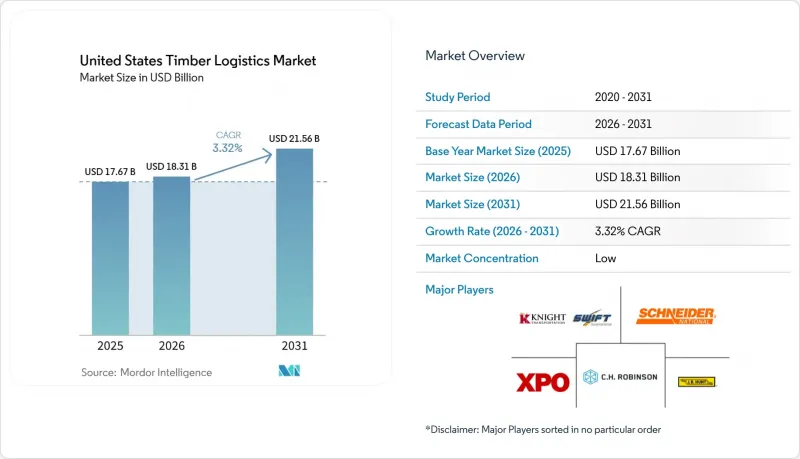
據 Mordor Intelligence 稱,2025 年美國木材物流市場價值 176.7 億美元,預計到 2031 年將達到 215.6 億美元,而 2026 年為 183.1 億美元,2026 年至 2031 年預測期內的複合年成長率為 3.32%。
美國木材物流市場受結構性變化驅動,例如應用領域向複合板和大型木材(木條)的轉變、聯邦政府擴大森林管理的廣泛舉措,以及主要木材運輸走廊中多式聯運的日益普及。本報告按服務(運輸、倉儲和儲存、附加價值服務)、木材產品類型(工業原木/原木、薪柴和生質能、其他)、終端用戶產業(建築和基礎設施、紙漿和造紙業、其他)以及地區(東北部、西南部、西部、東南部、中西部)進行細分。市場預測以美元計價。
美國木材物流市場趨勢與洞察
非住宅建築領域對大尺寸木材和工程木材的需求不斷成長。
大塊木材正從非住宅建築中的小眾建材轉變為更常見的結構材料,這一轉變正在改變美國木材物流市場的貨物運輸計劃。由於CLT(複合板木板的運輸方式與標準捆裝木材不同,承運商需要不同的平板裝載配置、更精確的裝載順序以及更準確的現場卸貨時間安排。此外,使用這些產品的建築專案在現場存放大型板材方面面臨挑戰,延誤會迅速拖慢施工團隊的工作進度,因此交付協調至關重要。因此,與傳統木材運輸相比,嚴格遵守運輸計畫、貨物保護和最後一公里配送更為關鍵。隨著複合板運輸量的增加,擁有專業處理能力的承運商正在美國木材物流市場中獲得更高價值的運輸路線。
增加多式聯運,以減少運輸距離和產品損壞。
在美國木材物流市場,多式聯運已不再只是一種有限的成本節約措施,而是逐漸成為木材供應鏈不可或缺的一部分。 CH Robinson 在 2025 年 4 月發布的《貨物趨勢報告》中指出,多式聯運合約價格年增 3.5%,推動了運輸路線的重新設計,以更好地利用現有資源。木材承運商擴大利用內陸港口樞紐進行長途鋸木和紙漿運輸,從而降低短途運輸成本並最大限度地減少卡車空駛里程。這種模式還有助於保護貨物質量,因為鐵路運輸一體化可以減少貨物在數天運輸過程中的末端損傷和受潮情況。能夠將鐵路運輸和最後一公里道路運輸整合到單一預訂和可視流程中的承運商,相比僅運營卡車運輸的承運商,具有服務優勢。
專業木材運輸司機短缺
駕駛人是結構性問題,而非週期性問題,其解決難度遠超過美國木材物流市場運輸能力普遍失衡的問題。喬治亞大學森林商業中心和美國農業部林務局2025年的一項研究發現,大多數原木卡車駕駛人年齡超過40歲,30歲以下的從業人員寥寥無幾。研究還指出,許多司機駕駛的是小規模老舊車輛,這導致保險和燃油成本增加,並限制了他們在工資方面與普通貨運公司競爭的能力。在美國南部,運輸成本佔木材運輸成本的40%之多,因此,司機短缺會直接影響鋸木廠的採購成本和運輸公司的利潤率。森林資源協會在2025年9月表示,根據2025年《許可法案》簡化商業駕駛執照(CDL)的措施可能有助於該行業,但由於培訓和車輛現代化都需要時間,因此這項改進仍需時日。能夠將部分大批量貨物轉為多式聯運的承運商,更有利於減輕每次運輸對駕駛人造成的直接負擔。
細分市場分析
2025年,運輸服務占美國木材物流市場規模的73.87%,證實了核心幹線運輸業務仍是整個服務結構中最大的收入來源。在全國範圍內,公路貨運仍然是主要的運輸方式,原木卡車仍然承擔著從伐木場到鋸木廠以及從鋸木廠到配送中心的大部分運輸任務。鐵路在長途運輸路線上發揮越來越重要的作用,尤其是在從東南部到東北部的木材運輸路線以及沿著太平洋西北地區的出口走廊上。水路通過墨西哥灣和大西洋沿岸的門戶,為散裝生質能、木片和原木的出口活動提供支援。在美國木材物流市場,隨著連接內陸碼頭和港口的鐵路樞紐對木材托運人的作用日益增強,多模態服務的範圍正在擴大。
預計2026年至2031年間,附加價值服務將以4.52%的複合年成長率成長,成為美國木材物流行業成長最快的服務類別。這一成長反映了市場對烘乾調整、再製造製程控制、數位化追蹤和追蹤系統、越庫作業以及其他日益複雜的木材運輸所需處理流程的需求不斷成長。美國農業部林務局的「國家積極森林管理策略」也促進了管理林和災害採伐林木的穩定供應,這些林木需要客製化處理,而非簡單的點對點運輸。這使得附加價值服務提供者比主要依靠價格競爭的純運輸商擁有更多獲利機會。
其他好處:
- Excel格式的市場預測(ME)表
- 3個月的分析師支持
目錄
第1章:引言
- 研究假設和市場定義
- 調查範圍
第2章:調查方法
第3章執行摘要
第4章 市場狀況
- 市場概覽
- 市場促進因素
- 非住宅建築對大尺寸木材和工程木材的需求不斷成長。
- 多式聯運中轉運量的增加旨在減少空駛距離,防止貨物損壞。
- 來自注重環境、社會和治理(ESG)的買家和公共採購部門的壓力,對數位化監管鏈提出了挑戰。
- 野火過後,進行救援行動、伐木和受損木材的回收。
- 最佳化鐵路和港口運力,以促進長途進出口物流。
- 透過本地鋸木廠和分銷網路縮短前置作業時間。
- 市場限制因素
- 特種木材運輸司機短缺
- 季節性道路限重和天氣相關的營運中斷
- 嚴格的生產歷史管理和遵守排放法規的相關成本。
- 森林道路和裝卸基礎設施受損
- 價值供應鏈分析
- 監理情勢
- 技術展望
- 波特五力分析
- 地緣政治事件對市場的影響
第5章 市場規模與成長預測
- 按服務
- 運輸
- 路
- 鐵路
- 水路
- 多模態
- 倉庫/存儲
- 附加價值服務
- 運輸
- 木製品類型
- 工業用原木/原木
- 薪柴和生質能
- 木材和木料
- 複合板製品
- 紙漿材、木片和纖維
- 顆粒和煤球
- 其他類型的木材
- 產業最終用途
- 建築和基礎設施
- 紙漿和造紙業
- 家具製造
- 包裝產業
- 能源與生質產業
- 其他終端用戶產業
- 按地區
- 東北
- 西南
- 西方
- 東南
- 中西部
第6章 競爭情勢
- 市場集中度
- 策略趨勢
- 市佔率分析
- 公司簡介
- JB Hunt Transport Services Inc.
- Schneider National, Inc.
- Knight-Swift Transportation Holdings Inc.
- CH Robinson Worldwide, Inc.
- XPO, Inc.
- FedEx Corporation
- Old Dominion Freight Line, Inc.
- Landstar System, Inc.
- Werner Enterprises, Inc.
- ArcBest Corporation
- Hub Group, Inc.
- Ryder System, Inc.
- Estes Express Lines
- Saia, Inc.
- TFI International Inc.
- Universal Logistics Holdings, Inc.
- Maverick Transportation, LLC
- Anderson Trucking Service, Inc.
- Melton Truck Lines, Inc.
- PS Logistics, LLC
- PGT Trucking, Inc.
第7章 市場機會與未來展望
According to Mordor Intelligence, the United States timber logistics market size was valued at USD 17.67 billion in 2025 and estimated to grow from USD 18.31 billion in 2026 to reach USD 21.56 billion by 2031, at a CAGR of 3.32% during the forecast period 2026-2031.
The United States timber logistics market is supported by a structural shift toward engineered wood and mass timber applications, a broader federal push to expand forest management, and the rising use of intermodal freight options in major timber corridors. This report is Segmented by Service (Transportation, Warehousing and Storage, and Value-Added Services), by Timber Product Type (Industrial Roundwood / Logs, Fuelwood & Biomass, and More), by End-Use Industry (Construction & Infrastructure, Pulp & Paper Industry, and More), and by Geography (Northeast, Southwest, West, Southeast, and Midwest). The Market Forecasts are Provided in Terms of Value (USD).
United States Timber Logistics Market Trends and Insights
Growing Demand for Mass Timber and Engineered Wood in Nonresidential Construction
Mass timber is moving from a niche building choice to a more regular structural option in nonresidential construction, and that shift is changing freight planning in the United States timber logistics market. CLT and glulam panels do not travel like standard bundles of sawn lumber, so carriers need different flatbed setups, tighter load sequencing, and more precise unloading windows at jobsites. Construction projects using these products also depend on coordinated deliveries because oversized panels are harder to store on site, and delays can slow installation crews quickly. That makes scheduling discipline, cargo protection, and final-mile execution more important than in conventional timber hauling. As engineered wood volumes rise, carriers with specialized handling capability are gaining access to higher-value freight lanes within the United States timber logistics market.
Higher Intermodal Reloading to Reduce Empty Miles and Product Damage
Intermodal reloading is becoming a structural part of timber supply chains rather than a narrow cost tactic in the United States timber logistics market. C.H. Robinson reported that intermodal contract prices were up 3.5% year over year in its April 2025 freight update, reinforcing the push to redesign lanes to better utilize assets. Timber operators are increasingly routing long-haul lumber and pulp traffic through inland port nodes to reduce drayage expense and cut empty miles on truck legs. The model also helps protect payload quality because rail-linked moves can reduce edge damage and moisture exposure over multi-day trips. Carriers that can combine rail and final-mile road movements within a single booking and visibility flow hold a stronger service position than truck-only operators.
Driver Shortages in Specialized Timber Haulage
The shortage of log truck drivers is more structural than cyclical, making it harder to fix than a typical freight capacity imbalance in the United States timber logistics market. A 2025 review from the University of Georgia Center for Forest Business and the USDA Forest Service found that most log truck drivers were over 40 and that very few workers under 30 were entering the field. The same review noted that many operators run smaller, older fleets, which increases insurance and fuel costs and limits their ability to compete with general freight employers on pay. Transportation can account for up to 40% of delivered wood cost in the United States South, so any tightening in driver availability quickly affects mill procurement economics and carrier margins. The Forest Resources Association stated in September 2025 that CDL streamlining under the License Act of 2025 could help the sector, but relief would still take time because training and fleet renewal do not happen quickly. Carriers that can move some higher-volume freight into intermodal patterns are better positioned to reduce the direct driver pressure per load.
Other drivers and restraints analyzed in the detailed report include:
- Digital Chain-of-Custody Pressure From ESG-Sensitive Buyers and Public Procurement
- Wildfire-Driven Salvage Logging and Distressed Timber Recovery
- Seasonal Road Weight Restrictions and Weather Disruptions
For complete list of drivers and restraints, kindly check the Table Of Contents.
Segment Analysis
Transportation services accounted for 73.87% of the United States timber logistics market size in 2025, confirming that core line-haul activity remains the largest revenue driver across the service mix. Road freight remains the dominant transport mode because log trucks still handle most harvest-to-mill and mill-to-distribution movements across the country. Rail has a larger role on long-distance lanes, especially on Southeast-to-Northeast lumber routes and Pacific Northwest export corridors. Waterway freight supports bulk biomass, wood chip, and log export activity through Gulf and Atlantic gateways. Multimodal offerings are expanding as inland terminals and port-linked rail nodes become more useful to timber shippers in the United States timber logistics market.
Value-added services are forecast to grow at a 4.52% CAGR from 2026 to 2031, making them the fastest-moving service category in the United States timber logistics industry. Growth reflects rising demand for kiln-drying coordination, remanufacturing sequencing, digital track-and-trace, cross-docking, and other handling steps that more complex timber flows now require. The USDA Forest Service's National Active Forest Management Strategy also supports a steadier pipeline of managed and salvage volumes that need customized handling rather than simple point-to-point hauling. That gives value-added providers a better chance to capture margin than pure-haul carriers that compete mainly on price.
Complete Report Scope:
- By Service
- Transportation
- Road
- Rail
- Waterway
- Multimodal
- Warehousing and Storage
- Value-Added Services
- Transportation
- By Timber Product Type
- Industrial roundwood / logs
- Fuelwood & biomass
- Sawn timber & lumber
- Engineered wood products
- Pulpwood, chips, and fibre
- Pellets and briquettes
- Other Timber Types
- By End-Use Industry
- Construction & Infrastructure
- Pulp & Paper Industry
- Furniture Manufacturing
- Packaging Industry
- Energy & Biomass Industry
- Other End-Use Industries
- By Geography
- Northeast
- Southwest
- West
- Southeast
- Midwest
List of Companies Covered in this Report:
- J.B. Hunt Transport Services Inc.
- Schneider National, Inc.
- Knight-Swift Transportation Holdings Inc.
- C.H. Robinson Worldwide, Inc.
- XPO, Inc.
- FedEx Corporation
- Old Dominion Freight Line, Inc.
- Landstar System, Inc.
- Werner Enterprises, Inc.
- ArcBest Corporation
- Hub Group, Inc.
- Ryder System, Inc.
- Estes Express Lines
- Saia, Inc.
- TFI International Inc.
- Universal Logistics Holdings, Inc.
- Maverick Transportation, LLC
- Anderson Trucking Service, Inc.
- Melton Truck Lines, Inc.
- PS Logistics, LLC
- PGT Trucking, Inc.
Additional Benefits:
- The market estimate (ME) sheet in Excel format
- 3 months of analyst support
TABLE OF CONTENTS
1 Introduction
- 1.1 Study Assumptions and Market Definition
- 1.2 Scope of the Study
2 Research Methodology
3 Executive Summary
4 Market Landscape
- 4.1 Market Overview
- 4.2 Market Drivers
- 4.2.1 Growing Demand for Mass Timber and Engineered Wood in Nonresidential Construction
- 4.2.2 Higher Intermodal Reloading to Reduce Empty Miles and Product Damage
- 4.2.3 Digital Chain-of-Custody Pressure from ESG-Sensitive Buyers and Public Procurement
- 4.2.4 Wildfire-Driven Salvage Logging and Distressed Timber Recovery
- 4.2.5 Rail and Port Slot Optimization for Longer-Distance Inbound and Export Flows
- 4.2.6 Shorter Lead Times from Regionalized Sawmill and Distribution Networks
- 4.3 Market Restraints
- 4.3.1 Driver Shortages in Specialized Timber Haulage
- 4.3.2 Seasonal Road Weight Restrictions and Weather Disruptions
- 4.3.3 Tight Chain-of-Custody and Emissions Compliance Costs
- 4.3.4 Fragmented Forest Access Roads and Loading Infrastructure
- 4.4 Value / Supply-Chain Analysis
- 4.5 Regulatory Landscape
- 4.6 Technological Outlook
- 4.7 Porter's Five Forces Analysis
- 4.7.1 Bargaining Power of Suppliers
- 4.7.2 Bargaining Power of Buyers
- 4.7.3 Threat of New Entrants
- 4.7.4 Threat of Substitutes
- 4.7.5 Industry Rivalry
- 4.8 Impact of Geopolitical Events on the Market
5 Market Size & Growth Forecasts (Value in USD)
- 5.1 By Service
- 5.1.1 Transportation
- 5.1.1.1 Road
- 5.1.1.2 Rail
- 5.1.1.3 Waterway
- 5.1.1.4 Multimodal
- 5.1.2 Warehousing and Storage
- 5.1.3 Value-Added Services
- 5.1.1 Transportation
- 5.2 By Timber Product Type
- 5.2.1 Industrial roundwood / logs
- 5.2.2 Fuelwood & biomass
- 5.2.3 Sawn timber & lumber
- 5.2.4 Engineered wood products
- 5.2.5 Pulpwood, chips, and fibre
- 5.2.6 Pellets and briquettes
- 5.2.7 Other Timber Types
- 5.3 By End-Use Industry
- 5.3.1 Construction & Infrastructure
- 5.3.2 Pulp & Paper Industry
- 5.3.3 Furniture Manufacturing
- 5.3.4 Packaging Industry
- 5.3.5 Energy & Biomass Industry
- 5.3.6 Other End-Use Industries
- 5.4 By Geography
- 5.4.1 Northeast
- 5.4.2 Southwest
- 5.4.3 West
- 5.4.4 Southeast
- 5.4.5 Midwest
6 Competitive Landscape
- 6.1 Market Concentration
- 6.2 Strategic Moves
- 6.3 Market Share Analysis
- 6.4 Company Profiles (includes Global Level Overview, Market Level Overview, Core Segments, Financials as available, Strategic Information, Market Rank/Share, Products and Services, Recent Developments)
- 6.4.1 J.B. Hunt Transport Services Inc.
- 6.4.2 Schneider National, Inc.
- 6.4.3 Knight-Swift Transportation Holdings Inc.
- 6.4.4 C.H. Robinson Worldwide, Inc.
- 6.4.5 XPO, Inc.
- 6.4.6 FedEx Corporation
- 6.4.7 Old Dominion Freight Line, Inc.
- 6.4.8 Landstar System, Inc.
- 6.4.9 Werner Enterprises, Inc.
- 6.4.10 ArcBest Corporation
- 6.4.11 Hub Group, Inc.
- 6.4.12 Ryder System, Inc.
- 6.4.13 Estes Express Lines
- 6.4.14 Saia, Inc.
- 6.4.15 TFI International Inc.
- 6.4.16 Universal Logistics Holdings, Inc.
- 6.4.17 Maverick Transportation, LLC
- 6.4.18 Anderson Trucking Service, Inc.
- 6.4.19 Melton Truck Lines, Inc.
- 6.4.20 PS Logistics, LLC
- 6.4.21 PGT Trucking, Inc.
7 Market Opportunities & Future Outlook
- 7.1 White-Space and Unmet-Need Assessment


