


 |
市場調查報告書
商品編碼
2099067
加密貨幣交易所:市場佔有率分析、行業趨勢和統計數據、成長預測(2026-2031)Crypto Exchange - Market Share Analysis, Industry Trends & Statistics, Growth Forecasts (2026 - 2031) |
||||||

※ 本網頁內容可能與最新版本有所差異。詳細情況請與我們聯繫。
根據 Mordor Intelligence 預測,加密貨幣交易市場規模將從 2025 年的 81.27 兆美元成長到 2026 年的 95.02 兆美元,到 2031 年達到 204.97 兆美元,2026 年至 2031 年的複合成長率為 16.62%。
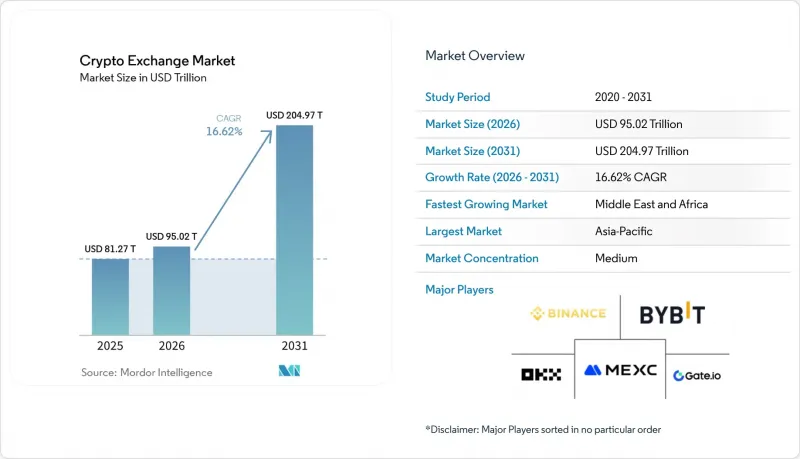
本報告按交易模式(集中式和分散式交易所)、交易類型(現貨和衍生性商品)以及地區(北美、南美、歐洲、亞太地區以及中東和非洲)進行分類。市場預測以美元計價。
全球加密貨幣交易所市場的趨勢與洞察
機構投資者正在增加對數位資產的配置。
機構投資者進入加密貨幣交易所市場不再處於試驗階段,而是更持久地影響交易量的分佈。一項針對351家機構投資者的2026年1月調查顯示,73%的受訪者計劃在2026年增加其對數位資產的配置,預計年內將超過5%總資產管理規模(AUM)配置於數位資產的機構投資者比例將從18%上升至29%。這項轉變對加密貨幣交易所市場意義重大,因為隨著投資配置的成長,那些具備可審計性、完善的報告系統和營運韌性,且符合機構投資者標準的交易所更容易被選中。此外,傳統避險基金對數位資產的投資比例也從2024年的47%上升至2025年的55%,顯示其投資策略正從試驗轉向持續性資本投資。託管機構的選擇標準也發生了顯著變化,安全性和金鑰簽署協議在託管機構選擇中的主要考慮因素從8%上升至66%。這直接有利於那些提供更強大的自主託管或多方管理框架的加密貨幣交易所營運商。
擴大受監管的現貨和衍生性商品交易所
在主要司法管轄區,受監管的現貨和衍生性商品交易平台的快速擴張也在重塑加密貨幣交易所市場。 OKX於2026年在美國推出現貨交易,在其覆蓋45個州的匯款許可證範圍內,提供約75種數位資產的交易服務。這加劇了長期主導國內市場的老牌交易所面臨的競爭壓力。 Coinbase於2025年8月完成了Deribit的29億美元收購,使其從一家領先的現貨交易所轉型為一家能夠即時擴展期權和永續合約的更廣泛的衍生品平台。收購時,Deribit的未平倉合約量接近600億美元,其交易量在2025年7月超過1,850億美元。這表明產品深度在如今的加密貨幣交易所市場中至關重要。因此,交易所不再僅僅作為「僅現貨」或「僅衍生性商品」平台展開競爭。這是因為,在目前的加密貨幣交易市場中,能夠在單一營運結構下提供現貨、永續合約和選擇權等受監管交易的平台越來越受到重視。
不同許可證制度下的監管碎片化
由於各國和地區許可製度的差異,加密貨幣交易所市場持續面臨許多阻礙。在歐盟,加密資產市場監管條例(MiCA)將於2026年全面實施,歐洲證券及市場管理局(ESMA)已聲明,過渡期結束後,未持有有效許可證的平台必須停止向歐盟客戶提供服務。這顯著提高了目前正在接受審查的營運商的合規門檻。在阿拉伯聯合大公國(阿拉伯聯合大公國),多個數位資產管理體制(包括CMA、VARA、DFSA、FSRA和CBUAE)同時運作,每個機構的監管範圍和資本要求各不相同,這增加了區域擴張的成本和複雜性。中型交易所承受的負擔最為沉重,因為大規模全球營運商可以將法律和報告成本分散到更廣泛的收入來源中,而小規模公司則無法做到這一點。因此,儘管監管機構努力提高透明度並保護投資者,但加密貨幣交易所市場的集中度可能會進一步提高,最終由幾家頂級公司壟斷。
細分市場分析
2025年,中心化交易所(CEX)佔據了86.1%的市場總交易量,即使來自鏈上替代方案的競爭日益激烈,它們仍然保持著主導地位。這種主導地位源於更強大的法幣入場能力、更快的撮合基礎設施和更廣泛的牌照發放,所有這些因素對機構投資者而言仍然至關重要,甚至比協議開放性本身更為重要。從2025年8月到2026年1月,幣安累計現貨交易量達3.54兆美元,占同期現貨交易總額的39.6%。 2025年10月,中心化交易所的永續期貨未平倉合約量達到最高2,135億美元,較2024年1月成長291%。這表明,加密貨幣交易所市場槓桿交易的流動性深度仍然嚴重依賴中心化平台。另一方面,MEXC 和 Gate.io 在 2025 年下半年的迅速崛起表明,加密貨幣交易所市場並沒有停滯在低層級,因為手續費的降低和新功能的快速推出正在削弱傳統市場地位的穩定性。
去中心化交易所(DEX)是加密貨幣交易市場中成長最快的板塊,預計到2031年,其市場規模將以22.8%的複合年成長率成長。 DEX現貨交易佔有率從2024年1月的6.9%加倍,達到2026年1月的13.6%,同期DEX永續期貨未平倉合約量增加了12倍,達到150億美元。 PancakeSwap和Uniswap在2025年8月至2026年1月期間的累積交易量位居全球十大現貨交易所。這表明,即使在曾經由大型中心化交易所(CEX)主導的領域,加密貨幣交易市場也湧現出可靠的鏈上競爭對手。 Hyperliquid上線黃金、白銀和標普500永續期貨進一步拓寬了加密貨幣交易產業的競爭格局,將DEX的競爭擴展到先前主要由中心化交易所主導的商品類型。機構投資者的需求也呈現類似的趨勢,56%的受訪投資者預計到2028年將使用DeFi協議,主要用於借貸和衍生性商品交易。這表明,隨著合規管理的日趨成熟,來自無牌照機構投資者的資金流入加密貨幣交易市場的可能性將進一步增加。
區域分析
到2025年,亞太地區將佔據加密貨幣交易所42.9%的市場佔有率,成為最大的區域交易中心。這一地位得益於大規模的個人使用者群體、高鏈上利用率以及已開發國家和新興國家多元化的監管方式。截至2025年6月的12個月內,該地區的加密貨幣交易量從1.4兆美元增加至2.4兆美元,年增69%。印度、越南和巴基斯坦是這一成長的主要動力。印度在Chainalysis發布的2024年和2025年全球加密貨幣採用指數中均位居第一。此外,Coinbase於2026年6月在該地區推出以印度盧比(INR)計價的支付系統,顯示全球交易所正致力於透過與法定貨幣的直接整合,推動用戶在加密貨幣交易市場中參與度的提升。韓國的實名帳戶系統、日本金融廳主導的模式、與中國相關的離岸活動,以及印尼和越南的行動優先交易模式,都為亞太地區加密貨幣交易市場的深度和多樣性做出了貢獻。
預計北美在2025年仍將保持第二大市場的地位,這主要得益於許可流程的簡化和機構投資者資金流入的增加。 2024年1月比特幣現貨ETF的獲批,進一步刺激了機構投資者的持續購買需求,使得全球加密貨幣ETP在2025年淨流入超過400億美元,管理資產規模一度突破2,000億美元。 OKX於2026年進軍美國市場,以及Coinbase和Deribit的合併,都預示著加密貨幣交易所市場對機構投資者和高階散戶投資者訂單流的競爭將更加激烈。在加拿大,受監管的交易所容量透過加拿大證券監管局(CSA)監管的機制得以擴展;而在墨西哥,散戶投資者透過行動主導參與的趨勢推動了市場持續成長。
中東和非洲是加密貨幣交易所市場成長最快的地區,預計到2031年,該地區的市場規模將以23.5%的複合年成長率成長。這一成長得益於阿拉伯聯合大公國的牌照發放勢頭強勁、土耳其、埃及和南非基層用戶接受度的提高,以及海灣地區各國為構建加密貨幣監管框架所做的廣泛努力。在歐洲,加密貨幣市場監管(MiCA)框架下正在經歷一個獨特的整合階段,一旦獲得批准,資金雄厚的交易所即可在所有27個成員國拓展業務。南美洲在加密貨幣交易所市場也佔據著重要地位,阿根廷對穩定幣的需求以及巴西更為完善的監管體系,都為點對點交易和交易所主導的美元掛鉤資產交易活動提供了支持。
其他好處:
- Excel格式的市場預測(ME)表
- 3個月的分析師支持
目錄
第1章:引言
- 研究假設和市場定義
- 調查範圍
第2章:調查方法
第3章執行摘要
第4章 市場狀況
- 市場概覽
- 市場促進因素
- 機構投資人對數位資產的配置比例正在增加。
- 受監管的現貨和衍生性商品市場的擴張
- 行動優先交易與嵌入式金融服務
- 代幣化政府債券和穩定幣的結算流程
- 一種降低費用甚至免除費用的客戶獲取模式。
- 對交易所儲備金認證和可審計性的需求
- 市場限制因素
- 許可證制度中監管規定的碎片化
- 因駭客攻擊、故障和保管缺陷造成的交易對手風險。
- 將流動性轉移至場外和鏈上交易場所
- 銀行服務管道和法定貨幣存取通道可能中斷
- 價值鏈分析
- 監理情勢
- 技術展望
- 波特五力分析
第5章 市場規模與成長預測
- 透過交易模式
- 集中式交易所
- 去中心化交易所
- 按交易類型
- 現貨交易
- 衍生性商品交易
- 按地區
- 北美洲
- 美國
- 加拿大
- 墨西哥
- 南美洲
- 巴西
- 阿根廷
- 其他南美國家
- 歐洲
- 德國
- 英國
- 法國
- 義大利
- 西班牙
- 其他歐洲國家
- 亞太地區
- 中國
- 印度
- 日本
- 韓國
- 澳洲
- 印尼
- 其他亞太國家
- 中東和非洲
- 土耳其
- 以色列
- 沙烏地阿拉伯
- 阿拉伯聯合大公國
- 南非
- 埃及
- 其他中東和非洲國家
- 北美洲
第6章 競爭情勢
- 市場集中度
- 策略趨勢
- 市佔率分析
- 公司簡介
- Binance
- Coinbase Global, Inc.
- Bybit
- OKX
- Gate.io
- MEXC
- Kraken
- Bitget
- Crypto.com
- KuCoin
- HTX
- Upbit
- Bitfinex
- Gemini
- Bitstamp
- Robinhood Markets, Inc.
- eToro Group Ltd.
- BitMEX
- Coincheck, Inc.
- Luno
- CEX.IO
第7章 市場機會與未來展望
According to Mordor Intelligence, the crypto exchange market size is expected to increase from USD 81.27 trillion in 2025 to USD 95.02 trillion in 2026 and reach USD 204.97 trillion by 2031, growing at a CAGR of 16.62% over 2026-2031.
This report is Segmented by Exchange Model (Centralized Exchanges and Decentralized Exchanges), by Trading Type (Spot Trading and Derivatives Trading), and by Geography (North America, South America, Europe, Asia-Pacific, and the Middle East and Africa). The Market Forecasts are Provided in Terms of Value (USD).
Global Crypto Exchange Market Trends and Insights
Rising Institutional Allocation to Digital Assets
Institutional participation in the crypto exchange market has moved beyond trial activity and is now shaping volume distribution more permanently. In January 2026, a survey of 351 institutional investors found that 73% planned to increase digital asset allocations in 2026, and the share targeting more than 5% of AUM was expected to rise from 18% to 29% within the year. That change matters for the crypto exchange market because larger allocation sizes tend to favor venues that can support auditability, reporting, and operational resilience at institutional standards. Traditional hedge fund exposure to digital assets also reached 55% in 2025, up from 47% in 2024, which reinforced the shift from exploratory positioning to repeat capital deployment. Custody selection criteria also changed sharply, with security and key-signing protocols rising from 8% to 66% as the leading factor in custodian selection, directly favoring crypto exchange market operators that offer stronger self-custody or multi-party control frameworks.
Expansion of Regulated Spot and Derivatives Venues
The faster buildout of regulated spot and derivatives platforms across major jurisdictions is also reshaping the crypto exchange market. OKX opened United States spot trading in 2026 with access to nearly 75 digital assets under Money Transmitter License coverage across 45 states, which raised the competitive pressure on incumbents that had long dominated the domestic market. Coinbase's USD 2.9 billion acquisition of Deribit closed in August 2025, expanding its position from a major spot venue into a broader derivatives platform with immediate scale in options and perpetuals. At the time of the deal, Deribit held close to USD 60 billion in open interest and processed more than USD 185 billion in trading volume in July 2025, which showed how much product depth now matters in the crypto exchange market. The practical result is that exchanges are no longer competing as spot-only or derivatives-only venues, because the crypto exchange market now rewards platforms that can offer regulated access across spot, perpetuals, and options within one operating structure.
Regulatory Fragmentation Across Licensing Regimes
The crypto exchange market still faces a material drag from uneven licensing systems across countries and regions. In the EU, Markets in Crypto-Assets (MiCA) entered full enforcement in 2026, and the European Securities and Markets Authority (ESMA) stated that platforms without valid authorization must stop serving EU clients after the transition period ends, sharply raising the compliance threshold for any operator still under review. The United Arab Emirates also operates multiple digital asset regimes across the CMA, VARA, DFSA, FSRA, and CBUAE, each with distinct activity scopes and capital requirements, which increases the cost and complexity of regional expansion. That burden falls hardest on mid-tier exchanges, because large global operators can spread legal and reporting costs across broader revenue pools while smaller firms cannot. The result is that the crypto exchange market can become even more concentrated at the top, even as regulators try to improve transparency and investor protection.
Other drivers and restraints analyzed in the detailed report include:
- Mobile First Trading and Embedded Finance Access
- Tokenized Treasury and Stablecoin Settlement Flows
- Counterparty Risk from Hacks, Insolvencies, and Custody Failures
For complete list of drivers and restraints, kindly check the Table Of Contents.
Segment Analysis
Centralized exchanges accounted for 86.1% of total market volume in 2025, maintaining their dominance despite rising competition from on-chain alternatives. That lead came from stronger fiat on-ramp capability, faster matching infrastructure, and broader regulatory licensing, all of which still matter more to institutions than protocol openness alone. Binance processed USD 3.54 trillion in spot cumulative volume between August 2025 and January 2026, accounting for 39.6% of tracked spot exchange volume during that period. CEX perpetual open interest peaked at USD 213.5 billion in October 2025, up 291% from January 2024, which showed how much of the crypto exchange market still depends on centralized liquidity depth for leveraged trading. At the same time, late 2025 gains by MEXC and Gate.io showed that the crypto exchange market is not locked in at the bottom tier, as fee cuts and faster feature rollouts are eroding the stability of inherited market positions.
Decentralized exchanges are the fastest-growing segment of the crypto exchange market, with the market size projected to grow at a 22.8% CAGR through 2031. Their spot share doubled from 6.9% in January 2024 to 13.6% in January 2026, and DEX perpetual open interest rose 12-fold to USD 15 billion over the same period. PancakeSwap and Uniswap entered the top 10 global spot exchanges by cumulative volume between August 2025 and January 2026, which showed that the crypto exchange market now has credible on-chain challengers in categories once dominated by major CEXs. Hyperliquid's launch of gold, silver, and S&P 500 perpetuals widened the competitive landscape of the crypto exchange industry by pushing DEX competition into instrument types that were once largely tied to centralized venues. Institutional appetite also points in that direction, with 56% of surveyed investors expecting to engage with DeFi protocols by 2028, mainly for lending and derivatives, suggesting that the crypto exchange market could see more permissionless institutional flows as compliance controls mature.
Complete Report Scope:
- By Exchange Model
- Centralized Exchanges
- Decentralized Exchanges
- By Trading Type
- Spot Trading
- Derivatives Trading
- By Geography
- North America
- United States
- Canada
- Mexico
- South America
- Brazil
- Argentina
- Rest of South America
- Europe
- Germany
- United Kingdom
- France
- Italy
- Spain
- Rest of Europe
- Asia-Pacific
- China
- India
- Japan
- South Korea
- Australia
- Indonesia
- Rest of Asia-Pacific
- Middle East and Africa
- Turkey
- Israel
- Saudi Arabia
- United Arab Emirates
- South Africa
- Egypt
- Rest of Middle East and Africa
- North America
Geography Analysis
Asia-Pacific held 42.9% of the crypto exchange market share in 2025, making it the largest regional center for trading activity. That position rests on a combination of large retail user bases, high on-chain engagement, and a wide mix of regulatory approaches across developed and emerging countries. Regional crypto transaction volume rose from USD 1.4 trillion to USD 2.4 trillion over the 12 months to June 2025, representing 69% year-on-year growth, with India, Vietnam, and Pakistan among the main contributors. India ranked first in the Chainalysis Global Adoption Index in both 2024 and 2025, and Coinbase's local INR rails launch in June 2026 showed how global exchanges are targeting the next stage of user activation in the crypto exchange market through direct fiat access. South Korea's real-name account system, Japan's FSA-led model, offshore China-linked activity, and Indonesia's and Vietnam's mobile-first trading patterns together give the Asia-Pacific crypto exchange market both depth and diversification.
North America remained the second-largest region in 2025, supported by clearer exchange licensing pathways and the growing presence of institutional capital. Spot Bitcoin ETF approvals in January 2024 helped create a sustained institutional bid, and global crypto ETPs attracted more than USD 40 billion in net inflows in 2025 while assets under management briefly moved above USD 200 billion. OKX's 2026 United States market entry and the Coinbase-Deribit combination both pointed to stronger competition for institutional and advanced retail order flow in the crypto exchange market. Canada added regulated exchange capacity through CSA-supervised structures, while Mexico continued to expand through mobile-led retail participation.
The Middle East and Africa are the fastest-growing regions in the crypto exchange market, with the region's market size forecast to grow at a 23.5% CAGR through 2031. Growth there is being supported by United Arab Emirates licensing momentum, rising grassroots adoption in Turkey, Egypt, and South Africa, and a broader push to formalize virtual asset oversight across Gulf markets. Europe is moving through a separate consolidation phase under MiCA, where better-capitalized exchanges have a clearer path to scale across all 27 member states once approvals are secured. South America also remains relevant for the crypto exchange market, because stablecoin demand in Argentina and more structured regulation in Brazil are supporting both peer-to-peer and exchange-led activity in USD-pegged assets.
- Binance
- Coinbase Global, Inc.
- Bybit
- OKX
- Gate.io
- MEXC
- Kraken
- Bitget
- Crypto.com
- KuCoin
- HTX
- Upbit
- Bitfinex
- Gemini
- Bitstamp
- Robinhood Markets, Inc.
- eToro Group Ltd.
- BitMEX
- Coincheck, Inc.
- Luno
- CEX.IO
Additional Benefits:
- The market estimate (ME) sheet in Excel format
- 3 months of analyst support
TABLE OF CONTENTS
1 INTRODUCTION
- 1.1 Study Assumptions and Market Definition
- 1.2 Scope of the Study
2 RESEARCH METHODOLOGY
3 EXECUTIVE SUMMARY
4 MARKET LANDSCAPE
- 4.1 Market Overview
- 4.2 Market Drivers
- 4.2.1 Rising Institutional Allocation to Digital Assets
- 4.2.2 Expansion of Regulated Spot and Derivatives Venues
- 4.2.3 Mobile First Trading and Embedded Finance Access
- 4.2.4 Tokenized Treasury and Stablecoin Settlement Flows
- 4.2.5 Fee Compression and Zero Fee Acquisition Models
- 4.2.6 Exchange Proof of Reserve and Auditability Demand
- 4.3 Market Restraints
- 4.3.1 Regulatory Fragmentation Across Licensing Regimes
- 4.3.2 Counterparty Risk From Hacks, Insolvencies, and Custody Failures
- 4.3.3 Liquidity Migration to Off-Exchange and Onchain Venues
- 4.3.4 Banking Access and Fiat On-Ramp Disruption Risk
- 4.4 Value Chain Analysis
- 4.5 Regulatory Landscape
- 4.6 Technological Outlook
- 4.7 Porter's Five Forces Analysis
- 4.7.1 Threat of New Entrants
- 4.7.2 Bargaining Power of Buyers
- 4.7.3 Bargaining Power of Suppliers
- 4.7.4 Threat of Substitutes
- 4.7.5 Intensity of Competitive Rivalry
5 MARKET SIZE AND GROWTH FORECASTS
- 5.1 By Exchange Model
- 5.1.1 Centralized Exchanges
- 5.1.2 Decentralized Exchanges
- 5.2 By Trading Type
- 5.2.1 Spot Trading
- 5.2.2 Derivatives Trading
- 5.3 By Geography
- 5.3.1 North America
- 5.3.1.1 United States
- 5.3.1.2 Canada
- 5.3.1.3 Mexico
- 5.3.2 South America
- 5.3.2.1 Brazil
- 5.3.2.2 Argentina
- 5.3.2.3 Rest of South America
- 5.3.3 Europe
- 5.3.3.1 Germany
- 5.3.3.2 United Kingdom
- 5.3.3.3 France
- 5.3.3.4 Italy
- 5.3.3.5 Spain
- 5.3.3.6 Rest of Europe
- 5.3.4 Asia-Pacific
- 5.3.4.1 China
- 5.3.4.2 India
- 5.3.4.3 Japan
- 5.3.4.4 South Korea
- 5.3.4.5 Australia
- 5.3.4.6 Indonesia
- 5.3.4.7 Rest of Asia-Pacific
- 5.3.5 Middle East and Africa
- 5.3.5.1 Turkey
- 5.3.5.2 Israel
- 5.3.5.3 Saudi Arabia
- 5.3.5.4 United Arab Emirates
- 5.3.5.5 South Africa
- 5.3.5.6 Egypt
- 5.3.5.7 Rest of Middle East and Africa
- 5.3.1 North America
6 COMPETITIVE LANDSCAPE
- 6.1 Market Concentration
- 6.2 Strategic Moves
- 6.3 Market Share Analysis
- 6.4 Company Profiles (includes Global Level Overview, Market Level Overview, Core Segments, Financials as available, Strategic Information, Market Rank/Share, Products and Services, Recent Developments)
- 6.4.1 Binance
- 6.4.2 Coinbase Global, Inc.
- 6.4.3 Bybit
- 6.4.4 OKX
- 6.4.5 Gate.io
- 6.4.6 MEXC
- 6.4.7 Kraken
- 6.4.8 Bitget
- 6.4.9 Crypto.com
- 6.4.10 KuCoin
- 6.4.11 HTX
- 6.4.12 Upbit
- 6.4.13 Bitfinex
- 6.4.14 Gemini
- 6.4.15 Bitstamp
- 6.4.16 Robinhood Markets, Inc.
- 6.4.17 eToro Group Ltd.
- 6.4.18 BitMEX
- 6.4.19 Coincheck, Inc.
- 6.4.20 Luno
- 6.4.21 CEX.IO
7 MARKET OPPORTUNITIES AND FUTURE OUTLOOK
- 7.1 White-space and Unmet-Need Assessment

 2026年全球受監管穩定幣支付基礎設施市場報告2026年全球穩定幣基礎設施與跨境付款管道市場報告
 加密貨幣託管工具市場規模、佔有率和成長分析:按產品、託管類型、部署模式、組織規模、最終用戶和地區分類-產業預測(2026-2033 年)
 加密貨幣交易平台市場-2026-2032年全球市場預測加密貨幣市場-2026年至2032年全球市場預測
 穩定幣:市場佔有率分析、產業趨勢與統計、成長預測(2026-2031)
 全球加密貨幣交易平台市場規模、佔有率、趨勢和成長分析報告(2026-2034年)數位貨幣市場:按貨幣類型、平台、應用和最終用戶分類-2026-2032年全球市場預測
 穩定幣和數位貨幣支付基礎設施市場預測至2034年-全球分析(按組件、穩定幣類型、基礎設施層、支付類型、應用、最終用戶和地區分類)2026年全球穩定幣合規市場報告