


 |
市場調查報告書
商品編碼
2099055
穩定幣:市場佔有率分析、產業趨勢與統計、成長預測(2026-2031)Stablecoin - Market Share Analysis, Industry Trends & Statistics, Growth Forecasts (2026 - 2031) |
||||||

※ 本網頁內容可能與最新版本有所差異。詳細情況請與我們聯繫。
根據 Mordor Intelligence 預測,穩定幣市場規模將從 2025 年的 3,000 億美元成長到 2026 年的 3,300 億美元,然後在 2031 年達到 1.16 兆美元,2026 年至 2031 年的複合年成長率為 28.77%。
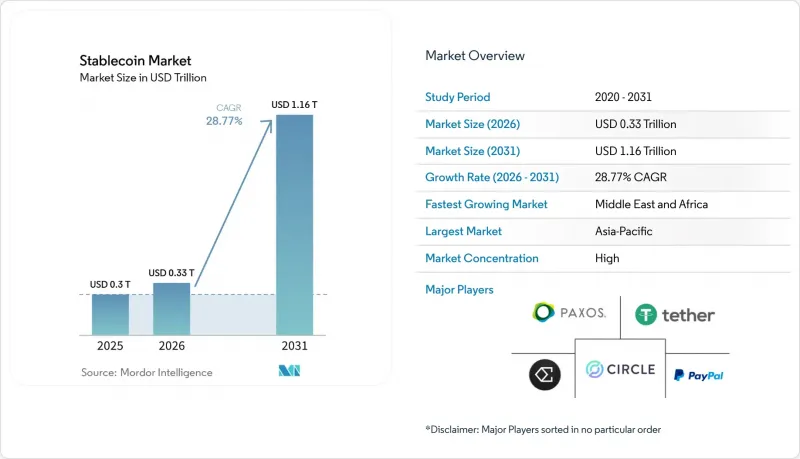
本報告按抵押品類型(例如,法幣支援的穩定幣)、區塊鏈平台(例如,以太坊)、應用程式(例如,加密貨幣交易和流動性管理)、最終用戶(例如,普通消費者)、分銷管道(例如,中心化交易所)和地區(例如,北美、南美)進行分類。市場預測以美元計價。
全球穩定幣市場趨勢及洞察
即時跨境支付的需求日益成長
跨境支付的摩擦持續支撐著穩定幣市場。這是因為穩定幣支付網路可以隨時進行支付,從而減少了對代理銀行網路的依賴,而代理銀行網路的處理往往耗時較長。這一點在傳統支付系統成本高昂的地區尤其重要,因為傳統系統有轉帳費用、支付延遲以及外匯獲取管道有限等問題,對個人和企業而言成本都較高。此外,在早期採用階段,支付方式的經濟效益往往優先於正式的監管發展,尤其是在用戶優先考慮速度和成本而非產品複雜性的情況下,這也有利於穩定幣市場的發展。 Circle支付網路報告稱,截至2026年3月31日,其年化交易量已達到83億美元,這得益於其透過新增匯款管道(包括巴西和奈及利亞)擴展了法幣支付連線。這為大額匯款和B2B支付領域的發行方和合作夥伴帶來了優勢,因為他們可以將低成本的區塊鏈支付方式與可靠的本地現金支付基礎設施相結合。
澄清有關儲備金支持的穩定幣的監管規定
監管規定的明確化極大地推動了穩定幣市場的發展,因為機構投資者一直在等待關於儲備金、認證、託管和發行方監管等方面的更清晰的指南。美國的《天才法案》(Genius Act)和歐洲的《貨幣資訊與應用法案》(MiCA)正在大規模平台上線、企業合作以及大型金融機構將穩定幣納入其客戶服務的意願。因此,合規性不再只是法律要求,而是一種分銷優勢,正在重塑整個穩定幣市場的競爭格局。
儲備透明度與償付信心之間的差距。
由於機構投資者仍然優先考慮清晰的贖回機制、檢驗的儲備金和一致的報告標準,儲備金透明度仍然是穩定幣市場面臨的直接限制。儘管新規已經訂定,但並非所有主要市場都已全面實施,許多投資者和營運合作夥伴仍然依賴自願證明和不均衡的資訊揭露做法。因此,穩定幣市場中出現了品質差距:一方面是遵循更嚴格資訊揭露標準的大型發行方,另一方面是難以持續證明其儲備金穩健性的小型發行方。此外,隨著鏈上儲備金檢驗工具的普及,DeFi協議也在收緊抵押品接受標準,這可能會縮小那些無法滿足日益成長的透明度期望的發行方的市場。歐洲央行在2025年7月也發出警告,如果監理不力的發行方間接進入監理較嚴格的市場,美國和歐洲監理的差異可能會導致監理套利和系統性風險。
細分市場分析
2025年,法幣支持的穩定幣佔了92.3%的市場佔有率,顯示儲備金支持的美元計價金融工具仍然是穩定幣市場的基準。雖然USDT和USDC合計約佔總供應量的83%,但其他法幣支持的穩定幣發行方,例如Paxos(USDP和USDG)、PayPal(PYUSD)、First Digital Trust(FDUSD)和Ripple(RLUSD),仍然專注於滿足特定的合規要求和麵向機構投資者的細分市場。這一趨勢表明,對於大部分穩定幣市場而言,可靠性、流動性深度和交易所接受度仍然比產品多樣性更為重要。像MakerDAO的DAI這樣的加密貨幣支持的穩定幣繼續佔據著重要的結構性地位,因為它們在DeFi借貸和交易系統中繼續發揮著核心抵押品的作用。包括 Tether Gold 和 Paxos Gold 在內的商品支援型代幣也受益於 2025 年金價上漲。此外,Tether 於 2026 年 2 月以 1.5 億美元收購 Gold.com 12% 的股份,這意味著代幣化黃金的流通現在與貴金屬的需求更加直接地聯繫在一起。
混合型和演算法型穩定幣預計到2031年將以44.8%的複合年成長率成長,成為穩定幣市場中成長最快的抵押品板塊。這一成長主要源自於市場對收益產生機制的需求,以取代零收益的儲備支持型穩定幣,尤其是機構投資者尋求透過持有數位美元來提高資本效率。 Ethena的USDe就是一個典型的例子,它採用基於Delta中性永續衍生頭寸而非簡單儲備持有的合成美元結構。當前一代合成產品與2022年失敗的純演算法型產品有著本質差異。新設計提供了更精細的風險控制,並更接近結構化信貸產品。然而,穩定幣市場在這方面仍有監管漏洞。儘管存在成長空間,但如果監管迅速收緊,也存在明顯的下行風險,因為關於如何監管這些新結構的法規尚未完全制定。
到2025年,Tron將佔據34.9%的市場佔有率,成為穩定幣市場中最大的區塊鏈平台。這一地位反映了其極低的交易費用,以及其在東南亞、撒哈拉以南非洲和拉丁美洲等新興市場作為USDT微交易管道的首選地位。 Tron上的穩定幣市場與其支付功能緊密相關,而非單純的投機,因為許多用戶依賴Tron作為日常跨境匯款最經濟的選擇。以太坊憑藉其在機構DeFi、高價值支付和廣泛應用支援方面的作用,仍然保持著相當大的市場佔有率。幣安智慧鏈(BSC)和Solana也服務於不同的用戶群體,其中Solana上的PYUSD受益於低於美分的低手續費以及機構支付處理商日益成長的興趣。
二層網路預計到2031年將以39.5%的複合年成長率成長,成為穩定幣市場成長最快的領域。根據草案,到2025年,這些網路每天將處理超過190萬筆交易,其中穩定幣將佔二層交易量的70%以上,凸顯了擴展普及與穩定幣使用之間的密切關聯。此外,預計到2025年底,二層網路的普及率將達到以太坊交易吞吐量的85%,而擁有強勁USDC交易量的Base預計將處理超過30%的美國穩定幣交易。一個關鍵的營運轉折點是主要二層網路從橋接協議過渡到原生穩定幣發行。 Arbitrum在2025年底從USDC.e過渡到原生USDC正體現了這一變化,這對穩定幣市場具有重大意義。這是因為,在可擴展的區塊鏈上早期建立原生流動性的發行人,比依賴橋接分銷的後期進入者,能夠更有效地保護其市場地位。
區域分析
2025年,亞太地區佔據了39.6%的穩定幣市場佔有率,成為最大的區域市場。該地區的主導地位得益於活躍的匯款活動、積極的交易所參與、行動優先的金融實踐,以及新加坡、香港、韓國和日本等市場較早的監管發展。在東南亞地區,個人USDT在Tron平台上的流動仍佔有尤為重要的地位。這是因為低廉的交易費用和便利的存取方式滿足了價格敏感型用戶和跨境匯款者的需求。由於政策制定者在發行機構類別方面存在持續分歧,韓國的《基本數位資產法》預計將於2026年中期獲得通過。因此,以該地貨幣計價的穩定幣發行被推遲,美元計價的全球穩定幣在短期內仍然佔據主導地位。印度、印尼、泰國、越南和馬來西亞也仍然是穩定幣市場的重要成長市場。這是因為一部分人無法獲得銀行服務,無法使用智慧型手機進行金融活動,以及大量匯款的湧入,都持續推動穩定幣的普及。
北美和歐洲在穩定幣市場的合規性方面處於領先地位,因為這兩個地區都在製定機構投資者可能遵循的規則。在美國,根據《GENIUS法案》,最終規則必須在2026年7月18日之前製定完成,該法案將在120天後生效。這意味著,根據草案,機構市場的正式啟動預計將在2026年底或2027年初進行。 Tether於2026年1月透過Anchorage Digital Bank推出了USAT,並在Cantor Fitzgerald存入了儲備金,這表明主要發行方正在專門調整其產品結構,以符合美國的合規環境。在歐洲,MiCA過渡期於2026年7月1日結束。根據草案,已有10家發行機構獲得正式授權,而USDT已於2025年第一季從歐盟監管平台移除。此外,歐盟委員會於2026年5月20日啟動公眾意見徵詢,以評估MiCA是否仍符合其預期目標。草案顯示,歐元計價穩定幣的市場規模為7.74億歐元(約8.359億美元),而美元計價穩定幣的市場規模已達3200億美元,凸顯了歐元計價穩定幣和美元計價穩定幣市場規模的巨大差異。
預計到2031年,中東和非洲地區的年複合成長率將達到35.6%,成為穩定幣市場成長最快的區域板塊。對匯款的高度依賴、外匯獲取管道受限以及匯款管道基礎設施的不斷改進是推動這一成長的主要因素。在杜拜的法規環境以及與海外匯款流動密切相關的市場,這一趨勢尤其顯著。隨著企業尋求結算管道以減少對中斷的代理銀行管道的依賴,穩定幣市場在阿拉伯聯合大公國也蓬勃發展。同時,南美洲,特別是巴西和阿根廷,仍然是一個重要的市場,因為與美元掛鉤的穩定幣在外匯受限的環境下發揮實用作用。根據草案,阿根廷約佔該國穩定幣交易量的46%,而巴西央行和金融科技生態系統正在探索與USDC和即時結算系統「PIX」的整合,這有望在預測期內開闢大規模機構結算管道。
其他好處:
- Excel格式的市場預測(ME)表
- 3個月的分析師支持
目錄
第1章:引言
- 研究假設和市場定義
- 調查範圍
第2章:調查方法
第3章執行摘要
第4章 市場狀況
- 市場概覽
- 市場促進因素
- 即時跨境支付的需求日益成長
- 加密貨幣交易和去中心化金融的流動性橋樑
- 澄清有關儲備金支持的穩定幣的監管規定
- 影響政府公債殖利率的經濟因素取決於發行人的規模
- 企業導向的鏈上資金管理與現金管理
- 合成穩定幣的風險分類與收益需求
- 市場限制因素
- 儲備透明度與償付信心之間的差距。
- 全球許可體系碎片化與合規負擔
- 除了使用加密貨幣進行的支付之外,其他支付方式的普及程度有限。
- 市場集中化限制了新發行人的網路效應。
- 價值鏈分析
- 監理情勢
- 技術展望
- 波特五力分析
第5章 市場規模與成長預測
- 按抵押品類型
- 法幣支持的穩定幣
- 由加密資產支持的穩定幣
- 演算法穩定幣
- 商品支持的穩定幣
- 其他穩定幣
- 透過區塊鏈平台
- 以太坊
- 創戰紀
- 幣安智慧鏈
- 索拉納
- 二層網路
- 其他區塊鏈平台
- 透過使用
- 加密貨幣交易與流動性管理
- 跨境支付和匯款
- 去中心化金融
- 電子商務和商家支付
- 財務和現金管理
- 其他用途
- 最終用戶
- 一般消費者
- 加密貨幣交易所和交易平台
- 金融機構和支付服務供應商
- 公司和企業
- 開發者和 Web3 平台
- 政府和公共部門機構
- 透過分銷管道
- 集中式交易所
- 去中心化交易所
- 錢包提供者
- 付款閘道和金融科技平台
- 場外交易平台及機構投資者仲介
- 按地區
- 北美洲
- 美國
- 加拿大
- 墨西哥
- 南美洲
- 巴西
- 阿根廷
- 其他南美國家
- 歐洲
- 英國
- 德國
- 法國
- 義大利
- 西班牙
- 其他歐洲國家
- 亞太地區
- 印度
- 中國
- 日本
- 澳洲
- 韓國
- 東南亞(新加坡、馬來西亞、泰國、印尼、越南、菲律賓)
- 其他亞太國家
- 中東和非洲
- 沙烏地阿拉伯
- 阿拉伯聯合大公國
- 土耳其
- 南非
- 埃及
- 其他中東和非洲國家
- 北美洲
第6章 競爭情勢
- 市場集中度
- 策略趨勢
- 市佔率分析
- 公司簡介
- Tether Limited
- Circle Internet Financial, Inc.
- PayPal Holdings, Inc.
- Paxos Trust Company, LLC
- MakerDAO
- Ethena Labs
- First Digital Trust
- Ripple Labs, Inc.
- Binance Holdings Limited
- Coinbase Global, Inc.
- Anchorage Digital Bank, NA
- BitGo, Inc.
- Fireblocks Ltd.
- Gemini Trust Company, LLC
- Societe Generale-FORGE
- Visa Inc.
- Mastercard Incorporated
- Stripe, Inc.
- Fiserv, Inc.
- Kraken
第7章 市場機會與未來展望
According to Mordor Intelligence, the stablecoin market size is expected to grow from USD 0.3 trillion in 2025 to USD 0.33 trillion in 2026 and is forecast to reach USD 1.16 trillion by 2031 at 28.77% CAGR over 2026-2031.
This report is Segmented by Collateral Type (Fiat-Backed Stablecoins, and More), by Blockchain (Ethereum, and More), by Application (Cryptocurrency Trading and Liquidity Management, and More), by End User (Retail Consumers, and More), by Distribution (Centralized Exchanges, and More), and by Geography (North America, South America, and More). The Market Forecasts are Provided in Terms of Value (USD).
Global Stablecoin Market Trends and Insights
Rising Demand for Real-Time Cross-Border Settlement
Cross-border payment friction continues to support the stablecoin market because stablecoin rails can settle at any time and reduce reliance on slower correspondent banking chains. This matters most in corridors where transfer fees, settlement delays, and limited foreign exchange access still make traditional systems costly for both individuals and businesses. The stablecoin market is also benefiting from the fact that corridor economics often matter more than formal rulemaking in early adoption environments, especially where users prioritize speed and cost over product complexity. Circle's Payments Network reported USD 8.3 billion in annualized transaction volume as of March 31, 2026, after expanding fiat payout connectivity through new corridors, including Brazil and Nigeria. This creates an advantage for issuers and partners that can combine low-cost blockchain routes with dependable local cash-out infrastructure in high-volume remittance and B2B payment corridors.
Regulatory Clarity for Reserve-Backed Stablecoins
Regulatory clarity is a major support for the stablecoin market because institutional users have been waiting for clearer expectations on reserves, attestations, custody, and issuer oversight. The GENIUS Act in the United States and MiCA in Europe are setting the first large-scale compliance framework for payment stablecoins, changing how exchanges, banks, and payment firms evaluate distribution partners. The stablecoin market is now separating more clearly between issuers that meet formal operating standards and those that still rely on regulatory gray areas. That split affects platform listings, enterprise partnerships, and the willingness of large financial institutions to integrate stablecoins into customer-facing products. The practical result is that compliance is becoming a distribution advantage rather than merely a legal requirement, reshaping competitive positioning across the stablecoin market.
Reserve Transparency and Redemption Confidence Gaps
Reserve transparency remains a direct limit on the stablecoin market because institutional users still place a high value on clear redemption mechanics, verified reserves, and consistent reporting standards. Even with new regulations, implementation is not yet complete across all major markets, meaning many investors and operating partners still rely on voluntary attestations and uneven disclosure practices. The stablecoin market is therefore developing a quality gap between the largest issuers, which adhere to stronger disclosure standards, and smaller issuers that struggle to consistently demonstrate reserve strength. DeFi protocols are also becoming more selective in their collateral acceptance as on-chain reserve verification tools gain traction, potentially reducing the addressable market for issuers that fail to meet rising transparency expectations. The European Central Bank also warned in July 2025 that differences between United States and European rules could create regulatory arbitrage and raise systemic concerns if under-supervised issuers find indirect access into stricter markets.
Other drivers and restraints analyzed in the detailed report include:
- On-Chain Treasury and Cash Management for Enterprises
- Liquidity Bridge For Crypto Trading And DeFi
- Fragmented Global Licensing and Compliance Burden
For complete list of drivers and restraints, kindly check the Table Of Contents.
Segment Analysis
Fiat-backed stablecoins held 92.3% of the market in 2025, indicating that reserve-backed dollar instruments still set the baseline for the stablecoin market. USDT and USDC together accounted for approximately 83% of total supply, while other fiat-backed issuers, such as Paxos with USDP and USDG, PayPal with PYUSD, First Digital Trust with FDUSD, and Ripple with RLUSD, remained more focused on targeted compliance and institutional niches. This pattern shows that trust, liquidity depth, and exchange acceptance still matter more than product variety in the largest part of the stablecoin market. Crypto-collateralized stablecoins such as MakerDAO's DAI remain structurally important because they continue to serve as core collateral in DeFi lending and trading systems. Commodity-backed tokens, including Tether Gold and Paxos Gold, also benefited from stronger gold prices in 2025, and Tether's February 2026 USD 150 million purchase of a 12% stake in Gold.com linked tokenized gold distribution more directly to precious metals demand.
Hybrid and algorithmic stablecoins are projected to expand at a 44.8% CAGR through 2031, making them the fastest-growing collateral segment in the stablecoin market. Growth is being driven by demand for yield-bearing structures that offer an alternative to zero-yield reserve-backed models, especially among institutional allocators seeking greater capital efficiency from digital dollar exposure. Ethena's USDe is a clear example because it uses a synthetic dollar structure built on delta-neutral perpetual derivative positions rather than simple reserve storage. The current generation of synthetic products is materially different from the purely algorithmic formats that failed in 2022, because the newer designs are more risk-segmented and closer in form to structured credit products. Even so, the stablecoin market still faces a policy gap here because regulation has not fully codified how these newer structures should be supervised, leaving room for growth and a clear downside risk if oversight tightens abruptly.
Tron held a 34.9% share in 2025, making it the largest blockchain platform segment in the stablecoin market. That position reflects its very low transaction fees and its role as the preferred route for retail USDT transfers in emerging market corridors across Southeast Asia, Sub-Saharan Africa, and Latin America. The stablecoin market on Tron remains closely tied to payment utility rather than solely to speculation, as many users rely on it as the cheapest available option for routine cross-border transfers. Ethereum still maintained a large position because of its role in institutional DeFi, high-value settlement, and broader application support. Binance Smart Chain and Solana also served distinct user groups, and PYUSD on Solana benefited from sub-cent fees and growing interest from institutional payment processors.
Layer-2 networks are projected to grow at a 39.5% CAGR through 2031, making them the fastest-growing segment of the stablecoin market. The source draft stated that these networks processed more than 1.9 million daily transactions in 2025 and that stablecoins accounted for more than 70% of Layer-2 transaction volume, underscoring the close link between scaling adoption and stablecoin usage. It also stated that Layer-2 adoption reached 85% of Ethereum transaction throughput by late 2025, while Base processed more than 30% of the United States stablecoin transactions through strong USDC volumes. A major operating shift is the move from bridged contracts to native stablecoin issuance on leading Layer-2 networks, and Arbitrum's migration from USDC.e to native USDC by late 2025 reflected that change. This matters for the stablecoin market because issuers that establish native liquidity early on scalable chains can defend market position more effectively than late entrants that rely on bridge-dependent distribution.
Complete Report Scope:
- By Collateral Type
- Fiat-Backed Stablecoins
- Crypto-Collateralized Stablecoins
- Algorithmic Stablecoins
- Commodity-Backed Stablecoins
- Other Stablecoins
- By Blockchain Platform
- Ethereum
- Tron
- Binance Smart Chain
- Solana
- Layer-2 Networks
- Other Blockchain Platforms
- By Application
- Cryptocurrency Trading and Liquidity Management
- Cross-Border Payments and Remittances
- Decentralized Finance
- E-Commerce and Merchant Payments
- Treasury and Cash Management
- Other Applications
- By End User
- Retail Consumers
- Crypto Exchanges and Trading Platforms
- Financial Institutions and Payment Service Providers
- Enterprises and Merchants
- Developers and Web3 Platforms
- Government and Public Sector Entities
- By Distribution Channel
- Centralized Exchanges
- Decentralized Exchanges
- Wallet Providers
- Payment Gateways and Fintech Platforms
- OTC Desks and Institutional Brokers
- By Geography
- North America
- United States
- Canada
- Mexico
- South America
- Brazil
- Argentina
- Rest of South America
- Europe
- United Kingdom
- Germany
- France
- Italy
- Spain
- Rest of Europe
- Asia-Pacific
- India
- China
- Japan
- Australia
- South Korea
- South East Asia (Singapore, Malaysia, Thailand, Indonesia, Vietnam, and Philippines)
- Rest of Asia-Pacific
- Middle East and Africa
- Saudi Arabia
- United Arab Emirates
- Turkey
- South Africa
- Egypt
- Rest of Middle East and Africa
- North America
Geography Analysis
Asia-Pacific accounted for 39.6% of the stablecoin market in 2025, making it the largest regional market. The region's leadership reflects a combination of high remittance activity, active participation in exchanges, mobile-first financial behavior, and early regulatory development across markets such as Singapore, Hong Kong, South Korea, and Japan. Retail USDT flows on Tron remained especially important across Southeast Asian corridors because low transaction fees and easy availability fit the needs of price-sensitive users and cross-border senders. South Korea's Digital Asset Basic Law remained stalled through mid-2026 because policymakers continued to disagree over which issuer categories should be allowed, delaying local-currency stablecoin issuance and keeping global-dollar stablecoins more prominent in the interim. India, Indonesia, Thailand, Vietnam, and Malaysia also remain important growth markets for the stablecoin market because underbanked populations, smartphone-based finance, and meaningful remittance inflows continue to support adoption.
North America and Europe define the compliance frontier for the stablecoin market because both regions are shaping the rules that institutional users are likely to follow. In the United States, final rules under the GENIUS Act are required by July 18, 2026, with the law taking effect within 120 days after that, which places formal institutional market activation on a late 2026 to early 2027 timeline in the source draft. Tether launched USAT in January 2026 through Anchorage Digital Bank, with reserves held at Cantor Fitzgerald, demonstrating how major issuers are preparing product structures specifically for the United States compliance environment. In Europe, the full MiCA transition period ends on July 1, 2026, and the source draft noted that 10 issuers received formal authorization, while USDT had already been removed from regulated EU platforms by the first quarter of 2025. The European Commission also opened a consultation on May 20, 2026, to review whether MiCA remains fit for purpose, and the source draft noted that euro stablecoins represented EUR 774 million, or USD 835.9 million, versus USD 320 billion for dollar-denominated instruments, highlighting the wide current gap between euro and dollar stablecoin activity.
The Middle East and Africa are projected to grow at a 35.6% CAGR through 2031, which makes it the fastest-growing regional segment in the stablecoin market. High remittance dependence, foreign exchange access constraints, and expanding corridor infrastructure are supporting this rise, especially in markets linked to Dubai's regulatory environment and broader expatriate payment flows. The stablecoin market is also gaining traction in the UAE as firms seek payment routes that reduce reliance on disrupted correspondent banking channels. At the same time, South America, especially Brazil and Argentina, remains important because dollar-linked stablecoins serve as practical tools in foreign-exchange-constrained settings. Argentina was cited in the source draft as accounting for approximately 46% of local stablecoin volumes, while Brazil's central bank and fintech ecosystem are exploring links with USDC and the PIX instant payment system, which could open a large institutional corridor during the forecast period.
- Tether Limited
- Circle Internet Financial, Inc.
- PayPal Holdings, Inc.
- Paxos Trust Company, LLC
- MakerDAO
- Ethena Labs
- First Digital Trust
- Ripple Labs, Inc.
- Binance Holdings Limited
- Coinbase Global, Inc.
- Anchorage Digital Bank, N.A.
- BitGo, Inc.
- Fireblocks Ltd.
- Gemini Trust Company, LLC
- Societe Generale - FORGE
- Visa Inc.
- Mastercard Incorporated
- Stripe, Inc.
- Fiserv, Inc.
- Kraken
Additional Benefits:
- The market estimate (ME) sheet in Excel format
- 3 months of analyst support
TABLE OF CONTENTS
1 INTRODUCTION
- 1.1 Study Assumptions and Market Definition
- 1.2 Scope of the Study
2 RESEARCH METHODOLOGY
3 EXECUTIVE SUMMARY
4 MARKET LANDSCAPE
- 4.1 Market Overview
- 4.2 Market Drivers
- 4.2.1 Rising Demand for Real-Time Cross-Border Settlement
- 4.2.2 Liquidity Bridge For Crypto Trading And DeFi
- 4.2.3 Regulatory Clarity For Reserve-Backed Stablecoins
- 4.2.4 Treasury Yield Economics Supporting Issuer Scale
- 4.2.5 On-Chain Treasury And Cash Management For Enterprises
- 4.2.6 Synthetic Stablecoin Risk Segmentation And Yield Demand
- 4.3 Market Restraints
- 4.3.1 Reserve Transparency And Redemption Confidence Gaps
- 4.3.2 Fragmented Global Licensing And Compliance Burden
- 4.3.3 Limited Payments Penetration Beyond Crypto-Native Use
- 4.3.4 Market Concentration Limits New Issuer Network Effects
- 4.4 Value Chain Analysis
- 4.5 Regulatory Landscape
- 4.6 Technological Outlook
- 4.7 Porter's Five Forces Analysis
- 4.7.1 Threat of New Entrants
- 4.7.2 Bargaining Power of Suppliers
- 4.7.3 Bargaining Power of Buyers
- 4.7.4 Threat of Substitutes
- 4.7.5 Competitive Rivalry
5 MARKET SIZE AND GROWTH FORECASTS
- 5.1 By Collateral Type
- 5.1.1 Fiat-Backed Stablecoins
- 5.1.2 Crypto-Collateralized Stablecoins
- 5.1.3 Algorithmic Stablecoins
- 5.1.4 Commodity-Backed Stablecoins
- 5.1.5 Other Stablecoins
- 5.2 By Blockchain Platform
- 5.2.1 Ethereum
- 5.2.2 Tron
- 5.2.3 Binance Smart Chain
- 5.2.4 Solana
- 5.2.5 Layer-2 Networks
- 5.2.6 Other Blockchain Platforms
- 5.3 By Application
- 5.3.1 Cryptocurrency Trading and Liquidity Management
- 5.3.2 Cross-Border Payments and Remittances
- 5.3.3 Decentralized Finance
- 5.3.4 E-Commerce and Merchant Payments
- 5.3.5 Treasury and Cash Management
- 5.3.6 Other Applications
- 5.4 By End User
- 5.4.1 Retail Consumers
- 5.4.2 Crypto Exchanges and Trading Platforms
- 5.4.3 Financial Institutions and Payment Service Providers
- 5.4.4 Enterprises and Merchants
- 5.4.5 Developers and Web3 Platforms
- 5.4.6 Government and Public Sector Entities
- 5.5 By Distribution Channel
- 5.5.1 Centralized Exchanges
- 5.5.2 Decentralized Exchanges
- 5.5.3 Wallet Providers
- 5.5.4 Payment Gateways and Fintech Platforms
- 5.5.5 OTC Desks and Institutional Brokers
- 5.6 By Geography
- 5.6.1 North America
- 5.6.1.1 United States
- 5.6.1.2 Canada
- 5.6.1.3 Mexico
- 5.6.2 South America
- 5.6.2.1 Brazil
- 5.6.2.2 Argentina
- 5.6.2.3 Rest of South America
- 5.6.3 Europe
- 5.6.3.1 United Kingdom
- 5.6.3.2 Germany
- 5.6.3.3 France
- 5.6.3.4 Italy
- 5.6.3.5 Spain
- 5.6.3.6 Rest of Europe
- 5.6.4 Asia-Pacific
- 5.6.4.1 India
- 5.6.4.2 China
- 5.6.4.3 Japan
- 5.6.4.4 Australia
- 5.6.4.5 South Korea
- 5.6.4.6 South East Asia (Singapore, Malaysia, Thailand, Indonesia, Vietnam, and Philippines)
- 5.6.4.7 Rest of Asia-Pacific
- 5.6.5 Middle East and Africa
- 5.6.5.1 Saudi Arabia
- 5.6.5.2 United Arab Emirates
- 5.6.5.3 Turkey
- 5.6.5.4 South Africa
- 5.6.5.5 Egypt
- 5.6.5.6 Rest of Middle East and Africa
- 5.6.1 North America
6 COMPETITIVE LANDSCAPE
- 6.1 Market Concentration
- 6.2 Strategic Moves
- 6.3 Market Share Analysis
- 6.4 Company Profiles (includes Global Level Overview, Market Level Overview, Core Segments, Financials as available, Strategic Information, Market Rank/Share, Products and Services, Recent Developments)
- 6.4.1 Tether Limited
- 6.4.2 Circle Internet Financial, Inc.
- 6.4.3 PayPal Holdings, Inc.
- 6.4.4 Paxos Trust Company, LLC
- 6.4.5 MakerDAO
- 6.4.6 Ethena Labs
- 6.4.7 First Digital Trust
- 6.4.8 Ripple Labs, Inc.
- 6.4.9 Binance Holdings Limited
- 6.4.10 Coinbase Global, Inc.
- 6.4.11 Anchorage Digital Bank, N.A.
- 6.4.12 BitGo, Inc.
- 6.4.13 Fireblocks Ltd.
- 6.4.14 Gemini Trust Company, LLC
- 6.4.15 Societe Generale - FORGE
- 6.4.16 Visa Inc.
- 6.4.17 Mastercard Incorporated
- 6.4.18 Stripe, Inc.
- 6.4.19 Fiserv, Inc.
- 6.4.20 Kraken
7 MARKET OPPORTUNITIES AND FUTURE OUTLOOK
- 7.1 White-Space and Unmet-Need Assessment

 2026年全球受監管穩定幣支付基礎設施市場報告2026年全球穩定幣基礎設施與跨境付款管道市場報告
 加密貨幣託管工具市場規模、佔有率和成長分析:按產品、託管類型、部署模式、組織規模、最終用戶和地區分類-產業預測(2026-2033 年)
 加密貨幣交易平台市場-2026-2032年全球市場預測加密貨幣市場-2026年至2032年全球市場預測
 加密貨幣交易所:市場佔有率分析、行業趨勢和統計數據、成長預測(2026-2031)
 全球加密貨幣交易平台市場規模、佔有率、趨勢和成長分析報告(2026-2034年)數位貨幣市場:按貨幣類型、平台、應用和最終用戶分類-2026-2032年全球市場預測
 穩定幣和數位貨幣支付基礎設施市場預測至2034年-全球分析(按組件、穩定幣類型、基礎設施層、支付類型、應用、最終用戶和地區分類)2026年全球穩定幣合規市場報告