


 |
市場調查報告書
商品編碼
2097504
非加熱滅菌:市場佔有率分析、產業趨勢與統計、成長預測(2026-2031 年)Non-thermal Pasteurization - Market Share Analysis, Industry Trends & Statistics, Growth Forecasts (2026 - 2031) |
||||||

※ 本網頁內容可能與最新版本有所差異。詳細情況請與我們聯繫。
據 Mordor Intelligence 稱,2025 年非熱滅菌市值為 31.8 億美元,預計到 2031 年將從 2026 年的 34.9 億美元成長至 55.1 億美元,預測期(2026-2031 年)複合年成長率為 9.57%。
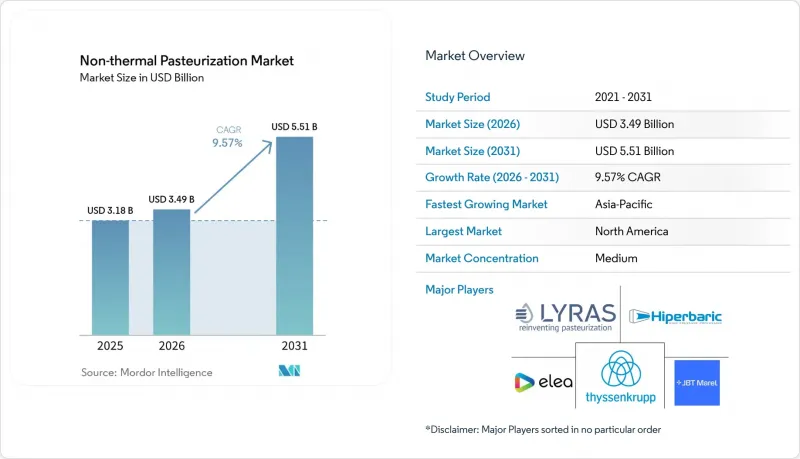
本報告按技術(高壓加工、脈衝電場加工、磁粉清洗、超音波、輻射加工及其他)、形態(液體、固體、半固體)、應用(食品飲料、藥品、膳食補充劑及其他)和地區(北美、歐洲、亞太、南美、中東和非洲)進行細分。市場預測以美元計價。
全球非加熱滅菌市場趨勢及洞察
消費者對潔淨標示、加工最少的食品的需求日益成長。
消費者對原料透明度的需求主導,這為非熱滅菌食品市場帶來了結構性利好,而這種利好僅靠傳統的食品安全經濟學無法解釋。國際食品資訊理事會 (IFIC) 發布的 2025 年調查顯示,美國消費者中將「健康食品」定義為「最低限度加工或未加工」的比例將從 2022 年的 20% 上升至 2025 年的 28%,而同期選擇「人工添加劑或防腐劑含量有限或人工添加劑或防腐劑的消費者比例也將從 18% 2% 中加入人工添加劑含量有限或人工添加劑或防腐劑的消費者比例也將從 18% 25% 中也將從中加入人工添加劑或防腐劑含量上升 18% 的消費者添加 25%。這種轉變具有直接的商業性影響力。高壓滅菌 (HPP) 和脈衝電場 (PEF) 處理的產品零售價格更高,足以抵消加工成本,並隨著規模化生產提高單位盈利。這裡一個至關重要但常被忽視的洞見是,對潔淨標示的需求並非單一的消費者趨勢。這種需求是由包括餐飲服務商和零售商在內的機構買家推動的,他們對供應商提出了潔淨標示方面的具體要求,從而創造了比消費者研究顯示的更深層次的 B2B 需求。 Lyras A/S 的紫外線殺菌技術與熱力殺菌相比,可降低 60% 至 90% 的能耗和 60% 至 80% 的用水量。這項技術已被全球工業酵素領導者諾維信 (Novozymes) 採納,因為其清潔、非熱處理的特性符合該公司的永續性政策。這項技術的連鎖效應也體現在 PEF 的研究成果:在 2019 年至 2025 年間,經同行評審的期刊文章數量幾乎加倍,這些文章檢驗了PEF 生產不含防腐劑的植物奶和飲料的能力。
延長保存期限,且不造成熱傷害
與傳統保藏方法相比,透過非熱處理延長保存期限具有截然不同的價值提案,因為它消除了食品安全和感官品質之間的權衡。高壓處理(HPP)在 400–600 MPa 的壓力下,能夠去活化植物病原體,而不會引發梅納反應或破壞熱敏酶和維生素。這使得產品的保存期限能夠比未經處理的同類產品延長 3–6 倍,同時保持新鮮風味。從戰略角度來看,非熱滅菌消除了物流障礙,使生鮮食品的長途運輸和出口不再不經濟,從而有效地擴大了優質生鮮食品的區域市場。 2025 年 2 月,JBT Marel 的子公司 Avure Technologies 公佈了研究成果,證實高壓處理能夠顯著提高多種農產品中生物活性化合物(包括熱敏維生素和植物營養素)的保留率,優於熱處理。對於採用即時補貨模式的零售和餐飲服務採購商而言,無需添加劑即可延長保存期限是一項直接的庫存管理優勢,能夠降低食品廢棄物和損耗的風險。此外,高壓處理延長保存期限還能帶來一項不太明顯的商業性效益:使製造商能夠進入亞太和南美地區的低溫運輸市場,而這些地區快速存貨周轉所需的基礎設施尚不完善。
水力發電和脈衝電廠的高資本密集度設施
資金壁壘仍是限制非熱巴氏殺菌市場擴張的最持久的結構性因素。在中等收入國家和新興市場,由於資金獲取管道有限,這一趨勢尤為突出。工業規模的高壓加工(HPP)和脈衝電場(PEF)系統購置成本高昂,對於加工量不足以支撐專用設備的中小型食品生產商而言,這構成了一道重要的資金籌措障礙。此外,還需要使用能夠承受壓力下約15%體積縮減的耐壓包裝材料,這進一步加劇了這項挑戰,導致除了設備採集費用外,還需承擔採購和產品重新設計的成本。在北美,隨著設備即服務(EaaS)模式和合約加工網路的擴展,此限制因素正得到部分緩解。 2025年,Hyperbaric的全球合約加工網路(包括位於北卡羅來納州和賓州的新設施)將在北美地區提供按磅或按批次計費的高壓加工服務,無需承擔資本投資負擔。然而,在亞太地區、南美洲以及中東和非洲地區,合約製造基礎設施的密度仍然較低,迫使這些地區的製造商要麼自行承擔全部設備購置成本,要麼徹底放棄實施高壓加工(HPP)的想法。特別是,實施脈衝電弧爐(PEF)面臨諸多障礙。與擁有成熟設備市場和完善服務網路的高壓加工(HPP)不同,脈衝電弧爐(PEF)系統需要更先進的技術專長進行操作和檢驗,而且合格的操作人員數量有限。
細分市場分析
到2025年,高壓滅菌(HPP)在非熱滅菌市場佔據48.73%的佔有率,遙遙領先其他所有技術。其主導地位源自於其悠久的商業歷史、食品安全方面的廣泛認可,以及在包括飲料、即食肉類、水產品、醬料和高階冷藏食品在內的眾多行業的適用性。脈衝電場(PEF)是成長最快的技術,預計到2031年將以10.67%的複合年成長率成長。這顯示非熱滅菌市場正在從HPP擴展到能夠處理大批量連續生產線的各種技術。微波加熱(MVH)、超音波和輻照佔據剩餘的市場佔有率,每種技術都針對更具體的應用場景,在這些場景中,快速體積加熱、改善質傳或有針對性地減少微生物是主要目標。
「其他」類別包含一些商業性應用有限,但在非熱巴氏殺菌市場中,尤其是在高度專業化的液體應用領域,具有發揮重要作用潛力的技術。 Lyras公司將「Lustlization」定位為一種基於UV-C的不透明液體殺菌解決方案,並聲稱與熱巴氏殺菌相比,該系統可降低60%至90%的能耗和60%至80%的用水量。冰島Mjolkursamsalan公司的實施案例表明,小眾的替代技術可以進入乳製品行業,而乳製品行業的水資源、衛生和產品品質都至關重要。高壓處理(HPP)仍然是非熱巴氏殺菌市場中最強大的技術,因為它可以在包裝後進行處理,從而降低加工後污染的風險。對於需要高安全標準的冷藏食品而言,這仍然是一個顯著的優勢。
區域分析
預計到2025年,北美將繼續保持非熱巴氏殺菌市場最大的佔有率,達到32.36%。美國之所以能佔據主導地位,得益於其最成熟的高壓加工(HPP)設備基礎和最廣泛的合約加工網路,這降低了知名品牌和中小加工商進入非熱巴氏殺菌市場的門檻。此外,美國清晰的監管路徑也促進了HPP技術的普及,因為FDA和USDA-FSIS已經明確了HPP在果汁、牡蠣和肉類肉製品等食品安全應用中的作用。 USDA-FSIS於2024年12月發布的關於李斯特菌的公告進一步推動了HPP技術的發展,因為從2025年1月起,僅採用衛生控制方法的加工商將面臨更加嚴格的合規環境。加拿大和墨西哥也是非熱巴氏殺菌市場的區域推動力量。另一方面,拉丁美洲的成功實施(始於 2005 年的智利)表明,出口導向食品產業可能是商業性HPP 擴張的第一條切實可行的途徑。
歐洲仍然是非熱巴氏殺菌技術的第二大市場,其中德國、西班牙、荷蘭和英國構成了北美以外最成熟的市場。該地區的一大優勢在於其技術檢驗服務基礎設施,蒂森克虜伯位於夸克姆布魯克的「卓越中心」提供合約生產、產品開發、微生物檢測和檢驗支持,從而降低了新用戶的採用風險。此外,歐洲部分非熱巴氏殺菌市場的監管路徑正變得更加謹慎。在歐盟法規對新食品的審查會影響某些動物性產品商業化進程的地區,這趨勢尤其明顯。這種差異迫使供應商建立更強大的文件和檢驗能力,同時也推遲了部分產品的上市,這有利於規模更大、技術更成熟的營運商。南美洲仍然是非熱巴氏殺菌市場的新興地區,巴西、智利、哥倫比亞和秘魯是主要的採用中心,這得益於肉類、水產品和果汁的出口,這些出口推動了對既能滿足進口國食品安全標準又能保持品質的技術的需求。
亞太地區是非熱巴氏殺菌市場成長最快的地區,預計到2031年,該地區市場規模將以11.38%的複合年成長率成長。中國是該地區最重要的轉折點,這得益於JB/T 15299-2025標準對設備規範的正式確立,以及中國農業大學對更廣泛的集團標準化工作的支持,這些工作涵蓋了從加工設備到產品層面的分類,例如NFC果汁、果菜汁、茶飲料和液態咖啡。隨著對高階包裝食品的需求成長和食品加工基礎設施的完善,印度、日本、韓國、澳洲、新加坡和印尼也不斷擴大其在非熱巴氏殺菌市場的佔有率。中東和非洲仍處於起步階段,但阿拉伯聯合大公國和南非正逐漸成為早期中心,它們將推動非熱巴氏殺菌市場的第一波普及,其應用領域涵蓋高階飲料、乳製品和肉品。
其他好處:
- Excel格式的市場預測(ME)表
- 3個月的分析師支持
目錄
第1章:引言
- 研究假設和市場定義
- 調查範圍
第2章:調查方法
第3章執行摘要
第4章 市場動態
- 市場概覽
- 市場促進因素
- 消費者對潔淨標示食品和低加工食品的需求日益成長。
- 延長保存期限,且不造成熱傷害
- 食品安全合規和病原體控制方面的壓力
- 拓展適用於低溫運輸的高階飲料形式
- 「設備即服務」模式降低了採用門檻。
- 擴大高壓處理技術在肉類和海鮮加工的應用
- 市場限制因素
- 水力發電(HPP)和抽水蓄能(PEF)設施的資本密集度較高
- 檢驗、包裝和生產線整合的複雜性。
- 放射治療和跨境標籤方面的監管不確定性。
- 對高昂的能源和維護成本的擔憂
- 供應鏈分析
- 監理情勢
- 技術展望
- 波特五力模型
第5章 市場規模與成長預測
- 透過技術/透過技術
- 高壓加工(HPP)
- 脈衝場(PEF)
- 微波體積加熱(MVH)
- 超音波
- 輻射
- 其他
- 按形式
- 液體
- 固體的
- 半固體
- 透過使用
- 食品/飲料
- 飲料
- 水果和蔬菜
- 肉類和水產品
- 乳製品和乳製品替代品
- 即食餐
- 沾醬
- 製藥
- 營養保健品
- 其他
- 食品/飲料
- 按地區
- 北美洲
- 美國
- 加拿大
- 墨西哥
- 其他北美國家
- 歐洲
- 德國
- 英國
- 義大利
- 法國
- 西班牙
- 荷蘭
- 波蘭
- 比利時
- 瑞典
- 其他歐洲國家
- 亞太地區
- 中國
- 印度
- 日本
- 韓國
- 澳洲
- 印尼
- 泰國
- 新加坡
- 其他亞太國家
- 南美洲
- 巴西
- 阿根廷
- 哥倫比亞
- 智利
- 秘魯
- 其他南美國家
- 中東和非洲
- 南非
- 沙烏地阿拉伯
- 阿拉伯聯合大公國
- 土耳其
- 奈及利亞
- 埃及
- 摩洛哥
- 其他中東和非洲國家
- 北美洲
第6章 競爭情勢
- 市場集中度
- 策略趨勢
- 市場排名分析
- 公司簡介
- JBT Marel Corporation
- Hiperbaric SA
- thyssenkrupp AG
- Kobe Steel, Ltd./Kobelco
- Elea Technology GmbH
- Pulsemaster BV
- Lyras A/S
- Syntegon Technology GmbH
- MULTIVAC Sepp Haggenmuller SE & Co. KG
- Stansted Fluid Power Ltd.
- Nordion Inc./Sotera Health
- AseptoRay Ltd.
- American Pasteurization Company
- Universal Pure, LLC
- Lineage, Inc.
- HPP Food Technology SL
- Bao Tou KeFa High Pressure Technology Co., Ltd.
- FresherTech
- Hydrolock
- EXDIN Solutions Sp. z oo
第7章 市場機會與未來趨勢
According to Mordor Intelligence, the non-thermal pasteurization market size was valued at USD 3.18 billion in 2025 and estimated to grow from USD 3.49 billion in 2026 to reach USD 5.51 billion by 2031, at a CAGR of 9.57% during the forecast period (2026-2031).
This report is Segmented by Technique (HPP, PEF, MVH, Ultrasonic, Irradiation, Others), Form (Liquid, Solid, Semi-Solid), Application (Food and Beverages, Pharmaceuticals, Nutraceuticals, Others), and Geography (North America, Europe, Asia-Pacific, South America, Middle East and Africa). The Market Forecasts are Provided in Terms of Value (USD).
Global Non-thermal Pasteurization Market Trends and Insights
Rising demand for clean-label, minimally processed foods
Consumer-led pressure on ingredient transparency is acting as a structural tailwind for the non-thermal pasteurization market in a way that traditional food safety economics alone cannot explain. A 2025 survey by the International Food Information Council (IFIC) found that the share of US consumers defining "healthy food" as "minimally or no processing" increased from 20% in 2022 to 28% in 2025, with "limited or no artificial ingredients or preservatives" rising from 18% to 25% over the same period. This shift has direct commercial consequences: HPP and PEF-processed products command retail price premiums that offset the processing cost premium, improving unit economics at scale. The critical but under-appreciated insight here is that clean-label demand is not a homogeneous consumer trend; it is being reinforced by institutional buyers, including foodservice operators and retailers, who are imposing clean-label supplier specifications, creating a B2B pull that reaches further into the supply chain than consumer surveys suggest. Lyras A/S's UV-based pasteurization technology, which saves 60-90% in energy and 60-80% in water use compared to thermal pasteurization, has been adopted by Novozymes, a global industrial enzyme leader, precisely because its clean, non-thermal processing profile aligns with corporate sustainability claims. The knock-on effect is visible in PEF research output, where publications in peer-reviewed journals examining PEF's ability to produce preservative-free plant-based milks and beverages nearly doubled between 2019 and 2025.
Shelf-life extension without thermal damage
Shelf-life extension through non-thermal processing offers a materially different value proposition than conventional preservation, as it eliminates the trade-off between food safety and sensory quality. HPP applied at pressures of 400-600 MPa inactivates vegetative pathogens without triggering the Maillard reaction or degrading heat-sensitive enzymes and vitamins, enabling the production of products with shelf lives 3 to 6 times longer than untreated equivalents while retaining a fresh-like profile. The strategic implication is that non-thermal pasteurization effectively expands the addressable geographic market for premium perishable goods by closing the logistics gap that previously made long-haul or export distribution of fresh products uneconomical. JBT Marel's Avure Technologies published research findings in February 2025 confirming that HPP processing preserves bioactive compounds, including heat-sensitive vitamins and phytonutrients, at levels significantly higher than those achieved with thermal treatment across multiple produce categories. For retail and foodservice buyers operating on just-in-time replenishment cycles, extended shelf life without additives is a direct inventory management benefit that reduces food waste and write-down risk. The secondary commercial effect, less remarked upon, is that shelf-life extension through HPP allows manufacturers to enter cold-chain markets in APAC and South America that lack the infrastructure density for rapid inventory turnover.
High capital intensity for HPP and PEF installations
Capital barriers represent the most persistent structural constraint on the expansion of the non-thermal pasteurization market, particularly in middle-income and emerging market geographies where access to equipment financing is limited. Industrial-scale HPP and PEF systems entail high procurement costs, creating a significant financing hurdle for small- and mid-size food manufacturers that lack the processing volume to justify dedicated equipment ownership. The challenge is compounded by the need for pressure-flexible packaging materials, which must withstand approximately 15% volume reduction during pressurization and therefore incur procurement and reformulation costs beyond equipment acquisition. The EaaS model and tolling network expansion are partially addressing this constraint in North America, where Hiperbaric's global tolling network, which includes newly established facilities in North Carolina and Pennsylvania as of 2025, provides access to HPP on a per-pound or per-batch basis without a capex commitment. However, in APAC, South America, and MEA, tolling infrastructure density remains low, meaning that manufacturers in these regions must absorb the full capital cost of equipment or forgo HPP adoption entirely. PEF adoption specifically faces a compounded barrier: unlike HPP, which has a mature equipment market with established service networks, PEF systems require more technical expertise to operate and validate, limiting the pool of qualified operators.
Other drivers and restraints analyzed in the detailed report include:
- Food safety compliance and pathogen control pressure
- Expansion of cold-chain premium beverage formats
- Regulatory uncertainty for irradiation and cross-border labeling
For complete list of drivers and restraints, kindly check the Table Of Contents.
Segment Analysis
HPP held 48.73% of the non-thermal pasteurization market share in 2025, maintaining a clear lead over all other techniques. Its lead comes from a long commercial history, clear food safety acceptance, and broad fit across beverages, ready-to-eat meat, seafood, sauces, and premium refrigerated foods. PEF is the fastest-growing technique, with a projected CAGR of 10.67% through 2031, indicating that the non-thermal pasteurization market is expanding beyond HPP into technologies that can serve large-volume, continuous processing lines. MVH, ultrasonic processing, and irradiation make up the remaining share, and each serves narrower use cases where rapid volumetric heating, enhanced mass transfer, or targeted microbial reduction is the main priority.
The Others category includes technologies that still have smaller commercial footprints but can matter in very specific liquid applications within the non-thermal pasteurization market. Lyras has positioned raslysation as a UV-C-based solution for opaque liquids, and the company states that the system can reduce energy use by 60% to 90% and water use by 60% to 80% compared with thermal pasteurization. Its installation at Mjolkursamsalan in Iceland shows that niche alternatives can enter dairy systems where water, hygiene, and product quality are all important. HPP still has the strongest structural position in the non-thermal pasteurization market because it works after packaging and lowers the chance of post-process contamination, which remains a major advantage in high-safety chilled foods.
Complete Report Scope:
- By Technique / Technology
- High Pressure Processing (HPP)
- Pulsed Electric Field (PEF)
- Microwave Volumetric Heating (MVH)
- Ultrasonic
- Irradiation
- Others
- By Form
- Liquid
- Solid
- Semi-Solid
- By Application
- Food and Beverages
- Beverages
- Fruits & Vegetables
- Meat & Seafood
- Dairy & Dairy Alternatives
- Ready-to-eat Meals
- Sauces & Dips
- Pharmaceuticals
- Nutraceuticals
- Others
- Food and Beverages
- By Geography
- North America
- United States
- Canada
- Mexico
- Rest of North America
- Europe
- Germany
- United Kingdom
- Italy
- France
- Spain
- Netherlands
- Poland
- Belgium
- Sweden
- Rest of Europe
- Asia-Pacific
- China
- India
- Japan
- South Korea
- Australia
- Indonesia
- Thailand
- Singapore
- Rest of Asia-Pacific
- South America
- Brazil
- Argentina
- Colombia
- Chile
- Peru
- Rest of South America
- Middle East and Africa
- South Africa
- Saudi Arabia
- United Arab Emirates
- Turkey
- Nigeria
- Egypt
- Morocco
- Rest of Middle East and Africa
- North America
Geography Analysis
North America retained the largest share of the non-thermal pasteurization market, accounting for 32.36% in 2025. The United States anchors this lead because it combines the most mature installed HPP base with the broadest tolling network, which lowers entry barriers for both large brands and smaller processors in the non-thermal pasteurization market. U.S. adoption has also benefited from a clearer regulatory path, as FDA and USDA-FSIS have already established the role of HPP in food safety applications relevant to juices, oysters, and ready-to-eat meat systems. The USDA-FSIS December 2024 Listeria announcement added further momentum, as processors using sanitation-only approaches now face a more stringent compliance environment from January 2025 onward. Canada and Mexico add regional support to the non-thermal pasteurization market, while Latin American rollout history, starting with Chile in 2005, shows how export-oriented food sectors can become the first practical route for commercial HPP expansion.
Europe remained the second-largest geography in the non-thermal pasteurization market, with Germany, Spain, the Netherlands, and the UK forming the most established base outside North America. A major regional strength is the service infrastructure around technology validation, and thyssenkrupp's Centre of Excellence in Quakenbruck offers toll processing, product development, microbiological testing, and validation support that reduce adoption risk for new users. Europe also has a more cautious regulatory path in parts of the non-thermal pasteurization market, especially where novel food review affects commercialization timelines for some animal-origin applications under EU rules. That difference slows some product launches, but it also pushes suppliers to build stronger documentation and validation capabilities, which benefits larger and more technically prepared operators. South America is still an emerging part of the non-thermal pasteurization market, but Brazil, Chile, Colombia, and Peru stand out as the main adoption hubs, with meat, seafood, and juice exports driving demand for technologies that preserve quality while meeting importer food safety expectations.
Asia-Pacific is the fastest-growing region in the non-thermal pasteurization market, and the Asia-Pacific non-thermal pasteurization market size is projected to expand at 11.38% CAGR through 2031. China is the region's most important turning point, because JB/T 15299-2025 formalized equipment specifications and China Agricultural University backed a broader group standard effort that extends from processing equipment into product-level categories such as NFC juice, vegetable juice, tea beverages, and coffee liquids. India, Japan, South Korea, Australia, Singapore, and Indonesia are also building relevance in the non-thermal pasteurization market as premium packaged food demand rises and food processing infrastructure improves. The Middle East and Africa remain early-stage, but the UAE and South Africa have started to emerge as initial centers where premium beverage, dairy, and meat applications can support first-wave deployment in the non-thermal pasteurization market.
- JBT Marel Corporation
- Hiperbaric S.A.
- thyssenkrupp AG
- Kobe Steel, Ltd. / Kobelco
- Elea Technology GmbH
- Pulsemaster B.V.
- Lyras A/S
- Syntegon Technology GmbH
- MULTIVAC Sepp Haggenmuller SE & Co. KG
- Stansted Fluid Power Ltd.
- Nordion Inc. / Sotera Health
- AseptoRay Ltd.
- American Pasteurization Company
- Universal Pure, LLC
- Lineage, Inc.
- HPP Food Technology S.L.
- Bao Tou KeFa High Pressure Technology Co., Ltd.
- FresherTech
- Hydrolock
- EXDIN Solutions Sp. z o.o.
Additional Benefits:
- The market estimate (ME) sheet in Excel format
- 3 months of analyst support
TABLE OF CONTENTS
1 INTRODUCTION
- 1.1 Study Assumptions and Market Definition
- 1.2 Scope of the Study
2 RESEARCH METHODOLOGY
3 EXECUTIVE SUMMARY
4 MARKET DYNAMICS
- 4.1 Market Overview
- 4.2 Market Drivers
- 4.2.1 Rising Demand for Clean-Label, Minimally Processed Foods
- 4.2.2 Shelf-Life Extension Without Thermal Damage
- 4.2.3 Food Safety Compliance and Pathogen Control Pressure
- 4.2.4 Expansion of Cold-Chain Premium Beverage Formats
- 4.2.5 Equipment-as-a-Service Models Lowering Adoption Barriers
- 4.2.6 Rising use of HPP in Meat and Seafood Processing
- 4.3 Market Restraints
- 4.3.1 High Capital Intensity for HPP and PEF Installations
- 4.3.2 Validation, Packaging, and Line-Integration Complexity
- 4.3.3 Regulatory Uncertainty for Irradiation and Cross-Border Labeling
- 4.3.4 High Energy and Maintenance Cost Concerns
- 4.4 Supply Chain Analysis
- 4.5 Regulatory Landscape
- 4.6 Technological Outlook
- 4.7 Porter's Five Forces
- 4.7.1 Threat of New Entrants
- 4.7.2 Bargaining Power of Buyers/Consumers
- 4.7.3 Bargaining Power of Suppliers
- 4.7.4 Threat of Substitute Products
- 4.7.5 Intensity of Competitive Rivalry
5 MARKET SIZE AND GROWTH FORECASTS (VALUE)
- 5.1 By Technique / Technology
- 5.1.1 High Pressure Processing (HPP)
- 5.1.2 Pulsed Electric Field (PEF)
- 5.1.3 Microwave Volumetric Heating (MVH)
- 5.1.4 Ultrasonic
- 5.1.5 Irradiation
- 5.1.6 Others
- 5.2 By Form
- 5.2.1 Liquid
- 5.2.2 Solid
- 5.2.3 Semi-Solid
- 5.3 By Application
- 5.3.1 Food and Beverages
- 5.3.1.1 Beverages
- 5.3.1.2 Fruits & Vegetables
- 5.3.1.3 Meat & Seafood
- 5.3.1.4 Dairy & Dairy Alternatives
- 5.3.1.5 Ready-to-eat Meals
- 5.3.1.6 Sauces & Dips
- 5.3.2 Pharmaceuticals
- 5.3.3 Nutraceuticals
- 5.3.4 Others
- 5.3.1 Food and Beverages
- 5.4 By Geography
- 5.4.1 North America
- 5.4.1.1 United States
- 5.4.1.2 Canada
- 5.4.1.3 Mexico
- 5.4.1.4 Rest of North America
- 5.4.2 Europe
- 5.4.2.1 Germany
- 5.4.2.2 United Kingdom
- 5.4.2.3 Italy
- 5.4.2.4 France
- 5.4.2.5 Spain
- 5.4.2.6 Netherlands
- 5.4.2.7 Poland
- 5.4.2.8 Belgium
- 5.4.2.9 Sweden
- 5.4.2.10 Rest of Europe
- 5.4.3 Asia-Pacific
- 5.4.3.1 China
- 5.4.3.2 India
- 5.4.3.3 Japan
- 5.4.3.4 South Korea
- 5.4.3.5 Australia
- 5.4.3.6 Indonesia
- 5.4.3.7 Thailand
- 5.4.3.8 Singapore
- 5.4.3.9 Rest of Asia-Pacific
- 5.4.4 South America
- 5.4.4.1 Brazil
- 5.4.4.2 Argentina
- 5.4.4.3 Colombia
- 5.4.4.4 Chile
- 5.4.4.5 Peru
- 5.4.4.6 Rest of South America
- 5.4.5 Middle East and Africa
- 5.4.5.1 South Africa
- 5.4.5.2 Saudi Arabia
- 5.4.5.3 United Arab Emirates
- 5.4.5.4 Turkey
- 5.4.5.5 Nigeria
- 5.4.5.6 Egypt
- 5.4.5.7 Morocco
- 5.4.5.8 Rest of Middle East and Africa
- 5.4.1 North America
6 COMPETITIVE LANDSCAPE
- 6.1 Market Concentration
- 6.2 Strategic Moves
- 6.3 Market Ranking Analysis
- 6.4 Company Profiles (includes Global level Overview, Market level overview, Core Segments, Financials, Strategic Information, Market Rank/Share, Products and Services, Recent Developments)
- 6.4.1 JBT Marel Corporation
- 6.4.2 Hiperbaric S.A.
- 6.4.3 thyssenkrupp AG
- 6.4.4 Kobe Steel, Ltd. / Kobelco
- 6.4.5 Elea Technology GmbH
- 6.4.6 Pulsemaster B.V.
- 6.4.7 Lyras A/S
- 6.4.8 Syntegon Technology GmbH
- 6.4.9 MULTIVAC Sepp Haggenmuller SE & Co. KG
- 6.4.10 Stansted Fluid Power Ltd.
- 6.4.11 Nordion Inc. / Sotera Health
- 6.4.12 AseptoRay Ltd.
- 6.4.13 American Pasteurization Company
- 6.4.14 Universal Pure, LLC
- 6.4.15 Lineage, Inc.
- 6.4.16 HPP Food Technology S.L.
- 6.4.17 Bao Tou KeFa High Pressure Technology Co., Ltd.
- 6.4.18 FresherTech
- 6.4.19 Hydrolock
- 6.4.20 EXDIN Solutions Sp. z o.o.


