


 |
市場調查報告書
商品編碼
2097481
人力資源文件管理與電子簽章:市場佔有率分析、產業趨勢與統計資料、成長預測(2026-2031 年)HR Document Management and ESignature - Market Share Analysis, Industry Trends & Statistics, Growth Forecasts (2026 - 2031) |
||||||

※ 本網頁內容可能與最新版本有所差異。詳細情況請與我們聯繫。
據 Mordor Intelligence 稱,人力資源文件管理和電子簽章市場預計將從 2025 年的 72.4 億美元成長到 2026 年的 80.7 億美元,到 2031 年達到 138.9 億美元,2026 年至 2031 年的複合年成長率為 11.47%。
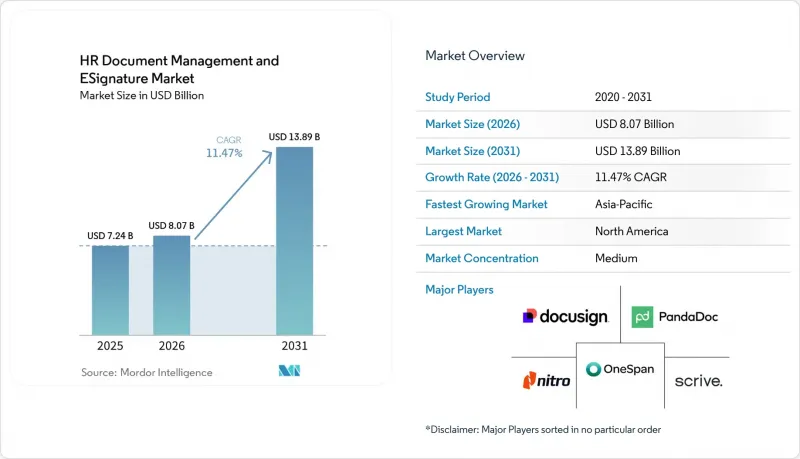
本報告按元件(軟體和服務)、部署模式(雲端、本地部署、混合部署)、組織規模(大型企業和中小企業)、產業(銀行、金融服務和保險、資訊科技和電信等)以及地區進行細分。市場預測以美元計價。
全球人力資源文件管理及電子簽章市場趨勢及洞察
無紙化人力資源工作流程的廣泛應用
無紙化人力資源管理的轉型仍然是人力資源文件管理和電子簽章市場需求的最主要推動要素。隨著數位化工作流程減少入職、政策批准和合約處理等環節的延誤,並使記錄的搜尋和審核更加便捷,企業正在從紙本文件轉向數位化文件。 Avature 的報告顯示,60% 的受訪者將自動化和人工智慧驅動的人力資源流程最佳化列為 2025 年企業工作的重中之重,凸顯了企業對文件工作流程數位化的高度重視。數位化帶來的好處遠不止於提高效率。更順暢的入職體驗減輕了新員工的行政負擔,促進了他們更快融入職場。一旦企業建立了搜尋的數位化文件和可審計的文件歷史記錄,在人力資源文件管理和電子簽章市場,企業將很難再回到舊的營運模式。
利用雲端原生技術實現人力資源技術的現代化
雲端現代化正在重塑買家對人力資源文件管理和電子簽章市場的評估方式。雇主越來越傾向於選擇能夠與雲端人力資源環境整合、支援遠端訪問,並且無需等待漫長的內部發布週期即可更新範本和合規性管理的文件平台。當企業管理跨多個司法管轄區的員工,且無法依賴耗時的手動更正來應對當地法規的變更時,這種需求就更加強烈。 Aconso 於 2026 年 3 月發布的最新報告《AWS 歐洲主權雲端上的人力資源文件管理》顯示,供應商仍以雲端服務為核心,同時致力於解決資料居住和主權問題。因此,人力資源文件管理和電子簽章市場正在轉變,消費者更傾向於選擇能夠將雲端服務與高階系統整合相結合的供應商,而不是僅提供基本簽章功能的供應商。
資料隱私和員工同意要求
由於員工資料涵蓋從招聘和入職到日常管理和離職流程等廣泛的活動,隱私法規一直是人力資源文件管理和電子簽章市場長期面臨的限制。這些挑戰不僅限於靜態資料安全,還包括合法處理、資料保留期限管理以及員工資料相關法規在不同地區的適用差異。歐洲法院 (CJEU) 在 C-65/23 號案件中的裁決進一步強化了人力資源資料處理必須符合 GDPR 必要性標準的法律要求,從而加重了雇主和平台供應商的合規負擔。跨國公司需要針對特定國家/地區的配置模型,而中小企業往往難以評估供應商的隱私保護措施是否足以應對自身的風險狀況。因此,儘管人力資源文件管理和電子簽章市場持續成長,但產品維護成本也不斷上升,並且在法規環境更為複雜的地區,市場普及速度正在放緩。
細分市場分析
到2025年,軟體將佔總收入的69.44%,這表明應用層仍然是人力資源文件管理和電子簽章市場的主要採購重點。買家仍然傾向於選擇能夠在一個統一的操作環境中涵蓋文件創建、模板管理、數位文件處理、安全儲存、歸檔和簽名等功能的平台。這反映出企業需要在實施更廣泛的諮詢和轉型支援之前,先對其日常人力資源工作流程進行標準化。此外,人力資源文件管理和電子簽章市場也受益於對能夠確保文件可存取性、可審計性以及符合當地保存要求的員工記錄系統的需求。
預計到2031年,服務業的複合年成長率將達到13.65%,超過軟體產業,預示著人力資源文件管理和電子簽章市場的收入結構將會轉變。企業很少單獨部署人力資源文件管理工具;相反,它們會將這些工具與現有的人力資本管理 (HCM)、薪資核算和工作流程系統整合,從而擴大部署和整合範圍。隨著雇主需要將監管要求轉化為文件設計、保留規則和流程控制的幫助,諮詢服務也變得越來越重要。 Aconso表示,它為全球600多個人力資源團隊管理超過10億份人力資源文檔,這表明規模、部署專業知識和合規支持正日益成為人力資源文檔管理和電子簽章市場中強力的差異化因素。
到2025年,雲端將佔據68.16%的市場佔有率,成為人力資源文件管理和電子簽章市場規模成長的最大貢獻者。人力資源文件管理和電子簽章市場之所以青睞雲,主要得益於其可擴展性、遠端存取和供應商管理的更新等優勢,而這些優勢在孤立的本地環境中難以實現。隨著企業在多個地點運營,並需要一致的工作流程來簽署、搜尋和分發政策,雲端的重要性日益凸顯。因此,採用雲端不僅是成本方面的考量,還關乎速度、簡化管理以及適應監管變化。
混合部署預計到 2031 年將以 12.78% 的複合年成長率成長,成為人力資源文件管理和電子簽章市場中成長最快的模式。許多公司將歷史人力資源檔案儲存在本地,同時透過雲端系統處理諸如錄用通知書、入職文件和政策批准等活躍工作流程。這種架構正逐漸成為一種深思熟慮的長期設計選擇,而非臨時過渡階段,尤其是在嚴格監管的環境中。 Aconso 對 AWS 歐洲主權雲端的研究凸顯了人力資源文件管理和電子簽章市場的部署選擇為何越來越與主權、資料居住和營運管理相關,而不再僅僅是「雲端與本地部署」之爭。
區域分析
到2025年,北美將佔全球整體收入的36.41%,成為人力資源文件管理和電子簽章市場最大的區域貢獻者。該地區受益於成熟的雲端人力資源基礎設施、對電子簽章工作流程的高度親和性以及對整合人才管理平台的積極採用。在美國,I-9表格的修訂收緊了程序要求,同時保留了合格的雇主進行遠端文件審查的選項。這直接推動了對結構化數位文件工作流程的需求。此外,美國公民及移民服務局(USCIS)持續澄清遠端文件審查的可選替代程序,進一步凸顯了對檢驗數位流程而非非正式的人工回應的需求。在加拿大,需求受到各省就業條件差異和文書工作複雜性的驅動;而在墨西哥,跨國公司子公司正在逐步採用電子簽名,以加強跨境員工合規性。
到2025年,歐洲將成為全球第二大區域市場(按銷售額計),並且仍然是人力資源文件管理和電子簽章市場監管最嚴格的地區。歐盟第2024/1183號條例為各國推出數位身分錢包設定了明確的時間表,迫使供應商調整其僱傭合約簽署流程以適應此新框架。歐盟委員會第2026/248號實施條例補充了公共機構必須認可的高級電子簽章和電子印章格式的技術細節,提高了對平台提供者的精確度要求。儘管市場需求強勁,但由於德國勞動委員會和其他歐洲市場類似勞動管治機構的批准要求,普及速度仍然緩慢。
預計到2031年,亞太地區將以12.33%的複合年成長率成長,成為人力資源文件管理和電子簽章市場成長最快的地區。該地區受益於不斷成長的勞動力、跨國公司活性化的招聘活動以及支持線上身份驗證和簽署的國家數位身分系統的發展。印度是一個特別重要的市場。其電子簽章環境使人力資源平台能夠顯著且切實地縮短招聘流程所需的時間,而基於雲端的人力資源管理在韓國和其他數位化經濟體中持續發展。中東和非洲的銷售額仍然較小,但阿拉伯聯合大公國和沙烏地阿拉伯等市場的國家主導的數位轉型計畫正在為員工相關文件管理工具創造新的需求。南美洲仍然以巴西和阿根廷為中心,銀行業和零售業的大規模應用支撐了銷售,但通膨壓力和數位身分基礎設施的不平衡仍然限制了整體成長的加速。
其他好處:
- Excel格式的市場預測(ME)表
- 3個月的分析師支持
目錄
第1章:引言
- 研究假設和市場定義
- 調查範圍
第2章:調查方法
第3章執行摘要
第4章 市場狀況
- 市場概覽
- 市場促進因素
- 擴大無紙化人力資源工作流程的採用
- 現代化雲端原生人力資源技術
- 更嚴格的審計和記錄保存要求
- 對符合合規要求的全球招募和入職流程的需求日益成長。
- 擴展遠端 I-9 表格和數位身分驗證工作流程
- 用於簽訂跨國僱傭合約的 eIDAS 2.0 錢包的準備狀態。
- 市場限制因素
- 資料隱私和員工同意要求
- 整合人力資源資訊系統、薪資核算系統和身分管理系統的複雜性。
- 員工代表和跨境資料傳輸的限制
- 使用無辦公桌和共用設備的員工之間存在著身分認同摩擦
- 產業價值鏈分析
- 監理情勢
- 技術展望
- 宏觀經濟因素對市場的影響
- 波特五力分析
第5章 市場規模與成長預測
- 按組件
- 軟體
- 文件建立和範本管理系統
- 員工記錄和數位文件管理平台
- 文件儲存、搜尋和歸檔系統
- 安全文件簽署和加密解決方案
- 其他軟體
- 服務
- 實施和整合服務
- 諮詢和顧問服務
- 軟體
- 部署模式
- 雲
- 現場
- 混合
- 按組織規模
- 大公司
- 小型企業
- 按行業分類
- 銀行業、金融服務業及保險業
- 資訊科技/通訊
- 醫療保健和生命科學
- 政府/公共部門
- 零售與電子商務
- 製造業
- 其他工業部門
- 按地區
- 北美洲
- 美國
- 加拿大
- 墨西哥
- 南美洲
- 巴西
- 阿根廷
- 其他南美國家
- 歐洲
- 德國
- 英國
- 法國
- 義大利
- 西班牙
- 俄羅斯
- 其他歐洲國家
- 亞太地區
- 中國
- 日本
- 印度
- 韓國
- 澳洲和紐西蘭
- 其他亞太國家
- 中東
- 阿拉伯聯合大公國
- 沙烏地阿拉伯
- 土耳其
- 其他中東國家
- 非洲
- 南非
- 奈及利亞
- 其他非洲國家
- 北美洲
第6章 競爭情勢
- 市場集中度
- 策略趨勢
- 市佔率分析
- 公司簡介
- DocuSign, Inc.
- PandaDoc, Inc.
- OneSpan Inc.
- Nitro Software, Inc.
- SIGNiX, Inc.
- Yousign SAS
- Skribble AG
- Penneo A/S
- Scrive AB
- Ivnosys Soluciones, SLU
- Ascertia Limited
- Solutions Notarius Inc.
- Actalis SpA
- Bit4id Srl
- Dokobit, UAB
- SigniFlow(Pty)Limited
- Legalesign Limited
- Secured Signing Limited
- aconso AG
- Blue Ribbon Technologies
第7章 市場機會與未來展望
According to Mordor Intelligence, the HR document management and eSignature market size is expected to increase from USD 7.24 billion in 2025 to USD 8.07 billion in 2026 and reach USD 13.89 billion by 2031, growing at a CAGR of 11.47% over 2026-2031.
This report is Segmented by Component (Software, and Services), Deployment Mode (Cloud, On-Premises, and Hybrid), Organization Size (Large Enterprises, and Small and Medium-Sized Enterprises), Industry Vertical (Banking, Financial Services and Insurance, Information Technology and Telecommunications, and More), and Geography. The Market Forecasts are Provided in Terms of Value (USD).
Global HR Document Management and ESignature Market Trends and Insights
Rising Adoption of Paperless HR Workflows
The shift to paperless HR administration remains the clearest demand driver for the HR document management and eSignature market. Organizations are replacing paper files because digital workflows reduce delays in onboarding, policy acknowledgment, and contract handling, and they also make records easier to find and review. Avature reported that 60% of survey respondents identified streamlining HR processes through automation and AI as their top organizational priority in 2025, which supports the strong focus on document workflow digitization. The effect goes beyond efficiency, as a smoother onboarding experience at the start of employment reduces administrative friction for new hires and supports better early engagement. Once a company builds searchable digital files and auditable document trails, the operating model of the HR document management and eSignature market becomes much harder to reverse.
Cloud-Native HR Tech Modernization
Cloud modernization is reshaping how buyers evaluate the HR document management and eSignature market. Employers increasingly want document platforms that integrate with cloud HR environments, support remote access, and enable updates to templates or compliance controls without long internal release cycles. This demand is even stronger when organizations manage employees across several jurisdictions and cannot rely on slow manual patching after local regulatory changes. aconso's March 2026 update on HR document management in the AWS European Sovereign Cloud showed how vendors are responding to data residency and sovereignty concerns while still keeping cloud delivery at the center of the offering. As a result, the HR document management and eSignature market is rewarding vendors that pair cloud delivery with deep system integration rather than those that offer only basic signature functions.
Data Privacy and Employee Consent Requirements
Privacy regulation remains a long-running restraint on the HR document management and eSignature market because employee data touches recruitment, onboarding, daily administration, and offboarding. The difficulty is not only storage security, but also lawful processing, retention discipline, and local variation in how employee data rules are applied. The CJEU ruling in Case C-65/23 added further legal weight to the requirement that HR data processing must meet the GDPR's necessity standards, thereby raising the compliance burden for both employers and platform vendors. Multinational employers, therefore, need country-specific configuration models, and smaller firms often struggle to assess whether a vendor's privacy posture is strong enough for their risk profile. This keeps the HR document management and eSignature market growing, but it also raises the cost of product maintenance and slows adoption in more complex regulatory settings.
Other drivers and restraints analyzed in the detailed report include:
- Tightening Audit and Records Retention Requirements
- Growing Demand for Compliant Global Hiring and Onboarding
- Integration Complexity across HRIS, Payroll, and Identity Systems
For complete list of drivers and restraints, kindly check the Table Of Contents.
Segment Analysis
Software accounted for 69.44% of total revenue in 2025, indicating that the core buying priority in the HR document management and eSignature market still lies in the application layer. Buyers continue to favor platforms that cover document creation, template management, digital file handling, secure storage, archiving, and signing in a single operating environment. This reflects the need to standardize routine HR workflows before companies add broader advisory or transformation support. The HR document management and eSignature market also benefits from demand for employee record systems that can keep documents accessible, auditable, and aligned with local retention expectations.
Services are projected to grow at a 13.65% CAGR through 2031, faster than software, pointing to a changing commercial mix in the HR document management and eSignature market. Implementation and integration work is expanding because organizations rarely deploy HR document tools in isolation; instead, they connect them to HCM, payroll, and workflow systems already in place. Advisory work is also gaining weight as employers need help translating regulatory requirements into document design, storage rules, and process controls. aconso stated that it manages more than 1 billion HR documents for over 600 HR teams globally, which shows why scale, deployment expertise, and compliance support are becoming stronger differentiators across the HR document management and eSignature market.
Cloud commanded 68.16% of the market in 2025, making it the largest contributor to the HR document management and eSignature market size among deployment options. The preference for cloud in the HR document management and eSignature market is driven by scalability, remote access, and vendor-managed updates, which are difficult to match in isolated on-premises environments. This matters more as employers operate across multiple locations and need consistent workflows for signing, retrieval, and policy distribution. The cloud position is therefore not only a cost decision, but also a response to speed, administrative simplicity, and regulatory change.
Hybrid deployment is projected to grow at a 12.78% CAGR through 2031, making it the fastest-growing model in the HR document management and eSignature market. Many enterprises are keeping historical personnel archives on-premises while routing active workflows, such as offers, onboarding packets, and policy acknowledgments, through cloud systems. That structure is becoming a deliberate long-term design choice rather than a temporary migration stage, especially in regulated settings. aconso's work on AWS's European Sovereign Cloud highlights why the HR document management and eSignature market is increasingly linking deployment choice to sovereignty, residency, and operational control rather than a simple cloud-versus-on-premises debate.
Complete Report Scope:
- By Component
- Software
- Document Creation and Template Management Systems
- Employee Records and Digital File Management Platforms
- Document Storage, Retrieval and Archiving Systems
- Secure Document Signing and Encryption Solutions
- Other Software
- Services
- Implementation and Integration Services
- Consulting and Advisory Services
- Software
- By Deployment Mode
- Cloud
- On-Premises
- Hybrid
- By Organization Size
- Large Enterprises
- Small and Medium-Sized Enterprises
- By Industry Vertical
- Banking, Financial Services and Insurance
- Information Technology and Telecommunications
- Healthcare and Life Sciences
- Government and Public Sector
- Retail and E-commerce
- Manufacturing
- Other Industry Verticals
- By Geography
- North America
- United States
- Canada
- Mexico
- South America
- Brazil
- Argentina
- Rest of South America
- Europe
- Germany
- United Kingdom
- France
- Italy
- Spain
- Russia
- Rest of Europe
- Asia-Pacific
- China
- Japan
- India
- South Korea
- Australia and New Zealand
- Rest of Asia-Pacific
- Middle East
- United Arab Emirates
- Saudi Arabia
- Turkey
- Rest of Middle East
- Africa
- South Africa
- Nigeria
- Rest of Africa
- North America
Geography Analysis
North America accounted for 36.41% of global revenue in 2025, making it the largest regional contributor to the HR document management and eSignature market. The region benefits from mature cloud HR infrastructure, high familiarity with e-signature workflows, and strong adoption of integrated talent management platforms. In the United States, changes to Form I-9 preserved the remote document examination option for eligible employers while imposing tighter procedural requirements, which directly support demand for structured digital document workflows. USCIS also continues to detail the optional alternative procedure for remote document examination, which reinforces the need for verifiable digital processes rather than informal manual workarounds. Canada is seeing demand driven by provincial employment variations and documentation complexity, while Mexico is seeing adoption rise among multinational subsidiaries that need stronger cross-border workforce compliance.
Europe was the second-largest regional market by revenue in 2025 and remains the most regulation-heavy environment in the HR document management and eSignature market. Regulation (EU) 2024/1183 established a firm timetable for the availability of national digital identity wallets, pushing vendors to align employment signing workflows with the new framework. Commission Implementing Regulation (EU) 2026/248 added technical specificity to the formats that public-sector bodies must recognize for advanced electronic signatures and seals, thereby increasing the precision required of platform providers. Germany's works council approval requirements and similar labor governance structures in other European markets continue to slow deployment speed even as demand remains solid.
Asia-Pacific is projected to grow at 12.33% CAGR through 2031, the fastest regional pace in the HR document management and eSignature market. The region is benefiting from workforce expansion, stronger multinational hiring activity, and national digital identity systems that support online verification and signing. India is particularly important because its eSign environment gives HR platforms a practical way to reduce onboarding cycle time at scale, while South Korea and other digitally active economies continue to support cloud-based HR administration. The Middle East and Africa are still smaller in revenue terms, but sovereign digital transformation programs in markets such as the UAE and Saudi Arabia are opening new demand paths for workforce documentation tools. South America remains centered on Brazil and Argentina, where large enterprise adoption in banking and retail supports revenue, though inflationary pressures and uneven digital identity infrastructure continue to limit broader acceleration.
- DocuSign, Inc.
- PandaDoc, Inc.
- OneSpan Inc.
- Nitro Software, Inc.
- SIGNiX, Inc.
- Yousign SAS
- Skribble AG
- Penneo A/S
- Scrive AB
- Ivnosys Soluciones, S.L.U.
- Ascertia Limited
- Solutions Notarius Inc.
- Actalis S.p.A.
- Bit4id S.r.l.
- Dokobit, UAB
- SigniFlow (Pty) Limited
- Legalesign Limited
- Secured Signing Limited
- aconso AG
- Blue Ribbon Technologies
Additional Benefits:
- The market estimate (ME) sheet in Excel format
- 3 months of analyst support
TABLE OF CONTENTS
1 INTRODUCTION
- 1.1 Study Assumptions and Market Definition
- 1.2 Scope of the Study
2 RESEARCH METHODOLOGY
3 EXECUTIVE SUMMARY
4 MARKET LANDSCAPE
- 4.1 Market Overview
- 4.2 Market Drivers
- 4.2.1 Rising Adoption of Paperless HR Workflows
- 4.2.2 Cloud-Native HR Tech Modernization
- 4.2.3 Tightening Audit and Records Retention Requirements
- 4.2.4 Growing Demand for Compliant Global Hiring and Onboarding
- 4.2.5 Expansion of Remote I-9 and Digital Identity Verification Workflows
- 4.2.6 eIDAS 2.0 Wallet Readiness for Cross-Border Employment Signing
- 4.3 Market Restraints
- 4.3.1 Data Privacy and Employee Consent Requirements
- 4.3.2 Integration Complexity Across HRIS, Payroll, and Identity Systems
- 4.3.3 Works Council and Cross-Border Data Transfer Constraints
- 4.3.4 Identity Friction for Deskless and Shared-Device Workforces
- 4.4 Industry Value Chain Analysis
- 4.5 Regulatory Landscape
- 4.6 Technological Outlook
- 4.7 Impact of Macroeconomic Factors on the Market
- 4.8 Porter's Five Forces Analysis
- 4.8.1 Threat of New Entrants
- 4.8.2 Bargaining Power of Suppliers
- 4.8.3 Bargaining Power of Buyers
- 4.8.4 Threat of Substitutes
- 4.8.5 Intensity of Competitive Rivalry
5 MARKET SIZE AND GROWTH FORECASTS (VALUE)
- 5.1 By Component
- 5.1.1 Software
- 5.1.1.1 Document Creation and Template Management Systems
- 5.1.1.2 Employee Records and Digital File Management Platforms
- 5.1.1.3 Document Storage, Retrieval and Archiving Systems
- 5.1.1.4 Secure Document Signing and Encryption Solutions
- 5.1.1.5 Other Software
- 5.1.2 Services
- 5.1.2.1 Implementation and Integration Services
- 5.1.2.2 Consulting and Advisory Services
- 5.1.1 Software
- 5.2 By Deployment Mode
- 5.2.1 Cloud
- 5.2.2 On-Premises
- 5.2.3 Hybrid
- 5.3 By Organization Size
- 5.3.1 Large Enterprises
- 5.3.2 Small and Medium-Sized Enterprises
- 5.4 By Industry Vertical
- 5.4.1 Banking, Financial Services and Insurance
- 5.4.2 Information Technology and Telecommunications
- 5.4.3 Healthcare and Life Sciences
- 5.4.4 Government and Public Sector
- 5.4.5 Retail and E-commerce
- 5.4.6 Manufacturing
- 5.4.7 Other Industry Verticals
- 5.5 By Geography
- 5.5.1 North America
- 5.5.1.1 United States
- 5.5.1.2 Canada
- 5.5.1.3 Mexico
- 5.5.2 South America
- 5.5.2.1 Brazil
- 5.5.2.2 Argentina
- 5.5.2.3 Rest of South America
- 5.5.3 Europe
- 5.5.3.1 Germany
- 5.5.3.2 United Kingdom
- 5.5.3.3 France
- 5.5.3.4 Italy
- 5.5.3.5 Spain
- 5.5.3.6 Russia
- 5.5.3.7 Rest of Europe
- 5.5.4 Asia-Pacific
- 5.5.4.1 China
- 5.5.4.2 Japan
- 5.5.4.3 India
- 5.5.4.4 South Korea
- 5.5.4.5 Australia and New Zealand
- 5.5.4.6 Rest of Asia-Pacific
- 5.5.5 Middle East
- 5.5.5.1 United Arab Emirates
- 5.5.5.2 Saudi Arabia
- 5.5.5.3 Turkey
- 5.5.5.4 Rest of Middle East
- 5.5.6 Africa
- 5.5.6.1 South Africa
- 5.5.6.2 Nigeria
- 5.5.6.3 Rest of Africa
- 5.5.1 North America
6 COMPETITIVE LANDSCAPE
- 6.1 Market Concentration
- 6.2 Strategic Moves
- 6.3 Market Share Analysis
- 6.4 Company Profiles (includes Global Level Overview, Market Level Overview, Core Segments, Financials as available, Strategic Information, Market Rank/Share, Products and Services, Recent Developments)
- 6.4.1 DocuSign, Inc.
- 6.4.2 PandaDoc, Inc.
- 6.4.3 OneSpan Inc.
- 6.4.4 Nitro Software, Inc.
- 6.4.5 SIGNiX, Inc.
- 6.4.6 Yousign SAS
- 6.4.7 Skribble AG
- 6.4.8 Penneo A/S
- 6.4.9 Scrive AB
- 6.4.10 Ivnosys Soluciones, S.L.U.
- 6.4.11 Ascertia Limited
- 6.4.12 Solutions Notarius Inc.
- 6.4.13 Actalis S.p.A.
- 6.4.14 Bit4id S.r.l.
- 6.4.15 Dokobit, UAB
- 6.4.16 SigniFlow (Pty) Limited
- 6.4.17 Legalesign Limited
- 6.4.18 Secured Signing Limited
- 6.4.19 aconso AG
- 6.4.20 Blue Ribbon Technologies
7 MARKET OPPORTUNITIES AND FUTURE OUTLOOK
- 7.1 White-Space and Unmet-Need Assessment

 企業員工檔案管理工具市場分析與預測(至2035年):類型、產品、服務、技術、組件、應用、部署、最終用戶、功能、解決方案
 文件管理系統市場規模、市場佔有率、全球產業分析、區域趨勢、成長率及2026-2034年預測。
 文件管理系統:市場佔有率分析、產業趨勢與統計、成長預測(2026-2031)
 企業文件管理系統市場:依組件、部署類型、文件類型、組織規模與產業分類-2026-2032年全球市場預測
 文件自動化軟體市場預測至2034年-按元件、部署模式、文件類型、應用、最終使用者和地區分類的全球分析
 2026年全球通訊與協作服務市場報告財務文件管理解決方案市場預測至2034年-按文件功能、文件類型、技術、部署模式和最終使用者分類的全球分析
 2026-2030年全球文件管理系統市場
 文件管理系統市場報告:按交付方式、部署方式、組織機構、應用領域和地區分類(2026-2034 年)全球文件管理系統市場規模、佔有率、趨勢和成長分析報告(2026-2034年)