


 |
市場調查報告書
商品編碼
2097480
製造業IT永續性和能源管理軟體:市場佔有率分析、產業趨勢和統計數據以及成長預測(2026-2031年)Manufacturing IT Sustainability and Energy Management Software - Market Share Analysis, Industry Trends & Statistics, Growth Forecasts (2026 - 2031) |
||||||

※ 本網頁內容可能與最新版本有所差異。詳細情況請與我們聯繫。
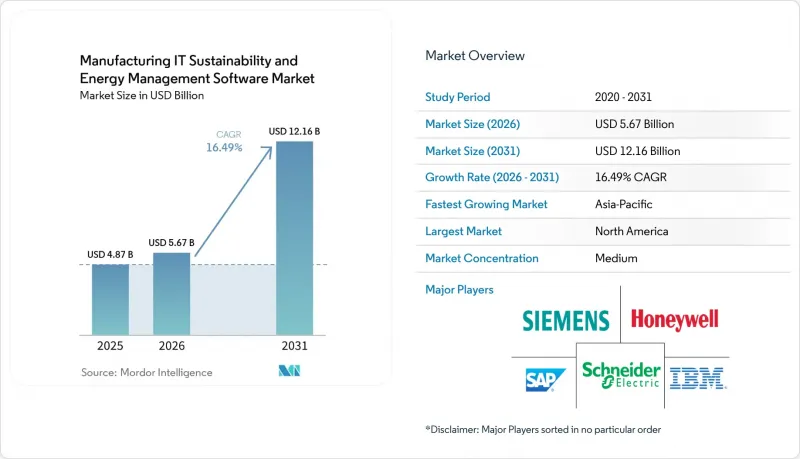
根據 Mordor Intelligence 預測,製造業 IT 永續性和能源管理軟體的市場規模預計將從 2025 年的 48.7 億美元和 2026 年的 56.7 億美元成長到 2031 年的 121.6 億美元,2026 年至 2031 年的複合成長率為 16.49%。
本報告按部署模式(雲端、本地部署、混合部署)、模組(工業能源和公用事業管理、碳排放和永續發展管理、工業資產管理等)、最終用戶產業(汽車、食品飲料等)以及地區進行細分。市場預測以美元計價。
全球IT永續性和能源管理軟體市場趨勢及製造業洞察
利用人工智慧技術最佳化所有工業資產的能源利用率
人工智慧驅動的能源最佳化在工廠運作上正變得越來越實用化。這是因為製造商現在需要能夠回應即時生產狀態的軟體,而不僅僅是報告前一天的用量。在製造業IT永續性和能源管理軟體市場,當需要同時管理生產計畫、公用設施訊號和工廠資產時,這一點尤其重要。日立工廠服務公司宣布,將從2026年4月起增強其面向工廠和研究設施的FEMS平台的能源管理功能。這推動了從被動監控轉向更主動的工廠級控制的更廣泛趨勢。Honeywell也在2026年3月發布了一款人工智慧驅動的控制室助手,這表明越來越多的軟體工具能夠幫助操作人員在工業環境中更快採取行動。由於能源績效現在取決於軟體協調生產、公用設施和工廠響應的能力,商業性價值正在轉移到整合到日常營運中的系統。因此,在製造業IT永續性和能源管理軟體市場,能夠將人工智慧整合到工廠工作流程中而不是將其與營運堆疊分離的供應商正獲得越來越多的認可。
自動化合規主導永續發展報告
強制性永續發展報告是製造業IT永續發展和能源管理軟體市場短期內最明顯的購買促進因素之一。製造商被迫減少因收集眾多工廠的數據、維護審計追蹤以及縮短報告週期而增加的人工工作量。 2026年5月,SAP宣布其新的永續發展AI代理在測試版用例中將場景模擬時間從一天縮短到20分鐘,並將包裝合規性審查時間縮短了50%以上。這表明軟體需求正在從手動文件處理轉向自動化。這一點至關重要,因為報告系統不再僅用於年度揭露,即時監控和營運決策也需要相同的資料結構。事實上,隨著製造商建立經驗證的站點級合規資料流,他們也在為提高整個生產網路的能源可見度奠定基礎。因此,製造業IT永續發展和能源管理軟體市場正受益於合規相關支出與營運軟體長期投資的協調一致。
與傳統OT和控制系統進行高階整合的挑戰
在製造業IT永續發展和能源管理軟體市場中,整合仍然是最具挑戰性的障礙之一。許多工業場所採用多種控制系統、資料歷史記錄器和分錶計量設置,這些系統無法與現代雲端軟體無縫整合。因此,企劃團隊必須花費大量時間進行中間件開發、自訂映射和資料清洗,才能向工廠管理人員展示其價值。此外,如果現有感測器數據過於粗略,無法提供更精確的預測、需量反應或生產線層面的碳排放追蹤,則負擔會進一步加重。因此,初始部署會被延遲且成本高昂,尤其是在棕地工廠中,能源和永續發展軟體必須適應老舊的工廠環境。因此,製造業IT永續發展和能源管理軟體市場的普及速度持續放緩,並非因為缺乏興趣,而是因為將軟體連接到現場所需的實際工作量巨大。
細分市場分析
到2025年,基於雲端的部署將佔據69.41%的市場佔有率,使雲端架構成為製造業IT永續發展和能源管理軟體市場的預設架構,而非進階選項。主要原因在於其實用性:製造商需要一個單一環境,能夠整合來自工廠、儀器、電源、企業系統和現場用戶的數據,而無需在每個站點重建系統堆疊。在製造業IT永續發展和能源管理軟體產業,雲端也更適合多站點營運模式,因為能源和永續發展團隊需要即時比較不同設施的績效。當報告、碳數據收集和營運分析都依賴相同資訊流時,這種模式更具吸引力。此外,預計到2031年,基於雲端的部署將以19.67%的複合年成長率成長,這表明即使整個製造業IT永續發展和能源管理軟體市場快速成長,雲端架構的市場佔有率也在不斷擴大。
此外,由於買家對財務系統、資產管理系統、工廠儀錶板和永續發展報告工具之間更緊密整合的需求,雲端平台正日益受到青睞。當企業軟體供應商和工業軟體供應商將他們的產品定位為互聯的服務層而非孤立的應用程式時,採用雲端的合理性進一步增強。日立工廠服務公司 (Hitachi Plant Services) 對其面向工廠和研究設施的 FEMS 平台進行了 2025 年更新,以增強其能源管理功能,這凸顯了這種向更互聯、可擴展的部署模式轉變的趨勢,這種模式正遍及整個站點網路。Honeywell(Honeywell) 發布的軟體整合控制和營運解決方案也表明,供應商正在將數位層視為持續運作的作業系統,而非一次性的現場工具。儘管如此,混合部署和本地部署方案在製造業 IT 永續發展和能源管理軟體市場仍然存在,尤其是在國防相關營運、關鍵設施以及需要嚴格控制營運數據的領域。雖然這些模式仍然可行,但隨著雲端成為新投資的標準,它們正逐漸成為例外。
區域分析
到2025年,北美將佔據34.14%的市場佔有率,成為製造業IT永續發展和能源管理軟體市場的領先地區。該地區受益於汽車生產、高價值製造業和大規模數位基礎設施的多元化組合,從而產生了跨多個終端用戶群體的需求。此外,北美許多工業環境中的企業軟體應用更為成熟,支援雲端遷移和跨所有站點的軟體整合。因此,製造業IT永續發展和能源管理軟體市場的規模如今建立在現有的IT和營運數據之上,而不是像過去那樣從零開始,在每個工廠建立手動系統。美國仍然是這一需求模式的核心,加拿大和墨西哥則透過跨境製造合作和通用的供應鏈需求為其提供支援。
歐洲仍然是製造業IT永續性和能源管理軟體市場中政策主導最強的地區之一。這是因為該地區的製造商面臨越來越大的壓力,需要將經過檢驗的永續性數據與工廠能源使用相結合。德國尤其在歐洲脫穎而出,這得益於其大規模的製造地以及對整個工業運作進行更系統化能源管理的需求。該地區汽車行業的脫碳努力也推動了軟體需求,例如Stellantis在其製造工廠中擴展脫碳電源和儲能系統。因此,歐洲持續塑造製造業IT永續性和能源管理軟體市場,這得益於合規壓力、工業規模以及工廠營運與環境報告之間日益緊密的聯繫等因素。
預計到2031年,亞太地區將以18.12%的複合年成長率成長,成為製造業IT永續發展和能源管理軟體市場成長最快的區域板塊。在日本,日立工廠服務公司(Hitachi Plant Services)是積極採用該技術的傑出代表之一,該公司將於2026年4月起增強其面向工廠和研發設施的FEMS平台的能源管理功能。該地區還受益於製造業產能的擴張、新型數位基礎設施的建設以及工業場所對能源管理日益成長的需求。中國和印度正在擴大市場規模,而韓國則透過其電子和半導體業務(這些業務已依賴系統化的能源追蹤)來支撐需求。南美洲繼續受到巴西工業基礎的驅動,而中東和非洲的需求則與各國脫碳計劃和新的工業項目密切相關。因此,製造業IT永續發展和能源管理軟體市場涵蓋範圍廣泛,但各區域的成熟度仍有顯著差異。
其他好處:
- Excel格式的市場預測(ME)表
- 3個月的分析師支持
目錄
第1章:引言
- 研究假設和市場定義
- 調查範圍
第2章:調查方法
第3章執行摘要
第4章 市場狀況
- 市場概覽
- 市場促進因素
- 能源成本上漲與工廠電力成本波動
- 自動化合規主導永續發展報告
- 利用人工智慧技術最佳化所有工業資產的能源利用率
- 製造操作和工藝熱的電氣化
- 將碳計量與ERP和MES系統整合
- 面向多地點工廠的邊緣到雲端工業能源視覺化
- 市場限制因素
- 努力與傳統OT和控制系統進行高級整合
- 工業雲中的網路安全和資料儲存限制
- 工業能源資料模型標準化過程中的延誤
- 工廠級實施中的變更管理摩擦
- 產業價值鏈分析
- 監理情勢
- 技術展望
- 宏觀經濟因素對市場的影響
- 波特五力分析
第5章 市場規模與成長預測
- 依部署類型
- 基於雲端的
- 現場
- 混合
- 模組特定
- 工業能源與公用事業管理
- 碳與永續發展管理
- 工業資產和設施的永續性管理
- 合規與監理管理
- 產業最終用途
- 車
- 食品/飲料
- 化學與材料
- 製藥
- 重工業製造
- 石油和天然氣
- 能源公用事業
- 商業設施和建築物
- 資料中心和IT基礎設施
- 按地區
- 北美洲
- 美國
- 加拿大
- 墨西哥
- 南美洲
- 巴西
- 阿根廷
- 其他南美國家
- 歐洲
- 德國
- 英國
- 法國
- 義大利
- 俄羅斯
- 其他歐洲國家
- 亞太地區
- 中國
- 印度
- 日本
- 韓國
- 澳洲
- 其他亞太國家
- 中東和非洲
- 中東
- 沙烏地阿拉伯
- 阿拉伯聯合大公國
- 土耳其
- 其他中東國家
- 非洲
- 南非
- 奈及利亞
- 其他非洲國家
- 北美洲
第6章 競爭情勢
- 市場集中度
- 策略趨勢
- 市佔率分析
- 公司簡介
- Schneider Electric SE
- Siemens AG
- IBM Corporation
- SAP SE
- Honeywell International Inc.
- Johnson Controls International plc
- ABB Ltd.
- Emerson Electric Co.
- Eaton Corporation plc
- Rockwell Automation, Inc.
- Oracle Corporation
- GE Vernova Inc.
- Mitsubishi Electric Corporation
- Enel X Srl
- Verdigris Technologies, Inc.
- Cisco Systems, Inc.
- C3.ai, Inc.
- UL Solutions Inc.
- Sphera Solutions, Inc.
- Enablon North America Corporation
- EnergyCAP, LLC
第7章 市場機會與未來展望
According to Mordor Intelligence, the manufacturing IT sustainability and energy management software market size is projected to expand from USD 4.87 billion in 2025 and USD 5.67 billion in 2026 to USD 12.16 billion by 2031, registering a CAGR of 16.49% over 2026-2031.
This report is Segmented by Deployment Type (Cloud-Based, On-Premise, and Hybrid), Module (Industrial Energy and Utility Management, Carbon and Sustainability Management, Industrial Asset Management, and More), End-User Industry (Automotive, Food and Beverage, and More), and Geography. The Market Forecasts are Provided in Terms of Value (USD).
Global Manufacturing IT Sustainability and Energy Management Software Market Trends and Insights
AI-Based Energy Optimization Across Industrial Assets
AI-based energy optimization is becoming more practical inside plant operations, because manufacturers now want software that can respond to live production conditions instead of only reporting yesterday's usage. In the manufacturing IT sustainability and energy management software market, this matters most when production schedules, utility signals, and plant assets need to be managed at the same time. Hitachi Plant Services stated that it strengthened the energy management functions of its FEMS platform from April 2026 for factories and research facilities, which supports the wider move toward more active plant-level control rather than passive monitoring. Honeywell also commercially launched its AI-powered control room assistant in March 2026, showing that operators are being given software tools that can surface actions faster inside industrial environments. The commercial value is shifting toward systems that sit inside day-to-day operations, because energy performance now depends on how well software can connect production, utilities, and plant response. That is why the manufacturing IT sustainability and energy management software market is increasingly rewarding vendors that can embed AI into plant workflows instead of keeping it separate from the operating stack.
Compliance-Driven Sustainability Reporting Automation
Mandatory sustainability reporting is one of the clearest near-term buying triggers in the manufacturing IT sustainability and energy management software market. Manufacturers are under pressure to collect plant data across many facilities, maintain audit trails, and reduce manual work that breaks down as reporting cycles become more demanding. SAP said in May 2026 that its new sustainability AI agents reduced scenario simulation time from 1 day to 20 minutes in beta use cases and cut packaging compliance review hours by more than 50%, demonstrating how software demand is moving toward automation rather than manual file handling. This matters because reporting systems are no longer purchased solely for annual disclosures, as the same data structure is also needed for live monitoring and operational decisions. In practice, once manufacturers build verified, site-level data flows for compliance, they also lay the foundation for stronger energy visibility across production networks. The manufacturing IT sustainability and energy management software market is therefore benefiting from a link between compliance spending and longer-term operating software investment.
High Integration Effort With Legacy OT and Control Systems
Integration remains one of the hardest obstacles in the manufacturing IT sustainability and energy management software market. Many industrial sites still run a mix of control systems, data historians, and sub-metering setups that do not connect cleanly to modern cloud software. This forces project teams to spend more time on middleware, custom mapping, and data cleaning before any value can be shown to plant managers. The burden grows further when a facility discovers that existing sensor data is too coarse for tighter forecasting, demand response, or carbon tracking at the production-line level. That makes first deployments slower and more expensive, especially in brownfield facilities where energy and sustainability software must adapt to older plant conditions. As a result, the manufacturing IT sustainability and energy management software market still sees adoption delayed, not by lack of interest, but by the practical effort needed to connect software to the plant floor.
Other drivers and restraints analyzed in the detailed report include:
- Carbon Accounting Integration With Erp and Mes Stacks
- Rising Energy Costs and Plant Utility Volatility
- Cybersecurity and Data Residency Constraints in Industrial Clouds
For complete list of drivers and restraints, kindly check the Table Of Contents.
Segment Analysis
Cloud-based deployment held 69.41% share of the market in 2025, which made cloud the default architecture for the manufacturing IT sustainability and energy management software market rather than a premium option. The main reason is practical, because manufacturers need one environment that can ingest data from plants, meters, utility feeds, enterprise systems, and site users without rebuilding the stack at every location. In the manufacturing IT sustainability and energy management software industry, cloud also fits multi-site operating models better, since energy and sustainability teams are expected to compare performance across facilities in real time. That model becomes more attractive when reporting, carbon data collection, and operating analysis all depend on the same flow of information. Cloud-based deployment is also projected to expand at a 19.67% CAGR through 2031, which shows that this architecture is gaining share even as the overall manufacturing IT sustainability and energy management software market grows quickly.
Cloud platforms are also being favored because buyers want fewer breaks between finance systems, asset systems, plant dashboards, and sustainability reporting tools. The case for cloud is stronger when enterprise software vendors and industrial software providers both position their offerings as connected service layers instead of isolated applications. Hitachi Plant Services' 2025 update to strengthen the energy management functions of its FEMS platform for factories and research facilities supports this shift toward more connected and scalable deployment models across site networks. Honeywell's software-linked control and operations launches also show that vendors are presenting digital layers as ongoing operating systems rather than one-time site tools. Even so, the manufacturing IT sustainability and energy management software market still leaves room for hybrid and on-premises choices in defense-linked operations, critical facilities, and locations with strict controls on operational data. Those models remain relevant, but they are gradually becoming exceptions as cloud defines the baseline for new investment.
Complete Report Scope:
- By Deployment Type
- Cloud-Based
- On-Premise
- Hybrid
- By Module
- Industrial Energy and Utility Management
- Carbon and Sustainability Management
- Industrial Asset and Facility Sustainability Management
- Compliance and Regulatory Management
- By End Use Industry
- Automotive
- Food and Beverage
- Chemicals and Materials
- Pharmaceuticals
- Heavy Industrial Manufacturing
- Oil and Gas
- Energy and Utilities
- Commercial Facilities and Buildings
- Data Centers and IT Infrastructure
- By Geography
- North America
- United States
- Canada
- Mexico
- South America
- Brazil
- Argentina
- Rest of South America
- Europe
- Germany
- United Kingdom
- France
- Italy
- Russia
- Rest of Europe
- Asia-Pacific
- China
- India
- Japan
- South Korea
- Australia
- Rest of Asia-Pacific
- Middle East and Africa
- Middle East
- Saudi Arabia
- United Arab Emirates
- Turkey
- Rest of Middle East
- Africa
- South Africa
- Nigeria
- Rest of Africa
- North America
Geography Analysis
North America held 34.14% share of the market in 2025, which gave the region the lead in the manufacturing IT sustainability and energy management software market. The region benefits from a broad mix of automotive production, high-value manufacturing, and large-scale digital infrastructure that creates demand across more than one end-user group. Enterprise software adoption is also more mature in many North American industrial settings, which supports cloud migration and software integration across site portfolios. This has helped the manufacturing IT sustainability and energy management software market size build on existing IT and operational data foundations instead of starting from manual systems in every facility. The United States remains the center of this demand pattern, while Canada and Mexico add support through cross-border manufacturing linkages and shared supply-chain requirements.
Europe remains one of the most policy-driven regions in the manufacturing IT sustainability and energy management software market, because industrial companies there face stronger pressure to manage verified sustainability data and plant energy use together. Germany stands out in Europe due to its large manufacturing base and its need for more structured energy management across industrial operations. Automotive decarbonization efforts in the region also reinforce software demand, as shown by Stellantis' expansion of decarbonized electricity sourcing and storage across manufacturing plants. Europe therefore continues to shape the manufacturing IT sustainability and energy management software market through a mix of compliance pressure, industrial scale, and stronger links between plant operations and environmental reporting.
Asia-Pacific is projected to expand at an 18.12% CAGR through 2031, making it the fastest-growing regional block in the manufacturing IT sustainability and energy management software market. Japan is showing one of the clearest examples of active deployment, with Hitachi Plant Services strengthening the energy management functions of its FEMS platform from April 2026 for factories and research facilities. The region also benefits from expanding manufacturing capacity, new digital infrastructure, and rising energy management needs across industrial sites. China and India add scale, while South Korea supports demand through electronics and semiconductor operations that already depend on structured energy tracking. South America remains led by Brazil's industrial base, and the Middle East and Africa are seeing demand tied to national decarbonization programs and newer industrial projects. This keeps the manufacturing IT sustainability and energy management software market geographically broad, even though maturity levels still vary sharply by region.
- Schneider Electric SE
- Siemens AG
- IBM Corporation
- SAP SE
- Honeywell International Inc.
- Johnson Controls International plc
- ABB Ltd.
- Emerson Electric Co.
- Eaton Corporation plc
- Rockwell Automation, Inc.
- Oracle Corporation
- GE Vernova Inc.
- Mitsubishi Electric Corporation
- Enel X S.r.l.
- Verdigris Technologies, Inc.
- Cisco Systems, Inc.
- C3.ai, Inc.
- UL Solutions Inc.
- Sphera Solutions, Inc.
- Enablon North America Corporation
- EnergyCAP, LLC
Additional Benefits:
- The market estimate (ME) sheet in Excel format
- 3 months of analyst support
TABLE OF CONTENTS
1 INTRODUCTION
- 1.1 Study Assumptions and Market Definition
- 1.2 Scope of the Study
2 RESEARCH METHODOLOGY
3 EXECUTIVE SUMMARY
4 MARKET LANDSCAPE
- 4.1 Market Overview
- 4.2 Market Drivers
- 4.2.1 Rising Energy Costs and Plant Utility Volatility
- 4.2.2 Compliance-Driven Sustainability Reporting Automation
- 4.2.3 AI-Based Energy Optimization Across Industrial Assets
- 4.2.4 Electrification of Manufacturing Operations and Process Heat
- 4.2.5 Carbon Accounting Integration With ERP and MES Stacks
- 4.2.6 Edge-To-Cloud Industrial Energy Visibility for Multi-Site Plants
- 4.3 Market Restraints
- 4.3.1 High Integration Effort With Legacy OT and Control Systems
- 4.3.2 Cybersecurity and Data Residency Constraints in Industrial Clouds
- 4.3.3 Limited Standardization of Industrial Energy Data Models
- 4.3.4 Change-Management Friction in Plant-Level Adoption
- 4.4 Industry Value-Chain Analysis
- 4.5 Regulatory Landscape
- 4.6 Technological Outlook
- 4.7 Impact of Macroeconomic Factors on the Market
- 4.8 Porter's Five Forces Analysis
- 4.8.1 Threat of New Entrants
- 4.8.2 Bargaining Power of Suppliers
- 4.8.3 Bargaining Power of Buyers
- 4.8.4 Threat of Substitutes
- 4.8.5 Competitive Rivalry
5 MARKET SIZE AND GROWTH FORECASTS (VALUE)
- 5.1 By Deployment Type
- 5.1.1 Cloud-Based
- 5.1.2 On-Premise
- 5.1.3 Hybrid
- 5.2 By Module
- 5.2.1 Industrial Energy and Utility Management
- 5.2.2 Carbon and Sustainability Management
- 5.2.3 Industrial Asset and Facility Sustainability Management
- 5.2.4 Compliance and Regulatory Management
- 5.3 By End Use Industry
- 5.3.1 Automotive
- 5.3.2 Food and Beverage
- 5.3.3 Chemicals and Materials
- 5.3.4 Pharmaceuticals
- 5.3.5 Heavy Industrial Manufacturing
- 5.3.6 Oil and Gas
- 5.3.7 Energy and Utilities
- 5.3.8 Commercial Facilities and Buildings
- 5.3.9 Data Centers and IT Infrastructure
- 5.4 By Geography
- 5.4.1 North America
- 5.4.1.1 United States
- 5.4.1.2 Canada
- 5.4.1.3 Mexico
- 5.4.2 South America
- 5.4.2.1 Brazil
- 5.4.2.2 Argentina
- 5.4.2.3 Rest of South America
- 5.4.3 Europe
- 5.4.3.1 Germany
- 5.4.3.2 United Kingdom
- 5.4.3.3 France
- 5.4.3.4 Italy
- 5.4.3.5 Russia
- 5.4.3.6 Rest of Europe
- 5.4.4 Asia-Pacific
- 5.4.4.1 China
- 5.4.4.2 India
- 5.4.4.3 Japan
- 5.4.4.4 South Korea
- 5.4.4.5 Australia
- 5.4.4.6 Rest of Asia-Pacific
- 5.4.5 Middle East and Africa
- 5.4.5.1 Middle East
- 5.4.5.2 Saudi Arabia
- 5.4.5.3 United Arab Emirates
- 5.4.5.4 Turkey
- 5.4.5.5 Rest of Middle East
- 5.4.6 Africa
- 5.4.6.1 South Africa
- 5.4.6.2 Nigeria
- 5.4.6.3 Rest of Africa
- 5.4.1 North America
6 COMPETITIVE LANDSCAPE
- 6.1 Market Concentration
- 6.2 Strategic Moves
- 6.3 Market Share Analysis
- 6.4 Company Profiles (includes Global Level Overview, Market Level Overview, Core Segments, Financials as available, Strategic Information, Market Rank/Share, Products and Services, Recent Developments)
- 6.4.1 Schneider Electric SE
- 6.4.2 Siemens AG
- 6.4.3 IBM Corporation
- 6.4.4 SAP SE
- 6.4.5 Honeywell International Inc.
- 6.4.6 Johnson Controls International plc
- 6.4.7 ABB Ltd.
- 6.4.8 Emerson Electric Co.
- 6.4.9 Eaton Corporation plc
- 6.4.10 Rockwell Automation, Inc.
- 6.4.11 Oracle Corporation
- 6.4.12 GE Vernova Inc.
- 6.4.13 Mitsubishi Electric Corporation
- 6.4.14 Enel X S.r.l.
- 6.4.15 Verdigris Technologies, Inc.
- 6.4.16 Cisco Systems, Inc.
- 6.4.17 C3.ai, Inc.
- 6.4.18 UL Solutions Inc.
- 6.4.19 Sphera Solutions, Inc.
- 6.4.20 Enablon North America Corporation
- 6.4.21 EnergyCAP, LLC
7 MARKET OPPORTUNITIES AND FUTURE OUTLOOK
- 7.1 White-Space and Unmet-Need Assessment

 2026年全球電動車充電負載管理軟體市場報告
 永續發展與能源管理軟體市場:2026-2032年全球市場預測(按軟體類型、技術、部署模式、應用程式、企業規模和最終用戶分類)
 永續發展和能源管理軟體市場:按軟體、最終用途、模組和地區分類
 能源管理軟體市場預測-全球分析(按組件、部署類型、企業規模、應用、最終用戶和地區分類)——2034年2026年全球永續發展與能源管理軟體市場報告能源網路安全市場:依設備類型、安全類型和地區分類能源管理軟體市場:按組件、應用、部署類型和最終用戶產業分類-2026-2032年全球預測
 日本能源管理軟體市場規模、佔有率、趨勢及預測(依軟體、解決方案、最終用戶產業及地區分類),2026-2034年
 能源管理軟體市場-全球產業規模、佔有率、趨勢、機會及預測(按軟體、解決方案、最終用戶、地區和競爭格局分類,2021-2031年)
 能源與永續發展追蹤報告 - 電信業者(2025):與 Teral Research 合作進行的最新研究 - 2024 年電信業者的能源消耗量保持穩定,但由於採用再生能源和範圍 3 減排措施,溫室氣體排放量持續下降