


 |
市場調查報告書
商品編碼
2097478
醫療保健IT永續發展軟體:市場佔有率分析、產業趨勢與統計及成長預測(2026-2031年)Healthcare IT Sustainability Software - Market Share Analysis, Industry Trends & Statistics, Growth Forecasts (2026 - 2031) |
||||||

※ 本網頁內容可能與最新版本有所差異。詳細情況請與我們聯繫。
據 Mordor Intelligence 稱,醫療保健 IT 永續性軟體的市場規模預計將從 2025 年的 13.4 億美元成長到 2026 年的 16.2 億美元,到 2031 年達到 42.5 億美元,預計 2026 年至 2031 年的複合年成長率為 21.28%。
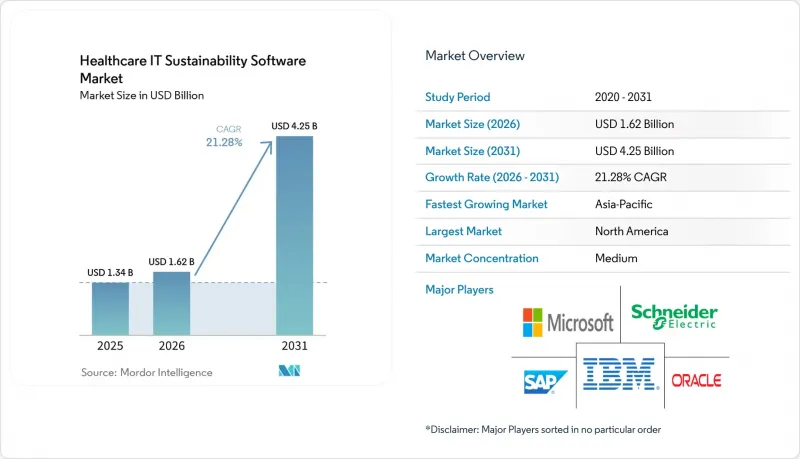
本報告按組件(軟體和服務)、部署模式(雲端、本地部署、混合部署)、應用程式(能源和公用事業最佳化管理、碳排放計算和報告、ESG和監管合規管理等)、最終用戶行業(醫院等)以及地區進行細分。市場預測以價值(美元)表示。
全球醫療保健IT永續軟體市場趨勢與洞察
醫院在實現淨零排放和強制實施脫碳方面的進展。
醫院脫碳目標正從廣泛的政策聲明轉向具體的實施期限,這加速了醫療IT永續軟體市場的發展。英國國家醫療服務體系(NHS England)透過其「淨零排放路徑」繼續引領此一變革,目標是在2028年至2032年間將直接管理的排放量減少80%,並在2040年實現淨零排放。在美國,衛生與公眾服務部(HHS)的「脫碳與舉措計劃」為尋求年度排放報告公開認可的醫院創建了一個更清晰的框架,使更有系統的數據收集更具聲譽意義。因此,醫療IT永續性軟體市場的採購週期正在縮短,因為那些設定短期脫碳里程碑的機構無法承受長時間進行人工基準計算。此外,由於醫療機構佔全球溫室氣體排放量的4.4%,醫療系統面臨更廣泛的壓力,排放管理一直是董事會、監管機構和相關人員關注的焦點。因此,醫療保健 IT 永續性軟體市場正與資本規劃週期、管治審查和整體系統營運目標越來越緊密地連結在一起。
擴大範圍 1、範圍 2 和範圍 3 的排放報告要求
範圍 1、範圍 2 和範圍 3 報告規定的擴展是推動醫療保健 IT 永續性軟體市場需求的最顯著因素之一。美國衛生與公眾服務部 (HHS) 指出,醫療機構的範圍 3 排放量通常超過範圍 1 和範圍 2總合的總和,因為範圍 3 涵蓋了藥品、醫療設備、運輸和其他外部供應鏈活動。世界衛生組織 (WHO) 也發布了符合《溫室氣體會計系統》的測量架構。這使得排放量計算從模糊的目標轉變為醫療系統內部清晰的能力。這種轉變也影響軟體採購行為。醫院在推進範圍 3 專案時需要與供應商協作、自動資料收集以及定期更新調查方法的工具,而這些功能無法透過基本的電子表格系統充分滿足。在麻薩諸塞州,急診醫院已被要求在 2025 年 6 月之前提交檢驗的範圍 1 和範圍 2 排放報告,這表明報告預期正從自願披露轉向更正式的監管。這些要求使得建立健全的報告系統變得難以推遲,因此,醫療保健 IT 的永續性軟體市場正在受益。
分散的設施和臨床數據架構
醫療保健IT永續性軟體市場面臨的主要障礙之一是醫院對設施數據、臨床系統、採購記錄和公用設施資訊的管理方式分散。 2025年發表在《Frontiers in Health Services》上的一項系統性綜述表明,醫療保健資料生態系統通常以孤立、異質的軟體環境運行,缺乏標準化的整合結構。美國國家醫學科學院也強調了建立國家醫療保健數位資料架構的必要性,並指出該領域持續缺乏互通性。實際上,這意味著永續性平台通常需要連接到建築管理系統、電子健康記錄、計量表、採購工具和其他並非為無縫資料交換而設計的系統。儘管醫療保健IT永續軟體市場在這種情況下仍在不斷發展,但對於中型企業而言,實施過程漫長、依賴服務且難以預測。這導致了採用延遲,因為許多機構需要比其現有資料架構處理速度更快的報告。
細分市場分析
預計到2025年,軟體將佔市場佔有率的68.32%,而服務業預計到2031年將以21.97%的複合年成長率成長。在醫療保健IT永續發展軟體市場,這種構成比表明,當報告規則和碳計量方法發生變化時,買家仍然傾向於能夠集中更新的平台。軟體層仍然是核心,因為醫院集團需要的是可復現的資料收集、審計追蹤和全公司範圍報告的工作流程,而不是一次性的諮詢服務。同時,醫療保健永續發展軟體產業的服務領域正在迅速擴張,因為部署很少僅止於簡單的安裝。調查範圍、供應商資料要求或業務規模的變化往往會帶來新的配置、整合和支援需求。
這種關係在醫療保健IT永續性軟體市場催生了一種新的收入模式:軟體確保長期「記錄系統」的有效性,而服務則有助於醫療機構維持這些系統的效用。分析還表明,供應商的定位正在轉變,企業級供應商正從大規模軟體合約轉向多年服務合約。 ISG評估了永續性管理、永續性洞察和永續性合規三個類別的20家供應商,並將Workiva、Salesforce和Oracle評為整體領導者。這印證了全套解決方案供應商不僅在功能上競爭,也在產品廣度上競爭的觀點。 SAP宣布推出其永續性人工智慧代理,承諾將合規審查時間縮短50%以上,並將場景模擬時間從一天縮短至20分鐘,這表明未來一些依賴服務的任務可能會自動化。儘管如此,由於醫療機構的營運環境仍然因機構、所有者和法規環境的不同而存在顯著差異,因此預計醫療保健IT永續性軟體市場對服務的需求仍將保持旺盛。
預計到2025年,基於雲端的部署將佔據72.92%的市場佔有率,而混合部署預計到2031年將以22.83%的複合年成長率成長。醫療保健IT永續性軟體市場在雲端部署方面繼續保持領先地位,因為主要供應商已將永續性模組整合到用於財務、人力資源、採購和供應鏈功能的廣泛雲端套件中。這降低了大規模醫療保健系統採用雲端部署的門檻,這些系統希望擴展現有技術夥伴關係,而不是部署單獨的系統。混合部署仍然是成長最快的選擇,因為許多組織需要雲端規模的分析功能,但又不想將所有設施和營運資料遷移到公共雲端環境。在醫療保健IT永續軟體市場,這與其說是技術偏好問題,不如說是合規性問題。
此外,在醫療保健永續發展軟體產業,混合模式在跨多個監管轄區的醫療保健系統中越來越受歡迎。這些機構需要對敏感的營運數據進行更嚴格的控制,同時也要支援複雜的範圍 3 計算和系統級基準測試。本地部署的市場佔有率持續下降,但在政府所有的醫院網路和其他具有更嚴格主權要求的環境中仍然佔據重要地位。在以隱私為中心的管治架構下,供應商關於資料居住、安全措施和設計要求的文件已成為採購評估的常規內容。因此,儘管雲端在醫療保健永續發展軟體市場的規模上仍然佔據主導地位,但混合模式正在成為連接合規要求和高階分析需求的實用橋樑。
區域分析
到2025年,北美將佔據37.64%的市場佔有率,這一地位主要得益於監管壓力最大、數位化準備充分以及大規模醫療機構的存在。北美在醫療IT永續發展軟體市場持續佔據主導地位,是因為該地區集中了眾多整合醫療系統、IDN(整合醫療網路)和大學附屬醫療中心,這些機構能夠支持企業級報告和分析。在美國,對排放報告、氣候變遷承諾和採購成熟度的日益成長的期望,正推動醫院採用更正式的軟體進行永續發展管理。美國衛生與公眾服務部(HHS)關於範圍3和更廣泛的脫碳計畫的指導意見,也在加速從人工報告轉變為更結構化的數據系統。加拿大也透過智慧基礎設施模式,包括長期的數位化醫院夥伴關係(例如Cortellaci Vaughan醫院的案例),為醫療IT永續發展軟體市場做出貢獻。
在歐洲,報告法規和政策,以及建築能源效率的義務,正在塑造市場格局,使得醫療保健IT永續性軟體市場在結構上受政策主導。德國尤為突出,因為業內相關人員預計大多數醫院都將受到永續性報告義務的約束,而DKTIG正在與合作夥伴共同建立一個符合CSRD和ESRS要求的行業專用永續管理軟體平台。英國也在透過NHS實現淨零排放的路徑以及更重視能源監測和報告系統的信託級綠色計畫取得進展。在南歐,維修的經濟效益正在顯現,托斯卡納的醫療設施維修展示了一條從自動化投資到可衡量的節能減排的切實可行的路徑。雖然在南美洲,該領域的應用仍處於早期階段,但隨著外部資本市場日益重視ESG合規性,巴西和阿根廷的大型私立醫院集團很可能成為最有前景的切入點。
預計到2031年,亞太地區將以23.17%的複合年成長率成長,成為醫療保健IT永續發展軟體市場成長最快的地區。該地區受益於多種因素的協同效應,例如資訊揭露勢頭日益強勁、對數位化醫院的投資不斷增加,以及大規模醫療機構不斷加強其企業資料管理能力。日本就是一個顯著的例子,Astellas來製藥在其企業社會責任報告(CSRD)和環境和社會責任報告(ESRS)相關的資訊揭露工作中採用了IBM Envizi ESG Suite,而富士通則與大阪醫院合作開展了一個關於生成式人工智慧和永續醫院管理的計畫。在印度,隨著醫療保健數位化與更廣泛的氣候變遷減緩措施同步推進,人們對醫療保健IT永續發展軟體的興趣也開始成長。中東和非洲雖然目前的市場規模仍然較小,但卻是具有重要戰略意義的地區,尤其是沙烏地阿拉伯,該國正在國家轉型議程的推動下加大對ESG基礎設施的投資。因此,醫療保健IT永續發展軟體市場正在地域上不斷擴張,北美在部署規模方面主導,歐洲在政策框架方面領先,而亞太地區則在成長率方面領先。
其他好處:
- Excel格式的市場預測(ME)表
- 3個月的分析師支持
目錄
第1章:引言
- 研究假設和市場定義
- 調查範圍
第2章:調查方法
第3章執行摘要
第4章 市場狀況
- 市場概覽
- 宏觀經濟因素對市場的影響
- 市場促進因素
- 醫院為實現淨零排放所做的努力以及強制性脫碳範圍的擴大
- 擴大範圍 1、範圍 2 和範圍 3 的排放報告要求
- 急診機構和整個校園設施面臨不斷上漲的能源成本壓力。
- 拓展智慧醫院的數位化建築運營
- 需要對多站點醫療保健系統中的 ESG 資料進行自動匯總。
- 醫療保健資本規劃中對可衡量的永續性投資報酬率的需求日益成長。
- 市場限制因素
- 分散的設施和臨床數據架構
- 老舊建築和IT系統的更新週期很長。
- 中小醫療機構的預算限制
- 基於雲端的永續發展平台中的網路安全和資料隱私問題
- 產業價值鏈分析
- 監理情勢
- 技術展望
- 波特五力分析
第5章 市場規模與成長預測
- 按組件
- 軟體
- 服務
- 實施和整合服務
- 支援和維護服務
- 部署模式
- 基於雲端的
- 現場
- 混合
- 透過使用
- 能源和公共產業最佳化管理
- 碳排放量的計算和報告
- 環境資源管理(水和廢棄物)
- ESG和監理合規管理
- 永續性分析和績效基準
- 按最終用戶行業分類
- 醫院(專科醫院及綜合醫院)
- 醫療保健系統和綜合醫療保健網路(IDN)
- 門診手術中心
- 診所和私人診所
- 長期照護機構
- 學術與教育醫療中心
- 其他終端用戶產業
- 按地區
- 北美洲
- 美國
- 加拿大
- 墨西哥
- 其他北美國家
- 南美洲
- 巴西
- 阿根廷
- 其他南美國家
- 歐洲
- 德國
- 英國
- 法國
- 義大利
- 西班牙
- 俄羅斯
- 其他歐洲國家
- 亞太地區
- 中國
- 日本
- 印度
- 韓國
- 澳洲
- 其他亞太國家
- 中東
- 沙烏地阿拉伯
- 阿拉伯聯合大公國
- 土耳其
- 其他中東國家
- 非洲
- 南非
- 埃及
- 其他非洲國家
- 北美洲
第6章 競爭情勢
- 市場集中度
- 策略趨勢
- 市佔率分析
- 公司簡介
- IBM Corporation
- SAP SE
- Microsoft Corporation
- Oracle Corporation
- Schneider Electric SE
- Salesforce, Inc.
- Johnson Controls International plc
- Honeywell International Inc.
- Siemens AG
- GE HealthCare Technologies Inc.
- Philips Koninklijke NV
- AWS, Inc.
- ServiceNow, Inc.
- Wolters Kluwer NV
- EcoOnline AS
- Cority Software Inc.
- Diligent Corporation
- FigBytes Inc.
- Intelex Technologies ULC
- UL Solutions Inc.
- Quentic GmbH
- EnergyCAP, LLC
第7章 市場機會與未來展望
According to Mordor Intelligence, the healthcare IT sustainability software market size is expected to increase from USD 1.34 billion in 2025 to USD 1.62 billion in 2026 and reach USD 4.25 billion by 2031, growing at a CAGR of 21.28% over 2026-2031.
This report is Segmented by Component (Software, and Services), Deployment Mode (Cloud-Base, On-Premise, and Hybrid), Application (Energy and Utility Optimization Management, Carbon Emissions Accounting and Reporting, ESG and Regulatory Compliance Management, and More), End-User Industry (Hospitals, and More), and Geography. The Market Forecasts are Provided in Terms of Value (USD).
Global Healthcare IT Sustainability Software Market Trends and Insights
Rising Hospital Net Zero Commitments and Decarbonization Mandates
Hospital decarbonization targets have shifted from broad policy statements to operational deadlines, accelerating the healthcare IT sustainability software market. NHS England continued to anchor this shift with its net zero pathway, which targets an 80% reduction in directly controlled emissions by 2028-2032 and full net zero by 2040. In the United States, the HHS Decarbonization and Resilience Initiative created a clearer framework for hospitals that want public recognition for annual emissions reporting, which adds reputational weight to more structured data collection. The healthcare IT sustainability software market is, therefore, seeing shorter procurement windows because organizations with near-term decarbonization milestones cannot wait for long manual baseline exercises. Health systems also face wider pressure because healthcare facilities account for 4.4% of global greenhouse gas emissions, which keeps emissions management visible to boards, regulators, and institutional stakeholders. As a result, the healthcare IT sustainability software market is becoming more tied to capital planning cycles, governance reviews, and systemwide operating targets.
Growth of Scope 1, Scope 2, and Scope 3 Emissions Reporting Requirements
The expansion of Scope 1, Scope 2, and Scope 3 reporting rules is one of the clearest demand drivers for the healthcare IT sustainability software market. HHS noted that Scope 3 emissions for healthcare organizations often exceed Scope 1 and Scope 2 emissions combined because they include pharmaceuticals, devices, transport, and other external supply chain activities. WHO also published a measurement framework aligned with the GHG Protocol, which helped turn emissions accounting from a broad ambition into a defined internal capability for health systems. This changes software buying behavior because hospitals moving into Scope 3 work need supplier engagement tools, automated data ingestion, and regular methodology updates that basic spreadsheet systems do not handle well. Massachusetts acute hospitals were already required to submit verified Scope 1 and Scope 2 emissions reports by June 2025, which shows how reporting expectations are moving from voluntary disclosure into more formal oversight. The healthcare IT sustainability software market is benefiting because these requirements make robust reporting architecture harder to defer.
Fragmented Facility and Clinical Data Architecture
A major barrier for the healthcare IT sustainability software market is the fragmented way hospitals manage facility data, clinical systems, procurement records, and utility information. A 2025 systematic review in Frontiers in Health Services found that healthcare data ecosystems often operate as isolated and heterogeneous software environments without standardized integration structures. The National Academy of Medicine also highlighted the need for a national health digital and data architecture, underscoring the continued incompleteness of interoperability across the sector. In practical terms, this means sustainability platforms must often connect to building systems, electronic records, meters, and procurement tools that were never designed to exchange data smoothly. The healthcare IT sustainability software market continues to advance under those conditions, but implementation work becomes longer, more service-intensive, and less predictable for mid-tier operators. This slows adoption because many organizations want faster reporting than their current data architecture can support.
Other drivers and restraints analyzed in the detailed report include:
- Rising Energy Cost Pressure Across Acute Care and Campus Facilities
- Expansion of Digital Building Operations in Smart Hospitals
- Long Replacement Cycles for Legacy Building and IT Systems
For complete list of drivers and restraints, kindly check the Table Of Contents.
Segment Analysis
Software accounted for 68.32% of the market in 2025, while services are projected to grow at a 21.97% CAGR through 2031. In the healthcare IT sustainability software market, that mix shows that buyers still prefer platforms that can be updated centrally as reporting rules and carbon accounting methods change. The software layer remains the anchor because hospital groups want repeatable workflows for data capture, audit trails, and enterprise reporting instead of one-time advisory work. At the same time, services are expanding quickly because implementation rarely ends with installation in the healthcare sustainability software industry. Every change in reporting scope, supplier data needs, or operating footprint tends to create new demand for configuration, integration, and support.
This relationship gives the healthcare IT sustainability software market a revenue model where software secures the long-term system of record, and services help institutions keep it useful. The input also points to a shift in vendor positioning, with enterprise providers trying to turn large software contracts into multiyear service relationships. ISG assessed 20 providers across sustainability management, sustainability insights, and sustainability compliance categories, and named Workiva, Salesforce, and Oracle as overall leaders, which supports the view that full-suite vendors are competing on breadth as much as functionality. The announcement of SAP sustainability AI agents, with promised reductions of more than 50% in compliance review hours and a fall in scenario simulation time from one day to 20 minutes, also suggests that some service-heavy tasks may be automated over time. Even so, the healthcare IT sustainability software market is likely to keep meaningful services demand because healthcare operating environments remain highly varied across sites, owners, and regulatory contexts.
Cloud-based deployment held 72.92% share in 2025, while hybrid deployment is projected to expand at a 22.83% CAGR through 2031. The healthcare IT sustainability software market size in cloud deployment remained ahead because major vendors already embed sustainability modules into broader cloud suites used for finance, HR, procurement, and supply chain functions. This lowers adoption friction for large health systems that want to extend existing technology relationships rather than introduce a separate stack. Hybrid deployment is still the fastest growing option because many organizations need cloud-scale analytics without moving all facility and operational data into public cloud environments. In the healthcare IT sustainability software market, this is less a matter of technical taste and more a response to compliance architecture.
The healthcare sustainability software industry is also seeing hybrid models gain favor among health systems that operate across several regulatory jurisdictions. These organizations need stronger control over sensitive operational data while still supporting complex Scope 3 calculations and systemwide benchmarking. On-premise deployments continue to lose share, but they remain relevant in government owned hospital networks and other settings where sovereignty requirements are stricter. Vendor documentation on data residency, security controls, and design requirements is now a routine part of procurement evaluations under privacy-focused governance frameworks. The healthcare sustainability software market, therefore, keeps cloud at the center of scale, but hybrid models are becoming the practical bridge between compliance needs and the ambition for advanced analytics.
Complete Report Scope:
- By Component
- Software
- Services
- Implementation and Integration Services
- Support and Maintenance Services
- By Deployment Mode
- Cloud Based
- On Premise
- Hybrid
- By Application
- Energy and Utility Optimization Management
- Carbon Emissions Accounting and Reporting
- Environmental Resource Management (Water and Waste)
- ESG and Regulatory Compliance Management
- Sustainability Analytics and Performance Benchmarking
- By End-User Industry
- Hospitals (Standalone and Multi-specialty)
- Health Systems and IDNs
- Ambulatory Surgical Centers
- Clinics and Physician Practices
- Long-Term Care Facilities
- Academic and Teaching Medical Centers
- Other End-User Industries
- By Geography
- North America
- United States
- Canada
- Mexico
- Rest of North America
- South America
- Brazil
- Argentina
- Rest of South America
- Europe
- Germany
- United Kingdom
- France
- Italy
- Spain
- Russia
- Rest of Europe
- Asia-Pacific
- China
- Japan
- India
- South Korea
- Australia
- Rest of Asia-Pacific
- Middle East
- Saudi Arabia
- United Arab Emirates
- Turkey
- Rest of Middle East
- Africa
- South Africa
- Egypt
- Rest of Africa
- North America
Geography Analysis
North America held 37.64% share of the market in 2025, and that lead reflects the strongest combination of regulatory pressure, digital readiness, and large enterprise healthcare operators. The healthcare IT sustainability software market share in North America remained the highest because the region has a dense base of integrated health systems, IDNs, and academic medical centers that can support enterprise-wide reporting and analytics. In the United States, emissions reporting expectations, climate pledges, and procurement maturity are pushing hospitals toward more formal software-backed sustainability management. HHS guidance on Scope 3 and broader decarbonization planning also supports a shift from manual reporting to more structured data systems. Canada is also contributing to the healthcare IT sustainability software market through smart infrastructure models, including the long-term digital hospital partnership highlighted at Cortellucci Vaughan Hospital.
Europe is shaped by reporting regulation and building efficiency mandates, which gives the healthcare IT sustainability software market a structurally policy-led profile. Germany stands out because sector participants expect a large share of hospitals to fall under sustainability reporting obligations, and DKTIG has partnered on a sector-focused sustainability management software platform aligned with CSRD and ESRS requirements. The United Kingdom is also advancing through the NHS net zero pathway and trust-level green plans that place more emphasis on energy monitoring and reporting systems. Southern Europe is benefiting from retrofit economics, as the Tuscany healthcare building upgrade showed a practical path from automation investment to measurable energy savings and lower emissions. South America remains earlier in adoption, but large private hospital groups in Brazil and Argentina are the most likely entry point as external capital markets place more weight on ESG readiness.
Asia-Pacific is projected to expand at a 23.17% CAGR through 2031, making it the fastest-growing regional part of the healthcare IT sustainability software market size. The region benefits from a mix of disclosure momentum, digital hospital investment, and large healthcare organizations that are strengthening enterprise data capabilities. Japan offers a visible example, where Astellas adopted IBM Envizi ESG Suite for CSRD and ESRS-related disclosure work, and Fujitsu Japan started a project with Osaka Hospital around generative AI and sustainable hospital management. India is beginning to show interest as healthcare digitalization advances alongside broader climate commitments. The Middle East and Africa remain smaller in current value, but they are strategically relevant because ESG infrastructure investment is rising under national transformation agendas, especially in Saudi Arabia. The healthcare IT sustainability software market is therefore broadening geographically, with North America leading in installed scale, Europe in policy structure, and Asia-Pacific in growth speed.
- IBM Corporation
- SAP SE
- Microsoft Corporation
- Oracle Corporation
- Schneider Electric SE
- Salesforce, Inc.
- Johnson Controls International plc
- Honeywell International Inc.
- Siemens AG
- GE HealthCare Technologies Inc.
- Philips Koninklijke N.V.
- AWS, Inc.
- ServiceNow, Inc.
- Wolters Kluwer N.V.
- EcoOnline AS
- Cority Software Inc.
- Diligent Corporation
- FigBytes Inc.
- Intelex Technologies ULC
- UL Solutions Inc.
- Quentic GmbH
- EnergyCAP, LLC
Additional Benefits:
- The market estimate (ME) sheet in Excel format
- 3 months of analyst support
TABLE OF CONTENTS
1 INTRODUCTION
- 1.1 Study Assumptions and Market Definition
- 1.2 Scope of the Study
2 RESEARCH METHODOLOGY
3 EXECUTIVE SUMMARY
4 MARKET LANDSCAPE
- 4.1 Market Overview
- 4.2 Impact of Macroeconomic Factors on the Market
- 4.3 Market Drivers
- 4.3.1 Rising Hospital Net Zero Commitments and Decarbonization Mandates
- 4.3.2 Growth of Scope 1, Scope 2, and Scope 3 Emissions Reporting Requirements
- 4.3.3 Rising Energy Cost Pressure Across Acute Care and Campus Facilities
- 4.3.4 Expansion of Digital Building Operations in Smart Hospitals
- 4.3.5 Need for Automated ESG Data Consolidation Across Multi Site Health Systems
- 4.3.6 Rising Demand for Measurable Sustainability ROI in Healthcare Capital Planning
- 4.4 Market Restraints
- 4.4.1 Fragmented Facility and Clinical Data Architecture
- 4.4.2 Long Replacement Cycles for Legacy Building and IT Systems
- 4.4.3 Budget Constraints in Small and Mid Sized Healthcare Providers
- 4.4.4 Cybersecurity and Data Privacy Concerns in Cloud Based Sustainability Platforms
- 4.5 Industry Value Chain Analysis
- 4.6 Regulatory Landscape
- 4.7 Technological Outlook
- 4.8 Porter's Five Forces Analysis
- 4.8.1 Bargaining Power of Buyers
- 4.8.2 Bargaining Power of Suppliers
- 4.8.3 Threat of New Entrants
- 4.8.4 Threat of Substitutes
- 4.8.5 Industry Rivalry
5 MARKET SIZE AND GROWTH FORECASTS
- 5.1 By Component
- 5.1.1 Software
- 5.1.2 Services
- 5.1.2.1 Implementation and Integration Services
- 5.1.2.2 Support and Maintenance Services
- 5.2 By Deployment Mode
- 5.2.1 Cloud Based
- 5.2.2 On Premise
- 5.2.3 Hybrid
- 5.3 By Application
- 5.3.1 Energy and Utility Optimization Management
- 5.3.2 Carbon Emissions Accounting and Reporting
- 5.3.3 Environmental Resource Management (Water and Waste)
- 5.3.4 ESG and Regulatory Compliance Management
- 5.3.5 Sustainability Analytics and Performance Benchmarking
- 5.4 By End-User Industry
- 5.4.1 Hospitals (Standalone and Multi-specialty)
- 5.4.2 Health Systems and IDNs
- 5.4.3 Ambulatory Surgical Centers
- 5.4.4 Clinics and Physician Practices
- 5.4.5 Long-Term Care Facilities
- 5.4.6 Academic and Teaching Medical Centers
- 5.4.7 Other End-User Industries
- 5.5 By Geography
- 5.5.1 North America
- 5.5.1.1 United States
- 5.5.1.2 Canada
- 5.5.1.3 Mexico
- 5.5.1.4 Rest of North America
- 5.5.2 South America
- 5.5.2.1 Brazil
- 5.5.2.2 Argentina
- 5.5.2.3 Rest of South America
- 5.5.3 Europe
- 5.5.3.1 Germany
- 5.5.3.2 United Kingdom
- 5.5.3.3 France
- 5.5.3.4 Italy
- 5.5.3.5 Spain
- 5.5.3.6 Russia
- 5.5.3.7 Rest of Europe
- 5.5.4 Asia-Pacific
- 5.5.4.1 China
- 5.5.4.2 Japan
- 5.5.4.3 India
- 5.5.4.4 South Korea
- 5.5.4.5 Australia
- 5.5.4.6 Rest of Asia-Pacific
- 5.5.5 Middle East
- 5.5.5.1 Saudi Arabia
- 5.5.5.2 United Arab Emirates
- 5.5.5.3 Turkey
- 5.5.5.4 Rest of Middle East
- 5.5.6 Africa
- 5.5.6.1 South Africa
- 5.5.6.2 Egypt
- 5.5.6.3 Rest of Africa
- 5.5.1 North America
6 COMPETITIVE LANDSCAPE
- 6.1 Market Concentration
- 6.2 Strategic Moves
- 6.3 Market Share Analysis
- 6.4 Company Profiles (includes Global Level Overview, Market Level Overview, Core Segments, Financials as available, Strategic Information, Market Rank/Share, Products and Services, Recent Developments)
- 6.4.1 IBM Corporation
- 6.4.2 SAP SE
- 6.4.3 Microsoft Corporation
- 6.4.4 Oracle Corporation
- 6.4.5 Schneider Electric SE
- 6.4.6 Salesforce, Inc.
- 6.4.7 Johnson Controls International plc
- 6.4.8 Honeywell International Inc.
- 6.4.9 Siemens AG
- 6.4.10 GE HealthCare Technologies Inc.
- 6.4.11 Philips Koninklijke N.V.
- 6.4.12 AWS, Inc.
- 6.4.13 ServiceNow, Inc.
- 6.4.14 Wolters Kluwer N.V.
- 6.4.15 EcoOnline AS
- 6.4.16 Cority Software Inc.
- 6.4.17 Diligent Corporation
- 6.4.18 FigBytes Inc.
- 6.4.19 Intelex Technologies ULC
- 6.4.20 UL Solutions Inc.
- 6.4.21 Quentic GmbH
- 6.4.22 EnergyCAP, LLC
7 MARKET OPPORTUNITIES AND FUTURE OUTLOOK
- 7.1 White Space and Unmet Need Assessment
- 7.2 Future Growth Opportunities

 2026年全球環境循環能源網路市場報告2026年全球精益能源管理市場報告
 心理能量最佳化市場預測至2034年-按解決方案類型、消費者細分、技術、應用、最終用戶和地區分類的全球分析智慧熱能網路管理市場預測至2034年-全球解決方案類型、組件、部署模式、技術、應用、最終用戶和區域分析資料中心能源最佳化和電源管理解決方案市場預測至 2034 年—按部署模式、技術、應用、最終用戶和地區分類的全球分析
 伺服器虛擬化能源最佳化軟體:市場佔有率分析、產業趨勢與統計及成長預測(2026-2031)物聯網能源管理市場:2034 年預測-按設備、部署模式、連接方式、技術、應用、最終用戶和地區分類的全球分析能源最佳化軟體市場預測至2034年—按組件、部署類型、企業規模、應用、最終用戶和地區分類的全球分析
 2026-2030年全球併網建築解決方案市場
 工業能源效率市場:按交付類型、最終用戶產業和地區分類