


 |
市場調查報告書
商品編碼
2097443
北美蚊蟲驅避劑市場:市場佔有率分析、產業趨勢與統計及成長預測(2026-2031 年)North America Mosquito Repellent - Market Share Analysis, Industry Trends & Statistics, Growth Forecasts (2026 - 2031) |
||||||

※ 本網頁內容可能與最新版本有所差異。詳細情況請與我們聯繫。
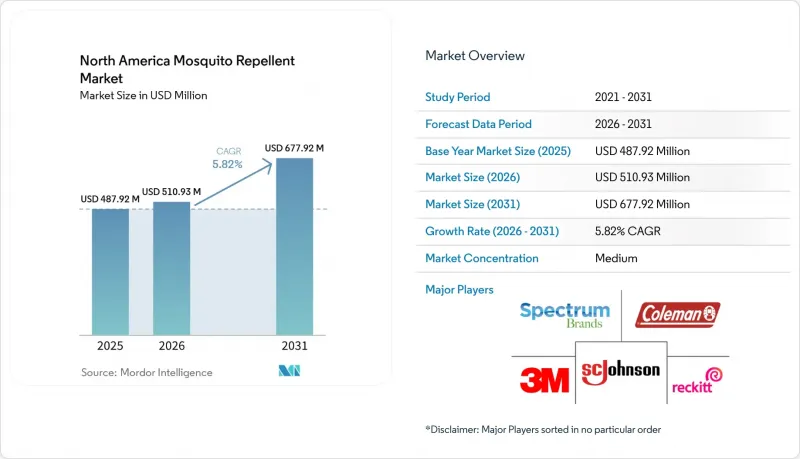
根據 Mordor Intelligence 預測,北美驅蚊劑市場規模將從 2025 年的 4.879 億美元和 2026 年的 5.109 億美元成長到 2031 年的 6.779 億美元,2026 年至 2031 年的年複合成長率(CAGR)為 5.8%。
本報告按產品類型(液體噴霧劑、乳霜/乳液等)、成分類型(天然成分和傳統成分)、最終用戶(成人和兒童)、銷售管道(超級市場、便利商店、藥店、線上零售等)以及地區(美國、加拿大、墨西哥、北美及其他地區)進行細分。市場預測以美元計價。
北美蚊蟲驅避劑市場趨勢及洞察
對蚊媒疾病的認知提高,以及預防投入增加
在北美,登革熱病例數量持續上升,帶動了對驅蚊產品的需求。即使在疫情間歇期,公共衛生問題也始終備受關注。 2024年,美國疾病管制與預防中心(CDC)報告稱,全美各州和華盛頓特區共報告了3798例登革熱病例。與2010年至2023年的年均病例數相比,增幅高達359%。佛羅裡達州、加利福尼亞州、紐約州和德克薩斯州是主要的感染熱點地區,其中佛羅裡達州有10個縣報告了社區傳播病例。美國衛生與公眾服務部已通過其2024年國家公共衛生戰略,將登革熱疾病列為聯邦優先事項。該策略旨在促進CDC和美國環保署(EPA)之間的合作,並在無需品牌行銷的情況下提高消費者的防疫意識。隨著感染疾病的性行為感染,機構對傳統外用驅蚊劑以外的太空驅蚊技術的興趣日益濃厚。莊臣公司(SC Johnson)的「Guardian」於2025年8月成為第一個獲得世界衛生組織(WHO)政策批准的空氣驅蚊產品。這表明,在北美,此類產品類型可能會從公共衛生領域轉向一般零售市場。此外,學校的預防宣傳活動和政府的旅遊建議也發揮了免費的宣傳作用,在無需額外行銷成本的情況下擴大了驅蚊產品市場。
戶外休閒和旅遊用途達到頂峰。
根據美國經濟分析局的報告,2024年北美戶外休閒創造了高達1.2兆美元的經濟效益,佔GDP的2.3%,並提供了500萬個工作機會。這一規模表明,戶外休閒已超越了以往的小眾範疇,如今已成為主流經濟的重要組成部分。戶外產業協會(OIA)發布的《2025年參與趨勢報告》顯示,美國戶外參與者人數較去年同期成長3%,到2024年達到1.811億。其中,健行和露營尤其吸引了超過200萬新參與者,作為“入門級活動”,它們增加了人們接觸蚊蟲的機會,從而促進了驅蚊產品的銷售。 KOA發布的《2026年露營、戶外及旅館業報告》顯示,2025年北美地區將有超過5,200萬戶家庭享有露營活動。戶外旅館業的支出飆升至660億美元,比2024年增加50億美元。這些數據證實,後疫情時代人們對戶外活動的熱情並未減至2020年之前的水準。受這些以家庭為中心的戶外活動趨勢的影響,「兒童」終端使用者群體預計到2031年將以7.12%的複合年成長率成長。隨著越來越多的家庭將露營、健行和水上休閒納入旅遊計劃,兒童使用驅蚊劑的頻率和種類也隨之增加。
合成活性成分的安全隱患
儘管美國環保署 (EPA) 和加拿大衛生署數十年來一直建議使用避蚊胺 (DEET),但對其安全性的評估正在減少,尤其是在幼兒父母群體中。這些父母經常給孩子嬌嫩的皮膚塗抹驅蚊劑,他們越來越傾向於個人認知而非科學證據。 2025 年發表在 PubMed Central 上的一項研究強調了潛在風險,發現 DEET 暴露與兒童和青少年性荷爾蒙水平和骨密度的不良影響之間存在流行病學關聯。如果人們更廣泛地了解這些發現,可能會加速推動兒童產品配方的重新調整,並引發人們對現有科學證據之外的安全疑慮。同時,加拿大衛生署在其重新評估決定 PRVD2025-09(2025 年 10 月)中,倡導更新 DEET 產品標籤。這包括兒童用藥濃度指南,凸顯了目前正在進行的更嚴格的審查,這種審查正在重塑父母對驅蚊配方的選擇。預計到2025年,傳統驅蚊產品將佔成分類產品的82.72%,但其品牌價值正因形象風險而逐漸受損。高階零售商正擴大商店「更清潔」的替代品,而線上育兒社群對安全性的擔憂也日益加劇,其影響遠遠超出本研究的流行病學意義。然而,也存在一些自身設限。在高風險地區,避蚊胺(DEET)對埃及斑蚊和庫蚊的驅蚊效果已得到證實,優於大多數天然來源的替代品。儘管如此,這種認知差距預計將在可預見的未來減緩傳統驅蚊產品市場的成長速度。
細分市場分析
到2025年,噴霧/氣霧型驅蚊劑將佔據北美驅蚊劑市場43.79%的佔有率,這主要得益於消費者對其的熟悉度和多功能性。美國環保署(EPA)和加拿大衛生署批准的活性成分,如避蚊胺(DEET)、派卡瑞丁和IR3535,進一步鞏固了其市場主導地位。這種形式的驅蚊劑尤其適用於露營、健行和釣魚等戶外活動,其易於重複使用,而針對埃及斑蚊和蠓等蚊媒的高濃度配方也增強了其在大眾市場的吸引力。液體噴霧劑是成長最快的產品類型,預計到2031年將以6.96%的複合年成長率成長,這主要得益於消費者對室內和戶外空間非接觸式、無味驅蚊劑的需求。因此,消費者從外用驅蚊劑轉向液體噴霧劑,使其在零售市場佔據了獨特的地位,並推高了平均售價。雖然蚊香在戶外和低收入人群中仍然佔據重要地位,尤其是在墨西哥,但乳霜、乳液和滾珠式驅蚊劑作為兒童和敏感皮膚人群的精準塗抹選擇越來越受歡迎,並且還具有減少全身吸收的額外好處。
Thermacell 於 2026 年 6 月推出的 LIV 2.0 是一款經美國環保署 (EPA) 註冊的系統,每個中心可保護高達 3,140 平方英尺的區域免受蚊蟲叮咬。該產品凸顯了技術主導的區域控制型產品在高階戶外和機構市場日益成長的重要性。雖然貼片和穿戴式產品仍屬於小眾領域,但隨著北美年輕人對便利免持產品的需求,它們正穩定成長。另一個值得關注的趨勢是,可充電區域控制型設備在美國和加拿大迅速普及,這可能會加速蚊香需求的下降。隨著無菸型蚊香在郊區戶外用戶中越來越受歡迎,自有品牌蚊香供應商可能會落後於積極進行市場推廣活動的品牌蚊香製造商。
預計到2031年,天然驅蚊劑的複合年成長率將達到6.81%。這一成長率超過了傳統配方驅蚊劑,後者先前一直佔據著穩定且近乎壟斷的地位。至2025年,傳統驅蚊劑在成分類型細分市場中佔比高達82.72%。如此龐大的市佔率凸顯了消費者對避蚊胺(DEET)、派卡瑞丁和IR3535的堅定信任。這些成分在蚊蟲高發生率環境中已展現出數十年的有效性,並同時獲得了美國環保署(EPA)和加拿大衛生署的雙重註冊。這兩個細分市場成長軌跡的差異被認為源自於消費者對成分透明度期望的世代轉變。例如,千禧世代的父母越來越像審視食品和個人保健產品一樣,嚴格審查驅蚊產品的「潔淨標示」。這使得他們更傾向於使用經 EPA已通過核准的植物來源活性成分,例如檸檬桉油和派卡瑞丁,這些成分介於完全合成的配方和完全植物來源的配方之間。
天然產品領域的關鍵不在於其目前的市場規模,而在於其在量販店上的快速擴張。這一趨勢通常預示著產品正逐步滲透主流市場,並徵兆著消費品銷售量的激增。 PMC 2025年的一項研究表明,避蚊胺(DEET)暴露與兒童內分泌干擾指標之間可能存在關聯。如果一項大規模隊列研究證實了這項發現,主導可能會強制要求對產品配方進行調整,從而加速天然驅蚊劑的成長,其速度甚至可能超過目前的預期。此外,香茅油和檸檬桉油的微膠囊化等技術進步正在縮小天然和合成避蚊胺在驅蚊持續時間上的差距。這些進步將使天然品牌能夠在更廣泛的戶外環境和疾病風險情境中競爭,有效解決先前阻礙其市場滲透的關鍵性能問題。
其他好處:
- Excel格式的市場預測(ME)表
- 3個月的分析師支持
目錄
第1章:引言
- 研究假設和市場定義
- 調查範圍
第2章:調查方法
第3章執行摘要
第4章 市場狀況
- 市場概覽
- 市場促進因素
- 對蚊媒疾病的認知不斷提高以及預防成本不斷上升
- 戶外休閒和旅行導致使用高峰。
- 天然及不含避蚊胺產品的零售優質化
- 利用電子商務進行試用、訂閱和續訂活動
- 北美南部氣候導致生長季延長
- 人們對「皮膚親和性」和「全家適用」等說法越來越感興趣。
- 市場限制因素
- 對合成活性成分安全性的擔憂
- 關於新活性成分及其功效/作用的證明所面臨的監管挑戰
- 天然和植物來源替代品的價格溢價
- 低成本進口產品在合規性和有效性方面存在差異
- 價值鏈分析
- 監理情勢
- 技術展望
- 波特五力模型
第5章 市場規模與成長預測
- 產品類型
- 液體汽化器
- 蚊香
- 噴霧/氣霧劑
- 乳霜、乳液、滾珠式潤膚露
- 貼片和穿戴式產品
- 其他產品類型
- 按成分
- 天然驅蚊劑
- 傳統驅蚊劑
- 最終用戶
- 成人
- 孩子們
- 銷售管道
- 超級市場和大賣場
- 便利商店
- 藥局/藥局
- 線上零售通路
- 其他分銷管道
- 地區
- 美國
- 加拿大
- 墨西哥
- 其他北美國家
第6章 競爭情勢
- 市場集中度
- 策略趨勢
- 市場排名分析
- 公司簡介
- SC Johnson & Son, Inc.
- Reckitt Benckiser Group plc
- Spectrum Brands Holdings, Inc.
- 3M Company
- The Coleman Company, Inc.
- Thermacell Repellents, Inc.
- Quantum Health, Inc.
- Coghlan's Ltd.
- Tender Corporation
- Sawyer Products, Inc.
- The Avon Company
- Godrej Consumer Products Limited
- Dabur India Ltd.
- Jyothy Laboratories Ltd.
- Newell Brands Inc.
- Hello Bello LLC
- Murphy's Naturals, Inc.
- PIC Corporation
- Henkel AG and Co. KGaA
- The Honest Company, Inc.
第7章 市場機會與未來展望
According to Mordor Intelligence, the North America mosquito repellent market size is projected to expand from USD 487.9 million in 2025 and USD 510.9 million in 2026 to USD 677.9 million by 2031, registering a CAGR of 5.8% between 2026 and 2031.
This report is Segmented by Product Type (Liquid Vaporizer, Creams/Lotions, and More), Ingredient Type (Natural and Conventional), End User (Adults and Kids), Distribution Channel (Supermarkets, Convenience Stores, Pharmacies, Online Retail, and Others), and Geography (United States, Canada, Mexico, and the Rest of North America). Market Forecasts are Provided in Terms of Value (USD).
North America Mosquito Repellent Market Trends and Insights
Rising mosquito-borne disease awareness and preventive spend
In North America, rising cases of vector-borne diseases are driving demand for insect repellents, keeping public health in the spotlight even during lulls between outbreaks. In 2024, the CDC reported 3,798 dengue cases across U.S. states and D.C., marking a staggering 359% surge from the 2010-2023 annual average. Florida, California, New York, and Texas were the primary hotspots, with ten counties in Florida confirming local transmissions. The U.S. Department of Health and Human Services, through its 2024 National Public Health Strategy, has spotlighted vector-borne diseases as a federal priority. This strategy promotes collaboration between the CDC and EPA, leading to widespread consumer education without the need for individual brand marketing. As the disease threat grows, there's a heightened institutional interest in spatial repellent technology, moving beyond traditional skin-applied formats. SC Johnson's Guardian, in August 2025, became the first spatial repellent to earn a WHO policy nod, hinting at a potential shift of this product category from public health channels to mainstream retail in North America. Moreover, school prevention campaigns and government travel advisories serve as free educational tools, broadening the market for insect repellents without added marketing costs.
Outdoor recreation and travel-led usage peaks
In 2024, outdoor recreation in North America generated a whopping USD 1.2 trillion in economic output, accounting for 2.3% of the GDP and supporting 5 million jobs, as reported by the US Bureau of Economic Analysis. This scale underscores the mainstream economic significance of outdoor recreation, moving it beyond its previously perceived niche status. According to the OIA's 2025 Participation Trends Report, the US outdoor participant base grew by 3% year-on-year, reaching 181.1 million Americans in 2024. Notably, hiking and camping each welcomed over 2 million new participants, serving as gateway activities that heighten exposure to mosquitoes and subsequently drive repellent purchases. KOA's 2026 Camping and Outdoor Hospitality Report highlighted that over 52 million North American households went camping in 2025. Outdoor hospitality spending surged to USD 66 billion, marking a USD 5 billion jump from 2024. This data confirms that the post-pandemic enthusiasm for outdoor activities hasn't waned to pre-2020 levels. Reflecting this family-oriented outdoor trend, the Kids end-user segment is projected to grow at a 7.12% CAGR through 2031. As families increasingly incorporate camping, hiking, and waterside recreation into their travel plans, the frequency and diversity of pediatric-specific repellent use occasions are expanding.
Safety perception risks around synthetic actives
Despite decades of endorsement from the EPA and Health Canada, DEET's safety narrative is losing ground, especially among parents of young children. These parents, who frequently apply repellents on their children's sensitive skin, are increasingly swayed by perception over evidence. A 2025 study in PubMed Central highlighted potential risks: it found epidemiological links between DEET exposure and negative impacts on sex hormones and bone mass in children and adolescents. If these findings gain traction on a larger scale, they could prompt a push for pediatric reformulations and heighten safety concerns beyond the current evidence. Meanwhile, Health Canada, in its proposed re-evaluation decision PRVD2025-09 (October 2025), is advocating for updated DEET product labels. These include concentration guidelines for children, underscoring the scrutiny reshaping parental choices in repellent formulations. While conventional repellents held an 82.72% share of the ingredient segment in 2025, brand equity is being chipped away by perception risks. Premium retailers are increasingly favoring "clean" alternatives on their shelves, and online parenting communities are amplifying safety concerns, reaching audiences far beyond the study's epidemiological significance. Yet, there's a self-imposed limit: DEET's established effectiveness against Aedes aegypti and Culex pipiens in high-risk areas outshines most natural alternatives. However, this perception gap is poised to stifle growth rates in the conventional segment for the foreseeable future.
Other drivers and restraints analyzed in the detailed report include:
- Retail premiumization toward natural and DEET-free formats
- E-commerce-enabled trial, subscription, and replenishment behavior
- Regulatory friction for novel actives and claims substantiation
For complete list of drivers and restraints, kindly check the Table Of Contents.
Segment Analysis
In 2025, the Spray/Aerosol format held a 43.79% share of North America's mosquito repellent market, driven by consumer familiarity and multi-surface versatility. Active ingredients like DEET, picaridin, and IR3535, validated by EPA and Health Canada, further reinforce its dominance. The format excels in outdoor activities such as camping, hiking, and fishing, where ease of reapplication and high-concentration formulations for Aedes and Culex vectors strengthen its mass-market appeal. The Liquid Vaporizer is the fastest-growing product type, with a 6.96% CAGR through 2031, fueled by demand for contactless, odor-neutral protection in indoor and patio spaces. This shift from skin-applied formats creates distinct retail positioning and higher average selling prices. Coils remain relevant in outdoor and lower-income segments, particularly in Mexico, while Creams, Lotions, and Roll-ons gain traction as precision-application options for children and sensitive-skin users, offering reduced systemic absorption.
Thermacell's June 2026 launch of LIV 2.0, an EPA-registered system protecting up to 3,140 sq. ft. per hub against mosquitoes and no-see-ums, highlights the growing importance of technology-driven zone formats in premium outdoor and institutional markets. Patches and Wearables, though niche, are growing steadily, driven by demand for hands-free convenience among younger North Americans. Another trend to monitor is the rapid adoption of rechargeable zone devices in the US and Canada, which could accelerate the decline of coil demand. As smoke-free formats gain traction among urban-adjacent outdoor users, private-label coil suppliers may lag behind branded vaporizer players who are actively educating the market.
Natural mosquito repellents are projected to grow at a 6.81% CAGR through 2031. This growth is outpacing the conventional formulations, which until recently enjoyed a stable and largely uncontested position. In 2025, conventional mosquito repellents commanded 82.72% of the ingredient-type segment. This dominance underscores the enduring consumer trust in DEET, picaridin, and IR3535. These ingredients boast multi-decade efficacy validation in high-exposure vector environments and enjoy dual registration status under both EPA and Health Canada frameworks. The divergent growth trajectories of the two segments can be attributed to a generational shift in ingredient transparency expectations. Millennial parents, for instance, are now scrutinizing repellent products through the same clean-label lens they apply to food and personal care. This has led them to favor EPA-approved botanical actives, such as Oil of Lemon Eucalyptus, and picaridin, which serve as a middle ground between fully synthetic and entirely botanical formulations.
In the naturals segment, the key takeaway isn't its current size but its rapid ascent in shelf-space within mass-market retail. This trend often signals mainstream adoption, a precursor to volume surges in consumer goods. A 2025 PMC study hinted at a potential link between DEET exposure and endocrine disruption markers in children. Should larger cohort studies validate this, it might spur a regulatory-driven reformulation mandate, propelling the growth of natural repellents beyond current projections. Moreover, advancements like the microencapsulation of citronella and lemon eucalyptus oil are narrowing the protection-duration gap with synthetic DEET. This progress empowers natural brands to compete in a wider array of outdoor and disease-risk scenarios, effectively addressing a core performance concern that has historically constrained their market reach.
Complete Report Scope:
- Product Type
- Liquid Vaporizer
- Coils
- Spray/Aerosol
- Creams, Lotions, and Roll-ons
- Patches and Wearables
- Other Product Types
- Ingredient Type
- Natural Mosquito Repellent
- Conventional Mosquito Repellent
- End User
- Adults
- Kids
- Distribution Channel
- Supermarkets/Hypermarkets
- Convenience Stores
- Pharmacies and Drug Stores
- Online Retail Channels
- Other Distribution Channels
- Geography
- United States
- Canada
- Mexico
- Rest of North America
List of Companies Covered in this Report:
- S. C. Johnson & Son, Inc.
- Reckitt Benckiser Group plc
- Spectrum Brands Holdings, Inc.
- 3M Company
- The Coleman Company, Inc.
- Thermacell Repellents, Inc.
- Quantum Health, Inc.
- Coghlan's Ltd.
- Tender Corporation
- Sawyer Products, Inc.
- The Avon Company
- Godrej Consumer Products Limited
- Dabur India Ltd.
- Jyothy Laboratories Ltd.
- Newell Brands Inc.
- Hello Bello LLC
- Murphy's Naturals, Inc.
- PIC Corporation
- Henkel AG and Co. KGaA
- The Honest Company, Inc.
Additional Benefits:
- The market estimate (ME) sheet in Excel format
- 3 months of analyst support
TABLE OF CONTENTS
1 INTRODUCTION
- 1.1 Study Assumptions and Market Definition
- 1.2 Scope of the Study
2 RESEARCH METHODOLOGY
3 EXECUTIVE SUMMARY
4 MARKET LANDSCAPE
- 4.1 Market Overview
- 4.2 Market Drivers
- 4.2.1 Rising Mosquito-Borne Disease Awareness and Preventive Spend
- 4.2.2 Outdoor Recreation and Travel-Led Usage Peaks
- 4.2.3 Retail Premiumization Toward Natural and DEET-Free Formats
- 4.2.4 E-Commerce-Enabled Trial, Subscription, and Replenishment Behavior
- 4.2.5 Climate-Driven Season Extension in Southern North America
- 4.2.6 Higher Sensitivity to Skin-Compatibility and Family-Safe Claims
- 4.3 Market Restraints
- 4.3.1 Safety Perception Risks Around Synthetic Actives
- 4.3.2 Regulatory Friction for Novel Actives and Claims Substantiation
- 4.3.3 Price Premium of Natural and Plant-Based Alternatives
- 4.3.4 Product Compliance and Efficacy Gaps in Low-Cost Imports
- 4.4 Value Chain Analysis
- 4.5 Regulatory Landscape
- 4.6 Technological Outlook
- 4.7 Porter's Five Forces
- 4.7.1 Threat of New Entrants
- 4.7.2 Bargaining Power of Buyers
- 4.7.3 Bargaining Power of Suppliers
- 4.7.4 Threat of Substitutes
- 4.7.5 Intensity of Competitive Rivalry
5 MARKET SIZE AND GROWTH FORECASTS (VALUE)
- 5.1 Product Type
- 5.1.1 Liquid Vaporizer
- 5.1.2 Coils
- 5.1.3 Spray/Aerosol
- 5.1.4 Creams, Lotions, and Roll-ons
- 5.1.5 Patches and Wearables
- 5.1.6 Other Product Types
- 5.2 Ingredient Type
- 5.2.1 Natural Mosquito Repellent
- 5.2.2 Conventional Mosquito Repellent
- 5.3 End User
- 5.3.1 Adults
- 5.3.2 Kids
- 5.4 Distribution Channel
- 5.4.1 Supermarkets/Hypermarkets
- 5.4.2 Convenience Stores
- 5.4.3 Pharmacies and Drug Stores
- 5.4.4 Online Retail Channels
- 5.4.5 Other Distribution Channels
- 5.5 Geography
- 5.5.1 United States
- 5.5.2 Canada
- 5.5.3 Mexico
- 5.5.4 Rest of North America
6 COMPETITIVE LANDSCAPE
- 6.1 Market Concentration
- 6.2 Strategic Moves
- 6.3 Market Ranking Analysis
- 6.4 Company Profiles
- 6.4.1 S. C. Johnson & Son, Inc.
- 6.4.2 Reckitt Benckiser Group plc
- 6.4.3 Spectrum Brands Holdings, Inc.
- 6.4.4 3M Company
- 6.4.5 The Coleman Company, Inc.
- 6.4.6 Thermacell Repellents, Inc.
- 6.4.7 Quantum Health, Inc.
- 6.4.8 Coghlan's Ltd.
- 6.4.9 Tender Corporation
- 6.4.10 Sawyer Products, Inc.
- 6.4.11 The Avon Company
- 6.4.12 Godrej Consumer Products Limited
- 6.4.13 Dabur India Ltd.
- 6.4.14 Jyothy Laboratories Ltd.
- 6.4.15 Newell Brands Inc.
- 6.4.16 Hello Bello LLC
- 6.4.17 Murphy's Naturals, Inc.
- 6.4.18 PIC Corporation
- 6.4.19 Henkel AG and Co. KGaA
- 6.4.20 The Honest Company, Inc.
7 MARKET OPPORTUNITIES AND FUTURE OUTLOOK

 蚊蟲驅避劑市場:2026-2032年全球市場預測(依劑型、原料、應用方法、使用環境及通路分類)
 2026-2030年全球驅蚊劑市場
 蚊蟲驅避劑市場報告:按產品類型、成分類型、銷售管道和地區分類(2026-2034 年)
 蚊蟲驅避劑:市場佔有率分析、產業趨勢與統計、成長預測(2026-2031)
 蚊蟲驅避劑市場報告:趨勢、預測及競爭分析(至2035年)
 全球驅蚊劑市場規模、佔有率、趨勢和成長分析報告(2026-2034)
 蚊蟲驅避劑市場-全球產業規模、佔有率、趨勢、機會及預測(按類型、銷售管道、地區及競爭格局分類,2021-2031年)室內驅蚊劑市場按劑型、活性成分、價格範圍、有效持續時間、銷售管道和最終用戶分類-2026-2032年全球預測日本驅蚊劑市場報告(依產品類型、成分類型、配銷通路和地區分類,2026-2034年)
 全球驅蚊蠟燭市場