


 |
市場調查報告書
商品編碼
2066624
蚊蟲驅避劑:市場佔有率分析、產業趨勢與統計、成長預測(2026-2031)Mosquito Repellent - Market Share Analysis, Industry Trends & Statistics, Growth Forecasts (2026 - 2031) |
||||||

※ 本網頁內容可能與最新版本有所差異。詳細情況請與我們聯繫。
據 Mordor Intelligence 稱,2026 年蚊蟲驅避劑市場價值 48.8 億美元,預計將從 2025 年的 42.1 億美元成長到 2031 年的 72.3 億美元。
預計該行業將以 8.11% 的複合年成長率成長,這得益於疾病的蔓延、氣候變遷導致的傳播媒介擴張以及產品形式的多樣化。
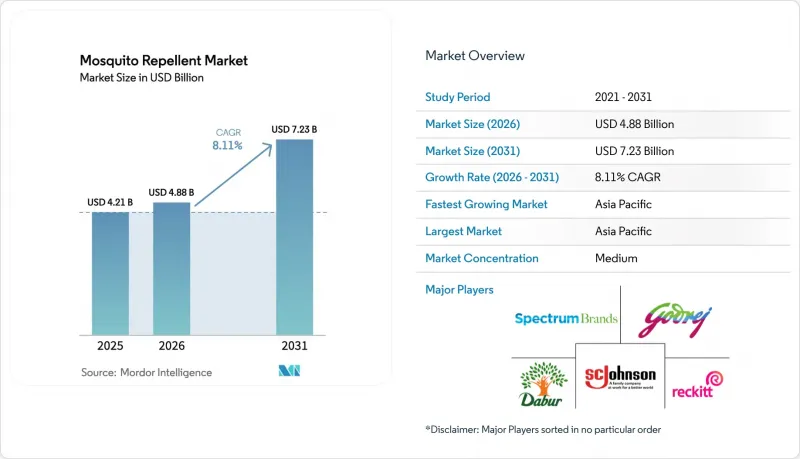
本報告按產品類型(液體霧化器、線圈、噴霧劑/氣霧劑等)、成分類型(天然和傳統)、最終用戶(成人和兒童)、配銷通路(超級市場/大賣場、便利商店/雜貨店等)和地區(北美、歐洲、亞太、南美等)進行細分。市場預測以美元計價。
全球蚊香市場趨勢及洞察
蚊媒疾病增加
2024年,全球登革熱病例激增至1,460萬例,死亡人數超過1.2萬人。根據美國疾病管制與預防中心(CDC)預測,光是2025年前七個月,登革熱病例就將超過400萬例,死亡人數超過3,000人。同時,2023年瘧疾病例達2.46億例,每年因瘧疾死亡的人數超過70萬人。氣候變遷正在延長瘧疾的流行季節,並使埃及斑蚊和斑蚊得以擴散到原本的溫帶地區,將零星爆發的疫情轉變為持續存在的威脅。 2024年,印度記錄了285,296例登革熱病例和190例死亡,而2023年瘧疾病例達160萬例。在印度尼西亞,登革熱病例達143,266例,死亡1,481例;在泰國,病例達134,784例,死亡141例。氣溫升高和都市化在水容器、廢棄輪胎和建築工地等場所為蚊子創造了滋生地,導致熱帶都市地區全年蚊蟲肆虐。因此,在驅蚊產品市場,使用外用和空間驅蚊劑的個人防護已從季節性預防措施轉變為日常必需品,推動了流行地區需求的持續成長。
人們越來越偏好天然、有機和植物來源的驅蟲劑。
在驅蚊產品市場,北美和歐洲的消費者越來越謹慎地對待DEET等合成成分,因為他們擔心這些成分會刺激皮膚、產生神經毒性,並且在環境中會殘留。 Lafe's Baby Organic Mosquito Repellent(Lafe's嬰兒有機驅蚊噴霧)採用美國農業部認證的有機精油配製而成,4盎司裝售價8.99美元。同時,Hello Bello的植物來源噴霧,6.7盎司裝售價10.99美元,並透過CVS、Kohl's、Target和Walmart等主要零售商銷售。 Wondercide提供經過實驗室測試的植物來源產品,價格從12.99美元到44.99美元不等,目標客戶是尋求不含DEET替代品的寵物飼主和家庭。美國環保署(EPA)已將某些植物來源成分列為第25(b)條豁免產品,允許其無需完成完整的報名手續即可快速進入市場。然而,研究表明,與派卡瑞丁和IR3535等成熟成分相比,這些成分的驅蚊效果持續時間較短。每個品牌都需要仔細衡量其行銷宣傳與產品實際效果之間的平衡。消費者的偏好各不相同,有些人願意每兩小時重新塗抹一次驅蚊劑,而有些人則喜歡能夠提供全天候防護的產品。這種需求的多樣性是推動蚊蟲驅避劑市場成長的主要動力。
人們對合成化學品的毒性、皮膚刺激性和長期影響的健康和安全問題表示擔憂。
健康方面的擔憂減緩了這些產品在家長、孕婦和敏感肌膚人群中的普及。避蚊胺(DEET)是應用最廣泛的活性成分,儘管幾十年來一直獲得美國環保署(EPA)和歐洲化學品管理局(ECHA)的監管批准,但其潛在的神經毒性和皮膚反應仍備受詬病。派卡瑞丁(Picaridin)和IR3535具有類似的效果,但對皮膚的刺激性較小,然而由於消費者對其認知度較低,避蚊胺在許多市場仍然是首選。香茅、檸檬草和尤加利等精油的驅蚊效果持續時間較短(通常不到兩小時),因此在蚊蟲活動高峰期需要頻繁補塗或縮小塗抹範圍。美國食品藥物管理局(FDA)和疾病管制與預防中心(CDC)建議使用EPA註冊的驅蚊產品以獲得可靠的保護。然而,在網路論壇和社群媒體上不斷傳播的副作用軼事正在削弱人們對含有合成成分產品的信心。在蚊香市場,注重臨床試驗、皮膚病學測試和透明成分標籤的品牌,可以在安全意識日益重要的市場中脫穎而出,與競爭對手區分開來。
細分市場分析
到2025年,噴霧和氣霧劑型驅蚊產品將佔蚊蟲驅避劑市場46.25%的佔有率,凸顯了消費者對攜帶式速效產品的強勁需求,尤其是在戶外活動、旅行和緊急情況下。液體薰香型驅蚊劑因其整夜有效、無需皮膚接觸或頻繁補塗而備受青睞,預計到2031年將以9.14%的複合年成長率成長,尤其是在登革熱高發地區。在印度,Godley Consumer Products公司的「Goodnight」液體薰香型驅蚊劑在都市區和半都市區市場佔據主導地位。同樣,利潔時旗下的「Moltein」品牌在澳洲和東南亞也擁有相當大的市佔率。蚊香在電力供應有限的農村地區和戶外環境中仍然被廣泛使用。
然而,由於擔心吸入煙霧和燃燒時間短,這類產品在都市區的受歡迎程度有所下降。對於家長來說,乳霜、乳液和滾珠式驅蚊劑更容易控制塗抹在孩子身上的用量,其中達布爾(Dabul)的「Odomos」乳霜在印度外用驅蚊產品市場佔據領先地位。貼片和穿戴式產品雖然市佔率最小,但卻湧現出一些值得關注的創新產品。 「Wondercide」和「Hello Bello」等品牌正在為健行者、音樂節參與者和相關人員開發不含避蚊胺(DEET)的夾式裝置和黏性貼片。美國環保署(EPA)的VERV計畫正在加速這些創新驅蚊系統的審查,鼓勵製造商投資研發空氣驅蚊劑和長效配方,從而減少頻繁補塗的需求。
到2025年,傳統合成殺蟲劑將佔據蚊蟲驅避劑市場83.48%的佔有率,這主要得益於避蚊胺(DEET)數十年來經實踐驗證的有效性,以及其獲得美國環保署和歐洲化學品管理局的批准。預計從2026年到2031年,天然來源的蚊蟲驅避劑將以9.55%的複合年成長率成長。這主要歸功於北美和歐洲的消費者越來越重視成分標籤,並且越來越傾向於選擇香茅、檸檬草、桉樹和印楝等植物來源的活性成分。 Lafe's Baby Organic Mosquito Repellent(Lafe's嬰兒有機蚊蟲驅避劑)採用美國農業部認證的有機精油,4盎司裝售價8.99美元。同時,Hello Bello的植物來源噴霧,6.7盎司裝售價10.99美元,在CVS、Kohl's、Target和Walmart等主要零售商均有販售。 Wondercide 為尋求不含避蚊胺 (DEET) 產品的寵物飼主和家庭提供經實驗室測試的植物來源,價格從 12.99 美元到 44.99 美元不等。
然而,兩者在功效上仍有顯著差異。精油的防護效果通常持續約兩小時,而派卡瑞丁和IR3535等合成成分則可提供八至十二小時的防護。因此,天然產品的使用者要麼需要更頻繁地補塗,要麼就得接受其防護效果在蚊蟲最活躍的季節會減弱的事實。美國環保署(EPA)已將某些植物來源成分列為第25(b)條豁免產品,允許其無需完成完整的報名手續即可快速進入市場。然而,上市後監測顯示,不同配方之間的表現存在差異。在驅蚊產品市場,專注於微膠囊化、緩釋聚合物和協同混合物等創新技術的品牌可以提高天然產品的功效,並縮小與合成產品之間的性能差距。這可以吸引那些不願意為僅有的微小改進支付高價的注重成本的消費者。
區域分析
預計到2025年,亞太地區將佔據全球蚊蟲驅避劑市場54.72%的顯著佔有率,並保持其作為成長最快地區的地位,到2031年將以9.58%的複合年成長率保持強勁成長。這一成長主要受登革熱疫情嚴峻局勢的推動。 2024年,印度報告了285,296例登革熱病例和190例死亡,印尼記錄了143,266例病例和1,481例死亡,泰國報告了134,784例病例和141例死亡。在中國,國家衛生健康委員會正積極在廣東、廣南、福建等南方省份推動登革熱防控工作,重點關注年病例數在2,000至10,000例之間的地區。在中國、印度和印度尼西亞,可支配收入的成長推動了對高品質、天然配方和長效霧化產品的需求,促使消費者從傳統的線圈式霧化器轉向液體霧化器和氣霧劑產品。在日本、韓國和新加坡等成熟市場,空氣驅蚊劑和穿戴式裝置的普及率已經很高。同時,在澳大利亞,人們喜愛戶外活動的生活方式持續支撐著對高濃度避蚊胺(DEET)和派卡瑞丁噴霧劑的需求。
在北美和歐洲的驅蚊產品市場,消費者對避蚊胺(DEET)等合成成分的擔憂日益加劇,因此越來越傾向於選擇含有天然和有機成分的產品。這些地區的法律規範透過推廣植物來源替代品的使用,進一步加速了這一轉變。例如,美國環保署(EPA)第25(b)條的豁免條款加速了某些植物來源成分的市場准入。同樣,歐洲化學品管理局(ECHA)根據《除生物劑條例》(EU) 528/2012執行嚴格的法規,要求活性成分獲得批准並獲得成員國的授權。 Lafe's、Hello Bello和Wondercide等品牌正在使用經美國農業部(USDA)認證的有機和植物來源配方,進軍高階市場,產品價格從8.99美元到44.99美元不等。這些產品可透過CVS、Kohl's、Target和Walmart等大型零售商以及直銷銷售管道廣泛購買。
在南美洲,登革熱和瘧疾等疾病的威脅仍然存在,因此對高效且價格合理的驅蚊產品的需求持續旺盛。莊臣公司在2024年阿根廷登革熱疫情爆發期間採取了積極措施,包括分發24萬份驅蚊產品。 2023年1月,該公司與巴西網紅塔塔·韋爾內克合作,透過社群媒體宣傳活動「#ViraOJogo」觸達了超過2.5萬人。登革熱在巴西、哥倫比亞、智利和秘魯等國呈現地方性流行。政府為學校、軍事基地和公共住宅項目提供的殺蟲劑合約確保了殺蟲劑的穩定需求,但預算限制和官僚主義的拖延常常擾亂殺蟲劑市場的供應鏈。在南非、沙烏地阿拉伯和阿拉伯聯合大公國(阿拉伯聯合大公國)等高人均收入地區,人們傾向於投資購買含有天然成分的高品質產品和長效煙霧型殺蟲劑。然而,資源短缺和政治不穩定繼續阻礙有效措施的實施,尤其是在受衝突影響的地區。
其他好處:
- Excel格式的市場預測(ME)表
- 3個月的分析師支持
目錄
第1章:引言
- 研究假設和市場定義
- 調查範圍
第2章:調查方法
第3章執行摘要
第4章 市場狀況
- 市場概覽
- 市場促進因素
- 蚊媒疾病增加
- 人們越來越偏好天然、有機和植物來源的驅蟲產品。
- 產品形式的創新,包括穿戴式產品、墊子、線圈和持久配方。
- 政府的努力和公共衛生宣傳活動
- 社群媒體平台與名人代言的影響
- 新興市場居民可支配收入的成長,使得他們能夠購買奢侈品和環保產品。
- 市場限制因素
- 仿冒品的氾濫
- 人們對合成化學品的毒性、皮膚刺激性和長期影響的健康和安全問題表示擔憂。
- 對化學成分的嚴格監管
- 消費者對傳統產品的偏好正在改變
- 消費行為分析
- 技術展望
- 監理展望
- 價值鏈分析
- 波特五力模型
第5章 市場規模與成長預測
- 產品類型
- 液體汽化器
- 線圈
- 噴霧/氣霧劑
- 乳霜、乳液、滾珠式潤膚露
- 貼片和穿戴式產品
- 其他產品類型
- 依成分類型
- 天然驅蚊劑
- 傳統驅蚊劑
- 按銷售管道
- 超級市場和大賣場
- 便利商店
- 藥局/藥局
- 線上零售通路
- 其他分銷管道
- 按地區
- 北美洲
- 美國
- 加拿大
- 墨西哥
- 其他北美國家
- 歐洲
- 德國
- 英國
- 義大利
- 法國
- 西班牙
- 荷蘭
- 波蘭
- 比利時
- 瑞典
- 其他歐洲國家
- 亞太地區
- 中國
- 印度
- 日本
- 澳洲
- 印尼
- 韓國
- 泰國
- 新加坡
- 其他亞太國家
- 南美洲
- 巴西
- 阿根廷
- 哥倫比亞
- 智利
- 秘魯
- 中東和非洲
- 南非
- 沙烏地阿拉伯
- 阿拉伯聯合大公國
- 奈及利亞
- 埃及
- 摩洛哥
- 土耳其
- 其他中東和非洲國家
- 北美洲
第6章 競爭情勢
- 市場集中度
- 策略趨勢
- 市場排名分析
- 公司簡介
- SC Johnson and Son, Inc.
- Reckitt Benckiser Group plc
- Spectrum Brands Holdings Inc.
- Godrej Consumer Products Limited
- Dabur India Ltd
- PIC Corporation
- Tiger Brands Ltd
- Coghlan's Ltd.
- HonasaConsumer Pvt. Ltd.
- Henkel AG and Co. KGaA
- Natura and Co. Holding SA(Avon)
- 3M Company
- Newell Brands Inc.
- Sawyer Products, Inc.
- Jyothy Labs Limited
- PelGar International Limited
- Enesis Group
- Clariant AG
- Hello Bello LLC
- Mother Sparsh Baby Care Private Limite
第7章 市場機會與未來展望
According to Mordor Intelligence, the mosquito repellent market size is valued at USD 4.88 billion in 2026, growing from the 2025 value of USD 4.21 billion, and is forecast to climb to USD 7.23 billion by 2031, advancing at a 8.11% CAGR, with accelerating disease prevalence, climate-driven vector expansion, and expanding product formats supporting demand.
This report is Segmented by Product Type (Liquid Vaporizers, Coils, Sprays/Aerosols, and More), Ingredient Type (Natural and Conventional), End User (Adults and Kids/Children), Distribution Channel (Supermarkets/Hypermarkets, Convenience/Grocery Stores, and More), and Geography (North America, Europe, Asia-Pacific, South America, and More). The Market Forecasts are Provided in Terms of Value (USD).
Global Mosquito Repellent Market Trends and Insights
Increasing Prevalence of Mosquito-Borne Diseases
In 2024, global dengue cases surged to 14.6 million, leading to over 12,000 fatalities. The Centers for Disease Control and Prevention reported that in the first seven months of 2025, there were more than 4 million cases and 3,000 deaths. Meanwhile, malaria cases stood at 246 million in 2023, and vector-borne diseases accounted for over 700,000 annual deaths. Climate change is lengthening transmission seasons and relocating Aedes and Anopheles mosquitoes to once-temperate areas, turning sporadic outbreaks into persistent threats. In 2024, India recorded 285,296 dengue cases with 190 deaths, and in 2023, it logged 1.6 million malaria cases. Indonesia faced 143,266 dengue cases and 1,481 deaths, while Thailand had 134,784 cases with 141 fatalities. Rising temperatures and urbanization are creating breeding grounds in water storage containers, discarded tires, and construction sites, enabling year-round transmission in tropical megacities. As a result, personal protection through topical and spatial repellents in the mosquito repellent market has shifted from a seasonal precaution to a daily necessity, driving sustained demand growth in endemic regions.
Rising Preference for Natural, Organic, and Plant-Based Repellents
In the mosquito repellent market, consumers in North America and Europe are increasingly cautious about synthetic ingredients like DEET, citing concerns over skin irritation, neurotoxicity, and environmental persistence. Lafe's Baby Organic Mosquito Repellent, featuring USDA Certified Organic essential oils, is priced at USD 8.99 for a 4-ounce bottle. In comparison, Hello Bello's plant-based spray, priced at USD 10.99 for 6.7 ounces, is distributed through major retailers such as CVS, Kohl's, Target, and Walmart. Wondercide offers lab-tested, plant-based formulations priced between USD 12.99 and USD 44.99, catering to pet owners and families seeking DEET-free alternatives. The U.S. Environmental Protection Agency (EPA) has categorized certain botanical ingredients under its 25(b) exemptions, enabling quicker market entry without full registration. However, studies reveal that these ingredients provide shorter protection durations compared to established options like picaridin or IR3535. Brands must carefully balance their marketing claims with product performance. Consumer preferences also vary, with some willing to reapply repellents every two hours, while others prioritize products offering all-day protection. This diversity in demand is a primary driver of growth in the mosquito repellent market.
Health and Safety Concerns Over Synthetic Chemicals' Toxicity, Skin Irritation, and Long-Term Effects
Health concerns are slowing adoption among parents, pregnant women, and individuals with sensitive skin. DEET, the most widely used active ingredient, faces criticism for potential neurotoxicity and skin reactions, despite decades of regulatory approval from the US Environmental Protection Agency and the European Chemicals Agency. Picaridin and IR3535 provide similar efficacy with gentler sensory profiles, but limited consumer awareness keeps DEET as the default choice in many markets. Essential oils like citronella, lemongrass, and eucalyptus offer shorter protection durations-typically two hours or less-requiring frequent reapplication or reduced coverage during peak biting periods. The US Food and Drug Administration and the Centers for Disease Control and Prevention recommend EPA-registered repellents for reliable protection. However, anecdotal reports of adverse reactions, amplified by online forums and social media, are undermining confidence in synthetic formulations. Brands in the mosquito repellent market that focus on clinical trials, dermatological testing, and transparent ingredient labeling can stand out in a market increasingly driven by safety perceptions.
Other drivers and restraints analyzed in the detailed report include:
- Innovation in Product Formats, Including Wearables, Mats, Coils, and Long-Lasting Formulations
- Government Initiatives and Public Health Campaigns
- Stringent Regulations on Chemical Ingredients
For complete list of drivers and restraints, kindly check the Table Of Contents.
Segment Analysis
In 2025, spray and aerosol formats accounted for 46.25% of the mosquito repellent market, highlighting strong consumer demand for portable and instant solutions, particularly for outdoor activities, travel, and emergencies. Liquid vaporizers, preferred for their overnight protection without requiring skin contact or frequent reapplication, are projected to grow at the fastest rate, with a 9.14% CAGR through 2031, especially in dengue-prone regions. In India, Godrej Consumer Products' Goodknight liquid vaporizers dominate urban and semi-urban markets. Similarly, Reckitt Benckiser's Mortein brand holds a significant market share in Australia and Southeast Asia. Coils continue to be widely used in rural areas and outdoor settings where electricity access is limited.
However, concerns about smoke inhalation and shorter burn durations have reduced their popularity in urban areas. For parents, creams, lotions, and roll-ons provide a controlled application option for children, with Dabur's Odomos cream leading India's topical market. Although patches and wearables represent the smallest segment, they are attracting notable innovation efforts. Brands such as Wondercide and Hello Bello are developing DEET-free clip-on devices and adhesive patches aimed at hikers, festival-goers, and military personnel. The US Environmental Protection Agency's VERV program is expediting the review of these innovative delivery systems, motivating manufacturers to invest in spatial repellents and long-lasting formulations that reduce the need for frequent reapplication.
In 2025, conventional synthetic repellents accounted for 83.48% of the mosquito repellent market share, supported by DEET's proven efficacy over decades and approvals from the US Environmental Protection Agency and the European Chemicals Agency. Between 2026 and 2031, natural mosquito repellents are projected to grow at a 9.55% CAGR, driven by North American and European consumers increasingly examining ingredient labels and favoring botanical actives such as citronella, lemongrass, eucalyptus, and neem. Lafe's Baby Organic Mosquito Repellent, made with USDA Certified Organic essential oils, is priced at USD 8.99 for a 4-ounce bottle. In comparison, Hello Bello's plant-based spray, priced at USD 10.99 for 6.7 ounces, is available through major retailers like CVS, Kohl's, Target, and Walmart. Wondercide offers lab-tested, plant-based formulations priced between USD 12.99 and USD 44.99, catering to pet owners and families seeking DEET-free options.
However, a significant efficacy gap remains: essential oils typically provide around two hours of protection, whereas synthetics like picaridin or IR3535 offer eight to twelve hours. As a result, users of natural products must either reapply more frequently or accept reduced coverage during peak biting periods. The US Environmental Protection Agency classifies certain botanical ingredients under its 25(b) exemptions, enabling faster market entry without full registration. However, post-market surveillance has revealed varying performance across formulations. In the mosquito repellent market, brands focusing on innovations such as microencapsulation, controlled-release polymers, and synergistic blends can improve the efficacy of natural products, narrowing the performance gap with synthetic alternatives and attracting cost-conscious consumers who are reluctant to pay higher prices for minimal improvements.
Geography Analysis
In 2025, Asia-Pacific accounted for a significant 54.72% share of the mosquito repellent market and is expected to maintain its position as the fastest-growing region with a strong 9.58% CAGR through 2031. This growth is primarily driven by concerning dengue statistics: India reported 285,296 cases and 190 deaths in 2024, Indonesia recorded 143,266 cases with 1,481 fatalities, and Thailand reported 134,784 cases with 141 deaths. In China, the National Health Commission actively manages dengue through integrated vector management in southern provinces such as Guangdong, Yunnan, and Fujian, where annual cases range between 2,000 and 10,000. Rising disposable incomes in China, India, and Indonesia are driving demand for premium natural formulations and long-lasting vaporizers, with a shift from traditional coils to liquid vaporizers and aerosols. In the mature markets of Japan, South Korea, and Singapore, spatial repellents and wearable devices have achieved high penetration. Meanwhile, Australia's outdoor lifestyle continues to sustain demand for high-concentration DEET and picaridin sprays.
In the mosquito repellent market in North America and Europe, consumers are increasingly cautious about synthetic ingredients like DEET, driving a preference for natural and organic formulations. Regulatory frameworks in these regions further support this shift by promoting botanical alternatives. For example, the US Environmental Protection Agency's 25(b) exemptions facilitate quicker market entry for certain plant-based ingredients. Similarly, the European Chemicals Agency enforces strict regulations under the Biocidal Products Regulation (EU) 528/2012, requiring active substance approval and member-state authorization. Brands such as Lafe's, Hello Bello, and Wondercide are capitalizing on the premium market with USDA Certified Organic and plant-powered formulations priced between USD 8.99 and USD 44.99. These products are widely available at major retailers like CVS, Kohl's, Target, and Walmart, as well as through direct-to-consumer channels.
In South America, the ongoing threat of diseases like dengue and malaria sustains demand for effective and affordable mosquito repellents. SC Johnson took proactive measures by distributing 240,000 mosquito repellents during Argentina's 2024 dengue outbreak. The company also partnered with Brazilian influencer Tata Werneck in January 2023, using the #ViraOJogo social media campaign to reach over 25,000 individuals. Countries such as Brazil, Colombia, Chile, and Peru face endemic dengue transmission. Government contracts for schools, military bases, and public housing projects provide stable demand for repellents, but budget limitations and bureaucratic delays often disrupt supply chains within the mosquito repellent market. Regions like South Africa, Saudi Arabia, and the UAE, with higher per-capita incomes, are more likely to invest in premium natural formulations and long-lasting vaporizers. However, resource shortages and political instability, particularly in conflict-affected areas, continue to hinder effective implementation.
- S. C. Johnson and Son, Inc.
- Reckitt Benckiser Group plc
- Spectrum Brands Holdings Inc.
- Godrej Consumer Products Limited
- Dabur India Ltd
- PIC Corporation
- Tiger Brands Ltd
- Coghlan's Ltd.
- HonasaConsumer Pvt. Ltd.
- Henkel AG and Co. KGaA
- Natura and Co. Holding SA (Avon)
- 3M Company
- Newell Brands Inc.
- Sawyer Products, Inc.
- Jyothy Labs Limited
- PelGar International Limited
- Enesis Group
- Clariant AG
- Hello Bello LLC
- Mother Sparsh Baby Care Private Limite
Additional Benefits:
- The market estimate (ME) sheet in Excel format
- 3 months of analyst support
TABLE OF CONTENTS
1 INTRODUCTION
- 1.1 Study Assumptions and Market Definition
- 1.2 Scope of the Study
2 RESEARCH METHODOLOGY
3 EXECUTIVE SUMMARY
4 MARKET LANDSCAPE
- 4.1 Market Overview
- 4.2 Market Drivers
- 4.2.1 Increasing prevalence of mosquito-borne diseases
- 4.2.2 Rising preference for natural, organic, and plant-based repellents
- 4.2.3 Innovation in product formats, including wearables, mats, coils, and long-lasting formulations
- 4.2.4 Government initiatives and public health campaigns
- 4.2.5 Influence of Social Media Platforms and Celebrity Endorsements
- 4.2.6 Higher disposable incomes in developing markets enable spending on premium and eco-friendly products
- 4.3 Market Restraints
- 4.3.1 Proliferation of Counterfeit Products
- 4.3.2 Health and safety concerns over synthetic chemicals' toxicity, skin irritation, and long-term effects
- 4.3.3 Stringent regulations on chemical ingredients
- 4.3.4 Consumer shift toward Traditional products
- 4.4 Consumer Behaviour Analysis
- 4.5 Technology Outlook
- 4.6 Regulatory Outlook
- 4.7 Value Chain Analysis
- 4.8 Porter's Five Forces
- 4.8.1 Threat of New Entrants
- 4.8.2 Bargaining Power of Buyers/Consumers
- 4.8.3 Bargaining Power of Suppliers
- 4.8.4 Threat of Substitute Products
- 4.8.5 Intensity of Competitive Rivalry
5 MARKET SIZE AND GROWTH FORECASTS (VALUE)
- 5.1 Product Type
- 5.1.1 Liquid Vaporizer
- 5.1.2 Coils
- 5.1.3 Spray/Aerosol
- 5.1.4 Creams, Lotions, and Roll-ons
- 5.1.5 Patches and Wearables
- 5.1.6 Other Product Types
- 5.2 Ingredient Type
- 5.2.1 Natural Mosquito Repellent
- 5.2.2 Conventional Mosquito Repellent
- 5.3 Distribution Channels
- 5.3.1 Supermarkets/Hypermarkets
- 5.3.2 Convenience Stores
- 5.3.3 Pharmacies and Drug Stores
- 5.3.4 Online Retail Channels
- 5.3.5 Other Distrbution Channels
- 5.4 By Geography
- 5.4.1 North America
- 5.4.1.1 United States
- 5.4.1.2 Canada
- 5.4.1.3 Mexico
- 5.4.1.4 Rest of North America
- 5.4.2 Europe
- 5.4.2.1 Germany
- 5.4.2.2 United Kingdom
- 5.4.2.3 Italy
- 5.4.2.4 France
- 5.4.2.5 Spain
- 5.4.2.6 Netherlands
- 5.4.2.7 Poland
- 5.4.2.8 Belgium
- 5.4.2.9 Sweden
- 5.4.2.10 Rest of Europe
- 5.4.3 Asia-Pacific
- 5.4.3.1 China
- 5.4.3.2 India
- 5.4.3.3 Japan
- 5.4.3.4 Australia
- 5.4.3.5 Indonesia
- 5.4.3.6 South Korea
- 5.4.3.7 Thailand
- 5.4.3.8 Singapore
- 5.4.3.9 Rest of Asia-Pacific
- 5.4.4 South America
- 5.4.4.1 Brazil
- 5.4.4.2 Argentina
- 5.4.4.3 Colombia
- 5.4.4.4 Chile
- 5.4.4.5 Peru
- 5.4.5 Middle East and Africa
- 5.4.5.1 South Africa
- 5.4.5.2 Saudi Arabia
- 5.4.5.3 United Arab Emirates
- 5.4.5.4 Nigeria
- 5.4.5.5 Egypt
- 5.4.5.6 Morocco
- 5.4.5.7 Turkey
- 5.4.5.8 Rest of Middle East and Africa
- 5.4.1 North America
6 COMPETITIVE LANDSCAPE
- 6.1 Market Concentration
- 6.2 Strategic Moves
- 6.3 Market Ranking Analysis
- 6.4 Company Profiles (includes Global-level Overview, Market-level Overview, Core Segments, Financials (if available), Strategic Information, Market Rank/Share, Products and Services, Recent Developments)
- 6.4.1 S. C. Johnson and Son, Inc.
- 6.4.2 Reckitt Benckiser Group plc
- 6.4.3 Spectrum Brands Holdings Inc.
- 6.4.4 Godrej Consumer Products Limited
- 6.4.5 Dabur India Ltd
- 6.4.6 PIC Corporation
- 6.4.7 Tiger Brands Ltd
- 6.4.8 Coghlan's Ltd.
- 6.4.9 HonasaConsumer Pvt. Ltd.
- 6.4.10 Henkel AG and Co. KGaA
- 6.4.11 Natura and Co. Holding SA (Avon)
- 6.4.12 3M Company
- 6.4.13 Newell Brands Inc.
- 6.4.14 Sawyer Products, Inc.
- 6.4.15 Jyothy Labs Limited
- 6.4.16 PelGar International Limited
- 6.4.17 Enesis Group
- 6.4.18 Clariant AG
- 6.4.19 Hello Bello LLC
- 6.4.20 Mother Sparsh Baby Care Private Limite
7 MARKET OPPORTUNITIES AND FUTURE OUTLOOK

 蚊蟲驅避劑市場:2026-2032年全球市場預測(依劑型、原料、應用方法、使用環境及通路分類)
 2026-2030年全球驅蚊劑市場
 蚊蟲驅避劑市場報告:按產品類型、成分類型、銷售管道和地區分類(2026-2034 年)
 蚊蟲驅避劑市場報告:趨勢、預測及競爭分析(至2035年)
 全球驅蚊劑市場規模、佔有率、趨勢和成長分析報告(2026-2034)
 蚊蟲驅避劑市場-全球產業規模、佔有率、趨勢、機會及預測(按類型、銷售管道、地區及競爭格局分類,2021-2031年)室內驅蚊劑市場按劑型、活性成分、價格範圍、有效持續時間、銷售管道和最終用戶分類-2026-2032年全球預測日本驅蚊劑市場報告(依產品類型、成分類型、配銷通路和地區分類,2026-2034年)
 全球驅蚊蠟燭市場植物來源驅蚊劑的全球市場