


 |
市場調查報告書
商品編碼
2097440
碳酸氫鈉:市場佔有率分析、產業趨勢與統計、成長預測(2026-2031)Sodium Bicarbonate - Market Share Analysis, Industry Trends & Statistics, Growth Forecasts (2026 - 2031) |
||||||

※ 本網頁內容可能與最新版本有所差異。詳細情況請與我們聯繫。
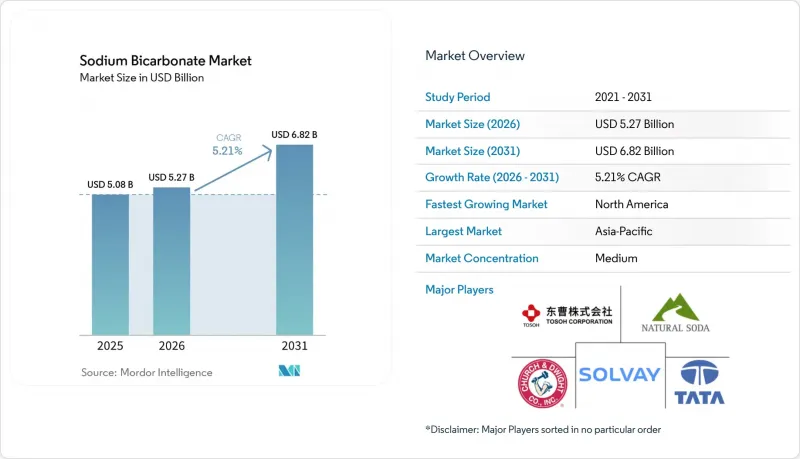
據 Mordor Intelligence 稱,2025 年碳酸氫鈉市值為 50.8 億美元,預計到 2031 年將達到 68.2 億美元,而 2026 年為 52.7 億美元,預測期(2026-2031 年)的複合年成長率為 5.21%。
本報告按等級(醫藥級、食品級、工業級、飼料級)、形態(粉末、液體、晶體、顆粒)、應用(食品飲料、藥品、動物飼料等)和地區(北美、歐洲、亞太、南美、中東和非洲)進行細分。市場預測以價值(美元)和數量(噸)表示。
全球碳酸氫鈉市場趨勢及洞察
對廢氣處理和排放控制的需求日益成長
碳酸氫鈉市場正受惠於垃圾焚化發電發電廠和工業燃燒設施日益嚴格的排放法規。在需要無水酸性氣體處理方法且只需簡單維修的場所,使用碳酸氫鈉的乾式吸附劑噴射技術正變得越來越受歡迎。發表在《RSC Advances》期刊上的一項研究表明,在溫度與氧氣比大於1且氧氣含量超過5%的條件下,碳酸氫鈉去除SO₂和NO的效率超過90%。此外,一項2025年的工程研究發現,利用垃圾焚化發電發電廠回收的CO₂在現場生產碳酸氫鈉在經濟上是可行的。這將降低物流成本,並在碳酸氫鈉市場內部創造需求。 2026年2月,歐盟委員會修訂了其排放交易框架中堿灰的基準值。這為合規性提供了一個更廣泛的框架,將鼓勵在受監管的工業環境中使用碳酸氫鈉。
在食品加工和烘焙領域不斷拓展應用。
碳酸氫鈉市場持續受益於其在麵包製作、糖果製作和加工食品製造中的廣泛功能。食品級碳酸氫鈉在許多包裝食品類別中發揮至關重要的作用,膨鬆劑、pH緩衝劑和酸度調節劑。美國農業部2025年的技術報告證實了其在肉品、烘焙點心、烘焙混合料和可可加工中的應用,並指出其已獲歐盟批准作為食品添加劑E500(ii)。 2025年,食品級碳酸氫鈉佔了35.48%的市場佔有率,推動了碳酸氫鈉市場的發展。這反映出市場需求廣泛,而非僅限於單一應用領域。在這一碳酸氫鈉市場細分領域,擁有清真認證和猶太潔食認證等品質認證的生產商更有可能成為大型食品製造商的首選供應商。
與替代排放氣體控制技術的競爭
碳酸氫鈉市場仍面臨來自成熟煙氣處理技術的競爭。許多大型燃煤發電廠仍普遍採用石灰石濕式煙氣脫硫(FGD)系統,這使得碳酸氫鈉乾式噴射的應用僅限於維修工程和濕式系統較不適用的工業設施。這種限制在北美尤為突出,儘管排放法規日益嚴格,但濕式FGD設備的部署規模仍然大規模。碳酸氫鈉市場也面臨來自垃圾焚化發電發電廠的選擇性催化還原(SCR)系統和活性碳噴射技術的競爭,因為這些技術可以將相同的排放合規預算分配給特定的污染物。儘管如此,對於那些優先考慮操作簡單、用水量少和快速部署的業者來說,碳酸氫鈉仍然是一個相當吸引人的選擇。
細分市場分析
截至2025年,食品級碳酸氫鈉將佔碳酸氫鈉市場規模的35.48%,成為本研究最大的市場區隔。其主導地位源自於其在烘焙、乳製品、休閒食品和飲料等領域作為膨鬆劑、pH緩衝劑和酸度調節劑的廣泛應用。美國農業部2025年技術報告證實了其在多種食品類別中的處理和使用,並提及了其已獲得歐盟E500(ii)認證。醫藥級碳酸氫鈉是碳酸氫鈉市場中成長最快的細分市場,預計2026年至2031年將以6.55%的複合年成長率成長。
塔塔化工歐洲公司在諾斯威奇投資6000萬歐元,顯示在當前供應缺口縮小之前,生產商正在對醫藥級碳酸氫鈉的生產進行大量投資。工業級和飼料領域,需求範圍廣泛,但價格容易受到經濟波動的影響。飼料級碳酸氫鈉在水產養殖中用作瘤胃緩衝劑、電解質調節劑和pH調節劑。 2025年發表在《印度動物營養雜誌》上的一項研究證實了飼料級碳酸氫鈉在羔羊育肥方面的表現優勢。
區域分析
到2025年,亞太地區將佔據碳酸氫鈉市場38.31%的佔有率,成為最大的區域市場。該地區的主導地位主要歸功於中國龐大的供應規模以及對食品、工業、飼料和醫藥級碳酸氫鈉的廣泛需求。隨著塔塔化工在2025會計年度於米塔普爾運作14萬噸新的碳酸氫鈉產能,印度正崛起為碳酸氫鈉市場的第二大成長中心。日本和韓國仍然是注重品質的市場,對食品和醫藥原料的需求強於對低規格通用產品的需求。內蒙古博源阿拉山口計畫新增產能的擴建表明,該地區碳酸氫鈉市場的供應基礎仍在擴大。
北美是碳酸氫鈉市場成長最快的地區,預計到2031年將以6.48%的複合年成長率成長。在美國,更嚴格的排放法規、部分醫藥供應鏈的本地化程度提高以及對潔淨標示食品配料的穩定需求,都為市場成長提供了有利因素。加拿大和墨西哥憑藉對食品加工和動物飼料的需求,為市場提供了更穩定的基礎,有助於平衡企劃為基礎的工業消費。歐洲仍然是碳酸氫鈉市場中一個成熟但重要的地區,德國、法國和英國對醫藥和廢氣處理的需求支撐著市場。同樣,政策支持至關重要,包括歐盟的排放法規結構以及英國對使用二氧化碳從堿灰生產的碳酸氫鈉的氣候變遷稅豁免(計劃於2026年春季生效)。
南美洲、中東和非洲仍然是碳酸氫鈉市場具有顯著長期成長潛力的地區。巴西和阿根廷透過畜牧業和飼料應用來支撐需求,而哥倫比亞和秘魯正在發展大規模包裝食品產業,預計在未來擴大食品級碳酸氫鈉的應用範圍。在中東,阿拉伯聯合大公國和沙烏地阿拉伯正在提高其在化學品和污水處理領域的產能,支撐了對碳酸氫鈉的需求。在非洲,南非、奈及利亞、摩洛哥和埃及在食品、工業和水處理應用方面都有需求,而目前較高的進口依賴度也為未來投資興建本地碳酸氫鈉產能留下了空間。
其他好處:
- Excel格式的市場預測(ME)表
- 3個月的分析師支持
目錄
第1章:引言
- 研究假設和市場定義
- 調查範圍
第2章:調查方法
第3章執行摘要
第4章 市場狀況
- 市場概覽
- 市場促進因素
- 對廢氣處理和排放氣體控制的需求日益成長
- 在食品加工和烘焙領域不斷拓展應用。
- 優先選擇無毒環保化學品
- 對高純度、特殊等級產品的需求不斷成長
- 工業清洗應用範圍的擴大
- 飼料和畜牧業需求增加
- 市場限制因素
- 透過替代排放氣體控制技術展開競爭
- 醫藥級和食品級產品均有嚴格的品質要求。
- 運輸成本、貨運費用和全球物流成本不斷上漲。
- 碳酸氫鈉生產過程中能源、水和公用事業成本增加。
- 供應鏈展望
- 監理情勢
- 技術展望
- 波特五力模型
第5章 市場規模與成長預測
- 按年級
- 醫藥級
- 食品級
- 工業級
- 飼料級
- 按形狀
- 粉末
- 液體
- 水晶
- 調色盤
- 透過使用
- 食品/飲料
- 製藥
- 動物飼料
- 水處理
- 產業
- 其他
- 按地區
- 北美洲
- 美國
- 加拿大
- 墨西哥
- 其他北美國家
- 歐洲
- 德國
- 英國
- 法國
- 義大利
- 西班牙
- 荷蘭
- 瑞典
- 波蘭
- 比利時
- 其他歐洲國家
- 亞太地區
- 中國
- 印度
- 日本
- 澳洲
- 韓國
- 越南
- 印尼
- 泰國
- 新加坡
- 其他亞太國家
- 南美洲
- 巴西
- 阿根廷
- 智利
- 秘魯
- 哥倫比亞
- 其他南美國家
- 中東和非洲
- 阿拉伯聯合大公國
- 沙烏地阿拉伯
- 南非
- 奈及利亞
- 埃及
- 摩洛哥
- 土耳其
- 其他中東和非洲國家
- 北美洲
第6章 競爭情勢
- 市場集中度
- 策略趨勢
- 市場排名分析
- 公司簡介
- Solvay SA
- Church and Dwight Co., Inc.
- Tata Chemicals Limited
- Natural Soda LLC
- Tosoh Corporation
- AGC Inc.
- Ciech SA
- Sisecam
- Novacap Group
- Ciner Group
- Bashkir Soda Company
- Kazan Soda Elektrik Uretim AS
- Nirma Limited
- Genesis Energy, LP
- JM Huber Corporation
- Inner Mongolia Yuanxing Energy Co., Ltd.
- Shandong Haihua Group Co., Ltd.
- Qingdao Soda Ash Co., Ltd.
- Tokuyama Corporation
- Asahi Kasei Corporation
第7章 市場機會與未來展望
According to Mordor Intelligence, the sodium bicarbonate market size was valued at USD 5.08 billion in 2025 and estimated to grow from USD 5.27 billion in 2026 to reach USD 6.82 billion by 2031, at a CAGR of 5.21% during the forecast period (2026-2031).
This report is Segmented by Grade (Pharma Grade, Food Grade, Industrial Grade, and Feed Grade), Form (Powder, Liquid, Crystal, and Pallets), Application (Food and Beverages, Pharmaceuticals, Animal Feed, and More), and Geography (North America, Europe, Asia-Pacific, South America, and Middle East and Africa). The Market Forecasts are Provided in Terms of Value (USD) and Volume (Tons).
Global Sodium Bicarbonate Market Trends and Insights
Growing Demand for Flue Gas Treatment and Emission Control
The sodium bicarbonate market is gaining from tighter emissions control rules at waste-to-energy plants and industrial combustion facilities. Dry sorbent injection using sodium bicarbonate is increasingly preferred where operators need a water-free acid-gas treatment route with simpler retrofit needs. Research published in RSC Advances showed that sodium bicarbonate achieved SO2 and NO removal efficiencies above 90% when the temperature-to-oxygen ratio stayed above 1 and oxygen content exceeded 5%. A 2025 engineering study also found that producing sodium bicarbonate on site from captured CO2 at waste-to-energy plants is economically viable, which can lower logistics costs and create captive demand inside the sodium bicarbonate market. In February 2026, the European Commission revised soda ash benchmark values under the emissions trading framework, which supports the broader compliance backdrop that is favoring sodium bicarbonate in regulated industrial settings.
Rising Applications in Food Processing and Bakery Production
The sodium bicarbonate market continues to benefit from the compound's wide functional role in bakery, confectionery, and processed food manufacturing. Food-grade sodium bicarbonate serves as a leavening agent, pH buffer, and acidity regulator, which keeps it relevant across many packaged food categories. A 2025 technical report from the U.S. Department of Agriculture confirmed its use in meat products, baked goods, baking mixes, and cocoa processing, and also noted its authorization in the European Union as food additive E500(ii). Food grade led the sodium bicarbonate market with a 35.48% share in 2025, which reflects broad demand rather than a narrow single-use base. In this part of the sodium bicarbonate market, producers with halal, kosher, and other quality credentials are better placed to win preferred-supplier status with large food manufacturers.
Competition from Alternative Emission Control Technologies
The sodium bicarbonate market still faces competition from established flue gas treatment technologies. Wet flue gas desulfurization systems that use limestone remain embedded in many large coal power plants, which limits sodium bicarbonate dry injection to retrofit projects and to industrial units where wet systems are less practical. This restraint is strongest in North America, where the installed base of wet FGD equipment remains large even as emissions requirements become tighter. The sodium bicarbonate market also competes with selective catalytic reduction systems and activated carbon injection at waste-to-energy sites, because those technologies can draw from the same compliance budgets for certain pollutants. Even so, sodium bicarbonate remains attractive where operators value simple handling, lower water dependence, and quicker implementation.
Other drivers and restraints analyzed in the detailed report include:
- Preference for Non-Toxic and Environmentally Friendly Chemicals
- Increasing Demand for High-Purity Specialty Grades
- Stringent Quality Requirements for Pharmaceutical and Food Grades
For complete list of drivers and restraints, kindly check the Table Of Contents.
Segment Analysis
Food grade accounted for 35.48% of the sodium bicarbonate market size in 2025, making it the largest grade segment in the study. Its leadership comes from broad use as a leavening agent, pH buffer, and acidity regulator across bakery, dairy, snack food, and beverage applications. The U.S. Department of Agriculture's 2025 technical report confirmed its handling and use across several food categories and also referenced its EU authorization as E500(ii). Pharma grade is the fastest-growing grade segment in the sodium bicarbonate market and is projected to grow at a 6.55% CAGR from 2026 to 2031.
Tata Chemicals Europe's EUR 60 million investment in Northwich shows how producers are committing large capital to pharmaceutical-grade output before the current supply gap narrows. Industrial grade and feed grade made up the balance of volume and remained important to the sodium bicarbonate industry because they are tied to heavy industrial use and to livestock nutrition. Industrial grade serves flue gas treatment, paper processing, textile manufacturing, and fire suppression, which links it closely to cyclical but broad demand. Feed grade works as a rumen buffer, an electrolyte regulator, and an aquaculture pH agent, and a 2025 study in the Indian Journal of Animal Nutrition supported its performance benefits in feedlot lambs.
Complete Report Scope:
- By Grade
- Pharma Grade
- Food Grade
- Industrial Grade
- Feed Grade
- By Form
- Powder
- Liquid
- Crystal
- Pallets
- By Applications
- Food and Beverages
- Pharmaceuticals
- Animal Feed
- Water Treatment
- Industrial
- Others
- By Geography
- North America
- United States
- Canada
- Mexico
- Rest of North America
- Europe
- Germany
- United Kingdom
- France
- Italy
- Spain
- Netherlands
- Sweden
- Poland
- Belgium
- Rest of Europe
- Asia-Pacific
- China
- India
- Japan
- Australia
- South Korea
- Vietnam
- Indonesia
- Thailand
- Singapore
- Rest of Asia-Pacific
- South America
- Brazil
- Argentina
- Chile
- Peru
- Colombia
- Rest of South America
- Middle East and Africa
- United Arab Emirates
- Saudi Arabia
- South Africa
- Nigeria
- Egypt
- Morocco
- Turkey
- Rest of Middle East and Africa
- North America
Geography Analysis
Asia-Pacific accounted for 38.31% of the sodium bicarbonate market in 2025, making it the largest regional segment. The region's lead comes from China's scale in supply and from broad demand across food, industrial, feed, and pharmaceutical grades. India is emerging as the second major growth center in the sodium bicarbonate market after Tata Chemicals commissioned 140,000 MT of new bicarbonate capacity at Mithapur in FY2025. Japan and South Korea remain quality-sensitive markets, with stronger demand for food-grade and pharmaceutical-grade material than for low-spec commodity volumes. New capacity additions at Inner Mongolia Boyuan's Alashankou project show that the regional supply base in the sodium bicarbonate market is still expanding.
North America is the fastest-growing region in the sodium bicarbonate market and is projected to expand at a 6.48% CAGR through 2031. The United States is benefiting from tighter emissions compliance, a push to localize parts of the pharmaceutical supply chain, and steady demand for cleaner-label food ingredients. Canada and Mexico provide more stable support through food processing and animal feed demand, which helps balance project-based industrial consumption. Europe remains a mature but important part of the sodium bicarbonate market, with Germany, France, and the United Kingdom anchoring pharmaceutical and flue gas treatment demand. Policy support also matters here, including the EU regulatory framework on emissions and the UK Climate Change Levy exemption for sodium bicarbonate produced from soda ash using carbon dioxide, which takes effect in Spring 2026.
South America and the Middle East and Africa remain longer-horizon growth regions in the sodium bicarbonate market. Brazil and Argentina support demand through livestock and feed applications, while Colombia and Peru are building larger packaged food bases that can lift food-grade use over time. In the Middle East, the UAE and Saudi Arabia are adding chemical processing and wastewater treatment capacity that supports sodium bicarbonate demand. In Africa, South Africa, Nigeria, Morocco, and Egypt show demand across food, industrial, and water treatment uses, and current import dependence leaves room for future local capacity investment in the sodium bicarbonate market.
- Solvay S.A.
- Church and Dwight Co., Inc.
- Tata Chemicals Limited
- Natural Soda LLC
- Tosoh Corporation
- AGC Inc.
- Ciech S.A.
- Sisecam
- Novacap Group
- Ciner Group
- Bashkir Soda Company
- Kazan Soda Elektrik Uretim A.S.
- Nirma Limited
- Genesis Energy, L.P.
- J.M. Huber Corporation
- Inner Mongolia Yuanxing Energy Co., Ltd.
- Shandong Haihua Group Co., Ltd.
- Qingdao Soda Ash Co., Ltd.
- Tokuyama Corporation
- Asahi Kasei Corporation
Additional Benefits:
- The market estimate (ME) sheet in Excel format
- 3 months of analyst support
TABLE OF CONTENTS
1 INTRODUCTION
- 1.1 Study Assumptions and Market Definition
- 1.2 Scope of the Study
2 RESEARCH METHODOLOGY
3 EXECUTIVE SUMMARY
4 MARKET LANDSCAPE
- 4.1 Market Overview
- 4.2 Market Drivers
- 4.2.1 Growing Demand for Flue Gas Treatment and Emission Control
- 4.2.2 Rising Applications in Food Processing and Bakery Production
- 4.2.3 Preference for Non-Toxic and Environmentally Friendly Chemicals
- 4.2.4 Increasing Demand for High-Purity Specialty Grades
- 4.2.5 Growth in Industrial Cleaning Applications
- 4.2.6 Increasing Demand in Animal Feed and Livestock Industries
- 4.3 Market Restraints
- 4.3.1 Competition from Alternative Emission Control Technologies
- 4.3.2 Stringent Quality Requirements for Pharmaceutical and Food Grades
- 4.3.3 Rising Transportation, Freight, and Global Logistics Costs
- 4.3.4 Increasing Energy, Water, and Utility Expenses in Sodium Bicarbonate Manufacturing
- 4.4 Supply Chain Outlook
- 4.5 Regulatory Landscape
- 4.6 Technological Outlook
- 4.7 Porter's Five Forces
- 4.7.1 Bargaining Power of Suppliers
- 4.7.2 Bargaining Power of Buyers
- 4.7.3 Threat of New Entrants
- 4.7.4 Threat of Substitutes
- 4.7.5 Competitive Rivalry
5 MARKET SIZE AND GROWTH FORECASTS (VALUE AND VOLUME)
- 5.1 By Grade
- 5.1.1 Pharma Grade
- 5.1.2 Food Grade
- 5.1.3 Industrial Grade
- 5.1.4 Feed Grade
- 5.2 By Form
- 5.2.1 Powder
- 5.2.2 Liquid
- 5.2.3 Crystal
- 5.2.4 Pallets
- 5.3 By Applications
- 5.3.1 Food and Beverages
- 5.3.2 Pharmaceuticals
- 5.3.3 Animal Feed
- 5.3.4 Water Treatment
- 5.3.5 Industrial
- 5.3.6 Others
- 5.4 By Geography
- 5.4.1 North America
- 5.4.1.1 United States
- 5.4.1.2 Canada
- 5.4.1.3 Mexico
- 5.4.1.4 Rest of North America
- 5.4.2 Europe
- 5.4.2.1 Germany
- 5.4.2.2 United Kingdom
- 5.4.2.3 France
- 5.4.2.4 Italy
- 5.4.2.5 Spain
- 5.4.2.6 Netherlands
- 5.4.2.7 Sweden
- 5.4.2.8 Poland
- 5.4.2.9 Belgium
- 5.4.2.10 Rest of Europe
- 5.4.3 Asia-Pacific
- 5.4.3.1 China
- 5.4.3.2 India
- 5.4.3.3 Japan
- 5.4.3.4 Australia
- 5.4.3.5 South Korea
- 5.4.3.6 Vietnam
- 5.4.3.7 Indonesia
- 5.4.3.8 Thailand
- 5.4.3.9 Singapore
- 5.4.3.10 Rest of Asia-Pacific
- 5.4.4 South America
- 5.4.4.1 Brazil
- 5.4.4.2 Argentina
- 5.4.4.3 Chile
- 5.4.4.4 Peru
- 5.4.4.5 Colombia
- 5.4.4.6 Rest of South America
- 5.4.5 Middle East and Africa
- 5.4.5.1 United Arab Emirates
- 5.4.5.2 Saudi Arabia
- 5.4.5.3 South Africa
- 5.4.5.4 Nigeria
- 5.4.5.5 Egypt
- 5.4.5.6 Morocco
- 5.4.5.7 Turkey
- 5.4.5.8 Rest of Middle East and Africa
- 5.4.1 North America
6 COMPETITIVE LANDSCAPE
- 6.1 Market Concentration
- 6.2 Strategic Moves
- 6.3 Market Ranking Analysis
- 6.4 Company Profiles (Includes Global-level Overview, Market-level Overview, Core Segments, Financials, Strategic Info, Market Rank/Share, Products & Services, Recent Developments)
- 6.4.1 Solvay S.A.
- 6.4.2 Church and Dwight Co., Inc.
- 6.4.3 Tata Chemicals Limited
- 6.4.4 Natural Soda LLC
- 6.4.5 Tosoh Corporation
- 6.4.6 AGC Inc.
- 6.4.7 Ciech S.A.
- 6.4.8 Sisecam
- 6.4.9 Novacap Group
- 6.4.10 Ciner Group
- 6.4.11 Bashkir Soda Company
- 6.4.12 Kazan Soda Elektrik Uretim A.S.
- 6.4.13 Nirma Limited
- 6.4.14 Genesis Energy, L.P.
- 6.4.15 J.M. Huber Corporation
- 6.4.16 Inner Mongolia Yuanxing Energy Co., Ltd.
- 6.4.17 Shandong Haihua Group Co., Ltd.
- 6.4.18 Qingdao Soda Ash Co., Ltd.
- 6.4.19 Tokuyama Corporation
- 6.4.20 Asahi Kasei Corporation
7 MARKET OPPORTUNITIES AND FUTURE OUTLOOK

 碳酸氫鈉市場-2026-2032年全球市場預測
 北美碳酸氫鈉市場:市場佔有率分析、產業趨勢與統計及成長預測(2026-2031)
 碳酸氫鈉全球市場規模、佔有率、趨勢和成長分析報告(2026-2034)依應用、終端用戶產業、純度等級及劑型分類的亞硫酸氫鈉市場-2026-2032年全球預測
 碳酸氫鈉市場規模、佔有率和成長分析(按等級類型、形態、最終用途和地區分類)-2026-2033年產業預測碳酸氫鈉市場-2025-2030年全球預測
 碳酸氫鈉-全球市佔率及排名、總收入及需求預測(2025-2031年)
 碳酸氫鈉市場機會、成長動力、產業趨勢分析及 2025 - 2034 年預測
 全球碳酸氫鈉市場:成長、未來展望與競爭分析(2024-2032 年)