


 |
市場調查報告書
商品編碼
2097415
北美整合工作場所管理系統 (IWMS):市場佔有率分析、行業趨勢和統計數據以及成長預測 (2026-2031)North America Integrated Workplace Management System (IWMS) - Market Share Analysis, Industry Trends & Statistics, Growth Forecasts (2026 - 2031) |
||||||

※ 本網頁內容可能與最新版本有所差異。詳細情況請與我們聯繫。
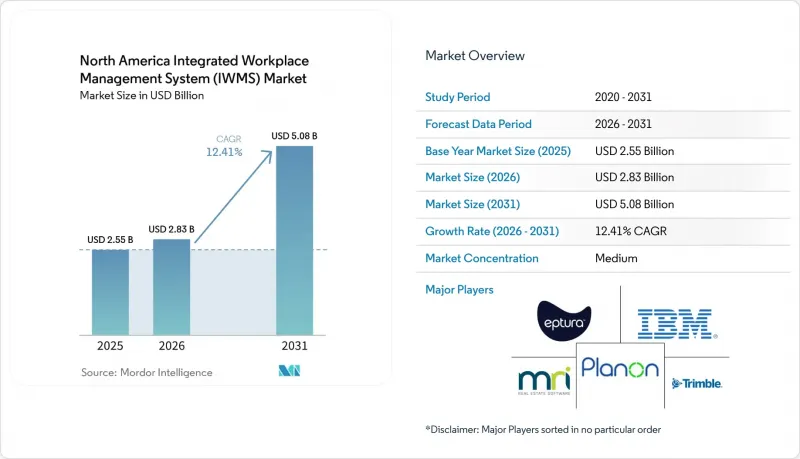
據 Mordor Intelligence 稱,北美整合工作場所管理系統 (IWMS) 市場在 2025 年的價值為 25.5 億美元,在 2026 年的價值為 28.3 億美元,預計到 2031 年將達到 50.8 億美元,從 2026 億美元,預計到 2031 年將達到 50.8 億美元,從 2026 年到 2031 年的複合年成長率。
本報告按產品/服務(解決方案和服務)、部署方式(雲端、本地部署、混合部署)、企業規模(大型企業和中小企業)、最終用戶行業(銀行、金融服務和保險、醫療保健和生命科學、零售和電子商務、工業製造等)以及地區進行細分。市場預測以美元計價。
北美整合工作場所管理系統 (IWMS) 市場趨勢與洞察
最佳化大規模投資組合中的混合辦公和辦公桌佈局
系統化的混合辦公模式正逐漸成為大規模企業營運的標準,這為北美整合工作場所管理系統 (IWMS) 市場創造了更清晰的應用情境。根據一項針對 84 家機構和 7.16 億平方英尺辦公空間的 2026 年基準調查,北美實際利用率與目標利用率之間的差距仍然是全球最大的,實際利用率為 41%,而目標利用率為 77%。該基準調查還顯示,每週在辦公室工作 3-4 天的員工比例預計將從 2025 年的 36% 上升到 2026 年的 55%,而完全遠距辦公的員工比例預計將從 18% 下降到 10%,這表明需求正日益集中在每週更有限的幾個時段。這種趨勢正在削弱傳統空間分配方法的可靠性,因為高峰日的客流量比平均出勤率更為重要。此外,實施混合辦公模式的理由也從簡單的成本管理轉變為避免容量短缺,以免削弱強制返崗計畫的實施。因此,空間分析、預約管理和使用率預測正變得越來越重要,成為各區域市場的關鍵採購優先事項。
工作場所和設施管理軟體的雲端遷移
雲端遷移正在持續改變北美整合工作場所管理系統 (IWMS) 市場的軟體採購方式。這是因為企業越來越傾向於持續採用 SaaS 模式,而非資本密集的本地部署。 2026 年 4 月,Planon 將 IWMS 上架 AWS Marketplace,讓客戶能夠利用現有的 AWS 企業折扣計畫抵扣額度進行採購,降低常見的預算門檻。此舉反映了供應商與超大規模資料中心業者雲端服務商合作採購管道以縮短核准流程並降低 IT 阻力的更廣泛趨勢。儘管預計到 2025 年雲端市場佔有率將達到 66.80%,但高度監管行業中本地部署的持續成長表明,買家並非孤立地選擇單一模式。相反,越來越多的組織正在採用混合部署結構,例如將敏感工作負載保留在私有基礎架構上,同時將管理模組遷移到雲端。此外,SAP 將 2027 年 12 月 31 日設定為其 HCM 本地解決方案維護的終止日期,這也促使相關應用程式發生變化,進一步增加了對具有強大 SAP 連接器的雲端 IWMS 平台的需求。
引進週期長以及變革管理所帶來的摩擦
部署週期過長仍然是北美整合工作場所管理系統 (IWMS) 市場的一大障礙。這是因為企業的專案通常需要 12 到 24 個月才能全面運作。這段時間不僅包括軟體配置,還包括流程重組、資料遷移和跨職能協調。一項 2026 年的基準調查顯示,儘管混合工作模式的複雜性日益增加,但擁有正式變更管理專案的企業比例卻從 2025 年的 40% 下降到 2026 年的 31%。中型企業負責人對此感受特別強烈,因為他們通常缺乏大型企業用於協調企劃團隊和日常營運的管治結構。雖然供應商試圖透過預置模板和行業特定的加速器來減輕負擔,但這些方法往往會縮小初始部署階段的範圍,並將一些功能推遲到後續投資。這會縮短實現價值的時間,如果客戶無法迅速從初始部署過渡到全面使用,還會拖慢供應商累積績效的速度。
細分市場分析
到2025年,該解決方案將佔據北美整合工作場所管理系統(IWMS)市場71.30%的佔有率,顯示大規模買家仍更傾向於整合平台而非多個獨立工具。北美整合工作場所管理系統(IWMS)行業的這一細分市場涵蓋房地產和租賃管理、空間和設施管理、資產和維護管理、資本項目管理、工作場所體驗和分析,以及永續發展和ESG(環境、社會和治理)信息,所有這些都基於單一數據模型。這種吸引力在於其實用性,因為使用非整合工具,企業需要客製化資料處理才能產生全公司範圍的報告。仲量聯行(JLL)的報告顯示,69%的企業房地產團隊將單一可靠的空間資料資訊來源列為2026年的優先事項,這進一步印證了整合解決方案的持續主導地位。在眾多解決方案中,工作場所體驗和分析是最活躍的領域之一,這主要源於企業對結構化混合辦公模式下高峰日需求的日益成長的了解。
此外,在北美整合工作管理系統 (IWMS) 市場,隨著延期續約需求和報告截止日期的延長變得越來越困難,資本項目管理和永續性相關模組的重要性日益凸顯。 2026 年 4 月,Gordian 宣布,高等教育機構的資本更新項目積壓成本在 2025 年達到每平方英尺總占地面積156 美元,年增 8%。這凸顯了對專案和生命週期管理工具日益成長的需求。大規模平台部署後,通常需要實施、整合和託管支持,預計到 2031 年,服務市場將以 16.84% 的複合年成長率成長。隨著實施支援、更新和客戶成功擴大納入訂閱模式,解決方案和服務之間的界線也變得模糊。這一趨勢增加了現有供應商的轉換成本,同時也讓買家更清楚地了解長期擁有成本。
預計到2025年,雲端將佔據北美整合工作場所管理系統 (IWMS) 市場佔有率的66.80%,而本地部署市場預計到2031年將以15.27%的複合年成長率成長。這一趨勢並非顯示人們對雲端的偏好發生了逆轉。相反,它反映了政府機構、國防相關企業、醫療保健提供者和金融機構仍然需要在託管基礎設施上保留一些建築和人員佔用資料這一現實。在這些產業中,買家擴大選擇混合部署模式,將合規性至關重要的工作負載保留在私有環境中,同時將較不重要的工作負載遷移到公共雲端環境。這為能夠同時支援雲端、本地部署和託管私有雲端選項且不影響用戶體驗的供應商創造了新的商機。
江森自控在2026年發布的報告顯示,63%的美國大學高階主管計劃在未來一年內將生成式人工智慧應用於營運和維護。這進一步增加了架構的複雜性,因為建築資料通常需要低延遲存取。 SAP計劃於2027年底停止對「本地部署HCM」的支持,這也促使人們重新審視相關的工作負載,這對擁有與SAP雲端進行強大整合路徑的IWMS供應商來說是一個優勢。因此,北美整合工作場所管理系統(IWMS)市場的買家不再將柔軟性和控制力作為兩個獨立的目標,而是同時追求兩者。供應商之間的差異化越來越取決於平台在滿足安全性和資料儲存要求的同時,能否兼顧可擴展性和易於升級性。
其他好處:
- Excel格式的市場預測(ME)表
- 3個月的分析師支持
目錄
第1章:引言
- 研究假設和市場定義
- 調查範圍
第2章:調查方法
第3章執行摘要
第4章 市場狀況
- 市場概覽
- 市場促進因素
- 最佳化大型投資組合中的混合辦公和辦公桌佈局
- 職場和設施管理軟體的雲端遷移
- 永續發展報告和建築脫碳要求
- 與ERP、HRIS、BIM和建築系統整合
- 投資組合合理化和降低房地產成本
- 用於公共部門現代化和高等教育的支出
- 市場限制因素
- 引進週期延長與變革管理中的摩擦
- 與傳統企業系統整合具有高度複雜性
- 對資料安全、隱私和管治的擔憂
- 由於優先發展相互競爭的職場技術,預算面臨壓力。
- 產業價值鏈分析
- 監理情勢
- 技術展望
- 宏觀經濟因素對市場的影響
- 波特五力分析
第5章 市場規模與成長預測
- 報價
- 解決方案
- 房地產和租賃管理
- 設施和空間管理
- 資產和維護管理
- 資本項目管理
- 工作場所經驗與分析
- 永續性和ESG智慧(嵌入式/疊加層)
- 服務
- 解決方案
- 不同的發展
- 雲
- 現場
- 混合
- 按公司規模
- 大公司
- 小型企業
- 按最終用戶行業分類
- BFSI
- 醫療保健和生命科學
- 資訊科技/通訊
- 零售與電子商務
- 工業製造
- 政府/公共部門
- 其他終端用戶產業
- 按地區
- 美國
- 加拿大
- 墨西哥
第6章 競爭情勢
- 市場集中度
- 策略趨勢
- 市佔率分析
- 公司簡介
- IBM Corporation
- Planon Group BV
- MRI Software LLC
- Trimble Inc.
- Eptura, Inc.
- Accruent LLC
- ServiceNow, Inc
- FM:Systems Group, LLC
- Spacewell International NV
- Nuvolo, Inc.
- Tango Analytics LLC
- Johnson Controls International plc
- SAP SE
- Service Works Global Limited
- MCS Solutions NV
- OfficeSpace Software, Inc.
- Facilio, Inc.
- Oracle Corporation
- AssetWorks, LLC
- Skedda Pty Ltd.
第7章 市場機會與未來展望
According to Mordor Intelligence, the North America integrated workplace management system (IWMS) market size was valued at USD 2.55 billion in 2025, USD 2.83 billion in 2026, and is forecast to reach USD 5.08 billion by 2031, growing at a CAGR of 12.41% over 2026-2031.
This report is Segmented by Offering (Solutions, and Services), Deployment (Cloud, On-Premises, and Hybrid), Enterprise Size (Large Enterprises, and Small and Medium Enterprises), End-User Industry (BFSI, Healthcare and Life Sciences, Retail and E-Commerce, Industrial Manufacturing, and More), and Geography. The Market Forecasts are Provided in Terms of Value (USD).
North America Integrated Workplace Management System (IWMS) Market Trends and Insights
Hybrid Work And Desk Optimization Across Large Portfolios
Structured hybrid work has become the operating baseline across large employers, creating a clearer use case for the North America Integrated Workplace Management System (IWMS) market. The 2026 benchmark, which covered 84 organizations and 716 million square feet, shows that North America still has the widest actual-to-target utilization gap globally, with actual utilization at 41% against a 77% target. The same benchmark shows that the share of employees attending 3-4 in-office days a week rose to 55% in 2026 from 36% in 2025, while fully remote work fell to 10% from 18%, pushing more demand into a narrower part of the workweek. That pattern makes older space-allocation methods less dependable, because peak-day pressure now matters more than average attendance. It also shifts the buying case away from simple cost control and toward avoiding capacity failures that weaken mandated return-to-office programs. As a result, space analytics, reservation management, and occupancy forecasting are moving closer to core buying priorities across the regional market.
Cloud Migration Of Workplace And Facilities Software
Cloud migration continues to reshape software buying in the North America Integrated Workplace Management System (IWMS) market, as enterprises now prefer recurring SaaS deployments over capital-intensive on-premises rollouts. Planon listed its IWMS on AWS Marketplace in April 2026, allowing customers to apply existing AWS Enterprise Discount Program credits to procurement and lowering a common budget barrier. That move reflects a broader pattern in which vendors align with hyperscaler purchasing channels to shorten approvals and reduce IT resistance. Cloud held 66.80% share in 2025, yet the continued growth of on-premises deployments in regulated sectors shows that buyers are not choosing one model in isolation. Instead, more organizations are adopting mixed deployment structures in which sensitive workloads remain on private infrastructure while administrative modules move to the cloud. SAP's December 31, 2027, maintenance deadline for HCM On-Premise also supports adjacent application changes that create additional pull for cloud-ready IWMS platforms with strong SAP connectors.
Long Implementation Cycles And Change-Management Friction
Implementation length remains a practical drag on the North America Integrated Workplace Management System market because enterprise programs often take 12-24 months to reach full operating scope. That time frame reflects process redesign, data migration, and cross-functional alignment needs, not just software setup. The 2026 benchmark showed that organizations running formal change-management programs fell to 31% in 2026 from 40% in 2025, even as hybrid work planning became more complex. Mid-market buyers feel this more sharply because they usually do not have the governance structures that large enterprises use to coordinate project teams and ongoing operations. Vendors are trying to reduce the burden with pre-built templates and vertical accelerators, but those methods often narrow the first deployment phase and leave some capabilities for later investment. This keeps time-to-value under pressure and can slow reference building for vendors when customers do not move quickly from initial rollout to full usage.
Other drivers and restraints analyzed in the detailed report include:
- Sustainability Reporting And Building Decarbonization Requirements
- Integration With ERP, HRIS, BIM, And Building Systems
- High Integration Complexity With Legacy Enterprise Systems
For complete list of drivers and restraints, kindly check the Table Of Contents.
Segment Analysis
Solutions held 71.30% of the North America Integrated Workplace Management System (IWMS) market in 2025, indicating that large buyers still favor unified platforms over multiple point tools. This part of the North America Integrated Workplace Management System (IWMS) industry covers real estate and lease management, space and facilities management, asset and maintenance management, capital project management, workplace experience and analytics, and sustainability and ESG intelligence under one data model. The appeal is practical because disconnected tools need custom data handling before enterprises can generate portfolio-wide reporting. JLL reported that 69% of corporate real estate teams identified a single source of truth for space data as a 2026 priority, which supports the continued dominance of integrated solutions. Within the solutions stack, workplace experience and analytics have become among the most active areas, as companies need better visibility into peak-day demand under structured hybrid work.
Capital project management and sustainability modules are also gaining weight within the North America IWMS market as deferred renewal needs and reporting deadlines become harder to postpone. Gordian said in April 2026 that the higher education capital renewal backlog reached USD 156 per gross square foot in 2025, up 8% year over year, which supports stronger demand for project and lifecycle tools. Services are projected to grow at a 16.84% CAGR through 2031, as implementation, integration, and managed support typically follow large platform deployments. The boundary between solutions and services is also becoming less clear as subscription models increasingly bundle rollout support, updates, and customer success into recurring contracts. That trend raises switching costs for incumbents, while also making long-term ownership costs more visible for buyers.
On-premises is projected to expand at a 15.27% CAGR through 2031, even though cloud held 66.80% of the North America Integrated Workplace Management System (IWMS) market share in 2025. This pattern does not signal a reversal of cloud preference. Instead, it reflects how government agencies, defense contractors, healthcare providers, and financial institutions continue to hold some building and occupancy data on controlled infrastructure. In these segments, buyers are increasingly selecting hybrid deployment models so that compliance-sensitive workloads remain private while less-sensitive workloads move to public cloud environments. That creates room for vendors that can support cloud, on-premises, and hosted private-cloud options without splitting the user experience.
Johnson Controls reported in 2026 that 63% of US university leaders planned to implement generative AI for operations and maintenance over the next year, adding another layer of architectural complexity, as building data often requires low-latency access. SAP's scheduled end of maintenance for HCM On-Premise at the end of 2027 is also pushing adjacent workload reviews that benefit IWMS vendors with stronger SAP cloud integration paths. Buyers in the North America Integrated Workplace Management System market are therefore not deciding between flexibility and control as separate goals. They are asking for both at the same time. Vendor differentiation increasingly depends on how well platforms can meet security and residency needs without giving up scalability or easier upgrades.
Complete Report Scope:
- By Offering
- Solution
- Real Estate and Lease Management
- Facilities and Space Management
- Asset and Maintenance Management
- Capital Project Management
- Workplace Experience and Analytics
- Sustainability and ESG Intelligence (embedded/overlay layer)
- Services
- Solution
- By Deployment
- Cloud
- On-Premises
- Hybrid
- By Enterprise Size
- Large Enterprises
- Small and Medium Enterprises
- By End-user Industry
- BFSI
- Healthcare and Life Sciences
- Information Technology and Telecom
- Retail and E-commerce
- Industrial Manufacturing
- Government and Public Sector
- Other End-user Industries
- By Geography
- United States
- Canada
- Mexico
List of Companies Covered in this Report:
- IBM Corporation
- Planon Group B.V.
- MRI Software LLC
- Trimble Inc.
- Eptura, Inc.
- Accruent LLC
- ServiceNow, Inc
- FM:Systems Group, LLC
- Spacewell International NV
- Nuvolo, Inc.
- Tango Analytics LLC
- Johnson Controls International plc
- SAP SE
- Service Works Global Limited
- MCS Solutions NV
- OfficeSpace Software, Inc.
- Facilio, Inc.
- Oracle Corporation
- AssetWorks, LLC
- Skedda Pty Ltd.
Additional Benefits:
- The market estimate (ME) sheet in Excel format
- 3 months of analyst support
TABLE OF CONTENTS
1 INTRODUCTION
- 1.1 Study Assumptions and Market Definition
- 1.2 Scope of the Study
2 RESEARCH METHODOLOGY
3 EXECUTIVE SUMMARY
4 MARKET LANDSCAPE
- 4.1 Market Overview
- 4.2 Market Drivers
- 4.2.1 Hybrid Work and Desk Optimization Across Large Portfolios
- 4.2.2 Cloud Migration of Workplace and Facilities Software
- 4.2.3 Sustainability Reporting and Building Decarbonization Requirements
- 4.2.4 Integration With ERP, HRIS, BIM, and Building Systems
- 4.2.5 Portfolio Rationalization and Real Estate Cost Reduction
- 4.2.6 Public Sector and Higher Education Modernization Spending
- 4.3 Market Restraints
- 4.3.1 Long Implementation Cycles and Change-Management Friction
- 4.3.2 High Integration Complexity With Legacy Enterprise Systems
- 4.3.3 Data Security, Privacy, and Governance Concerns
- 4.3.4 Budget Pressure From Competing Workplace Technology Priorities
- 4.4 Industry Value-Chain Analysis
- 4.5 Regulatory Landscape
- 4.6 Technological Outlook
- 4.7 Impact of Macroeconomic Factors on the Market
- 4.8 Porter's Five Forces Analysis
- 4.8.1 Threat of New Entrants
- 4.8.2 Bargaining Power of Suppliers
- 4.8.3 Bargaining Power of Buyers
- 4.8.4 Threat of Substitutes
- 4.8.5 Intensity of Competitive Rivalry
5 MARKET SIZE AND GROWTH FORECASTS (VALUE)
- 5.1 By Offering
- 5.1.1 Solution
- 5.1.1.1 Real Estate and Lease Management
- 5.1.1.2 Facilities and Space Management
- 5.1.1.3 Asset and Maintenance Management
- 5.1.1.4 Capital Project Management
- 5.1.1.5 Workplace Experience and Analytics
- 5.1.1.6 Sustainability and ESG Intelligence (embedded/overlay layer)
- 5.1.2 Services
- 5.1.1 Solution
- 5.2 By Deployment
- 5.2.1 Cloud
- 5.2.2 On-Premises
- 5.2.3 Hybrid
- 5.3 By Enterprise Size
- 5.3.1 Large Enterprises
- 5.3.2 Small and Medium Enterprises
- 5.4 By End-user Industry
- 5.4.1 BFSI
- 5.4.2 Healthcare and Life Sciences
- 5.4.3 Information Technology and Telecom
- 5.4.4 Retail and E-commerce
- 5.4.5 Industrial Manufacturing
- 5.4.6 Government and Public Sector
- 5.4.7 Other End-user Industries
- 5.5 By Geography
- 5.5.1 United States
- 5.5.2 Canada
- 5.5.3 Mexico
6 COMPETITIVE LANDSCAPE
- 6.1 Market Concentration
- 6.2 Strategic Moves
- 6.3 Market Share Analysis
- 6.4 Company Profiles (includes Global Level Overview, Market Level Overview, Core Segments, Financials as available, Strategic Information, Market Rank/Share, Products and Services, Recent Developments)
- 6.4.1 IBM Corporation
- 6.4.2 Planon Group B.V.
- 6.4.3 MRI Software LLC
- 6.4.4 Trimble Inc.
- 6.4.5 Eptura, Inc.
- 6.4.6 Accruent LLC
- 6.4.7 ServiceNow, Inc
- 6.4.8 FM:Systems Group, LLC
- 6.4.9 Spacewell International NV
- 6.4.10 Nuvolo, Inc.
- 6.4.11 Tango Analytics LLC
- 6.4.12 Johnson Controls International plc
- 6.4.13 SAP SE
- 6.4.14 Service Works Global Limited
- 6.4.15 MCS Solutions NV
- 6.4.16 OfficeSpace Software, Inc.
- 6.4.17 Facilio, Inc.
- 6.4.18 Oracle Corporation
- 6.4.19 AssetWorks, LLC
- 6.4.20 Skedda Pty Ltd.
7 MARKET OPPORTUNITIES AND FUTURE OUTLOOK
- 7.1 White-Space and Unmet-Need Assessment

 整合工作場所管理系統市場-2026-2032年全球市場預測
 2026年全球職場人工智慧(AI)市場報告
 融合工作站市場分析及預測(至2035年):依類型、產品類型、服務、技術、組件、應用、部署類型、最終用戶及功能分類
 全球整合工作場所管理系統(IWMS)市場規模、佔有率、趨勢和成長分析報告(2026-2034年)
 整合工作場所管理系統市場規模、佔有率和成長分析(按產品類型、部署類型、企業規模、最終用途和地區分類)-2026-2033年產業預測
 2032 年神經包容性穿戴裝置市場預測:按裝置類型、整合模式、技術、應用、最終用戶和地區進行的全球分析2032 年神經包容性職場市場預測:按產品、軟體類型、神經多樣性人群、就業生命週期階段、組織規模、最終用戶和地區進行的全球分析
 整合工作場所管理系統 (IWMS):市場佔有率分析、行業趨勢、統計數據和成長預測 (2025-2030)