


 |
市場調查報告書
商品編碼
2097408
RAID 控制器卡:市場佔有率分析、行業趨勢和統計數據、成長預測(2026-2031 年)RAID Controller Card - Market Share Analysis, Industry Trends & Statistics, Growth Forecasts (2026 - 2031) |
||||||

※ 本網頁內容可能與最新版本有所差異。詳細情況請與我們聯繫。
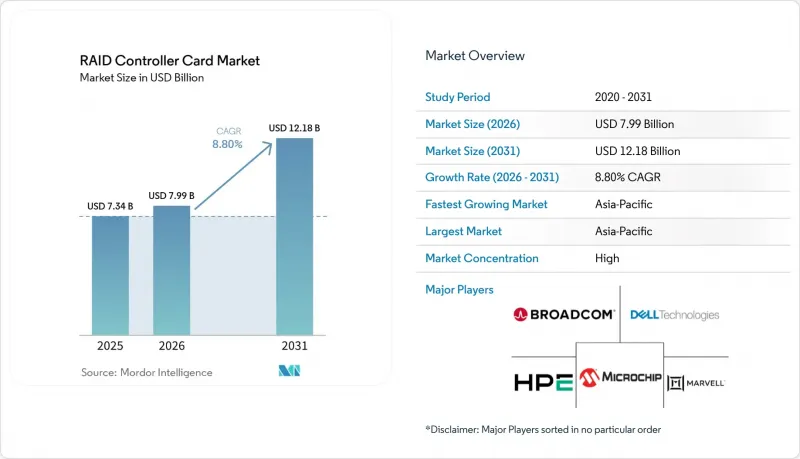
根據 Mordor Intelligence 預測,RAID 控制器卡市場規模將從 2025 年的 73.4 億美元和 2026 年的 79.9 億美元成長到 2031 年的 121.8 億美元,2026 年至 2031 年的複合年成長率為 8.8%。
本報告按介面(SATA、SAS、NVMe、光纖通道等)、外形尺寸(PCIe RAID 控制器卡、外部 RAID 控制器卡等)、應用程式(伺服器、儲存系統等)、最終用戶(資料中心、雲端服務供應商、企業、政府和國防、醫療保健、製造業等)以及地區進行細分。市場預測以美元(USD)為單位。
全球 RAID 控制器卡市場趨勢與洞察
超大規模和企業資料中心擴展
超大規模領域的資本投入正推動 RAID(獨立磁碟冗餘陣列)控制器卡市場的採購週期超越典型的伺服器更換週期。 AWS 正在投資 500 億美元,用於擴展其美國政府雲端區域的人工智慧和高效能運算 (HPC) 容量,該專案已進入全面開發階段,預計到 2026 年容量將增加約 1.3 GW。隨著機架密度目標的提高,每個伺服器中需要控制器支援的高速儲存設備數量也在增加,因此這項投資意義重大。企業市場買家也在向 PCIe Gen5 遷移,這意味著新的伺服器基準需要能夠支援更快 NVMe 背板和 24 Gbps SAS 連接的最新一代控制器。超大規模擴展和企業平台升級的結合,使得 RAID 控制器卡市場的需求週期比之前的 PCIe Gen3 到 Gen4 過渡週期更長。
儲存背板向 NVMe 和 PCIe Gen5 的遷移
隨著 PCIe Gen5 的部署,RAID(獨立磁碟冗餘陣列)控制器卡市場正經歷近年來最重大的平台轉型之一。博通的 97xx MegaRAID 適配器,結合了 PCIe 5.0 x16 主機介面和 24 Gbps SAS 三模支持,適用於混合硬碟環境,已成為當前企業級市場的標竿。戴爾的 PERC13 H975i 在測試中實現了 52.5 GB/s 的最大吞吐量和 1250 萬 IOPS 的峰值性能,寫入頻寬較上一代產品提升了 318%。這進一步凸顯了新型硬體 RAID 與基於主機的替代解決方案之間的效能差距。隨著 Gen5 速度的提升,軟體 RAID 需要更多 CPU 週期進行奇偶校驗處理,這使得專用卸載引擎在 RAID 控制器卡市場的價值更加凸顯。 Microchip 的 Adaptec SmartRAID 4300 透過將異或運算轉移到專用加速晶片上,同時保持從 CPU 到 NVMe 的直接資料路徑,解決了這項變更。該公司表示,與前幾代硬體 RAID 相比,其效能提升高達 7 倍。
向軟體定義儲存和糾刪編碼過渡
向軟體定義儲存的轉變是 RAID 控制器卡市場面臨的最顯著的結構性限制因素之一。在物件儲存、橫向擴充檔案系統和超融合環境中,分散式容錯機制正日益取代節點層級控制器邏輯,從而降低了某些部署場景下對專用卡的需求。這種壓力在以 Ceph、Lustre、MinIO 和類似平台為中心的架構中尤為突出,因為這些架構的冗餘管理是在整個叢集而非單一伺服器內部進行的。此外,高容量 NVMe SSD 的普及使得重建行為成為更明顯的設計挑戰,促使買家重新評估傳統硬體 RAID 仍然能夠提供最佳權衡的場景。儘管如此,在受監管的資料庫、裸機系統和對效能要求極高的環境中,RAID 控制器卡市場依然保持強勁勢頭,因為在這些環境中,僅靠軟體難以實現確定性延遲、快取保護寫入和斷電保護等功能。
細分市場分析
到 2025 年,SAS 將在 RAID 控制器卡市場佔據 45.38% 的佔有率,這充分展現了其在企業級陣列、關鍵任務叢集和磁帶儲存環境中的龐大部署規模。如此龐大的部署規模意義重大,因為這些環境中的更新換代更多是由伺服器的迭代更新驅動,而非高速介面的過時。在核心企業環境中更換控制器時,買家仍優先考慮向後相容性、可預測的韌體行為以及長期認證記錄。雖然 SATA 仍然用於對成本敏感的儲存和歸檔應用場景,但隨著 SSD 密度的提高以及 NVMe 在高容量設計中越來越受歡迎,SATA 的作用正在逐漸減弱。光纖通道控制器在 SAN 連接環境中仍然是一種特殊選擇,尤其是在金融服務和醫療保健行業,這些行業對傳統基礎設施和認證的要求仍然至關重要。
NVMe 預計將成為成長最快的介面,到 2031 年的複合年成長率將達到 9.0%,這正在穩步改變整個 RAID 控制器卡市場的設計重點。 Silicon Motion 的 SM8008 展示了工程重點已轉向第五代 NVMe 基礎設施,該公司在其企業級控制器平台上強調了高達 14 GB/s 的連續式吞吐量和低於 5 W 的運行功耗。隨著許多公司需要在分階段更新周期中混合使用傳統的 SAS 硬碟和新的 NVMe 硬碟,三模控制器的重要性也日益突出。 Broadcom 目前的 97xx 系列透過結合 SAS、SATA 和 NVMe 功能來支援這種橋接,使介面遷移成為平台設計決策,而不是完全更換儲存裝置。在 RAID 控制器卡產業,擁有豐富的三模檢驗經驗的供應商在贏得混合更新專案中具有優勢,因為他們可以減輕 OEM 和企業買家的認證工作。
到 2025 年,PCIe RAID 控制器卡將佔據 64.56% 的市場佔有率,繼續保持其在大多數企業伺服器和儲存採購中的預設外形尺寸地位。這一主導地位源於其廣泛的兼容性、成熟的管理軟體以及在領先 OEM 伺服器平台上長期獲得認證的良好記錄。標準的半高半長卡仍然是許多採購和維護儲存硬體的企業的理想選擇,它們提供了熟悉的更換路徑和清晰的現場支援流程。 HPE 目前的平台文件也表明,控制器管理正與 iLO 等系統級工具以及相關的伺服器管理框架日益緊密地整合,進一步鞏固了 HPE 在 RAID 控制器卡市場的現有地位。雖然外部控制器在直連和機箱式應用場景中仍然很重要,但隨著 RAID 邏輯向伺服器主機板和機箱控制器靠攏,它們不再是成長的主要方向。
預計到 2031 年,OCP 和嵌入式 RAID 模組的複合年成長率將達到 9.12%,使其成為 RAID 控制器卡市場中成長最快的外形尺寸。這項轉變主要由超大規模營運商推動,因為符合 OCP 標準的硬體能夠實現標準化部署,並釋放 PCIe 插槽用於 GPU 和網路設備。 HPE 發布的 MR416i-o Gen11 和 MR216i-o Gen11 展示了 OEM 廠商如何將儲存保護功能整合到面向 OCP 的伺服器設計中。嵌入式模組也非常適合「啟動容錯」場景,在這種場景下,無需分配專用擴充卡即可實現鏡像作業系統磁碟區。在 RAID 控制器卡產業,這意味著外形尺寸的選擇越來越取決於伺服器架構和工作負載密度,而不是控制器本身的功能。
區域分析
預計到2025年,亞太地區將佔據RAID控制器卡市場40.67%的佔有率,並在2031年之前以9.08%的複合年成長率持續成長,保持其作為規模最大、成長最快的區域市場的地位。該地區的領先地位源於新建的超大規模資料中心以及企業、通訊和製造系統龐大的部署基礎,這些系統仍然依賴升級後的SAS和三模控制器。印度是其中最突出的例子之一,印度資料中心協會和印度可再生能源協會的數據顯示,到2025年,印度的資料中心市場規模將達到90億至100億美元,這得益於超大規模資料中心業者到2025年底超過675億美元的投資承諾。中國、日本、韓國和東南亞也正在推動RAID控制器卡市場的發展,這主要得益於新型人工智慧基礎設施和持續的企業現代化所帶來的協同效應。由於該地區的許多新計畫都直接採用最新一代的伺服器,因此亞太地區在部署支援 PCIe Gen5 的控制器平台方面,比更新速度較慢的地區更具優勢。
北美擁有全球第二大 RAID 控制器卡市場佔有率,這得益於其最廣泛的超大規模部署和最先進的企業級更新週期。 AWS 承諾投資 500 億美元以擴展美國政府的人工智慧和高效能運算 (HPC) 能力,這表明公共雲端和主權雲端計畫持續推動大規模伺服器和儲存採購的蓬勃發展。該地區也率先在檢驗對認證韌體和檢驗的控制器安全協定堆疊的關注度日益提高。
歐洲 RAID 控制器卡市場受資料主權法規、DORA 和 NIS2 合規性以及金融服務、製造業和公共部門大規模的企業部署基礎的影響。微軟向其波蘭資料中心投資 28 億波蘭茲羅提,亞馬遜向其位於西班牙的 AWS 基礎設施投資 337 億歐元(364 億美元),這些都表明超大規模的擴張持續推動全部區域控制器的新需求。德國、英國和法國仍然是主要的需求中心,而俄羅斯則因技術出口限制而削弱了其市場地位。南美市場雖然規模較小,但巴西、阿根廷和智利等新興需求中心正在崛起,該地區仍然特別容易受到進口 ASIC 定價、關稅以及美元計價組件外匯壓力的影響。
其他好處:
- Excel格式的市場預測(ME)表
- 3個月的分析師支持
目錄
第1章:引言
- 研究假設和市場定義
- 調查範圍
第2章:調查方法
第3章執行摘要
第4章 市場狀況
- 市場概覽
- 宏觀經濟因素對市場的影響
- 市場促進因素
- 超大規模和企業資料中心擴展
- 儲存背板向 NVMe 和 PCIe Gen5 的遷移
- 數據可用性提高和網路韌性監管更加嚴格
- 需要確定性低延遲儲存的人工智慧和分析工作負載
- 一款三模控制器,可混合使用 SAS、SATA 和 NVMe 驅動器,從而簡化刷新週期。
- 需要緊湊啟動功能和本機容錯 RAID 的邊緣伺服器。
- 市場限制因素
- 向軟體定義儲存和糾刪編碼過渡
- 高成本控制器和快取保護功能的材料清單和整合成本。
- 透過安全韌體和加密檢驗延長設計週期。
- 關稅和ASIC供應集中度推高了接收成本。
- 產業價值鏈分析
- 監理情勢
- 技術展望
- 產業生命週期分析
- 客戶購買標準
- 波特五力分析
第5章 市場規模與成長預測
- 透過介面
- SATA
- SAS
- NVMe
- 三模 SAS、SATA、NVMe
- 光纖通道
- 按外形尺寸
- PCIe RAID 控制器卡
- 外置 RAID 控制器卡
- OCP 和嵌入式 RAID 模組
- 透過使用
- 伺服器
- 儲存系統
- 工作站
- 邊緣和工業系統
- 最終用戶
- 資料中心
- 雲端服務供應商
- 公司
- 政府/國防
- 衛生保健
- 資訊科技/通訊
- 製造業
- 媒體與娛樂
- 其他最終用戶
- 按地區
- 北美洲
- 美國
- 加拿大
- 墨西哥
- 南美洲
- 巴西
- 阿根廷
- 智利
- 其他南美國家
- 歐洲
- 德國
- 英國
- 法國
- 義大利
- 西班牙
- 俄羅斯
- 其他歐洲國家
- 亞太地區
- 中國
- 日本
- 印度
- 韓國
- 其他亞太國家
- 中東
- 沙烏地阿拉伯
- 阿拉伯聯合大公國
- 土耳其
- 其他中東國家
- 非洲
- 南非
- 埃及
- 奈及利亞
- 其他非洲國家
- 北美洲
第6章 競爭情勢
- 市場集中度
- 策略趨勢
- 市佔率分析
- 公司簡介
- Broadcom Inc.
- Microchip Technology Incorporated
- Marvell Technology, Inc.
- Dell Technologies Inc.
- Hewlett Packard Enterprise Company
- Lenovo Group Limited
- Fujitsu Limited
- Intel Corporation
- International Business Machines Corporation
- Areca Technology Corporation
- HighPoint Technologies, Inc.
- ATTO Technology, Inc.
- PROMISE Technology, Inc.
- Super Micro Computer, Inc.
- Huawei Technologies Co., Ltd.
- Cisco Systems, Inc.
- NEC Corporation
- Advantech Co., Ltd.
- Infortrend Technology, Inc.
- Graid Technology Inc.
第7章 市場機會與未來展望
According to Mordor Intelligence, the RAID controller card market size is projected to expand from USD 7.34 billion in 2025 and USD 7.99 billion in 2026 to USD 12.18 billion by 2031, registering a CAGR of 8.8% between 2026 to 2031.
This report is Segmented by Interface (SATA, SAS, Nvme, Fibre Channel, and More), Form Factor (PCIe RAID Controller Cards, External RAID Controller Cards, and More), Application (Servers, Storage Systems, and More), End User (Data Centers, Cloud Service Providers, Enterprises, Government and Defense, Healthcare, Manufacturing, and More), and Geography. The Market Forecasts are Provided in Terms of Value (USD).
Global RAID Controller Card Market Trends and Insights
Hyperscale and Enterprise Data Center Expansion
Hyperscale capital expenditure is lifting procurement levels in the RAID (Redundant Array of Independent Disks) controller card market beyond a normal server refresh cycle. AWS committed USD 50 billion to expand AI and high-performance computing capacity for U.S. government cloud regions, and the program moved into active development with nearly 1.3 GW of added capacity in 2026. This matters because higher rack density goals increase the number of high-speed storage devices that need controller support inside each server. Enterprise buyers are also moving through PCIe Gen5 transitions, which means new server baselines now require updated controller generations that can support faster NVMe backplanes and 24 Gbps SAS connectivity. The overlap between hyperscale expansion and enterprise platform refresh is creating a wider pull-through cycle for the RAID controller card market than the prior shift from PCIe Gen3 to Gen4.
NVMe and PCIe Gen5 Transition in Storage Backplanes
The PCIe Gen5 rollout is pushing the RAID (Redundant Array of Independent Disks) controller card market through one of its most important platform transitions in recent years. Broadcom's 97xx MegaRAID adapters have become a current enterprise reference point because they combine PCIe 5.0 x16 host interfaces with 24 Gbps SAS tri-mode support for mixed drive environments. Dell's PERC13 H975i showed 52.5 GB/s maximum throughput and 12.5 million IOPS in testing, and write bandwidth improved by 318% from the previous generation, which reinforced the performance gap between new hardware RAID and host-based alternatives. As Gen5 speeds rise, software RAID needs more CPU cycles for parity work, so the value of dedicated offload engines becomes clearer in the RAID controller card market. Microchip's Adaptec SmartRAID 4300 responded to that shift by moving XOR processing to dedicated accelerator silicon while keeping direct CPU-to-NVMe data paths, and the company stated performance gains of up to 7x over earlier hardware RAID generations.
Shift Toward Software-Defined Storage and Erasure Coding
The shift toward software-defined storage is one of the clearest structural limits on the RAID controller card market. Object stores, scale-out file systems, and hyper-converged environments are increasingly using distributed resiliency instead of node-level controller logic, which reduces the need for a dedicated card in some deployments. This pressure is strongest in architectures built around Ceph, Lustre, MinIO, and similar platforms where redundancy is managed across the cluster and not inside a single server. Large NVMe SSD capacities also make rebuild behavior a more visible design issue, so buyers are reevaluating where classic hardware RAID still creates the best tradeoff. Even so, the RAID controller card market remains more defensible in regulated databases, bare-metal systems, and performance-sensitive environments where deterministic latency, cache-protected writes, and power-loss protection are hard to replace with software alone.
Other drivers and restraints analyzed in the detailed report include:
- Rising Data Availability and Cyber Resilience Mandates
- AI and Analytics Workloads Needing Deterministic Low-Latency Storage
- High Controller and Cache Protection Bill of Materials and Integration Cost
For complete list of drivers and restraints, kindly check the Table Of Contents.
Segment Analysis
SAS held 45.38% of RAID controller card market share in 2025, which shows how large the installed base remains across enterprise arrays, mission-critical clusters, and tape-linked storage environments. That installed base matters because refresh cycles in these deployments are guided more by server generation changes than by fast interface obsolescence. Buyers continue to value backward compatibility, predictable firmware behavior, and long qualification histories when they replace controllers in core enterprise environments. SATA still serves cost-sensitive storage and archival use cases, but its role is narrowing as SSD density improves and NVMe becomes more attractive even for capacity-oriented designs. Fibre Channel controllers remain a specialized option in SAN-attached environments, especially in financial services and healthcare where legacy infrastructure and certification requirements still carry weight.
NVMe is projected to be the fastest-growing interface at a 9.0% CAGR through 2031, which is steadily changing design priorities across the RAID controller card market. Silicon Motion's SM8008 showed how much engineering focus has shifted toward Gen5 NVMe infrastructure, with the company highlighting up to 14 GB/s sequential throughput and active power below 5 W on its enterprise controller platform. Tri-mode controllers are also becoming more important because many enterprises need to mix legacy SAS drives with newer NVMe additions during staggered refresh cycles. Broadcom's current 97xx family supports that bridge with combined SAS, SATA, and NVMe capability, which turns interface migration into a platform design decision instead of a full storage replacement event. In the RAID controller card industry, vendors with strong tri-mode validation are better placed to capture mixed-refresh projects because they reduce certification work for OEMs and enterprise buyers.
PCIe RAID controller cards held 64.56% share in 2025, which kept them as the default form factor across most enterprise server and storage procurements. Their lead comes from broad compatibility, mature management software, and long-established qualification with major OEM server platforms. The standard half-height, half-length card still fits how many enterprises buy and service storage hardware because it gives a familiar replacement path and clear field support procedures. HPE's current platform documents also show that controller management is increasingly tied into system-level tools such as iLO and related server management frameworks, which reinforces incumbent position in the RAID controller card market. External controllers remain relevant for direct-attached and enclosure-based use cases, but they are no longer the center of growth as more RAID logic is moving closer to the server board or enclosure controller.
OCP and embedded RAID modules are forecast to grow at a 9.12% CAGR through 2031, which makes them the fastest-moving form factor in the RAID controller card market. Hyperscale operators are driving that shift because OCP-aligned hardware can standardize deployment and preserve PCIe slots for GPUs and networking. HPE's MR416i-o Gen11 and MR216i-o Gen11 releases show how OEMs are moving more storage protection into OCP-oriented server designs. Embedded modules also fit the boot-resilience role, where mirrored operating system volumes are required without dedicating a full add-in card to that task. In the RAID controller card industry, that means form factor choice is becoming more tied to server architecture and workload density than to controller function alone.
Complete Report Scope:
- By Interface
- SATA
- SAS
- NVMe
- Tri-Mode SAS, SATA, and NVMe
- Fibre Channel
- By Form Factor
- PCIe RAID Controller Cards
- External RAID Controller Cards
- OCP and Embedded RAID Modules
- By Application
- Servers
- Storage Systems
- Workstations
- Edge and Industrial Systems
- By End User
- Data Centers
- Cloud Service Providers
- Enterprises
- Government and Defense
- Healthcare
- IT and Telecommunications
- Manufacturing
- Media and Entertainment
- Other End Users
- By Geography
- North America
- United States
- Canada
- Mexico
- South America
- Brazil
- Argentina
- Chile
- Rest of South America
- Europe
- Germany
- United Kingdom
- France
- Italy
- Spain
- Russia
- Rest of Europe
- Asia-Pacific
- China
- Japan
- India
- South Korea
- Rest of Asia-Pacific
- Middle East
- Saudi Arabia
- United Arab Emirates
- Turkey
- Rest of Middle East
- Africa
- South Africa
- Egypt
- Nigeria
- Rest of Africa
- North America
Geography Analysis
Asia-Pacific held 40.67% of RAID controller card market share in 2025 and is forecast to expand at a 9.08% CAGR through 2031, which keeps it as both the largest and the fastest-growing regional market. The regional advantage comes from a mix of greenfield hyperscale builds and a large installed base of enterprise, telecom, and manufacturing systems that still rely on SAS and tri-mode controller refresh. India is one of the clearest examples, with the country's data center market valued at USD 9 billion to USD 10 billion in 2025 and supported by more than USD 67.5 billion in hyperscaler pledges as of late 2025 according to the Data Center Association of India and the Renewable Energy Society of India. China, Japan, South Korea, and Southeast Asia are also supporting the RAID controller card market through a combination of new AI infrastructure and continuing enterprise modernization. Because many new projects in the region are starting directly on recent server generations, Asia-Pacific is well placed to adopt PCIe Gen5-aligned controller platforms earlier than slower refresh regions.
North America is the second-largest regional market for RAID controller cards, and it benefits from the deepest hyperscale footprint and one of the most advanced enterprise refresh cycles. AWS's USD 50 billion commitment to expand U.S. government AI and high-performance computing capacity shows how public cloud and sovereign cloud programs still translate into large server and storage procurement waves. The region is also where several next-generation designs were first validated in commercial server platforms, including Dell's PERC13, HighPoint's Gen5 NVMe RAID adapters, and Microchip's SmartRAID 4300. Federal supply-chain security expectations and use of the NIST Cybersecurity Framework 2.0 are also keeping attention on attested firmware and validated controller security stacks in the RAID controller card market.
Europe's RAID controller card market is shaped by data sovereignty rules, DORA and NIS2 compliance, and a large enterprise installed base in financial services, manufacturing, and the public sector. Microsoft's PLN 2.8 billion expansion of Polish data centers and Amazon's EUR 33.7 billion (USD 36.40 billion) investment in Spain for AWS infrastructure show that hyperscale expansion is still adding fresh controller demand across the region. Germany, the United Kingdom, and France remain the main demand centers, while Russia's role has weakened because of technology export restrictions. South America is smaller, but Brazil, Argentina, and Chile are creating an emerging pocket of demand, and the region remains especially sensitive to imported ASIC pricing, tariffs, and currency pressure against USD-denominated components.
- Broadcom Inc.
- Microchip Technology Incorporated
- Marvell Technology, Inc.
- Dell Technologies Inc.
- Hewlett Packard Enterprise Company
- Lenovo Group Limited
- Fujitsu Limited
- Intel Corporation
- International Business Machines Corporation
- Areca Technology Corporation
- HighPoint Technologies, Inc.
- ATTO Technology, Inc.
- PROMISE Technology, Inc.
- Super Micro Computer, Inc.
- Huawei Technologies Co., Ltd.
- Cisco Systems, Inc.
- NEC Corporation
- Advantech Co., Ltd.
- Infortrend Technology, Inc.
- Graid Technology Inc.
Additional Benefits:
- The market estimate (ME) sheet in Excel format
- 3 months of analyst support
TABLE OF CONTENTS
1 INTRODUCTION
- 1.1 Study Assumptions and Market Definition
- 1.2 Scope of the Study
2 RESEARCH METHODOLOGY
3 EXECUTIVE SUMMARY
4 MARKET LANDSCAPE
- 4.1 Market Overview
- 4.2 Impact of Macroeconomic Factors on the Market
- 4.3 Market Drivers
- 4.3.1 Hyperscale and Enterprise Data Center Expansion
- 4.3.2 NVMe and PCIe Gen5 Transition in Storage Backplanes
- 4.3.3 Rising Data Availability and Cyber Resilience Mandates
- 4.3.4 AI and Analytics Workloads Needing Deterministic Low-Latency Storage
- 4.3.5 Tri-Mode Controllers Simplifying Mixed SAS, SATA, and NVMe Refresh Cycles
- 4.3.6 Edge Servers Needing Compact Boot and Local Resilience RAID
- 4.4 Market Restraints
- 4.4.1 Shift Toward Software-Defined Storage and Erasure Coding
- 4.4.2 High Controller and Cache Protection Bill of Materials and Integration Cost
- 4.4.3 Secure Firmware and Encryption Validation Lengthening Design Cycles
- 4.4.4 Tariff and ASIC Supply Concentration Inflating Landed Costs
- 4.5 Industry Value Chain Analysis
- 4.6 Regulatory Landscape
- 4.7 Technological Outlook
- 4.8 Industry Life Cycle Analysis
- 4.9 Customer Purchase Criteria
- 4.10 Porter's Five Forces Analysis
- 4.10.1 Bargaining Power of Buyers
- 4.10.2 Bargaining Power of Suppliers
- 4.10.3 Threat of New Entrants
- 4.10.4 Threat of Substitutes
- 4.10.5 Intensity of Competitive Rivalry
5 MARKET SIZE AND GROWTH FORECASTS (VALUE)
- 5.1 By Interface
- 5.1.1 SATA
- 5.1.2 SAS
- 5.1.3 NVMe
- 5.1.4 Tri-Mode SAS, SATA, and NVMe
- 5.1.5 Fibre Channel
- 5.2 By Form Factor
- 5.2.1 PCIe RAID Controller Cards
- 5.2.2 External RAID Controller Cards
- 5.2.3 OCP and Embedded RAID Modules
- 5.3 By Application
- 5.3.1 Servers
- 5.3.2 Storage Systems
- 5.3.3 Workstations
- 5.3.4 Edge and Industrial Systems
- 5.4 By End User
- 5.4.1 Data Centers
- 5.4.2 Cloud Service Providers
- 5.4.3 Enterprises
- 5.4.4 Government and Defense
- 5.4.5 Healthcare
- 5.4.6 IT and Telecommunications
- 5.4.7 Manufacturing
- 5.4.8 Media and Entertainment
- 5.4.9 Other End Users
- 5.5 By Geography
- 5.5.1 North America
- 5.5.1.1 United States
- 5.5.1.2 Canada
- 5.5.1.3 Mexico
- 5.5.2 South America
- 5.5.2.1 Brazil
- 5.5.2.2 Argentina
- 5.5.2.3 Chile
- 5.5.2.4 Rest of South America
- 5.5.3 Europe
- 5.5.3.1 Germany
- 5.5.3.2 United Kingdom
- 5.5.3.3 France
- 5.5.3.4 Italy
- 5.5.3.5 Spain
- 5.5.3.6 Russia
- 5.5.3.7 Rest of Europe
- 5.5.4 Asia-Pacific
- 5.5.4.1 China
- 5.5.4.2 Japan
- 5.5.4.3 India
- 5.5.4.4 South Korea
- 5.5.4.5 Rest of Asia-Pacific
- 5.5.5 Middle East
- 5.5.5.1 Saudi Arabia
- 5.5.5.2 United Arab Emirates
- 5.5.5.3 Turkey
- 5.5.5.4 Rest of Middle East
- 5.5.6 Africa
- 5.5.6.1 South Africa
- 5.5.6.2 Egypt
- 5.5.6.3 Nigeria
- 5.5.6.4 Rest of Africa
- 5.5.1 North America
6 COMPETITIVE LANDSCAPE
- 6.1 Market Concentration
- 6.2 Strategic Moves
- 6.3 Market Share Analysis
- 6.4 Company Profiles (includes Global Level Overview, Market Level Overview, Core Segments, Financials as available, Strategic Information, Market Rank/Share, Products and Services, Recent Developments)
- 6.4.1 Broadcom Inc.
- 6.4.2 Microchip Technology Incorporated
- 6.4.3 Marvell Technology, Inc.
- 6.4.4 Dell Technologies Inc.
- 6.4.5 Hewlett Packard Enterprise Company
- 6.4.6 Lenovo Group Limited
- 6.4.7 Fujitsu Limited
- 6.4.8 Intel Corporation
- 6.4.9 International Business Machines Corporation
- 6.4.10 Areca Technology Corporation
- 6.4.11 HighPoint Technologies, Inc.
- 6.4.12 ATTO Technology, Inc.
- 6.4.13 PROMISE Technology, Inc.
- 6.4.14 Super Micro Computer, Inc.
- 6.4.15 Huawei Technologies Co., Ltd.
- 6.4.16 Cisco Systems, Inc.
- 6.4.17 NEC Corporation
- 6.4.18 Advantech Co., Ltd.
- 6.4.19 Infortrend Technology, Inc.
- 6.4.20 Graid Technology Inc.
7 MARKET OPPORTUNITIES AND FUTURE OUTLOOK
- 7.1 White Space and Unmet Need Assessment

 硬體 RAID 控制器卡市場:全球市場預測,2026-2032 年
 2026年全球消費性資料儲存設備市場報告光學儲存與智慧整合系統市場:全球市場預測,2026-2032年
 可攜式邊緣資料儲存市場-全球及區域分析:按產品、應用和國家分類-分析與預測(2026-2035年)
 全球資料儲存市場規模、佔有率、趨勢和成長分析報告(2026-2034年)
 2026 年至 2035 年個人及入門級儲存系統的市場機會、成長促進因素、產業趨勢分析及預測。
 DNA資料儲存市場規模、佔有率和成長分析:按儲存方法、組件、應用、最終用戶、部署模式、交付模式和地區分類-2026-2033年產業預測
 全球DNA資料儲存市場:按組件、技術、應用、終端用戶產業和地區分類-市場規模、產業動態、機會分析和預測(2026-2035年)2026年全球雲端個人及入門級儲存市場報告
 RAID 控制器卡市場報告:按產品、類型、企業規模、最終用戶和地區分類(2026-2034 年)