

 |
市場調查報告書
商品編碼
2109142
2026 年至 2035 年個人及入門級儲存系統的市場機會、成長促進因素、產業趨勢分析及預測。Personal and Entry Level Storage System (PLES) Market Opportunity, Growth Drivers, Industry Trend Analysis, and Forecast 2026 - 2035 |
||||||

全球個人及入門級儲存系統(PLES)市場預計到 2025 年將達到 425 億美元,並以 14.6% 的複合年成長率成長,到 2035 年達到 1,742 億美元。
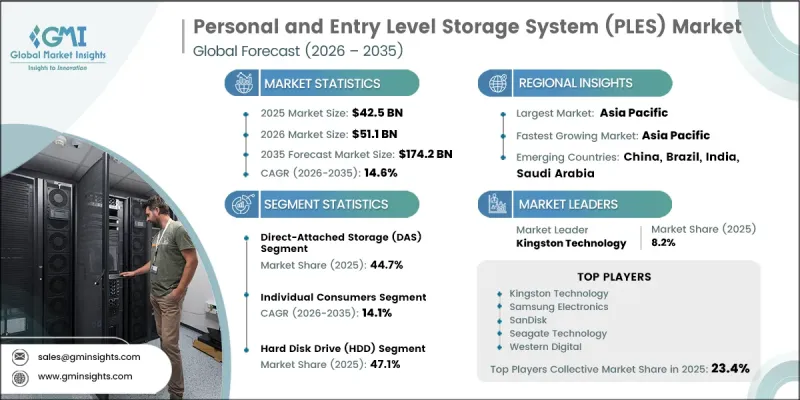
由於消費者和專業人士創建的數位內容數量迅速成長,市場正經歷強勁成長。高解析度多媒體、數位文件、創新專案、商業文件和其他資料密集型應用的日益普及,推動了對可靠、高容量且經濟高效的儲存解決方案的需求。數位轉型的推動、連網型設備的普及以及遠距辦公環境的擴展,進一步加速了對高效能個人儲存系統的需求。消費者越來越需要效能更快、資料保護更完善、管理柔軟性更高的儲存解決方案,以便更好地管理其不斷成長的數位圖書館。儲存技術的持續進步,包括速度、容量、便攜性和能源效率的提升,正在推動消費者和專業市場的產品升級。安全資料備份、無縫文件存取和長期資料保留的重要性日益凸顯,進一步強化了市場需求。
| 市場範圍 | |
|---|---|
| 開始年份 | 2025 |
| 預測期 | 2026-2035 |
| 起始金額 | 425億美元 |
| 預測金額 | 1742億美元 |
| 複合年成長率 | 14.6% |
預計到2025年,直接附加儲存(DAS)市佔率將達到44.7%,並在2035年之前以14.3%的複合年成長率成長。該細分市場持續保持領先地位,原因在於其能夠為個人用戶和企業用戶提供高速資料存取、簡易部署和經濟高效的儲存方案。對於尋求可靠備份、高效文件管理以及快速存取大量數位數位資料的個人用戶而言,直接附加儲存(DAS)解決方案仍然是首選。對能夠處理不斷成長的數位工作負載的高效能儲存設備的需求日益成長,進一步鞏固了該細分市場的主導地位。預計在預測期內,持續改進產品(重點在於儲存容量、傳輸速度和用戶便利性)將推動其進一步普及。
預計到2025年,個人消費者市場將佔據51.4%的市場佔有率,並在2035年之前以14.1%的複合年成長率成長。該細分市場仍然是最大的終端用戶群體,其成長主要得益於對經濟實惠且可靠的儲存解決方案的需求不斷成長,這些解決方案旨在支援個人資料管理和數位內容的保存。數位化生活方式的普及、個人電腦設備的廣泛使用以及人們對安全資料備份意識的提高,都促使消費者投資先進的儲存系統。個人儲存設備在多媒體內容、遊戲庫、商業文件和長期資料保護方面的日益普及,持續支撐著市場的持續成長。儲存效能、便攜性和易用性的提升預計將進一步加速個人用戶的需求成長。
美國個人及入門級儲存系統 (PLES) 市場預計到 2025 年將達到 117 億美元,並在 2026 年至 2035 年間以 13.5% 的複合年成長率成長。由於消費者、專業人士以及中小企業廣泛採用先進儲存技術,美國仍然是最大的區域市場之一。數位化進程的推進、遠端辦公的日益普及以及對大容量儲存設備日益成長的依賴,都持續推動著市場擴張。對先進儲存技術的持續投資,以及對安全、高效能和可擴展儲存解決方案日益成長的需求,為遍布全國的製造商創造了機會。對高效數據管理和長期數位儲存日益成長的需求預計將在整個預測期內推動市場強勁成長。
目錄
第1章:調查方法
第2章執行摘要
第3章 行業洞察
- 產業生態系分析
- 供應商情況
- 儲存硬體製造商
- NAND/快閃記憶體供應商
- 硬碟製造商
- NAS製造商
- 雲端儲存提供者
- 分銷和零售通路
- 利潤率
- 成本結構
- 每個階段增加的價值
- 影響價值鏈的因素
- 中斷
- 供應商情況
- 影響產業的因素
- 成長促進因素
- 數位內容生產的爆炸性成長
- 遠距辦公和SOHO細分市場的擴張
- NAND快閃記憶體體成本的下降正在推動固態硬碟在普通市場上的廣泛應用。
- 對數據主權和訂閱疲勞的擔憂
- 產業潛在風險與挑戰
- 雲端儲存的商品化正在給硬體利潤率帶來壓力。
- NAND和DRAM供應鏈的波動性
- 市場機遇
- 人工智慧驅動的個人儲存解決方案正在不斷普及
- 對混合雲端儲存生態系統的需求日益成長
- 創作者和遊戲玩家的儲存解決方案擴展
- 新興市場儲存應用不斷擴大
- 成長促進因素
- 成長潛力分析
- 技術與創新展望
- 最新科技趨勢
- 機械式硬碟 (HDD) 與固態硬碟 (SSD):效能與成本趨勢
- 新興儲存介面(NVMe、Thunderbolt 5、USB4)
- 高速儲存介面
- 新興技術
- 雲端原生個人儲存架構的創新
- 智慧NAS和AI驅動的儲存管理
- 高容量消費級儲存技術
- 最新科技趨勢
- 監理情勢
- 北美洲
- 美國聯邦貿易委員會 (FTC) 關於資料安全和消費者保護的要求
- 美國聯邦資訊處理標準 (FIPS) 和資料安全要求
- 歐洲
- 歐盟委員會(歐盟產品安全法規、CE標誌、RoHS、WEEE)
- 符合歐洲化學品管理局 (ECHA) RoHS 標準
- 亞太地區
- 中國工業和資訊化部
- 中國國家市場監督管理總局(SAMR)
- 拉丁美洲
- 巴西工業產權局(INPI)、巴西產品標準及認證
- 巴西國家標準與技術研究院 (INMETRO),電氣產品合格評定
- 中東和非洲
- 沙烏地阿拉伯標準、計量和品質組織(SASO),沙烏地阿拉伯
- 阿拉伯聯合大公國(阿拉伯聯合大公國)通訊和數位政府監管局(TDRA)
- 北美洲
- 波特的分析
- PESTLE分析
- 專利分析
- 價格分析
- 歷史價格趨勢分析:按儲存媒體分類的每 GB 成本(2022-2025 年)
- 依球員類型分類的定價策略(高級球員、超值球員、成本加成球員)
- 2025年成本細分分析
- 人工智慧和生成式人工智慧對市場的影響
- 利用人工智慧改造現有經營模式
- 按細分市場分類的生成式人工智慧用例和部署藍圖
- 風險、限制和監管考量
- 預測假設和情境分析
- 基本案例下推動複合年成長率的關鍵宏觀經濟和產業變量
- 樂觀情境:宏觀經濟與產業的順風
- 悲觀情景:宏觀經濟放緩或產業逆風
第4章 競爭情勢
- 介紹
- 企業市佔率分析
- 北美洲
- 歐洲
- 亞太地區
- 拉丁美洲
- 中東和非洲
- 主要市場公司的競爭分析
- 競爭定位矩陣
- 主要進展
- 併購
- 夥伴關係和聯盟
- 新產品發布
- 業務拓展計劃及資金籌措
- 按公司規模進行基準測試
- 排名分類標準與遴選標準
- 按銷售額、地區和創新能力分類的層級定位矩陣。
第5章 市場估算與預測:依儲存架構分類,2022-2035年
- 直接附加儲存(DAS)
- 網路附加儲存 (NAS)
- 基於雲端的個人存儲
- 混合式儲存解決方案
第6章 市場估算與預測:依儲存媒體分類,2022-2035年
- 硬碟機(HDD)
- 固態硬碟 (SSD) / 快閃記憶體
- 光碟/可錄製媒體
- 混合硬碟(HDD + SSD)
第7章 市場估算與預測:依儲存容量分類,2022-2035年
- 1 TB 或更少
- 1~5 TB
- 5~10 TB
- 超過10TB
第8章 市場估算與預測:依通路分類,2022-2035年
- 線上零售
- 線下零售
- 直銷
第9章 市場估計與預測:依最終用途分類,2022-2035年
- 個人消費者
- SOHO/中小企業
- 專業消費者內容創作者
- 教育相關人員
- 其他
第10章 市場估價與預測:依地區分類,2022-2035年
- 北美洲
- 美國
- 加拿大
- 歐洲
- 德國
- 英國
- 法國
- 義大利
- 西班牙
- 北歐的
- 俄羅斯
- 荷蘭
- 亞太地區
- 中國
- 印度
- 日本
- 韓國
- 澳洲
- 新加坡
- 馬來西亞
- 拉丁美洲
- 巴西
- 墨西哥
- 阿根廷
- 中東和非洲
- 南非
- 沙烏地阿拉伯
- UAE
第11章:公司簡介
- 世界公司
- Kingston Technology
- Kioxia
- QNAP
- Samsung Electronics
- SanDisk
- Seagate Technology
- Synology
- Western Digital
- 當地公司
- ADATA Technology
- Buffalo
- Fantec
- Integral Memory
- Netac Technology
- TerraMaster
- Toshiba Electronic Devices & Storage
- Transcend Information
- 新興企業
- ASUSTOR
- Sabrent
- TeamGroup
- Ugreen
The Global Personal and Entry Level Storage System (PLES) market was valued at USD 42.5 billion in 2025 and is estimated to grow at a CAGR of 14.6% to reach USD 174.2 billion by 2035.
The market is experiencing robust growth as the volume of digital content created by consumers and professionals continues to increase at a rapid pace. Rising demand for reliable, high-capacity, and cost-effective storage solutions is being driven by the growing use of high-definition multimedia, digital documents, creative projects, business files, and other data-intensive applications. Increasing digital transformation, widespread adoption of connected devices, and the expansion of remote work environments are further accelerating the need for efficient personal storage systems. Consumers are increasingly seeking storage solutions that offer faster performance, enhanced data protection, and greater flexibility for managing expanding digital libraries. Continuous advancements in storage technologies, including improvements in speed, capacity, portability, and energy efficiency, are encouraging product upgrades across both consumer and professional markets. The growing importance of secure data backup, seamless file accessibility, and long-term data preservation continues to strengthen market demand.
| Market Scope | |
|---|---|
| Start Year | 2025 |
| Forecast Year | 2026-2035 |
| Start Value | $42.5 Billion |
| Forecast Value | $174.2 Billion |
| CAGR | 14.6% |
The direct-attached storage (DAS) segment captured a 44.7% share in 2025 and is forecast to grow at a 14.3% CAGR through 2035. The segment continues to dominate the market due to its ability to deliver high-speed data access, straightforward deployment, and cost-effective storage for personal and professional users. Direct-attached storage solutions remain a preferred option for individuals seeking reliable backup, efficient file management, and quick access to large volumes of digital data. Growing demand for high-performance storage devices capable of supporting expanding digital workloads continues to reinforce the segment's leadership position. Continuous product enhancements focused on storage capacity, transfer speed, and user convenience are expected to further strengthen adoption throughout the forecast period.
The Individual consumers segment held a 51.4% share in 2025 and is forecast to grow at a 14.1% CAGR through 2035. This segment remains the largest end-user category due to increasing demand for affordable and dependable storage solutions that support personal data management and digital content preservation. Rising digital lifestyles, expanding use of personal computing devices, and increasing awareness regarding secure data backup are encouraging consumers to invest in advanced storage systems. Growing adoption of personal storage devices for multimedia content, gaming libraries, work-related files, and long-term data protection continues to support sustained market growth. Improvements in storage performance, portability, and ease of use are expected to further accelerate demand among individual users.
U.S. Personal and Entry Level Storage System (PLES) market generated USD 11.7 billion in 2025 and is forecast to grow at a 13.5% CAGR during 2026-2035. The United States continues to represent one of the largest regional markets due to strong adoption of advanced storage technologies across consumers, professionals, and small and medium-sized businesses. Increasing digitalization, growing remote work adoption, and rising dependence on high-capacity storage devices continue to support market expansion. Continuous investments in advanced storage technologies, combined with increasing demand for secure, high-performance, and scalable storage solutions, are creating favorable opportunities for manufacturers operating across the country. The growing need for efficient data management and long-term digital storage is expected to sustain robust market growth over the forecast period.
Major companies operating in the global personal and entry level storage system (PLES) market include Synology, Samsung Electronics, Seagate, Western Digital, SanDisk, Buffalo, TerraMaster, QNAP Systems, Kingston Technology, Toshiba E&S, and Kioxia. Companies operating in the global personal and entry level storage system (PLES) market are strengthening their competitive position by investing in product innovation, storage performance improvements, and capacity expansion. Manufacturers are developing advanced storage solutions with faster data transfer speeds, enhanced security features, improved reliability, and greater compatibility across multiple devices and operating systems. Strategic partnerships with technology providers, retail distributors, and cloud service companies are helping businesses expand their market reach and strengthen customer engagement. Companies are also increasing investments in research and development to improve energy efficiency, portability, and data protection capabilities while addressing evolving consumer requirements. Expansion of manufacturing capacity, broader product portfolios, and stronger after-sales support services continue to reinforce market competitiveness.
Table of Contents
Chapter 1 Methodology
- 1.1 Research approach
- 1.2 Quality Commitments
- 1.2.1 GMI AI policy & data integrity commitment
- 1.2.1.1 Source consistency protocol
- 1.2.1 GMI AI policy & data integrity commitment
- 1.3 Research Trail & Confidence Scoring
- 1.3.1 Research Trail Components
- 1.3.2 Scoring Components
- 1.4 Data Collection
- 1.4.1 Partial list of primary sources
- 1.5 Data mining sources
- 1.5.1 Paid sources
- 1.5.1.1 Sources, by region
- 1.5.1 Paid sources
- 1.6 Base estimates and calculations
- 1.6.1 Base year calculation
- 1.7 Forecast model
- 1.7.1 Quantified market impact analysis
- 1.7.1.1 Mathematical impact of growth parameters on forecast
- 1.7.1 Quantified market impact analysis
- 1.8 Research transparency addendum
- 1.8.1 Source attribution framework
- 1.8.2 Quality assurance metrics
- 1.8.3 Our commitment to trust
Chapter 2 Executive Summary
- 2.1 Industry 360° synopsis
- 2.2 Key market trends
- 2.2.1 Regional
- 2.2.2 Storage architecture
- 2.2.3 Storage medium
- 2.2.4 Storage capacity
- 2.2.5 Distribution channel
- 2.2.6 End use
- 2.3 TAM analysis, 2026-2035
- 2.4 CXO perspectives: Strategic imperatives
Chapter 3 Industry Insights
- 3.1 Industry ecosystem analysis
- 3.1.1 Supplier landscape
- 3.1.1.1 Storage hardware manufacturers
- 3.1.1.2 NAND/flash memory suppliers
- 3.1.1.3 HDD manufacturers
- 3.1.1.4 NAS manufacturers
- 3.1.1.5 Cloud storage providers
- 3.1.1.6 Distribution & retail channels
- 3.1.2 Profit margin
- 3.1.3 Cost structure
- 3.1.4 Value addition at each stage
- 3.1.5 Factor affecting the value chain
- 3.1.6 Disruptions
- 3.1.1 Supplier landscape
- 3.2 Industry impact forces
- 3.2.1 Growth drivers
- 3.2.1.1 Explosion of digital content creation
- 3.2.1.2 Remote work and SOHO segment expansion
- 3.2.1.3 Declining NAND flash costs enabling mass-market SSD adoption
- 3.2.1.4 Data sovereignty concerns and subscription fatigue
- 3.2.2 Industry pitfalls and challenges
- 3.2.2.1 Cloud storage commoditization compressing hardware margins
- 3.2.2.2 NAND and DRAM supply chain volatility
- 3.2.3 Market opportunities
- 3.2.3.1 Growing adoption of AI-driven personal storage solutions
- 3.2.3.2 Rising demand for hybrid cloud-storage ecosystems
- 3.2.3.3 Expansion of creator and gaming storage segments
- 3.2.3.4 Increasing storage adoption in emerging market
- 3.2.1 Growth drivers
- 3.3 Growth potential analysis
- 3.4 Technology and innovation landscape
- 3.4.1 Current technological trends
- 3.4.1.1 HDD vs SSD Performance & Cost Trajectory
- 3.4.1.2 Emerging Storage Interfaces (NVMe, Thunderbolt 5, USB4)
- 3.4.1.3 High-Speed Storage Interfaces
- 3.4.2 Emerging technologies
- 3.4.2.1 Cloud-Native Personal Storage Architecture Innovations
- 3.4.2.2 Smart NAS & AI-Assisted Storage Management
- 3.4.2.3 High-Capacity Consumer Storage Technologies
- 3.4.1 Current technological trends
- 3.5 Regulatory landscape
- 3.5.1 North America
- 3.5.1.1 Federal Trade Commission (FTC) Data Security & Consumer Protection Requirements (U.S.)
- 3.5.1.2 Federal Information Processing Standards (FIPS) & Data Security Requirements (U.S.)
- 3.5.2 Europe
- 3.5.2.1 European Commission (EU Product Safety Regulation, CE Marking, RoHS, WEEE)
- 3.5.2.2 European Chemicals Agency (ECHA) RoHS Compliance
- 3.5.3 Asia Pacific
- 3.5.3.1 Ministry of Industry and Information Technology (MIIT), China
- 3.5.3.2 State Administration for Market Regulation (SAMR), China
- 3.5.4 Latin America
- 3.5.4.1 National Institute of Industrial Property (INPI), Brazil Product Standards & Certification
- 3.5.4.2 National Institute of Standards and Technology (INMETRO), Brazil Electrical Product Compliance
- 3.5.5 Middle East & Africa
- 3.5.5.1 Saudi Standards, Metrology and Quality Organization (SASO), Saudi Arabia
- 3.5.5.2 Telecommunications and Digital Government Regulatory Authority (TDRA), UAE
- 3.5.1 North America
- 3.6 Porter’s analysis
- 3.7 PESTEL analysis
- 3.8 Patent analysis (Driven by Primary Research)
- 3.9 Pricing Analysis (Driven by Primary Research)
- 3.9.1 Historical Price Trend Analysis Cost Per GB by Storage Medium, 2022-2025
- 3.9.2 Pricing Strategy by Player Type (Premium / Value / Cost-plus)
- 3.10 Cost breakdown analysis, 2025
- 3.11 Impact of AI & Generative AI on the Market
- 3.11.1 AI-driven disruption of existing business models
- 3.11.2 GenAI use cases & adoption roadmap by segment
- 3.11.3 Risks, limitations & regulatory considerations
- 3.12 Forecast assumptions & scenario analysis (Driven by primary research)
- 3.12.1 Base Case key macro & industry variables driving CAGR
- 3.12.2 Optimistic Scenarios Favorable macro and industry tailwinds
- 3.12.3 Pessimistic Scenario Macroeconomic slowdown or industry headwinds
Chapter 4 Competitive Landscape, 2025
- 4.1 Introduction
- 4.2 Company market share analysis
- 4.2.1 North America
- 4.2.2 Europe
- 4.2.3 Asia Pacific
- 4.2.4 LATAM
- 4.2.5 MEA
- 4.3 Competitive analysis of major market players
- 4.4 Competitive positioning matrix
- 4.5 Key developments
- 4.5.1 Mergers & acquisitions
- 4.5.2 Partnerships & collaborations
- 4.5.3 New product launches
- 4.5.4 Expansion plans and funding
- 4.6 Company tier benchmarking
- 4.6.1 Tier classification criteria & qualifying thresholds
- 4.6.2 Tier positioning matrix by revenue, geography & innovation
Chapter 5 Market Estimates & Forecast, By Storage architecture, 2022 2035 ($Mn)
- 5.1 Key trends
- 5.2 Direct-attached storage (DAS)
- 5.3 Network-attached storage (NAS)
- 5.4 Cloud-based personal storage
- 5.5 Hybrid storage solutions
Chapter 6 Market Estimates & Forecast, By Storage medium, 2022 2035 ($Mn, Units)
- 6.1 Key trends
- 6.2 Hard disk drive (HDD)
- 6.3 Solid-state drive (SSD) / flash-based
- 6.4 Optical / recordable media
- 6.5 Hybrid (HDD + SSD)
Chapter 7 Market Estimates & Forecast, By Storage capacity, 2022 2035 ($Mn, Units)
- 7.1 Key trends
- 7.2 Up to 1 TB
- 7.3 1–5 TB
- 7.4 5–10 TB
- 7.5 Above 10 TB
Chapter 8 Market Estimates & Forecast, By Distribution channel, 2022 2035 ($Mn)
- 8.1 Key trends
- 8.2 Online retail
- 8.3 Offline retail
- 8.4 Direct sales
Chapter 9 Market Estimates & Forecast, By End use, 2022 2035 ($Mn)
- 9.1 Key trends
- 9.2 Individual Consumers
- 9.3 SOHO / Small Businesses
- 9.4 Prosumers & Content Creators
- 9.5 Educational Users
- 9.6 Others
Chapter 10 Market Estimates & Forecast, By Region, 2022 2035 ($Mn, Units)
- 10.1 Key trends
- 10.2 North America
- 10.2.1 U.S.
- 10.2.2 Canada
- 10.3 Europe
- 10.3.1 Germany
- 10.3.2 UK
- 10.3.3 France
- 10.3.4 Italy
- 10.3.5 Spain
- 10.3.6 Nordics
- 10.3.7 Russia
- 10.3.8 Netherlands
- 10.4 Asia Pacific
- 10.4.1 China
- 10.4.2 India
- 10.4.3 Japan
- 10.4.4 South Korea
- 10.4.5 Australia
- 10.4.6 Singapore
- 10.4.7 Malaysia
- 10.5 Latin America
- 10.5.1 Brazil
- 10.5.2 Mexico
- 10.5.3 Argentina
- 10.6 MEA
- 10.6.1 South Africa
- 10.6.2 Saudi Arabia
- 10.6.3 UAE
Chapter 11 Company Profiles
- 11.1 Global players
- 11.1.1 Kingston Technology
- 11.1.2 Kioxia
- 11.1.3 QNAP
- 11.1.4 Samsung Electronics
- 11.1.5 SanDisk
- 11.1.6 Seagate Technology
- 11.1.7 Synology
- 11.1.8 Western Digital
- 11.2 Regional players
- 11.2.1 ADATA Technology
- 11.2.2 Buffalo
- 11.2.3 Fantec
- 11.2.4 Integral Memory
- 11.2.5 Netac Technology
- 11.2.6 TerraMaster
- 11.2.7 Toshiba Electronic Devices & Storage
- 11.2.8 Transcend Information
- 11.3 Emerging players
- 11.3.1 ASUSTOR
- 11.3.2 Sabrent
- 11.3.3 TeamGroup
- 11.3.4 Ugreen

 硬體 RAID 控制器卡市場:全球市場預測,2026-2032 年
 2026年全球消費性資料儲存設備市場報告光學儲存與智慧整合系統市場:全球市場預測,2026-2032年
 可攜式邊緣資料儲存市場-全球及區域分析:按產品、應用和國家分類-分析與預測(2026-2035年)
 全球資料儲存市場規模、佔有率、趨勢和成長分析報告(2026-2034年)
 DNA資料儲存市場規模、佔有率和成長分析:按儲存方法、組件、應用、最終用戶、部署模式、交付模式和地區分類-2026-2033年產業預測
 RAID 控制器卡:市場佔有率分析、行業趨勢和統計數據、成長預測(2026-2031 年)
 全球DNA資料儲存市場:按組件、技術、應用、終端用戶產業和地區分類-市場規模、產業動態、機會分析和預測(2026-2035年)2026年全球雲端個人及入門級儲存市場報告
 RAID 控制器卡市場報告:按產品、類型、企業規模、最終用戶和地區分類(2026-2034 年)