


 |
市場調查報告書
商品編碼
2097395
FR-4 PCB:市場佔有率分析、產業趨勢與統計、成長預測(2026-2031)FR-4 PCB - Market Share Analysis, Industry Trends & Statistics, Growth Forecasts (2026 - 2031) |
||||||

※ 本網頁內容可能與最新版本有所差異。詳細情況請與我們聯繫。
根據 Mordor Intelligence 預測,FR-4 印刷基板市場規模預計將在 2026 年達到 450.2 億美元,到 2031 年將擴大到 561.4 億美元,複合年成長率為 4.51%。
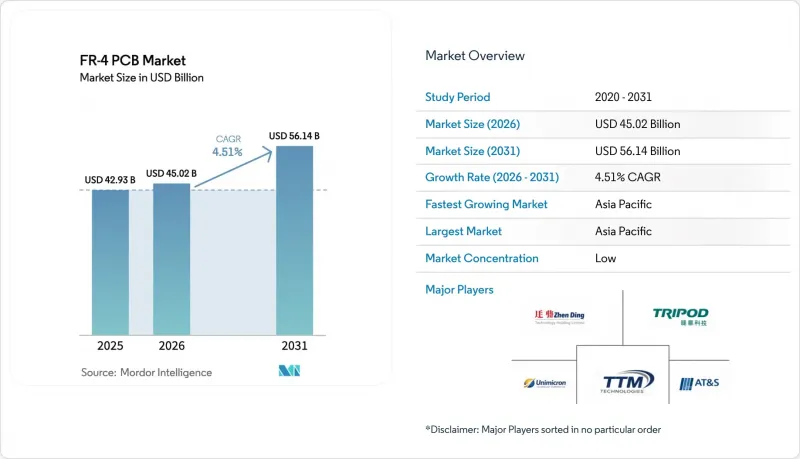
本報告按PCB類型(標準多層(非HDI)、剛性PCB等)、材料等級(標準FR-4(Tg 130 度C至140 度C))、用戶產業(家用電子電器、計算和資料中心、通訊、汽車和電動車、工業和電力、醫療保健/醫療、航太和國防等)以及終端地區進行細分。市場預測以美元計價。
全球FR-4印刷基板市場趨勢及洞察
家用電子電器小型化趨勢
受智慧型手機和穿戴式裝置輕薄化需求的推動,自 2022 年以來,元件密度提高了 34%。旗艦機型現在採用全層 HDI基板,微孔寬度僅 0.075 毫米,堆疊高度小於 1.2 毫米。軟硬複合結構使得血糖值監測儀能夠貼合半徑為 3 毫米的曲面,同時保持 IPC 3 級可靠性。高階行動電話的層數從 2020 年的 8 層增加到 2025 年的 12 層,儘管出貨量持平,但每台手機的平均層壓板消耗量仍增加了 22%。隨著 FR-4 印刷基板市場採用這些 HDI 設計,採用具有更精確控制的熱膨脹係數的中等 Tg 複合材料,可以保護焊點長達 5 年的使用壽命。因此,能夠製造小於 50 微米佈線而不影響良率的製造商預計將穩定成長。
加速推廣電動車車載充電器和動力傳動系統
在電動車電力電子領域,基板經常承受高達 800 伏特的暫態電壓和局部接近 175 度C的高溫。比亞迪為其「刀片電池」系統指定了分解溫度超過 340 度C 的高 Tg 層壓板,以承受 3000 次快速充電循環。英飛凌的「HybridPACK Drive G2」將 1.2 千伏的 SiC MOSFET 與覆有 105 微米銅箔的 10 層 FR-4基板相結合,其厚度是傳統基板的兩倍,可耗散 15 千瓦的熱量。將於 2025 年 7 月生效的歐盟 7 診斷標準要求電壓偵測精度在 10 毫伏以內,並將走線間距要求收緊至 0.05 毫米。這些條件提高了高 Tg 和高銅含量結構的重要性,預計與更廣泛的 FR-4 印刷基板市場相比,這些結構將具有更高的成長率。
高Tg玻璃纖維紗線的供應問題
只有三家獲得認證的製造商能夠供應耐鹼E玻璃纖維紗線,其尺寸穩定性在10,000次循環後仍能維持在0.02%。 2025年初,巨石集團東桑工廠發生火災,導致全球產能損失12%,前置作業時間也因此翻倍至16週。原始設備製造商(OEM)不得不以四倍於正常價格的價格,從歐文斯科寧位於南卡羅來納州的工廠空運紗線。目前,汽車一級供應商的庫存緩衝量已達12週,並且為雙源高Tg層壓板支付6%的溢價,這限制了FR-4印刷基板市場的短期需求彈性。
細分市場分析
預計到2025年,標準多層非HDI FR-4印刷基板的市場規模將達到121.1億美元,佔全球銷售額的26.87%。對價格敏感的消費性電子產品和工業控制設備仍能接受0.15毫米的走線寬度和0.3毫米的通孔。然而,軟性電路的複合年成長率(CAGR)為5.99%,比FR-4印刷基板整體市場高出148個基點,因為折疊式智慧型手機和醫療穿戴式裝置需要3毫米的彎曲半徑且不會發生分層。 HDI基板每平方英吋的導線密度超過200根,需求旺盛,尤其是在人工智慧加速器模組和毫米波無線設備領域。軟硬複合板雖然產量較小,但在航太和國防合約中仍然至關重要,因為這些合約要求其達到IPC-6013 3級耐久性標準,能夠承受2000G的衝擊。雖然單面和雙面基板在通用照明和電源等細分市場仍然佔有一席之地,但即使是低成本的消費性電子產品也正在向四層佈局發展,以滿足更嚴格的FCC輻射發射法規。厚銅FR-4板支援太陽能逆變器和馬達驅動器,其走線電流密度可達每平方毫米10安培,價格比標準層壓板高出三倍。
需求彈性因類型而異。在台灣和韓國,HDI 和軟硬複合的訂單到交貨前置作業時間為 5-7 天,這增強了早期投資於雷射直接曝光 (LDI) 和自動光學檢測 (AOI) 技術的製造商的競爭優勢。三星馬達預計,到 2025 年, 軟硬複合 的出貨量將年增 34%,這主要得益於軟式電路板在汽車抬頭顯示器(HUD) 狹窄儀表板中的應用。同時,中國快速週轉的製造商為通用型 8 層基板提供 2 天的樣板製作週期,這導致其價格每年下降 8-12%。隨著複雜性的增加,用於高層產品的 FR-4 印刷電路基板的市場佔有率將繼續逐步上升,而傳統雙面基板的市場佔有率將受到擠壓。
區域分析
預計到2025年,亞太地區將佔全球銷售額的82.54%,並預計在2031年前維持6.25%的複合年成長率。儘管中國佔全球產能的58%,但印度在生產連結獎勵計畫(HDI)產能的22%,並維持技術領先地位,為蘋果、英偉達和AMD等公司提供48小時原型製作週期的產品。日本則專注於汽車和工業領域的訂單,在這些領域,零缺陷率足以支撐30%的價格溢價。
2025年,北美和歐洲的銷售額僅佔17.46%,但它們正受惠於製造業回流。 2025年11月,TTM Technologies公司將其位於紐約州錫拉丘茲市符合ITAR規定的工廠規模擴大了一倍,從而加強了其對關鍵國防企業的供應鏈。 AT&S公司在奧地利萊奧本新增了一條24層HDI生產線,以確保獲得800伏特電動車的合約。在墨西哥瓜達拉哈拉走廊,隨著汽車OEM廠商將部分生產從亞洲轉移到近岸地區,2025年PCB產量增加了18%。儘管巴西的《資訊科技法》給予了優惠待遇,但南美洲仍然是淨進口地區。
地緣政治風險正在重塑採購結構。中美之間的技術分化迫使企業在中國當地以外地區進行雙重採購,預計到2026年,馬來西亞、泰國和墨西哥的市場佔有率將有所成長。歐洲買家傾向於選擇區域製造,以符合將於2026年生效的碳邊境調節機制(CBAM)規定。同時,印度的原型前置作業時間已從2023年的21天縮短至2025年底的12天,縮小了與台灣競爭對手的服務差距。在整個預測期內,隨著區域多元化的推進,亞太地區在FR-4印刷基板市場的佔有率預計將略有下降。
其他好處:
- Excel格式的市場預測(ME)表
- 3個月的分析師支持
目錄
第1章:引言
- 研究假設和市場定義
- 調查範圍
第2章:調查方法
第3章執行摘要
第4章 市場狀況
- 市場概覽
- 市場促進因素
- 家用電子電器。
- 加速電動車車載充電器和動力傳動系統的普及
- 快速部署5G基地台需要低損耗的FR-4變體
- 減少超大規模資料中心伺服器主機板的佈線寬度
- 印度和越南政府為國內PCB製造業提供獎勵措施
- 一款創新的AI加速板,可提高每個裝置的層數。
- 市場限制因素
- 高Tg玻璃纖維紗線的供應問題
- 人們對永續發展的日益成長的需求與高鹵素含量的環氧樹脂化學品之間存在衝突。
- 來自聚醯亞胺和金屬芯印刷電路板的競爭日益激烈
- 中美在科技領域的脫鉤正在使全球採購變得更加複雜。
- 宏觀經濟因素對市場的影響
- 產業價值鏈分析
- 監理情勢
- 技術展望
- 波特五力分析
第5章 市場規模與成長預測
- 按PCB類型分類
- 標準多層(非HDI)剛性
- 單面/雙面
- 高密度互連(HDI)
- 軟硬複合
- 其他PCB類型
- 按材料等級
- 標準FR-4(Tg 130 度C至 140 度C)
- 中 Tg FR-4(Tg 150 度C至 160 度C)
- 高Tg FR-4(Tg 170 度C或更高)
- 無鹵素FR-4
- 產業最終用途
- 家用電子產品
- 計算和資料中心
- 電訊
- 汽車和電動車
- 工業與電力
- 醫療保健/醫療
- 航太/國防
- 其他終端用戶產業
- 按地區
- 北美洲
- 美國
- 其他北美國家
- 歐洲
- 英國
- 德國
- 荷蘭
- 其他歐洲國家
- 亞太地區
- 中國
- 日本
- 印度
- 韓國
- 台灣
- 東南亞
- 其他亞太國家
- 世界其他地區
- 北美洲
第6章 競爭情勢
- 市場集中度
- 策略趨勢
- 市佔率分析
- 公司簡介
- AT&S AG
- TTM Technologies Inc.
- Tripod Technology Corp.
- Unimicron Technology Corp.
- Kingboard Holdings Ltd.
- Wus Printed Circuit Co. Ltd.
- Young Poong Electronics Co. Ltd.
- Nan Ya Printed Circuit Board Corp.
- Ibiden Co. Ltd.
- HannStar Board Corp.
- Zhen Ding Technology Holding Ltd.
- Compeq Manufacturing Co. Ltd.
- Sanmina Corp.
- NCAB Group AB
- Advanced Circuits Inc.
- Jabil Inc.(Chung Nam)
- Ellington Electronics Technology Group
- Shenzhen Kinwong Electronic Co. Ltd.
- Sumitomo Electric Printed Circuits Inc.
- Isola Group(Laminate Partner)
第7章 市場機會與未來展望
According to Mordor Intelligence, the FR-4 printed circuit board market size reached USD 45.02 billion in 2026 and is projected to advance to USD 56.14 billion by 2031, reflecting a 4.51% CAGR.
This report is Segmented by PCB Type (Standard Multilayer (non-HDI) Rigid, and More), Material Grade (Standard FR-4 (Tg 130°C-140°C), and More), End-Use Industry (Consumer Electronics, Computing and Data Centers, Telecommunications, Automotive and EV, Industrial and Power, Healthcare/Medical, Aerospace and Defense, and More), and Geography. The Market Forecasts are Provided in Terms of Value (USD).
Global FR-4 PCB Market Trends and Insights
Growing Miniaturization Trend in Consumer Electronics
Demand for thinner smartphones and wearables has driven a 34% jump in component density since 2022. Flagship devices now carry any-layer HDI boards with microvias only 0.075 millimeters wide, held within a 1.2-millimeter stack height. Rigid-flex constructions enable glucose monitors to wrap around 3-millimeter radii while maintaining IPC Class 3 reliability. Layer counts in high-end handsets rose from 8 in 2020 to 12 in 2025, lifting average laminate consumption per phone by 22% even as shipment volumes plateaued. As the FR-4 printed circuit board market integrates these HDI designs, mid-Tg formulations with tighter coefficient-of-thermal-expansion control protect solder joints over five-year duty cycles. The result is steady upside for producers that can image sub-50-micron lines without yield loss.
Accelerating Adoption of EV On-Board Chargers and Powertrains
Electric-vehicle power electronics regularly expose boards to 800-volt transients and localized hot spots nearing 175°C. BYD specified high-Tg laminates with decomposition temperatures above 340°C to withstand 3,000 fast-charge cycles in its Blade Battery system. Infineon's HybridPACK Drive G2 matches 1.2-kilovolt SiC MOSFETs to 10-layer FR-4 substrates clad with 105-micron copper foil, doubling conventional thickness to dissipate 15 kilowatts. Euro 7 diagnostics effective in July 2025 require voltage sensing within 10 millivolts, tightening trace-spacing rules to 0.05 millimeters. These conditions elevate high-Tg and heavy-copper constructions, securing a growth premium over the broader FR-4 Printed Circuit Board market.
Supply Insecurity of High-Tg Glass Yarns
Only three qualified producers supply alkali-resistant E-glass yarns able to maintain 0.02%-dimensional stability over 10,000 cycles. A fire at Jushi's Tongxiang plant removed 12% of global capacity for nine weeks in early 2025, doubling modified-epoxy lead times to 16 weeks. OEMs air-freighted yarn from Owens Corning's South Carolina site at quadruple normal cost. Automotive Tier-1 suppliers now hold 12-week buffer stock and pay a 6% premium for dual-sourced high-Tg laminates, tempering near-term volume elasticity in the FR-4 PCB market.
Other drivers and restraints analyzed in the detailed report include:
- Shrinking Server Motherboard Trace Widths in Hyperscale Data Centers
- Novel AI Accelerator Boards Driving Multilayer Count Per Device
- US-China Tech Decoupling Complicating Global Sourcing
For complete list of drivers and restraints, kindly check the Table Of Contents.
Segment Analysis
The FR-4 PCB market size for standard multilayer non-HDI product stood at USD 12.11 billion in 2025, translating to 26.87% of global revenue. Price-sensitive consumer devices and industrial controls continue to tolerate 0.15-millimeter lines and 0.3-millimeter through-hole vias. Yet flexible circuits are expanding at a 5.99% CAGR, a 148-basis-point uplift over the broader FR-4 printed circuit board market, as foldable phones and medical wearables demand 3-millimeter bend radii without delamination. HDI boards exceed 200 conductors per square inch, finding particular traction in AI accelerator modules and millimeter-wave radios. Rigid-flex designs, though lower in volume, remain indispensable for aerospace and defense contracts that specify IPC-6013 Class 3 endurance against 2,000 G shocks. One- and two-sided boards continue to exist in commodity lighting and power-supply niches as even low-cost appliances migrate to 4-layer layouts to satisfy stricter FCC radiated-emission rules. Heavy-copper FR-4 supports solar inverters and motor drives where trace current density reaches 10 amperes per square millimeter, commanding a threefold price premium over baseline laminates.
Demand elasticity differs sharply across types. HDI and rigid-flex orders carry cycle times of five to seven days in Taiwan and South Korea, reinforcing the competitive advantage of fabricators that invested early in laser-direct-imaging and automated optical inspection. Samsung Electro-Mechanics recorded a 34% year-over-year jump in rigid-flex shipments in 2025 as automotive head-up displays integrated flexible tails within tight instrument clusters. Meanwhile, Chinese quick-turn shops quote two-day prototype cycles for commodity eight-layer boards, driving 8-12% annual price erosion. As complexity rises, the FR-4 printed circuit board market share of high-layer-count product will continue to edge up at the expense of legacy double-sided formats.
Complete Report Scope:
- By PCB Type
- Standard Multilayer (non-HDI) Rigid
- 1-2 Sided
- High-Density Interconnect (HDI)
- Rigid-Flex
- Other PCB Type
- By Material Grade
- Standard FR-4 (Tg 130°C-140°C)
- Mid-Tg FR-4 (Tg 150°C-160°C)
- High-Tg FR-4 (Tg 170°C+)
- Halogen-Free FR-4
- By End-Use Industry
- Consumer Electronics
- Computing and Data Centres
- Telecommunications
- Automotive and EV
- Industrial and Power
- Healthcare / Medical
- Aerospace and Defense
- Other End-User Industries
- By Geography
- North America
- United States
- Rest of North America
- Europe
- United Kingdom
- Germany
- Netherlands
- Rest of Europe
- Asia-Pacific
- China
- Japan
- India
- South Korea
- Taiwan
- Southeast Asia
- Rest of Asia-Pacific
- Rest of World
- North America
Geography Analysis
Asia-Pacific anchored 82.54% of 2025 revenue and is on a 6.25% CAGR path through 2031. China supplied 58% of global capacity, yet India's Production Linked Incentive outlays of INR 550 billion (USD 6.6 billion) and Vietnam's USD 3.2 billion of 2025 investment signal a southward migration of cost-competitive volume. Taiwan preserves technology leadership with 22% of HDI capacity, serving Apple, NVIDIA, and AMD on 48-hour prototype cycles. Japan focuses on automotive and industrial jobs where zero-defect rates justify 30% price premiums.
North America and Europe combined for 17.46% of revenue in 2025 but benefit from reshoring. TTM Technologies doubled its Syracuse, New York, ITAR-compliant footprint in November 2025 to serve defense primes. AT&S added 24-layer HDI lines in Leoben, Austria, to chase 800-volt electric-vehicle contracts. Mexico's Guadalajara corridor grew PCB output 18% in 2025 as automotive OEMs nearshored procurement from Asia. South America remains a net importer despite Brazil's Lei de Informatica incentives.
Geopolitical risk reshapes sourcing. The US-China tech split forces dual-sourcing outside the People's Republic, lifting Malaysian, Thai, and Mexican share by 2026. European buyers favour in-region fabrication to comply with carbon-border-adjustment rules effective 2026. Meanwhile, lead times for prototypes in India dropped from 21 days in 2023 to 12 days by late 2025, narrowing the service gap with Taiwanese peers. Over the forecast horizon, the Asia-Pacific share of the FR-4 Printed Circuit Board market will ease modestly as regional diversification continues.
- AT&S AG
- TTM Technologies Inc.
- Tripod Technology Corp.
- Unimicron Technology Corp.
- Kingboard Holdings Ltd.
- Wus Printed Circuit Co. Ltd.
- Young Poong Electronics Co. Ltd.
- Nan Ya Printed Circuit Board Corp.
- Ibiden Co. Ltd.
- HannStar Board Corp.
- Zhen Ding Technology Holding Ltd.
- Compeq Manufacturing Co. Ltd.
- Sanmina Corp.
- NCAB Group AB
- Advanced Circuits Inc.
- Jabil Inc. (Chung Nam)
- Ellington Electronics Technology Group
- Shenzhen Kinwong Electronic Co. Ltd.
- Sumitomo Electric Printed Circuits Inc.
- Isola Group (Laminate Partner)
Additional Benefits:
- The market estimate (ME) sheet in Excel format
- 3 months of analyst support
TABLE OF CONTENTS
1 INTRODUCTION
- 1.1 Study Assumptions and Market Definition
- 1.2 Scope of the Study
2 RESEARCH METHODOLOGY
3 EXECUTIVE SUMMARY
4 MARKET LANDSCAPE
- 4.1 Market Overview
- 4.2 Market Drivers
- 4.2.1 Growing miniaturisation trend in consumer electronics
- 4.2.2 Accelerating adoption of EV on-board chargers and powertrains
- 4.2.3 Rapid rollout of 5G base-stations requiring low-loss FR-4 variants
- 4.2.4 Shrinking server motherboard trace widths in hyperscale data centres
- 4.2.5 Government incentives for domestic PCB fabrication in India and Vietnam
- 4.2.6 Novel AI accelerator boards driving multilayer count per device
- 4.3 Market Restraints
- 4.3.1 Supply insecurity of high-Tg glass yarns
- 4.3.2 Rising sustainability pressure versus halogen-rich epoxy chemistries
- 4.3.3 Intensifying price competition from polyimide and metal-core PCBs
- 4.3.4 US-China tech decoupling complicating global sourcing
- 4.4 Impact of Macroeconomic Factors on the Market
- 4.5 Industry Value-Chain Analysis
- 4.6 Regulatory Landscape
- 4.7 Technological Outlook
- 4.8 Porter's Five Forces Analysis
- 4.8.1 Threat of New Entrants
- 4.8.2 Bargaining Power of Suppliers
- 4.8.3 Bargaining Power of Buyers
- 4.8.4 Threat of Substitutes
- 4.8.5 Competitive Rivalry
5 MARKET SIZE AND GROWTH FORECASTS (VALUE)
- 5.1 By PCB Type
- 5.1.1 Standard Multilayer (non-HDI) Rigid
- 5.1.2 1-2 Sided
- 5.1.3 High-Density Interconnect (HDI)
- 5.1.4 Rigid-Flex
- 5.1.5 Other PCB Type
- 5.2 By Material Grade
- 5.2.1 Standard FR-4 (Tg 130°C-140°C)
- 5.2.2 Mid-Tg FR-4 (Tg 150°C-160°C)
- 5.2.3 High-Tg FR-4 (Tg 170°C+)
- 5.2.4 Halogen-Free FR-4
- 5.3 By End-Use Industry
- 5.3.1 Consumer Electronics
- 5.3.2 Computing and Data Centres
- 5.3.3 Telecommunications
- 5.3.4 Automotive and EV
- 5.3.5 Industrial and Power
- 5.3.6 Healthcare / Medical
- 5.3.7 Aerospace and Defense
- 5.3.8 Other End-User Industries
- 5.4 By Geography
- 5.4.1 North America
- 5.4.1.1 United States
- 5.4.1.2 Rest of North America
- 5.4.2 Europe
- 5.4.2.1 United Kingdom
- 5.4.2.2 Germany
- 5.4.2.3 Netherlands
- 5.4.2.4 Rest of Europe
- 5.4.3 Asia-Pacific
- 5.4.3.1 China
- 5.4.3.2 Japan
- 5.4.3.3 India
- 5.4.3.4 South Korea
- 5.4.3.5 Taiwan
- 5.4.3.6 Southeast Asia
- 5.4.3.7 Rest of Asia-Pacific
- 5.4.4 Rest of World
- 5.4.1 North America
6 COMPETITIVE LANDSCAPE
- 6.1 Market Concentration
- 6.2 Strategic Moves
- 6.3 Market Share Analysis
- 6.4 Company Profiles (includes Global Level Overview, Market Level Overview, Core Segments, Financials as available, Strategic Information, Market Rank/Share, Products and Services, Recent Developments)
- 6.4.1 AT&S AG
- 6.4.2 TTM Technologies Inc.
- 6.4.3 Tripod Technology Corp.
- 6.4.4 Unimicron Technology Corp.
- 6.4.5 Kingboard Holdings Ltd.
- 6.4.6 Wus Printed Circuit Co. Ltd.
- 6.4.7 Young Poong Electronics Co. Ltd.
- 6.4.8 Nan Ya Printed Circuit Board Corp.
- 6.4.9 Ibiden Co. Ltd.
- 6.4.10 HannStar Board Corp.
- 6.4.11 Zhen Ding Technology Holding Ltd.
- 6.4.12 Compeq Manufacturing Co. Ltd.
- 6.4.13 Sanmina Corp.
- 6.4.14 NCAB Group AB
- 6.4.15 Advanced Circuits Inc.
- 6.4.16 Jabil Inc. (Chung Nam)
- 6.4.17 Ellington Electronics Technology Group
- 6.4.18 Shenzhen Kinwong Electronic Co. Ltd.
- 6.4.19 Sumitomo Electric Printed Circuits Inc.
- 6.4.20 Isola Group (Laminate Partner)
7 MARKET OPPORTUNITIES AND FUTURE OUTLOOK
- 7.1 White-Space and Unmet-Need Assessment

 印刷基板市場:2026-2032年全球市場預測(依類型、基板結構、材料、元件安裝方式、層數、製造流程、應用、終端用戶產業及銷售管道)
 5G PCB:市場佔有率分析、產業趨勢與統計、成長預測(2025-2030)
 全球印刷電路基板市場規模、佔有率、趨勢和成長分析報告(2026-2034)類PCB基板:市場佔有率分析、產業趨勢與統計及成長預測(2026-2031年)
 印刷基板市場規模、佔有率和成長分析:按產品類型、最終用戶和地區分類-2026-2033年產業預測
 2026-2030年全球印刷基板(PCB)市場
 伺服器PCB市場:按應用、技術、最終用戶產業、規模、客戶類型、價格範圍、元件整合、環境永續、採購管道和地區分類
 AI推理伺服器PCB市場報告:趨勢、預測與競爭分析(至2035年)
 印刷基板市場規模、佔有率和趨勢分析報告:按產品類型、基板材料、最終用途、地區和細分市場預測(2026-2033 年)高密度互連(HDI)印刷基板市場:依技術節點、應用與地區分類