


 |
市場調查報告書
商品編碼
2097331
5G PCB:市場佔有率分析、產業趨勢與統計、成長預測(2025-2030)5G PCB - Market Share Analysis, Industry Trends & Statistics, Growth Forecasts (2025 - 2030) |
||||||

※ 本網頁內容可能與最新版本有所差異。詳細情況請與我們聯繫。
根據 Mordor Intelligence 預測,5G PCB 市場規模預計在 2025 年達到 202.5 億美元,到 2030 年達到 361.8 億美元,年複合成長率為 12.31%。
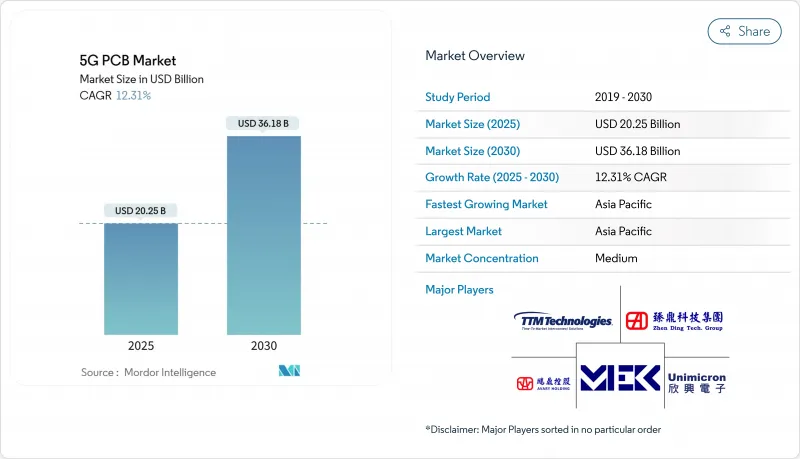
本報告按產品類型(剛性PCB、軟性PCB、軟硬複合PCB等)、應用領域(5G基地台、小型基地台、智慧型手機、物聯網設備、汽車、工業)、頻段(6GHz以下、中頻段、毫米波)、基板材料(FR-4、PTFE、LCP、陶瓷、金屬芯)、最終用戶(電信、家用電子電器)和地區進行細分。市場預測以美元(USD)為單位。
全球5G PCB市場趨勢與洞察
5G中頻段和毫米波基地台密度快速成長
通訊業者持續部署小型無線電設備和小型基地台以填補覆蓋盲區,這推動了對兼具精細佈線和強大散熱能力的印刷電路板 (PCB) 的需求。面向 C 波段網路的元件供應商提出了只有陶瓷-聚四氟乙烯 (PTFE) 混合材料才能滿足的插入損耗容差要求,導致採購方式從傳統的 FR-4 材料轉向其他材料。戶外安裝的無線電設備會經歷加速的熱循環,因此能夠確保 3 級可靠性的製造商更受青睞。這些嚴格的規範推高了平均售價,鞏固了專業製造商在高頻領域的地位。
5G智慧型手機的微型化與封裝內天線設計
智慧型手機OEM廠商正將天線直接整合到軟硬複合基板中,以便為更大的電池騰出空間。這種轉變對混合層壓結構(結合液晶聚合物和改性聚醯亞胺層)的介電常數提出了極為嚴格的控制要求。微米級的層壓空隙會干擾多頻段陣列的調諧,增加良率風險,因此供應商正在大力投資線上X光和光學測量技術。這一趨勢正在加速SiP平台的應用,在基板同時也是射頻模組的載體。
覆銅板供應鏈的波動
由於中國產能削減和環境審計,層壓板價格預計在2024年將上漲18%,將對中型晶圓廠的毛利率構成壓力。雖然大型企業正透過多供應商合約來緩解這些衝擊,但小規模製造商的原物料庫存通常不到一個月,極易受到現貨價格大幅上漲的影響。這種波動對高頻產品的影響尤其嚴重,因為經認證的替代品仍然稀缺。
細分市場分析
2024年,剛性基板佔總銷售額的33.58%,是我們核心大型基地台合約的基礎。射頻/微波基板雖然產量較低,但其複合年成長率(CAGR)高達12.54%,遠超其他基板,這充分證明高頻功能在5G PCB市場中創造了相對較高的價值。隨著通訊業者向毫米波(mmWave)無線電過渡,而毫米波無線電需要多層陶瓷/聚四氟乙烯(PTFE)混合基板,預計射頻/微波設計在5G PCB市場中的佔有率將進一步擴大。 HDI技術透過實現更精細的佈線和堆疊式微孔,降低傳輸損耗,從而推動了這一轉變。
隨著層數超過20層後良率管理複雜性急劇增加,晶圓廠正在實現光電阻監測自動化以維持盈利。軟式電路板和軟硬複合基板已應用於折疊式智慧型手機和穿戴式醫療設備,但就銷售而言,它們仍屬於小眾市場。據深南電路公司稱,射頻基板的平均售價約為標準剛性基板的四倍,這表明技術領先者可以獲得豐厚的溢價。
2024年,宏基地台和微基地台的需求佔比為42.37%,5G PCB市場規模與通訊業者的資本投資週期密切相關。然而,工業IoT和邊緣節點預計到2030年將維持12.67%的複合年成長率,這一成長趨勢主要由智慧工廠中優先考慮超高可靠性和低延遲連接的專用網路驅動。小型基地台的部署透過將基礎設施級射頻組件與消費級機殼相結合,正在彌合這兩個領域的差距。
隨著中國和歐洲的V2X法規逐漸成形,汽車遠端資訊處理正成為另一個成長領域。雖然智慧型手機出貨量趨於平穩,但產品型號日益複雜,PCB層數卻不斷增加。旗艦機型如今在單一軟硬複合板中整合了六個或更多天線陣列。在醫療設備,小型化的5G收發器正被用於持續的患者監測,這擴大了優先考慮生物相容性層壓板的設計的應用範圍。
區域分析
2024年,亞太地區佔全球銷售額的63.84%,預計到2030年將以13.23%的複合年成長率成長。中國是生產基地,韓國和日本在材料科學方面實力雄厚,台灣則具備PCB和先進封裝的生產能力。各國政府對5G基地台部署的聯合支援正在推動國內對高頻基板的需求。然而,該地區對少數覆銅板供應商的依賴使其面臨原物料價格突然波動的風險。
北美位居第二,這主要得益於國防和航太領域對關鍵任務通訊的需求。 TTM Technologies公司報告稱,其2024年的銷售額將達到32億美元,其中航太和國防領域貢獻了47%。這反映了該地區對高階產品的需求。聯邦政府對國內基板生產的補貼旨在減少對亞洲供應的過度依賴。
歐洲以汽車和工業自動化為中心。鼓勵私有網路授權的區域性指令正在促進原始設備製造商 (OEM) 和製造商之間的合作。環境法規正推動製造工廠採用閉合迴路銅回收和無揮發性有機化合物 (VOC) 的層壓工藝,這使得歐盟供應商在以永續性為重點的詢價 (RFQ) 中具有優勢。中東、非洲和南美洲尚處於起步階段,依賴進口高頻基板,但隨著通訊業者加速部署 5G,投資正在增加。
其他好處:
- Excel格式的市場預測(ME)表
- 3個月的分析師支持
目錄
第1章:引言
- 市場分析與定義的前提條件
- 分析範圍
第2章 分析方法
第3章執行摘要
第4章 市場狀況
- 市場概覽
- 市場促進因素
- 5G中頻段和毫米波基地台密度快速成長
- 5G智慧型手機的微型化與封裝內天線設計
- 採用高頻層壓板以提高訊號完整性
- 從汽車V2X到5G車載資訊系統的過渡
- 工業 4.0 的專用 5G 網路正在推動對耐環境影響的 PCB 的需求。
- 投資於 5.5G/6G 研究與開發以及先進基板。
- 市場限制因素
- 覆銅層壓板供應鏈的波動性
- 超高層射頻印刷電路基板高成本、良率低
- 對先進印刷電路基板出口的貿易限制(美國和中國)
- 毫米波頻段溫度控管面臨的挑戰
- 產業價值鏈與供應鏈分析
- 監理情勢
- 技術展望
- 波特五力分析
第5章:預測市場規模與成長率
- 依產品類型
- 剛性PCB
- 軟性印刷電路板
- 軟硬複合板
- 高密度互連(HDI)PCB
- 射頻/微波PCB
- 透過使用
- 5G宏/微基地台
- 5G小型基地台和CPE
- 5G智慧型手機和平板電腦
- 物聯網邊緣設備
- 汽車V2X模組
- 工業和商業設備
- 按頻段
- 低於 6 GHz
- 中頻段(2–6 GHz)
- 毫米波(24 GHz 以上)
- 按基板
- 標準 FR-4
- 用於高頻的聚四氟乙烯
- 液晶聚合物(LCP)
- 陶瓷混合材料
- 金屬核
- 最終用戶
- 電信基礎設施供應商
- 家用電子電器OEM製造商
- 汽車OEM廠商
- 工業製造商
- 其他最終用戶
- 按地區
- 北美洲
- 美國
- 加拿大
- 墨西哥
- 歐洲
- 德國
- 英國
- 法國
- 俄羅斯
- 其他歐洲國家
- 亞太地區
- 中國
- 日本
- 印度
- 韓國
- 澳洲
- 其他亞太國家
- 中東和非洲
- 中東
- 沙烏地阿拉伯
- 阿拉伯聯合大公國
- 其他中東國家
- 非洲
- 南非
- 埃及
- 其他非洲國家
- 中東
- 南美洲
- 巴西
- 阿根廷
- 其他南美國家
- 北美洲
第6章 競爭情勢
- 市場集中度
- 策略趨勢
- 市佔率分析
- 公司簡介
- Avary Holding(Shenzhen)Co., Ltd.
- Zhen Ding Technology Holding Limited
- Nippon Mektron, Ltd.
- Unimicron Technology Corporation
- TTM Technologies, Inc.
- AT&S Austria Technologie & Systemtechnik AG
- Compeq Manufacturing Co., Ltd.
- Tripod Technology Corporation
- Ibiden Co., Ltd.
- Meiko Electronics Co., Ltd.
- Dongshan Precision Manufacturing Co., Ltd.(DSBJ)
- WUS Printed Circuit Co., Ltd.
- Flexium Interconnect, Inc.
- Shennan Circuits Co., Ltd.
- Kinwong Electronic Co., Ltd.
- HannStar Board Corporation
- Kinsus Interconnect Technology Corp.
- Victory Giant Technology(HuiZhou)Co., Ltd.
- China Circuit Technology Co., Ltd.(CCTC)
- CMK Corporation
- NCAB Group AB
第7章 市場機會與未來展望
According to Mordor Intelligence, the 5G PCB market size stands at USD 20.25 billion in 2025 and is forecast to reach USD 36.18 billion by 2030, expanding at a 12.31% CAGR.
This report is Segmented by Product Type (Rigid PCB, Flexible PCB, Rigid-Flex PCB, and More), Application (5G Base Stations, Small Cells, Smartphones, Iot Devices, Automotive, Industrial), Frequency Band (Sub-6 GHz, Mid-Band, Mmwave), Substrate Material (FR-4, PTFE, LCP, Ceramic, Metal-Core), End-User (Telecom, Consumer Electronics, and More), and Geography. The Market Forecasts are Provided in Terms of Value (USD).
Global 5G PCB Market Trends and Insights
Rapid densification of 5G mid-band and mmWave base stations
Operators continue to deploy compact radios and small cells to close coverage gaps, raising demand for PCBs that blend fine-line geometry with robust thermal paths. Component vendors targeting C-band networks specify insertion-loss budgets that only ceramic-PTFE hybrids can meet, steering procurement away from legacy FR-4. Manufacturers able to guarantee Class 3 reliability win preference because outdoor radios face accelerated thermal cycling. These stringent specifications elevate average selling prices and lock in high-frequency specialists.
Miniaturization and antenna-in-package design in 5G smartphones
Phone OEMs integrate antennas directly onto rigid-flex stacks to free space for larger batteries. This shift forces ultra-tight dielectric-constant control across hybrid stack-ups combining LCP and modified polyimide layers. Yield risk climbs because a micron-level lamination void can detune multiband arrays, so suppliers invest heavily in inline X-ray and optical metrology. The trend accelerates the adoption of SiP platforms where the board doubles as an RF module carrier.
Supply-chain volatility of copper-clad laminates
Capacity curbs and environmental audits in China pushed laminate prices up 18% in 2024, eroding gross margins across mid-tier fabs. Large players neutralize shocks via multi-sourcing contracts, yet smaller shops often carry under one-month raw-stock cover, exposing them to spot-price spikes. Volatility is most acute in high-frequency products because qualified substitutes remain scarce.
Other drivers and restraints analyzed in the detailed report include:
- Adoption of high-frequency laminates for signal integrity
- Automotive V2X migration to 5G telematics
- Thermal-management challenges at mmWave frequencies
For complete list of drivers and restraints, kindly check the Table Of Contents.
Segment Analysis
Rigid boards delivered 33.58% of 2024 revenue, anchoring bread-and-butter macro-cell contracts. RF/Microwave boards, though smaller in volume, outpaced all peers with a 12.54% CAGR, a clear signal that high-frequency functionality commands disproportionate value in the 5G PCB market. The 5G PCB market share of RF/Microwave designs is set to widen as operators transition to mmWave radios requiring multilayer ceramic-PTFE hybrids. HDI technology complements this shift by enabling finer traces and stacked microvias that cut transmission loss.
Yield complexity escalates sharply above 20 layers, prompting fabs to automate optical-impedance monitoring to sustain profitability. Flexible and rigid-flex boards serve foldable phones and wearable healthcare devices, yet remain niche in revenue terms. Shennan Circuits reported RF board ASPs running nearly 4 X those of standard rigid units, illustrating the premium available to technology leaders.
Macro and micro base stations supplied 42.37% of 2024 demand and bind the 5G PCB market size tightly to operator capex cycles. However, industrial IoT and edge nodes will clock a 12.67% CAGR through 2030, a trajectory fueled by smart-factory private networks that prize ultra-reliable low-latency connections. Small-cell deployments bridge both domains, pairing infrastructure-grade RF sections with consumer-priced enclosures.
Automotive telematics emerges as another bright spot as V2X mandates crystallize in China and Europe. Smartphone volume growth is plateauing, yet SKU complexity keeps PCB layer counts rising: flagship devices now integrate more than six antenna arrays within a single rigid-flex stack. Healthcare devices exploit miniaturized 5G transceivers for continuous patient monitoring, expanding the addressable base for designs prioritizing biocompatible laminates.
Complete Report Scope:
- By Product Type
- Rigid PCB
- Flexible PCB
- Rigid-Flex PCB
- High-Density Interconnect (HDI) PCB
- RF / Microwave PCB
- By Application
- 5G Macro/Micro Base Stations
- 5G Small Cells and CPE
- 5G Smartphones and Tablets
- IoT and Edge Devices
- Automotive and V2X Modules
- Industrial and Enterprise Equipment
- By Frequency Band
- Sub-6 GHz
- Mid-Band (2-6 GHz)
- mmWave (>24 GHz)
- By Substrate Material
- Standard FR-4
- High-Frequency PTFE
- Liquid-Crystal Polymer (LCP)
- Ceramic and Hybrid
- Metal-Core
- By End-User
- Telecom Infrastructure Vendors
- Consumer Electronics OEMs
- Automotive OEMs
- Industrial Manufacturers
- Other End-User
- By Geography
- North America
- United States
- Canada
- Mexico
- Europe
- Germany
- United Kingdom
- France
- Russia
- Rest of Europe
- Asia-Pacific
- China
- Japan
- India
- South Korea
- Australia
- Rest of Asia-Pacific
- Middle East and Africa
- Middle East
- Saudi Arabia
- United Arab Emirates
- Rest of Middle East
- Africa
- South Africa
- Egypt
- Rest of Africa
- Middle East
- South America
- Brazil
- Argentina
- Rest of South America
- North America
Geography Analysis
Asia-Pacific controlled 63.84% of 2024 revenue and is expected to grow 13.23% CAGR to 2030. China anchors volume, South Korea and Japan contribute material science depth, and Taiwan meshes PCB and advanced packaging capacity. Governments co-sponsor 5G factory deployments, reinforcing domestic pull for high-frequency boards. Yet dependence on a narrow set of copper-clad laminate vendors exposes the region to raw-material shocks.
North America ranks second, propelled by the defense and aerospace appetite for mission-critical communications. TTM Technologies reported USD 3.2 billion 2024 revenue with aerospace and defense accounting for 47%-a proxy for the region's premium-grade demand. Federal subsidies targeting on-shore substrate production aim to temper over-reliance on Asian supply.
Europe centers on automotive and industrial automation. Regional directives encouraging private-network licenses stimulate OEM-fabricator partnerships. Environmental regulations push fabs toward closed-loop copper recovery and VOC-free lamination, giving EU suppliers an edge in sustainability-weighted RFQs. Middle East and Africa and South America are early-stage, leaning on imported high-frequency boards but showing investment upticks as telecom operators accelerate 5G rollouts.
- Avary Holding (Shenzhen) Co., Ltd.
- Zhen Ding Technology Holding Limited
- Nippon Mektron, Ltd.
- Unimicron Technology Corporation
- TTM Technologies, Inc.
- AT&S Austria Technologie & Systemtechnik AG
- Compeq Manufacturing Co., Ltd.
- Tripod Technology Corporation
- Ibiden Co., Ltd.
- Meiko Electronics Co., Ltd.
- Dongshan Precision Manufacturing Co., Ltd. (DSBJ)
- WUS Printed Circuit Co., Ltd.
- Flexium Interconnect, Inc.
- Shennan Circuits Co., Ltd.
- Kinwong Electronic Co., Ltd.
- HannStar Board Corporation
- Kinsus Interconnect Technology Corp.
- Victory Giant Technology (HuiZhou) Co., Ltd.
- China Circuit Technology Co., Ltd. (CCTC)
- CMK Corporation
- NCAB Group AB
Additional Benefits:
- The market estimate (ME) sheet in Excel format
- 3 months of analyst support
TABLE OF CONTENTS
1 INTRODUCTION
- 1.1 Study Assumptions and Market Definition
- 1.2 Scope of the Study
2 RESEARCH METHODOLOGY
3 EXECUTIVE SUMMARY
4 MARKET LANDSCAPE
- 4.1 Market Overview
- 4.2 Market Drivers
- 4.2.1 Rapid densification of 5G mid-band and mmWave base-stations
- 4.2.2 Miniaturization and antenna-in-package design in 5G smartphones
- 4.2.3 Adoption of high-frequency laminates for signal integrity
- 4.2.4 Automotive V2X migration to 5G telematics
- 4.2.5 Private 5G networks for Industry 4.0 driving rugged PCB demand
- 4.2.6 5.5G / 6G R&D investment in advanced substrates
- 4.3 Market Restraints
- 4.3.1 Supply-chain volatility of copper-clad laminates
- 4.3.2 High cost and lower yields of ultra-high multilayer RF PCBs
- 4.3.3 Trade restrictions on advanced PCB exports (US-China)
- 4.3.4 Thermal-management challenges at mmWave frequencies
- 4.4 Industry Value / Supply-Chain Analysis
- 4.5 Regulatory Landscape
- 4.6 Technological Outlook
- 4.7 Porter's Five Forces Analysis
- 4.7.1 Threat of New Entrants
- 4.7.2 Bargaining Power of Suppliers
- 4.7.3 Bargaining Power of Buyers
- 4.7.4 Threat of Substitutes
- 4.7.5 Industry Rivalry
5 MARKET SIZE AND GROWTH FORECASTS (VALUE)
- 5.1 By Product Type
- 5.1.1 Rigid PCB
- 5.1.2 Flexible PCB
- 5.1.3 Rigid-Flex PCB
- 5.1.4 High-Density Interconnect (HDI) PCB
- 5.1.5 RF / Microwave PCB
- 5.2 By Application
- 5.2.1 5G Macro/Micro Base Stations
- 5.2.2 5G Small Cells and CPE
- 5.2.3 5G Smartphones and Tablets
- 5.2.4 IoT and Edge Devices
- 5.2.5 Automotive and V2X Modules
- 5.2.6 Industrial and Enterprise Equipment
- 5.3 By Frequency Band
- 5.3.1 Sub-6 GHz
- 5.3.2 Mid-Band (2-6 GHz)
- 5.3.3 mmWave (>24 GHz)
- 5.4 By Substrate Material
- 5.4.1 Standard FR-4
- 5.4.2 High-Frequency PTFE
- 5.4.3 Liquid-Crystal Polymer (LCP)
- 5.4.4 Ceramic and Hybrid
- 5.4.5 Metal-Core
- 5.5 By End-User
- 5.5.1 Telecom Infrastructure Vendors
- 5.5.2 Consumer Electronics OEMs
- 5.5.3 Automotive OEMs
- 5.5.4 Industrial Manufacturers
- 5.5.5 Other End-User
- 5.6 By Geography
- 5.6.1 North America
- 5.6.1.1 United States
- 5.6.1.2 Canada
- 5.6.1.3 Mexico
- 5.6.2 Europe
- 5.6.2.1 Germany
- 5.6.2.2 United Kingdom
- 5.6.2.3 France
- 5.6.2.4 Russia
- 5.6.2.5 Rest of Europe
- 5.6.3 Asia-Pacific
- 5.6.3.1 China
- 5.6.3.2 Japan
- 5.6.3.3 India
- 5.6.3.4 South Korea
- 5.6.3.5 Australia
- 5.6.3.6 Rest of Asia-Pacific
- 5.6.4 Middle East and Africa
- 5.6.4.1 Middle East
- 5.6.4.1.1 Saudi Arabia
- 5.6.4.1.2 United Arab Emirates
- 5.6.4.1.3 Rest of Middle East
- 5.6.4.2 Africa
- 5.6.4.2.1 South Africa
- 5.6.4.2.2 Egypt
- 5.6.4.2.3 Rest of Africa
- 5.6.4.1 Middle East
- 5.6.5 South America
- 5.6.5.1 Brazil
- 5.6.5.2 Argentina
- 5.6.5.3 Rest of South America
- 5.6.1 North America
6 COMPETITIVE LANDSCAPE
- 6.1 Market Concentration
- 6.2 Strategic Moves
- 6.3 Market Share Analysis
- 6.4 Company Profiles (includes Global level Overview, Market level overview, Core Segments, Financials as available, Strategic Information, Market Rank/Share for key companies, Products and Services, and Recent Developments)
- 6.4.1 Avary Holding (Shenzhen) Co., Ltd.
- 6.4.2 Zhen Ding Technology Holding Limited
- 6.4.3 Nippon Mektron, Ltd.
- 6.4.4 Unimicron Technology Corporation
- 6.4.5 TTM Technologies, Inc.
- 6.4.6 AT&S Austria Technologie & Systemtechnik AG
- 6.4.7 Compeq Manufacturing Co., Ltd.
- 6.4.8 Tripod Technology Corporation
- 6.4.9 Ibiden Co., Ltd.
- 6.4.10 Meiko Electronics Co., Ltd.
- 6.4.11 Dongshan Precision Manufacturing Co., Ltd. (DSBJ)
- 6.4.12 WUS Printed Circuit Co., Ltd.
- 6.4.13 Flexium Interconnect, Inc.
- 6.4.14 Shennan Circuits Co., Ltd.
- 6.4.15 Kinwong Electronic Co., Ltd.
- 6.4.16 HannStar Board Corporation
- 6.4.17 Kinsus Interconnect Technology Corp.
- 6.4.18 Victory Giant Technology (HuiZhou) Co., Ltd.
- 6.4.19 China Circuit Technology Co., Ltd. (CCTC)
- 6.4.20 CMK Corporation
- 6.4.21 NCAB Group AB
7 MARKET OPPORTUNITIES AND FUTURE OUTLOOK
- 7.1 White-space and Unmet-Need Assessment

 印刷基板市場:2026-2032年全球市場預測(依類型、基板結構、材料、元件安裝方式、層數、製造流程、應用、終端用戶產業及銷售管道)
 FR-4 PCB:市場佔有率分析、產業趨勢與統計、成長預測(2026-2031)
 全球印刷電路基板市場規模、佔有率、趨勢和成長分析報告(2026-2034)類PCB基板:市場佔有率分析、產業趨勢與統計及成長預測(2026-2031年)
 印刷基板市場規模、佔有率和成長分析:按產品類型、最終用戶和地區分類-2026-2033年產業預測
 2026-2030年全球印刷基板(PCB)市場
 伺服器PCB市場:按應用、技術、最終用戶產業、規模、客戶類型、價格範圍、元件整合、環境永續、採購管道和地區分類
 AI推理伺服器PCB市場報告:趨勢、預測與競爭分析(至2035年)
 印刷基板市場規模、佔有率和趨勢分析報告:按產品類型、基板材料、最終用途、地區和細分市場預測(2026-2033 年)高密度互連(HDI)印刷基板市場:依技術節點、應用與地區分類