


 |
市場調查報告書
商品編碼
2097380
印度建築及裝飾石材:市場佔有率分析、產業趨勢與統計及成長預測(2026-2031)India Construction Ornamental Stone - Market Share Analysis, Industry Trends & Statistics, Growth Forecasts (2026 - 2031) |
||||||

※ 本網頁內容可能與最新版本有所差異。詳細情況請與我們聯繫。
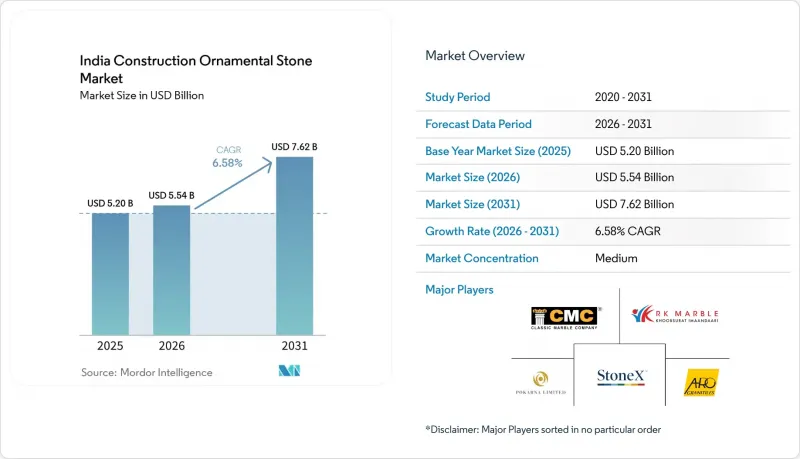
根據 Mordor Intelligence 預測,印度裝飾建築石材市場規模將從 2025 年的 52 億美元成長到 2026 年的 55.4 億美元,然後在 2031 年達到 76.2 億美元,2026 年至 2031 年的複合年成長率為 6.58%。
本報告按石材類型(花崗岩、大理石等)、生產狀態(未加工、未拋光等)、應用領域(地板材料、牆壁材料等)、最終用戶(住宅、商業)、配銷通路(製造商直銷、經銷商/加工商)和地區(印度北部、印度南部等)進行分類。市場預測以美元計價。
印度建築裝飾石材市場趨勢及洞察。
一二線城市對豪華住宅的需求
在印度,高階公寓和豪華別墅的需求在豪華房地產市場中激增。同時,住宅中高級產品的使用也日益增加。天然石材曾經使用較少,如今已廣泛應用於建築工程。隨著消費者購買力的提升,豪華專案的建造成本和投資金額加倍。包括進口品牌在內的義大利大理石和大型高檔瓷磚的需求正在上升。巴西產品因其公認的高品質而備受歡迎,但其高昂的價格仍然是一項挑戰。豪華住宅正在改變印度裝飾石材市場的石材,不僅在全國範圍內,而且在專案層面也是如此。預計到2025年,售價超過1,000萬印度盧比(1krolle rupee)的住宅將佔住宅總銷售額的50%,高於2024年的44%,顯示市場正迅速向高附加價值銷售模式轉變。
智慧城市和城市景觀發展的支出
公共工程項目是印度裝飾石材市場的另一個支柱,因為它們創造的需求不受私人住宅市場週期的影響。截至2025年中期,「智慧城市計畫」已完成8067個項目中的94%,在100個城市的總投資額達到1.64兆印度盧比。 2026年預算將資本支出增加到1.22兆印度盧比,並引入了「城市經濟區」的概念,從而維持了對鋪路、廣場開發、歷史街區地板材料以及其他公共空間應用(在這些領域,石材仍然是首選材料)的持續需求。 「AMRUT 2.0」計畫正在將這種需求擴展到更多城市,使印度裝飾石材市場的地理覆蓋範圍超越主要大都會圈。此外,政府採購越來越傾向於國產砂岩、科塔石和花崗岩,從而保護了不完全依賴豪華住宅的當地採石和加工產業叢集的需求。
使用陶瓷和燒結表面材料的替代方案
在印度裝飾石材市場的部分領域,大尺寸瓷磚和燒結表面材料正成為最明顯的替代威脅。燒結產品具有低孔隙率、完全抗紫外線和高硬度等優點,且隨著板材尺寸的增加,可見的勾縫線減少,最終表面效果更接近天然石材。這種挑戰在廚房檯面和浴室牆板領域尤為突出,因為中等價位的住宅在比較安裝成本、維護成本和視覺效果時,往往比地板材料和公共區域應用更關注這些方面。這種壓力在500萬至1000萬印度盧比的住宅區間最為明顯,在這個價位區間,設計考量依然很高,但價格敏感度也更高。隨著莫爾比的陶瓷製造商擴大燒結產品的產能,替代風險正在向下蔓延,並影響那些曾經為天然石材帶來更高利潤的應用領域。
基於細分市場的分析
到2025年,花崗岩將佔據印度裝飾石材市場40.9%的佔有率,並繼續保持其最暢銷石材的地位。其優勢在於特倫甘納邦、卡納塔克邦和安得拉邦穩定的國內原料供應,以及其在公共建築地板材料、豪華住宅和商業室內裝飾等領域的廣泛應用。在印度裝飾石材產業,花崗岩仍然是那些既需要視覺一致性又需要大占地面積採購的項目中最實用的材料。充足的供應,加上人們對其規格的熟悉,使得花崗岩的需求基礎比其他石材更為廣泛。
大理石仍是第二大石材類別,主要用於豪華住宅大廳、酒店室內裝潢和寺廟建設。拉賈斯坦邦的馬克拉納和基尚加爾地區仍然是新德里(NCR)和孟買高階項目的供應中心,在這些地區,白色和裝飾性大理石仍然與豪華規格緊密相關。石英岩和板岩雖然市場佔有率較小,但由於設計師在豪華建築立面和酒店建設中偏愛紋理和搪光錶面,它們也從中受益。石灰石、砂岩和科塔石則用於公共空間、寺廟和修復工程,在印度裝飾石材市場中佔據了一席之地,與廚房和浴室應用相比,它們受到的替代品壓力相對較小。
在印度裝飾石材市場,預計到2025年,未經加工的天然石材將佔據80.6%的市場佔有率,顯示其基礎供應規模龐大。然而,預計到2031年,拋光板材的年複合成長率將達到7.8%,使其成為印度裝飾石材市場成長最快的產品形式。因此,儘管原料貿易仍然是最大的收入來源,但增值方向正轉向更先進的加工流程。這種轉變是由高階住宅、商業維修以及出口對更高品質成品表面的需求所驅動的。
長期以來,印度一直向中國、中東和歐洲的加工商供應原石,其未加工石材市場所佔的較大佔有率也反映了這種既定的貿易模式。然而,隨著泰米爾納德邦和古吉拉突邦的國內加工商在拋光板材領域(包括皮革面花崗岩、搪光大理石和拉絲石英岩)的積極拓展,這種格局正在改變。這些表面處理流程使印度供應商不僅能夠透過原石供應,還能透過精湛的工藝和優質的成品來維持利潤率。這正在擴大印度裝飾石材行業中追求增值加工商和仍然主要依賴原石交易的加工商之間的差距。
其他好處:
- Excel格式的市場預測(ME)表
- 3個月的分析師支持
目錄
第1章:引言
- 市場分析與定義的前提條件
- 分析範圍
第2章 分析方法
第3章執行摘要
第4章 市場狀況
- 市場概覽
- 市場促進因素
- 一二線城市對豪華住宅的需求
- 智慧城市和城市景觀發展的支出
- 商業地產翻新週期
- 高階專案採用覆層層外牆
- 工程石英產能擴張及進口成分變化
- 數控工具機、線鋸和數位化製造技術的介紹
- 市場限制因素
- 承擔商品及服務稅遵循成本
- 採石場的供應正轉向出口等級。
- 利用陶瓷和燒結材料進行表面置換
- 採礦許可證和環境審核延誤
- 產業價值鏈分析
- 波特五力分析
- 洞察最新產業趨勢與創新
- 分析最新產業趨勢(新產品發布、策略性舉措、投資、合作、合資、業務擴張、併購等)
第5章:預測市場規模與成長率
- 按石材類型
- 花崗岩
- 大理石
- 矽質岩
- 石板
- 其他天然石材(石灰石、砂岩等)
- 製造條件
- 未經加工/未拋光
- 拋光板
- 裁切至所需尺寸
- 透過使用
- 地板材料
- 壁掛式/牆面面板
- 廚房和浴室檯面
- 其他用途(寺廟、紀念碑、家具)
- 最終用戶
- 住宅
- 商業設施
- 透過分銷管道
- 廠商直銷
- 經銷商和加工商
- 按地區
- 印度北部
- 南印度
- 西印度群島
- 印度東部、東北部
第6章 競爭情勢
- 市場集中度
- 策略趨勢
- 市佔率分析
- 公司簡介
- Pokarna Limited
- Aro Granite Industries Ltd
- RK Marble
- Classic Marble Company(KalingaStone)
- Stonex India Pvt Ltd
- Asian Granito India Ltd
- Madhav Marbles & Granites Ltd
- Tab India Pvt Ltd
- Johnson Marble & Quartz
- Global Stone(India)Pvt Ltd
- Paradigm Granite
- Divyashakti Granites Ltd
- Tripura Stones Pvt Ltd
- Titia Granites Pvt Ltd
- Radhamadhav Marbles
- Aravali India Marbles & Granites
- Regatta Universal Exports Ltd
- Kajaria Stone Pvt Ltd
- Levantina India
- Bhandari Marble Group
第7章 市場機會與未來展望
According to Mordor Intelligence, the India construction ornamental stone market size is expected to grow from USD 5.20 billion in 2025 to USD 5.54 billion in 2026 and is forecast to reach USD 7.62 billion by 2031 at 6.58% CAGR over 2026-2031.
This report is Segmented by Stone Type (Granite, Marble, and More), Manufacturing Type (Raw/Unpolished, and More), Application (Flooring, Walls, and More), End User (Residential, Commercial), Distribution Channel (Directly From the Manufacturers, Dealers and Fabricators), and Region (North India, South India, and More). The Market Forecasts are Provided in Value (USD).
India Construction Ornamental Stone Market Trends and Insights
Premium Housing Demand in Tier-I and Tier-II Cities
In India, the luxury real estate market is experiencing a surge in demand for high-end apartments and premium bungalows. This trend is accompanied by an increased use of premium products in residential construction. Natural stones, once used sparingly, are now widely incorporated into construction projects. The cost of construction and investment in luxury projects has doubled, aligning with increased consumer spending capacity. Italian marble and large-sized premium tiles, including imported brands, are in higher demand. Brazilian products are popular due to their recognized premium quality, though high prices remain a challenge. Premium residential construction is changing stone demand in the India ornamental stone market at the project level, not only at the national level. Homes priced above INR 1 crore made up 50% of total housing sales in 2025, compared with 44% in 2024, which shows how quickly sales have shifted toward higher-value formats.
Smart Cities and Urban Landscaping Spend
Public works remain a second strong support for the India ornamental stone market because they create demand outside private housing cycles. As of mid-2025, the Smart Cities Mission had completed 94% of its 8,067 projects, with total investment reaching INR 1.64 lakh crore across 100 cities. Budget 2026 also raised capital expenditure to INR 12.2 lakh crore and introduced City Economic Regions, which keeps the pipeline active for paving, plaza work, heritage-zone flooring, and other public-space uses where stone remains a preferred material AMRUT 2.0 widens this demand to more cities and expands the geographic reach of the India ornamental stone market beyond the main metro clusters. Government procurement also tends to favor domestic sandstone, kota stone, and granite, which protects demand for local quarrying and processing clusters that do not rely on luxury housing alone..
Ceramic and Sintered Surface Substitution
Large-format porcelain and sintered surfaces are becoming the clearest substitute threat to parts of the India ornamental stone market. Sintered products offer low porosity, full UV resistance, and high hardness, while larger slab sizes reduce visible joints and make the final surface look closer to natural stone. This challenge is strongest in kitchen countertops and bathroom wall panels, where mid-market home buyers compare installed cost, upkeep, and visual finish more directly than in flooring or civic applications. The pressure is most visible in the INR 50 lakh to INR 1 crore housing bracket, where design aspirations remain high but price sensitivity is tighter. As Morbi-based ceramic producers expand sintered capabilities, the substitute risk is moving lower across price bands and affecting application areas that once carried better margins for natural stone.
Other drivers and restraints analyzed in the detailed report include:
- Commercial Real Estate Renovation Cycle
- CNC, Wire Saw, and Digital Fabrication Adoption
- Mining Permission and Environmental Clearance Delays
For complete list of drivers and restraints, kindly check the Table Of Contents.
Segment Analysis
Granite held 40.9% of the Indian ornamental stone market share in 2025, maintaining its leading revenue position among stone types. Its strength comes from dependable domestic block supply in Telangana, Karnataka, and Andhra Pradesh, as well as broad use in institutional flooring, luxury residences, and commercial interiors. In the India ornamental stone industry, granite remains the most practical material for projects that need both visual consistency and easier procurement across large floor areas. This combination of supply depth and familiarity with specifications gives granite a broader base than other stones.
Marble remained the second-largest category and stayed concentrated in high-end residential lobbies, hospitality interiors, and temple construction. Rajasthan's Makrana and Kishangarh belts continued to anchor premium marble supply for projects in Delhi NCR and Mumbai, where white and decorative grades remain closely tied to luxury specifications. Quartzite and slate occupied a smaller share, but they benefited from designer preference for textured and honed surfaces in premium facade and hospitality work. Limestone, sandstone, and Kota stone served public-space, temple, and restoration uses, giving the Indian ornamental stone market a set of demand pockets that face weaker substitute pressure than kitchen and bathroom applications.
Raw and unpolished stone accounted for 80.6% share of the India ornamental stone market size in 2025, which shows how large the basic supply layer still is. Even so, polished slabs are forecast to expand at 7.8% CAGR through 2031, which makes them the fastest-growing manufacturing format in the India ornamental stone market. The direction of value is therefore moving toward higher-finish processing even though raw material trade still holds the biggest revenue base. This shift is being driven by premium housing, commercial upgrades, and export demand for better-finished surfaces.
India has long supplied raw blocks to processors in China, the Middle East, and Europe, so the large share of unpolished material reflects that established trade pattern. However, that structure is changing as domestic processors in Tamil Nadu and Gujarat compete more actively in polished slab categories such as leathered granite, honed marble, and brushed quartzite. These finishes allow Indian suppliers to defend margins through workmanship and finish quality rather than only through raw stone availability. In the India ornamental stone industry, this is widening the gap between operators that process for value and those that still depend mainly on block trading.
Complete Report Scope:
- By Stone Type
- Granite
- Marble
- Quartzites
- Slates
- Other Natural Stones, Limestone, Sandstone, Etc.
- By Manufacturing Type
- Raw/Unpolished
- Polished Slabs
- Cut-to-Size
- By Application
- Flooring
- Walls or Wall Panels
- Countertops, Both Kitchen and Bathroom
- Other Applications, Temples, Monuments, Furniture
- By End-User
- Residential
- Commercial
- By Distribution Channel
- Directly from the Manufacturers
- Dealers and Fabricators
- By Region
- North India
- South India
- West India
- East & North-East India
List of Companies Covered in this Report:
- Pokarna Limited
- Aro Granite Industries Ltd
- R K Marble
- Classic Marble Company (KalingaStone)
- Stonex India Pvt Ltd
- Asian Granito India Ltd
- Madhav Marbles & Granites Ltd
- Tab India Pvt Ltd
- Johnson Marble & Quartz
- Global Stone (India) Pvt Ltd
- Paradigm Granite
- Divyashakti Granites Ltd
- Tripura Stones Pvt Ltd
- Titia Granites Pvt Ltd
- Radhamadhav Marbles
- Aravali India Marbles & Granites
- Regatta Universal Exports Ltd
- Kajaria Stone Pvt Ltd
- Levantina India
- Bhandari Marble Group
Additional Benefits:
- The market estimate (ME) sheet in Excel format
- 3 months of analyst support
TABLE OF CONTENTS
1 Introduction
- 1.1 Study Assumptions & Market Definition
- 1.2 Scope of the Study
2 Research Methodology
3 Executive Summary
4 Market Landscape
- 4.1 Market Overview
- 4.2 Market Drivers
- 4.2.1 Premium Housing Demand in Tier-I and Tier-II Cities
- 4.2.2 Smart Cities and Urban Landscaping Spend
- 4.2.3 Commercial Real Estate Renovation Cycle
- 4.2.4 Dry-Cladding Facade Adoption in Premium Projects
- 4.2.5 Engineered Quartz Capacity Expansion and Import Mix Shift
- 4.2.6 CNC, Wire Saw, and Digital Fabrication Adoption
- 4.3 Market Restraints
- 4.3.1 GST and Compliance Cost Burden
- 4.3.2 Quarry Supply Diversion Toward Export Grades
- 4.3.3 Ceramic and Sintered Surface Substitution
- 4.3.4 Mining Permission and Environmental Clearance Delays
- 4.4 Industry Value Chain Analysis
- 4.5 Porter's Five Forces Analysis
- 4.5.1 Threat of New Entrants
- 4.5.2 Bargaining Power of Suppliers
- 4.5.3 Bargaining Power of Buyers
- 4.5.4 Threat of Substitutes
- 4.5.5 Competitive Rivalry
- 4.6 Insights into the Latest Trends and Innovations in the Industry
- 4.7 Insights into the Recent Developments (New Product Launches, Strategic Initiatives, Investments, Partnerships, JVs, Expansion, M&As, etc.) in the Industry
5 Market Size & Growth Forecasts (Value, INR Billion)
- 5.1 By Stone Type
- 5.1.1 Granite
- 5.1.2 Marble
- 5.1.3 Quartzites
- 5.1.4 Slates
- 5.1.5 Other Natural Stones, Limestone, Sandstone, Etc.
- 5.2 By Manufacturing Type
- 5.2.1 Raw/Unpolished
- 5.2.2 Polished Slabs
- 5.2.3 Cut-to-Size
- 5.3 By Application
- 5.3.1 Flooring
- 5.3.2 Walls or Wall Panels
- 5.3.3 Countertops, Both Kitchen and Bathroom
- 5.3.4 Other Applications, Temples, Monuments, Furniture
- 5.4 By End-User
- 5.4.1 Residential
- 5.4.2 Commercial
- 5.5 By Distribution Channel
- 5.5.1 Directly from the Manufacturers
- 5.5.2 Dealers and Fabricators
- 5.6 By Region
- 5.6.1 North India
- 5.6.2 South India
- 5.6.3 West India
- 5.6.4 East & North-East India
6 Competitive Landscape
- 6.1 Market Concentration
- 6.2 Strategic Moves
- 6.3 Market Share Analysis
- 6.4 Company Profiles (includes Global level Overview, Market level overview, Core Segments, Financials as available, Strategic Information, Market Rank/Share for key companies, Products & Services, and Recent Developments)
- 6.4.1 Pokarna Limited
- 6.4.2 Aro Granite Industries Ltd
- 6.4.3 R K Marble
- 6.4.4 Classic Marble Company (KalingaStone)
- 6.4.5 Stonex India Pvt Ltd
- 6.4.6 Asian Granito India Ltd
- 6.4.7 Madhav Marbles & Granites Ltd
- 6.4.8 Tab India Pvt Ltd
- 6.4.9 Johnson Marble & Quartz
- 6.4.10 Global Stone (India) Pvt Ltd
- 6.4.11 Paradigm Granite
- 6.4.12 Divyashakti Granites Ltd
- 6.4.13 Tripura Stones Pvt Ltd
- 6.4.14 Titia Granites Pvt Ltd
- 6.4.15 Radhamadhav Marbles
- 6.4.16 Aravali India Marbles & Granites
- 6.4.17 Regatta Universal Exports Ltd
- 6.4.18 Kajaria Stone Pvt Ltd
- 6.4.19 Levantina India
- 6.4.20 Bhandari Marble Group
7 Market Opportunities & Future Outlook
- 7.1 Green-Certified Stone Demand in Premium Projects
- 7.2 Prefab Stone-Panel Systems for Metro and Transit Infra

 建築裝飾石材:市場佔有率分析、產業趨勢與統計及成長預測(2026-2031)
 2026年全球建築石材市場報告
 建築石材市場規模、佔有率及成長分析(按類型、應用、最終用途及地區分類)-2026-2033年產業預測