


 |
市場調查報告書
商品編碼
2097369
歐洲消費與工業半導體裝置:市場佔有率分析、產業趨勢與統計及成長預測(2025-2030 年)Europe Semiconductor Device In Consumer Industry - Market Share Analysis, Industry Trends & Statistics, Growth Forecasts (2025 - 2030) |
||||||

※ 本網頁內容可能與最新版本有所差異。詳細情況請與我們聯繫。
根據 Mordor Intelligence 預測,歐洲消費和工業半導體裝置市場規模預計將在 2025 年達到 72.6 億美元,到 2030 年達到 97 億美元,2025 年至 2030 年的複合年成長率為 5.97%。
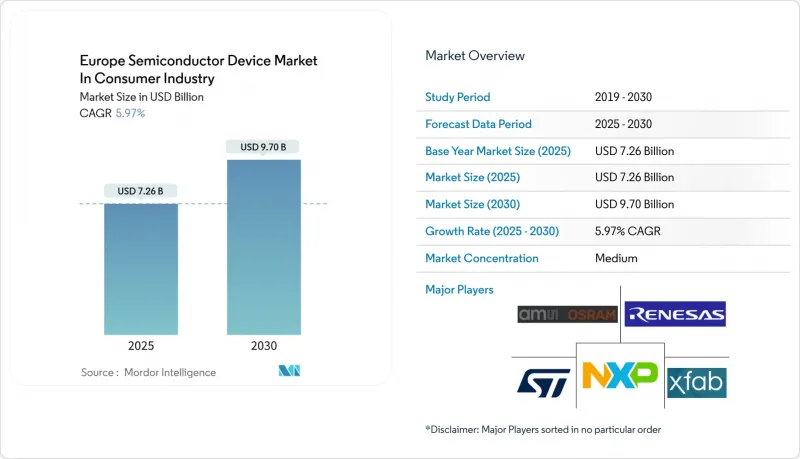
本報告按裝置類型(離散半導體、光電元件等)、應用領域(智慧型手機/平板電腦、穿戴式裝置等)、製程節點(28奈米以上、14-22奈米、10奈米以下)、材料(矽、碳化矽等)和地區(英國、德國等)進行細分。市場預測以美元計價。
歐洲消費與工業半導體裝置市場趨勢與分析
5G相容智慧型手機和穿戴式裝置的普及
歐洲通訊業者正在建造5G獨立網路核心網,預計2024年中期將覆蓋87%的都市區,這推動了智慧型手機和智慧型手錶中射頻(RF)前端模組的快速現代化。 3.4至3.8 GHz中頻寬的分配促進了氮化鎵(GaN)功率放大器和絕緣體上矽(SOI)開關的普及,這些技術可將每瓦成本降低18%。電池容量小於300 mAh的穿戴式裝置目前採用包絡追蹤電源管理積體電路(PMIC),可將通話時間延長22%。北歐半導體公司的nRF91在2024年已獲得14項設計採用,這表明其蜂窩功能和Cortex-M33邏輯的整合解決方案可以取代分立式基頻晶片。 2025 年無線電設備指令的網路安全條款強制要求安全啟動和韌體認證,這推動了 NXP 和 STMicroelectronics 等公司對嵌入式安全元件的需求。
向智慧家庭生態系統的轉型正在加速。
2024 年,Matter 1.2 將 Thread、Zigbee 和 Wi-Fi 6 整合到單一應用層,使閘道器製造商能夠將各個無線模組整合到單晶片解決方案中。 Silicon Labs 和 Nordic Semiconductor 的 SoC 佔 Matter 認證產品發布量的 60%,材料清單(BOM) 降低了 12%。支援遠場語音助理的揚聲器現在採用了意法半導體 (STMicroelectronics) 的 MEMS 麥克風,這些麥克風透過佔空比控制的喚醒詞檢測,符合 0.3 W 的生態設計標準待機功耗限制。經認證的 KNX 智慧家庭安裝量年增 31%,推動了照明和 HVAC 節點 MCU 的出貨量。 802.15.4 PHY 層的通用使晶片供應商能夠重複使用射頻模組,從而將設計成本分攤到大規模生產中,並加速其在中階消費性電子產品中的應用。
先進節點製造領域資本密集度高
目前,在歐洲建造一座5奈米級晶圓廠的成本超過150億歐元(174.7億美元),但沒有一家本土整合元件製造商(IDM)將全部資金投入消費級產品。克羅爾工廠專注於18奈米FD-SOI工藝,德勒斯登工廠專注於28-40奈米功率裝置,而智慧型手機和平板電腦處理器則外包給亞洲的代工廠。 「晶片法」優先發展汽車和國防領域,將消費級通用積體電路置於次要地位。因此,歐洲品牌被迫依賴台灣和韓國的先進邏輯半導體,導致供應鏈中斷,前置作業時間延長4-6個月。此外,附近缺乏先進節點製造地也阻礙了區域無廠半導體公司在設計和製程方面的聯合最佳化。
基於細分市場的分析
預計到2030年,感測器市場將以6.28%的複合年成長率成長,超過所有其他裝置類別,包括積體電路(IC)。積體電路在2024年佔總銷售額的48.20%。歐洲感測器半導體裝置市場由環境感測器、慣性感測器和生物識別感測器驅動,這些感測器將邊緣智慧擴展到健身追蹤器、智慧音箱、空氣品質監測器等產品中。意法半導體(STMicroelectronics)的LSM6DSV16X慣性模組可在晶片上執行手勢姿態辨識,從而將MCU喚醒事件減少47%,並將智慧型手錶電池續航時間延長兩天。博世Sensortec公司計畫在2024年出貨1.8億個MEMS元件,其中氣壓感測器和氣體感測器將支援環境智慧應用場景。光電子元件在智慧型手機OLED驅動市場佔據主導地位,而由於散熱量降低30%,分離式GaN電晶體正在取代矽MOSFET,用於快速充電轉接器。
儘管面向消費性電子產品的低成本平行微控制器仍牢牢佔據130nm製程的主導地位,但感測器領域正受益於40nm和22nm FD-SOI製程帶來的更高整合度,透過降低漏電流來延長紐扣電池的使用壽命。在歐洲半導體裝置市場,隨著電源管理單元、影像感測器和邏輯控制器轉向以感測器主導架構為主導的多晶片模組,積體電路的佔有率預計將略有下降。隨著Matter和KNX的推出,提供感測器、連接和電源管理積體電路參考設計的供應商有望獲得大規模的平台訂單。
儘管智慧型手機和平板電腦在2024年佔了35.70%的銷售額,但穿戴式裝置正以7.01%的複合年成長率成長,這主要得益於歐盟醫療設備法規(MDR)核准的健康遙測技術。像Nordic的nRF5340這樣的雙核心藍牙SoC,可以將連續心率監測期間的電流消耗降低到5毫安培以下,預計將進一步擴大歐洲穿戴裝置半導體裝置的市場。智慧家庭設備也在成長,這得益於Matter標準化以及德國現有KNX設備的改造升級,推動了對多重通訊協定微控制器的需求。儘管高頻寬圖形處理器的市場佔有率仍然較小,但它們在遊戲和AR/VR領域的需求依然旺盛,預計台積電德勒斯登工廠很快就會採用先進的封裝技術,從而緩解物流延誤問題。
由於穿戴式裝置依賴超低漏電流的FD-SOI工藝,歐洲基板供應商處於有利地位。同時,智慧型手機仍是單晶片矽面積最大的產品,預計向3nm以下製程節點的過渡還將持續。整合智慧型手機、智慧型手錶和智慧家居處理器藍圖的品牌可以透過利用通用晶片互連技術來最佳化研發投入的時間分配,並改進設備的整體材料清單(BOM)。
其他好處:
- Excel格式的市場預測(ME)表
- 3個月的分析師支持
目錄
第1章:引言
- 市場分析與定義的前提條件
- 分析範圍
第2章 分析方法
第3章執行摘要
第4章 市場狀況
- 市場概覽
- 市場促進因素
- 家用電器需求增加
- 消費性物聯網設備的廣泛應用
- 5G相容智慧型手機和穿戴式裝置的普及
- 加速向智慧家庭生態系統轉型
- 低功耗消費性電子產品中基於晶片組的模組化架構的興起
- 歐盟生態設計法規正在推動對超低待機功耗積體電路的需求。
- 市場限制因素
- 半導體供應鏈持續受到干擾。
- 歐洲先進節點製造領域資本密集度高
- 面向消費者的原始設備製造商 (OEM) 設計週期的分散加劇了非經常性工程 (NRE) 成本的波動性。
- 歐盟加強化學品法規(包括禁止使用 PFAS)使微影術材料的情況變得更加複雜。
- 產業價值鏈分析
- 監理情勢
- 技術展望
- 波特五力分析
- 宏觀經濟因素對市場的影響
- 投資分析
第5章:預測市場規模與成長率
- 依設備類型
- 法令半導體
- 光電子學
- 感應器
- 積體電路
- 模擬
- 邏輯
- 記憶
- 微
- 微處理器
- 微控制器
- 數位訊號處理器
- 透過使用
- 智慧型手機和平板電腦
- 穿戴式裝置
- 智慧家庭設備
- 遊戲機、AR/VR設備
- 依技術節點
- 28奈米或更大
- 14~22 nm
- 小於10奈米
- 材料
- 矽
- 碳化矽
- 氮化鎵
- 其他化合物半導體
- 國家
- 英國
- 德國
- 法國
- 西班牙
- 義大利
- 其他歐洲國家
第6章 競爭情勢
- 市場集中度
- 策略趨勢
- 市佔率分析
- 公司簡介
- Infineon Technologies AG
- STMicroelectronics NV
- NXP Semiconductors NV
- Dialog Semiconductor Plc(Renesas Electronics Corporation)
- AMS-OSRAM AG
- X-FAB Silicon Foundries SE
- SOITEC SA
- Soitec SA
- Silicon Labs
- Qualcomm Technologies Inc.
- Nordic Semiconductor ASA
- ON Semiconductor Corporation
- Microchip Technology Inc.
- Texas Instruments Incorporated
- Broadcom Inc.
- MediaTek Inc.
- Skyworks Solutions Inc.
- Analog Devices Inc.
- Murata Manufacturing Co. Ltd.
第7章 市場機會與未來展望
According to Mordor Intelligence, the Europe semiconductor device market size in the consumer segment reached USD 7.26 billion in 2025 and is projected to touch USD 9.70 billion by 2030, translating into a 5.97% CAGR over 2025-2030.
This report is Segmented by Device Type (Discrete Semiconductors, Optoelectronics, and More), Application (Smartphones and Tablets, Wearables, and More), Technology Node (>=28 Nm, 14-22 Nm, <10 Nm), Material (Silicon, Silicon Carbide, and More), and Geography (United Kingdom, Germany, and More). The Market Forecasts are Provided in Terms of Value (USD).
Insights and Trends of Europe Semiconductor Device Market In Consumer Industry
Proliferation Of 5G-Enabled Smartphones And Wearables
European operators had built 5G standalone cores that covered 87% of city populations by mid-2024, prompting rapid refresh of radio-frequency front-end modules in smartphones and smartwatches. Mid-band allocations at 3.4-3.8 GHz favor gallium-nitride power amplifiers and silicon-on-insulator switches that lower cost per watt by 18%. Wearables with sub-300 mAh batteries now rely on envelope-tracking PMICs, extending talk time by 22%. Nordic Semiconductor's nRF91 secured 14 design wins in 2024, proving that integrated cellular plus Cortex-M33 logic displaces discrete basebands. Cyber-security clauses in the 2025 Radio Equipment Directive mandate secure boot and firmware attestation, which lifts demand for embedded secure elements from NXP and STMicroelectronics.
Accelerated Shift Toward Smart-Home Ecosystems
Matter 1.2 unified Thread, Zigbee and Wi-Fi 6 under one application layer in 2024, letting gateway makers collapse discrete radios into single-die solutions. Silicon Labs and Nordic Semiconductor SoCs captured 60% of Matter-certified launches, trimming bill-of-materials by 12%. Far-field voice-assistant speakers now embed STMicroelectronics MEMS microphones that respect the 0.3 W Ecodesign standby ceiling through duty-cycled wake-word detection. Certified KNX smart-home installations climbed 31% year-on-year, stimulating MCU shipments for lighting and HVAC nodes. Shared 802.15.4 PHY layers let chip vendors reuse RF blocks, spreading design cost over larger volumes and accelerating penetration into mid-tier appliances.
High Capital Intensity Of Advanced-Node Fabrication
Building a 5 nm-class fab in Europe now costs beyond EUR 15 billion(USD 17.47 billion), and no local IDM has earmarked that sum exclusively for consumer workloads. Crolles focuses on 18 nm FD-SOI, Dresden on 28-40 nm power devices, leaving phone and tablet processors to Asian foundries. Chips Act grants prioritize automotive and defense, sidelining commodity consumer ICs. Consequently, European brands depend on Taiwan and Korea for advanced logic, fragmenting supply chains and extending lead times by four to six months. Lack of proximal advanced nodes also hinders co-optimization of design and process for regional fabless firms.
Other drivers and restraints analyzed in the detailed report include:
- Emergence Of Chiplet-Based Modular Architectures
- EU Ecodesign Regulations For Ultra-Low-Standby Power ICs
- Stricter EU Chemicals Restriction (PFAS Ban)
For complete list of drivers and restraints, kindly check the Table Of Contents.
Segment Analysis
Sensors' 6.28% CAGR through 2030 outflanks all other device categories even though integrated circuits owned 48.20% of 2024 revenue. The Europe semiconductor device market size for sensors is buoyed by environmental, inertial and biometric arrays that extend edge intelligence into fitness trackers, smart speakers and air-quality monitors. STMicroelectronics' LSM6DSV16X inertial module executes gesture-recognition on-chip, cutting MCU wake events 47% and adding two days to smartwatch battery life. Bosch Sensortec shipped 180 million MEMS devices in 2024, with barometric and gas sensors underpinning ambient-intelligence use cases. Optoelectronics command share in smartphone OLED drivers, while discrete GaN transistors are replacing silicon MOSFETs in fast-charge adapters due to 30% lower heat dissipation.
Parallel cost-sensitive appliance MCUs remain entrenched at 130 nm, but sensors benefit from tighter integration at 40 nm and 22 nm FD-SOI, where reduced leakage prolongs coin-cell life. The Europe semiconductor device market share for integrated circuits will decline modestly as power-management units, image sensors and logic controllers migrate into multi-chip modules dominated by sensor-driven architectural choices. Suppliers that bundle sensor, connectivity and PMIC reference designs stand to capture bigger platform wins in Matter and KNX deployments.
Smartphones and tablets owned 35.70% of 2024 revenue, yet wearables are growing at 7.01% CAGR on the back of health telemetry cleared under EU MDR. The Europe semiconductor device market size for wearables will strengthen further as dual-core Bluetooth SoCs such as Nordic's nRF5340 trim continuous heart-rate monitoring current to sub-5 mA. Smart-home appliances also climb due to Matter standardization and retrofits in Germany's KNX base, driving demand for multi-protocol microcontrollers. Gaming and AR/VR, a smaller slice, still require high-bandwidth graphics processors whose advanced packaging may soon be performed in TSMC's Dresden facility, cutting logistics lag.
Wearables' reliance on ultra-low-leakage FD-SOI processes positions European substrate providers favorably. Meanwhile, smartphones will keep absorbing the largest silicon area per unit, sustaining node migration toward 3 nm and below. Brands that harmonize phone, watch and smart-home processor roadmaps can leverage shared die-to-die interconnects to time-slice R&D spend and improve bill-of-materials across devices.
Complete Report Scope:
- By Device Type
- Discrete Semiconductors
- Optoelectronics
- Sensors
- Integrated Circuits
- Analog
- Logic
- Memory
- Micro
- Microprocessor
- Microcontroller
- Digital Signal Processors
- By Application
- Smartphones and Tablets
- Wearables
- Smart Home Appliances
- Gaming Consoles and AR-VR Devices
- By Technology Node
- >=28 nm
- 14-22 nm
- <10 nm
- By Material
- Silicon
- Silicon Carbide
- Gallium Nitride
- Other Compound Semiconductors
- By Country
- United Kingdom
- Germany
- France
- Spain
- Italy
- Rest of Europe
List of Companies Covered in this Report:
- Infineon Technologies AG
- STMicroelectronics N.V.
- NXP Semiconductors N.V.
- Dialog Semiconductor Plc (Renesas Electronics Corporation)
- AMS-OSRAM AG
- X-FAB Silicon Foundries SE
- SOITEC S.A.
- Soitec S.A.
- Silicon Labs
- Qualcomm Technologies Inc.
- Nordic Semiconductor ASA
- ON Semiconductor Corporation
- Microchip Technology Inc.
- Texas Instruments Incorporated
- Broadcom Inc.
- MediaTek Inc.
- Skyworks Solutions Inc.
- Analog Devices Inc.
- Murata Manufacturing Co. Ltd.
Additional Benefits:
- The market estimate (ME) sheet in Excel format
- 3 months of analyst support
TABLE OF CONTENTS
1 INTRODUCTION
- 1.1 Study Assumptions and Market Definition
- 1.2 Scope of the Study
2 RESEARCH METHODOLOGY
3 EXECUTIVE SUMMARY
4 MARKET LANDSCAPE
- 4.1 Market Overview
- 4.2 Market Drivers
- 4.2.1 Rising Demand for Consumer Electronics Products
- 4.2.2 Growing Adoption of Consumer IoT Devices
- 4.2.3 Proliferation of 5G-Enabled Smartphones and Wearables
- 4.2.4 Accelerated Shift Toward Smart Home Ecosystems
- 4.2.5 Emergence of Chiplet-Based Modular Architectures in Low-Power Consumer Devices
- 4.2.6 EU Ecodesign Regulations Driving Demand for Ultra-Low-Standby Power ICs
- 4.3 Market Restraints
- 4.3.1 Persistent Semiconductor Supply Chain Disruptions
- 4.3.2 High Capital Intensity of Advanced Node Fabrication in Europe
- 4.3.3 Fragmented Consumer OEM Design Cycles Increasing NRE Cost Volatility
- 4.3.4 Stricter EU Chemicals Restriction (PFAS Ban) Complicating Lithography Materials
- 4.4 Industry Value Chain Analysis
- 4.5 Regulatory Landscape
- 4.6 Technological Outlook
- 4.7 Porter's Five Forces Analysis
- 4.7.1 Bargaining Power of Suppliers
- 4.7.2 Bargaining Power of Buyers
- 4.7.3 Threat of New Entrants
- 4.7.4 Threat of Substitutes
- 4.7.5 Intensity of Competitive Rivalry
- 4.8 Impact of Macroeconomic Factors on the Market
- 4.9 Investment Analysis
5 MARKET SIZE AND GROWTH FORECASTS
- 5.1 By Device Type
- 5.1.1 Discrete Semiconductors
- 5.1.2 Optoelectronics
- 5.1.3 Sensors
- 5.1.4 Integrated Circuits
- 5.1.4.1 Analog
- 5.1.4.2 Logic
- 5.1.4.3 Memory
- 5.1.4.4 Micro
- 5.1.4.4.1 Microprocessor
- 5.1.4.4.2 Microcontroller
- 5.1.4.4.3 Digital Signal Processors
- 5.2 By Application
- 5.2.1 Smartphones and Tablets
- 5.2.2 Wearables
- 5.2.3 Smart Home Appliances
- 5.2.4 Gaming Consoles and AR-VR Devices
- 5.3 By Technology Node
- 5.3.1 >=28 nm
- 5.3.2 14-22 nm
- 5.3.3 <10 nm
- 5.4 By Material
- 5.4.1 Silicon
- 5.4.2 Silicon Carbide
- 5.4.3 Gallium Nitride
- 5.4.4 Other Compound Semiconductors
- 5.5 By Country
- 5.5.1 United Kingdom
- 5.5.2 Germany
- 5.5.3 France
- 5.5.4 Spain
- 5.5.5 Italy
- 5.5.6 Rest of Europe
6 COMPETITIVE LANDSCAPE
- 6.1 Market Concentration
- 6.2 Strategic Moves
- 6.3 Market Share Analysis
- 6.4 Company Profiles (includes Global level Overview, Market level overview, Core Segments, Financials as available, Strategic Information, Market Rank/Share for key companies, Products and Services, and Recent Developments)
- 6.4.1 Infineon Technologies AG
- 6.4.2 STMicroelectronics N.V.
- 6.4.3 NXP Semiconductors N.V.
- 6.4.4 Dialog Semiconductor Plc (Renesas Electronics Corporation)
- 6.4.5 AMS-OSRAM AG
- 6.4.6 X-FAB Silicon Foundries SE
- 6.4.7 SOITEC S.A.
- 6.4.8 Soitec S.A.
- 6.4.9 Silicon Labs
- 6.4.10 Qualcomm Technologies Inc.
- 6.4.11 Nordic Semiconductor ASA
- 6.4.12 ON Semiconductor Corporation
- 6.4.13 Microchip Technology Inc.
- 6.4.14 Texas Instruments Incorporated
- 6.4.15 Broadcom Inc.
- 6.4.16 MediaTek Inc.
- 6.4.17 Skyworks Solutions Inc.
- 6.4.18 Analog Devices Inc.
- 6.4.19 Murata Manufacturing Co. Ltd.
7 MARKET OPPORTUNITIES AND FUTURE OUTLOOK
- 7.1 White-space and Unmet-need Assessment

 半導體報告包
 神經形態人工智慧半導體市場規模、佔有率和成長分析:按組件、部署、應用、最終用戶和地區分類——2026-2033年產業預測
 半導體金屬加熱器市場:按產品類型、應用、加熱器類型、最終用戶、國家和地區分類-全球產業分析、市場規模及佔有率和未來預測(2026-2033)
 導線架市場:按材料、應用和地區分類
 半導體物流市場規模、佔有率和趨勢分析:按產品、營運模式、服務、目的地、地區和細分市場分類的預測(2026-2033 年)半導體市場報告:趨勢、預測和競爭分析(至2035年)半導體模擬市場報告:趨勢、預測與競爭分析(至2035年)
 印度半導體市場:市場佔有率分析、產業趨勢與統計及成長預測(2026-2031)
 用於替代能源技術的半導體:機會和市場
 IC逆向工程市場:全球市場預測,2026-2032年