

 |
市場調查報告書
商品編碼
2125748
印度半導體市場:市場佔有率分析、產業趨勢與統計及成長預測(2026-2031)India Semiconductor - Market Share Analysis, Industry Trends & Statistics, Growth Forecasts (2026 - 2031) |
||||||

※ 本網頁內容可能與最新版本有所差異。詳細情況請與我們聯繫。
根據 Mordor Intelligence 預測,印度半導體市場規模預計將在 2026 年達到 124.1 億美元,到 2031 年達到 174.2 億美元,2026 年至 2031 年的複合年成長率為 7.02%。
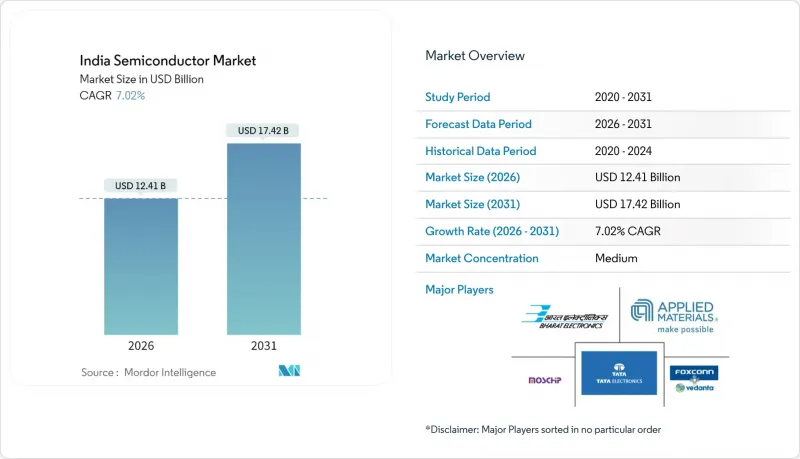
本報告按元件類型(離散半導體、光電子元件、感測器/MEMS、積體電路)、積體電路類型(類比、微、邏輯、記憶體)、製程節點(3nm以下、5nm、7nm、16nm、28nm及以上)及終端用戶產業(汽車、電信、消費性電子及其他)進行細分。市場預測以美元計價。
印度半導體市場趨勢與洞察
政府獎勵計畫(PLI、DLI)
在生產連結獎勵計畫(PLI) 和設計關聯獎勵計劃 (DLI) 的推動下,印度已累計投資 7,600 億印度盧比(約 91 億美元),使合格的專案資本成本降低了高達 50%,並使曾經難以實現的待開發區專案在商業性可行。塔塔電子已開始在多雷拉 (Dorella) 建造一座 300 毫米晶圓廠,目標是在其成熟節點上實現每月 5 萬片晶圓的產量。美光科技位於薩南德 (Sanand) 的後端工廠已於 2024 年底交付了首批封裝記憶體。 2025 年聯邦預算進一步取消了微影術設備和超高純度氣體的關稅,縮短了建設週期並降低了進口壁壘。這些財政措施共同推動印度半導體市場朝著更垂直整合的方向發展。
交通運輸業的快速電氣化
在「促進混合動力汽車和電動車發展計畫 (FAME)」的推動下,電動車銷量激增,政府已撥款1000億印度盧比(約12億美元)用於充電基礎設施建設。高壓驅動系統需要碳化矽 (SiC) MOSFET、絕緣柵雙極電晶體(IGBT) 和電源管理積體電路 (IC),這帶動了印度對這些先前依賴進口的裝置的需求。因此,預計汽車領域的終端用戶銷售額將以8.66%的複合年成長率成長,成為所有產業中成長率最高的產業。計畫中的多雷拉工廠將把部分產能用於生產電動摩托車和乘用車的類比電源管理積體電路和微控制器,預計將降低印度供應鏈對海外晶圓代工廠的依賴。
先進節點工程領域人員短缺
根據印度電子與半導體協會 (IESA) 估計,儘管到 2027 年預計需要新增 85,000 名工程師,但設計、製造和測試領域仍將面臨 30 萬名工程師的缺口。雖然當地大學正在擴充課程,印度半導體發展署也已累計50 億印度盧比(約 6000 萬美元)用於獎學金和學徒計劃,但主要設計中心的離職率仍然超過 20%。這種人才短缺引發了人們對晶片流片延遲和量產時間延長的擔憂,尤其是在 2 奈米以下製程製程方面。
細分市場分析
2025年,電晶體佔分立元件銷售額的48.92%,但預計到2031年,二極體的年複合成長率將達到7.82%,因為碳化矽(SiC)肖特基二極體設計因其能最大限度降低開關損耗,在電動車充電器和可再生能源逆變器中更受歡迎。因此,隨著FAME計畫相關充電器在全國範圍內的推廣,印度分立二極體的半導體市場規模預計將會擴大。壓敏電阻、閘流體和暫態電壓抑制器在通訊和消費性電子產品的突波保護中繼續發揮重要作用,確保了產品組合的平衡。
Cyient-Azimuth 的 ARKA GKT-1系統晶片計劃於 2026 年年中量產,它將閘極驅動器和 MOSFET 整合在單一晶片上,從而減少了摩托車 OEM 廠商的基板空間。 「設計關聯激勵計畫」對化合物半導體的重視可望加速國內絕緣柵雙極電晶體(IGBT) 繼續在工業自動化和 UPS(不斷電系統)應用的高電流開關領域佔據主導地位,即使二極體出貨量加速成長,IGBT 仍然是電晶體需求的基礎。
到2025年,發光二極體 )將佔光電子產品銷售額的38.83%,但雷射二極體預計將以8.02%的複合年成長率超越發光二極體 ,這反映了資料中心向Gigabit和Gigabit乙太網路的升級。影像感測器(主要由CMOS構成)支撐著蓬勃發展的智慧型手機市場,年出貨量超過1.5億顆;而光耦合器則為工業馬達驅動裝置提供電氣隔離。
印度的國內光電子生產仍處於起步階段,超過80%的零件依賴進口,因此政府實施了一項分階段的製造計劃,對光子積體電路製造廠15%的資本進行補貼。 BharatNet光纖網路的建設預計到2030年將需要約5,000萬個光收發器,這將為垂直腔面共振器雷射(VCSEL)創造一個巨大的壟斷市場。目前,喀拉拉邦和特倫甘納邦正在努力引入光電組裝線,這表明印度半導體市場正處於地域多角化的早期階段。
其他好處
- Excel格式的市場預測(ME)表
- 3個月的分析師支持
目錄
第1章:引言
- 研究假設和市場定義
- 調查範圍
第2章:調查方法
第3章執行摘要
第4章 市場狀況
- 市場概覽
- 市場促進因素
- 政府獎勵計畫(PLI、DLI)
- 交通運輸業的快速電氣化
- 透過 BharatNet 部署 5G 並擴展光纖網路
- 資料中心和人工智慧工作負載
- 國內GaN/SiC試驗晶圓廠
- 高度可靠的國防級晶圓廠認證
- 市場限制因素
- 先進節點工程領域人員短缺
- 超高純水和電力基礎設施有限
- 分散式 OSAT 生產能力
- 土地和環境許可程序延誤
- 產業價值鏈分析
- 監管和獎勵框架
- 技術展望
- 波特五力模型
- SWOT分析(印度的積體電路設計、製造與應用技術)
- 投資分析(資本投資與現金流量趨勢)
第5章 市場規模與成長預測
- 依設備類型
- 離散半導體
- 二極體
- 電晶體
- 功率電晶體
- 整流器和閘流體
- 其他分立元件
- 光電子學
- 發光二極體(LED)
- 雷射二極體
- 影像感測器
- 歐普託卡普拉
- 其他光電裝置
- 感測器和微機電系統
- 壓力感測器
- 磁場感測器
- 執行器
- 加速度計和偏航率感測器
- 溫度感測器和其他感測器
- 積體電路
- 依積體電路類型
- 模擬
- 微
- 微處理器(MPU)
- 微控制器(MCU)
- 數位訊號處理器
- 邏輯
- 記憶
- 依製程節點(針對積體電路)
- 3奈米或更小
- 5nm
- 7nm
- 16nm
- 28nm
- 大於28奈米
- 依積體電路類型
- 離散半導體
- 按最終用戶行業分類
- 車
- 通訊(有線和無線)
- 家用電器
- 產業
- 計算和數據存儲
- 資料中心
- 人工智慧
- 政府(航太/國防)
第6章 競爭情勢
- 市場集中度
- 策略性舉措(併購、合資、基本協議)
- 市佔率分析
- 公司簡介(包括全球整體概覽、市場概覽、主要業務板塊、財務資訊、策略資訊、市場排名/佔有率、產品和服務以及近期發展動態)
- Tata Electronics Private Limited
- Vedanta-Foxconn Semiconductors Limited
- Bharat Electronics Limited
- MosChip Technologies Limited
- Applied Materials India Private Limited
- ASM Technologies Limited
- Suchi Semiconductors Private Limited
- NXP Semiconductors NV
- HCL Technologies Limited
- Infineon Technologies AG
- Renesas Electronics Corporation
- STMicroelectronics NV
- Powerchip Semiconductor Manufacturing Corporation
- Intel Corporation
- Samsung Electronics Co., Ltd.
- Qualcomm Incorporated
- Micron Technology, Inc.
- Texas Instruments Incorporated
- MediaTek Inc.
- Taiwan Semiconductor Manufacturing Company Limited
第7章 市場機會與未來展望
According to Mordor Intelligence, the India semiconductor market size stood at USD 12.41 billion in 2026 and is projected to reach USD 17.42 billion by 2031, advancing at a 7.02% CAGR during 2026-2031.
This report is Segmented by Device Type (Discrete Semiconductors, Optoelectronics, Sensors and MEMS, and Integrated Circuits), Integrated Circuit Type (Analog, Micro, Logic, and Memory), Technology Node (Less Than or Equal To 3nm, 5nm, 7nm, 16nm, 28nm, and More), End-User Industry (Automotive, Communication, Consumer Electronics, and More). The Market Forecasts are Provided in Terms of Value (USD).
India Semiconductor Market Trends and Insights
Government Incentive Schemes (PLI, DLI)
A combined outlay of INR 760 billion (USD 9.1 billion) under the Production Linked Incentive and Design Linked Incentive programs is lowering capital costs by as much as 50% for qualified projects, making greenfield fabs commercially viable where they once were prohibitive. Tata Electronics began site preparation for a 300-millimeter facility in Dholera that targets 50,000 wafer starts per month at mature nodes, and Micron Technology's back-end plant in Sanand dispatched its first packaged memory in late 2024. The Union Budget 2025 further eliminated customs duties on lithography tools and ultrapure gases, trimming build-out timelines and import barriers. Collectively, these fiscal levers are steering the India semiconductor market toward a more vertically integrated footing.
Rapid Electrification of Transport
Electric-vehicle sales are rising precipitously under the Faster Adoption and Manufacturing of Hybrid and Electric Vehicles scheme, which allocates INR 100 billion (USD 1.2 billion) to charging infrastructure. Higher voltage drivetrains require silicon-carbide MOSFETs, insulated-gate bipolar transistors, and power-management ICs, boosting demand for devices that India has historically imported. Automotive end-user revenue is therefore forecast to grow at an 8.66% CAGR, the fastest among all verticals. The upcoming Dholera fab will dedicate part of its capacity to analog power-management ICs and microcontrollers for electric two-wheelers and passenger cars, narrowing supply-chain exposure to offshore foundries.
Skill Shortage in Advanced-node Engineering
The India Electronics and Semiconductor Association estimates a shortfall of 300,000 engineers across design, fabrication and test disciplines, despite a projected need for 85,000 additional professionals by 2027. Local universities are expanding curricula, and the India Semiconductor Mission has set aside INR 5 billion (USD 60 million) for scholarships and apprenticeships, yet attrition rates above 20% persist in key design hubs. The talent squeeze risks delaying tape-outs and stretching ramp-up timelines, especially for 2-nanometer and below.
Other drivers and restraints analyzed in the detailed report include:
- 5G Roll-out and BharatNet Fibre Expansion
- Data-Center and AI Workloads
- Limited Ultrapure Water and Power Infrastructure
For complete list of drivers and restraints, kindly check the Table Of Contents.
Segment Analysis
Transistors held 48.92% of discrete-device revenue in 2025, yet diodes are expected to grow at a 7.82% CAGR to 2031 as electric-vehicle chargers and renewable-energy inverters favor silicon-carbide Schottky designs that minimize switching losses. The India semiconductor market size for discrete diodes is therefore set to expand in line with nationwide charger rollouts linked to the FAME program. Varistors, thyristors and transient-voltage suppressors remain relevant for surge protection in telecom and consumer devices, ensuring a balanced product mix.
Cyient-Azimuth's ARKA GKT-1 system-on-chip, slated for mid-2026 production, integrates gate drivers and MOSFETs on one die, shrinking board space for two-wheeler OEMs. The Design Linked Incentive scheme's emphasis on compound semiconductors is poised to unlock domestic gallium-nitride transistor development, reducing import reliance for 5G base-station equipment and satellite terminals. Across industrial automation and UPS applications, insulated-gate bipolar transistors continue to dominate high-current switching, anchoring transistor demand even as diode shipments accelerate.
Light-emitting diodes commanded 38.83% of optoelectronic revenue in 2025, but laser diodes are projected to outpace with an 8.02% CAGR, reflecting data-center upgrades to 400-gigabit and 800-gigabit Ethernet. Image sensors, chiefly CMOS, service a buoyant smartphone market of more than 150 million annual shipments, while optocouplers enable galvanic isolation in industrial motor drives.
India's local optoelectronics output remains nascent, with over 80% of parts imported, prompting the phased manufacturing program to offer 15% capital subsidies for photonic IC fabs. BharatNet's fiber build-out will require roughly 50 million optical transceivers by 2030, creating a sizable captive market for vertical-cavity surface-emitting lasers. Initiatives in Kerala and Telangana are exploring photonics assembly lines, signaling early-stage regional diversification within the India semiconductor market.
Complete Report Scope:
- By Device Type
- Discrete Semiconductors
- Diodes
- Transistors
- Power Transistors
- Rectifiers and Thyristors
- Other Discrete Devices
- Optoelectronics
- Light-Emitting Diodes (LEDs)
- Laser Diodes
- Image Sensors
- Optocouplers
- Other Optoelectronic Devices
- Sensors and MEMS
- Pressure Sensors
- Magnetic Field Sensors
- Actuators
- Acceleration and Yaw Rate Sensors
- Temperature and Other Sensors
- Integrated Circuits
- By Integrated Circuit Type
- Analog
- Micro
- Microprocessors (MPU)
- Microcontrollers (MCU)
- Digital Signal Processors
- Logic
- Memory
- By Technology Node (For Integrated Circuits)
- Less Than or Equal to 3nm
- 5 nm
- 7 nm
- 16 nm
- 28 nm
- Greater Than 28nm
- By Integrated Circuit Type
- Discrete Semiconductors
- By End-User Industry
- Automotive
- Communication (Wired and Wireless)
- Consumer Electronics
- Industrial
- Computing and Data Storage
- Data Center
- Artificial Intelligence
- Government (Aerospace and Defense)
List of Companies Covered in this Report:
- Tata Electronics Private Limited
- Vedanta-Foxconn Semiconductors Limited
- Bharat Electronics Limited
- MosChip Technologies Limited
- Applied Materials India Private Limited
- ASM Technologies Limited
- Suchi Semiconductors Private Limited
- NXP Semiconductors N.V.
- HCL Technologies Limited
- Infineon Technologies AG
- Renesas Electronics Corporation
- STMicroelectronics N.V.
- Powerchip Semiconductor Manufacturing Corporation
- Intel Corporation
- Samsung Electronics Co., Ltd.
- Qualcomm Incorporated
- Micron Technology, Inc.
- Texas Instruments Incorporated
- MediaTek Inc.
- Taiwan Semiconductor Manufacturing Company Limited
Additional Benefits:
- The market estimate (ME) sheet in Excel format
- 3 months of analyst support
TABLE OF CONTENTS
1 INTRODUCTION
- 1.1 Study Assumptions and Market Definition
- 1.2 Scope of the Study
2 RESEARCH METHODOLOGY
3 EXECUTIVE SUMMARY
4 MARKET LANDSCAPE
- 4.1 Market Overview
- 4.2 Market Drivers
- 4.2.1 Government Incentive Schemes (PLI, DLI)
- 4.2.2 Rapid Electrification of Transport
- 4.2.3 5G Roll-out and BharatNet Fibre Expansion
- 4.2.4 Data-Centre and AI Workloads
- 4.2.5 Indigenous GaN/SiC Pilot Fabs
- 4.2.6 Trusted Defense-grade Fab Accreditation
- 4.3 Market Restraints
- 4.3.1 Skill Shortage in Advanced-node Engineering
- 4.3.2 Limited Ultrapure Water and Power Infrastructure
- 4.3.3 Fragmented OSAT Capacity
- 4.3.4 Land and Environmental Clearance Delays
- 4.4 Industry Value Chain Analysis
- 4.5 Regulatory and Incentive Framework
- 4.6 Technological Outlook
- 4.7 Porter's Five Forces
- 4.7.1 Bargaining Power of Buyers
- 4.7.2 Bargaining Power of Suppliers
- 4.7.3 Threat of Substitute Products
- 4.7.4 Threat of New Entrants
- 4.7.5 Intensity of Competitive Rivalry
- 4.8 SWOT Analysis (India IC Design D Fab D ATP)
- 4.9 Investment Analysis (CapEx Trends and Funding Flows)
5 MARKET SIZE AND GROWTH FORECASTS (VALUE)
- 5.1 By Device Type
- 5.1.1 Discrete Semiconductors
- 5.1.1.1 Diodes
- 5.1.1.2 Transistors
- 5.1.1.3 Power Transistors
- 5.1.1.4 Rectifiers and Thyristors
- 5.1.1.5 Other Discrete Devices
- 5.1.2 Optoelectronics
- 5.1.2.1 Light-Emitting Diodes (LEDs)
- 5.1.2.2 Laser Diodes
- 5.1.2.3 Image Sensors
- 5.1.2.4 Optocouplers
- 5.1.2.5 Other Optoelectronic Devices
- 5.1.3 Sensors and MEMS
- 5.1.3.1 Pressure Sensors
- 5.1.3.2 Magnetic Field Sensors
- 5.1.3.3 Actuators
- 5.1.3.4 Acceleration and Yaw Rate Sensors
- 5.1.3.5 Temperature and Other Sensors
- 5.1.4 Integrated Circuits
- 5.1.4.1 By Integrated Circuit Type
- 5.1.4.1.1 Analog
- 5.1.4.1.2 Micro
- 5.1.4.1.2.1 Microprocessors (MPU)
- 5.1.4.1.2.2 Microcontrollers (MCU)
- 5.1.4.1.2.3 Digital Signal Processors
- 5.1.4.1.3 Logic
- 5.1.4.1.4 Memory
- 5.1.4.2 By Technology Node (For Integrated Circuits)
- 5.1.4.2.1 Less Than or Equal to 3nm
- 5.1.4.2.2 5 nm
- 5.1.4.2.3 7 nm
- 5.1.4.2.4 16 nm
- 5.1.4.2.5 28 nm
- 5.1.4.2.6 Greater Than 28nm
- 5.1.4.1 By Integrated Circuit Type
- 5.1.1 Discrete Semiconductors
- 5.2 By End-User Industry
- 5.2.1 Automotive
- 5.2.2 Communication (Wired and Wireless)
- 5.2.3 Consumer Electronics
- 5.2.4 Industrial
- 5.2.5 Computing and Data Storage
- 5.2.6 Data Center
- 5.2.7 Artificial Intelligence
- 5.2.8 Government (Aerospace and Defense)
6 COMPETITIVE LANDSCAPE
- 6.1 Market Concentration
- 6.2 Strategic Moves (M&A, JVs, MoUs)
- 6.3 Market Share Analysis
- 6.4 Company Profiles {includes Global-level Overview, Market-level Overview, Core Segments, Financials, Strategic Information, Market Rank/Share, Products and Services, Recent Developments}
- 6.4.1 Tata Electronics Private Limited
- 6.4.2 Vedanta-Foxconn Semiconductors Limited
- 6.4.3 Bharat Electronics Limited
- 6.4.4 MosChip Technologies Limited
- 6.4.5 Applied Materials India Private Limited
- 6.4.6 ASM Technologies Limited
- 6.4.7 Suchi Semiconductors Private Limited
- 6.4.8 NXP Semiconductors N.V.
- 6.4.9 HCL Technologies Limited
- 6.4.10 Infineon Technologies AG
- 6.4.11 Renesas Electronics Corporation
- 6.4.12 STMicroelectronics N.V.
- 6.4.13 Powerchip Semiconductor Manufacturing Corporation
- 6.4.14 Intel Corporation
- 6.4.15 Samsung Electronics Co., Ltd.
- 6.4.16 Qualcomm Incorporated
- 6.4.17 Micron Technology, Inc.
- 6.4.18 Texas Instruments Incorporated
- 6.4.19 MediaTek Inc.
- 6.4.20 Taiwan Semiconductor Manufacturing Company Limited
7 MARKET OPPORTUNITIES AND FUTURE OUTLOOK
- 7.1 White-space and Unmet-Need Assessment

 半導體報告包
 半導體金屬加熱器市場:按產品類型、應用、加熱器類型、最終用戶、國家和地區分類-全球產業分析、市場規模及佔有率和未來預測(2026-2033)
 導線架市場:按材料、應用和地區分類半導體市場報告:趨勢、預測和競爭分析(至2035年)半導體模擬市場報告:趨勢、預測與競爭分析(至2035年)
 用於替代能源技術的半導體:機會和市場
 IC逆向工程市場:全球市場預測,2026-2032年導線架市場報告:趨勢、預測與競爭分析(至2035年)半導體擴散設備市場:依產品類型、技術、晶圓尺寸、最終用戶、應用、國家及地區分類-全球產業分析、市場規模、市場佔有率及2026年至2033年預測半導體聚焦環市場:依產品類型、應用、最終用戶、國家及地區分類-全球產業分析、市場規模、市場佔有率及2026年至2033年預測