


 |
市場調查報告書
商品編碼
2097323
電解二氧化錳:市場佔有率分析、產業趨勢與統計、成長預測(2026-2031)Electrolytic Manganese Dioxide - Market Share Analysis, Industry Trends & Statistics, Growth Forecasts (2026 - 2031) |
||||||

※ 本網頁內容可能與最新版本有所差異。詳細情況請與我們聯繫。
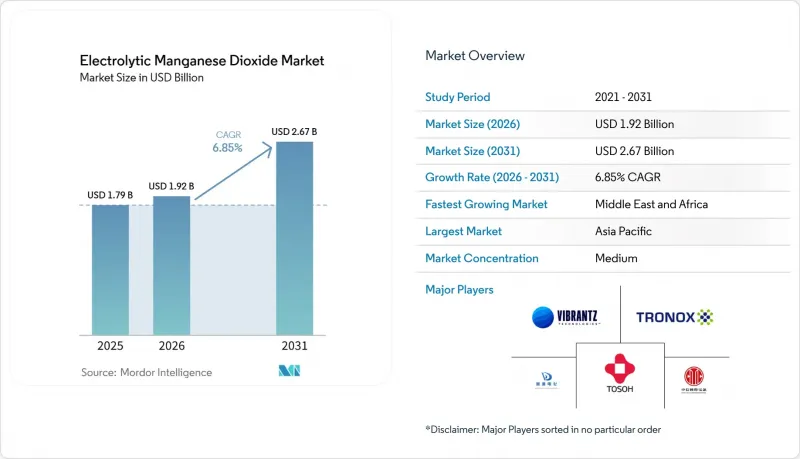
根據 Mordor Intelligence 預測,電解二氧化錳的市場規模預計將在 2025 年達到 17.9 億美元,2026 年達到 19.2 億美元,到 2031 年達到 26.7 億美元,2026 年至 2031 年的複合年成長率為 6.85%。
本報告按類型(鹼性電池用二氧化錳、鋰離子電池用二氧化錳、鋅碳電池用二氧化錳)、應用(電池、水處理、其他)、最終用戶(汽車、家用電子電器、工業、其他)和地區(北美、歐洲、亞太、南美、中東和非洲)進行細分。市場預測以美元計價。
全球電解錳市場趨勢及洞察
高錳含量鋰離子正極材料的快速發展
汽車製造商和電池生產商正在加速採用NMC 8和NMC 9系列化學配方,以減少對鈷的依賴。然而,預計到2030年,全球鋰離子電池產量將超過3太瓦時(TWh),錳的整體需求正在上升。中信大盟計畫在2025年將其廣西鋰錳氧化物(LMO)產能運作,目前該廠的年產能為3,000噸。同時,韓國和日本的前驅體生產商已簽署了電池級硫酸錳的長期採購協議。雖然從NMC 5系列(錳含量20%)過渡到NMC 8系列(錳含量10%)會降低單節電池的錳含量,但單節電池能量密度的提高可以實現更小的電池組,從而保持了對錳的強勁需求。高錳配方尤其適用於混合動力傳動系統,因為在這些系統中,熱穩定性和峰值輸出比體積能量密度更為重要。因此,採購團隊專注於純度規格,例如銅含量低於 1 ppm 和一致的 D50 粒徑,以確保循環壽命並最大限度地降低保固風險。
基於美國《內部資源分配法案》(IRA)和歐盟《競爭資源管理法案》(CRMA)的在地化獎勵
《通貨膨脹削減法案》(IRA) 第 45X 條規定,從美國或其他自由貿易協定國家採購的電池級錳可享有 10% 的生產稅額扣抵。同時,CRMA 已指定 47 個戰略項目,總額達 225 億歐元,其中包括 7 個錳礦中心,這些中心將受益於最短 27 個月的核准流程。 Euro Manganese 的 Hvaletice 尾礦項目和 Northvolt 的 NorthCYCLE 回收工廠表明,合規供應可帶來 15-20% 的價格溢價,高於不具備可追溯性的材料。對於希望獲得《通貨膨脹削減法案》(IRA) 成品電動車 (EV)稅額扣抵抵免的一級陰極材料採購商和汽車原始設備製造商 (OEM) 而言,透過 ISO 14001 審核來記錄溫室氣體 (GHG) 排放強度和勞工實踐正日益成為一項標準要求。
磷酸鐵鋰和鈉離子基化學組合物的市佔率迅速擴大
預計到2025年,磷酸鋰鐵(LFP)將佔中國搭乘用電動車(EV)正極材料市場50%以上的佔有率。這主要歸功於其平均電池組價格降至108美元/kWh時,使其比鎳錳鈷(NMC)正極材料具有15%的成本優勢。寧德時代(CATL)和比亞迪(BYD)等公司商業化的鈉離子電池,為低成本汽車和摩托車提供了不含錳的替代方案,加劇了市場競爭。一旦汽車製造商(OEM)採用LFP或鈉離子平台,再轉而使用NMC可能需要長達24個月的重新認證,這將導致含錳量高的正極材料市場佔有率持續下降。預計到2025年,鈉離子電池的產量將達到12吉瓦時,凸顯了其快速擴充性以及降低新興市場未來對電解二氧化錳(EMD)需求的潛力。
細分市場分析
到2025年,鹼性電池級電解二氧化錳(EMD)將佔據電解二氧化錳市場49.5%的佔有率,主要服務於穩定的一次電池領域。此等級產品的特點是活性氧含量為91%至92%,重金屬含量低於50 ppm,從而最大限度地降低了自放電。相較之下,鋰離子電池級EMD的銅含量低於1 ppm,D50粒徑為26 µm,預計到2031年將以8.4%的複合年成長率成長,超過鹼性電池級EMD的成長速度。這一成長主要得益於其在汽車和電網儲能領域應用的不斷拓展,抵消了因從傳統的NMC 5系列配方轉向高鎳NMC 8系列配方而導致的錳含量從20%下降到10%的影響。
東曹株式會社在日本和希臘擁有兩大生產基地,年總合達6萬噸,約佔全球市場佔有率的20%。然而,Element 25和Euro Manganese等公司正在開發的新型濕式工藝可望將轉化成本降低25%至30%,對傳統的電解工藝構成挑戰。這些替代製程所生產的EMD(電解錳廢棄物)固態排放量低40%至60%,符合目的地設備製造商(OEM)範圍3的減排目標。 2028年後的產能部署將取決於高階電池級產品的定價是否足以支撐資本密集電解線的投入,或者直接硫酸鹽沉澱法是否會取代傳統的EMD生產流程。
區域分析
到2025年,亞太地區將佔全球銷售額的52.4%,這主要得益於中國在礦石開採、EMD轉化和下游正極材料組裝的主導地位。廣西壯族自治區和湖南省合計佔全球EMD產能的近60%。然而,由於廢水排放法規日益嚴格,中型製造商紛紛退出市場,導致供應趨緊,而國內正極材料需求正以兩位數的速度成長。日本和韓國嚴重依賴從中國和澳洲進口電池級EMD,因此極易受到反傾銷稅和運費波動的影響。同時,印度MOIL公司正透過降低出口價格尋求其他買家。
預計到2031年,中東和非洲地區的年複合成長率將達到7.6%。在沙烏地阿拉伯,由北方石墨公司和奧貝坎公司聯合建造的價值2億美元的電池活性材料工廠計劃於2028年投產。南非錳金屬公司正穩步推進,力爭年產超過6,000噸高純度硫酸錳。加蓬正準備從2029年起禁止原礦出口,旨在促進國內礦石加工。然而,該地區面臨許多挑戰,例如高昂的電費(每千瓦時可超過12美分,佔冶煉廠現金成本的40%),以及需要多邊融資來降低基礎設施風險。
在北美和歐洲,各國正在擴大國內產能,以符合有關供應鏈安全的法規。在美國,根據第45X條規定,可享有10%的稅額扣抵;在歐洲,《關鍵原料法案》(CRMA)加快了許可核准流程。重點項目包括Euro Manganese公司的Hvaletice尾礦再處理項目(該項目被指定為歐盟戰略項目)以及South32公司位於亞利桑那州赫莫薩的電池錳礦礦床。 Element25公司的Butcherbird計畫預計於2024年完成最終可行性研究(DFS),並於2026年獲得最終投資決定(FID)。這將確保美國正極前驅體工廠能夠獲得符合自由貿易協定的原料供應。澳洲、墨西哥和南非的生產商正在利用對中國EMD進口徵收高達149.92%的反傾銷稅,以滿足《通貨膨脹抑制法案》(IRA)的要求,並縮短運往東海岸超級工廠的運輸路線。
其他好處:
- Excel格式的市場預測(ME)表
- 3個月的分析師支持
目錄
第1章:引言
- 研究假設和市場定義
- 調查範圍
第2章:調查方法
第3章執行摘要
第4章 市場狀況
- 市場概覽
- 市場促進因素
- 新興國家對鹼性一次電池的需求激增
- 快速大規模生產高錳含量鋰離子正極材料(NMC、LMO)
- 基於美國《工業關係法》(IRA)和歐盟《碳排放交易法》(CRMA),促進國內電池用錳生產措施。
- 採用EMD陰極的鋅離子固定儲能系統的商業化
- 廢棄鹼性電池和鋰錳電池的閉合迴路回收流程
- 利用爐灰和紅土廢水,透過低碳水性冶金法進行電化學沉積(EMD)
- 市場限制因素
- 錳礦石和電力成本的波動給利潤率帶來了壓力。
- 入門級電動車中磷酸鐵鋰電池和鈉離子電池的市場佔有率迅速擴張
- 中國環境許可標準的收緊正在抑制高純度EMD的生產。
- 主要貿易路線上的電子製造設備反傾銷稅和出口限制
- 供應鏈分析
- 監理情勢
- 技術展望
- 波特五力分析
第5章 市場規模與成長預測
- 按類型
- 鹼性級EMD
- 鋰離子電池的EMD
- 鋅碳基EMD
- 透過使用
- 電池
- 水處理
- 其他
- 最終用戶
- 車
- 家用電子產品
- 產業
- 其他
- 按地區
- 北美洲
- 美國
- 加拿大
- 墨西哥
- 歐洲
- 德國
- 英國
- 法國
- 義大利
- 北歐國家
- 俄羅斯
- 其他歐洲國家
- 亞太地區
- 中國
- 印度
- 日本
- 韓國
- 東南亞國協
- 其他亞太國家
- 南美洲
- 巴西
- 阿根廷
- 其他南美國家
- 中東和非洲
- 沙烏地阿拉伯
- 阿拉伯聯合大公國
- 南非
- 埃及
- 其他中東和非洲國家
- 北美洲
第6章 競爭情勢
- 市場集中度
- 策略趨勢(併購、聯盟、購電協議)
- 市場佔有率分析(主要公司的市場排名和佔有率)
- 公司簡介
- American Manganese Inc.
- CITIC Dameng Holdings Limited
- Delta EMD
- Element 25 Limited
- Erachem Comilog SA
- Euro Manganese Inc.
- Group Stars Chemical Co., Ltd.
- Guiliu Chemical Co., Ltd.
- Guizhou Dalong Huicheng New Material Co., Ltd.
- Gulf Manganese Corporation Limited
- Mesa Minerals Limited
- MMC Norilsk Nickel
- NantEnergy, Inc.
- Nippon Denko Co., Ltd.
- Prince International(Vibrantz)
- South32 Limited
- Tosoh Corporation
- Tronox Holdings plc
- Urban Electric Power, Inc.
- Xiangtan Electrochemical Scientific Co., Ltd.
第7章 市場機會與未來展望
According to Mordor Intelligence, the electrolytic manganese dioxide market size is projected to be USD 1.79 billion in 2025, USD 1.92 billion in 2026, and reach USD 2.67 billion by 2031, growing at a CAGR of 6.85% from 2026 to 2031.
This report is Segmented by Type (Alkaline Grade EMD, Lithium-Ion Battery Grade EMD, Zinc-Carbon Grade EMD), Application (Batteries, Water Treatment, Others), End-User (Automotive, Consumer Electronics, Industrial, Others), and Geography (North America, Europe, Asia-Pacific, South America, Middle East and Africa). Market Forecasts are Provided in Value (USD).
Global Electrolytic Manganese Dioxide Market Trends and Insights
Rapid Scale-Up of Lithium-Ion Cathodes with High-Manganese Content
Automakers and battery manufacturers are accelerating the adoption of NMC 8-series and 9-series chemistries to reduce cobalt dependency. However, overall manganese demand is increasing as global lithium-ion cell production is projected to surpass 3 TWh by 2030. CITIC Dameng is set to commission 3,000 tons per year of lithium manganese oxide (LMO) capacity in Guangxi by 2025, with plans to triple this capacity. Meanwhile, South Korean and Japanese precursor manufacturers have secured long-term offtake agreements for battery-grade manganese sulfate. Although the transition from NMC 5-series (20% Mn) to NMC 8-series (10% Mn) reduces manganese content per cell, improvements in cell-level energy density enable pack downsizing, sustaining positive manganese demand. High-manganese blends are particularly suited for hybrid powertrains, where thermal stability and peak power delivery are prioritized over volumetric energy density. As a result, procurement teams are focusing on purity specifications, such as sub-1 ppm copper levels and consistent D50 particle sizes, to ensure cycle life and minimize warranty risks.
Localization Incentives under US IRA & EU CRMA
Section 45X of the IRA grants a 10% production tax credit for battery-grade manganese sourced from the United States or free-trade-agreement nations. In parallel, the CRMA listed 47 strategic projects worth EUR 22.5 billion, including seven manganese hubs that enjoy accelerated permitting capped at 27 months. Euro Manganese's Chvaletice tailings project and Northvolt's NorthCYCLE recycling plant demonstrate how compliant supply can achieve a 15-20% price premium compared to non-traceable materials. The documentation of greenhouse gas (GHG) intensity and labor practices through ISO 14001 audits is increasingly becoming a standard requirement for Tier-1 cathode buyers and automotive OEMs aiming to qualify for Inflation Reduction Act tax credits on finished electric vehicles (EVs).
Rapid Share Gains of LFP & Sodium-Ion Chemistries
In 2025, lithium iron phosphate (LFP) accounted for over 50% of China's passenger electric vehicle (EV) cathode market, driven by a decline in average pack prices to USD 108/kWh, representing a 15% cost advantage compared to nickel manganese cobalt (NMC) cathodes. Sodium-ion cells, introduced commercially by CATL and BYD, added competitive pressure by providing manganese-free alternatives for low-cost vehicles and two-wheelers. Once an original equipment manufacturer (OEM) adopts LFP or sodium-ion platforms, transitioning back to NMC can require up to 24 months for requalification, leading to sustained market share losses for manganese-intensive cathodes. Sodium-ion production reached 12 GWh in 2025, highlighting its rapid scalability and potential to reduce future demand for electrolytic manganese dioxide (EMD) in emerging markets.
Other drivers and restraints analyzed in the detailed report include:
- Demand Surge from Alkaline Batteries in Emerging Economies
- Commercialization of Zinc-ion Stationary Storage Using EMD Cathodes
- Stricter Chinese Environmental Permits Curbing High-Purity Output
For complete list of drivers and restraints, kindly check the Table Of Contents.
Segment Analysis
Alkaline-battery grade EMD represented 49.5% of the Electrolytic Manganese Dioxide market share in 2025, primarily supporting the stable primary-cell segment. This grade is characterized by 91-92% active oxygen content and heavy-metal levels below 50 ppm, which help minimize self-discharge. In contrast, Lithium-Ion Battery Grade EMD, refined to contain less than 1 ppm copper and designed with a D50 particle size of 26 µm, is anticipated to grow at a compound annual growth rate (CAGR) of 8.4% through 2031, outpacing the growth of alkaline-grade EMD. This growth is driven by the expansion of automotive and grid storage applications, which offset the reduction in manganese content from 20% to 10% when transitioning from legacy NMC 5-series to high-nickel NMC 8-series formulations.
Tosoh's dual-site production facilities in Japan and Greece, with a combined capacity of 60,000 tons per year, account for approximately 20% of the global market share. However, emerging hydrometallurgical processes from companies like Element 25 and Euro Manganese have the potential to reduce conversion costs by 25-30%, posing a challenge to traditional electrolytic methods. These alternative processes produce low-carbon EMD with 40-60% less solid waste, aligning with original equipment manufacturers' (OEM) Scope-3 emission reduction targets. The future of capacity deployment beyond 2028 will depend on whether premium battery-grade pricing can justify the capital-intensive electrolysis lines or if direct sulfate precipitation methods will replace conventional EMD production.
Complete Report Scope:
- By Type
- Alkaline Grade EMD
- Lithium-ion Battery Grade EMD
- Zinc-carbon Grade EMD
- By Application
- Batteries
- Water Treatment
- Others
- By End-user
- Automotive
- Consumer Electronics
- Industrial
- Others
- By Geography
- North America
- United States
- Canada
- Mexico
- Europe
- Germany
- United Kingdom
- France
- Italy
- NORDIC Countries
- Russia
- Rest of Europe
- Asia-Pacific
- China
- India
- Japan
- South Korea
- ASEAN Countries
- Rest of Asia-Pacific
- South America
- Brazil
- Argentina
- Rest of South America
- Middle East and Africa
- Saudi Arabia
- United Arab Emirates
- South Africa
- Egypt
- Rest of Middle East and Africa
- North America
Geography Analysis
In 2025, the Asia-Pacific region accounted for 52.4% of global revenue, driven by China's leadership in ore mining, EMD conversion, and downstream cathode assembly. Guangxi and Hunan provinces collectively host nearly 60% of global EMD capacity. However, stricter wastewater regulations are prompting mid-tier producers to exit the market, tightening supply as domestic cathode demand grows at double-digit rates. Japan and South Korea rely heavily on imports of battery-grade EMD from China and Australia, leaving them vulnerable to anti-dumping tariffs and fluctuations in freight rates. Meanwhile, India's MOIL is seeking alternative buyers by reducing export prices.
The Middle East and Africa are projected to grow at a compound annual growth rate (CAGR) of 7.6% through 2031. In Saudi Arabia, a USD 200 million Northern Graphite-Al Obeikan battery active-material plant is planned for start-up in 2028. South Africa's Manganese Metal Company is advancing toward producing over 6,000 tons per year of high-purity manganese sulfate. Gabon is preparing to ban raw ore exports after 2029, aiming to boost domestic beneficiation. However, the region faces challenges such as high electricity tariffs, which can exceed 12 cents per kWh and account for 40% of smelter cash costs, as well as the need for multilateral lending to mitigate infrastructure risks.
North America and Europe are ramping up domestic production capacity in response to supply chain security mandates. In the United States, Section 45X offers a 10% tax credit, while the Critical Raw Materials Act (CRMA) in Europe facilitates fast-track permitting. Key projects include Euro Manganese's Chvaletice tailings reprocessing, designated as an EU Strategic Project, and South32's Hermosa battery-grade manganese deposit in Arizona. Element 25's Butcherbird project completed its definitive feasibility study (DFS) in 2024, with a final investment decision (FID) expected in 2026, enabling free-trade-agreement-compliant feedstock for U.S. cathode precursor plants. Anti-dumping margins of up to 149.92% on Chinese EMD imports are being leveraged by producers in Australia, Mexico, and South Africa, who aim to meet Inflation Reduction Act (IRA) requirements and shorter shipping lanes into East Coast gigafactories.
- American Manganese Inc.
- CITIC Dameng Holdings Limited
- Delta EMD
- Element 25 Limited
- Erachem Comilog S.A.
- Euro Manganese Inc.
- Group Stars Chemical Co., Ltd.
- Guiliu Chemical Co., Ltd.
- Guizhou Dalong Huicheng New Material Co., Ltd.
- Gulf Manganese Corporation Limited
- Mesa Minerals Limited
- MMC Norilsk Nickel
- NantEnergy, Inc.
- Nippon Denko Co., Ltd.
- Prince International (Vibrantz)
- South32 Limited
- Tosoh Corporation
- Tronox Holdings plc
- Urban Electric Power, Inc.
- Xiangtan Electrochemical Scientific Co., Ltd.
Additional Benefits:
- The market estimate (ME) sheet in Excel format
- 3 months of analyst support
TABLE OF CONTENTS
1 Introduction
- 1.1 Study Assumptions & Market Definition
- 1.2 Scope of the Study
2 Research Methodology
3 Executive Summary
4 Market Landscape
- 4.1 Market Overview
- 4.2 Market Drivers
- 4.2.1 Demand surge from alkaline primary batteries in emerging economies
- 4.2.2 Rapid scale-up of lithium-ion cathodes with high-manganese content (NMC, LMO)
- 4.2.3 Localization incentives for battery-grade manganese under US IRA & EU CRMA
- 4.2.4 Commercialization of zinc-ion stationary storage using EMD cathodes
- 4.2.5 Closed-loop recycling streams for spent alkaline & Li-Mn batteries
- 4.2.6 Low-carbon hydrometallurgical EMD from furnace-dust & laterite effluents
- 4.3 Market Restraints
- 4.3.1 Manganese ore & power cost volatility squeezing margins
- 4.3.2 Rapid share gains of LFP and sodium-ion chemistries in entry-level EVs
- 4.3.3 Stricter Chinese environmental permits curbing high-purity EMD output
- 4.3.4 Anti-dumping duties & export controls on EMD in key trade lanes
- 4.4 Supply-Chain Analysis
- 4.5 Regulatory Landscape
- 4.6 Technological Outlook
- 4.7 Porters Five Forces Analysis
- 4.7.1 Threat of New Entrants
- 4.7.2 Bargaining Power of Buyers
- 4.7.3 Bargaining Power of Suppliers
- 4.7.4 Threat of Substitutes
- 4.7.5 Competitive Rivalry
5 Market Size & Growth Forecasts
- 5.1 By Type
- 5.1.1 Alkaline Grade EMD
- 5.1.2 Lithium-ion Battery Grade EMD
- 5.1.3 Zinc-carbon Grade EMD
- 5.2 By Application
- 5.2.1 Batteries
- 5.2.2 Water Treatment
- 5.2.3 Others
- 5.3 By End-user
- 5.3.1 Automotive
- 5.3.2 Consumer Electronics
- 5.3.3 Industrial
- 5.3.4 Others
- 5.4 By Geography
- 5.4.1 North America
- 5.4.1.1 United States
- 5.4.1.2 Canada
- 5.4.1.3 Mexico
- 5.4.2 Europe
- 5.4.2.1 Germany
- 5.4.2.2 United Kingdom
- 5.4.2.3 France
- 5.4.2.4 Italy
- 5.4.2.5 NORDIC Countries
- 5.4.2.6 Russia
- 5.4.2.7 Rest of Europe
- 5.4.3 Asia-Pacific
- 5.4.3.1 China
- 5.4.3.2 India
- 5.4.3.3 Japan
- 5.4.3.4 South Korea
- 5.4.3.5 ASEAN Countries
- 5.4.3.6 Rest of Asia-Pacific
- 5.4.4 South America
- 5.4.4.1 Brazil
- 5.4.4.2 Argentina
- 5.4.4.3 Rest of South America
- 5.4.5 Middle East and Africa
- 5.4.5.1 Saudi Arabia
- 5.4.5.2 United Arab Emirates
- 5.4.5.3 South Africa
- 5.4.5.4 Egypt
- 5.4.5.5 Rest of Middle East and Africa
- 5.4.1 North America
6 Competitive Landscape
- 6.1 Market Concentration
- 6.2 Strategic Moves (M&A, Partnerships, PPAs)
- 6.3 Market Share Analysis (Market Rank/Share for key companies)
- 6.4 Company Profiles (includes Global level Overview, Market level overview, Core Segments, Financials as available, Strategic Information, Products & Services, and Recent Developments)
- 6.4.1 American Manganese Inc.
- 6.4.2 CITIC Dameng Holdings Limited
- 6.4.3 Delta EMD
- 6.4.4 Element 25 Limited
- 6.4.5 Erachem Comilog S.A.
- 6.4.6 Euro Manganese Inc.
- 6.4.7 Group Stars Chemical Co., Ltd.
- 6.4.8 Guiliu Chemical Co., Ltd.
- 6.4.9 Guizhou Dalong Huicheng New Material Co., Ltd.
- 6.4.10 Gulf Manganese Corporation Limited
- 6.4.11 Mesa Minerals Limited
- 6.4.12 MMC Norilsk Nickel
- 6.4.13 NantEnergy, Inc.
- 6.4.14 Nippon Denko Co., Ltd.
- 6.4.15 Prince International (Vibrantz)
- 6.4.16 South32 Limited
- 6.4.17 Tosoh Corporation
- 6.4.18 Tronox Holdings plc
- 6.4.19 Urban Electric Power, Inc.
- 6.4.20 Xiangtan Electrochemical Scientific Co., Ltd.
7 Market Opportunities & Future Outlook
- 7.1 White-space & Unmet-Need Assessment

 全球電解二氧化錳(EMD)市場規模、佔有率、趨勢和成長分析報告(2026-2034)
 錳礦開採市場-2026-2032年全球市場預測
 錳鐵市場:依等級、應用、製造方法和地區分類錳市場:全球市場按產品類型、純度等級、技術、形態和應用分類的預測 - 2026-2032 年電解二氧化錳市場:按產品類型、製造流程、原料來源、應用和終端用戶產業分類的全球預測,2026年至2032年全球矽錳市場規模、佔有率、趨勢和成長分析報告(2026-2034年)
 2026年全球矽錳市場報告2026年全球錳鐵市場報告
 錳:市場佔有率分析、產業趨勢與統計、成長預測(2026-2031)
 全球錳鐵市場-產業規模、佔有率、趨勢、機會及預測(依等級、應用、生產方法、區域及競爭格局分類,2021-2031年預測)