


 |
市場調查報告書
商品編碼
2097311
串列設備伺服器:市場佔有率分析、產業趨勢與統計資料、成長預測(2026-2031 年)Serial Device Server - Market Share Analysis, Industry Trends & Statistics, Growth Forecasts (2026 - 2031) |
||||||

※ 本網頁內容可能與最新版本有所差異。詳細情況請與我們聯繫。
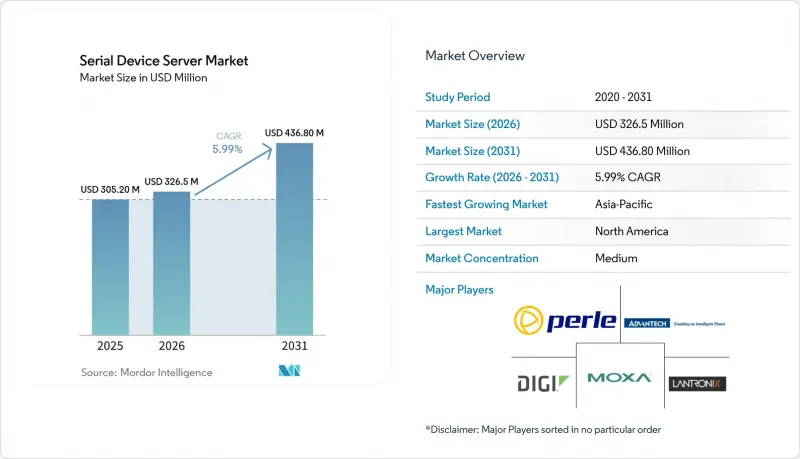
據 Mordor Intelligence 稱,串行設備伺服器市場預計將從 2026 年的 3.265 億美元成長到 2031 年的 4.368 億美元,2026 年至 2031 年的複合年成長率為 5.99%。
本報告按連接埠數量(1埠、2埠、4埠及其他)、連接方式(有線乙太網路、無線Wi-Fi及其他)、支援的串列協定(RS-232、RS-422、RS-485、多重通訊協定)、外形尺寸(DIN導軌安裝、機架安裝及其他)、產業領域(工業自動化、能源和公共產業等地區進行區域進行細分。市場預測以美元(USD)計價。
全球串列設備伺服器市場趨勢及洞察
擴大工業4.0和工業物聯網的應用
製造商若要實現即時分析,就需要擷取幾十年前儲存在PLC和磁碟機中的資料。序列設備伺服器透過增加IP連接,同時保留現有佈線,避免了更換整個控制器而造成的高昂停機成本。多埠型號減少了交換器的數量,簡化了拓撲結構,並實現了集中管理。這是全面採用工業4.0,進一步提高生產力的關鍵一步。目前,中國和印度(乙太網路之前的機械設備仍然很普遍)以及德國和義大利(能源效率指令要求對機械設備進行精細的遙測)的採用最為活躍。
從序列網路遷移到以太網
電力公司和鐵路營運商正在逐步淘汰專有的串行SCADA鏈路,轉而採用以太網,以實現頻寬、標準化的管理和加密通訊。在此過渡期間,容納RTU的變電站機櫃仍然透過RS-485進行通訊,因此,功能強大的串行轉以太網閘道器至關重要。北美電力公司正在加快其NERC-CIP合規進程,而歐洲鐵路公司則正在將其傳統的聯鎖系統整合到基於IP的列車控制系統中。由於機櫃通常安裝在室外,因此,具有雙電源和寬溫耐受範圍的強大閘道器是首選。
過渡到具有原生乙太網路支援的工業設備
如今,越來越多的自動化項目指定使用內建乙太網路APL或乙太網路/IP協定的控制器、驅動器和感測器,從而完全消除了對轉換器的需求。美國和德國更短的硬體更新周期加速了這一趨勢,降低了對獨立閘道器的需求。儘管供應商正在整合邊緣運算和協定轉換腳本以保持競爭力,但挑戰依然存在。
細分市場分析
高密度底盤正在取代單一用途的盒式集群。 2025年,4埠系統佔總銷售額的25.81%,而32埠及以上等級的系統預計到2031年將維持7.80%的複合年成長率。營運商正在整合串行終端,以減少框架單位的數量並簡化佈線。 8埠級產品在中型控制室中佔據了相當大的佔有率,而2埠閘道器則被用於遠端油井和資訊亭。隨著變電站的逐步現代化,公共產業領域對16埠級系統的需求依然強勁。
遠端配置需求的持續成長,使得配備熱插拔電源和雙乙太網路上行鏈路的型號更受青睞。隨著韌體工具的日趨成熟,現在無需任何技術人員現場操作,即可將連接埠從 RS-232 重新分配到 RS-485。這對於管理數千個機櫃的跨國公司至關重要。因此,串行設備伺服器市場正持續向靈活、高密度的硬體轉型,以減少面積和人工成本。
有線乙太網路仍佔據主導地位,預計到2025年仍將佔據可觀的銷售額,而蜂窩/LTE方案的複合年成長率(CAGR)為9.20%。在光纖不可用時,公共產業會採用CAT-M和NB-IoT等分散式能源監控技術。 Wi-Fi佔據了很大的市場佔有率,尤其是在醫院和展覽館等場所的臨時連接方面。串列轉USB模組正被應用於需要緊湊型一體化卡的無風扇邊緣電腦。
盈利最高的細分市場是雙模(蜂窩+乙太網路),它能夠實現滿足嚴格正常運作合約的容錯移轉路徑。閘道器製造商目前正在預先安裝通訊業者eSIM卡,加速在難以覆蓋地區的部署。隨著私有5G園區的日益普及,提供通過n77頻段認證的閘道器的供應商將能夠更早獲得智慧工廠的預算,從而增強串行設備伺服器市場中蜂窩SKU的長期前景。
區域分析
預計到2025年,亞太地區將成為最大的市場,佔全球銷售額的30.56%,並有望以9.30%的複合年成長率成長,這主要得益於中國對現有工廠的維修以及印度智慧城市基礎設施的部署。低成本的本土品牌正透過將協議轉換應用程式與硬體捆綁,擴大其在二線城市的市場佔有率。同時,具有確定性調度功能的低延遲閘道在日本的機器人單元和韓國的半導體製造工廠中正得到廣泛應用。
預計到2025年,北美將佔據相當大的銷售佔有率,市場成長動能良好。 NERC-CIP的實施將促進電力公司的批量採購,而貨運公司則透過認證的蜂窩伺服器連接J1939總線,實現即時路線規劃。美國零件製造商在伊利諾伊州和墨西哥的擴張表明,串行設備伺服器市場的國內供應鏈前景樂觀。
預計到2025年,歐洲將佔據相當大的銷售佔有率,並有望實現顯著的複合年成長率。隨著歐盟《建築能源性能指令》要求能源數據高度透明,建築自動化維修正在加速前進。德國、法國和西班牙的鐵路現代化改造正在將傳統號誌站整合到IP骨幹網路中,推動了多端口DIN導軌的銷售。中東和非洲地區合計佔據了較高的市場佔有率,這主要得益於沿岸地區石油相關設施的LTE項目以及南非的電網升級改造。
其他好處:
- Excel格式的市場預測(ME)表
- 3個月的分析師支持
目錄
第1章:引言
- 研究假設和市場定義
- 調查範圍
第2章:調查方法
第3章執行摘要
第4章 市場狀況
- 市場概覽
- 市場促進因素
- 擴大工業4.0和工業物聯網在製造工廠的應用
- 棕地計畫中對傳統設備連接的需求
- 公共產業和交通運輸領域從串行網路向乙太網路的遷移
- 對遠端設備管理和預測性維護的需求
- OT網路安全合規性正在推動對安全串列伺服器的需求。
- 邊緣人工智慧推理需要確定性串列資料閘道器
- 市場限制因素
- 過渡到具有原生乙太網路支援的工業設備
- 新興市場的價格敏感性
- 已部署設備缺少與 IPv6 相容的韌體
- 高密度城市中無線設備伺服器的頻譜限制
- 產業供應鏈分析
- 監理情勢
- 技術展望
- 波特五力分析
第5章 市場規模與成長預測
- 按連接埠數量
- 1個連接埠
- 2 個連接埠
- 4個連接埠
- 8個連接埠
- 16個連接埠
- 32個或更多端口
- 按連線類型
- 有線以太網
- 無線(Wi-Fi)
- 蜂窩/LTE
- 透過 USB 進行串口通訊
- 透過串行協定支援狀態
- RS-232
- RS-422
- RS-485
- 多重通訊協定(MEI)
- 按外形規格
- DIN導軌安裝型
- 機架安裝型
- 嵌入式/板級
- 面板安裝
- 按行業分類
- 工業自動化
- 能源公用事業
- 運輸/物流
- 零售和POS
- 醫療保健和醫療設備
- 建築自動化及暖通空調
- 其他工業部門
- 按地區
- 北美洲
- 美國
- 加拿大
- 墨西哥
- 歐洲
- 德國
- 英國
- 法國
- 義大利
- 其他歐洲國家
- 亞太地區
- 中國
- 日本
- 印度
- 韓國
- 其他亞太國家
- 中東和非洲
- 南美洲
- 北美洲
第6章 競爭情勢
- 市場集中度
- 策略趨勢
- 市佔率分析
- 公司簡介
- Moxa Inc.
- Digi International Inc.
- Lantronix Inc.
- Advantech Co., Ltd.
- Perle Systems Ltd.
- Pepperl+Fuchs SE(Comtrol)
- Sealevel Systems Inc.
- Westermo Network Technologies AB
- 3onedata Co., Ltd.
- Cisco Systems, Inc.
- HMS Networks AB
- ATEN International Co., Ltd.
- Tibbo Technology Inc.
- ACKSYS Communications & Systems
- EtherWAN Systems, Inc.
- B+B SmartWorx Inc.
- Kyland Technology Co., Ltd.
- ORing Industrial Networking Corp.
- ICP DAS Co., Ltd.
- SENA Technologies Inc.
- Omron Corporation
第7章 市場機會與未來展望
According to Mordor Intelligence, the serial device server market size is expected to increase from USD 326.50 million in 2026 to USD 436.80 million by 2031, growing at a CAGR of 5.99% over 2026-2031.
This report is Segmented by Port Count (1-Port, 2-Port, 4-Port, and More), Connectivity Type (Wired Ethernet, Wireless Wi-Fi, and More), Serial Protocol Support (RS-232, RS-422, RS-485, and Multi-Protocol), Form Factor (DIN-Rail Mount, Rack-Mount, and More), Industry Vertical (Industrial Automation, Energy and Utilities, and More), and Geography. The Market Forecasts are Provided in Terms of Value (USD).
Global Serial Device Server Market Trends and Insights
Rising Adoption of Industry 4.0 And IIoT
Manufacturers chasing real-time analytics must surface data locked inside decades-old PLCs and drives. Serial device servers preserve installed wiring while adding IP connectivity, preventing costly downtime from wholesale controller swaps. Multi-port models reduce switch counts, simplify topology, and deliver unified management, a critical step toward the higher productivity lift associated with full Industry 4.0 rollouts. Adoption is most intense in China and India, where pre-Ethernet machinery dominates, and in Germany and Italy, where energy-efficiency directives demand granular machine telemetry.
Transition From Serial To Ethernet Networks
Utilities and rail operators are decommissioning proprietary serial SCADA links in favor of Ethernet for bandwidth, standard management, and encrypted traffic. During migration, substation cabinets packed with RTUs still speak RS-485, making robust serial-to-Ethernet gateways indispensable. North American utilities expedite upgrades to comply with NERC-CIP, while European railways integrate legacy interlocking with IP-based train control systems. Ruggedized gateways with dual power feeds and wide temperature tolerances receive preference as cabinets often sit outdoors.
Shift Toward Natively Ethernet-Enabled Industrial Devices
Greenfield automation projects now specify controllers, drives, and sensors with built-in Ethernet-APL or EtherNet/IP, eliminating the need for conversion altogether. Shorter hardware refresh cycles in the United States and Germany accelerate this drift, cutting replacement demand for standalone gateways. Vendors respond by embedding edge compute and protocol-translation scripts to stay relevant, yet the headwind persists.
Other drivers and restraints analyzed in the detailed report include:
- Demand For Remote Device Management And Predictive Maintenance
- OT-Cyber-Security Compliance Boosting Secure Gateways
- Price Sensitivity In Emerging Economies
For complete list of drivers and restraints, kindly check the Table Of Contents.
Segment Analysis
High-density chassis are replacing fleets of single-purpose boxes. In 2025, the 4-port tier accounted for 25.81% of revenue, while the 32-port-plus category is projected to post a 7.80% CAGR through 2031. Operators consolidate serial endpoints to cut rack units and streamline cabling. The 8-port class accounted for a significant share of the market in mid-sized control rooms, whereas 2-port gateways served remote wells or kiosks. Uptake of the 16-port tier in utilities remains steady as substations modernize gradually.
A parallel drive for remote configuration favors models with hot-swappable power and dual Ethernet uplinks. As firmware tools mature, a single technician can reassign ports from RS-232 to RS-485 without site visits, a critical advantage for multinationals managing thousands of cabinets. Hence, the serial device server market continues to gravitate toward flexible, high-density hardware that shrinks footprint and man-hours alike.
Wired Ethernet remained dominant, accounting for significant revenue in 2025, while Cellular/ LTE options are expanding at a 9.20% CAGR. Utilities that monitor distributed energy resources use CAT-M and NB-IoT variants when fiber is unavailable. Wi-Fi accounted for a significant share of the market, especially on temporary lines at hospitals or exhibition centers. Serial-over-USB modules are used in fanless edge computers that need compact all-in-one cards.
The most profitable niche is dual-mode cellular plus Ethernet, allowing failover paths that satisfy stringent uptime contracts. Gateway makers now pre-install carrier eSIMs, speeding deployment in hard-to-reach geographies. As private 5G campuses proliferate, suppliers that field gateways certified for band n77 gain early access to smart factory budgets, strengthening the long-run outlook for cellular SKUs within the serial device server market.
Complete Report Scope:
- By Port Count
- 1-Port
- 2-Port
- 4-Port
- 8-Port
- 16-Port
- 32-Port and Above
- By Connectivity Type
- Wired Ethernet
- Wireless (Wi-Fi)
- Cellular / LTE
- Serial-over-USB
- By Serial Protocol Support
- RS-232
- RS-422
- RS-485
- Multi-protocol (MEI)
- By Form Factor
- DIN-Rail Mount
- Rack-mount
- Embedded / Board-Level
- Panel Mount
- By Industry Vertical
- Industrial Automation
- Energy and Utilities
- Transportation and Logistics
- Retail and POS
- Healthcare and Medical Devices
- Building Automation and HVAC
- Other Industry Verticals
- By Geography
- North America
- United States
- Canada
- Mexico
- Europe
- Germany
- United Kingdom
- France
- Italy
- Rest of Europe
- Asia-Pacific
- China
- Japan
- India
- South Korea
- Rest of Asia-Pacific
- Middle East and Africa
- South America
- North America
Geography Analysis
Asia-Pacific led with 30.56% revenue in 2025 and will likely climb at 9.30% CAGR as China retrofits brownfield factories and India rolls out smart-city infrastructure. Low-cost domestic brands bundle protocol conversion apps with hardware, expanding adoption across tier-2 cities. Japanese robotics cells and Korean fabs, meanwhile, prize low-latency gateways with deterministic scheduling.
North America accounted for a significant share of revenue in 2025 and is projected to grow in the market. NERC-CIP enforcement drives bulk purchases by utilities, while freight carriers connect J1939 buses through certified cellular servers for real-time routing. United States component maker expansions in Illinois and Mexico reveal optimism in the domestic supply chain for the serial device server market.
Europe captured a significant share of revenue in 2025 and is set to grow at a significant CAGR. Building-automation retrofits gain pace as the EU Energy Performance of Buildings Directive demands transparent energy data. Rail modernization across Germany, France, and Spain integrates legacy signal boxes into IP backbones, fueling multi-port DIN-rail sales. Middle East and Africa together posted a high share, buoyed by Gulf oil patch LTE projects and South African grid upgrades.
- Moxa Inc.
- Digi International Inc.
- Lantronix Inc.
- Advantech Co., Ltd.
- Perle Systems Ltd.
- Pepperl+Fuchs SE (Comtrol)
- Sealevel Systems Inc.
- Westermo Network Technologies AB
- 3onedata Co., Ltd.
- Cisco Systems, Inc.
- HMS Networks AB
- ATEN International Co., Ltd.
- Tibbo Technology Inc.
- ACKSYS Communications & Systems
- EtherWAN Systems, Inc.
- B+B SmartWorx Inc.
- Kyland Technology Co., Ltd.
- ORing Industrial Networking Corp.
- ICP DAS Co., Ltd.
- SENA Technologies Inc.
- Omron Corporation
Additional Benefits:
- The market estimate (ME) sheet in Excel format
- 3 months of analyst support
TABLE OF CONTENTS
1 INTRODUCTION
- 1.1 Study Assumptions and Market Definition
- 1.2 Scope of the Study
2 RESEARCH METHODOLOGY
3 EXECUTIVE SUMMARY
4 MARKET LANDSCAPE
- 4.1 Market Overview
- 4.2 Market Drivers
- 4.2.1 Rising Adoption Of Industry 4.0 And IIoT In Manufacturing Plants
- 4.2.2 Need For Legacy Equipment Connectivity In Brown-Field Projects
- 4.2.3 Transition From Serial To Ethernet Networks In Utilities And Transport
- 4.2.4 Demand For Remote Device Management And Predictive Maintenance
- 4.2.5 OT-Cyber-Security Compliance Boosting Demand For Secure Serial Servers
- 4.2.6 Edge-AI Inference Requiring Deterministic Serial Data Gateways
- 4.3 Market Restraints
- 4.3.1 Shift Toward Natively Ethernet-Enabled Industrial Devices
- 4.3.2 Price Sensitivity In Emerging Economies
- 4.3.3 Scarcity Of IPv6-Ready Firmware In Installed Base
- 4.3.4 Radio-Spectrum Limits On Wireless Device Servers In Dense Cities
- 4.4 Industry Supply Chain Analysis
- 4.5 Regulatory Landscape
- 4.6 Technological Outlook
- 4.7 Porter's Five Forces Analysis
- 4.7.1 Threat of New Entrants
- 4.7.2 Bargaining Power of Suppliers
- 4.7.3 Bargaining Power of Buyers
- 4.7.4 Threat of Substitutes
- 4.7.5 Competitive Rivalry
5 MARKET SIZE AND GROWTH FORECASTS (VALUE)
- 5.1 By Port Count
- 5.1.1 1-Port
- 5.1.2 2-Port
- 5.1.3 4-Port
- 5.1.4 8-Port
- 5.1.5 16-Port
- 5.1.6 32-Port and Above
- 5.2 By Connectivity Type
- 5.2.1 Wired Ethernet
- 5.2.2 Wireless (Wi-Fi)
- 5.2.3 Cellular / LTE
- 5.2.4 Serial-over-USB
- 5.3 By Serial Protocol Support
- 5.3.1 RS-232
- 5.3.2 RS-422
- 5.3.3 RS-485
- 5.3.4 Multi-protocol (MEI)
- 5.4 By Form Factor
- 5.4.1 DIN-Rail Mount
- 5.4.2 Rack-mount
- 5.4.3 Embedded / Board-Level
- 5.4.4 Panel Mount
- 5.5 By Industry Vertical
- 5.5.1 Industrial Automation
- 5.5.2 Energy and Utilities
- 5.5.3 Transportation and Logistics
- 5.5.4 Retail and POS
- 5.5.5 Healthcare and Medical Devices
- 5.5.6 Building Automation and HVAC
- 5.5.7 Other Industry Verticals
- 5.6 By Geography
- 5.6.1 North America
- 5.6.1.1 United States
- 5.6.1.2 Canada
- 5.6.1.3 Mexico
- 5.6.2 Europe
- 5.6.2.1 Germany
- 5.6.2.2 United Kingdom
- 5.6.2.3 France
- 5.6.2.4 Italy
- 5.6.2.5 Rest of Europe
- 5.6.3 Asia-Pacific
- 5.6.3.1 China
- 5.6.3.2 Japan
- 5.6.3.3 India
- 5.6.3.4 South Korea
- 5.6.3.5 Rest of Asia-Pacific
- 5.6.4 Middle East and Africa
- 5.6.5 South America
- 5.6.1 North America
6 COMPETITIVE LANDSCAPE
- 6.1 Market Concentration
- 6.2 Strategic Moves
- 6.3 Market Share Analysis
- 6.4 Company Profiles (includes Global level Overview, Market level overview, Core Segments, Financials as available, Strategic Information, Market Rank/Share for key companies, Products and Services, and Recent Developments)
- 6.4.1 Moxa Inc.
- 6.4.2 Digi International Inc.
- 6.4.3 Lantronix Inc.
- 6.4.4 Advantech Co., Ltd.
- 6.4.5 Perle Systems Ltd.
- 6.4.6 Pepperl+Fuchs SE (Comtrol)
- 6.4.7 Sealevel Systems Inc.
- 6.4.8 Westermo Network Technologies AB
- 6.4.9 3onedata Co., Ltd.
- 6.4.10 Cisco Systems, Inc.
- 6.4.11 HMS Networks AB
- 6.4.12 ATEN International Co., Ltd.
- 6.4.13 Tibbo Technology Inc.
- 6.4.14 ACKSYS Communications & Systems
- 6.4.15 EtherWAN Systems, Inc.
- 6.4.16 B+B SmartWorx Inc.
- 6.4.17 Kyland Technology Co., Ltd.
- 6.4.18 ORing Industrial Networking Corp.
- 6.4.19 ICP DAS Co., Ltd.
- 6.4.20 SENA Technologies Inc.
- 6.4.21 Omron Corporation
7 MARKET OPPORTUNITIES AND FUTURE OUTLOOK
- 7.1 White-space and Unmet-Need Assessment

 寬頻擴大機市場規模、佔有率和成長分析:按擴大機類型、頻寬、應用、最終用戶、安裝方式和地區分類-2026-2033年產業預測
 串行設備伺服器市場規模、佔有率、成長率、全球產業分析、區域趨勢以及 2026 年至 2034 年的預測。
 軟交換設備市場:全球市場預測,2026-2032年
 訊號放大器市場規模、佔有率和成長分析:按產品類型、網路技術、覆蓋範圍、安裝類型、最終用戶和地區分類-2026-2033年產業預測
 CityLoop網路市場預測至2034年—按網路類型、部署模式、技術、應用、最終用戶和區域分類的全球分析
 軟交換設備市場規模、佔有率和成長分析:依架構分類、服務元件配置、部署基礎設施模型、用戶數量和地區分類-2026-2033年產業預測
 白盒交換器:市場佔有率分析、產業趨勢與統計、成長預測(2026-2031)通訊網路視覺化解決方案市場預測至2034年—按組件、部署模式、技術、應用、最終用戶和地區分類的全球分析
 2026年全球網際網路協定(IP)網路市場報告2026年全球核心網路設備市場報告