


 |
市場調查報告書
商品編碼
2097283
工業物聯網 (IIoT) 安全:市場佔有率分析、行業趨勢和統計數據以及成長預測 (2026-2031)Industrial Internet Of Things (IIoT) Security - Market Share Analysis, Industry Trends & Statistics, Growth Forecasts (2026 - 2031) |
||||||

※ 本網頁內容可能與最新版本有所差異。詳細情況請與我們聯繫。
根據 Mordor Intelligence 預測,工業物聯網 (IIoT) 安全市場規模預計將在 2025 年達到 121.4 億美元,2026 年達到 143.6 億美元,到 2031 年達到 332.6 億美元,2026 年至 2031 年的複合年成長率為 18.9%。
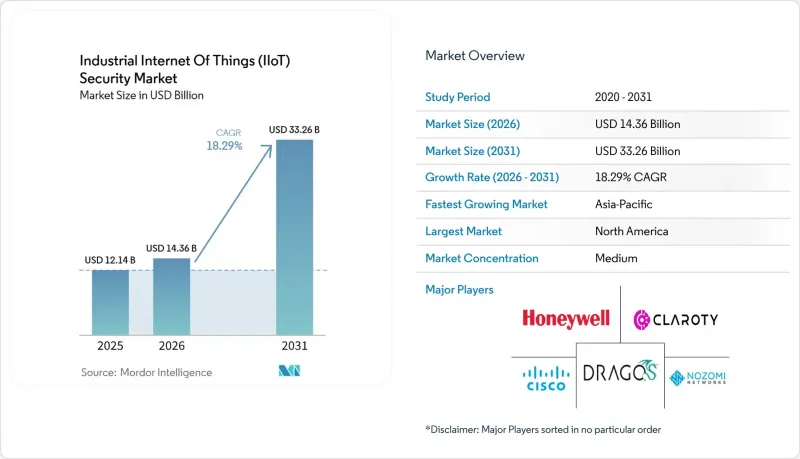
本報告按組件(解決方案和服務)、安全類型(網路安全、設備和終端安全、應用程式和 API 安全等)、部署模式(本地部署等)、最終用戶產業(工業製造、能源和公共產業、石油和天然氣等)以及地區進行細分。市場預測以價值(美元)表示。
全球工業物聯網 (IIoT) 安全市場趨勢與洞察
IT與OT的融合正在擴大攻擊面。
工業物聯網 (IIoT) 安全市場的蓬勃發展源自於一個簡單的事實:在大多數工業環境中,企業系統和工廠系統不再完全隔離。 Palo Alto Networks、西門子和愛達荷國家實驗室的研究表明,到 2024 年,將有 2000 萬台獨特的工業設備暴露在公共網際網路上。這表明,如今工廠外部對運作環境的存取範圍已相當廣泛。研究還發現,攻擊者通常會在實際利用系統漏洞之前進行長時間的監控。這意味著,在工業物聯網 (IIoT) 安全市場中,監控盲點的重要性與邊界控制不相上下。因此,買家越來越重視跨域可見性、身分控制和分段策略,以便能夠跨 IT 系統、OT 區域和混合雲端連接追蹤資產。此外,隨著營運商越來越傾向於採用能夠追蹤從辦公室網路到工程工作站的移動,甚至控制資產的整合式安全層,採購標準也在轉變。因此,工業物聯網 (IIoT) 安全市場更青睞那些能夠在單一營運模式下展現協議感知、快速資產映射和持續威脅監控能力的供應商。
提高互聯工廠中工業物聯網設備的密度
工業物聯網 (IIoT) 安全市場也受惠於感測器、閘道和連網邊緣設備在整個生產環境中的快速普及。 Palo Alto Networks 和愛達荷國家實驗室的數據顯示,到 2024 年,暴露於網路的 OT 設備數量將超過 1.1 億台。這反映了製造業、能源和公共產業行業中聯網資產的快速成長。設備數量的激增導致持續資產管理出現缺口,因為許多資產被部署在更靠近營運現場的位置,而中央 IT 和安全團隊可能無法以相同的速度更新其視覺化工具。 TXOne Networks 的報告顯示,到 2025 年,60% 的企業將至少經歷一次 OT 安全事件,88% 的企業將增加 10% 以上的 OT 安全支出。這表明,設備數量的無序成長與工業物聯網 (IIoT) 安全市場採購的緊迫性直接相關。此外,羅克韋爾自動化公司2025年的一項調查顯示,38%的製造商計劃利用現有營運數據來提升網路安全。這表明,資產智慧正逐漸成為防禦性設計的起點,而非被動的補救措施。因此,工業物聯網(IIoT)安全市場正從孤立的獨立產品轉向能夠應對不斷變化的工廠資產圖景的更廣泛的檢測、監控和響應工具。
維修舊式控制器和現場設備的成本很高。
工業物聯網 (IIoT) 安全市場仍面臨許多根本性挑戰。這是因為許多工業場所仍依賴設計壽命長、但自身安全功能有限的設備。 TXOne Networks 2026 年的一項調查發現,54% 的工業企業認為與傳統設備的兼容性是安全部署的最大障礙,38% 的企業仍然認為高昂的更換成本是阻礙因素。這解釋了為什麼許多業者更傾向於維持現狀的保護策略,而不是徹底更換控制器,尤其是在生產線無法承受長時間停機的情況下。此外,調查數據顯示,更換一套完整的 PLC 的成本在 3 萬歐元到 15 萬歐元(3.3 萬美元到 16.5 萬美元)之間,而維修整條生產線的成本可能高達每條 300 萬歐元(330 萬美元),這表明即使不考慮停機時間,成本壓力仍然非常巨大。此外,TXOne指出,到2025年,策略性的延壽措施可為每個舊有系統節省200萬至500萬美元的成本。這解釋了為什麼工業物聯網(IIoT)安全市場的買家優先考慮虛擬修補程式、網路控制和隔離工具,而不是硬體升級。因此,即使經營團隊認知到舊有系統比採用安全設計的新站點更容易受到攻擊,現有設施(棕地)的部署仍然滯後。
細分市場分析
到2025年,解決方案業務將佔總收入的57.35%,並且該業務板塊在工業物聯網(IIoT)安全市場中繼續佔據核心地位。這是因為大多數專案仍然從可見性、分段、偵測和漏洞管理工具著手。買家通常從核心控制功能開始。這是因為在棕地設施中,在製定策略、調整警報以及隔離企業網路和工廠系統之間的高風險路徑之前,迫切需要了解哪些設備已連接。在工業物聯網(IIoT)網路安全產業,初始投資仍集中在資產發現平台、協議感知監控和工業入侵檢測方面。這是因為這些工具能夠建立對運行環境的整體情況,而後續服務都依賴於此。解決方案基礎架構也繼續佔據重要地位,因為許多受監管實體仍然希望直接控制關鍵設施內的架構決策和工具部署。
預計到2031年,服務市場將以20.21%的複合年成長率成長,這一強勁的成長速度反映了市場對託管偵測、事件回應、合規支援和遠端安全營運中心(SOC)能力日益成長的需求。 Dragos在2026年報告中指出,全面的營運技術(OT)視覺性將事件潛伏時間從產業平均42天縮短至5天。這表明,隨著營運商對更快響應的需求不斷成長,服務主導模式具有明顯的效能優勢。因此,工業物聯網(IIoT)安全市場正穩步轉向結合技術、監控和回應的持續服務合約。這種轉變也給那些僅提供工業IoT網路安全產品的供應商帶來了壓力,因為買家越來越要求證明控制措施不僅已部署,而且能夠有效運作。從長遠來看,解決方案預計仍將佔據大部分收入,但由於人員安全和課責要求不斷提高,服務可能會在新支出中佔據更大的佔有率。
到 2025 年,網路安全將佔工業物聯網 (IIoT) 安全市場整體佔有率的 41.69%。這是因為工業運營商仍然優先考慮網路分段、防火牆和內部流量可見性,而非其他許多控制層。這種情況反映了傳統 OT 環境的結構,在這些環境中,區域隔離和東西向流量監控對於限制 IT 系統向控制網路的流量流動仍然至關重要。 Palo Alto Networks 及其研究合作夥伴的研究表明,到 2024 年,工業設備對公共網際網路的整體暴露程度仍將很高,這凸顯了工業物聯網 (IIoT) 安全市場對網路感知防禦的持續投資。網路安全之所以保持其預算優先地位,還在於它可以同時降低從工程工作站到遠端存取路徑和邊緣閘道器等多種資產類別的風險。
預計到2031年,雲端安全將以21.26%的複合年成長率成長,顯示工業物聯網(IIoT)安全市場正朝著雲端連接的SCADA、遠端監控、身分服務和託管分析方向發展。隨著營運商將更多監控和管理功能遷移到混合環境中,需要能夠保護工廠邊界之外的資料流、憑證和應用程式鏈路的控制措施。 Dragos在2026年指出,攻擊者正積極瞄準更深層的營運層,例如工程工作站和配置資料。這凸顯了對能夠跨互聯環境追蹤身分和工作負載的控制措施日益成長的需求。隨著買家越來越需要多層控制而非單一防禦點,應用程式安全、身分和存取管理、資料安全以及持續威脅監控也正在蓬勃發展。因此,儘管網路安全在基準年仍是工業物聯網(IIoT)安全市場的主導因素,但隨著雲端採用率的加速,新的支出正轉向分散式防禦模式。
區域分析
2025年,北美仍是最大的區域貢獻者,佔據工業物聯網 (IIoT) 安全市場佔有率的38.25%。該地區受益於關鍵基礎設施的密集部署基礎,以及工業設施所有者已熟悉OT專用工具和資安管理服務的採購環境。聯邦能源監管委員會 (FERC) 於2025年7月批准了CIP-015-1,擴大了強制性內部監控要求,加強了電力及相關關鍵系統持續支出的合規性基礎。 FERC也在2025年9月推動了擴大供應鏈保護,強調了對更廣泛的網路資產進行穩健管理的必要性。 Dragos也指出,北美是工業OT網路風險財務曝險最高的地區,這也是工業物聯網 (IIoT) 安全市場的買家通常優先考慮偵測深度、回應支援和供應商整合的原因之一。
預計到2031年,亞太地區工業物聯網(IIoT)安全市場將以23.87%的複合年成長率成長,成為該市場規模成長最快的區域。這一成長主要得益於各行業的快速數字轉型、大規模製造地的建設以及營運環境的日益互聯互通,許多工廠正在組建專業的營運技術(OT)安全團隊。在日本,經濟產業省(METI)於2025年發布了針對半導體元件工廠的「OT安全指南」。該指南將工廠安全與認證標準更緊密地聯繫起來,進一步提升了OT網路安全要求在戰略製造業中的重要性。此類特定產業的監管發展意義重大,因為它會影響整個生產網路的採購條件、審計要求以及供應商的準備。因此,亞太地區正成為工業物聯網(IIoT)安全市場的高成長區域。這不僅是因為風險敞口的增加,還因為隨著營運商正式提出安全要求,對託管服務的需求持續成長。
歐洲仍然是工業物聯網 (IIoT) 安全市場的主要需求中心,因為能源、製造、運輸和數位基礎設施營運商面臨廣泛的安全和報告義務。德國在歐洲持續保持領先地位,其工業基礎對營運技術 (OT) 可視性、分段和控制系統感知監控有著持續的需求。英國也是一個重要的市場,因為其 OT 安全指南已逐漸向國際認可的管理框架靠攏,促使工業業者支持更標準化的採購標準。南美、中東和非洲仍然是重要的成長區域,儘管收入規模仍然較小,因為國有能源和公共產業公司往往面臨高風險,而其內部專業知識卻有限。這一趨勢表明,這些地區對工業物聯網 (IIoT) 安全市場的託管服務模式的需求將持續存在,尤其是在需要切實保護現有設施(棕地)而無需進行全面基礎設施現代化的情況下。
其他好處:
- Excel格式的市場預測(ME)表
- 3個月的分析師支持
目錄
第1章:引言
- 研究假設和市場定義
- 調查範圍
第2章:調查方法
第3章執行摘要
第4章 市場狀況
- 市場概覽
- 市場促進因素
- IT與OT的融合擴大了攻擊面。
- 互聯工廠中工業物聯網設備的密度不斷增加
- 監管壓力對關鍵基礎設施安全的影響
- 網路保險承保人要求加強營運技術管理。
- 確保供應商能夠安全地遠端存取工業資產。
- 由於邊緣感測器管理不善,導致資產偵測出現漏洞。
- 市場限制因素
- 維修舊式控制器和現場設備的成本很高。
- OT網路安全人員短缺
- 安全實施過程中的停機風險
- 營運、IT 和工程部門之間的職責分配
- 產業價值鏈分析
- 供應鍊和生態系統分析
- 監理情勢
- 技術展望
- 波特五力分析
- 宏觀經濟因素對市場的影響
第5章 市場規模與成長預測
- 按組件
- 解決方案
- 服務
- 按安全類型
- 網路安全
- 設備和端點安全
- 應用程式和 API 安全
- 身份和存取安全
- 資料安全和隱私
- 安全監控和威脅偵測
- 部署模式
- 現場
- 雲
- 混合
- 按最終用戶行業分類
- 工業製造
- 能源公用事業
- 石油和天然氣
- 運輸/物流
- 醫療保健和生命科學
- 其他終端用戶產業
- 按地區
- 北美洲
- 美國
- 加拿大
- 墨西哥
- 南美洲
- 巴西
- 阿根廷
- 其他南美國家
- 歐洲
- 德國
- 英國
- 法國
- 義大利
- 西班牙
- 俄羅斯
- 其他歐洲國家
- 亞太地區
- 中國
- 日本
- 印度
- 韓國
- 澳洲和紐西蘭
- 其他亞太國家
- 中東
- 沙烏地阿拉伯
- 阿拉伯聯合大公國
- 土耳其
- 其他中東國家
- 非洲
- 南非
- 埃及
- 其他非洲國家
- 北美洲
第6章 競爭情勢
- 市場集中度
- 策略趨勢
- 市佔率分析
- 公司簡介
- Claroty Ltd.
- Nozomi Networks Inc.
- Dragos Inc.
- Cisco Systems, Inc.
- Honeywell International Inc.
- Siemens AG
- Schneider Electric SE
- Rockwell Automation, Inc.
- ABB Ltd.
- Fortinet, Inc.
- Palo Alto Networks, Inc.
- Forescout Technologies, Inc.
- Tenable Holdings, Inc.
- IBM Corporation
- Armis, Inc.
- TXOne Networks Inc.
- Radiflow Ltd.
- Waterfall Security Solutions Ltd.
- Microsoft Corporation
- Check Point Software Technologies Ltd.
第7章 市場機會與未來展望
According to Mordor Intelligence, the industrial internet of things (IIoT) security market size is projected to be USD 12.14 billion in 2025, USD 14.36 billion in 2026, and reach USD 33.26 billion by 2031, growing at a CAGR of 18.29% from 2026 to 2031.
This report is Segmented by Component (Solutions and Services), Security Type (Network Security, Device and Endpoint Security, Application and API Security, and More), Deployment Mode (On-Premises, and More), End-User Industry (Industrial Manufacturing, Energy and Utilities, Oil and Gas, and More), and Geography. The Market Forecasts are Provided in Terms of Value (USD).
Global Industrial Internet Of Things (IIoT) Security Market Trends and Insights
IT and OT Convergence Expanding the Attack Surface
The industrial internet of things (IIoT) security market is being pushed higher by the simple fact that most industrial environments no longer keep enterprise systems and plant systems fully separate. Palo Alto Networks, Siemens, and Idaho National Laboratory documented 20 million unique industrial devices exposed to the public internet in 2024, which shows how much of the operating environment is now reachable from outside the plant boundary. The same research found that adversaries often remained in view for extended periods before active exploitation, which means monitoring gaps now matter as much as perimeter controls in the industrial internet of things (IIoT) security market. Buyers are therefore putting more weight on cross-domain visibility, identity controls, and segmentation policies that can follow assets across IT systems, OT zones, and hybrid cloud links. This is also changing purchase logic because operators increasingly prefer unified protection layers that can track movement from office networks into engineering workstations and then toward control assets. As a result, the industrial internet of things (IIoT) security market is favoring vendors that can show protocol awareness, rapid asset mapping, and continuous threat monitoring in one operating model.
Rising IIoT Device Density Across Connected Plants
The industrial internet of things (IIoT) security market is also benefiting from the fast spread of sensors, gateways, and connected edge devices across production environments. Palo Alto Networks and Idaho National Laboratory recorded more than 110 million observations of OT devices exposed to the internet in 2024, which reflected how quickly connected assets were accumulating across manufacturing, energy, and utilities. This growing device base creates persistent inventory gaps because many assets are added close to operations, while central IT and security teams may not update visibility tools at the same pace. TXOne Networks reported that 60% of organizations experienced at least 1 OT security incident in 2025, and 88% increased OT security spending by more than 10%, which shows how device sprawl is turning directly into buying urgency for the industrial internet of things (IIoT) security market. Rockwell Automation also found in 2025 that 38% of manufacturers planned to use existing operational data to improve cybersecurity, which suggests that asset intelligence is becoming a starting point for defense design rather than a later improvement step. The result is that the industrial internet of things (IIoT) security market is moving beyond isolated point products and toward broader discovery, monitoring, and response tools that can keep pace with changing plant asset maps.
High Retrofit Costs for Legacy Controllers and Field Devices
The industrial internet of things (IIoT) security market still faces a basic obstacle because many industrial sites continue to rely on equipment designed for long service lives and limited native security. TXOne Networks found in 2026 that 54% of industrial organizations cited compatibility with legacy equipment as the leading barrier to security adoption, while 38% still pointed to high replacement costs as a constraint. This helps explain why many operators prefer protection-in-place strategies instead of full controller replacement, especially where production lines cannot tolerate prolonged shutdowns. The input data also showed full PLC replacement costs of EUR 30,000 to EUR 150,000 (USD 33,000 to USD 165,000) and complete production line retrofits at EUR 3 million (USD 3.3 million) per line, so cost pressure remains substantial even before downtime is factored in. TXOne also noted in 2025 that strategic life extension can avoid USD 2 million to USD 5 million in costs per legacy system, which is why buyers in the industrial internet of things (IIoT) security market often choose virtual patching, network controls, and isolation tools before they choose hardware renewal. The result is slower adoption in brownfield facilities, even when management recognizes that legacy exposure is widening relative to newer, security-by-design sites.
Other drivers and restraints analyzed in the detailed report include:
- Regulatory Pressure on Critical Infrastructure Security
- Cyber Insurance Underwriting Requiring Stronger OT Controls
- OT Cybersecurity Skills Shortage
For complete list of drivers and restraints, kindly check the Table Of Contents.
Segment Analysis
Solutions held 57.35% of revenue in 2025, which kept this segment at the center of the industrial internet of things (IIoT) security market because most programs still begin with visibility, segmentation, detection, and vulnerability management tools. Buyers usually start with core controls because brownfield facilities need an immediate view of what is connected before they can set policy, tune alerts, or isolate risky paths between enterprise networks and plant systems. In the cybersecurity for industrial IoT industry, early spend continues to favor asset-discovery platforms, protocol-aware monitoring, and industrial intrusion detection because these tools establish the operating picture that later services depend on. The solutions base also remains important because many regulated operators still want direct control over architecture decisions and tool placement inside critical facilities.
Services are projected to expand at a 20.21% CAGR through 2031, and that stronger pace reflects the growing need for managed detection, incident response, compliance support, and remote SOC coverage. Dragos reported in 2026 that comprehensive OT visibility reduced incident dwell time from an industry average of 42 days to 5 days, which gives service-led models a clear performance argument when operators need faster outcomes. This is why the industrial internet of things (IIoT) security market is steadily moving toward contracts that combine technology, monitoring, and response into a recurring service relationship. In the cybersecurity for industrial IoT industry, that shift also puts pressure on product-only vendors because buyers increasingly want proof that controls can be operated effectively, not just installed. Over time, solutions should remain the larger revenue base, but services are likely to capture a rising share of new spending because staffing pressure and accountability demands continue to grow.
Network security held 41.69% share in 2025, and it accounted for 41.69% of the industrial internet of things (IIoT) security market share because industrial operators still prioritize segmentation, firewalling, and internal traffic visibility before many other control layers. That position reflects the structure of legacy OT environments, where separating zones and monitoring east-west traffic remains essential to limit movement from IT systems into control networks. Palo Alto Networks and its research partners showed that public internet exposure across industrial devices remained large in 2024, which supports continued spending on network-aware defenses in the industrial internet of things (IIoT) security market. Network security also retains budget priority because it can reduce risk across many asset classes at once, from engineering workstations to remote access paths and edge gateways.
Cloud security is projected to grow at a 21.26% CAGR through 2031, which shows how much the industrial internet of things (IIoT) security market is shifting toward cloud-connected SCADA, remote monitoring, identity services, and hosted analytics. As operators move more monitoring and management functions into hybrid environments, they need controls that can protect data flows, credentials, and application links outside the plant boundary. Dragos noted in 2026 that adversaries were actively targeting deeper operational layers, including engineering workstations and configuration data, which supports a stronger demand for controls that can follow identities and workloads across connected environments. Application security, identity and access management, data security, and continuous threat monitoring are also gaining ground because buyers increasingly want layered control rather than single-point defenses. The industrial internet of things (IIoT) security market, therefore, continues to favor network security in the base year, while faster cloud adoption is pulling newer spending toward distributed defense models.
Complete Report Scope:
- By Component
- Solutions
- Services
- By Security Type
- Network Security
- Device and Endpoint Security
- Application and API Security
- Identity and Access Security
- Data Security and Privacy
- Security Monitoring and Threat Detection
- By Deployment Mode
- On-Premises
- Cloud
- Hybrid
- By End-User Industry
- Industrial Manufacturing
- Energy and Utilities
- Oil and Gas
- Transportation and Logistics
- Healthcare and Life Sciences
- Other End-User Industries
- By Geography
- North America
- United States
- Canada
- Mexico
- South America
- Brazil
- Argentina
- Rest of South America
- Europe
- Germany
- United Kingdom
- France
- Italy
- Spain
- Russia
- Rest of Europe
- Asia-Pacific
- China
- Japan
- India
- South Korea
- Australia and New Zealand
- Rest of Asia-Pacific
- Middle East
- Saudi Arabia
- United Arab Emirates
- Turkey
- Rest of the Middle East
- Africa
- South Africa
- Egypt
- Rest of Africa
- North America
Geography Analysis
North America held 38.25% of the industrial internet of things (IIoT) security market share in 2025, which kept it as the largest regional contributor. The region benefits from a dense installed base of critical infrastructure and a procurement environment where industrial owners are already familiar with OT-specific tools and managed security services. FERC approval of CIP-015-1 in July 2025 widened mandatory internal monitoring requirements, which strengthened the compliance case for continued spending across electricity and related critical systems. FERC also pushed for broader supply chain protections in September 2025, which added to the need for stronger control across a wider set of cyber assets. Dragos also identified North America as carrying the highest concentration of industrial OT cyber financial exposure, which helps explain why buyers in the industrial internet of things (IIoT) security market often prioritize detection depth, response support, and vendor consolidation.
Asia-Pacific is projected to expand at a 23.87% CAGR through 2031, which makes it the fastest-growing regional block in the industrial internet of things (IIoT) security market size. Growth is being supported by rapid industrial digitalization, a large manufacturing base, and an operating environment where many plants are increasing connectivity faster than they can build specialized OT security teams. In Japan, METI published OT Security Guidelines for semiconductor device factories in 2025, which tied plant security more closely to recognized standards and raised the profile of OT cyber requirements in a strategic manufacturing sector. This kind of sector-specific rulemaking matters because it influences procurement language, audit expectations, and supplier readiness across wider production networks. The result is that Asia-Pacific is becoming a high-growth part of the industrial internet of things (IIoT) security market, not only because of rising exposure, but also because operators are formalizing security requirements while managed service demand continues to increase.
Europe remains another major demand center in the industrial internet of things (IIoT) security market because energy, manufacturing, transport, and digital infrastructure operators face broad security and reporting obligations. Germany continues to stand out within Europe because its industrial base creates sustained demand for OT visibility, segmentation, and control-system-aware monitoring. The United Kingdom is also relevant because OT security guidance has moved closer to internationally recognized control frameworks, which supports more standardized buying criteria across industrial operators. South America, the Middle East, and Africa still represented smaller revenue pools, but they remained important growth areas where state-owned energy and utilities operators often carry high exposure with limited internal specialist capacity. That pattern keeps the industrial internet of things (IIoT) security market open to managed service models in those regions, especially where brownfield facilities need practical protection without full infrastructure replacement.
- Claroty Ltd.
- Nozomi Networks Inc.
- Dragos Inc.
- Cisco Systems, Inc.
- Honeywell International Inc.
- Siemens AG
- Schneider Electric SE
- Rockwell Automation, Inc.
- ABB Ltd.
- Fortinet, Inc.
- Palo Alto Networks, Inc.
- Forescout Technologies, Inc.
- Tenable Holdings, Inc.
- IBM Corporation
- Armis, Inc.
- TXOne Networks Inc.
- Radiflow Ltd.
- Waterfall Security Solutions Ltd.
- Microsoft Corporation
- Check Point Software Technologies Ltd.
Additional Benefits:
- The market estimate (ME) sheet in Excel format
- 3 months of analyst support
TABLE OF CONTENTS
1 INTRODUCTION
- 1.1 Study Assumptions and Market Definition
- 1.2 Scope of the Study
2 RESEARCH METHODOLOGY
3 EXECUTIVE SUMMARY
4 MARKET LANDSCAPE
- 4.1 Market Overview
- 4.2 Market Drivers
- 4.2.1 IT and OT Convergence Expanding the Attack Surface
- 4.2.2 Rising IIoT Device Density Across Connected Plants
- 4.2.3 Regulatory Pressure on Critical Infrastructure Security
- 4.2.4 Cyber Insurance Underwriting Requiring Stronger OT Controls
- 4.2.5 Securing Vendor Remote Access to Industrial Assets
- 4.2.6 Asset Discovery Gaps Created by Unmanaged Edge Sensors
- 4.3 Market Restraints
- 4.3.1 High Retrofit Costs for Legacy Controllers and Field Devices
- 4.3.2 OT Cybersecurity Skills Shortage
- 4.3.3 Downtime Risk During Security Deployment
- 4.3.4 Fragmented Ownership Between Operations, IT, and Engineering
- 4.4 Industry Value-Chain Analysis
- 4.5 Supply Chain and Ecosystem Analysis
- 4.6 Regulatory Landscape
- 4.7 Technological Outlook
- 4.8 Porter's Five Forces Analysis
- 4.8.1 Threat of New Entrants
- 4.8.2 Bargaining Power of Suppliers
- 4.8.3 Bargaining Power of Buyers
- 4.8.4 Threat of Substitutes
- 4.8.5 Intensity of Competitive Rivalry
- 4.9 Impact of Macroeconomic Factors on the Market
5 MARKET SIZE AND GROWTH FORECASTS (VALUE)
- 5.1 By Component
- 5.1.1 Solutions
- 5.1.2 Services
- 5.2 By Security Type
- 5.2.1 Network Security
- 5.2.2 Device and Endpoint Security
- 5.2.3 Application and API Security
- 5.2.4 Identity and Access Security
- 5.2.5 Data Security and Privacy
- 5.2.6 Security Monitoring and Threat Detection
- 5.3 By Deployment Mode
- 5.3.1 On-Premises
- 5.3.2 Cloud
- 5.3.3 Hybrid
- 5.4 By End-User Industry
- 5.4.1 Industrial Manufacturing
- 5.4.2 Energy and Utilities
- 5.4.3 Oil and Gas
- 5.4.4 Transportation and Logistics
- 5.4.5 Healthcare and Life Sciences
- 5.4.6 Other End-User Industries
- 5.5 By Geography
- 5.5.1 North America
- 5.5.1.1 United States
- 5.5.1.2 Canada
- 5.5.1.3 Mexico
- 5.5.2 South America
- 5.5.2.1 Brazil
- 5.5.2.2 Argentina
- 5.5.2.3 Rest of South America
- 5.5.3 Europe
- 5.5.3.1 Germany
- 5.5.3.2 United Kingdom
- 5.5.3.3 France
- 5.5.3.4 Italy
- 5.5.3.5 Spain
- 5.5.3.6 Russia
- 5.5.3.7 Rest of Europe
- 5.5.4 Asia-Pacific
- 5.5.4.1 China
- 5.5.4.2 Japan
- 5.5.4.3 India
- 5.5.4.4 South Korea
- 5.5.4.5 Australia and New Zealand
- 5.5.4.6 Rest of Asia-Pacific
- 5.5.5 Middle East
- 5.5.5.1 Saudi Arabia
- 5.5.5.2 United Arab Emirates
- 5.5.5.3 Turkey
- 5.5.5.4 Rest of the Middle East
- 5.5.6 Africa
- 5.5.6.1 South Africa
- 5.5.6.2 Egypt
- 5.5.6.3 Rest of Africa
- 5.5.1 North America
6 COMPETITIVE LANDSCAPE
- 6.1 Market Concentration
- 6.2 Strategic Moves
- 6.3 Market Share Analysis
- 6.4 Company Profiles (includes Global Level Overview, Market Level Overview, Core Segments, Financials as available, Strategic Information, Market Rank/Share, Products and Services, Recent Developments)
- 6.4.1 Claroty Ltd.
- 6.4.2 Nozomi Networks Inc.
- 6.4.3 Dragos Inc.
- 6.4.4 Cisco Systems, Inc.
- 6.4.5 Honeywell International Inc.
- 6.4.6 Siemens AG
- 6.4.7 Schneider Electric SE
- 6.4.8 Rockwell Automation, Inc.
- 6.4.9 ABB Ltd.
- 6.4.10 Fortinet, Inc.
- 6.4.11 Palo Alto Networks, Inc.
- 6.4.12 Forescout Technologies, Inc.
- 6.4.13 Tenable Holdings, Inc.
- 6.4.14 IBM Corporation
- 6.4.15 Armis, Inc.
- 6.4.16 TXOne Networks Inc.
- 6.4.17 Radiflow Ltd.
- 6.4.18 Waterfall Security Solutions Ltd.
- 6.4.19 Microsoft Corporation
- 6.4.20 Check Point Software Technologies Ltd.
7 MARKET OPPORTUNITIES AND FUTURE OUTLOOK
- 7.1 White-Space and Unmet-Need Assessment
- 7.2 Emerging Use Cases in Industrial IoT Security
- 7.3 Investment and Partnership Outlook

 工業IoT市場:按服務、解決方案、平台類型、產業和地區分類
 全球工業IoT市場規模、佔有率、趨勢和成長分析報告(2026-2034)
 物聯網硬體調查服務物聯網市場研究服務
 工業IoT閘道市場預測至2034年-全球分析(依閘道器類型、連接方式、元件、硬體類型、技術、應用、最終用戶和地區分類)
 工業IoT閘道市場-2026-2032年全球市場預測Frost Radar™:工業連接軟體,2026 年工業IoT市場-2026-2032年全球市場預測工業物聯網平台市場-2026-2032年全球市場預測物聯網(IoT)市場-2026-2032年全球市場預測