


 |
市場調查報告書
商品編碼
2097250
自行車頭盔:市場佔有率分析、產業趨勢與統計、成長預測(2026-2031)Cycling Helmet - Market Share Analysis, Industry Trends & Statistics, Growth Forecasts (2026 - 2031) |
||||||

※ 本網頁內容可能與最新版本有所差異。詳細情況請與我們聯繫。
根據 Mordor Intelligence 預測,自行車頭盔市場規模將從 2025 年的 21.8 億美元和 2026 年的 23.1 億美元成長到 2031 年的 31.6 億美元,2026 年至 2031 年的複合年成長率為 6.46%。
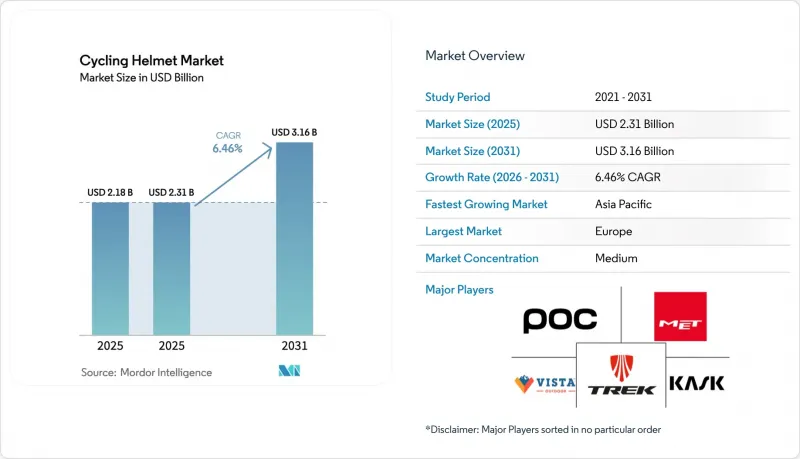
本報告按產品類型(公路/休閒頭盔、山地自行車頭盔、運動/探險頭盔)、最終用戶(兒童和成人)、類別(傳統頭盔和智慧頭盔)、銷售管道(實體店和網路商店)以及地區進行細分。市場預測以美元計價。
全球自行車頭盔市場趨勢與洞察
提高對頭部受傷風險的安全意識
流行病學數據顯示,騎乘相關的頭部損傷與長期認知障礙之間存在關聯,這正在影響消費者的認知。研究表明,頭盔能顯著降低頭部損傷的風險,具體風險取決於撞擊的性質。此外,一項瑞典研究發現,佩戴帶有釋放層系統的頭盔的電動自行車騎行者,其頭部損傷的風險顯著低於未佩戴頭盔的騎行者。世界衛生組織(WHO)的數據顯示,每年有數百萬人死於道路交通事故,其中絕大多數涉及行人和騎乘者。公共衛生組織正在利用這些數據來推廣戴頭盔,這不僅是一種個人選擇,更是一種公共衛生干預措施。維吉尼亞理工大學的頭盔安全評估系統對數百種頭盔型號進行評估和評分,並已被廣泛認可為行業標準。該評估系統透過提供性能基準,將實驗室結果轉化為消費者可操作的標準,從而影響零售展示和消費者的購買決策。根據美國小兒科會(AAP)統計,美國有數百萬名兒童騎自行車,近年來記錄在案的非致命性兒童受傷事件數量也相當可觀。然而,由於目前尚無法律強制要求佩戴頭盔,頭盔使用率仍然不足,這凸顯出僅靠宣傳活動不足以彌補監管措施的不足。在瑞典和荷蘭,保險公司正在試行為佩戴認證安全帽的車主提供保費折扣。這種經濟獎勵透過將安全意識與經濟行為的改變聯繫起來,從而鼓勵提高安全意識。此外,它還能產生可指南未來承保模式的保險統計資料。
政府法規強制要求佩戴頭盔。
在主要成長型市場,由於監管強制措施,頭盔的使用正從「可選」轉變為「強制」。例如,在印度,一項將於2026年1月生效的法規要求每輛新摩托車必須配備兩個經印度標準局(BIS)認證的安全帽。預計這項政策將顯著提高對認證頭盔的需求,並在製造業創造大量就業機會。此外,該法規還旨在打擊假頭盔市場,這些不合格且防護性能不足的頭盔以低成本生產,並透過零售商以高價出售。在美國,各州的頭盔使用法律各不相同,一些州的法規主要針對特定年齡以下的騎行者。加州議會第1774號法案將於2024年生效,該法案強制要求17歲以下的電動自行車騎行者佩戴頭盔,反映出監管方式的碎片化,導致執法存在漏洞。同樣,澳洲也在2024年修訂了其消費品安全標準,並提高了合規標準。在荷蘭,人們正努力推廣電動自行車頭盔的NTA-8776標準,該標準對跌落測試的要求比傳統的EN 1078認證更為嚴格。雖然這些不同的法律規範為跨國品牌帶來了合規方面的挑戰,但也為那些能夠比全球競爭對手更有效管理本地認證流程的本地專家創造了商機。在印度,公路運輸和高速公路部(MoRTH)在上一個財政年度開展了多次頭盔抽樣測試以及搜查和查扣行動。其中一次在德里進行的行動查獲了大量不合規頭盔,凸顯了印度加強監管力道的決心。
高性能頭盔高成本
旋轉衝擊吸收技術,例如多向衝擊保護系統 (MIPS)、WaveCel 和釋放層系統,導致組件成本上升,進而推高了零售價格。 ABUS 的「GAMECHANGER 2.0 MIPS」和 MET 的「Trenta 3K Carbon」等旗艦型號就清晰地體現了這一趨勢。這種定價結構正在造成市場兩極化。歐洲和北美的富裕消費者傾向於選擇具有先進安全功能的頭盔,而亞太和南美的對價格較為敏感的消費者則傾向於選擇符合最低認證標準但缺乏旋轉衝擊保護的基本發泡泡沫外殼頭盔。在印度,強制要求通過印度標準局 (BIS) 認證的「雙頭盔要求」預計將略微推高入門級頭盔的價格。這是因為製造商被迫升級生產設備以適應防鎖死煞車系統 (ABS) 和升級前輪碟煞。 Canyon 的「Deflectr」頭盔獲得了維吉尼亞理工大學的最高安全評級,證明其獨特的智慧財產權能夠以中等價位提供卓越的性能。然而,此類產品在同類產品中仍然十分罕見,並不普及。印度相關人員已提案降低安全帽的商品和服務稅(GST),此舉可望加速認證安全帽的普及。然而,新興市場的財政限制使得此類措施的實施在政治上難以實現。此外,智慧頭盔在推廣方面也面臨挑戰,因為消費者往往會在互聯功能的優勢與電池壽命和高昂的更換成本之間權衡利弊。
細分市場分析
預計到2031年,公路和休閒自行車頭盔的年增率將達到7.91%,超過山地自行車頭盔的成長率。儘管山地自行車頭盔在2025年的銷售量佔比高達39.21%。這一趨勢源自於都市區通勤者更注重空氣動力學性能、輕量化設計和整合連接等特性,而非專為越野騎行設計的衝擊保護功能。 POC在2025年環法自行車賽期間推出的「Cytal Lite」頭盔便是高階公路頭盔領域專注於性能提升的典型例證。同樣,Giant的2026款「Pursuit多向衝擊保護系統(MIPS)」和「Rev Pro多向衝擊保護系統」頭盔也優先考慮降低高速行駛時的空氣阻力,並獲得了維吉尼亞理工大學的五星級安全評級。雖然山地自行車頭盔的成長速度低於整個頭盔類別,但它們正在不斷融入模組化創新技術。例如,Leatt 的「Enduro 3.0」頭盔採用「三合一」設計,可作為帶有可拆卸下巴護罩的全罩式安全帽、半罩式安全帽或帶耳罩的開放式頭盔使用。這種設計兼顧了下坡騎行時的保護性和越野騎行時的透氣性。這款探險頭盔的設計介於公路自行車和山地自行車之間,其兼容遮陽板、後腦勺覆蓋範圍更廣以及配備運動攝影機和照明系統的安裝點等功能,滿足了礫石騎行者和自行車旅行愛好者的需求。
Canyon 的 Deflectr 頭盔於 2025 年 12 月上市,其取得專利的釋放層系統 (Release Layer System) 採用聚碳酸酯軸承,與不帶該系統的頭盔相比,可顯著降低旋轉速度。這項創新技術凸顯了自行車 OEM 廠商如何利用垂直整合來開發自身的安全技術,並與多向衝擊保護系統 (Multi-directional Impact Protection System) 等授權解決方案競爭。
2025年,成人頭盔銷售額佔總銷售額的78.71%,而兒童頭盔市場預計到2031年將以7.81%的年均成長率成長。學校推廣的頭盔發放計畫、家長對旋轉衝擊吸收技術投資意願的提高以及青少年體育運動參與率的上升,都在推動著諸如2024年6月在剪切機開展的頭盔發放活動等舉措。在北卡羅來納州,運輸部正利用其「共享道路」車牌計畫的收入資助自行車頭盔推廣舉措。同樣,密西根大學的「快閃安全小鎮」將免費發放頭盔與現場佩戴指導相結合,凸顯了社區健康計畫如何將產品培訓和發放相結合,以應對行為改變方面的挑戰。安全交通研究與教育中心(SafeTREC)的研究強調,如果沒有關於安全帽佩戴和維護的正確教育,僅靠免費發放是不夠的。因此,各大品牌現在正將尺寸選擇工具、虛擬試戴選項和售後支援等功能融入其直接面對消費者的銷售策略中。
成人頭盔的價格範圍很廣,從基本的發泡聚苯乙烯頭盔到配備整合式電子元件的高階碳纖維複合材料頭盔,應有盡有。這種細分反映了不同的使用情境、預算和安全功能。根據美國小兒科會統計,美國有數百萬兒童騎自行車,2020年報告了多起非致命性事故。然而,由於缺乏強制性法律,頭盔的使用率仍然很低。在新興市場,兒童自行車擁有量正以驚人的速度成長,這為那些能夠提供既符合當地認證要求(例如印度標準局 (BIS) 的標準)又價格合理的產品的品牌創造了商機。
區域分析
預計歐洲將引領全球自行車市場,2025年佔預測銷售量的37.21%。這一主導地位得益於許多因素,例如荷蘭強制佩戴頭盔的規定、德國和法國先進的自行車基礎設施,以及歐盟承諾在2027年新建數千公里自行車道。然而,該地區也面臨挑戰。其中之一是,由於疫情期間供應過剩導致的庫存調整,預計德國自行車市場在2024年將萎縮。 2024年,德國的自行車銷量將達到數百萬輛,其中電動自行車佔很大比例。同樣,荷蘭的自行車銷量也將達到數十萬輛,電動自行車的市佔率接近一半。同時,法國的自行車銷量也將達到數百萬輛,其中包括數十萬輛電動自行車,並因此獲得了可觀的收入。對自行車基礎設施的投資,例如荷蘭在2025年11月做出的資金承諾以及哥本哈根為類似項目撥出的預算,將繼續推動市場成長。這些投資,透過同儕影響和宣傳宣傳活動,也促進了頭盔使用率的提高。此外,NTA-8776電動自行車頭盔標準(其跌落測試標準高於EN 1078標準)的採用範圍正在荷蘭以外的地區擴大。這反映出隨著電動自行車速度的提升,人們對更高防護性能的需求日益成長,而積極應對更嚴格標準的品牌正在獲得合規優勢。
亞太地區預計將成為成長最快的市場,到2031年年平均成長率將達到7.71%。這一成長主要得益於印度將於2026年1月實施的「強制佩戴兩頂頭盔」政策、中國電動自行車的日益普及以及中產階級對安全認證設備的消費增加。印度的這項政策要求每購買一輛新的二輪車都必須配備兩頂經印度標準局(BIS)認證的頭盔,預計這將顯著提高認證頭盔的年需求量,為製造業創造大量就業機會,並減少損害消費者信心的仿冒品。在上一個財政年度,印度公路運輸和公路部進行了廣泛的頭盔抽樣檢測和多次搜索行動。其中包括在德里的一次行動,該行動查獲了大量不合規頭盔,表明相關法規的執行力道將進一步加強。截至2025年6月,眾多製造商已獲得印度標準局頒發的有效安全頭盔許可證,隨著強制性雙頭盔佩戴規定的實施,預計這一數字還將進一步成長。此外,發展中國家兒童自行車擁有量的穩定成長,也為提供符合印度標準4151:2015認證要求的產品的品牌創造了新的商機。這些標準對頭盔的衝擊吸收、抗穿刺性、固定系統的完整性、阻燃性、重量限制、周邊視野和麵罩清晰度等方面均有具體規定。
北美、南美以及中東和非洲地區合計佔全球銷售額的剩餘部分。在北美,對都市區自行車基礎設施的投資,包括各州強制佩戴頭盔的規定,以及紐約市交通局和加州「積極交通計畫」(第八週期)的資金支持,正在推動市場成長。在美國,由於法律規範分散,各州的頭盔法規主要針對特定年齡層以下的騎行者,因此難以在全國範圍內統一實施。然而,加州2024年提出的第1774號國會法案強制規定特定年齡段以下的電動自行車騎行者必須佩戴頭盔,這表明州級政策可以逐步推動需求成長。在南美和中東及非洲地區,由於價格挑戰、執法力度不足以及文化習俗優先考慮便利性而非安全,頭盔普及率仍然很低。儘管存在這些挑戰,但都市化的加速和摩托車擁有的成長正在創造潛在的需求。品牌可以透過設計價格合理的產品、在地化生產以及與當地安全項目合作來滿足這一需求。世界衛生組織(世衛組織)的數據顯示,每年約有120萬人死於交通事故,其中行人和騎自行車者佔四分之一以上。這凸顯了新興市場從公共衛生角度來看對防護裝備的需求,因為這些市場的道路安全基礎建設未能跟上汽車數量的成長。
其他好處:
- Excel格式的市場預測(ME)表
- 3個月的分析師支持
目錄
第1章:引言
- 研究假設和市場定義
- 調查範圍
第2章:調查方法
第3章執行摘要
第4章 市場狀況
- 市場概覽
- 市場促進因素
- 提高對頭部受傷風險的安全意識
- 政府法規強制要求佩戴頭盔。
- 旨在促進安全騎自行車的公眾宣傳活動
- 擴大自行車運動在促進健康和休閒的應用
- 支持永續交通的城市交通趨勢
- 電動自行車的廣泛普及需要增強其安全性能。
- 市場限制因素
- 高性能頭盔價格昂貴
- 與使用者舒適度和貼合度相關的挑戰
- 炎熱氣候下通風不足
- 破壞信任的仿冒品
- 消費行為分析
- 監理展望
- 波特五力模型
第5章 市場規模與成長預測
- 依產品類型
- 公路和休閒頭盔
- 山地自行車(MTB)頭盔
- 運動和探險頭盔
- 最終用戶
- 孩子們
- 成人
- 按類別
- 傳統頭盔
- 智慧頭盔
- 透過分銷管道
- 實體店面
- 線上零售商店
- 按地區
- 北美洲
- 美國
- 加拿大
- 墨西哥
- 其他北美國家
- 歐洲
- 德國
- 英國
- 義大利
- 法國
- 西班牙
- 荷蘭
- 波蘭
- 比利時
- 瑞典
- 其他歐洲國家
- 亞太地區
- 中國
- 印度
- 日本
- 澳洲
- 印尼
- 韓國
- 泰國
- 新加坡
- 其他亞太國家
- 南美洲
- 巴西
- 阿根廷
- 哥倫比亞
- 智利
- 秘魯
- 其他南美國家
- 中東和非洲
- 南非
- 沙烏地阿拉伯
- 阿拉伯聯合大公國
- 奈及利亞
- 埃及
- 摩洛哥
- 土耳其
- 其他中東和非洲國家
- 北美洲
第6章 競爭情勢
- 市場集中度
- 策略趨勢
- 市場排名分析
- 公司簡介
- Vista Outdoor Inc.
- POC Sports
- KASK SpA
- Trek Bicycle Corp.
- MET Helmets
- Specialized Bicycle Components
- Giant Manufacturing Co. Ltd.
- Shunde Moon Helmet Co., Ltd.
- Shenzhen GUB Bike Trading Co., Ltd.
- Uvex Sports GmbH
- Nixeycles
- Lazer Sport
- Mavic SAS
- Limar Helmets
- Thousand Helmets
- Sena Technologies Inc.
- Canyon Bicycles GmbH
- Decathlon SA
- Lumen Labs Inc.
- ABUS August Bremicker Sohne KG
第7章 市場機會與未來展望
According to Mordor Intelligence, the cycling helmet market size is projected to expand from USD 2.18 billion in 2025 and USD 2.31 billion in 2026 to USD 3.16 billion by 2031, registering a CAGR of 6.46% between 2026 to 2031.
This report is Segmented by Product Type (Road/Recreational Helmets, Mountain Bike (MTB) Helmets, and Sports/Adventure Helmets), End User (Kids and Adults), Category (Conventional Helmets and Smart Helmets), Distribution Channel (Offline Retail Stores and Online Retail Stores), and Geography. The Market Forecasts are Provided in Terms of Value (USD).
Global Cycling Helmet Market Trends and Insights
Rising safety awareness about head injury risks
Epidemiological data linking cycling head injuries to long-term cognitive impairment is shaping consumer perceptions. Research shows that helmets significantly reduce the risk of head injuries, depending on the nature of the impact. Furthermore, Swedish electric bike (e-bike) riders using helmets with Release Layer Systems face a notably lower risk of head injuries compared to those who do not wear helmets. According to the World Health Organization (WHO), millions of road deaths occur annually, with pedestrians and cyclists comprising a significant proportion . Public health agencies are using this data to promote helmet adoption as a public health intervention rather than merely an individual choice. Virginia Tech's helmet-safety ratings, which assess hundreds of models and assign scores, have become a recognized industry standard. These ratings influence retail placement and consumer purchasing decisions by providing a performance benchmark that translates laboratory findings into practical criteria for buyers. The American Academy of Pediatrics (AAP) has reported that millions of children ride bicycles in the United States, with a substantial number of non-fatal injuries recorded in recent years. However, helmet usage remains inadequate in the absence of mandatory laws, highlighting that awareness alone is insufficient without regulatory measures. In Sweden and the Netherlands, insurance companies are testing premium discounts for certified-helmet users. This financial incentive promotes safety awareness by linking it to economic behavior changes. Additionally, it generates actuarial data that could guide future underwriting models.
Government regulations mandating helmet use
Regulatory mandates are increasingly shifting helmet adoption from voluntary to mandatory in key growth markets. For example, India has introduced a regulation effective January 2026, requiring the sale of two Bureau of Indian Standards (BIS)-certified helmets with every new two-wheeler . This policy is anticipated to drive significant demand for certified helmets and generate substantial manufacturing employment opportunities. Additionally, it aims to combat the counterfeit helmet market, where non-compliant helmets, offering inadequate protection, are produced at low costs and sold at inflated prices through dealerships. In the United States, helmet laws differ by state, with several states enforcing regulations primarily for riders under specific age thresholds. California's Assembly Bill 1774, effective in 2024, mandates helmet use for electric bike (e-bike) riders under the age of 17, reflecting a fragmented regulatory approach that creates enforcement gaps. Similarly, Australia updated its Consumer Goods Safety Standard in 2024 to enhance compliance thresholds . In the Netherlands, efforts are underway to promote the adoption of the NTA-8776 standard for electric bike helmets, which imposes stricter drop-test requirements compared to the conventional EN 1078 certification. These diverse regulatory frameworks pose compliance challenges for multinational brands but also create opportunities for regional specialists who can navigate local certification processes more effectively than global competitors. In India, the Ministry of Road Transport and Highways (MoRTH) conducted multiple helmet-sample tests and search and seizure operations during the previous financial year. One such operation in Delhi resulted in the seizure of a significant number of non-compliant helmets, highlighting increased regulatory enforcement efforts.
High cost of advanced helmets
Rotational-impact technologies, including the Multi-directional Impact Protection System (MIPS), WaveCel, and Release Layer System, contribute to higher bill-of-materials costs, leading to retail price premiums. Flagship models such as the ABUS GAMECHANGER 2.0 MIPS and MET's Trenta 3K Carbon exemplify this trend. This pricing structure has resulted in a two-tier market. Affluent consumers in Europe and North America tend to prefer helmets with advanced safety features, while price-sensitive buyers in Asia-Pacific and South America often choose basic expanded polystyrene shells that meet minimum certification standards but lack rotational protection. In India, the two-helmet mandate, which requires Bureau of Indian Standards (BIS) certification, is anticipated to slightly increase entry-level helmet prices. This is due to manufacturers needing to retool for anti-lock braking system (ABS) compatibility and front-disc upgrades. Canyon's Deflectr, which holds Virginia Tech's top safety rating, demonstrates how proprietary intellectual property can deliver premium performance at mid-market price points. However, such offerings remain exceptions rather than the norm in the category. Proposals by Indian industry stakeholders to reduce the goods and services tax (GST) on helmets could potentially accelerate the adoption of certified helmets. However, fiscal constraints in emerging markets limit the political feasibility of implementing such measures. Additionally, smart helmets face adoption challenges as consumers often weigh the benefits of connectivity against concerns over battery life and higher replacement costs.
Other drivers and restraints analyzed in the detailed report include:
- Public campaigns promoting cycling safety
- Growth in cycling for fitness and recreation
- Comfort and fit issues for users
For complete list of drivers and restraints, kindly check the Table Of Contents.
Segment Analysis
Road and recreational helmets are projected to grow at an annual rate of 7.91% through 2031, surpassing the growth of mountain bike helmets, despite the latter accounting for 39.21% of 2025 revenue. This trend is driven by urban commuters prioritizing features such as aerodynamics, weight reduction, and integrated connectivity over trail-specific impact protection. POC's Cytal Lite, launched during the 2025 Tour de France, exemplifies the premium road segment's focus on incremental performance improvements. Similarly, Giant's 2026 Pursuit Multi-directional Impact Protection System (MIPS) and Rev Pro Multi-directional Impact Protection System helmets emphasize drag reduction at high speeds and have earned Virginia Tech's 5-star safety rating. While mountain bike helmets are growing at a slower pace than the overall category, they are incorporating modular innovations. For example, Leatt's Enduro 3.0 helmet offers a three-in-one design, functioning as a full-face helmet with a removable chin bar, a half-shell, or an open-face helmet with ear covers. This design addresses the need for a balance between downhill protection and trail ventilation. Adventure helmets, positioned between road and mountain bike designs, cater to gravel riders and bikepacking enthusiasts with features such as visor compatibility, extended rear coverage, and mounting points for action cameras and lighting systems.
Canyon's December 2025 release of the Deflectr helmet introduces a patented Release Layer System, which utilizes polycarbonate bearings to significantly reduce rotational velocity compared to helmets without this system. This innovation highlights how bicycle original equipment manufacturers are leveraging vertical integration to develop proprietary safety technologies, competing with licensed solutions such as the Multi-directional Impact Protection System.
Adults accounted for 78.71% of the revenue in 2025, while the kids' segment is projected to grow at an annual rate of 7.81% through 2031. School-based distribution programs, increased parental willingness to invest in rotational-impact technologies, and rising youth sports participation have driven initiatives such as Charlottesville's helmet distribution in June 2024. In North Carolina, the Department of Transportation funds its Bicycle Helmet Initiative through revenue generated from "Share the Road" license plates. Similarly, the University of Michigan's Pop-up Safety Town integrates free helmet distribution with hands-on fitting education, highlighting how community health programs are combining product training with distribution to address behavioral adoption challenges. Research from the Safe Transportation Research and Education Center (SafeTREC) emphasizes that free distribution alone is insufficient without proper education on fit and maintenance. This has led brands to incorporate features like sizing tools, virtual try-on options, and post-purchase support into their direct-to-consumer strategies.
Adult helmets are available across a wide price range, from basic expanded polystyrene models to premium carbon-composite designs with integrated electronics. This segmentation reflects varying use cases, budgets, and safety features. According to the American Academy of Pediatrics, millions of children in the United States ride bicycles, with a significant number of non-fatal injuries reported in 2020. However, helmet usage remains low in the absence of mandatory laws. In developing markets, bike ownership among children is increasing at a notable rate, creating opportunities for brands that can navigate local certification requirements and offer products balancing affordability with compliance to standards such as the Bureau of Indian Standards.
Complete Report Scope:
- By Product Type
- Road/Recreational Helmets
- Mountain Bike (MTB) Helmets
- Sports/Adventure Helmets
- By End User
- Kids
- Adult
- By Category
- Conventional Helmets
- Smart Helmets
- By Distribution Channel
- Offline Retail Stores
- Online Retail Stores
- By Geography
- North America
- United States
- Canada
- Mexico
- Rest of North America
- Europe
- Germany
- United Kingdom
- Italy
- France
- Spain
- Netherlands
- Poland
- Belgium
- Sweden
- Rest of Europe
- Asia-Pacific
- China
- India
- Japan
- Australia
- Indonesia
- South Korea
- Thailand
- Singapore
- Rest of Asia-Pacific
- South America
- Brazil
- Argentina
- Colombia
- Chile
- Peru
- Rest of South America
- Middle East and Africa
- South Africa
- Saudi Arabia
- United Arab Emirates
- Nigeria
- Egypt
- Morocco
- Turkey
- Rest of Middle East and Africa
- North America
Geography Analysis
Europe is set to lead the global cycling market, contributing 37.21% of the projected revenue in 2025. This leadership is supported by factors such as mandatory helmet regulations in the Netherlands, advanced cycling infrastructure in Germany and France, and the European Union's funding commitment through 2027 for developing thousands of kilometers of new cycle paths. However, the region faces challenges, including a contraction in Germany's bicycle market in 2024 due to inventory corrections following pandemic-era oversupply. In 2024, Germany recorded significant bicycle sales in the millions, with e-bikes accounting for a substantial share. Similarly, the Netherlands sold hundreds of thousands of bicycles, with e-bikes capturing nearly half of the market share, while France generated considerable revenue from millions of units sold, including hundreds of thousands of e-bikes. Investments in cycling infrastructure, such as the Netherlands' funding commitment in November 2025 and Copenhagen's budget allocation for similar initiatives, continue to drive market growth. These investments also promote helmet use through peer influence and visibility campaigns. Additionally, the adoption of the NTA-8776 standard for e-bike helmets, which requires higher drop-test thresholds compared to the EN 1078 standard, is expanding beyond the Netherlands. This reflects the growing need for enhanced protection due to higher e-bike speeds, offering a compliance advantage to brands that proactively meet the stricter standard.
The Asia-Pacific region is anticipated to be the fastest-growing segment, with an annual growth rate of 7.71% through 2031. This growth is driven by India's upcoming two-helmet mandate in January 2026, increasing e-bike adoption in China, and higher middle-class spending on safety-certified gear. India's policy mandates two Bureau of Indian Standards-certified helmets with every new two-wheeler purchase, which is expected to significantly boost annual demand for certified helmets, create substantial manufacturing jobs, and reduce counterfeit products that have eroded consumer trust. The Ministry of Road Transport and Highways conducted extensive helmet-sample tests and multiple search-and-seizure operations in the previous financial year, including a Delhi operation that confiscated a large number of non-compliant helmets, signaling stricter regulatory enforcement. As of June 2025, numerous manufacturers held valid Bureau of Indian Standards licenses for protective helmets, a number expected to rise as the two-helmet rule drives demand. Additionally, bike ownership among children in developing markets is steadily increasing, creating opportunities for brands to offer products that comply with Indian Standard 4151:2015 certification requirements. These standards cover impact absorption, penetration resistance, retention-system integrity, flame resistance, weight limits, peripheral vision, and visor clarity.
North America, South America, and the Middle East and Africa collectively account for the remaining global revenue. North America benefits from state-level helmet mandates and investments in urban cycling infrastructure, such as funding from New York City's Department of Transportation and California's Active Transportation Program Cycle 8. In the United States, helmet laws in several states, primarily targeting riders under a certain age, create a fragmented regulatory framework that limits uniform nationwide adoption. However, California's Assembly Bill 1774 for 2024, which mandates helmets for e-bike riders under a specific age, demonstrates how state-level policies can drive incremental demand. In South America and the Middle East and Africa, helmet adoption remains low due to affordability issues, weak enforcement, and cultural norms that prioritize convenience over safety. Despite these challenges, urbanization and rising two-wheeler ownership are generating latent demand. Brands can address this demand through affordable designs, local manufacturing, and partnerships with municipal safety programs. According to the World Health Organization, approximately 1.2 million road deaths occur annually, with pedestrians and cyclists accounting for over a quarter. This highlights the public health need for protective equipment in emerging markets, where road safety infrastructure has not kept pace with vehicle growth.
- Vista Outdoor Inc.
- POC Sports
- KASK S.p.A.
- Trek Bicycle Corp.
- MET Helmets
- Specialized Bicycle Components
- Giant Manufacturing Co. Ltd.
- Shunde Moon Helmet Co., Ltd.
- Shenzhen GUB Bike Trading Co., Ltd.
- Uvex Sports GmbH
- Nixeycles
- Lazer Sport
- Mavic SAS
- Limar Helmets
- Thousand Helmets
- Sena Technologies Inc.
- Canyon Bicycles GmbH
- Decathlon SA
- Lumen Labs Inc.
- ABUS August Bremicker Sohne KG
Additional Benefits:
- The market estimate (ME) sheet in Excel format
- 3 months of analyst support
TABLE OF CONTENTS
1 INTRODUCTION
- 1.1 Study Assumptions and Market Definition
- 1.2 Scope of the Study
2 RESEARCH METHODOLOGY
3 EXECUTIVE SUMMARY
4 MARKET LANDSCAPE
- 4.1 Market Overview
- 4.2 Market Drivers
- 4.2.1 Rising safety awareness about head injury risks
- 4.2.2 Government regulations mandating helmet use
- 4.2.3 Public campaigns promoting cycling safety
- 4.2.4 Growth in cycling for fitness and recreation
- 4.2.5 Urban mobility trends favoring sustainable transport
- 4.2.6 E-bike adoption requiring enhanced protection
- 4.3 Market Restraints
- 4.3.1 High cost of advanced helmets
- 4.3.2 Comfort and fit issues for users
- 4.3.3 Poor ventilation in hot climate
- 4.3.4 Counterfeit products undermining trust
- 4.4 Consumer Behaviour Analysis
- 4.5 Regulatory Outlook
- 4.6 Porter's Five Forces
- 4.6.1 Threat of New Entrants
- 4.6.2 Bargaining Power of Buyers
- 4.6.3 Bargaining Power of Suppliers
- 4.6.4 Threat of Substitute Products
- 4.6.5 Intensity of Competitive Rivalry
5 MARKET SIZE AND GROWTH FORECASTS (VALUE)
- 5.1 By Product Type
- 5.1.1 Road/Recreational Helmets
- 5.1.2 Mountain Bike (MTB) Helmets
- 5.1.3 Sports/Adventure Helmets
- 5.2 By End User
- 5.2.1 Kids
- 5.2.2 Adult
- 5.3 By Category
- 5.3.1 Conventional Helmets
- 5.3.2 Smart Helmets
- 5.4 By Distribution Channel
- 5.4.1 Offline Retail Stores
- 5.4.2 Online Retail Stores
- 5.5 By Geography
- 5.5.1 North America
- 5.5.1.1 United States
- 5.5.1.2 Canada
- 5.5.1.3 Mexico
- 5.5.1.4 Rest of North America
- 5.5.2 Europe
- 5.5.2.1 Germany
- 5.5.2.2 United Kingdom
- 5.5.2.3 Italy
- 5.5.2.4 France
- 5.5.2.5 Spain
- 5.5.2.6 Netherlands
- 5.5.2.7 Poland
- 5.5.2.8 Belgium
- 5.5.2.9 Sweden
- 5.5.2.10 Rest of Europe
- 5.5.3 Asia-Pacific
- 5.5.3.1 China
- 5.5.3.2 India
- 5.5.3.3 Japan
- 5.5.3.4 Australia
- 5.5.3.5 Indonesia
- 5.5.3.6 South Korea
- 5.5.3.7 Thailand
- 5.5.3.8 Singapore
- 5.5.3.9 Rest of Asia-Pacific
- 5.5.4 South America
- 5.5.4.1 Brazil
- 5.5.4.2 Argentina
- 5.5.4.3 Colombia
- 5.5.4.4 Chile
- 5.5.4.5 Peru
- 5.5.4.6 Rest of South America
- 5.5.5 Middle East and Africa
- 5.5.5.1 South Africa
- 5.5.5.2 Saudi Arabia
- 5.5.5.3 United Arab Emirates
- 5.5.5.4 Nigeria
- 5.5.5.5 Egypt
- 5.5.5.6 Morocco
- 5.5.5.7 Turkey
- 5.5.5.8 Rest of Middle East and Africa
- 5.5.1 North America
6 COMPETITIVE LANDSCAPE
- 6.1 Market Concentration
- 6.2 Strategic Moves
- 6.3 Market Ranking Analysis
- 6.4 Company Profiles (includes Global-level Overview, Market-level Overview, Core Segments, Financials (if available), Strategic Information, Market Rank/Share, Products and Services, Recent Developments)
- 6.4.1 Vista Outdoor Inc.
- 6.4.2 POC Sports
- 6.4.3 KASK S.p.A.
- 6.4.4 Trek Bicycle Corp.
- 6.4.5 MET Helmets
- 6.4.6 Specialized Bicycle Components
- 6.4.7 Giant Manufacturing Co. Ltd.
- 6.4.8 Shunde Moon Helmet Co., Ltd.
- 6.4.9 Shenzhen GUB Bike Trading Co., Ltd.
- 6.4.10 Uvex Sports GmbH
- 6.4.11 Nixeycles
- 6.4.12 Lazer Sport
- 6.4.13 Mavic SAS
- 6.4.14 Limar Helmets
- 6.4.15 Thousand Helmets
- 6.4.16 Sena Technologies Inc.
- 6.4.17 Canyon Bicycles GmbH
- 6.4.18 Decathlon SA
- 6.4.19 Lumen Labs Inc.
- 6.4.20 ABUS August Bremicker Sohne KG
7 MARKET OPPORTUNITIES AND FUTURE OUTLOOK

 滑雪與自行車頭盔市場-2026-2032年全球市場預測
 自行車頭盔市場規模、佔有率和成長分析:按類型、技術、材料、應用、最終用戶、分銷管道、價格範圍和地區分類-2026-2033年產業預測
 自行車頭盔市場-全球產業規模、佔有率、趨勢、機會和預測:按產品類型、最終用戶、分銷管道、地區和競爭格局分類,2021-2031年
 2026年全球自行車頭盔市場報告自行車頭盔市場-全球產業規模、佔有率、趨勢、機會、預測:按類型、應用、分銷管道、地區和競爭格局分類,2021-2031年智慧藍牙滑雪頭盔市場:按產品類型、連接技術、分銷管道和最終用戶分類,全球預測(2026-2032)
 全球自行車頭盔市場全球自行車頭盔市場
 二輪車用安全帽市場評估:產品類型·價格分佈·安全帽類型·流通管道·各地區的機會及預測 (2018-2032年)印度的二輪車用安全帽市場:各產品類型,各種價格,各安全帽類型,各流通管道,各地區,機會,預測,2018年~2032年