


 |
市場調查報告書
商品編碼
2097245
5G MVNO:市場佔有率分析、產業趨勢與統計、成長預測(2026-2031)5G MVNO - Market Share Analysis, Industry Trends & Statistics, Growth Forecasts (2026 - 2031) |
||||||

※ 本網頁內容可能與最新版本有所差異。詳細情況請與我們聯繫。
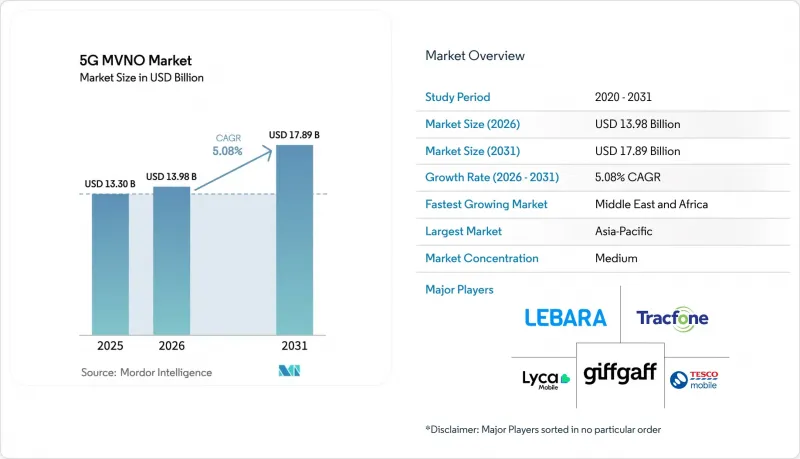
據 Mordor Intelligence 稱,5G MVNO 市場規模預計在 2026 年達到 139.8 億美元,高於 2025 年的 133 億美元,預計到 2031 年將達到 178.9 億美元。
預計從 2026 年到 2031 年,其複合年成長率將達到 5.08%。
本報告按用戶類型(企業用戶、消費者用戶)、營運模式(經銷商/輕型/品牌MVNO、服務供應商、全功能MVNO)、應用領域(M2M/物聯網連接等)、產業(製造業、醫療保健等)、網路技術(獨立組網5G、非獨立組網5G)和地區進行細分。市場預測以價值(美元)和數量(用戶數)兩種形式呈現。
全球5G MVNO市場趨勢與洞察
企業對物聯網連結的需求日益成長
製造業、物流業和醫療保健企業正在部署私有 5G 網路,用於即時流程控制和預測分析,這為以物聯網為中心的行動虛擬網路營運商 (MVNO) 創造了一個潛在價值 20 億美元的市場。企業連結的平均每用戶收入 (ARPU) 目前為 15 至 25 美元,約為消費者 ARPU 的兩倍。這是因為客戶願意為有保障的延遲和強大的安全性支付溢價。與邊緣運算的整合進一步提高了轉換成本,使 MVNO 能夠比預付設備的生命週期更長時間地留住客戶。
監理機關推動5G批發接入
加拿大廣播電視和電信委員會 (CRTC)、歐盟委員會和韓國監管機構正在強制推行「成本加成」批發定價模式,以允許虛擬通訊業者(MVNO) 購買 5G 容量,而無需承擔過重的使用義務。這些法規降低了准入門檻,促進了競爭,並透過要求基礎設施通訊業者共用網路切片能力,創造了一個 MVNO 可以銷售差異化企業套餐的環境。
經濟實惠的5G專用設備短缺
入門級 5G 設備的價格仍然比同級別的 4G 設備高出 40% 到 60%,這在價格敏感的市場中阻礙了消費者的接受度,而行動虛擬網路營運商 (MVNO) 又很少提供設備補貼。零件短缺進一步加劇了這一障礙,迫使虛擬品牌依賴翻新產品和自帶設備 (BYOD)宣傳活動,導致淨用戶成長放緩。
細分市場分析
到2025年,企業級市場將佔整個5G MVNO市場的66.72%。這是因為企業客戶對安全私有網路、物聯網連線和服務等級協定(SLA)的需求日益成長。這個高階市場為可預測的現金流量奠定了基礎,並促使NTT Data和Eurofiber聯合推出了完全託管的私人5G套餐。同時,受入門級設備和資料方案價格較低的推動,預計消費者市場將以8.52%的複合年成長率超越企業市場。隨著用戶規模的擴大,消費者市場的佔有率將落後於企業市場,但其用戶數量仍將繼續支撐整個5G MVNO市場的成長。
企業合約使行動虛擬網路營運商 (MVNO) 能夠提供邊緣運算附加元件、網路安全監控和產業專用的應用,從而緩解利潤壓力。同時,消費品牌正依靠數位自我護理應用程式、eSIM 部署和多月預付方案來降低獲客成本。隨著設備價格的日益親民,消費者群體也逐漸擴大,這種混合模式正幫助營運商實現收入來源多元化。
即使到了2025年,儘管轉售商和輕型MVNO模式仍將佔據52.10%的收入佔有率,但隨著收費和服務編配管理對於網路切片的貨幣化變得至關重要,整個全功能MVNO市場正以16.45%的複合年成長率快速擴張。擁有核心網路能夠實現差異化的服務品質、快速調整費率方案,並為企業客戶提供直接的API介面,從而提高了5G MVNO市場的轉換門檻,並為高價策略提供了合理的依據。
「服務業者混合模式」介於這兩種極端模式之間,它將無線鏈路外包,同時保留客戶管理,為缺乏資金實施完整核心解決方案的經銷商提供了升級途徑。整合營運商可以協商更低的批發價格,並投資於邊緣雲端創新,從而形成結構性優勢,削弱利基品牌經銷商所擁有的「長尾」優勢,並可能導致產業進一步整合。
區域分析
預計到2025年,亞太地區將佔全球整體收入的35.55%,這主要得益於日本和韓國強制推行的批發接入政策,以及製造業和智慧城市項目等企業數位轉型的快速推進。中國龐大的工廠基地正在推動對私有5G的需求,而印度預付市場的蓬勃發展,以及純數位方案和eSIM的快速普及,正在擴大消費者群體。粵港澳大灣區的跨境漫遊中心正協助行動虛擬網路營運商(MVNO)為跨國公司提供一體化服務入口網站。
中東和非洲是成長最快的地區,預計到2031年複合年成長率將達到7.42% 。沿岸地區的能源巨頭正在部署用於上游營運的專用網路,奈及利亞和南非的監管機構也正在向多家行動虛擬網路營運商(MVNO)發放許可證,以鼓勵競爭。設備價格下降、政府主導的雲端運算推廣計畫以及新海底光纜的鋪設,都提振了全部區域5G MVNO市場的前景。
在北美和歐洲,市場呈現穩定成長,但成長緩慢。在美國,T-Mobile 開放的 MVNO 政策以及 FCC 為統一批發價格而施加的壓力推動了市場發展;而加拿大 CRTC 的放鬆管制政策則提振了 2025 年的市場准入前景。歐盟的頻率共用指令將使新參與企業能夠在跨國企業交易中整合網路切片和邊緣運算技術,使其在基礎行動寬頻之外實現差異化競爭。
其他好處:
- Excel格式的市場預測(ME)表
- 3個月的分析師支持
目錄
第1章:引言
- 研究假設和市場定義
- 調查範圍
第2章:調查方法
第3章執行摘要
第4章 市場狀況
- 市場概覽
- 市場促進因素
- 企業對物聯網連結的需求日益成長
- 監管機構推動5G大規模普及
- 相容於 eSIM 的全球漫遊服務
- 已開發市場中具有成本效益的B2C資料包
- 透過人工智慧驅動的微細分提高盈利
- 工業園區的專用網路虛擬營運商
- 市場限制因素
- 經濟實惠的5G專用設備短缺
- 高額5G批發頻率使用費
- 對僅提供漫遊服務的虛擬業者進行國家安全審查
- MVNO IT 團隊邊緣雲端技能差距
- 產業價值鏈分析
- 監理情勢
- 波特五力分析
- 對影響市場的宏觀經濟因素進行評估
第5章 市場規模與成長預測
- 用戶類型
- 公司
- 一般消費者
- 按商業模式
- 經銷商/輕量級/品牌虛擬營運商
- 服務提供者
- 完整的虛擬營運商
- 透過使用
- M2M/IoT 連接
- 通訊服務解決方案
- 四合一服務解決方案
- 零售折扣方案
- 媒體與娛樂
- 僅限漫遊的解決方案
- B2B 資料(APN、FWA、SD-WAN)
- 私有 5G 園區解決方案
- 按行業分類
- 製造業
- 衛生保健
- 運輸/物流
- 零售與電子商務
- 能源公用事業
- 網路科技
- 獨立組網 5G
- 非獨立組網 5G
- 按地區
- 北美洲
- 美國
- 加拿大
- 墨西哥
- 南美洲
- 巴西
- 阿根廷
- 其他南美國家
- 歐洲
- 英國
- 德國
- 法國
- 義大利
- 西班牙
- 俄羅斯
- 其他歐洲國家
- 亞太地區
- 中國
- 日本
- 韓國
- 印度
- 澳洲和紐西蘭
- 印尼
- 馬來西亞
- 泰國
- 越南
- 菲律賓
- 其他亞太國家
- 中東和非洲
- 中東
- 沙烏地阿拉伯
- UAE
- 以色列
- 土耳其
- 非洲
- 南非
- 奈及利亞
- 肯亞
- 其他非洲國家
- 中東
- 北美洲
第6章 競爭情勢
- 市場集中度
- 策略趨勢
- 市佔率分析
- 公司簡介
- TracFone Wireless, Inc.(Verizon Value, Inc.)
- Lycamobile USA Inc.
- US Mobile, Inc.
- Sky UK Limited
- BT Group plc
- OCN Mobile(NTT Docomo)
- Tesco Mobile Ltd
- Japan Communications Inc.
- Truphone(TP Global Operations Limited)
- Google Fi Wireless(Google LLC)
- Cubic Telecom Limited
- Boost Mobile(Boost SubscriberCo LLC)
- Virgin Media UK Limited
- Lebara Limited
- Giffgaff Limited
- Mint Mobile, LLC
- Koodo Mobile(Telus Communications Inc.)
- Ting Mobile(DISH Wireless LLC)
第7章 市場機會與未來展望
According to Mordor Intelligence, 5G MVNO market size in 2026 is estimated at USD 13.98 billion, growing from 2025 value of USD 13.30 billion with 2031 projections showing USD 17.89 billion, growing at 5.08% CAGR over 2026-2031.
This report is Segmented by Subscriber Type (Enterprise, and Consumer), Operational Model (Resellers/Light/ Brand MVNO, Service Operator, and Full MVNO), Application (M2M/IoT Connectivity, and More), Industry Vertical (Manufacturing, Healthcare, and More), Network Technology (Standalone 5G, and Non-Standalone 5G), and Geography. The Market Forecasts are Provided in Terms of Value (USD) and Volume (Subscribers).
Global 5G MVNO Market Trends and Insights
Rising Enterprise IoT Connectivity Demand
Manufacturing, logistics, and healthcare operators are deploying private 5G networks for real-time process control and predictive analytics, creating a USD 2 billion addressable pool for IoT-centric MVNOs. Average revenue per enterprise connection now stands at USD 15-25, roughly double consumer ARPU, because customers pay premiums for guaranteed latency and robust security. Edge-computing tie-ins further lift switching costs, helping MVNOs retain accounts longer than the prepaid handset cycle.
Regulatory Push for Wholesale 5G Access
Canada's CRTC, the European Commission, and regulators in South Korea require cost-plus wholesale pricing that lets virtual operators buy 5G capacity without punitive volume commitments. These rules flatten entry barriers, foster price competition, and oblige facilities-based carriers to share network slicing functions, positioning MVNOs to sell differentiated enterprise packages.
Scarcity of Affordable 5G-Only Handsets
Entry-level 5G devices are still priced 40-60% higher than equivalent 4G models, constraining consumer uptake in price-sensitive markets where MVNOs seldom subsidize hardware. Component shortages continue to amplify this hurdle, forcing virtual brands to depend on refurbished stock or BYOD campaigns that slow net-add growth.
Other drivers and restraints analyzed in the detailed report include:
- eSIM-Enabled Global Roaming Propositions
- Cost-Efficient B2C Data Bundles in Developed Markets
- High 5G Wholesale Spectrum Fees
For complete list of drivers and restraints, kindly check the Table Of Contents.
Segment Analysis
The enterprise slice represented 66.72% of the total 5G MVNO market share in 2025 because industrial clients demand secure private networks, IoT connectivity, and service-level agreements. This premium segment underpins predictable cash flows and has spurred NTT Data and Eurofiber to co-launch fully managed private 5G bundles. Consumer lines, however, are projected to outpace enterprises at 8.52% CAGR owing to cheaper entry-level handsets and data bundles. As volumes scale, the consumer slice will remain below the enterprise share but will sustain overall subscriber momentum in the 5G MVNO market.
Enterprise contracts enable MVNOs to offer edge-compute addons, cybersecurity monitoring, and vertical apps that temper margin pressure. Meanwhile, consumer brands rely on digital self-care apps, eSIM onboarding, and multi-month prepaid plans that shrink acquisition costs. This hybrid approach helps operators diversify revenue as handset affordability gradually broadens the consumer base.
Reseller and light MVNO structures continued to hold 52.10% revenue in 2025, but the full MVNO cohort is expanding at 16.45% CAGR as control over billing and service orchestration becomes essential for network-slice monetization. Owning a core permits differentiated quality-of-service, faster tariff tweaks, and direct API exposure for enterprise clients, raising switching barriers and justifying premium pricing within the 5G MVNO market.
Service-operator hybrids that outsource the radio link yet keep customer management rank between the two extremes, offering an upgrade bridge for resellers that lack capital for a full core. Consolidation is likely because integrated players negotiate lower wholesale rates and can invest in edge-cloud innovation, creating a structural advantage that erodes the long tail of niche brand resellers.
Complete Report Scope:
- By Subscriber Type
- Enterprise
- Consumer
- By Operational Model
- Resellers/Light/ Brand MVNO
- Service Operator
- Full MVNO
- By Application
- M2M/IoT Connectivity
- Telecom Service Solutions
- Bundled Quad-play Solutions
- Retail Discount Solutions
- Media and Entertainment
- Roaming-Only Solutions
- B2B Data (APN, FWA, SD-WAN)
- Private-5G Campus Solutions
- By Industry Vertical
- Manufacturing
- Healthcare
- Transportation and Logistics
- Retail and eCommerce
- Energy and Utilities
- By Network Technology
- Standalone 5G
- Non-Standalone 5G
- By Geography
- North America
- United States
- Canada
- Mexico
- South America
- Brazil
- Argentina
- Rest of South America
- Europe
- United Kingdom
- Germany
- France
- Italy
- Spain
- Russia
- Rest of Europe
- Asia-Pacific
- China
- Japan
- South Korea
- India
- Australia and New Zealand
- Indonesia
- Malaysia
- Thailand
- Vietnam
- Philippines
- Rest of Asia-Pacific
- Middle East and Africa
- Middle East
- Saudi Arabia
- UAE
- Israel
- Turkey
- Africa
- South Africa
- Nigeria
- Kenya
- Rest of Africa
- Middle East
- North America
Geography Analysis
Asia-Pacific claimed 35.55% global revenue in 2025, fueled by mandatory wholesale access in Japan and South Korea and surging enterprise digitization across manufacturing and smart-city projects. China's enormous factory base drives demand for private 5G, while India's prepaid boom broadens the consumer segment with digital-only plans and rapid eSIM uptake. Cross-border roaming hubs in the Greater Bay Area let MVNOs provide unified service portals for multinational enterprises.
The Middle East and Africa are the fastest-growing territories at a 7.42% CAGR through 2031. Gulf energy giants deploy private networks for upstream operations, and regulators in Nigeria and South Africa now license multiple MVNOs to widen competition. Falling handset prices, government cloud initiatives, and new subsea cables buoy the 5G MVNO market outlook across the region.
North America and Europe exhibit stable but slower growth. The United States benefits from T-Mobile's open-MVNO stance and FCC pressure for wholesale parity, whereas the Canadian CRTC mandates lifted entry prospects in 2025. The European Union's spectrum-sharing directives enable newcomers to integrate slicing and edge computing in cross-border enterprise deals, elevating differentiation beyond basic mobile broadband.
- TracFone Wireless, Inc. (Verizon Value, Inc.)
- Lycamobile USA Inc.
- US Mobile, Inc.
- Sky UK Limited
- BT Group plc
- OCN Mobile(NTT Docomo)
- Tesco Mobile Ltd
- Japan Communications Inc.
- Truphone (TP Global Operations Limited)
- Google Fi Wireless (Google LLC)
- Cubic Telecom Limited
- Boost Mobile (Boost SubscriberCo L.L.C.)
- Virgin Media UK Limited
- Lebara Limited
- Giffgaff Limited
- Mint Mobile, LLC
- Koodo Mobile (Telus Communications Inc.)
- Ting Mobile (DISH Wireless L.L.C.)
Additional Benefits:
- The market estimate (ME) sheet in Excel format
- 3 months of analyst support
TABLE OF CONTENTS
1 INTRODUCTION
- 1.1 Study Assumptions and Market Definition
- 1.2 Scope of the Study
2 RESEARCH METHODOLOGY
3 EXECUTIVE SUMMARY
4 MARKET LANDSCAPE
- 4.1 Market Overview
- 4.2 Market Drivers
- 4.2.1 Rising enterprise IoT connectivity demand
- 4.2.2 Regulatory push for wholesale 5G access
- 4.2.3 eSIM-enabled global roaming propositions
- 4.2.4 Cost-efficient B2C data bundles in developed markets
- 4.2.5 AI-driven micro-segmentation profitability
- 4.2.6 Private-network MVNOs for industrial campuses
- 4.3 Market Restraints
- 4.3.1 Scarcity of affordable 5G-only handsets
- 4.3.2 High 5G wholesale spectrum fees
- 4.3.3 National security scrutiny of roaming-only MVNOs
- 4.3.4 Edge-cloud skill gap within MVNO IT teams
- 4.4 Industry Value Chain Analysis
- 4.5 Regulatory Landscape
- 4.6 Porter's Five Forces Analysis
- 4.6.1 Bargaining Power of Suppliers
- 4.6.2 Bargaining Power of Buyers
- 4.6.3 Threat of New Entrants
- 4.6.4 Threat of Substitutes
- 4.6.5 Competitive Rivalry
- 4.7 Assessment of Macroeconomic Factors on the Market
5 MARKET SIZE AND GROWTH FORECASTS (VALUE)
- 5.1 By Subscriber Type
- 5.1.1 Enterprise
- 5.1.2 Consumer
- 5.2 By Operational Model
- 5.2.1 Resellers/Light/ Brand MVNO
- 5.2.2 Service Operator
- 5.2.3 Full MVNO
- 5.3 By Application
- 5.3.1 M2M/IoT Connectivity
- 5.3.2 Telecom Service Solutions
- 5.3.3 Bundled Quad-play Solutions
- 5.3.4 Retail Discount Solutions
- 5.3.5 Media and Entertainment
- 5.3.6 Roaming-Only Solutions
- 5.3.7 B2B Data (APN, FWA, SD-WAN)
- 5.3.8 Private-5G Campus Solutions
- 5.4 By Industry Vertical
- 5.4.1 Manufacturing
- 5.4.2 Healthcare
- 5.4.3 Transportation and Logistics
- 5.4.4 Retail and eCommerce
- 5.4.5 Energy and Utilities
- 5.5 By Network Technology
- 5.5.1 Standalone 5G
- 5.5.2 Non-Standalone 5G
- 5.6 By Geography
- 5.6.1 North America
- 5.6.1.1 United States
- 5.6.1.2 Canada
- 5.6.1.3 Mexico
- 5.6.2 South America
- 5.6.2.1 Brazil
- 5.6.2.2 Argentina
- 5.6.2.3 Rest of South America
- 5.6.3 Europe
- 5.6.3.1 United Kingdom
- 5.6.3.2 Germany
- 5.6.3.3 France
- 5.6.3.4 Italy
- 5.6.3.5 Spain
- 5.6.3.6 Russia
- 5.6.3.7 Rest of Europe
- 5.6.4 Asia-Pacific
- 5.6.4.1 China
- 5.6.4.2 Japan
- 5.6.4.3 South Korea
- 5.6.4.4 India
- 5.6.4.5 Australia and New Zealand
- 5.6.4.6 Indonesia
- 5.6.4.7 Malaysia
- 5.6.4.8 Thailand
- 5.6.4.9 Vietnam
- 5.6.4.10 Philippines
- 5.6.4.11 Rest of Asia-Pacific
- 5.6.5 Middle East and Africa
- 5.6.5.1 Middle East
- 5.6.5.1.1 Saudi Arabia
- 5.6.5.1.2 UAE
- 5.6.5.1.3 Israel
- 5.6.5.1.4 Turkey
- 5.6.5.2 Africa
- 5.6.5.2.1 South Africa
- 5.6.5.2.2 Nigeria
- 5.6.5.2.3 Kenya
- 5.6.5.2.4 Rest of Africa
- 5.6.5.1 Middle East
- 5.6.1 North America
6 COMPETITIVE LANDSCAPE
- 6.1 Market Concentration
- 6.2 Strategic Moves
- 6.3 Market Share Analysis
- 6.4 Company Profiles {(includes Global level Overview, Market level overview, Core Segments, Financials as available, Strategic Information, Market Rank/Share for key companies, Products and Services, and Recent Developments)}
- 6.4.1 TracFone Wireless, Inc. (Verizon Value, Inc.)
- 6.4.2 Lycamobile USA Inc.
- 6.4.3 US Mobile, Inc.
- 6.4.4 Sky UK Limited
- 6.4.5 BT Group plc
- 6.4.6 OCN Mobile(NTT Docomo)
- 6.4.7 Tesco Mobile Ltd
- 6.4.8 Japan Communications Inc.
- 6.4.9 Truphone (TP Global Operations Limited)
- 6.4.10 Google Fi Wireless (Google LLC)
- 6.4.11 Cubic Telecom Limited
- 6.4.12 Boost Mobile (Boost SubscriberCo L.L.C.)
- 6.4.13 Virgin Media UK Limited
- 6.4.14 Lebara Limited
- 6.4.15 Giffgaff Limited
- 6.4.16 Mint Mobile, LLC
- 6.4.17 Koodo Mobile (Telus Communications Inc.)
- 6.4.18 Ting Mobile (DISH Wireless L.L.C.)
7 MARKET OPPORTUNITIES AND FUTURE OUTLOOK
- 7.1 White-space and Unmet-need Assessment

 印尼電信行動網路業者:市場佔有率分析、產業趨勢與統計及成長預測(2026-2031)
 行動虛擬網路營運商 (MVNO) 市場-2026-2032 年全球市場預測美國虛擬行動服務業者(MVNO):市場佔有率分析、行業趨勢和統計數據以及成長預測(2026-2031 年)
 行動虛擬網路啟用器市場規模、佔有率和趨勢分析報告:按服務類型、部署模式、最終用戶產業、地區和細分市場預測(2026-2033 年)行動虛擬網路聚合器市場規模、佔有率和趨勢分析報告:按服務、最終用途、地區和細分市場分類(2026-2033 年)
 全球行動虛擬網路營運商(MVNO)市場規模、佔有率、趨勢和成長分析報告(2026-2034年)
 行動虛擬網路營運商 (MVNO) 市場:按服務類型、商業模式、最終用戶和地區分類虛擬行動服務業者(MVNO) 市場:市場規模、佔有率和趨勢分析(按類型、商業模式、服務類型、合約類型、最終用途和地區分類),細分市場預測(2026-2033 年)5G MVNO市場:按套餐類型、最終用戶、設備類型、銷售管道、產業和網路類型分類-2026-2032年全球市場預測
 2026年全球行動虛擬網路營運商(MVNO)市場報告