


 |
市場調查報告書
商品編碼
2097243
交通運輸業的測試、檢驗和認證:市場佔有率分析、行業趨勢和統計數據以及成長預測(2026-2031 年)Testing, Inspection, and Certification for the Transportation Industry - Market Share Analysis, Industry Trends & Statistics, Growth Forecasts (2026 - 2031) |
||||||

※ 本網頁內容可能與最新版本有所差異。詳細情況請與我們聯繫。
根據 Mordor Intelligence 的數據,2025 年交通運輸業的測試、檢驗和認證市場規模為 58.7 億美元,預計到 2031 年將從 2026 年的 61.2 億美元成長到 75.6 億美元,預測期(2026-2031 年)的複合成長率為 4.33%。
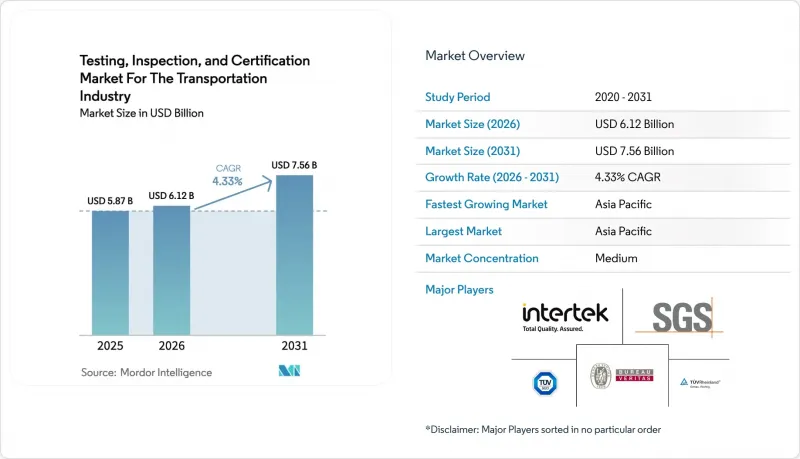
本報告按服務類型(測試服務、檢驗服務、認證服務)、採購類型(內部採購和外包)以及地區(北美、南美、歐洲、亞太、中東和非洲)進行細分。市場預測以美元計價。
交通運輸產業測試、檢驗和認證的全球趨勢與洞察
更嚴格的交通安全和排放氣體法規。
2024年全球排放氣體和安全法規的實施提高了合規標準。值得注意的是,這包括歐盟7實際道路排放氣體監測方案以及中國的輪胎標準GB 9743-2024和GB 9744-2024。聯合國歐洲經濟委員會(UNECE)的WP.29論壇加速了標準的協調統一,使製造商能夠透過單一測試方案在多個司法管轄區獲得認證。基於結果的指標如今已十分普遍,這使得測試實驗室能夠設計出反映實際運作週期的創新測試程序。自動駕駛功能安全標準ISO 26262的全球採用增加了高度專業化檢驗的需求。由於涉及重大的責任風險,此類檢驗通常價格不菲。
隨著電動車和自動駕駛汽車的迅速普及,需要新的測試規程。
UL 2580 的修訂版新增了熱失控基準測試,ISO 6469 則擴大了其適用範圍,將計畫於 2027 年後發布的固態電池納入其中。基於 SAE J3018 和 ISO/TS 5083:2025 的自動駕駛標準要求進行多層感測器、演算法和網路安全測試,這雖然延長了檢驗週期,但增加了每個專案的收入。 2024 年,為響應電力公司對雙向安全認證的需求,V2G(車輛到電網)介面測試成為一項獨立的服務項目。
中小企業合規性測試成本高昂
根據歐盟委員會的調查,小規模供應商目前每年在車輛測試上花費5萬至10萬歐元(約5.35萬至10.7萬美元),這筆支出正在加劇其流動資金緊張。建造電池測試實驗室的成本高達200萬至500萬美元,這為新進入者設定了進入門檻。漫長的認證流程意味著產品上市前資金被佔用,迫使許多中小企業採用合作開發或訂閱模式。
細分市場分析
測試服務佔據最大的市場佔有率,這反映了從零件到整車類型認證的強制性多階段檢驗。在整個交通運輸行業的測試、檢驗和認證市場中,預計到2025年,測試服務將佔58.92%的佔有率,這主要得益於嚴格的電池測試和ADAS(高級駕駛輔助系統)檢驗。同時,認證產業預計將以4.88%的複合年成長率成長,這主要受監管機構基於結果導向標準進行遠端審核的數位證書需求不斷成長的推動。鑑於ISO 26262和ISO 21434網路安全認證的高額費用,這項轉變也將帶來更高的利潤率。
檢測業務雖然穩定,但成長速度相對緩慢。由於遠端監控和自動化攝影系統減少了重複的現場檢查,檢測業務的成長速度較測試和認證業務有所放緩。服務供應商正在調整其檢測業務模式,轉向「異常檢測」模式,即演算法僅識別不合規車輛,然後進行人工複檢,從而在控制成本的同時保持服務的有效性。
區域分析
預計到2025年,亞太地區將引領市場,在運輸業的測試、檢驗和認證市場中佔據39.12%的收入佔有率。該地區預計也將保持最高的成長率,到2031年複合年成長率將達到5.18%。在中國,由於GB 38031-2020電池安全標準和積極的新能源汽車配額制度,實驗室運轉率保持穩定。同時,印度正基於Bharat NCAP 2.0標準向高級駕駛輔助系統(ADAS)測試過渡,吸引了大量外國的測試、檢驗和認證投資。在日本和韓國,與固態固態電池和自動駕駛班車相關的高附加價值需求不斷成長,但由於車輛基數趨於成熟,銷量成長受到限制。
北美也緊隨其後,嚴格的聯邦車輛安全標準(FMVSS)以及對聯網汽車網路安全日益重視,催生了對高價專業測試的需求。隨著2024年聯邦機動車輛安全管理局(FMCSA)修正案加強了對商用車輛的監管,美國車隊營運商佔據了外包測試的大部分佔有率。
歐洲仍保持強勁勢頭,這得益於WP.29框架下法規的協調統一以及即將實施的歐7排放標準(該標準要求進行實際排放氣體檢驗)。該地區的測試實驗室擁有大規模的攜帶式排放氣體測試和電池防火測試能力,服務國內和跨大西洋的製造商。
中東、非洲和南美洲正崛起為新興市場。波灣合作理事會(GCC)成員國正努力將規則與聯合國法規接軌,而巴西的國內生產基地和南方共同市場貿易集團則推動了區域供應商的業務擴張。外匯波動和基礎設施不足仍然限制著短期市場滲透,但隨著標準的趨同,長期成長空間巨大。
其他好處:
- Excel格式的市場預測(ME)表
- 3個月的分析師支持
目錄
第1章:引言
- 研究假設和市場定義
- 調查範圍
第2章:調查方法
第3章執行摘要
第4章 市場狀況
- 市場概覽
- 市場促進因素
- 更嚴格的交通安全和排放氣體法規。
- 全球貿易的擴張帶動了對車輛檢驗需求的成長。
- 電動車和自動駕駛汽車的快速普及需要新的測試規程。
- 老化的交通基礎設施需要定期檢查
- 數位孿生技術的出現使得遠端連續檢測成為可能。
- FaaS(車隊即服務)模式的興起,涉及將合規營運外包。
- 市場限制因素
- 中小企業合規性測試成本高昂
- 各地區法規結構的差異
- 透過人工智慧驅動的自我診斷,減少對第三方檢測的依賴。
- 合格的無損檢測(NDT)專家短缺
- 產業價值鏈分析
- 宏觀經濟因素的影響
- 監理情勢
- 技術展望
- 波特五力分析
第5章 市場規模與成長預測
- 按服務類型
- 測試服務
- 檢查服務
- 身份驗證服務
- 透過採購方式
- 內部
- 外包
- 按地區
- 北美洲
- 美國
- 加拿大
- 墨西哥
- 南美洲
- 巴西
- 阿根廷
- 其他南美國家
- 歐洲
- 德國
- 英國
- 法國
- 義大利
- 西班牙
- 俄羅斯
- 其他歐洲國家
- 亞太地區
- 中國
- 日本
- 印度
- 韓國
- 東南亞
- 其他亞太國家
- 中東和非洲
- 中東
- 沙烏地阿拉伯
- 阿拉伯聯合大公國
- 土耳其
- 其他中東國家
- 非洲
- 南非
- 奈及利亞
- 其他非洲國家
- 中東
- 北美洲
第6章 競爭情勢
- 市場集中度
- 策略趨勢
- 市佔率分析
- 公司簡介
- SGS SA
- Bureau Veritas SA
- Intertek Group plc
- DEKRA SE
- TUV SUD AG
- TUV Rheinland Group
- Applus Services SA
- DNV AS
- Lloyd's Register Group Ltd
- Element Materials Technology Group
- ALS Limited
- Eurofins Scientific SE
- UL LLC
- MISTRAS Group Inc.
- Kiwa NV
- CSA Group
- Control Union Certifications BV
- RINA SpA
- NSF International
- BSI Group
- TUV NORD AG
- PONY Testing International Group
- ABS Group of Companies Inc.
- Vicom Ltd
- CCIC(China Certification and Inspection Group)
第7章 市場機會與未來展望
According to Mordor Intelligence, the testing, inspection, and certification market size for the transportation industry was valued at USD 5.87 billion in 2025 and estimated to grow from USD 6.12 billion in 2026 to reach USD 7.56 billion by 2031, at a CAGR of 4.33% during the forecast period (2026-2031).
This report is Segmented by Service Type (Testing Services, Inspection Services, and Certification Services), Sourcing Type (In-House and Outsourced), and Geography (North America, South America, Europe, Asia-Pacific, and the Middle East and Africa). The Market Forecasts are Provided in Terms of Value (USD).
Global Testing, Inspection, and Certification for the Transportation Industry Trends and Insights
Increasing Regulatory Stringency For Transportation Safety And Emissions
Worldwide emissions and safety rules adopted in 2024 tightened compliance thresholds, notably Euro 7's real-world emissions monitoring scheme and China's GB 9743-2024 and GB 9744-2024 tire standards. The UN Economic Commission for Europe's WP.29 forum accelerated harmonization so that manufacturers can certify across multiple jurisdictions via a single test suite. Outcome-based metrics now dominate, letting laboratories design innovative test procedures that capture real-life duty cycles. Global uptake of ISO 26262 functional safety for autonomous driving raised demand for highly specialized validation-often priced at a premium because liability risk is significant.
Rapid Adoption Of EV And Autonomous Vehicles Needing New Test Protocols
UL 2580 revisions added thermal-runaway benchmarks, and ISO 6469 broadened its scope to solid-state batteries planned for release after 2027. Autonomous standards under SAE J3018 and ISO/TS 5083:2025 mandate multi-layered sensor, algorithm, and cybersecurity tests, lengthening validation cycles but driving higher revenue per project. Vehicle-to-grid interface testing became a standalone service line in 2024 as utilities demanded proof of bidirectional safety.
High Compliance Testing Costs For SMEs
European Commission studies found that small suppliers now spend EUR 50,000-100,000 (USD 53,500-107,000) each year on vehicle testing, an outlay that strains working capital. Battery laboratories cost USD 2-5 million to build, raising entry barriers for new providers. Lengthy certification timelines lock up cash before product launch, forcing many SMEs to adopt collaborative or subscription models.
Other drivers and restraints analyzed in the detailed report include:
- Emergence Of Digital Twins Enabling Continuous Remote Inspection
- Rise Of Fleet-As-A-Service Models Outsourcing Compliance
- Shortage Of Qualified NDT Professionals
For complete list of drivers and restraints, kindly check the Table Of Contents.
Segment Analysis
Testing services generated the largest share, reflecting mandatory multi-stage validation from component to full-vehicle homologation. Within the Testing, Inspection, and Certification for the Transportation Industry size, testing captured 58.92% in 2025, thanks to battery abuse tests and ADAS verification. Certification, however, is set to accelerate at a 4.88% CAGR as outcome-based standards spur demand for digital certificates that regulators can audit remotely. The shift also boosts margins because ISO 26262 and ISO 21434 cybersecurity sign-offs command premium fees.
Inspection remains a steady but slower-growing line. Remote monitoring and automated camera systems cut repetitive physical checks, depressing growth relative to testing and certification. Providers are retooling inspection portfolios around exception-based models where algorithms flag only non-conforming vehicles for manual review, preserving relevance while controlling cost.
Complete Report Scope:
- By Service Type
- Testing Services
- Inspection Services
- Certification Services
- By Sourcing Type
- In-house
- Outsourced
- By Geography
- North America
- United States
- Canada
- Mexico
- South America
- Brazil
- Argentina
- Rest of South America
- Europe
- Germany
- United Kingdom
- France
- Italy
- Spain
- Russia
- Rest of Europe
- Asia-Pacific
- China
- Japan
- India
- South Korea
- South-East Asia
- Rest of Asia-Pacific
- Middle East and Africa
- Middle East
- Saudi Arabia
- United Arab Emirates
- Turkey
- Rest of Middle East
- Africa
- South Africa
- Nigeria
- Rest of Africa
- Middle East
- North America
Geography Analysis
Asia-Pacific dominated the Testing, Inspection, and Certification for the Transportation Industry in 2025, with 39.12% revenue, and is poised for the fastest 5.18% CAGR through 2031. China's GB 38031-2020 battery safety and aggressive NEV quotas generate steady lab utilization, while India's move toward advanced driver assistance system testing under Bharat NCAP 2.0 attracts foreign TIC investment. Japan and South Korea add high-value demand tied to solid-state batteries and autonomous shuttles, though their mature vehicle bases temper volume growth.
North America follows with stringent Federal Motor Vehicle Safety Standards and heightened emphasis on connected-car cybersecurity, creating specialty test demand at premium rates. U.S. fleet operators account for sizeable, outsourced inspection volumes after the 2024 FMCSA update tightened commercial vehicle oversight.
Europe remains robust, benefiting from WP.29 harmonization and the imminent Euro 7 rollout that necessitates real-world emissions verification. Laboratories there tout large capacity for portable emissions measurements and battery fire-containment tests that serve both domestic and trans-Atlantic manufacturers.
The Middle East and Africa, and South America are emerging theaters. Gulf Cooperation Council states are aligning rules with UN regulations, while Brazil's domestic production base and Mercosur trading bloc encourage regional providers to scale. Currency volatility and infrastructure gaps still limit near-term penetration but offer a long-run upside as standards converge.
- SGS SA
- Bureau Veritas SA
- Intertek Group plc
- DEKRA SE
- TUV SUD AG
- TUV Rheinland Group
- Applus Services SA
- DNV AS
- Lloyd's Register Group Ltd
- Element Materials Technology Group
- ALS Limited
- Eurofins Scientific SE
- UL LLC
- MISTRAS Group Inc.
- Kiwa N.V.
- CSA Group
- Control Union Certifications B.V.
- RINA S.p.A.
- NSF International
- BSI Group
- TUV NORD AG
- PONY Testing International Group
- ABS Group of Companies Inc.
- Vicom Ltd
- CCIC (China Certification and Inspection Group)
Additional Benefits:
- The market estimate (ME) sheet in Excel format
- 3 months of analyst support
TABLE OF CONTENTS
1 INTRODUCTION
- 1.1 Study Assumptions and Market Definition
- 1.2 Scope of the Study
2 RESEARCH METHODOLOGY
3 EXECUTIVE SUMMARY
4 MARKET LANDSCAPE
- 4.1 Market Overview
- 4.2 Market Drivers
- 4.2.1 Increasing regulatory stringency for transportation safety and emissions
- 4.2.2 Growth in global trade boosting vehicle inspection demand
- 4.2.3 Rapid adoption of EV and autonomous vehicles needing new test protocols
- 4.2.4 Aging transport infrastructure requiring regular inspection
- 4.2.5 Emergence of digital twins enabling continuous remote inspection
- 4.2.6 Rise of fleet-as-a-service models outsourcing compliance
- 4.3 Market Restraints
- 4.3.1 High compliance testing costs for SMEs
- 4.3.2 Fragmented regulatory frameworks across regions
- 4.3.3 AI-based self-diagnostics reducing third-party testing reliance
- 4.3.4 Shortage of qualified NDT professionals
- 4.4 Industry Value Chain Analysis
- 4.5 Impact of Macroeconomic Factors
- 4.6 Regulatory Landscape
- 4.7 Technological Outlook
- 4.8 Porter's Five Forces Analysis
- 4.8.1 Bargaining Power of Suppliers
- 4.8.2 Bargaining Power of Buyers
- 4.8.3 Threat of New Entrants
- 4.8.4 Threat of Substitutes
- 4.8.5 Competitive Rivalry
5 MARKET SIZE AND GROWTH FORECASTS (VALUE)
- 5.1 By Service Type
- 5.1.1 Testing Services
- 5.1.2 Inspection Services
- 5.1.3 Certification Services
- 5.2 By Sourcing Type
- 5.2.1 In-house
- 5.2.2 Outsourced
- 5.3 By Geography
- 5.3.1 North America
- 5.3.1.1 United States
- 5.3.1.2 Canada
- 5.3.1.3 Mexico
- 5.3.2 South America
- 5.3.2.1 Brazil
- 5.3.2.2 Argentina
- 5.3.2.3 Rest of South America
- 5.3.3 Europe
- 5.3.3.1 Germany
- 5.3.3.2 United Kingdom
- 5.3.3.3 France
- 5.3.3.4 Italy
- 5.3.3.5 Spain
- 5.3.3.6 Russia
- 5.3.3.7 Rest of Europe
- 5.3.4 Asia-Pacific
- 5.3.4.1 China
- 5.3.4.2 Japan
- 5.3.4.3 India
- 5.3.4.4 South Korea
- 5.3.4.5 South-East Asia
- 5.3.4.6 Rest of Asia-Pacific
- 5.3.5 Middle East and Africa
- 5.3.5.1 Middle East
- 5.3.5.1.1 Saudi Arabia
- 5.3.5.1.2 United Arab Emirates
- 5.3.5.1.3 Turkey
- 5.3.5.1.4 Rest of Middle East
- 5.3.5.2 Africa
- 5.3.5.2.1 South Africa
- 5.3.5.2.2 Nigeria
- 5.3.5.2.3 Rest of Africa
- 5.3.5.1 Middle East
- 5.3.1 North America
6 COMPETITIVE LANDSCAPE
- 6.1 Market Concentration
- 6.2 Strategic Moves
- 6.3 Market Share Analysis
- 6.4 Company Profiles (includes Global level Overview, Market level overview, Core Segments, Financials as available, Strategic Information, Market Rank/Share for key companies, Products and Services, and Recent Developments)
- 6.4.1 SGS SA
- 6.4.2 Bureau Veritas SA
- 6.4.3 Intertek Group plc
- 6.4.4 DEKRA SE
- 6.4.5 TUV SUD AG
- 6.4.6 TUV Rheinland Group
- 6.4.7 Applus Services SA
- 6.4.8 DNV AS
- 6.4.9 Lloyd's Register Group Ltd
- 6.4.10 Element Materials Technology Group
- 6.4.11 ALS Limited
- 6.4.12 Eurofins Scientific SE
- 6.4.13 UL LLC
- 6.4.14 MISTRAS Group Inc.
- 6.4.15 Kiwa N.V.
- 6.4.16 CSA Group
- 6.4.17 Control Union Certifications B.V.
- 6.4.18 RINA S.p.A.
- 6.4.19 NSF International
- 6.4.20 BSI Group
- 6.4.21 TUV NORD AG
- 6.4.22 PONY Testing International Group
- 6.4.23 ABS Group of Companies Inc.
- 6.4.24 Vicom Ltd
- 6.4.25 CCIC (China Certification and Inspection Group)
7 MARKET OPPORTUNITIES AND FUTURE OUTLOOK
- 7.1 White-space and Unmet-Need Assessment

 化學品運輸服務市場:全球市場預測,2026-2032年全球運輸管理服務市場預測(2026-2032年)
 氫動力交通解決方案市場預測至2034年-全球分析(按運輸方式、氫氣類型、基礎設施、組件、技術、應用、最終用戶和地區分類)
 氫燃料公共運輸市場分析及預測(至2035年):類型、產品、服務、技術、組件、應用、部署、最終用戶、模式
 2026年全球低溫運輸服務市場報告2026年全球卡車運輸市場報告2026年全球運輸管理服務市場報告2026年全球企業員工交通服務市場報告
 企業員工交通服務:市場佔有率分析、產業趨勢與統計、成長預測(2026-2031)以資產為基礎的運輸服務市場(按服務類型、設備、運輸距離、溫度控制和最終用戶產業分類),全球預測,2026-2032年