


 |
市場調查報告書
商品編碼
2097207
亞太地區汽車潤滑油市場:市場佔有率分析、產業趨勢與統計及成長預測(2026-2031)Asia-Pacific Automotive Lubricants - Market Share Analysis, Industry Trends & Statistics, Growth Forecasts (2026 - 2031) |
||||||

※ 本網頁內容可能與最新版本有所差異。詳細情況請與我們聯繫。
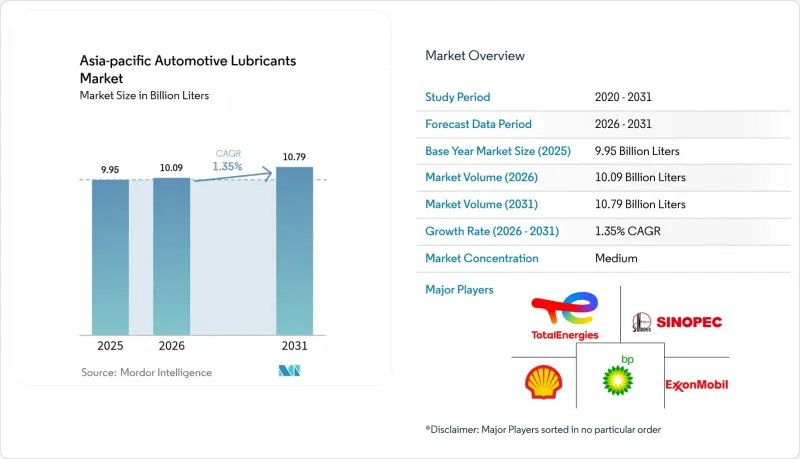
據 Mordor Intelligence 稱,亞太地區汽車潤滑油市場預計到 2026 年將達到 100.9 億公升,高於 2025 年的 99.5 億公升,預計到 2031 年將達到 107.9 億公升。
預計 2026 年至 2031 年的複合年成長率為 1.35%。
本報告按產品類型(汽車引擎油、手排變速箱油、自動變速箱油等)、車輛類型(乘用車、商用車、摩托車)和地區(中國、印度、韓國、泰國、印尼、馬來西亞、菲律賓、越南、烏茲別克等)進行細分。市場預測以銷售量(公升)為單位。
亞太地區汽車潤滑油市場趨勢及洞察。
乘用車數量迅速成長
在新興市場,乘用車數量持續成長,即使電池式電動車(BEV)的普及速度加快,仍推動了對潤滑油的需求。在印度,2024會計年度乘用車銷量達420萬輛,較去年成長8.4%,全國汽車保有量超過3,800萬輛。在印度尼西亞,輕型汽車銷量在2024年回升至106萬輛,摩托車註冊量超過680萬輛,凸顯了摩托車潤滑油消耗的重要性。在越南,受可支配收入成長和公共交通運力不足的推動,汽車保有量以每年12.3%的速度成長。由於這些市場車輛的平均使用壽命超過9年,且售後換油需求依然頻繁,儘管面臨電動車淘汰的風險,亞太地區的汽車潤滑油市場仍保持強勁勢頭。當地維修店對ISO 14001認證的採用,進一步提升了符合環保審核標準的低排放氣體潤滑油的需求。
整車製造商強制執行的「終身供油」合約正在提升潤滑油的品質。
汽車製造商在保固期內越來越傾向於將換油週期延長至15,000公里或更長,這迫使潤滑油生產商提升基礎油的品質和添加劑的耐久性。豐田的「全球卓越評估」(Global Outstanding Assessment)計畫要求潤滑油壽命達到150,000公里,該標準基於JASO GLV-2規範,實際上淘汰了原廠加註的I類基礎油。現代汽車在印度的「Smartstream」引擎要求0W-20潤滑油,即使在油底殼溫度超過120 度C的情況下也不會發生黏度剪切,這導致聚α烯烴增稠劑的廣泛應用。本田的「地球夢」(Earth Dreams)動力傳動系統要求潤滑油通過API SP資源節約認證,並採用低磷含量以保護觸媒轉換器。這些嚴格的OEM廠商要求樹立了品質標準,並且正向售後市場蔓延,推動亞太地區的汽車潤滑油市場轉型為利潤更高的合成潤滑油。
電池驅動電動車(EV)的廣泛普及降低了每輛車對潤滑油的需求。
與內燃機汽車相比,純電動車(BEV)每輛車所需的潤滑油量最多可減少80%,從而降低了每輛車的潤滑油需求。在中國,比亞迪和特斯拉的產量預計將超過800萬輛,預計到2024年,純電動車的市佔率將達到35.7%。在日本,儘管混合動力汽車佔據主導地位,但由於政府提供的85萬日圓購車補貼,預計到2024年,純電動車的國內銷量佔比將成長至3.2%。在韓國,隨著現代IONIQ 6轎車的上市,預計到2024年,純電動車的市佔率將達到8.8%。雖然這種轉型降低了對機油的需求,但剩餘內燃機汽車(ICE)為了彌補保養週期延長而對高品質合成油的持續需求,在一定程度上抵消了亞太地區汽車潤滑油市場銷售量的下滑。
細分市場分析
2025年,機油在亞太地區汽車潤滑油市場規模中佔66.10%。然而,預計到2031年,自動變速箱油將以1.56%的最高成長速度成長。機油的需求主要集中在印度、印尼和中國的農村地區,這些地區內燃機汽車仍佔據主導地位。然而,0W-20和0W-16黏度等級的轉變正在推動合成潤滑油的市場佔有率和價格成長。渦輪增壓汽油車顆粒過濾器的日益普及,促進了中國SAPS(高聚苯乙烯-磷酸酯類)化學技術的滲透,並推動了對高利潤率的III類及以上混合潤滑油的需求。在售後維修店,半合成5W-30產品正擴大提升銷售給尋求滿足保固要求的小型車車主。
自動變速箱油 (ATF) 市場正在擴張,這主要得益於 CVT 和雙離合器變速箱的日益普及,在日本和韓國的新乘用車中,這兩種變速箱的普及率均超過 60%。本田的 CVT 車型 City 和 HR-V 使用了專有的 HMMF 變速箱油,其抗振性能在 150 度C下超過 240 小時。日產在東協地區使用的 X-Tronic CVT 平台指定使用 NS-3 標準油,其價格比 Dexron VI 油高出 40%。儘管由於 ATF 換油週期延長至 10 萬公里,總銷量僅略有成長,但收入成長速度超過了銷量成長速度。手排變速箱油和煞車油市場保持平穩,而汽車潤滑脂的需求則呈現溫和成長,尤其是在重型卡車輪轂軸承的潤滑方面。產品組合的變化正在推動亞太地區汽車潤滑油市場的價值成長。
其他好處:
- Excel格式的市場預測(ME)表
- 3個月的分析師支持
目錄
第1章:引言
- 研究假設和市場定義
- 調查範圍
第2章:調查方法
第3章執行摘要
第4章 市場狀況
- 市場概覽
- 市場促進因素
- 在新興的東南亞國協,內燃機汽車的數量持續成長。
- OEM製造商與一家大型潤滑油公司建立工廠灌裝合作關係。
- 亞太地區更嚴格的燃油效率標準
- 叫車營運時間激增
- 有效距離式的電動兩輪混合動力汽車
- 市場限制因素
- 中國乘用車電動車滲透率
- 關於延長換油週期的原廠規範。
- 政府推廣生物潤滑劑
- 價值鍊和通路分析
- 波特五力模型
- 法律規範
- 汽車產業的發展趨勢
第5章 市場規模與成長預測
- 依樹脂類型
- 乘用車引擎機油(PCMO)
- 0W-XX
- 5W-XX
- 10W-XX
- 15W-XX
- 單級
- 其他年級
- 重型機油(HDMO)
- 0W-XX
- 5W-XX
- 10W-XX
- 15W-XX
- 單級
- 其他年級
- 摩托車機油(MCO)
- 0W-XX
- 5W-XX
- 10W-XX
- 15W-XX
- 單級
- 其他年級
- 乘用車引擎機油(PCMO)
- 透過股票溶液
- 礦物
- 合成
- 半合成
- 生物基
- 按地區
- 中國
- 印度
- 巴基斯坦
- 孟加拉
- 日本
- 韓國
- 台灣
- 澳洲
- 馬來西亞
- 印尼
- 泰國
- 越南
- 其他亞太國家
第6章 競爭情勢
- 市場集中度
- 策略趨勢
- 市佔率(%)** / 排名分析
- 公司簡介
- Shell plc
- Exxon Mobil Corporation
- BP plc
- TotalEnergies
- Chevron Corporation
- China Petroleum Corporation
- CNPC
- Indian Oil Corporation Limited
- ENEOS Corporation
- FUCHS
- Motul
- PT Pertamina
- PTT LUBRICANTS
- Idemitsu Kosan Co.
- Gulf Oil International
- Repsol
- Lukoil Lubricants
- SK Enmove co.Ltd.
- Bharat Petroleum Corporation
第7章 市場機會與未來展望
第8章:執行長面臨的關鍵策略挑戰
According to Mordor Intelligence, Asia-Pacific automotive lubricants market size in 2026 is estimated at 10.09 Billion Liters, growing from 2025 value of 9.95 Billion Liters with 2031 projections showing 10.79 Billion Liters, growing at 1.35% CAGR over 2026-2031.
This report is Segmented by Product Type (Automotive Engine Oil, Manual Transmission Fluids, Automatic Transmission Fluids, and More), Vehicle Type (Passenger Vehicles, Commercial Vehicles, and Two-Wheelers), and Geography (China, India, South Korea, Thailand, Indonesia, Malaysia, Philippines, Vietnam, Uzbekistan, and More). The Market Forecasts are Provided in Terms of Volume (Litres).
Asia-Pacific Automotive Lubricants Market Trends and Insights
Rapid Expansion of Passenger-Car Parc
Passenger-car ownership continues to rise in emerging economies, driving demand for lubricants even as the adoption of battery-electric vehicles (BEVs) accelerates. India sold 4.2 million passenger vehicles in fiscal 2024, representing an 8.4% year-over-year increase that pushed the national car parc to surpass 38 million units. Indonesia rebounded to 1.06 million light-vehicle sales in 2024, while motorcycle registrations surpassed 6.8 million units, underscoring the significant role of two-wheeler oil consumption. Vietnam's parc expanded at a rate of 12.3% annually as disposable incomes rose and public-transport capacity lagged. With an average vehicle age of over nine years across these markets, aftermarket drain events remain frequent, sustaining the Asia-Pacific Automotive Lubricants Market despite the risk of EV substitution. ISO 14001 certifications adopted by regional workshops further steer buyers toward branded, low-emission lubes that meet environmental audits.
OEM "Fill-for-Life" Mandates Boosting Lubricant Quality
Automakers are increasingly specifying drain intervals of 15,000 km or more under warranty, forcing blenders to upgrade the base-stock quality and additive durability. Toyota's Global Outstanding Assessment program demands 150,000-km fluid life under JASO GLV-2, effectively locking out Group I feedstocks from factory fill. Hyundai's Smartstream engines in India require 0W-20 oils that can withstand sump temperatures exceeding 120°C without viscosity shear, resulting in the widespread use of poly-alpha-olefin boosters. Honda's Earth Dreams powertrains require API SP Resource Conserving approval and low phosphorus to protect catalytic converters. These stringent OEM rules set a quality baseline that cascades through the aftermarket, elevating the Asia-Pacific Automotive Lubricants Market toward synthetics that command higher margins.
Battery-EV Penetration Lowering Lube Demand/Vehicle
Pure battery cars need up to 80% fewer lubricants by volume than internal combustion vehicles, eroding per-unit demand. China reached 35.7% BEV share in 2024, supported by BYD and Tesla output surpassing 8 million units. Japan's purchase subsidy of JPY 850,000 boosted national BEV sales to 3.2% in 2024, despite hybrid vehicles' dominance. South Korea achieved an 8.8% BEV share in 2024, as Hyundai inaugurated the IONIQ 6 sedan. The shift siphons engine oil, though residual ICE fleets require higher-grade synthetics to compensate for extended service intervals, partially offsetting volume loss in the Asia-Pacific Automotive Lubricants Market.
Other drivers and restraints analyzed in the detailed report include:
- Rising Demand for High-Performance Synthetic Lubes
- Explosive Growth of E-Scooter Delivery Fleets
- Volatile Base-Oil Pricing Squeezing Margins
For complete list of drivers and restraints, kindly check the Table Of Contents.
Segment Analysis
Automotive engine oil accounted for 66.10% of the Asia-Pacific Automotive Lubricants Market size in 2025; however, automatic transmission fluid is expected to register the fastest growth trajectory of 1.56% through 2031. Engine oil demand is concentrated in India, Indonesia, and rural China, where ICE vehicles remain prevalent. However, viscosity migration to 0W-20 and 0W-16 boosts the synthetic share and price realization. Rising adoption of turbo-gasoline particulate filters drives mid-SAPS chemistry, fostering demand for higher-margin Group III+ blends. Aftermarket workshops increasingly upsell semi-synthetic 5W-30 lines to small-car owners seeking warranty-compliant options.
ATF advances on the back of CVT and dual-clutch gearbox penetration, surpassing 60% in new Japanese and Korean passenger cars. Honda's CVT-equipped City and HR-V models utilize proprietary HMMF fluids, which have anti-shudder durability exceeding 240 hours at 150°C. Nissan's X-Tronic CVT platforms across ASEAN prescribe NS-3 spec oils that command a 40% premium over Dexron VI fluids. As ATF drain intervals extend to 100,000 km, total liter growth stays moderate, but revenue gains outstrip volume. Manual-transmission oil and brake-fluid segments plateau, while automotive greases see modest uptake for wheel-bearing relubrication in heavy-duty trucks. Product-mix evolution underpins value growth inside the Asia-Pacific Automotive Lubricants Market.
Complete Report Scope:
- By Resin Type
- Passenger Car Motor Oil (PCMO)
- 0W-XX
- 5W-XX
- 10W-XX
- 15W-XX
- Monogrades
- Other Grades
- Heavy Duty Motor Oil (HDMO)
- 0W-XX
- 5W-XX
- 10W-XX
- 15W-XX
- Monogrades
- Other Grades
- Motorcycle Engine Oil (MCO)
- 0W-XX
- 5W-XX
- 10W-XX
- 15W-XX
- Monogrades
- Other Grades
- Passenger Car Motor Oil (PCMO)
- By Base Stock
- Mineral
- Synthetic
- Semi-Synthetic
- Bio-Based
- By Geography
- China
- India
- Pakistan
- Bangladesh
- Japan
- South Korea
- Taiwan
- Australia
- Malaysia
- Indonesia
- Thailand
- Vietnam
- Rest of Asia-Pacific
List of Companies Covered in this Report:
- Shell plc
- Exxon Mobil Corporation
- BP p.l.c.
- TotalEnergies
- Chevron Corporation
- China Petroleum Corporation
- CNPC
- Indian Oil Corporation Limited
- ENEOS Corporation
- FUCHS
- Motul
- PT Pertamina
- PTT LUBRICANTS
- Idemitsu Kosan Co.
- Gulf Oil International
- Repsol
- Lukoil Lubricants
- SK Enmove co.Ltd.
- Bharat Petroleum Corporation
Additional Benefits:
- The market estimate (ME) sheet in Excel format
- 3 months of analyst support
TABLE OF CONTENTS
1 Introduction
- 1.1 Study Assumptions and Market Definition
- 1.2 Scope of the Study
2 Research Methodology
3 Executive Summary
4 Market Landscape
- 4.1 Market Overview
- 4.2 Market Drivers
- 4.2.1 ICE (Internal Combustion Engine) parc still expanding in emerging ASEAN
- 4.2.2 OEM factory-fill tie-ups with lube majors
- 4.2.3 Tightening APAC fuel-economy standards
- 4.2.4 Surge in ride-hailing motor-hours
- 4.2.5 Electrified two-wheeler range-extender hybrids
- 4.3 Market Restraints
- 4.3.1 Electronic Vehicle penetration in China passenger cars
- 4.3.2 Longer OEM drain-interval specifications
- 4.3.3 Government push for bio-lubricants
- 4.4 Value Chain and Distribution Channel Analysis
- 4.5 Porter's Five Forces
- 4.5.1 Threat of New Entrants
- 4.5.2 Bargaining Power of Suppliers
- 4.5.3 Bargaining Power of Buyers
- 4.5.4 Threat of Substitutes
- 4.5.5 Industry Rivalry
- 4.6 Regulatory Framework
- 4.7 Automotive Industry Trends
5 Market Size and Growth Forecasts (Volume)
- 5.1 By Resin Type
- 5.1.1 Passenger Car Motor Oil (PCMO)
- 5.1.1.1 0W-XX
- 5.1.1.2 5W-XX
- 5.1.1.3 10W-XX
- 5.1.1.4 15W-XX
- 5.1.1.5 Monogrades
- 5.1.1.6 Other Grades
- 5.1.2 Heavy Duty Motor Oil (HDMO)
- 5.1.2.1 0W-XX
- 5.1.2.2 5W-XX
- 5.1.2.3 10W-XX
- 5.1.2.4 15W-XX
- 5.1.2.5 Monogrades
- 5.1.2.6 Other Grades
- 5.1.3 Motorcycle Engine Oil (MCO)
- 5.1.3.1 0W-XX
- 5.1.3.2 5W-XX
- 5.1.3.3 10W-XX
- 5.1.3.4 15W-XX
- 5.1.3.5 Monogrades
- 5.1.3.6 Other Grades
- 5.1.1 Passenger Car Motor Oil (PCMO)
- 5.2 By Base Stock
- 5.2.1 Mineral
- 5.2.2 Synthetic
- 5.2.3 Semi-Synthetic
- 5.2.4 Bio-Based
- 5.3 By Geography
- 5.3.1 China
- 5.3.2 India
- 5.3.3 Pakistan
- 5.3.4 Bangladesh
- 5.3.5 Japan
- 5.3.6 South Korea
- 5.3.7 Taiwan
- 5.3.8 Australia
- 5.3.9 Malaysia
- 5.3.10 Indonesia
- 5.3.11 Thailand
- 5.3.12 Vietnam
- 5.3.13 Rest of Asia-Pacific
6 Competitive Landscape
- 6.1 Market Concentration
- 6.2 Strategic Moves
- 6.3 Market Share (%)**/Ranking Analysis
- 6.4 Company Profiles (includes Global level Overview, Market level overview, Core Segments, Financials as available, Production Capacity, Strategic Information, Market Rank/Share for key companies, Products and Services, and Recent Developments)
- 6.4.1 Shell plc
- 6.4.2 Exxon Mobil Corporation
- 6.4.3 BP p.l.c.
- 6.4.4 TotalEnergies
- 6.4.5 Chevron Corporation
- 6.4.6 China Petroleum Corporation
- 6.4.7 CNPC
- 6.4.8 Indian Oil Corporation Limited
- 6.4.9 ENEOS Corporation
- 6.4.10 FUCHS
- 6.4.11 Motul
- 6.4.12 PT Pertamina
- 6.4.13 PTT LUBRICANTS
- 6.4.14 Idemitsu Kosan Co.
- 6.4.15 Gulf Oil International
- 6.4.16 Repsol
- 6.4.17 Lukoil Lubricants
- 6.4.18 SK Enmove co.Ltd.
- 6.4.19 Bharat Petroleum Corporation
7 Market Opportunities and Future Outlook
- 7.1 White-space and Unmet-need Assessment
8 Key Strategic Questions for CEOs

 2026-2034年全球汽車潤滑油市場規模、佔有率、趨勢及成長分析報告
 乘用車潤滑油市場-2026-2032年全球市場預測商用車潤滑油市場-2026-2032年全球市場預測
 東非汽車潤滑油市場:市場佔有率分析、產業趨勢與統計及成長預測(2026-2031 年)汽車潤滑油市場:2026-2032年全球市場預測(依產品類型、基礎油類型、黏度等級、包裝、車輛類型及通路分類)非公路設備潤滑油市場:2026-2032年全球市場預測(依產品類型、基礎油類型、銷售管道、應用及最終用途產業分類)
 汽車懸吊系統潤滑油市場規模、佔有率和成長分析:按產品類型、應用、車輛類型、最終用戶和地區分類-2026-2033年產業預測
 汽車潤滑油市場規模、佔有率、趨勢和預測:按產品類型、車輛類型和地區分類,2026-2034年汽車潤滑油市場規模、佔有率、成長率及全球產業分析:按類型、應用和地區分類,並預測至2026-2034年
 汽車潤滑油市場:依產品類型、通路、車輛類型、國家及地區分類-產業分析、市場規模、市場佔有率及2025年至2032年預測