

 |
市場調查報告書
商品編碼
2097168
飛灰:市場佔有率分析、產業趨勢與統計、成長預測(2026-2031)Fly Ash - Market Share Analysis, Industry Trends & Statistics, Growth Forecasts (2026 - 2031) |
||||||

※ 本網頁內容可能與最新版本有所差異。詳細情況請與我們聯繫。
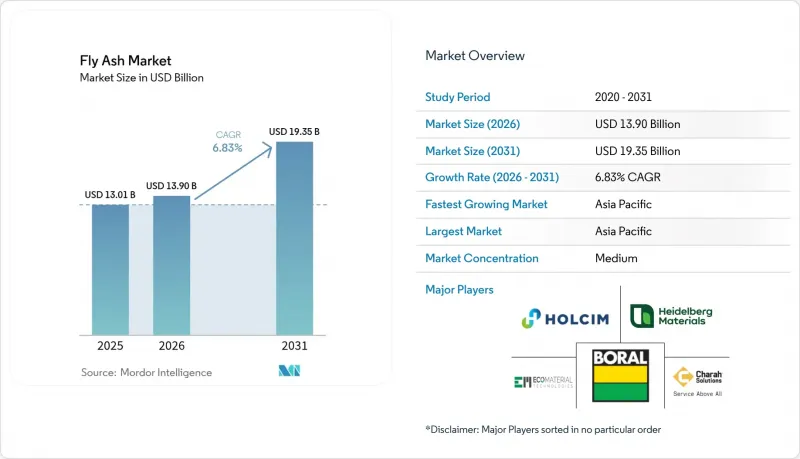
據 Mordor Intelligence 稱,2025 年飛灰市值為 130.1 億美元,預計到 2031 年將達到 193.5 億美元,而 2026 年為 139 億美元,預測期(2026-2031 年)的複合年成長率為 6.83%。
本報告按類型(F級、C級)、應用領域(建築業,包括波特蘭水泥和混凝土、磚塊和砌塊;道路建設;農業;採礦業;水處理;陶瓷業及其他應用領域,包括氧化鋁提取)和地區(亞太地區、北美地區、歐洲地區、南美地區、中東和非洲地區)進行細分。市場預測以美元(USD)為單位。
全球飛灰市場趨勢及洞察
美國、歐盟和印度紛紛推出環保水泥法規。
世界各國政府正在收緊採購法規,限制水泥熟料替代率,對飛灰的持續需求正逐漸成為結構性特徵,而非暫時的益處。在愛爾蘭,所有政府資助的計畫現在都必須用水泥熟料取代30%的熟料。法國的RE2020規範正在逐步降低住宅中隱含碳的上限,並鼓勵使用飛灰以符合法規要求。紐約州的「購買清潔混凝土」指南對超過100萬美元的州政府合約設定了排放上限,並要求預拌混凝土供應商從2025年起披露環境產品聲明(EPD)。一些地方先例,例如聖莫尼卡市第2778號法令,透過限制新建建築中的水泥含量,正在推動地方層級的行動。總而言之,這些措施支持最低用量承諾,並正在重塑公共基礎設施採購中混凝土混合料設計的標準。
公共基礎設施項目中快速採用低碳地無機聚合物混凝土
無機聚合物混凝土正從試驗階段邁向全面建設階段,其中飛灰作為主要的鋁矽酸鹽骨架,用於鹼活化。馬來西亞的冷岳河大橋已證實了超高性能預製構件的有效性,與鋼骨相比,成功降低了橋樑總成本30%。在英國的M25伍德福德西高架橋計畫中,使用了無水泥混凝土,僅用52立方公尺的混凝土就減少了77%的二氧化碳排放,相當於減少了9.4噸的碳排放。研究證實,由50%飛灰、40%碎高爐礦渣和10%二氧化矽組成的混合料,其抗壓強度可達4000至10000磅/平方英寸,同時顯著降低了水泥用量。由於無機聚合物混凝土強度發展迅速,且在室溫下即可硬化,承包商可以縮短關鍵路徑的施工時間,從而進一步刺激飛灰市場的需求。
經合組織市場燃煤發電結構的變化
受美國環保署2032年合規規定的推動,電廠關閉計畫的加速推進正在減少未來飛灰的供應,尤其是在那些碳捕集設備維修在經濟上不可行的情況下。每年高達5.36億美元至11億美元的合規成本正在加速電廠關閉,而飛灰市場傳統上依賴的穩定供應正在消失。歐洲電力公司也面臨類似的困境。德國的褐煤電廠目前運作時間有限,隨著低碳建造要求的加強,區域供應也日益緊張。
細分市場分析
預計到2025年,F級飛灰將維持61.58%的市佔率。這是因為其高矽鋁基質能與遊離石灰反應生成額外的CSH凝膠,進而增強其長期耐久性。由於成熟的混凝土標準仍參考其性能記錄,預計F級粉煤灰的銷售將帶動飛灰市場規模實現中等個位數成長。研究表明,當鹼濃度低於2 M時,基於F級無機聚合物混合物在室溫下養護可達到超過40 MPa的抗壓強度,這為預製構件的應用開闢了新的可能性。
然而,市場趨勢正轉向C級粉煤灰。其自黏合型特性對預拌混凝土生產商極具吸引力,因為他們無需使用化學促凝劑即可縮短保養時間。 C級粉煤灰預計將以7.47%的複合年成長率成長,成為飛灰市場中成長最快的細分市場。在美國,每年產生的2,200萬噸飛灰中,目前有43%被回收。隨著中西部電力公司轉向低硫次煙煤,C級粉煤灰的佔有率正在不斷擴大。除了初始強度優勢外,其對蘊藏量活化劑的需求量較低,這意味著無機聚合物生產商的能源儲備需求減少,預計到2031年,這一細分市場將更具吸引力。
區域分析
亞太地區佔據飛灰市場70.55%的佔有率,主要得益於該地區成熟的燃煤發電能力和大規模的公共產業計畫。光是中國每年就生產6億至8億噸飛灰,足以滿足該地區的替代能源配額,即便中國本身也在推動脫碳進程。在印度,相關法規強制規定電廠300公里半徑範圍內必須100%使用飛灰,從而在電力公司和水泥廠之間建立了循環供應機制,確保了需求的穩定性,即便目前正討論逐步淘汰燃煤發電廠的問題。
北美地區展現如何將監理阻力轉化為供應機會。喬治亞電力公司與Eco-Material Technologies公司簽訂了一份為期15年的契約,正在疏浚800萬噸現有煤灰,在修復儲存的同時,也為混凝土生產提供了原料。美國環保署的《遺留煤灰渣地表儲存法規》也在推動類似的回收利用工作,例如,Consumers Energy公司從JH Campbell煤灰廠址獲得了600萬噸煤灰用於選礦。回收的飛灰正被供應給紐約市軌道交通樞紐的都市區建設項目,這表明即使在燃煤發電廠逐步淘汰的地區,飛灰市場也具有強大的韌性。
在歐洲,儘管國內粉煤灰產量下降,但嚴格的碳排放閾值仍維持著市場需求。愛爾蘭強制要求30%的水泥熟料替代率,法國則以RE2020為基準減排目標,這些因素共同促成了飛灰市場對於建造低碳混凝土的建築商而言仍然至關重要。 Holcim位於阿爾特基希的工廠計畫於2024年實現100%再生水泥熟料生產,透過混合飛灰和其他廢棄物衍生材料,滿足區域循環經濟目標。來自南非、土耳其以及東南亞(且供應日益成長)的進口正在幫助填補供應缺口,但在一些歐盟內陸市場,物流附加費使得粉煤灰的運輸成本與歐盟第三類交付標準(LC3)的成本持平。
其他好處:
- Excel格式的市場預測(ME)表
- 3個月的分析師支持
目錄
第1章:引言
- 研究假設和市場定義
- 調查範圍
第2章:調查方法
第3章執行摘要
第4章 市場狀況
- 市場概覽
- 市場促進因素
- 美國、歐盟和印度強制使用環保水泥的浪潮
- 公共基礎設施項目中快速採用低碳地無機聚合物混凝土
- 東協工業園區內私營燃煤電廠的擴張
- 將排碳權貨幣化,以惠及大規模飛灰用戶
- 一項突破性的閃燃技術,可降低物流成本。
- 市場限制因素
- 經合組織國家燃煤發電比例的變化
- 內陸地區散裝粉末處理的物流瓶頸。
- 新型水泥熟料熟料矽酸鈣水泥減少了對飛灰的需求。
- 價值鏈分析
- 波特五力模型
第5章 市場規模與成長預測
- 按類型
- F級
- C級
- 透過使用
- 建造
- 波特蘭水泥和混凝土
- 磚塊
- 道路建設
- 農業
- 礦業
- 水處理
- 其他用途(陶瓷、氧化鋁萃取)
- 建造
- 按地區
- 亞太地區
- 中國
- 印度
- 日本
- 韓國
- ASEAN
- 其他亞太國家
- 北美洲
- 美國
- 加拿大
- 墨西哥
- 歐洲
- 德國
- 英國
- 義大利
- 法國
- 俄羅斯
- 其他歐洲國家
- 南美洲
- 巴西
- 阿根廷
- 其他南美國家
- 中東和非洲
- 沙烏地阿拉伯
- 南非
- 其他中東和非洲國家
- 亞太地區
第6章 競爭情勢
- 市場集中度
- 策略趨勢
- 市佔率分析
- 公司簡介
- Ashtech
- Boral
- Cement Australia Pty Limited
- Cemex SAB de CV
- Charah Solutions, Inc.
- Eco Material Technologies
- Heidelberg Materials
- Holcim
- Salt River Materials Group
- Separation Technologies LLC
- Suyog Suppliers
- Titan America
第7章 市場機會與未來展望
According to Mordor Intelligence, the fly ash market size was valued at USD 13.01 billion in 2025 and estimated to grow from USD 13.9 billion in 2026 to reach USD 19.35 billion by 2031, at a CAGR of 6.83% during the forecast period (2026-2031).
This report is Segmented by Type (Class F, Class C), Application (Construction Including Portland Cement and Concrete, Bricks and Blocks, Road Construction, Agriculture, Mining, Water Treatment, Other Applications Including Ceramics and Alumina Extraction), and Geography (Asia-Pacific, North America, Europe, South America, Middle East and Africa). The Market Forecasts are Provided in Terms of Value (USD).
Global Fly Ash Market Trends and Insights
Surging Green-Cement Mandates in the U.S., EU & India
Governments are tightening procurement rules that lock in clinker-replacement thresholds, making sustained demand for the fly ash market a structural feature rather than a cyclical benefit. Ireland now requires a 30% clinker substitute in all state-funded projects. France's RE2020 code progressively ratchets down embodied-carbon ceilings for housing, incentivising fly ash blends to remain compliant. New York State's Buy Clean Concrete guidance overlays emissions caps on state contracts above USD 1 million, forcing ready-mix suppliers to disclose EPDs from 2025. Municipal precedents such as Santa Monica's Ordinance #2778 add local momentum by capping cement content in new buildings. Collectively, these measures underpin minimum-volume commitments and are reshaping mix-design norms across public infrastructure procurement.
Rapid Adoption of Low-Carbon Geopolymer Concrete in Public Infrastructure Projects
Geopolymer concrete is pivoting from pilot trials to mainstream delivery schedules, and fly ash provides the primary aluminosilicate backbone for alkali activation. The Langat River Bridge in Malaysia validated ultra-high-performance precast elements that lowered overall bridge costs by 30% compared with steel options. The UK's M25 Woodford West Viaduct used Cemfree concrete, realising a 77% CO2 cut and preventing 9.4 t of emissions in just 52 m3 poured. Research confirms that blends containing 50% fly ash, 40% ground-granulated blast-furnace slag, and 10% silica deliver compressive strengths in the 4,000-10,000 psi band while slashing cement demand. Because geopolymer systems gain strength quickly and cure at ambient temperatures, contractors shorten critical-path timelines, creating further pull for the fly ash market.
Volatility in Coal-Fired Generation Mix Across OECD Markets
Aggressive timelines for plant closures-prodded by the EPA's 2032-compliance rule-are shrinking forward ash supply, especially where units cannot economically retrofit carbon capture. Compliance costs between USD 536 million and USD 1.1 billion annually are accelerating retirement schedules, removing predictable tonnage streams that the fly ash market historically depended upon. European utilities are on a similar glide path; Germany's lignite plants now operate under restricted hours, tightening regional supply even as low-carbon construction mandates intensify.
Other drivers and restraints analyzed in the detailed report include:
- Expansion of Coal-Based Captive-Power Plants in ASEAN Industrial Zones
- Carbon-Credit Monetisation for High-Volume Fly-Ash Users
- Logistics Bottlenecks for Bulk Powder Handling in Land-Locked Regions
For complete list of drivers and restraints, kindly check the Table Of Contents.
Segment Analysis
Class F retained 61.58% of fly ash market share in 2025, owing to its high silica-alumina matrix that reacts with free lime to form additional C-S-H gels, thereby boosting long-term durability. The fly ash market size linked to Class F sales is expected to post mid-single-digit growth as mature concrete codes still reference its performance pedigree. Research indicates that when alkali concentrations are kept below 2 M, Class F-based geopolymer mixes attain compressive strengths above 40 MPa at ambient curing, opening new territory in precast applications.
Momentum is shifting, however, toward Class C, whose self-cementing nature appeals to ready-mix operators eager to shorten set time without chemical accelerators. Class C's 7.47% CAGR projection positions it as the fastest-expanding slice of the fly ash market. In the United States, 43% of the 22 Mt generated annually is now recycled, with Class C taking a rising share as Midwestern utilities transition to low-sulfur sub-bituminous coal. Early-strength advantages, coupled with a lower alkali activator requirement, translate into reduced embodied energy for geopolymer producers, reinforcing the segment's attractiveness through 2031.
Complete Report Scope:
- By Type
- Class F
- Class C
- By Application
- Construction
- Portland Cement and Concrete
- Bricks and Blocks
- Road Construction
- Agriculture
- Mining
- Water Treatment
- Other Applications (Ceramics, Alumina Extraction)
- Construction
- By Geography
- Asia-Pacific
- China
- India
- Japan
- South Korea
- ASEAN
- Rest of Asia-Pacific
- North America
- United States
- Canada
- Mexico
- Europe
- Germany
- United Kingdom
- Italy
- France
- Russia
- Rest of Europe
- South America
- Brazil
- Argentina
- Rest of South America
- Middle East and Africa
- Saudi Arabia
- South Africa
- Rest of Middle East and Africa
- Asia-Pacific
Geography Analysis
Asia-Pacific's 70.55% slice of the fly ash market stems from entrenched coal capacity and large-scale public works pipelines. China alone produces between 600 Mt and 800 Mt of ash annually, a volume sufficient to satisfy regional substitution quotas even as it pursues its own decarbonisation schedule. India's mandate requiring 100% ash utilisation within a 300 km radius of generation points enforces a circular supply loop between utilities and cement plants, cementing predictable demand despite coal-retirement chatter.
North America illustrates how regulatory headwinds can be turned into supply opportunities. Georgia Power is dredging 8 Mt of legacy ash under a 15-year contract with Eco Material Technologies, ensuring concrete-grade feedstock while remediating impoundments. The EPA's Legacy CCR Surface Impoundments rule triggers similar harvest plays, with Consumers Energy earmarking 6 Mt from the J.H. Campbell site for beneficiation. Rail-linked terminals in New York City now distribute harvested ash into urban construction programs, proving the resilience of the fly ash market even in coal-retirement regions.
Europe maintains demand through stringent embodied-carbon thresholds despite dwindling domestic ash output. Ireland's 30% clinker-replacement edict and France's RE2020 baseline contraction collectively keep the fly ash market relevant for low-carbon concrete builders. Holcim's Altkirch plant achieved 100% recycled clinker production in 2024, using a mix of fly ash and other waste-sourced materials that comply with the region's circularity goals. Imports from South Africa, Turkey, and, increasingly, Southeast Asia help bridge the supply gap, though logistics surcharges elevate delivered-cost parity versus LC3 in some inland EU markets.
- Ashtech
- Boral
- Cement Australia Pty Limited
- Cemex SAB de CV
- Charah Solutions, Inc.
- Eco Material Technologies
- Heidelberg Materials
- Holcim
- Salt River Materials Group
- Separation Technologies LLC
- Suyog Suppliers
- Titan America
Additional Benefits:
- The market estimate (ME) sheet in Excel format
- 3 months of analyst support
TABLE OF CONTENTS
1 Introduction
- 1.1 Study Assumptions & Market Definition
- 1.2 Scope of the Study
2 Research Methodology
3 Executive Summary
4 Market Landscape
- 4.1 Market Overview
- 4.2 Market Drivers
- 4.2.1 Surging green-cement mandates in the U.S., EU & India
- 4.2.2 Rapid adoption of low-carbon geopolymer concrete in public infrastructure projects
- 4.2.3 Expansion of coal-based captive-power plants in ASEAN industrial zones
- 4.2.4 Carbon-credit monetisation for high-volume fly-ash users
- 4.2.5 Breakthrough flash-calcination technology lowering logistics cost
- 4.3 Market Restraints
- 4.3.1 Volatility in coal-fired generation mix across OECD markets
- 4.3.2 Logistics bottlenecks for bulk powder handling in land-locked regions
- 4.3.3 Emerging clinker-free calcium-silicate cements reducing fly-ash demand
- 4.4 Value Chain Analysis
- 4.5 Porter's Five Forces
- 4.5.1 Bargaining Power of Suppliers
- 4.5.2 Bargaining Power of Buyers
- 4.5.3 Threat of New Entrants
- 4.5.4 Threat of Substitutes
- 4.5.5 Degree of Competition
5 Market Size & Growth Forecasts (Value)
- 5.1 By Type
- 5.1.1 Class F
- 5.1.2 Class C
- 5.2 By Application
- 5.2.1 Construction
- 5.2.1.1 Portland Cement and Concrete
- 5.2.1.2 Bricks and Blocks
- 5.2.1.3 Road Construction
- 5.2.2 Agriculture
- 5.2.3 Mining
- 5.2.4 Water Treatment
- 5.2.5 Other Applications (Ceramics, Alumina Extraction)
- 5.2.1 Construction
- 5.3 By Geography
- 5.3.1 Asia-Pacific
- 5.3.1.1 China
- 5.3.1.2 India
- 5.3.1.3 Japan
- 5.3.1.4 South Korea
- 5.3.1.5 ASEAN
- 5.3.1.6 Rest of Asia-Pacific
- 5.3.2 North America
- 5.3.2.1 United States
- 5.3.2.2 Canada
- 5.3.2.3 Mexico
- 5.3.3 Europe
- 5.3.3.1 Germany
- 5.3.3.2 United Kingdom
- 5.3.3.3 Italy
- 5.3.3.4 France
- 5.3.3.5 Russia
- 5.3.3.6 Rest of Europe
- 5.3.4 South America
- 5.3.4.1 Brazil
- 5.3.4.2 Argentina
- 5.3.4.3 Rest of South America
- 5.3.5 Middle East and Africa
- 5.3.5.1 Saudi Arabia
- 5.3.5.2 South Africa
- 5.3.5.3 Rest of Middle East and Africa
- 5.3.1 Asia-Pacific
6 Competitive Landscape
- 6.1 Market Concentration
- 6.2 Strategic Moves
- 6.3 Market Share Analysis
- 6.4 Company Profiles (includes Global level Overview, Market level overview, Core Segments, Financials as available, Strategic Information, Market Rank/Share, Products & Services, Recent Developments)
- 6.4.1 Ashtech
- 6.4.2 Boral
- 6.4.3 Cement Australia Pty Limited
- 6.4.4 Cemex SAB de CV
- 6.4.5 Charah Solutions, Inc.
- 6.4.6 Eco Material Technologies
- 6.4.7 Heidelberg Materials
- 6.4.8 Holcim
- 6.4.9 Salt River Materials Group
- 6.4.10 Separation Technologies LLC
- 6.4.11 Suyog Suppliers
- 6.4.12 Titan America
7 Market Opportunities & Future Outlook
- 7.1 White-space & Unmet-need Assessment

 飛灰市場:2026-2032年全球市場預測(依物理形態、燃燒技術、化學分類、煤種、等級、應用及最終用途產業分類)
 2026-2030年全球飛灰市場
 飛灰市場規模、佔有率、成長及全球產業分析:按類型和應用、區域洞察及2026-2034年預測全球飛灰市場規模、佔有率、趨勢和成長分析報告(2026-2034)
 2026年全球飛灰市場報告
 飛灰市場-全球產業規模、佔有率、趨勢、機會及預測(按類型、應用、區域及競爭格局分類,2021-2031年)
 生物水泥建築應用市場機會、成長促進因素、產業趨勢分析及預測(2025-2034年)全球飛灰市場規模(按類型、應用、地區、範圍和預測)
 飛灰市場規模、佔有率、成長分析,按類型、來源、應用、地區 - 產業預測,2024-2031 年