


 |
市場調查報告書
商品編碼
2097151
吊扇:市佔率分析、產業趨勢與統計、成長預測(2026-2031)Ceiling Fan - Market Share Analysis, Industry Trends & Statistics, Growth Forecasts (2026 - 2031) |
||||||

※ 本網頁內容可能與最新版本有所差異。詳細情況請與我們聯繫。
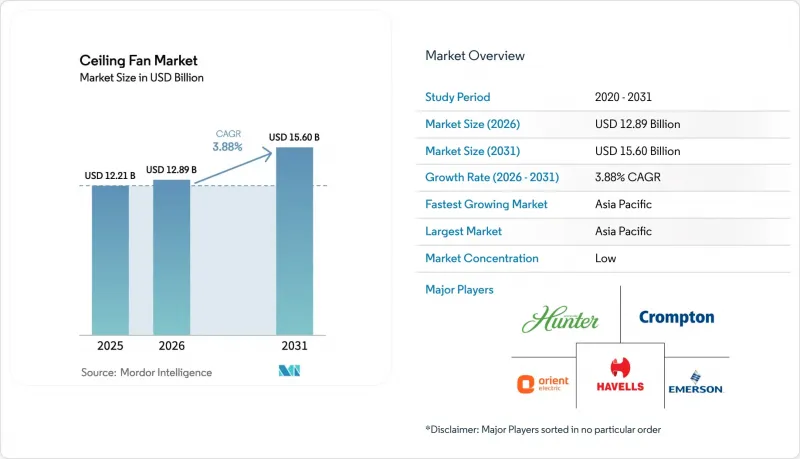
根據 Mordor Intelligence 預測,吊扇市場規模將從 2025 年的 122.1 億美元和 2026 年的 128.9 億美元成長到 2031 年的 156 億美元,2026 年至 2031 年的年複合成長率(CAGR)為 3.88%。
本報告按產品類型(標準型、裝飾型等)、技術(AC馬達、DC馬達、無刷直流馬達)、最終用戶(住宅、商業、工業)、通路(多品牌門市、線上通路、B2B/專案通路等)和地區(北美、南美、歐洲、亞太、中東和非洲)進行細分。市場預測以美元計價。
全球吊扇市場趨勢及洞察
更嚴格的能源效率法規正在加速向無刷直流吊扇的過渡。
全球政策的收緊直接促進了無刷直流風扇(BLDC)的普及。自2025年起,美國大直徑吊扇須遵守能源部製定的聯邦能源效率標準,該標準基於2020年推出的吊扇能源效率指數(CFEI)。新的測試程序於2023年推出,提高最低能源效率標準的修正案草案於2024年擬定,但這些修正案於2025年撤回。印度冷凍行動計畫(ICAP)預測,到2038年,印度吊扇的安裝數量將從5億台增加到10億台,凸顯了對節能冷氣解決方案的需求。 ICAP是國家氣候變遷行動計畫(NAPCC)的關鍵組成部分,其使命是「自然更節能」(NMEEE),由建築能源環境局(BEE)負責管理。 BLDC風扇憑藉其低功耗、長壽命和卓越的調速性能,與ICAP降低冷氣產業能源需求和排放的使命不謀而合。監管要求以及消費者對能源成本日益成長的關注,為BLDC吊扇創造了有利的市場環境,使得能源效率成為產品開發和採購決策的核心考量。
智慧家庭的日益普及帶動了對具備物聯網功能的吊扇的需求。
物聯網智慧吊扇的普及正在改變吊扇市場,為吊扇增添了連接性、便利性和能源管理功能。具備 Wi-Fi、藍牙或 Zigbee 連線功能的智慧吊扇的擴張速度是傳統吊扇市場的三倍以上,反映出消費者對智慧家庭的強勁需求。例如,Hunter 的「SIMPLEconnect」系列產品,其無線通訊通過了 Matter 認證,相容於 Apple、Google 和 Amazon 生態系統,展現了開放平台互通性的趨勢,無需專用集線器即可實現無縫整合。這些智慧吊扇可讓使用者透過應用程式或語音助理遠端控制氣流、照明和定時,從而提升了便利性和能源效率。此外,智慧吊扇產生的數據還支援使用情況分析和預測性維護等高級功能,進一步增強了其提案。隨著消費者對多功能、技術驅動型家用電器的需求日益成長,物聯網吊扇正在推動創新,為製造商帶來新的收入來源,並加速其在住宅和商業領域的普及。
在氣候溫暖的地區,低成本的室內空調正在減少人們對吊扇的依賴。
隨著低價室內空調的普及,都市區和新興市場對吊扇的需求正面臨日益嚴峻的挑戰。變頻空調價格的下降以及分期付款方式的增多,使得原本主要依賴吊扇的中等收入家庭也能負擔得起機械製冷。在印度,空調普及率預計將從2023年的8%上升到2028年的15%。同時,在巴西,家用空調普及率預計將在2024年達到22.6%,吊扇的更換週期正在縮短,因為消費者會將吊扇移至其他房間或徹底拆除。數據顯示,在巴西已安裝空調的家庭中,吊扇的使用率下降了40%至50%,而新購空調的家庭中有18%會在一年內拆除吊扇。在中東和北非地區,都市區空調普及率超過 85%,電風扇已淪為輔助工具,預計到 2028 年,空調的銷售成長速度將超過電風扇。在印度,超低成本空調的出現(其價格低於高效無刷直流風扇)進一步降低了吊扇的提案,尤其是在電力供應穩定的都市區,這表明人們的冷氣偏好正在發生結構性轉變。
細分市場分析
節能風扇預計到2031年將以5.47%的複合年成長率成長,超過吊扇市場的整體成長速度。印度2025年修訂的星級標準立即將傳統高階感應風扇的能源效率等級降至1星,引發了大規模的更換週期。這導致無刷直流(BLDC)吊扇的市場佔有率逐季成長。 Atomberg早期專注於100%無刷直流風扇的生產,使其在國內細分市場佔據了60%的佔有率,預計2024會計年度銷售額將達到84.8億盧比(約9,438萬美元)。這顯示優質化趨勢正在向大都會圈蔓延。擁有時尚扇葉、內建照明和高級飾面的裝飾性風扇正受到越來越多考慮更換基本款風扇的住宅的青睞。東方電氣(Orient Electric)報告稱,在2025會計年度,其「Cloud 3」無葉風扇的推動下,公司業績年增22%。獲得印度能源效率局(BEE)五星級認證的節能型無刷直流(BLDC)風扇在印度市場正在迅速擴張,隨著2025年「服務價值」基準值的重新調整,老式感應風扇逐漸被淘汰,因此更換需求也在加速成長。高速風扇和低風量(HVLS)風扇在工業和商業應用領域也備受關注,廣泛應用於車間、倉庫和低溫運輸設施。亨特工業(Hunter Industrial)和穆克羅艾爾科技(Mukroair Technologies)報告稱,2024年至2025年,兩家訂單量均將實現兩位數成長。
憑藉價格優勢,標準三葉交流風扇在2025年佔了37.81%的市場。然而,隨著補貼和成本削減,中檔無刷直流風扇的價格差距已縮小至個位數,其市佔率正在下降。亨特風扇的「SIMPLEconnect」系列和東方電氣的「Aeroslim」物聯網風扇在市場上贏得了良好的口碑,其中物聯網型號的價格溢價高達40-50%,從而提高了利潤率。Panasonic的WiFANDC馬達風扇配備人體感應器,可降低15-20%的能耗,並在東南亞地區廣受歡迎。 CSA Matter 1.2規範確保了跨平台相容性,促進了OEM廠商的採用,並使像Dreo這樣的新興企業能夠以具有競爭力的價格進入北美市場。雖然三葉交流風扇在農村和郊區市場仍然佔據主導地位,但無刷直流風扇製造成本的下降以及印度風扇更換試點計劃等政府補貼計劃正在逐漸改變消費者的偏好,使其轉向更高效、聯網的風扇。
由於材料成本較低(每台馬達8-12美元,而無刷直流馬達為18-28美元)以及成熟的供應鏈,預計到2025年,AC馬達在全球吊扇出貨量中仍將佔據55.49%的佔有率。然而,受監管要求、製造成本降低以及優質化趨勢的推動,無刷直流風扇正以6.22%的複合年成長率快速成長。雖然傳統的有刷直流馬達仍用於離網太陽能發電等小眾應用,但隨著無刷直流馬達單價跌破25美元,其在印度的市佔率已從2020年的45%下降到2024年的22%。無刷直流馬達採用永磁轉子和電子整流技術,可節能50-60%,降低逆變器電池消耗,並實現更安靜的運作。據Atomberg Technologies公司稱,其功耗僅為28-35瓦,而傳統風扇的功耗為70-75瓦。美國能源局(DOE) 的 2024 年 CFEI 和印度的 2025 年 BEE 星級重新評估等能源效率計劃,透過評估更高的氣流效率,進一步促進了無刷直流馬達 (BLDC) 的採用,有效地使舊式交流風扇和感應風扇型號過時。
製造成本的降低正在加速亞洲地區無刷直流馬達(BLDC)的普及。 Ebm Papst位於清奈的工廠(投資3,730萬美元)計畫在2026年實現EC/BLDC馬達在地化生產,這將降低20-25%的到岸成本。同時,海爾在大諾伊達的投資(4.2億美元)旨在2028年實現年產250萬台,將印度打造成為區域出口中心。 Atomberg Technologies已將普納的生產基地擴建至月產能超過100萬台。該公司採用了自動化繞線和磁鐵插入生產線,在原料價格上漲的情況下,降低了人事費用並提高了利潤率。 Crompton Greaves的「NUCLEUS」BLDC平台和Orient Electric的BLDC產品因其高市場接受度和比交流風扇高出40-50%的價格溢價而脫穎而出,預計2025會計年度同比成長超過50%。雖然AC馬達由於初始成本較低,在農村和郊區市場仍然佔據主導地位,但無刷直流馬達價格的下降和政府補貼計畫正在改變消費者的偏好,使他們傾向於選擇配備無刷直流技術的高效吊扇。
區域分析
預計到2025年,亞太地區將佔全球吊扇銷售量的48.52%,年複合成長率達5.16%,主要得益於印度的低收入住宅計畫和農村電氣化進程。這些計畫下的補貼每年將額外售出600萬至800萬台吊扇,平均每戶家庭購買2至3台。中國垂直整合的磁鐵供應體系支援低成本無刷直流吊扇出口到東南亞和非洲,從而實現價格競爭力並擴大市場普及。印度仍然是主要的成長動力,在新建築和現有建築的更換中,用無刷直流吊扇取代傳統交流吊扇的趨勢日益明顯。可支配收入的成長和都市化的加快,進一步擴大了亞太地區中高階吊扇市場。
北美市場主要受更換需求驅動,優質化和Matter認證智慧風扇的出現推高了平均售價。美國能源局(DOE)2026年的測試程序更新將把傳統交流風扇歸類為低效率產品,鼓勵家庭用戶更換無刷直流風扇(BLDC)。在南美洲,受熱浪影響,2024年銷售量激增33%,但隨後巴西空調的快速普及抑制了需求,導致經銷商庫存積壓。歐洲市場的成長主要受注重設計的更換需求和更嚴格的生態設計標準的推動。北歐國家優先考慮能源效率,而地中海地區則使用風扇來應對不斷上升的氣溫。在中東和非洲,海灣合作理事會(GCC)國家在大型零售項目中指定風扇用於室外和半空調區域。同時,在撒哈拉以南非洲,太陽能直流風扇正逐漸成為主流,預計到2028年,離網套件的銷售量將超過1,500萬台。
其他好處:
- Excel格式的市場預測(ME)表
- 3個月的分析師支持
目錄
第1章:引言
- 研究假設和市場定義
- 調查範圍
第2章:調查方法
第3章執行摘要
第4章 市場狀況
- 市場概覽
- 市場促進因素
- 更嚴格的能源效率法規正在加速向無刷直流吊扇的過渡。
- 智慧家庭的日益普及帶動了對具備物聯網功能的吊扇的需求。
- 亞洲各地具有成本競爭力的無刷直流馬達製造地的擴張將降低產品的價格障礙。
- 綠色建築標準的日益普及正在推動被動式冷卻和節能冷卻解決方案的發展。
- 在溫控物流設施和低溫運輸設施中擴大使用 HVLS 吊扇。
- 公共住宅計畫和農村電氣化計畫正在增加首次擁有電風扇的家庭數量。
- 市場限制因素
- 在氣候溫暖的地區,低成本室內空調的普及減少了人們對吊扇的依賴。
- 季節性銷售波動給庫存和價格帶來了壓力。
- 稀土元素磁鐵的供應緊張推高了 BLDC(載血細胞)的生產成本。
- 假冒電子元件正在引發產品召回和合規風險。
- 產業價值鏈分析
- 波特五力分析
- 洞察最新市場趨勢與創新
- 洞察近期市場趨勢(新產品發布、策略性舉措、投資、合作、合資、業務擴張、併購等)
- 主要地區法律規範與能源效率標準分析
第5章 市場規模與成長預測
- 依產品類型
- 標準
- 裝飾性的
- 節能
- 高速
- 內建燈
- HVLS
- 智慧/物聯網
- 太陽能供電
- 透過技術
- AC馬達
- DC馬達
- 無刷直流電機
- 最終用戶
- 住宅
- 商業的
- 產業
- 透過分銷管道
- B2C/零售通路
- 多品牌商店
- 品牌自營店
- 線上
- 其他分銷管道
- B2B/工程通路(廠商直銷)
- B2C/零售通路
- 按地區
- 北美洲
- 美國
- 加拿大
- 墨西哥
- 南美洲
- 巴西
- 秘魯
- 智利
- 阿根廷
- 其他南美國家
- 歐洲
- 英國
- 德國
- 法國
- 西班牙
- 義大利
- 比荷盧經濟聯盟(比利時、荷蘭、盧森堡)
- 北歐國家(丹麥、芬蘭、冰島、挪威、瑞典)
- 其他歐洲國家
- 亞太地區
- 印度
- 中國
- 日本
- 澳洲
- 韓國
- 東南亞(新加坡、馬來西亞、泰國、印尼、越南、菲律賓)
- 其他亞太國家
- 中東和非洲
- 阿拉伯聯合大公國
- 沙烏地阿拉伯
- 南非
- 奈及利亞
- 其他中東和非洲國家
- 北美洲
第6章 競爭情勢
- 市場集中度
- 策略趨勢
- 市佔率分析
- 公司簡介
- Hunter Fan Company
- Crompton Greaves Consumer Electricals Ltd.
- Orient Electric Ltd.
- Havells India Ltd.
- Emerson Electric Co.
- Panasonic Corporation
- Midea Group
- Minka Group
- Haier Group
- Usha International
- Superfan(Versa Drives)
- Atomberg Technologies
- Fanimation Inc.
- Westinghouse Lighting
- Vent-Axia(CEME Group)
- Casablanca Fan Company
- Delta Electronics
- LG Electronics
- Bajaj Electricals Ltd.
- Khind Holdings Berhad
第7章 市場機會與未來展望
According to Mordor Intelligence, the ceiling fan market size is projected to expand from USD 12.21 billion in 2025 and USD 12.89 billion in 2026 to USD 15.60 billion by 2031, registering a CAGR of 3.88% between 2026 to 2031.
This report is Segmented by Product Type (Standard, Decorative, and More), Technology (AC Motor, DC Motor, BLDC Motor), End-User (Residential, Commercial, Industrial), Distribution Channel (Multi-Brand Stores, Online, and More, B2B/Project Channels), and Geography (North America, South America, Europe, Asia-Pacific, Middle East and Africa). The Market Forecasts are Provided in Terms of Value (USD).
Global Ceiling Fan Market Trends and Insights
Tightening Energy-Efficiency Mandates, Accelerating the Transition to BLDC Ceiling Fans
Global policy tightening is translating directly into higher BLDC penetration. As of 2025, large-diameter ceiling fans in the U.S. remain subject to federal energy standards set by the Department of Energy, based on the Ceiling-Fan Energy Index (CFEI) introduced in 2020. Although a new test procedure was implemented in 2023 and proposed updates to raise minimum efficiency standards were drafted in 2024, these updates were withdrawn in 2025. The India Cooling Action Plan (ICAP) projects that India's ceiling fan stock will grow from 500 million to 1 billion by 2038, underscoring the need for energy-efficient cooling solutions. ICAP is an important element under the National Action Plan on Climate Change (NAPCC) with a mission focused on Enhanced Energy Efficiency (NMEEE), administered by BEE. BLDC fans, with lower electricity consumption, longer lifespans, and better speed control, align directly with ICAP's mission to reduce energy demand and emissions in the cooling sector. Regulatory requirements, combined with increasing consumer awareness of energy costs, are creating a favorable market environment for BLDC ceiling fans, making energy efficiency a central criterion in both product development and purchasing decisions.
Rising Penetration of Smart Homes is Driving Demand for IoT-Enabled Ceiling Fans
The proliferation of IoT-enabled smart ceiling fans is reshaping the ceiling fan market by adding connectivity, convenience, and energy management features. Smart fans equipped with WiFi, Bluetooth, or Zigbee radios are expanding at more than three times the rate of the traditional ceiling fan market, reflecting strong consumer demand for home automation. Products like Hunter's SIMPLEconnect series, which include Matter-certified radios compatible with Apple, Google, and Amazon ecosystems, demonstrate a trend toward open platform interoperability, eliminating the need for proprietary hubs and making integration seamless. These connected fans allow users to control speed, lighting, and scheduling remotely via apps or voice assistants, increasing convenience and energy efficiency. The data generated by smart fans also enables advanced features such as usage analytics and predictive maintenance, further enhancing their value proposition. As consumers increasingly seek multifunctional and tech-enabled home appliances, IoT-enabled ceiling fans are driving innovation, creating new revenue streams for manufacturers, and accelerating adoption in both residential and commercial sectors.
Low-Cost Room Air-Conditioners are Reducing Reliance on Ceiling Fans in Warm Regions
The growing penetration of low-cost room air conditioners is increasingly challenging ceiling fan demand in urban and emerging markets. Falling prices for inverter ACs, combined with extended financing options, are making mechanical cooling accessible to middle-income households that previously relied primarily on ceiling fans. In India, AC penetration is expected to rise from 8% in 2023 to 15% by 2028, while in Brazil, household AC penetration reached 22.6% in 2024, compressing ceiling-fan replacement cycles as consumers shift usage to secondary rooms or remove fans entirely. Data shows that Brazilian households with ACs reduced ceiling-fan use by 40-50%, and 18% of new AC buyers removed fans within a year. In the MENA region, where AC penetration exceeds 85% in urban areas, fans are relegated to supplementary roles, and AC sales are projected to grow faster than fans through 2028. The rise of ultra-low-cost ACs in India, priced below high-efficiency BLDC fans, further undermines the value proposition of ceiling fans, particularly in cities with reliable electricity, signaling a structural shift in cooling preferences.
Other drivers and restraints analyzed in the detailed report include:
- Scaling of Cost-Competitive BLDC Manufacturing Hubs Across Asia, Lowering Product Price Barriers
- Increasing Adoption of Green-Building Standards, Promoting Passive and Energy-Efficient Cooling Solutions
- Seasonal Sales Volatility Leading to Inventory and Pricing Pressure
For complete list of drivers and restraints, kindly check the Table Of Contents.
Segment Analysis
Energy-saving fans are expanding at a 5.47% CAGR to 2031, a pace that eclipses the overall ceiling fan market. India's 2025 star-band reset instantly downgraded yesterday's premium induction units to 1-star status and triggered a broad replacement cycle that lifts the ceiling fan market share of BLDC models every quarter. Atomberg's first-mover bet on 100% BLDC manufacturing translated into 60% domestic sub-segment share and FY 2024 revenue of Rs 848 crore (USD 94.38 million), proof that the premiumization narrative travels beyond metros. Decorative fans with designer blades, integrated lighting, and premium finishes are appealing to homeowners upgrading from basic models, with Orient Electric reporting 22% year-on-year growth in fiscal 2025, driven by its Cloud 3 bladeless fan. Energy-saving BLDC fans with BEE 5-star ratings are expanding in India, where recalibrated Service Value thresholds in 2025 have accelerated replacement demand by rendering older induction fans obsolete. High-speed and HVLS fans are gaining traction in industrial and commercial applications, serving workshops, warehouses, and cold-chain facilities, with Hunter Industrial and MacroAir Technologies reporting double-digit order growth in 2024-2025.
Standard three-blade AC fans still delivered 37.81% of 2025 revenue thanks to low entry prices, yet that slice is slipping as subsidies and cost-deflation compress the BLDC premium to single digits in mid-tier models. Hunter Fan's SIMPLEconnect series and Orient Electric's Aeroslim IoT fan have demonstrated strong market acceptance, with IoT models commanding 40-50% price premiums and driving margin expansion. Panasonic's WiFAN DC motor fans, equipped with occupancy sensors, are reducing energy consumption by 15-20% and expanding across Southeast Asia. The CSA's Matter 1.2 specification has ensured cross-platform compatibility, encouraging OEM adoption and enabling challengers like Dreo to enter North America at competitive prices. While 3-blade AC fans remain dominant in rural and semi-urban markets, declining BLDC manufacturing costs and government subsidy programs, such as India's pilot fan-replacement schemes, are gradually shifting consumer preference toward high-efficiency, connected fans.
AC motors retained 55.49% of global ceiling-fan volume in 2025 due to their low material cost (USD 8-12 per motor versus USD 18-28 for BLDC) and established supply chains. However, BLDC fans are growing rapidly at a 6.22% CAGR, fueled by regulatory mandates, falling manufacturing costs, and premiumization trends. Traditional brushed DC motors remain in niche off-grid solar applications, but their share in India dropped from 45% in 2020 to 22% in 2024 as BLDC prices fell below USD 25 per unit. BLDC motors, using permanent-magnet rotors and electronic commutation, deliver 50-60% energy savings, lower battery drain for inverters, and silent operation, with Atomberg Technologies reporting consumption of just 28-35 watts versus 70-75 watts for conventional fans. Energy-efficiency programs such as the U.S. DOE's 2024 CFEI and India's 2025 BEE star recalibration further incentivize BLDC adoption by rewarding higher airflow efficiency and rendering older AC or induction-fan models effectively obsolete.
Manufacturing-cost deflation is accelerating BLDC adoption in Asia. Ebm Papst's Chennai plant (USD 37.3 million) will localize EC/BLDC motor production by 2026, cutting landed costs by 20-25%, while Haier's Greater Noida investment (USD 420 million) aims for 2.5 million units annually by 2028, positioning India as a regional export hub. Atomberg Technologies scaled its Pune facility to over 1 million units per month, using automated winding and magnet insertion lines that reduce labor content and boost margins despite raw-material inflation. Crompton Greaves' NUCLEUS BLDC platform and Orient Electric's BLDC models, which grew over 50% YoY in fiscal 2025, highlight strong market acceptance and 40-50% price premiums over AC fans. Although AC motors remain dominant in rural and semi-urban markets due to lower upfront costs, declining BLDC prices, and government subsidy programs are shifting consumer preference toward high-efficiency, BLDC-equipped ceiling fans.
Complete Report Scope:
- By Product Type
- Standard
- Decorative
- Energy-Saving
- High-Speed
- With Integrated Light
- HVLS
- Smart / IoT
- Solar-Powered
- By Technology
- AC Motor
- DC Motor
- BLDC Motor
- By End-User
- Residential
- Commercial
- Industrial
- By Distribution Channel
- B2C/Retail Channels
- Multi-Brand Stores
- Exclusive Brand Outlets
- Online
- Other Distribution Channels
- B2B/Project Channels (direct from the manufacturers)
- B2C/Retail Channels
- By Geography
- North America
- United States
- Canada
- Mexico
- South America
- Brazil
- Peru
- Chile
- Argentina
- Rest of South America
- Europe
- United Kingdom
- Germany
- France
- Spain
- Italy
- BENELUX (Belgium, Netherlands, and Luxembourg)
- NORDICS (Denmark, Finland, Iceland, Norway, and Sweden)
- Rest of Europe
- Asia-Pacific
- India
- China
- Japan
- Australia
- South Korea
- South East Asia (Singapore, Malaysia, Thailand, Indonesia, Vietnam, and Philippines)
- Rest of Asia-Pacific
- Middle East and Africa
- United Arab Emirates
- Saudi Arabia
- South Africa
- Nigeria
- Rest of Middle East and Africa
- North America
Geography Analysis
Asia-Pacific accounted for 48.52% of global ceiling-fan revenue in 2025 and is expected to grow at a 5.16% CAGR, fueled by India's affordable-housing programs and rural electrification. Subsidies under these schemes generate 6-8 million additional fan units annually, with each household typically purchasing two to three fans. China's vertically integrated magnet supply supports low-cost BLDC exports to Southeast Asia and Africa, enabling competitive pricing and wider adoption. India remains a key growth driver, as BLDC fans are increasingly replacing legacy AC models in new constructions and replacement cycles. Rising disposable incomes and urbanization further expand the mid- and premium-tier fan segments in Asia-Pacific markets.
North America's market is largely replacement-driven, with premiumization and Matter-certified smart fans boosting average selling prices. The U.S. DOE's 2026 test procedure updates push legacy AC models into lower efficiency tiers, encouraging households to upgrade to BLDC fans. South America saw a 33% sales surge in 2024 due to extreme heat, though rapid AC adoption in Brazil is compressing follow-up demand and forcing distributors to hold larger inventories. Europe's growth is driven by design-focused replacements and stricter Ecodesign standards, with Northern countries prioritizing energy savings and Mediterranean regions using fans to complement rising temperatures. In the Middle East and Africa, GCC nations specify fans for outdoor and semi-conditioned zones in large retail projects, while Sub-Saharan Africa relies on solar-DC models, with off-grid kits projected to exceed 15 million units by 2028.
- Hunter Fan Company
- Crompton Greaves Consumer Electricals Ltd.
- Orient Electric Ltd.
- Havells India Ltd.
- Emerson Electric Co.
- Panasonic Corporation
- Midea Group
- Minka Group
- Haier Group
- Usha International
- Superfan (Versa Drives)
- Atomberg Technologies
- Fanimation Inc.
- Westinghouse Lighting
- Vent-Axia (CEME Group)
- Casablanca Fan Company
- Delta Electronics
- LG Electronics
- Bajaj Electricals Ltd.
- Khind Holdings Berhad
Additional Benefits:
- The market estimate (ME) sheet in Excel format
- 3 months of analyst support
TABLE OF CONTENTS
1 Introduction
- 1.1 Study Assumptions & Market Definition
- 1.2 Scope of the Study
2 Research Methodology
3 Executive Summary
4 Market Landscape
- 4.1 Market Overview
- 4.2 Market Drivers
- 4.2.1 Tightening energy-efficiency mandates, accelerating the transition to BLDC ceiling fans
- 4.2.2 Rising penetration of smart homes is driving demand for IoT-enabled ceiling fans
- 4.2.3 Scaling of cost-competitive BLDC manufacturing hubs across Asia, lowering product price barriers
- 4.2.4 Increasing adoption of green-building standards, promoting passive and energy-efficient cooling solutions
- 4.2.5 Growing use of HVLS ceiling fans in temperature-controlled logistics and cold-chain facilities
- 4.2.6 Public housing programs and rural electrification initiatives are expanding first-time fan ownership
- 4.3 Market Restraints
- 4.3.1 Low-cost room air-conditioners are reducing reliance on ceiling fans in warm regions
- 4.3.2 Seasonal sales volatility leading to inventory and pricing pressure
- 4.3.3 Rare-earth magnet supply tightness is increasing BLDC production costs
- 4.3.4 Counterfeit electronic components are driving recalls and compliance risk
- 4.4 Industry Value Chain Analysis
- 4.5 Porter's Five Forces Analysis
- 4.5.1 Threat Of New Entrants
- 4.5.2 Bargaining Power Of Suppliers
- 4.5.3 Bargaining Power Of Buyers
- 4.5.4 Threat Of Substitutes
- 4.5.5 Competitive Rivalry
- 4.6 Insights Into The Latest Trends And Innovations In The Market
- 4.7 Insights On Recent Developments (New Product Launches, Strategic Initiatives, Investments, Partnerships, JVs, Expansion, M&As, Etc.) In The Market
- 4.8 Insights on Regulatory Framework and Energy-Efficiency Standards in Key Geographies
5 Market Size & Growth Forecasts
- 5.1 By Product Type
- 5.1.1 Standard
- 5.1.2 Decorative
- 5.1.3 Energy-Saving
- 5.1.4 High-Speed
- 5.1.5 With Integrated Light
- 5.1.6 HVLS
- 5.1.7 Smart / IoT
- 5.1.8 Solar-Powered
- 5.2 By Technology
- 5.2.1 AC Motor
- 5.2.2 DC Motor
- 5.2.3 BLDC Motor
- 5.3 By End-User
- 5.3.1 Residential
- 5.3.2 Commercial
- 5.3.3 Industrial
- 5.4 By Distribution Channel
- 5.4.1 B2C/Retail Channels
- 5.4.1.1 Multi-Brand Stores
- 5.4.1.2 Exclusive Brand Outlets
- 5.4.1.3 Online
- 5.4.1.4 Other Distribution Channels
- 5.4.2 B2B/Project Channels (direct from the manufacturers)
- 5.4.1 B2C/Retail Channels
- 5.5 By Geography
- 5.5.1 North America
- 5.5.1.1 United States
- 5.5.1.2 Canada
- 5.5.1.3 Mexico
- 5.5.2 South America
- 5.5.2.1 Brazil
- 5.5.2.2 Peru
- 5.5.2.3 Chile
- 5.5.2.4 Argentina
- 5.5.2.5 Rest of South America
- 5.5.3 Europe
- 5.5.3.1 United Kingdom
- 5.5.3.2 Germany
- 5.5.3.3 France
- 5.5.3.4 Spain
- 5.5.3.5 Italy
- 5.5.3.6 BENELUX (Belgium, Netherlands, and Luxembourg)
- 5.5.3.7 NORDICS (Denmark, Finland, Iceland, Norway, and Sweden)
- 5.5.3.8 Rest of Europe
- 5.5.4 Asia-Pacific
- 5.5.4.1 India
- 5.5.4.2 China
- 5.5.4.3 Japan
- 5.5.4.4 Australia
- 5.5.4.5 South Korea
- 5.5.4.6 South East Asia (Singapore, Malaysia, Thailand, Indonesia, Vietnam, and Philippines)
- 5.5.4.7 Rest of Asia-Pacific
- 5.5.5 Middle East and Africa
- 5.5.5.1 United Arab Emirates
- 5.5.5.2 Saudi Arabia
- 5.5.5.3 South Africa
- 5.5.5.4 Nigeria
- 5.5.5.5 Rest of Middle East and Africa
- 5.5.1 North America
6 Competitive Landscape
- 6.1 Market Concentration
- 6.2 Strategic Moves
- 6.3 Market Share Analysis
- 6.4 Company Profiles (includes Global level Overview, Market level overview, Core Segments, Financials as available, Strategic Information, Market Rank/Share for key companies, Products & Services, and Recent Developments)
- 6.4.1 Hunter Fan Company
- 6.4.2 Crompton Greaves Consumer Electricals Ltd.
- 6.4.3 Orient Electric Ltd.
- 6.4.4 Havells India Ltd.
- 6.4.5 Emerson Electric Co.
- 6.4.6 Panasonic Corporation
- 6.4.7 Midea Group
- 6.4.8 Minka Group
- 6.4.9 Haier Group
- 6.4.10 Usha International
- 6.4.11 Superfan (Versa Drives)
- 6.4.12 Atomberg Technologies
- 6.4.13 Fanimation Inc.
- 6.4.14 Westinghouse Lighting
- 6.4.15 Vent-Axia (CEME Group)
- 6.4.16 Casablanca Fan Company
- 6.4.17 Delta Electronics
- 6.4.18 LG Electronics
- 6.4.19 Bajaj Electricals Ltd.
- 6.4.20 Khind Holdings Berhad
7 Market Opportunities & Future Outlook
- 7.1 Sustainable, Low-Toxicity Product Expansion through Omni-Channel Retail

 2026-2030年全球內置空調風扇市場
 無刷直流風扇市場-2026-2032年全球市場預測
 智慧吊扇市場-全球產業規模、佔有率、趨勢、機會、預測:按連接類型、應用、分銷管道、地區和競爭格局分類,2021-2031年無刷直流風扇市場 - 全球產業規模、佔有率、趨勢、機會、預測:按類型、最終用戶、風扇轉速、地區和競爭對手分類,2021-2031年
 無刷直流風扇:市場佔有率分析、產業趨勢與統計、成長預測(2026-2031)
 吊扇市場規模、佔有率、趨勢和預測:按產品類型、風扇尺寸、應用、銷售管道和地區分類,2026-2034年智慧吊扇市場:2026-2032年全球預測(按馬達類型、連接技術、控制系統、產品類型、安裝類型、扇葉材質、最終用戶和分銷管道分類)天花板式集塵機市場:按集塵機類型、安裝方式、流量和最終用戶分類的全球預測,2026-2032年無刷直流軸流風扇市場:依葉片直徑、風量範圍、轉速、終端用戶產業、應用及銷售管道,全球預測,2026-2032年
 全球吊扇市場規模、佔有率、成長率、按類型和應用分類的全球產業分析、區域趨勢以及 2026-2034 年預測。