


 |
市場調查報告書
商品編碼
2097111
美國建築環氧樹脂黏合劑:市場佔有率分析、產業趨勢和統計數據以及成長預測(2026-2031 年)American Epoxy Adhesives for Construction - Market Share Analysis, Industry Trends & Statistics, Growth Forecasts (2026 - 2031) |
||||||

※ 本網頁內容可能與最新版本有所差異。詳細情況請與我們聯繫。
據 Mordor Intelligence 稱,美國建築環氧樹脂黏合劑市場預計到 2026 年價值 2.6288 億美元,高於 2025 年的 2.4873 億美元,預計到 2031 年將達到 3.4672 億美元。
預計 2026 年至 2031 年的複合年成長率為 5.69%。
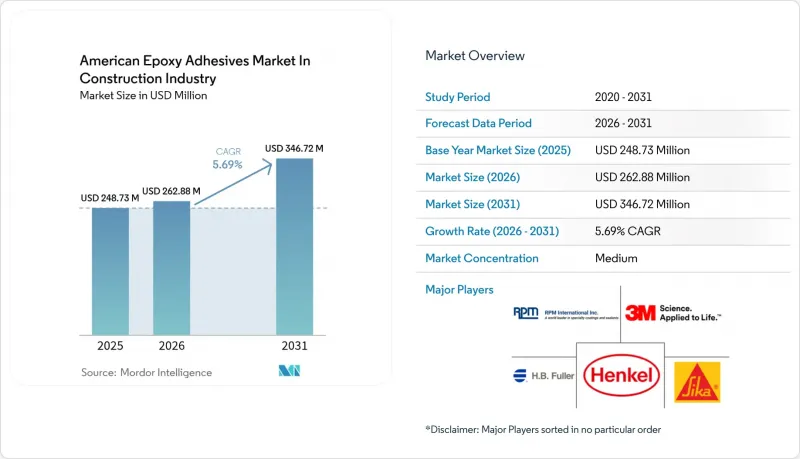
本報告按產品類型(單組分和雙組分)、技術(反應型、溶劑型等)、最終用戶應用(住宅和商業)以及地區(北美[美國、加拿大、墨西哥]和南美[巴西、阿根廷、智利和其他南美國家])進行細分。市場預測以美元(USD)計價。
美國建築環氧樹脂黏合劑市場趨勢與洞察
美國各地主導建設熱潮
基礎設施投資正推動美國建築環氧樹脂黏合劑市場向高性能配方發展。美國《基礎設施投資與就業法案》為道路和橋樑維修撥款巨資,優先採用環氧樹脂灌漿而非整體更換橋面,從而增加了對能夠滲透微裂縫的低粘度樹脂的需求。加拿大的「投資加拿大基礎設施計畫」資助的交通計畫強制要求使用預製模組,並用結構環氧樹脂進行黏合。在南美洲,由美國開發銀行(IDB)資助的特許經營項目正在腐蝕性土壤中的渦輪機基礎和管道接頭處使用環氧樹脂水泥漿。隨著專案從溫帶氣候轉向赤道氣候,配方開發商需要拓寬工作溫度範圍並延長適用期,以適應高溫環境下的施工。延長開放時間可以最大限度地減少大規模橋面施工中的廢棄物,提高專案經濟效益,同時保持膠合劑的可靠性。
預製和模組化建築系統的快速普及
預製建築正在推動美國建築環氧樹脂黏合劑市場的成長,這得益於在工廠可控環境下使用機器人精準塗覆輪胎邊緣形狀的能力。 2024年,美國模組化住宅的開工數量增加。這些住宅採用單組分薄膜黏合劑,固化溫度為120 度C ,從而避免了現場混合誤差的風險。根據西卡2024年年度報告,預製黏合劑的銷量正在成長,這得益於與德克薩斯州和安大略省領先製造商的合作。工廠自動化縮短了生產週期,但同時也需要固化曲線可預測、能夠與節拍時間同步的環氧樹脂。供應商需要與模組製造商合作,檢驗膠合劑在運輸振動和起重機起重負荷下的接縫性能,以確保獲得重複訂單。
雙酚A和環氧氯丙烷原料價格的波動
2024年,亞洲雙酚A價格出現顯著波動。同時,由於丙烯供應緊張,美國墨西哥灣沿岸地區的環氧氯丙烷合約價格上漲。環氧氯丙烷價格的飆升給受60天供貨合約約束的複合材料生產商的利潤率帶來了壓力。陶氏化學報告稱,2024年第四季環氧樹脂盈利下降,原因是原物料價格上漲幅度超過了銷售價格的漲幅。為此,主要生產商正在整合上游工程並簽訂多年期承包合約。與此同時,一些利基企業正在轉向生物基樹脂。這些樹脂價格昂貴,但可以緩衝石化產品價格的波動。持續的市場波動導致營運資金需求居高不下。因此,小規模新參與企業的風險接受度受到抑制,美國建築環氧黏合劑市場的複合年成長率略有放緩。
細分市場分析
到2025年,雙組分環氧樹脂將佔總銷售額的66.78%。其主導地位得益於室溫固化和超過25 MPa的搭接剪切強度,使其成為橋樑鋪裝和帷幕牆緊固的必備材料。由於施工失敗的成本遠高於增加的人事費用,承包商紛紛承擔起自行混合的重任。同時,單組分環氧樹脂正以6.08%的複合年成長率快速成長,這得益於潛伏催化劑的出現,它能夠實現與工廠兼容的固化程序,並可與面板壓機烘箱整合。漢高公司的樂泰EA 9497薄膜黏合劑使安大略省的模組化建築商無需計量泵即可粘合鋼骨框架,從而避免了常見的現場誤差。濕固化和冷藏預混合料產品在一些受限於低溫運輸物流和強度發展緩慢的特定領域中發揮作用。
單組分系統對需要簡單筒式塗裝的住宅建造商來說極具吸引力,但其較高的固化溫度目前限制了其在溫控工廠或溫暖季節的應用。阿科瑪的90 度C固化環氧樹脂專為交叉層壓木材(CLT)生產線而設計,這表明降低固化溫度將拓寬其現場應用範圍。未來,隨著自動化和預製建築的興起,預計到2031年,雙組分產品的市佔率將下降幾個百分點。這是因為美國建築環氧樹脂黏合劑市場正轉向熱活化型和薄膜型膠合劑,這類膠合劑兼具可靠性和易用性。
其他好處:
- Excel格式的市場預測(ME)表
- 3個月的分析師支持
目錄
第1章:引言
- 研究假設和市場定義
- 調查範圍
第2章:調查方法
第3章執行摘要
第4章 市場狀況
- 市場概覽
- 市場促進因素
- 美國各地主導建設熱潮
- 預製和模組化建築系統的快速普及
- 從機械緊固到高性能黏接的過渡
- 需要結構環氧樹脂複合材料的3D混凝土列印
- 巴西的公私合營(PPP)稅收優惠政策正在加速土木工程項目中對環氧樹脂的需求。
- 市場限制因素
- 雙酚A和環氧氯丙烷原料價格的波動
- 美國和加拿大對揮發性有機化合物和化學物質暴露有嚴格的規定。
- 雙組分系統認證安裝人員短缺
- 價值鏈分析
- 波特五力模型
第5章 市場規模與成長預測
- 依產品類型
- 單組分類型
- 雙組分型
- 透過技術
- 反應型
- 溶劑型
- 紫外光固化黏合劑
- 水性黏合劑
- 透過最終用戶應用程式
- 住宅
- 商業的
- 按地區
- 北美洲
- 美國
- 加拿大
- 墨西哥
- 南美洲
- 巴西
- 阿根廷
- 智利
- 其他南美國家
- 北美洲
第6章 競爭情勢
- 市場集中度
- 策略趨勢
- 市佔率和排名分析
- 公司簡介
- 3M
- Arkema Group
- Ashland
- Dow
- Dymax Corporation
- HB Fuller Company
- Henkel AG & Co. KGaA
- Hexcel Corporation
- Hexion
- Huntsman International LLC
- ITW Performance Polymers
- Jowat SE
- MAPEI SpA
- Parker Hannifin Corp
- Permabond
- RPM International Inc.
- Sika AG
- Wacker Chemie AG
第7章 市場機會與未來展望
According to Mordor Intelligence, the american epoxy adhesives market size in Construction Industry market size in 2026 is estimated at USD 262.88 million, growing from 2025 value of USD 248.73 million with 2031 projections showing USD 346.72 million, growing at 5.69% CAGR over 2026-2031.
This report is Segmented by Product Type (One-Component and Two-Component), Technology (Reactive, Solvent-Borne, and More), End-User Application (Residential and Commercial), and Geography (North America [United States, Canada, and Mexico] and South America [Brazil, Argentina, Chile, and Rest of South America]). The Market Forecasts are Provided in Terms of Value (USD).
American Epoxy Adhesives for Construction Market Trends and Insights
Infrastructure-Led Construction Boom Across the Americas
Infrastructure spending is steering the American epoxy adhesives market toward higher-performance formulations. The U.S. Infrastructure Investment and Jobs Act allocates significant funds to road and bridge upgrades and prioritizes epoxy injection over full deck replacement, lifting demand for low-viscosity resins that penetrate micro-cracks. Canada's Investing in Canada Infrastructure Program earmarks funding for transit projects that mandate prefabricated modules bonded with structural epoxies. South American concessions funded by the Inter-American Development Bank, with epoxy grouts anchoring turbine bases and pipeline joints in corrosive soils. As projects migrate from temperate to equatorial climates, formulators must widen service-temperature windows and extend pot life to accommodate hot-weather placement. Longer open times also minimize waste in large bridge-deck pours, improving job economics while maintaining bond reliability.
Rapid Adoption of Prefabricated and Modular Building Systems
Prefabrication is propelling growth across the American epoxy adhesives market as factory-controlled environments enable robotic dispensing of precise bead geometries. U.S. modular housing starts climbed in 2024, each using one-component film adhesives that cure at 120 °C and remove the risk of on-site mixing errors. Sika's 2024 annual report shows prefab-related adhesive sales rising, supported by partnerships with volumetric manufacturers in Texas and Ontario. Factory automation shortens cycle time, but it also demands epoxies with predictable cure profiles that synchronize with takt-time rhythms. Suppliers must co-develop with module builders, validating joints under shipping vibration and crane-lift loads to win repeat business.
Volatility in Bisphenol-A and Epichlorohydrin Raw-Material Prices
In 2024, Bisphenol-A prices in Asia experienced significant swings. Meanwhile, contracts for epichlorohydrin on the U.S. Gulf Coast rose, driven by tight propylene supplies. This surge in epichlorohydrin prices has put pressure on margins for formulators bound by 60-day supply contracts. Dow Chemical, in Q4 2024, faced a decline in epoxy-resin profitability, attributing it to feedstock inflation outpacing increases in selling prices. In response, major producers are either backward-integrating or entering into multiyear offtake agreements. On the other hand, niche players are venturing into bio-based resins. These resins, though pricier, offer a buffer against fluctuations in petrochemical prices. The ongoing volatility in the market is keeping working capital requirements elevated. This, in turn, is tempering the risk appetite of smaller entrants, leading to a slight deceleration in the CAGR of the American epoxy adhesives market.
Other drivers and restraints analyzed in the detailed report include:
- Shift from Mechanical Fastening to High-Performance Bonding
- 3-D Concrete Printing Requiring Structural Epoxy Formulations
- Stringent VOC and Chemical-Exposure Regulations in the United States and Canada
For complete list of drivers and restraints, kindly check the Table Of Contents.
Segment Analysis
Two-component epoxies controlled 66.78% of revenue in 2025, a dominance underpinned by ambient-temperature cure and greater than 25 MPa lap-shear strength, making them indispensable for bridge overlays and curtain-wall anchoring. Contractors absorb the mixing burden because failure costs dwarf labor premiums. However, one-component grades are expanding at a 6.08% CAGR as latent catalysts deliver factory-friendly cure schedules that integrate with panel-press ovens. Henkel's Loctite EA 9497 film adhesive allows Ontario modular builders to bond steel frames without metering pumps, eliminating common field errors. Moisture-cure and frozen pre-mix products occupy niche roles where cold-chain logistics or slow strength development limit broader uptake.
One-component systems appeal to residential builders needing simple cartridge application, though elevated cure temperatures currently confine them to climate-controlled plants or warm seasons. Arkema's 90 °C cure epoxy targets cross-laminated timber production lines, demonstrating how temperature reductions can unlock broader field usage. Looking ahead, automation and prefab adoption are expected to shave some percentage points from the two-component share by 2031 as the American epoxy adhesives market shifts toward heat-activated or film formats that merge reliability with process simplicity.
Complete Report Scope:
- By Product Type
- One-Component
- Two-Component
- By Technology
- Reactive
- Solvent-borne
- UV Cured Adhesives
- Water-borne
- By End-User Application
- Residential
- Commercial
- By Geography
- North America
- United States
- Canada
- Mexico
- South America
- Brazil
- Argentina
- Chile
- Rest of South America
- North America
List of Companies Covered in this Report:
- 3M
- Arkema Group
- Ashland
- Dow
- Dymax Corporation
- H.B. Fuller Company
- Henkel AG & Co. KGaA
- Hexcel Corporation
- Hexion
- Huntsman International LLC
- ITW Performance Polymers
- Jowat SE
- MAPEI S.p.A.
- Parker Hannifin Corp
- Permabond
- RPM International Inc.
- Sika AG
- Wacker Chemie AG
Additional Benefits:
- The market estimate (ME) sheet in Excel format
- 3 months of analyst support
TABLE OF CONTENTS
1 Introduction
- 1.1 Study Assumptions and Market Definition
- 1.2 Scope of the Study
2 Research Methodology
3 Executive Summary
4 Market Landscape
- 4.1 Market Overview
- 4.2 Market Drivers
- 4.2.1 Infrastructure-led construction boom across the Americas
- 4.2.2 Rapid adoption of prefabricated and modular building systems
- 4.2.3 Shift from mechanical fastening to high-performance bonding
- 4.2.4 3-D concrete printing requiring structural epoxy formulations
- 4.2.5 Brazil's PPP tax incentives accelerating epoxy demand in civil works
- 4.3 Market Restraints
- 4.3.1 Volatility in bisphenol-A and epichlorohydrin raw-material prices
- 4.3.2 Stringent VOC/chem-exposure regulations in United States and Canada
- 4.3.3 Shortage of certified applicators for two-component systems
- 4.4 Value Chain Analysis
- 4.5 Porter's Five Forces
- 4.5.1 Bargaining Power of Suppliers
- 4.5.2 Bargaining Power of Buyers
- 4.5.3 Threat of New Entrants
- 4.5.4 Threat of Substitutes
- 4.5.5 Degree of Competition
5 Market Size and Growth Forecasts (Value)
- 5.1 By Product Type
- 5.1.1 One-Component
- 5.1.2 Two-Component
- 5.2 By Technology
- 5.2.1 Reactive
- 5.2.2 Solvent-borne
- 5.2.3 UV Cured Adhesives
- 5.2.4 Water-borne
- 5.3 By End-User Application
- 5.3.1 Residential
- 5.3.2 Commercial
- 5.4 By Geography
- 5.4.1 North America
- 5.4.1.1 United States
- 5.4.1.2 Canada
- 5.4.1.3 Mexico
- 5.4.2 South America
- 5.4.2.1 Brazil
- 5.4.2.2 Argentina
- 5.4.2.3 Chile
- 5.4.2.4 Rest of South America
- 5.4.1 North America
6 Competitive Landscape
- 6.1 Market Concentration
- 6.2 Strategic Moves
- 6.3 Market Share (%)/Ranking Analysis
- 6.4 Company Profiles (includes Global level Overview, Market level overview, Core Segments, Financials as available, Strategic Information, Market Rank/Share, Products and Services, and Recent Developments)
- 6.4.1 3M
- 6.4.2 Arkema Group
- 6.4.3 Ashland
- 6.4.4 Dow
- 6.4.5 Dymax Corporation
- 6.4.6 H.B. Fuller Company
- 6.4.7 Henkel AG & Co. KGaA
- 6.4.8 Hexcel Corporation
- 6.4.9 Hexion
- 6.4.10 Huntsman International LLC
- 6.4.11 ITW Performance Polymers
- 6.4.12 Jowat SE
- 6.4.13 MAPEI S.p.A.
- 6.4.14 Parker Hannifin Corp
- 6.4.15 Permabond
- 6.4.16 RPM International Inc.
- 6.4.17 Sika AG
- 6.4.18 Wacker Chemie AG
7 Market Opportunities and Future Outlook
- 7.1 White-space and Unmet-Need Assessment

 雙組分純環氧樹脂黏合劑市場:全球市場預測(2026-2032年)
 單組分泡沫市場報告:趨勢、預測與競爭分析(至2035年)
 桌面環氧樹脂套裝市場規模、佔有率和成長分析:按樹脂類型、套裝組件、應用、最終用戶、分銷管道和地區分類-2026-2033年產業預測
 雙組分環氧樹脂黏合劑市場規模、佔有率和成長分析:按樹脂類型、配方類型、固化機制、基材類型、應用、終端用戶產業、分銷管道和地區分類-2026-2033年產業預測可注射錨固環氧樹脂市場(按最終用戶、應用和產品形式分類),全球預測,2026-2032年
 全球雙組分環氧樹脂粘合劑市場規模、佔有率、趨勢及成長分析報告(2026-2034)
 2026年全球純環氧樹脂注射式化學錨定劑市場報告2026年全球高強度環氧樹脂黏合劑市場報告環氧彩色砂漿市場按包裝類型、最終用途產業、應用和分銷管道分類-2026-2032年全球預測環氧樹脂抗衝擊黏合劑市場按樹脂類型、固化技術、產品形式、最終用途產業、應用和分銷管道分類,全球預測(2026-2032年)