


 |
市場調查報告書
商品編碼
2073510
託管式PBX(專用交換器):市場佔有率分析、產業趨勢與統計資料、成長預測(2026-2031年)Hosted Private Branch Exchange (PBX) - Market Share Analysis, Industry Trends & Statistics, Growth Forecasts (2026 - 2031) |
||||||

※ 本網頁內容可能與最新版本有所差異。詳細情況請與我們聯繫。
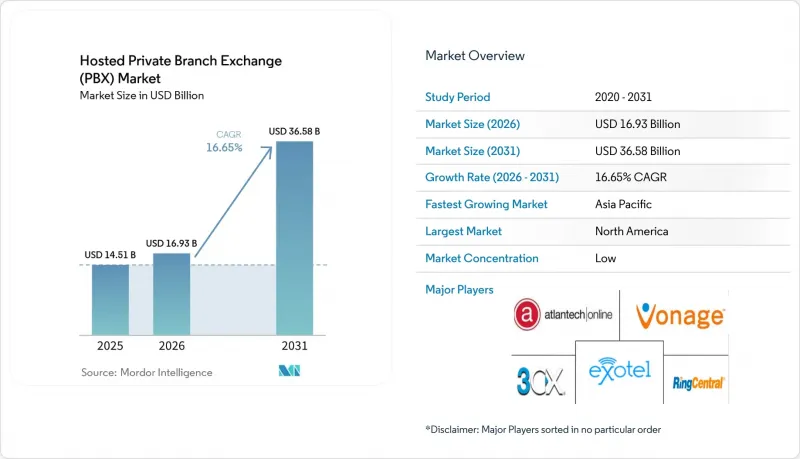
根據 Mordor Intelligence 預測,託管 PBX(專用交換器)市場規模將從 2025 年的 145.1 億美元成長到 2026 年的 169.3 億美元,然後在 2031 年達到 365.8 億美元,2026 年至 2031 年的複合年成長率為 16.5%。
本報告按組件(解決方案和服務)、企業規模(中小企業和大型企業)、應用(整合通訊與協作、行動辦公室和自帶設備辦公室等)、最終用戶行業(銀行、金融服務和保險、製造業、零售業和電子商務等)以及地區進行細分。市場預測以美元計價。
全球託管式PBX(專用交換器)市場趨勢與洞察
自帶設備辦公室(BYOD)帶來的需求激增正在重塑企業的行動辦公室策略。
美國中型企業正逐步淘汰桌上型電話,轉而採用「行動優先」的雲端語音服務,讓員工在個人行動電話上使用公司電話號碼。 Cavell Group預測,行動雲端服務用戶數將從2022年的100萬增至2027年的730萬,證實了託管PBX市場如今正由智慧型手機而非傳統電話主導。企業將固定通訊和行動通訊的整合視為一項關鍵功能,因為它簡化了合規流程,即使員工遠端辦公也能維持通話品質。 AT&T的「Webex Go雲端語音」方案展示了通訊業者如何整合網路覆蓋和協作軟體,從而彌合辦公室用戶和現場用戶之間的差距。
5G 網路消除了雲端語音部署的服務品質障礙。
獨立組網的5G網路將延遲控制在10毫秒以下,並提供關鍵任務語音通訊所需的保證頻寬。中國、韓國和印度的企業預計,基於5G技術的工業4.0應用場景將帶來高達20%的投資報酬率(ROI),這推動了託管式PBX(專用交換器)在現場協調中的應用。隨著可靠的無線連線消除了工廠和物流中心對雲端通話的最後顧慮,託管式PBX市場正在不斷擴張。通訊服務供應商現在將PBX許可證和5G切片打包銷售,從而允許在同一份合約中同時涵蓋網路連線和語音通訊。
資料主權要求對多租戶架構提出了挑戰。
《歐洲經濟共同體指令》(EECC Directive) 和《一般資料保護規範》(GDPR) 要求服務提供者將語音錄音儲存在歐盟境內,並建立詳細的使用者同意收集流程。多租戶 PBX 架構必須以國家/地區明確分類資料區域;否則,可能面臨高達全球營業額 4% 的罰款。為了解決這個問題,託管 PBX 市場的供應商正在建立區域資料中心,並提供客戶管理的加密金鑰。雖然這會增加營運成本,但卻能確保跨境功能保持一致。
細分市場分析
即使到了2025年,該解決方案預計仍將維持託管PBX(專用交換器)市場66.20%的收入佔有率。這主要歸功於市場對核心通話控制、自動應答和語音信箱的持續需求。然而,隨著企業尋求諮詢和託管支持,將雲端語音服務整合到其複雜的應用堆疊中,服務業預計將以17.45%的年成長率成長。專業服務團隊將負責部署準備評估、連接埠號碼配置和使用者培訓,而託管服務團隊將負責監控服務品質並執行相關策略。這種轉變將推動託管PBX產業從純粹的SaaS模式轉向基於績效的合約模式,供應商也將更加重視客戶成功指標。
目前,人工智慧正在實現自動化配置和異常檢測,使服務合作夥伴能夠保證 99.999% 的運轉率,即使在全球範圍內也是如此。 8x8 的「體驗通訊平台」展示瞭如何從單一管理介面整合語音、視訊、簡訊和 API,這種整合正在提高託管服務的附加率 [eclipsewholesale.co.uk]。託管服務的託管 PBX(專用交換機)市場預計將從 2025 年的 49 億美元成長到 2031 年的 129.4 億美元,這反映出市場需求主導以服務等級協定 (SLA) 為支撐的專業技術方向發展。
擁有 51 至 250 個席位的中小型企業 (SME) 預計在 2025 年將貢獻 61.10% 的收入。這是因為雲端語音服務消除了先前阻礙中小企業發展的巨額資本支出。固定的月費包含升級和安全措施,使財務部門更容易預測現金流。當這些公司開設分店時,管理員可以在幾分鐘內添加席位,從而保持高生產力。目前,大型企業正經歷最快的成長,複合年成長率 (CAGR) 為 16.70%,世界各地的 IT 部門正在將數十個本地 PBX 系統整合到一個租戶中,以便在全球範圍內應用一致的策略。
預計到2031年,大型企業的託管式PBX(專用交換器)市場規模將達到94.2億美元,進而縮小與中型企業市場的歷史差距。儘管目前針對微企業的服務仍不足,但分析師估計,每位使用者平均每月收入可達40至50美元,這表明一旦實現用戶註冊流程自動化,盈利將會提升。新參與企業正積極湧入這一細分市場,利用免費試用和自助服務模式,使得老牌企業難以固步自封,繼續依賴大型客戶。
區域分析
北美擁有成熟的寬頻環境、寬鬆的自帶設備 (BYOD) 政策以及雲端優先的採購策略,預計將引領市場,到 2025 年將佔據 34.70% 的市場佔有率。美國監管機構強制要求緊急呼叫回退至公共交換電話網路 (PSTN),雖然增加了成本,但也提高了可靠性。服務提供者正透過地理冗餘的中繼線路和 E911 服務配置來應對這項挑戰,從一開始就確保合規性。人工智慧驅動的語音分析技術正在迅速普及,將客戶對話轉化為數據,以改善服務。
亞太地區正經歷最快成長,複合年成長率達17.10%。中國和韓國的大規模5G部署正在緩解延遲問題,而印度的「數位優先」新創公司則選擇按月訂閱而非一次性購買設備。日本大型企業集團強烈要求開放API以避免廠商鎖定,並推動託管PBX市場朝向基於標準的擴展模式發展。政府推出的經濟獎勵策略,津貼雲端運算應用,正加速東南亞地區的雲端運算普及。
在歐洲,商業機會與監管之間存在著一種平衡。 TDM交換機的逐步淘汰以及昂貴的ISDN線路的存在,迫使中小企業遷移到SIP中繼和託管撥號方案;與此同時,GDPR(一般資料保護規則)迫使服務提供者投資於本地儲存和符合法律規定的竊聽。儘管面臨這些挑戰,歐洲託管PBX(專用交換器)市場預計將從2025年的43億美元成長到2031年的94.7億美元。各國旨在將光纖擴展到農村地區的寬頻計劃,預計將在本世紀後半葉縮小都市區通訊品質差距。
其他好處:
- Excel格式的市場預測(ME)表
- 3個月的分析師支持
目錄
第1章:引言
- 研究假設和市場定義
- 調查範圍
第2章:調查方法
第3章執行摘要
第4章 市場狀況
- 市場概覽
- 市場促進因素
- 受 BYOD(自備設備辦公室)趨勢的推動,北美中型企業對行動 PBX 的需求激增。
- 在亞洲部署5G獨立組網,以實現對服務品質要求較高的雲端語音服務
- 歐洲中小企業從 TDM 轉向 SIP 的轉變正在降低整體擁有成本。
- 疫情後的混合辦公政策正加速紐澳地區公司雲端通訊系統的更新週期。
- 中東一級通訊業者提供的 UCaaS 套餐正在推動託管授權的普及。
- 整合到託管 PBX(專用交換機)中的 AI 語音分析功能正在吸引拉丁美洲客服中心的注意。
- 市場限制因素
- 歐盟 GDPR 資料居住要求限制了多租戶語音儲存。
- 印度一線城市以外地區最後一公里光纖普及率低,導致服務品質問題。
- 在美國,有關 PSTN 回退的監管要求仍然有效,這推高了合規成本。
- 日本大型企業對專有API相關的供應商鎖定問題表示擔憂
- 價值鏈分析
- 監理展望
- 技術展望
- 波特五力分析
- 投資分析
第5章 市場規模與成長預測
- 基於組件的分割
- 解決方案
- 服務
- 託管服務
- 專業服務
- 網路和IT服務
- 按公司規模細分
- 小型企業
- 大公司
- 按應用程式進行細分
- 整合通訊與協作
- 促進行動辦公室和自備設備辦公室(BYOD)的普及
- 客服中心
- SIP中繼和呼叫路由
- 按最終用途行業進行細分
- BFSI
- 製造業
- 零售與電子商務
- 醫療保健和生命科學
- 政府/公共部門
- IT/通訊
- 教育
- 物流/運輸
- 飯店業
- 其他行業
- 區域分類
- 北美洲
- 美國
- 加拿大
- 墨西哥
- 南美洲
- 巴西
- 阿根廷
- 其他南美國家
- 歐洲
- 英國
- 德國
- 法國
- 義大利
- 西班牙
- 其他歐洲國家
- 北歐的
- 瑞典
- 挪威
- 丹麥
- 芬蘭
- 冰島
- 中東
- 沙烏地阿拉伯
- 阿拉伯聯合大公國
- 土耳其
- 以色列
- 其他中東國家
- 非洲
- 南非
- 奈及利亞
- 埃及
- 肯亞
- 其他非洲國家
- 亞太地區
- 中國
- 印度
- 日本
- 韓國
- ASEAN
- 其他亞太國家
- 北美洲
第6章 競爭情勢
- 市場集中度
- 策略趨勢
- 市佔率分析
- 公司簡介
- Mitel Networks Corp
- Avaya Inc
- Amazon Web Services(Amazon.com Inc)
- Microsoft Corporation
- 3CX
- Exotel Techcom Pvt Ltd
- Vonage
- RingCentral Inc
- Atlantech Online Inc
- Clearly Core Inc
- OnePipe Telecom
- Zaplee Inc
- G12 Communications LLC
- Yeastar Information Technology Co Ltd
- 8x8 Inc
- Cisco Systems Inc
- Nextiva Inc
- Twilio Inc
- Zoom Video Communications Inc
- Ooma Inc
第7章 市場機會與未來展望
According to Mordor Intelligence, the hosted private branch exchange market size is expected to grow from USD 14.51 billion in 2025 to USD 16.93 billion in 2026 and is forecast to reach USD 36.58 billion by 2031 at 16.65% CAGR over 2026-2031.
This report is Segmented by Component (Solutions and Services), Enterprise Size (Small and Medium Enterprises and Large Enterprises), Application (Unified Communication and Collaboration, Mobility and BYOD Enablement, and More), End-User Industry (BFSI, Manufacturing, Retail and E-Commerce, and More) and Geography. The Market Forecasts are Provided in Terms of Value (USD).
Global Hosted Private Branch Exchange (PBX) Market Trends and Insights
Surge in BYOD-Driven Demand Reshapes Enterprise Mobility Strategy
Mid-market firms in the United States are retiring desk phones in favor of mobile-first cloud voice that keeps corporate numbers on personal handsets. Cavell Group forecasts mobile-enabled cloud seats rising from 1 million in 2022 to 7.3 million by 2027, confirming that the hosted private branch exchange market is now shaped by smartphones rather than handsets. Businesses see fixed-mobile convergence as an essential feature because it simplifies compliance and preserves call quality while staff work remotely. AT&T's Cloud Voice with Webex Go shows how carriers integrate network reach with collaboration software to remove the divide between office and field users.
5G Networks Eliminate QoS Barriers to Cloud Voice Adoption
Standalone 5G is cutting latency below 10 ms and delivering the guaranteed bandwidth that mission-critical voice needs. Enterprises in China, South Korea, and India expect up to 20% returns from 5G-enabled Industry 4.0 use cases, which fuels the adoption of hosted PBX for shop-floor coordination. The hosted private branch exchange market gains because reliable wireless links remove the last objection to cloud calling in factories and logistics hubs. Communications service providers now package PBX seats with 5G slices so a single contract covers connectivity and voice.
Data Sovereignty Requirements Challenge Multi-Tenant Architectures
The EECC Directive and GDPR oblige providers to store voice recordings inside the EU and to furnish detailed consent workflows. Multi-tenant PBX architectures must carve out country-specific data zones or risk fines up to 4% of global turnover. Vendors in the hosted private branch exchange market respond by opening regional data centers and offering customer-managed encryption keys, which raises operating costs yet preserves feature parity across borders.
Other drivers and restraints analyzed in the detailed report include:
- SIP Trunking Migration Delivers Transformative Cost Benefits
- Hybrid Work Models Drive Comprehensive Communication Refresh
- Infrastructure Gaps Impede Quality Service Delivery in Emerging Markets
For complete list of drivers and restraints, kindly check the Table Of Contents.
Segment Analysis
Solutions continued to command a 66.20% revenue share of the hosted private branch exchange market in 2025, thanks to evergreen demand for core call control, auto-attendant, and voicemail. However, services are set to grow 17.45% annually as enterprises seek advisory and managed support to weave cloud voice into complex application stacks. Professional services teams run readiness assessments, port numbers, and train users, while managed services teams monitor quality of service and enforce policy. This shift broadens the hosted private branch exchange industry from pure SaaS toward outcome-based contracts, aligning providers with customer success metrics.
AI now automates provisioning and anomaly detection, letting service partners guarantee 99.999% uptime even at a global scale. 8x8's eXperience Communications Platform demonstrates how a single management pane unifies voice, video, SMS, and APIs; such consolidation bolsters attach rates for managed services [eclipsewholesale.co.uk]. The hosted private branch exchange market size for managed services is projected to expand from USD 4.9 billion in 2025 to USD 12.94 billion by 2031, reflecting this demand-led swing toward expertise backed by SLAs.
SMEs with 51-250 seats held 61.10% of 2025 revenue because cloud voice removes the capital spikes that traditionally deterred smaller firms. Fixed monthly pricing covers upgrades and security, letting finance teams predict cash flow. As these firms open branch offices, administrators add seats in minutes, keeping productivity high. Large enterprises now show the fastest growth at 16.70% CAGR as global IT departments consolidate dozens of local PBXs into a single tenant that enforces consistent policies worldwide.
The hosted private branch exchange market size for large enterprises is forecast to reach USD 9.42 billion by 2031, closing the historical gap with mid-market spending. Micro-enterprises remain underserved; yet analysts peg average monthly revenue at USD 40-50 per seat, proving profitability when onboarding is automated. New entrants use freemium trials and self-service setup to attack this niche, preventing incumbents from coasting on top-tier accounts.
Complete Report Scope:
- Segmentation by Component
- Solution
- Services
- Managed Services
- Professional Services
- Network and IT Services
- Segmentation by Enterprise Size
- Small and Medium Enterprises
- Large Enterprises
- Segmentation by Application
- Unified Communication and Collaboration
- Mobility and BYOD Enablement
- Contact Center
- SIP Trunking and Call Routing
- Segmentation by End-Use Industry
- BFSI
- Manufacturing
- Retail and E-commerce
- Healthcare and Life Sciences
- Government and Public Sector
- IT and Telecom
- Education
- Logistics and Transportation
- Hospitality
- Other Industries
- Segmentation by Geography
- North America
- United States
- Canada
- Mexico
- South America
- Brazil
- Argentina
- Rest of South America
- Europe
- United Kingdom
- Germany
- France
- Italy
- Spain
- Rest of Europe
- Nordics
- Sweden
- Norway
- Denmark
- Finland
- Iceland
- Middle East
- Saudi Arabia
- United Arab Emirates
- Turkey
- Israel
- Rest of Middle East
- Africa
- South Africa
- Nigeria
- Egypt
- Kenya
- Rest of Africa
- Asia Pacific
- China
- India
- Japan
- South Korea
- ASEAN
- Rest of Asia Pacific
- North America
Geography Analysis
North America led with 34.70% of 2025 revenue, buoyed by mature broadband, permissive BYOD policies, and cloud-first procurement. U.S. regulators compel PSTN fall-back for emergency calls, adding cost but cementing trust. Providers answer with geo-redundant trunks and E911 provisioning that complies out of the box. AI-driven voice analytics gain rapid traction, turning customer conversations into data that fuels service improvements.
Asia Pacific is the fastest climber at a 17.10% CAGR. Mass 5G coverage in China and South Korea removes latency complaints, while India's digital-first start-ups sign monthly subscriptions instead of buying gear. Japanese conglomerates insist on open APIs to avoid lock-in, pushing the hosted private branch exchange market toward standards-based extensions. Government stimulus packages that co-fund cloud adoption amplify uptake across Southeast Asia.
Europe balances opportunity with regulation. TDM switch shut-offs and expensive ISDN lines push SMBs toward SIP trunks and hosted dial plans, yet GDPR forces providers to invest in in-region storage and lawful intercept. Despite the burden, the hosted private branch exchange market size in Europe will grow from USD 4.3 billion in 2025 to USD 9.47 billion in 2031. National broadband plans that extend fiber to rural zones promise to shrink the urban-rural quality divide by the second half of the decade.
- Mitel Networks Corp
- Avaya Inc
- Amazon Web Services (Amazon.com Inc)
- Microsoft Corporation
- 3CX
- Exotel Techcom Pvt Ltd
- Vonage
- RingCentral Inc
- Atlantech Online Inc
- Clearly Core Inc
- OnePipe Telecom
- Zaplee Inc
- G12 Communications LLC
- Yeastar Information Technology Co Ltd
- 8x8 Inc
- Cisco Systems Inc
- Nextiva Inc
- Twilio Inc
- Zoom Video Communications Inc
- Ooma Inc
Additional Benefits:
- The market estimate (ME) sheet in Excel format
- 3 months of analyst support
TABLE OF CONTENTS
1 INTRODUCTION
- 1.1 Study Assumptions and Market Definition
- 1.2 Scope of the Study
2 RESEARCH METHODOLOGY
3 EXECUTIVE SUMMARY
4 MARKET LANDSCAPE
- 4.1 Market Overview
- 4.2 Market Drivers
- 4.2.1 Surge in BYOD-driven demand for mobile-integrated PBX among North-American mid-market firms
- 4.2.2 Roll-out of 5G standalone networks enabling QoS-sensitive cloud voice in Asia
- 4.2.3 Migration from TDM to SIP trunking across European SMBs lowering total cost of ownership
- 4.2.4 Post-pandemic hybrid-work policies accelerating cloud communication refresh cycles in ANZ enterprises
- 4.2.5 UCaaS bundling incentives offered by tier-1 carriers in the Middle-East driving hosted seat uptake
- 4.2.6 AI-powered voice analytics embedded in hosted PBX attracting contact-centres in Latin-America
- 4.3 Market Restraints
- 4.3.1 Data-residency mandates under EU GDPR restricting multi-tenant voice storage
- 4.3.2 Limited last-mile fiber penetration outside Tier-1 Indian cities causing QoS issues
- 4.3.3 Persistent PSTN-fallback regulatory requirements inflating compliance cost in the U.S.
- 4.3.4 Vendor lock-in concerns linked to proprietary APIs among Japanese large enterprises
- 4.4 Value Chain Analysis
- 4.5 Regulatory Outlook
- 4.6 Technological Outlook
- 4.7 Porter's Five Forces Analysis
- 4.7.1 Bargaining Power of Suppliers
- 4.7.2 Bargaining Power of Buyers
- 4.7.3 Threat of New Entrants
- 4.7.4 Threat of Substitutes
- 4.7.5 Intensity of Competitive Rivalry
- 4.8 Investment Analysis
5 MARKET SIZE AND GROWTH FORECASTS (VALUE)
- 5.1 Segmentation by Component
- 5.1.1 Solution
- 5.1.2 Services
- 5.1.2.1 Managed Services
- 5.1.2.2 Professional Services
- 5.1.2.3 Network and IT Services
- 5.2 Segmentation by Enterprise Size
- 5.2.1 Small and Medium Enterprises
- 5.2.2 Large Enterprises
- 5.3 Segmentation by Application
- 5.3.1 Unified Communication and Collaboration
- 5.3.2 Mobility and BYOD Enablement
- 5.3.3 Contact Center
- 5.3.4 SIP Trunking and Call Routing
- 5.4 Segmentation by End-Use Industry
- 5.4.1 BFSI
- 5.4.2 Manufacturing
- 5.4.3 Retail and E-commerce
- 5.4.4 Healthcare and Life Sciences
- 5.4.5 Government and Public Sector
- 5.4.6 IT and Telecom
- 5.4.7 Education
- 5.4.8 Logistics and Transportation
- 5.4.9 Hospitality
- 5.4.10 Other Industries
- 5.5 Segmentation by Geography
- 5.5.1 North America
- 5.5.1.1 United States
- 5.5.1.2 Canada
- 5.5.1.3 Mexico
- 5.5.2 South America
- 5.5.2.1 Brazil
- 5.5.2.2 Argentina
- 5.5.2.3 Rest of South America
- 5.5.3 Europe
- 5.5.3.1 United Kingdom
- 5.5.3.2 Germany
- 5.5.3.3 France
- 5.5.3.4 Italy
- 5.5.3.5 Spain
- 5.5.3.6 Rest of Europe
- 5.5.4 Nordics
- 5.5.4.1 Sweden
- 5.5.4.2 Norway
- 5.5.4.3 Denmark
- 5.5.4.4 Finland
- 5.5.4.5 Iceland
- 5.5.5 Middle East
- 5.5.5.1 Saudi Arabia
- 5.5.5.2 United Arab Emirates
- 5.5.5.3 Turkey
- 5.5.5.4 Israel
- 5.5.5.5 Rest of Middle East
- 5.5.6 Africa
- 5.5.6.1 South Africa
- 5.5.6.2 Nigeria
- 5.5.6.3 Egypt
- 5.5.6.4 Kenya
- 5.5.6.5 Rest of Africa
- 5.5.7 Asia Pacific
- 5.5.7.1 China
- 5.5.7.2 India
- 5.5.7.3 Japan
- 5.5.7.4 South Korea
- 5.5.7.5 ASEAN
- 5.5.7.6 Rest of Asia Pacific
- 5.5.1 North America
6 COMPETITIVE LANDSCAPE
- 6.1 Market Concentration
- 6.2 Strategic Moves
- 6.3 Market Share Analysis
- 6.4 Company Profiles (includes Global-level Overview, Market-level Overview, Core Segments, Financials, Strategic Information, Market Rank/Share, Products and Services, Recent Developments)
- 6.4.1 Mitel Networks Corp
- 6.4.2 Avaya Inc
- 6.4.3 Amazon Web Services (Amazon.com Inc)
- 6.4.4 Microsoft Corporation
- 6.4.5 3CX
- 6.4.6 Exotel Techcom Pvt Ltd
- 6.4.7 Vonage
- 6.4.8 RingCentral Inc
- 6.4.9 Atlantech Online Inc
- 6.4.10 Clearly Core Inc
- 6.4.11 OnePipe Telecom
- 6.4.12 Zaplee Inc
- 6.4.13 G12 Communications LLC
- 6.4.14 Yeastar Information Technology Co Ltd
- 6.4.15 8x8 Inc
- 6.4.16 Cisco Systems Inc
- 6.4.17 Nextiva Inc
- 6.4.18 Twilio Inc
- 6.4.19 Zoom Video Communications Inc
- 6.4.20 Ooma Inc
7 MARKET OPPORTUNITIES AND FUTURE OUTLOOK
- 7.1 White-space and Unmet-need Assessment

 固定和移動套餐:針對家庭的策略。
 虛擬PBX市場:2026-2032年全球市場預測(依服務類型、定價模式、產業、企業規模及部署模式分類)IP PBX市場:按組件、技術、收費模式、應用、部署類型、產業、組織規模和最終用戶分類-2026-2032年全球市場預測託管專用交換機市場:按組件、定價模式、組織規模、部署類型和最終用戶分類-2026-2032年全球市場預測
 2026年全球固移融合市場報告2026年全球託管式專用交換器市場報告企業虛擬電話號碼市場:按號碼類型、部署模式、定價模式、通路、用例、應用程式和最終用戶分類,全球預測,2026-2032年
 固移融合市場規模、佔有率及成長分析(依解決方案類型、部署模式、組件、公司規模及地區分類)-2026-2033年產業預測
 虛擬PBX市場規模、佔有率和成長分析(按組件、組織規模、最終用戶和地區分類)-2026-2033年產業預測
 託管式PBX市場規模、佔有率和成長分析:按組件、組織規模、應用、垂直產業和地區分類-2026年至2033年產業預測