


 |
市場調查報告書
商品編碼
2073490
穿戴式運算設備:市場佔有率分析、產業趨勢與統計及成長預測(2026-2031 年)Wearable Computing Devices - Market Share Analysis, Industry Trends & Statistics, Growth Forecasts (2026 - 2031) |
||||||

※ 本網頁內容可能與最新版本有所差異。詳細情況請與我們聯繫。
根據 Mordor Intelligence 估計,穿戴式運算裝置的市場規模在 2026 年將達到 954 億美元,高於 2025 年的 821.1 億美元,預計到 2031 年將達到 2019.2 億美元。
預計 2026 年至 2031 年的複合年成長率為 16.18%。
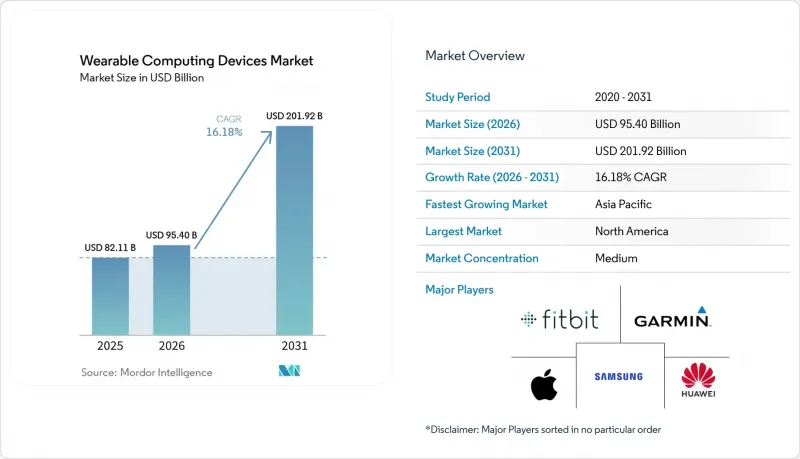
本報告按產品類型(智慧型手錶、智慧穿戴裝置、外骨骼、其他)、最終用戶(健身和健康、資訊娛樂、其他)、作業系統(watchOS、鴻蒙作業系統、其他)、連接技術(藍牙、蜂窩網路(LTE、5G)、Wi-Fi、其他)和地區進行分類。
全球穿戴式運算設備市場趨勢與洞察
一款採用微型感應器和出色電池效率的晶片組。
TDK的固態電池能量密度高達1000Wh/L,在縮小尺寸的同時延長了穿戴式耳機和智慧型手錶的運作力。晶片封裝技術的進步使得多個感測器能夠安裝在單一基板上,而蘋果的專利則展示了一種能夠根據使用者狀況動態調節功率和發熱量的技術,從而在不增加機殼厚度的情況下提高效率。清華大學開發的水系銨離子微型電池具有更安全、更靈活的化學成分,適用於與運作接觸的設備。這些突破將使持續健康指標監測以及低功耗的清晰微型LED顯示器成為可能。因此,日常配件中的持續監測功能有望得到更廣泛的應用。
健康監測的消費文化日益盛行
穿戴式裝置在檢測臨床層級事件方面的能力日益增強,例如,一款消費者佩戴的智慧手錶因檢測到異常心率而備受關注,最終促成了患者被診斷出患有心碎症候群(Takotsubo心肌病)。 Galaxy AI現在推出名為「能量評分」的洞察功能,結合睡眠、壓力和活動量等因素進行分析,從而提供個人化的健康指導。香港大學開發的感測器內運算原型可在本地處理生物訊號,降低延遲並最大限度地減少敏感資料線上外洩的風險。 MOTIVATE-T2D研究結果顯示,配戴運動追蹤器的糖尿病患者在運動計畫的依從性方面有所提高,並伴隨可量化的健康改善。這些進步正在增強消費者的信心,並使積極主動的自我護理成為日常生活的一部分。
對資料隱私和網路安全的擔憂
一項調查顯示,92%的用戶不清楚如何共用穿戴式裝置數據,導致他們在共用高度敏感的指標時猶豫不決。 HIPAA(健康保險流通與責任法案)對消費性設備的豁免條款造成了執法漏洞,而醫療保健領域的資料外洩事件在過去五年中增加了55%,凸顯了資料外洩的高風險。澳洲人權委員會警告稱,嬰兒穿戴式裝置中神經資料外洩的風險日益增加,並呼籲對隱私法進行現代化改革。區塊鏈原型可以將未授權存取減少45%,並將檢測時間縮短至10天以內,但成本和可擴展性仍然是限制因素。市場發展動力取決於透明的同意流程和「安全設計」架構。
細分市場分析
到2025年,智慧型手錶將佔據穿戴式運算設備市場45.30%的佔有率。這主要得益於其全面的健康儀錶板和廣泛的第三方應用程式生態系統,這些都確保了日常效用。隨著BioActive和其他多模態感測器能夠測量除心率之外的代謝指標,源自智慧型手錶的穿戴式運算設備市場規模預計將穩定成長。耳戴式設備預計到2031年將以18.02%的複合年成長率成長,其隱藏的外形設計以及體溫、心率和語音控制功能的加入推動了其市場成長。工業頭戴式顯示器透過將數位指令疊加到螢幕上,在造船和現場服務領域鞏固了其地位,顯著提高了生產效率。智慧穿戴裝置仍處於早期發展階段,但其在復健領域的應用案例正在不斷推進,例如在電子皮膚原型中,軟性印刷電路和嵌入纖維的電極的應用就體現了這一點。健身追蹤器正面臨來自入門級手錶的價格壓力,這些手錶以略高的價格提供類似的測量功能。
在穿戴式運算設備產業,人體攝影機和外骨骼正被應用於公共安全和製造業疲勞緩解等專業領域。新參與企業正專注於開放API,以便將影片串流和動態資料整合到企業儀錶板中。智慧眼鏡的應用範圍正在擴展到倉儲和醫療工作流程,從而減少人工掃描所需的時間和錯誤率。供應商正投資研發超低功耗晶片組,以確保處方鏡片型號滿足光學清晰度和電池續航時間的要求。總體而言,產品多元化正在擴大潛在市場規模,同時又不削弱智慧型手錶的主導地位,從而支持整個穿戴式運算裝置市場的多層次成長。
到2025年,健身和健康領域將佔穿戴式運算裝置市場規模的38.40%,這主要得益於消費者對計步、睡眠階段分析和手錶指導等功能的廣泛興趣。與訂閱式健身內容的整合正在增強使用者留存率。醫療保健應用預計將以18.7%的複合年成長率成長,隨著透過遠端患者監護項目進行持續生命徵象測量的保險覆蓋範圍擴大,相關設備正從健康配件轉變為保險涵蓋的臨床工具。對於慢性疾病患者,透過穿戴式裝置發出的警報和遠距醫療指導,血糖值控制已顯著改善。醫院正在將貼片式感測器引入術後護理,以減少床邊檢查次數,從而節省醫護人員的時間。
在資訊娛樂領域,身臨其境型音訊技術保持著強勁的發展動能;而在工業領域,環境監測器正被廣泛部署,以減少危險區域的事故發生。國防領域的應用包括生物識別和情境察覺疊加。穿戴式運算設備產業也正向教育領域延伸,注意力追蹤頭戴裝置正被用於建構自適應課程。隨著需求的融合,供應商需要同時滿足IEC醫療安全標準和環境耐受性(入侵防護等級),這進一步提高了設計和品質保證的專業化要求。
區域分析
到2025年,北美將維持34.10%的穿戴式計算設備市場佔有率,這得益於保險公司將此類設備納入健康獎勵,以及臨床醫生積極推廣遠端監測。蘋果、三星和新興的健康科技公司正受益於涵蓋持續生命徵象監測的報銷代碼,這提高了消費者支付額外自付費用的意願。加強資料收集監測迫使目前總部位於美國的供應商採用符合HIPAA標準的雲端技術和透明的知情同意流程。醫療系統的試點計畫表明,配戴連網貼片的心臟病患者的再入院率有所降低,這進一步提升了醫院採購此類設備的興趣。
亞太地區是成長最快的地區,預計到2031年複合年成長率將達到16.25%。印度本土品牌正透過提供智慧型手錶低於30美元、具備血氧和心率警報等功能的智慧手錶來擴大目標消費族群。中國正大力推動醫療健康數位化一體化,為慢性病遠距監測提供報銷,促進了醫療機構對醫療腕帶的採購。在日本,具有降溫功能的穿戴式裝置備受關注,這些裝置能夠提昇在潮濕環境下工作的人們的舒適度。同時,韓國的零件供應叢集正在支持全球生產規模的擴張。進口關稅促使原始設備製造商(OEM)將組裝基地多元化,轉移到越南和印度尼西亞,以降低成本波動的影響。在歐洲,儘管普及速度較為謹慎,但市場仍在穩定成長。 GDPR合規性增強了使用者信任,但也增加了文件負擔。各國醫療系統正在為慢性疾病患者提供設備補貼,但各成員國的報銷方案差異很大。在中東和非洲,富裕的海灣市場存在潛在需求,智慧健身已成為一種身分象徵,這與撒哈拉以南非洲地區基礎設施面臨的挑戰形成鮮明對比。在拉丁美洲,隨著健身文化的普及和智慧型手機的日益普及,巴西和墨西哥等國的在局部需求也日益成長。在所有地區,穿戴式運算設備市場的發展都持續受到醫療保健政策、可支配收入和通訊基礎設施成熟度的影響。
其他好處
- Excel格式的市場預測(ME)表
- 3個月的分析師支持
目錄
第1章:引言
- 研究假設和市場定義
- 調查範圍
第2章:調查方法
第3章執行摘要
第4章 市場動態
- 市場概覽
- 市場促進因素
- 一款採用微型感應器和出色電池效率的晶片組。
- 日益成長的健康管理消費文化
- 智慧型手機生態系統整合與超級應用
- 基於保險的遠距健康獎勵
- 用於現場工人安全的免手持式擴增實境穿戴設備
- 突破性的非侵入式代謝監測(例如,血糖值)
- 市場限制因素
- 對資料隱私和網路安全的擔憂
- 電池壽命和熱設計限制
- 關於醫用級產品的功效和效果的監管規定存在模糊之處。
- 先進元件(微型LED、SiP)供應瓶頸
- 價值鏈分析
- 監理情勢
- 技術展望
- 波特五力分析
- 投資分析
第5章 市場規模與成長預測
- 依產品類型
- 智慧型手錶
- 頭戴式顯示器
- 智慧服裝
- 耳戴式(可聽見的)
- 健身追蹤器
- 執法記錄儀
- 外骨骼
- 智慧眼鏡
- 最終用戶
- 健身與健康
- 醫療保健
- 資訊娛樂
- 工業與國防
- 其他
- 透過作業系統
- watchOS
- Android/Wear OS
- HarmonyOS
- RTOS
- 專有作業系統/其他
- 透過連接技術
- Bluetooth
- 蜂窩網路(LTE、5G)
- Wi-Fi
- NFC
- Ultra-Wideband
- 按地區
- 北美洲
- 美國
- 加拿大
- 墨西哥
- 南美洲
- 巴西
- 阿根廷
- 其他南美國家
- 歐洲
- 英國
- 德國
- 法國
- 義大利
- 西班牙
- 俄羅斯
- 其他歐洲國家
- 亞太地區
- 中國
- 日本
- 印度
- 韓國
- 澳洲
- 東南亞
- 亞太其他地區
- 中東和非洲
- 中東
- 沙烏地阿拉伯
- 阿拉伯聯合大公國
- 土耳其
- 其他中東國家
- 非洲
- 南非
- 奈及利亞
- 肯亞
- 其他非洲地區
- 中東
- 北美洲
第6章 競爭情勢
- 市場集中度
- 策略趨勢
- 市佔率分析
- 公司簡介
- Apple Inc.
- Samsung Electronics Co. Ltd.
- Xiaomi Corp.
- Huawei Technologies Co. Ltd.
- Garmin Ltd.
- Fitbit LLC(Google)
- Sony Corporation
- Microsoft Corporation
- Bose Corporation
- Huami Corp.(Amazfit)
- Withings
- Medtronic PLC
- AIQ Smart Clothing Inc.
- Sensoria Inc.
- GoPro Inc.
- Transcend Information Inc.
- Ekso Bionics Holdings Inc.
- Cyberdyne Inc.
- OMRON Healthcare Inc.
- Nuheara Limited
- Oppo Electronics Corp.
- Polar Electro Oy
- Vivo(BBK Electronics)
- Realme
- Zepp Health
- Motorola Mobility LLC
- Lenovo Group Ltd.
- Jabra(GN Audio)
- Valencell Inc.
第7章 市場機會與未來展望
According to Mordor Intelligence, wearable computing devices market size in 2026 is estimated at USD 95.4 billion, growing from 2025 value of USD 82.11 billion with 2031 projections showing USD 201.92 billion, growing at 16.18% CAGR over 2026-2031.
This report is Segmented by Product Type (Smartwatches, Smart Clothing, Exoskeletons, and More), End User (Fitness and Wellness, Infotainment, and More), Operating System (watchOS, Harmonyos, and More), Connectivity Technology (Bluetooth, Cellular (LTE, 5G), Wi-Fi and More), and Geography.
Global Wearable Computing Devices Market Trends and Insights
Sensor Miniaturization and Battery-Efficient Chipsets
Solid-state batteries from TDK achieve 1,000 Wh/l energy density, cutting size while extending run-time for hearables and watches. Chip packaging advances allow multiple sensors on one substrate, and Apple patents show dynamic power and thermal adjustment based on user context, boosting efficiency without thicker casings. Aqueous ammonium-ion micro batteries developed at Tsinghua University demonstrate safer and flexible chemistry suitable for skin-contact devices. These leaps enable always-on health metrics plus vivid micro-LED displays that draw minimal power. The outcome is a broader acceptance of continuous monitoring in everyday accessories.
Rising Consumer Health-Monitoring Culture
Wearables increasingly detect clinical-grade events, highlighted when a consumer's watch flagged cardiac abnormalities later diagnosed as takotsubo cardiomyopathy. Galaxy AI now delivers "Energy Score" insights that contextualize sleep, stress, and activity for personal coaching. In-sensor computing prototypes from the University of Hong Kong process bio-signals locally, lowering latency and reducing exposure of sensitive data online. Evidence from the MOTIVATE-T2D study shows enhanced adherence to exercise regimens among diabetes patients equipped with trackers, supporting quantifiable health gains. These developments deepen consumer trust and normalize proactive self-care.
Data-Privacy and Cybersecurity Concerns
A study shows 92% of users lack clarity on how wearable data is shared, fueling hesitation about sharing sensitive metrics. HIPAA exclusions for consumer devices leave enforcement gaps, and healthcare breaches rose 55% over five years, underlining exposure. The Australian Human Rights Commission warns of heightened neural-data risk in child-oriented wearables, prompting calls for privacy law modernization. Blockchain prototypes reduce unauthorized access by 45% and cut detection time to under 10 days, but cost and scalability remain barriers. Market momentum hinges on transparent consent flows and security-by-design architectures.
Other drivers and restraints analyzed in the detailed report include:
- Smartphone-Ecosystem Integration and Super-Apps
- Breakthrough Non-Invasive Metabolic Monitoring
- Battery Life and Thermal-Design Limits
For complete list of drivers and restraints, kindly check the Table Of Contents.
Segment Analysis
Smartwatches accounted for 45.30% of wearable computing devices market share in 2025, anchored by comprehensive health dashboards and extensive third-party app ecosystems that secure daily relevance. The wearable computing devices market size attributed to smartwatches is poised to grow steadily as BioActive and other multi-modal sensors enable metabolic readings beyond heart rate. Ear-worn devices, advancing at 18.02% CAGR to 2031, benefit from discreet form factors and the addition of temperature, heart-rate and voice command functions. Industrial head-mounted displays gain ground in shipbuilding and field service by overlaying digital instructions, driving measurable productivity gains. Smart clothing remains nascent, though flexible printed circuits and textile-embedded electrodes from e-skin prototypes advance rehabilitation use cases. Fitness trackers feel price pressure from entry-level watches that bundle similar metrics at little premium.
The wearable computing devices industry sees body-worn cameras and exoskeletons serving specialist verticals such as public safety and manufacturing fatigue mitigation. Market entrants emphasize open APIs so video streams and biomechanical data feed into employer dashboards. Smart glasses pivot to warehouse and healthcare workflows, cutting manual scanning time and error rates. Vendors invest in ultra-low-power chipsets so prescription-lens variants meet optical clarity and battery objectives. Overall, product diversification expands the total addressable base without eroding smartwatch primacy, supporting layered growth across the wearable computing devices market.
Fitness and wellness accounted for 38.40% of the wearable computing devices market size in 2025, held up by broad consumer interest in step counts, sleep staging, and on-watch coaching. Integration with subscription fitness content strengthens retention. Medical and healthcare applications, forecast to grow 18.7% CAGR, transition devices from wellness accessories to reimbursable clinical tools as remote patient monitoring programs reimburse continuous vitals capture. Chronic-disease cohorts such as Type 2 diabetes show measurable blood-glucose control improvements when guided by wearable-generated alerts and tele-consultation prompts. Hospitals adopt patch-based sensors for post-operative care, reducing bedside checks and freeing staff time.
Infotainment keeps momentum through immersive audio, while industrial firms deploy environmental monitors to cut exposure incidents in hazardous zones. Defense uses include biometric authentication and situational awareness overlays. The wearable computing devices industry also touches education, where attention-tracking headsets inform adaptive curricula. Demand convergence pushes suppliers to meet both IEC medical safety norms and ruggedized ingress ratings, further professionalizing design and quality assurance obligations.
Complete Report Scope:
- By Product Type
- Smartwatches
- Head-Mounted Displays
- Smart Clothing
- Ear-worn (Hearables)
- Fitness Trackers
- Body-worn Cameras
- Exoskeletons
- Smart Glasses
- By End User
- Fitness and Wellness
- Medical and Healthcare
- Infotainment
- Industrial and Defense
- Others
- By Operating System
- watchOS
- Android / Wear OS
- HarmonyOS
- RTOS
- Proprietary / Other
- By Connectivity Technology
- Bluetooth
- Cellular (LTE, 5G)
- Wi-Fi
- NFC
- Ultra-Wideband
- By Geography
- North America
- United States
- Canada
- Mexico
- South America
- Brazil
- Argentina
- Rest of South America
- Europe
- United Kingdom
- Germany
- France
- Italy
- Spain
- Russia
- Rest of Europe
- APAC
- China
- Japan
- India
- South Korea
- Australia
- South-East Asia
- Rest of Asa-Pacific
- Middle East and Africa
- Middle East
- Saudi Arabia
- United Arab Emirates
- Turkey
- Rest of Middle East
- Africa
- South Africa
- Nigeria
- Kenya
- Rest of Africa
- Middle East
- North America
Geography Analysis
North America retained 34.10% share of the wearable computing devices market in 2025 as insurers integrated devices into wellness incentives and clinicians embraced remote monitoring enrolment. Apple, Samsung and rising health-tech specialists benefit from reimbursement codes that cover continuous vitals capture, reinforcing consumer willingness to pay out-of-pocket premiums. Heightened scrutiny of data collection pushes vendors to adopt US-based HIPAA-aligned clouds and transparent consent flows. Health-system pilots demonstrate lower readmissions among cardiac patients equipped with connected patches, amplifying hospital procurement interest.
Asia Pacific is the fastest-growing region at 16.25% CAGR to 2031. Local brands in India offer sub-USD 30 smartwatches that still package blood-oxygen and heart-rate alerts, expanding addressable consumer segments. China pursues integrated health-digitization polices that reimburse remote monitoring for chronic diseases, encouraging hospital procurement of medical-grade wristbands. Japan showcases cooling wearables for workforce comfort in humid environments, while South Korea's component supply clusters underpin global production scalability. Import tariffs push OEMs to diversify assembly into Vietnam and Indonesia, mitigating cost swings. Europe posts steady growth under a more cautious adoption curve. GDPR alignment delivers user trust yet adds documentation overhead. National health systems pilot device subsidies for chronic-care populations, but reimbursement schedules differ widely between member states. Middle East and Africa see potential in affluent Gulf markets where connected fitness is a status symbol, contrasted by infrastructure hurdles in sub-Saharan regions. Latin America records pockets of demand in Brazil and Mexico as gym culture and smartphone penetration improve. Across regions, the wearable computing devices market continues to be shaped by healthcare policy, disposable income and telecom infrastructure maturity.
- Apple Inc.
- Samsung Electronics Co. Ltd.
- Xiaomi Corp.
- Huawei Technologies Co. Ltd.
- Garmin Ltd.
- Fitbit LLC (Google)
- Sony Corporation
- Microsoft Corporation
- Bose Corporation
- Huami Corp. (Amazfit)
- Withings
- Medtronic PLC
- AIQ Smart Clothing Inc.
- Sensoria Inc.
- GoPro Inc.
- Transcend Information Inc.
- Ekso Bionics Holdings Inc.
- Cyberdyne Inc.
- OMRON Healthcare Inc.
- Nuheara Limited
- Oppo Electronics Corp.
- Polar Electro Oy
- Vivo (BBK Electronics)
- Realme
- Zepp Health
- Motorola Mobility LLC
- Lenovo Group Ltd.
- Jabra (GN Audio)
- Valencell Inc.
Additional Benefits:
- The market estimate (ME) sheet in Excel format
- 3 months of analyst support
TABLE OF CONTENTS
1 INTRODUCTION
- 1.1 Study Assumptions and Market Definition
- 1.2 Scope of the Study
2 RESEARCH METHODOLOGY
3 EXECUTIVE SUMMARY
4 MARKET DYNAMICS
- 4.1 Market Overview
- 4.2 Market Drivers
- 4.2.1 Sensor miniaturization and battery-efficient chipsets
- 4.2.2 Rising consumer health-monitoring culture
- 4.2.3 Smartphone-ecosystem integration and super-apps
- 4.2.4 Insurance tele-wellness incentives
- 4.2.5 Hands-free AR wearables for frontline workforce safety
- 4.2.6 Breakthrough non-invasive metabolic monitoring (e.g., glucose)
- 4.3 Market Restraints
- 4.3.1 Data-privacy and cybersecurity concerns
- 4.3.2 Battery life and thermal-design limits
- 4.3.3 Regulatory ambiguity for medical-grade claims
- 4.3.4 Advanced component supply bottlenecks (micro-LED, SiP)
- 4.4 Value Chain Analysis
- 4.5 Regulatory Landscape
- 4.6 Technological Outlook
- 4.7 Porter's Five Forces Analysis
- 4.7.1 Threat of New Entrants
- 4.7.2 Bargaining Power of Buyers
- 4.7.3 Bargaining Power of Suppliers
- 4.7.4 Threat of Substitutes
- 4.7.5 Intensity of Competitive Rivalry
- 4.8 Investment Analysis
5 MARKET SIZE AND GROWTH FORECASTS (VALUE)
- 5.1 By Product Type
- 5.1.1 Smartwatches
- 5.1.2 Head-Mounted Displays
- 5.1.3 Smart Clothing
- 5.1.4 Ear-worn (Hearables)
- 5.1.5 Fitness Trackers
- 5.1.6 Body-worn Cameras
- 5.1.7 Exoskeletons
- 5.1.8 Smart Glasses
- 5.2 By End User
- 5.2.1 Fitness and Wellness
- 5.2.2 Medical and Healthcare
- 5.2.3 Infotainment
- 5.2.4 Industrial and Defense
- 5.2.5 Others
- 5.3 By Operating System
- 5.3.1 watchOS
- 5.3.2 Android / Wear OS
- 5.3.3 HarmonyOS
- 5.3.4 RTOS
- 5.3.5 Proprietary / Other
- 5.4 By Connectivity Technology
- 5.4.1 Bluetooth
- 5.4.2 Cellular (LTE, 5G)
- 5.4.3 Wi-Fi
- 5.4.4 NFC
- 5.4.5 Ultra-Wideband
- 5.5 By Geography
- 5.5.1 North America
- 5.5.1.1 United States
- 5.5.1.2 Canada
- 5.5.1.3 Mexico
- 5.5.2 South America
- 5.5.2.1 Brazil
- 5.5.2.2 Argentina
- 5.5.2.3 Rest of South America
- 5.5.3 Europe
- 5.5.3.1 United Kingdom
- 5.5.3.2 Germany
- 5.5.3.3 France
- 5.5.3.4 Italy
- 5.5.3.5 Spain
- 5.5.3.6 Russia
- 5.5.3.7 Rest of Europe
- 5.5.4 APAC
- 5.5.4.1 China
- 5.5.4.2 Japan
- 5.5.4.3 India
- 5.5.4.4 South Korea
- 5.5.4.5 Australia
- 5.5.4.6 South-East Asia
- 5.5.4.7 Rest of Asa-Pacific
- 5.5.5 Middle East and Africa
- 5.5.5.1 Middle East
- 5.5.5.1.1 Saudi Arabia
- 5.5.5.1.2 United Arab Emirates
- 5.5.5.1.3 Turkey
- 5.5.5.1.4 Rest of Middle East
- 5.5.5.2 Africa
- 5.5.5.2.1 South Africa
- 5.5.5.2.2 Nigeria
- 5.5.5.2.3 Kenya
- 5.5.5.2.4 Rest of Africa
- 5.5.5.1 Middle East
- 5.5.1 North America
6 COMPETITIVE LANDSCAPE
- 6.1 Market Concentration
- 6.2 Strategic Moves
- 6.3 Market Share Analysis
- 6.4 Company Profiles (includes Global level Overview, Market level overview, Core Segments, Financials as available, Strategic Information, Market Rank/Share for key companies, Products and Services, and Recent Developments)
- 6.4.1 Apple Inc.
- 6.4.2 Samsung Electronics Co. Ltd.
- 6.4.3 Xiaomi Corp.
- 6.4.4 Huawei Technologies Co. Ltd.
- 6.4.5 Garmin Ltd.
- 6.4.6 Fitbit LLC (Google)
- 6.4.7 Sony Corporation
- 6.4.8 Microsoft Corporation
- 6.4.9 Bose Corporation
- 6.4.10 Huami Corp. (Amazfit)
- 6.4.11 Withings
- 6.4.12 Medtronic PLC
- 6.4.13 AIQ Smart Clothing Inc.
- 6.4.14 Sensoria Inc.
- 6.4.15 GoPro Inc.
- 6.4.16 Transcend Information Inc.
- 6.4.17 Ekso Bionics Holdings Inc.
- 6.4.18 Cyberdyne Inc.
- 6.4.19 OMRON Healthcare Inc.
- 6.4.20 Nuheara Limited
- 6.4.21 Oppo Electronics Corp.
- 6.4.22 Polar Electro Oy
- 6.4.23 Vivo (BBK Electronics)
- 6.4.24 Realme
- 6.4.25 Zepp Health
- 6.4.26 Motorola Mobility LLC
- 6.4.27 Lenovo Group Ltd.
- 6.4.28 Jabra (GN Audio)
- 6.4.29 Valencell Inc.
7 MARKET OPPORTUNITIES AND FUTURE OUTLOOK
- 7.1 White-space and Unmet-need Assessment

 全球穿戴式運算設備市場:按裝置類型、組件、應用和地區分類
 穿戴式計算設備市場報告:按產品類型、連接方式、應用和地區分類(2026-2034 年)
 2026年全球穿戴式運算市場報告
 穿戴式運算全球市場規模、佔有率、趨勢和成長分析報告(2026-2034)
 穿戴式運算市場-全球產業規模、佔有率、趨勢、機會和預測,依產品類型、作業系統、最終用戶產業、地區和競爭格局分類,2021-2031年預測
 穿戴式運算市場規模、佔有率和成長分析(按產品類型、性別、應用和地區分類)-2026-2033年產業預測
 穿戴式運算市場,按產品類型、按連接性、按最終用戶、按國家和地區 - 2025 年至 2032 年全球行業分析、市場規模、市場佔有率和預測