


 |
市場調查報告書
商品編碼
2073434
合成潤滑油:市場佔有率分析、產業趨勢與統計、成長預測(2026-2031)Synthetic Lubricants - Market Share Analysis, Industry Trends & Statistics, Growth Forecasts (2026 - 2031) |
||||||

※ 本網頁內容可能與最新版本有所差異。詳細情況請與我們聯繫。
據 Mordor Intelligence 稱,預計到 2026 年,合成潤滑油市場將達到 55.7 億公升,高於 2025 年的 50.8 億公升,預計到 2031 年將達到 88.1 億公升。
預計從 2026 年到 2031 年,其複合年成長率將達到 9.6%。
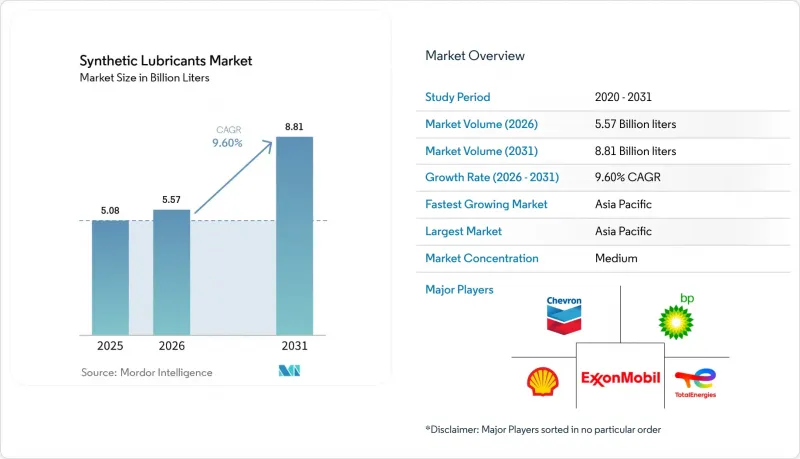
本報告按產品類型(引擎油、變速箱齒輪油、液壓油等)、基礎油(聚α烯烴(PAO)、酯類、聚亞烷基二醇 (PAG) 等)、最終用戶(發電、汽車、重型機械等)和地區(亞太地區、北美地區、歐洲地區等)對產業進行細分。市場預測以銷售量(公升)為單位。
全球合成潤滑油市場趨勢及洞察
汽車售後市場對高性能合成機油的需求不斷成長
自2024年起,售後市場向全合成機油的轉變隨著2025年3月API SQ標準的實施而愈發明顯。殼牌Helix Ultra系列符合此新標準,在保持強勁動力的同時,顯著提升了燃油效率,促使服務中心推薦優質合成機油作為預設加註機油。由於低黏度機油能夠提升冷啟動時的燃油效率,市場偏好正快速轉向0W-20甚至0W-8黏度等級。勝牌(Valvoline)於2024年底推出的優質全合成齒輪油,其抗磨損保護性能是傳統產品的四倍,在了解其總體擁有成本(TCO)後,消費者也樂於接受其更高的價格。由於嚴格的法規和消費者較高的意識,北美和歐洲仍然處於領先地位,但隨著經銷商網路強調延長換油週期,這股勢頭正蔓延至亞太地區的都市區市場。
嚴格的排放氣體和燃油消耗法規
歐盟7排放標準將於2025年7月依計畫生效。在美國,EPA 2026年標準收緊了重型車輛的排放法規。這些法規強制要求使用低黏度等級的潤滑油,例如5W-20和0W-20,迫使潤滑油配方開發商提高其抗氧化穩定性,以滿足新一代柴油引擎65萬英里(約105萬公里)的超長使用壽命要求。 ILSAC GF-7標準增加了低壓早燃(LSPI)保護和正時鏈條磨損抑制功能,這些功能難以用礦物油實現,因此合成基礎油必不可少。中國正在製定的「中國六號排放標準」和印度正在製定的「印度七號排放標準」等框架也在朝著類似的基準值靠攏,有效地在全球範圍內統一了最嚴格的排放要求。標準的統一將使跨國供應商受益,他們可以在全球部署相同的配方,從而縮短檢驗週期並增強規模經濟效益。
合成潤滑油初始成本高
全合成潤滑油的售價通常是礦物油的兩到三倍,這種價格差異在對成本敏感的細分市場中仍然是一大障礙。對於短週期運作而言,延長換油週期的效益有限,這使得開發中國家的車隊管理者難以證明其高昂成本的合理性。加德士的數據證實,當保養週期小於5,000公里時,很難實現投資報酬率。然而,原油價格的上漲導致礦物油的成本基礎成長速度快於合成潤滑油,從而縮小了兩者之間的價格差距。同時,預測性維護工具正在凸顯其降低全生命週期成本的潛力,並逐步降低商用車隊的抵觸情緒。
細分市場分析
到2025年,機油將佔據合成潤滑油市場34.10%的佔有率(按銷量計)。這一地位得益於龐大的內燃機車輛保有量以及合成潤滑油卓越的耐久性。變速箱油和齒輪油是第二大品類,因為自動化生產線和風力發電機都需要高負載、乾淨的運轉環境。液壓油受益於建設產業的蓬勃發展和機器人技術的引入,在寬廣的溫度範圍內都能保持穩定的黏度。潤滑脂在航太航太執行器和重型機械接頭中仍然至關重要,因為無滴漏潤滑對這些零件至關重要。儘管金屬加工液的銷售量佔有率較小,但隨著精密加工和積層製造技術的日趨成熟,其複合年成長率高達10.84%,是所有產品中成長最快的。
此細分市場的前景受ILSAC GF-7和API SQ標準的推動,這兩項標準均降低了允許磨損量和低速點火(LSPI)的發生率。這項變化有利於高階合成潤滑油的發展,因為高階合成潤滑油可以延長換油週期,減少維修次數和廢油處理量。此外,低霧化、高閃點的金屬加工液也促使工廠轉向使用合成酯類和聚醚醚酮(PAG)體系,以降低工作場所的風險。綜上所述,這些趨勢必將推動非引擎用合成潤滑油市場在2031年前持續成長。
區域分析
預計到2025年,亞太地區將佔全球合成潤滑油市場佔有率的40.00%,複合年成長率(CAGR)為10.62%。中國先進製造業的復甦以及印度汽車銷售的兩位數成長,正支撐著該地區的消費。中國沿海地區新建的調配工廠,例如計劃於2026年運作的桂格霍頓張家港工廠,清晰地展現了供應商致力於為高成長行業實現本地化供應的決心。日本對高品質原廠潤滑油的需求依然強勁,而東南亞國家的工業生產也不斷擴張,從而擴大了基本客群。越南的潤滑油市場持續成長,主要得益於汽車製造商和重型設備營運商需求的不斷成長。
北美在銷售量方面佔據第二大市場佔有率,並且一直是技術標竿。美國環保署 (EPA) 2026 年的法規和美國石油學會 (API) 的分類流程正推動化合物製造商轉型為下一代添加劑化學。美國憑藉其完善的丙烯基礎設施,在高黏度聚環氧乙烷 (PAO) 的供應方面也佔據主導地位,但預計到 2025 年年中丙烯供應短缺可能會考驗利潤率。加拿大油砂和礦用車輛以及墨西哥的汽車出口基地都是穩定的需求來源,它們依賴合成潤滑油來維持和保證運轉率準備就緒。
歐洲憑藉嚴格的環境法規和先進的OEM技術標準,保持其領先地位。歐盟7排放標準要求更低的黏度和與後處理系統更高的相容性,這促使酯類增強配方在輕型和重型車輛中得到更廣泛的應用。北海離岸離岸風力發電走廊和伊比利亞半島新興的可再生能源叢集需要能夠耐受海水腐蝕的「加註後無需更換」的變速箱油,從而擴大了高價值PAG和PAO混合油的應用範圍。在東歐工業基地,隨著自動化投資的加速,需求趨於多元化。中東和非洲雖然市場規模較小,但隨著沿岸地區的石化中心和南非的礦場致力於在嚴苛氣候條件下延長換油週期,這些地區也正逐步從礦物油轉向合成油。
其他好處:
- Excel格式的市場預測(ME)表
- 3個月的分析師支持
目錄
第1章:引言
- 研究假設和市場定義
- 調查範圍
第2章:調查方法
第3章執行摘要
第4章 市場狀況
- 市場概覽
- 市場促進因素
- 汽車售後市場對高性能合成機油的需求不斷成長
- 嚴格的排放氣體和燃油消耗法規
- 隨著工業自動化的發展,對先進油壓油和齒輪油的需求也不斷成長。
- 航太和國防領域的快速擴張正在推動對合成渦輪機油的需求不斷成長。
- 離岸風力發電發電廠裝置的激增推高了對長壽命合成齒輪箱油的需求。
- 市場限制因素
- 與礦物油相比,初始成本較高。
- 電動車數量的增加導致對引擎油的需求下降。
- 聚α烯烴(PAO)原料供應波動
- 價值鏈分析
- 波特五力分析
第5章 市場規模與成長預測
- 依產品類型
- 機油
- 變速箱和齒輪油
- 油壓
- 切削用潤滑液
- 潤滑脂
- 其他產品類型(例如,通用工業油)
- 基礎油
- 聚α烯烴(PAO)
- 酯類
- 聚亞烷基二醇(PAG)
- III類/GTL衍生合成油
- 其他(例如甲醇烷基化萘)
- 最終用戶
- 車
- 發電
- 重型機械
- 冶金/金屬加工
- 其他終端用戶產業(石油和天然氣、航運、資料中心等)
- 按地區
- 亞太地區
- 中國
- 印度
- 日本
- 韓國
- 馬來西亞
- 印尼
- 泰國
- 越南
- 其他亞太國家
- 北美洲
- 美國
- 加拿大
- 墨西哥
- 歐洲
- 德國
- 英國
- 法國
- 義大利
- 俄羅斯
- 北歐國家
- 土耳其
- 其他歐洲國家
- 南美洲
- 巴西
- 阿根廷
- 哥倫比亞
- 其他南美國家
- 中東和非洲
- 沙烏地阿拉伯
- 阿拉伯聯合大公國
- 卡達
- 埃及
- 南非
- 奈及利亞
- 其他中東和非洲國家
- 亞太地區
第6章 競爭情勢
- 市場集中度
- 策略趨勢
- 市佔率分析
- 公司簡介
- Shell plc
- Exxon Mobil Corporation
- BP plc(Castrol)
- Chevron Corporation
- TotalEnergies
- Valvoline Global Operations(Saudi Aramco)
- China Petrochemical Corporation(Sinopec)
- PETRONAS Lubricants International
- FUCHS SE
- ENEOS Corporation
- Indian Oil Corporation Ltd
- AMSOIL Inc.
- Idemitsu Kosan Co.,Ltd.
- Gazpromneft-Lubricants Ltd.
- LUKOIL
- Phillips 66 Company
- Suncor Energy Inc.
- Quaker Chemical Corporation
- Repsol
- Motul
第7章 市場機會與未來展望
According to Mordor Intelligence, synthetic lubricants market size in 2026 is estimated at 5.57 Billion liters, growing from 2025 value of 5.08 Billion liters with 2031 projections showing 8.81 Billion liters, growing at 9.6% CAGR over 2026-2031.
This report Segments the Industry by Product Type (Engine Oils, Transmission and Gear Oils, Hydraulic Fluids, and More), by Base Oil (Polyalpha-Olefin (PAO), Esters, Polyalkylene Glycol (PAG), and More), by End User (Power Generation, Automotive, Heavy Equipment, and More), and Geography (Asia-Pacific, North America, Europe, and More). The Market Forecasts are Provided in Terms of Volume (Liters).
Global Synthetic Lubricants Market Trends and Insights
Increasing Usage of High-Performance Synthetic Engine Oils in the Automotive Aftermarket
The post-2024 aftermarket pivot toward full-synthetic engine oils became pronounced once the API SQ standard entered force in March 2025. Shell's Helix Ultra line, which satisfies the new category, demonstrates full power retention and better fuel economy, convincing service centers to recommend premium synthetics as default fills . Market preference is shifting rapidly to 0W-20 and even 0W-8 grades because lower viscosity improves fuel efficiency during cold starts. Valvoline's premium full-synthetic gear oils, launched late 2024, provide four-fold wear protection over conventional products and command price premiums that customers accept when total cost of ownership is explained. North America and Europe remain at the forefront thanks to higher regulatory stringency and consumer awareness, yet momentum is spreading to urban markets in Asia-Pacific as dealership networks highlight extended drain intervals.
Stringent Emission and Fuel-Economy Regulations
July 2025 marked the planned start of Euro 7, while EPA 2026 tightens heavy-duty requirements in the United States. These rules mandate lower-viscosity grades such as 5W-20 and 0W-20, forcing lubricant formulators to boost oxidation stability to satisfy extended service limits of 650,000 miles for next-generation diesel engines. The ILSAC GF-7 specification adds LSPI protection and timing chain wear control that mineral oils struggle to achieve, making synthetic base stocks indispensable. China's evolving China VI and India's Bharat Stage VII frameworks are converging toward similar thresholds, which effectively globalize the most stringent requirements. Harmonized standards benefit multinational suppliers that can deploy one formulation worldwide, cutting validation cycles and strengthening economies of scale.
Higher Upfront Cost of Synthetic Lubricants
Full-synthetic products often sell at prices two to three times those of mineral oils, a differential that remains a stumbling block in cost-sensitive segments. In short duty cycles the benefit of extended drains is muted, preventing fleet managers in developing economies from justifying the premium. Caltex data confirm that where service intervals sit below 5,000 km, ROI is difficult to secure. Rising crude prices, however, are lifting the cost base of mineral oils faster than synthetics, narrowing the gap. Meanwhile, predictive maintenance tools underscore lifetime savings, gradually eroding resistance among commercial fleets.
Other drivers and restraints analyzed in the detailed report include:
- Growth in Industrial Automation Demanding Advanced Hydraulic & Gear Oils
- Rapid Expansion in Aerospace, Defense and Offshore Renewables Demanding Synthetic Turbine & Gearbox Oils
- Growing Electric-Vehicle Fleet
For complete list of drivers and restraints, kindly check the Table Of Contents.
Segment Analysis
Engine oils captured 34.10% of the synthetic lubricants market in 2025 by volume, a position protected by the vast installed base of internal-combustion vehicles and the superior longevity synthetics deliver. Transmission and gear oils follow as the second-largest category because automated manufacturing lines and wind turbines both require high-load, clean-running formulations. Hydraulic fluids benefit from a construction upswing and robotics integration, supplying stable viscosity across wide temperature spreads. Greases remain indispensable in aerospace actuators and heavy machinery joints where drip-free lubrication is vital. Metalworking fluids, though holding a smaller volume share, advance at the fastest 10.84% CAGR as precision machining and additive manufacturing mature.
The segment outlook is shaped by ILSAC GF-7 and API SQ, both of which reduce permissible wear and LSPI occurrence. This shift favors premium synthetics that can sustain longer drains, reducing workshop visits, and oil disposal. Furthermore, metalworking fluids with low mist and high flash points mitigate occupational hazards, leading factories to migrate to synthetic ester-and-PAG systems. Together, these trends ensure that the synthetic lubricants market size for fluids beyond engine oils will expand steadily through 2031.
Complete Report Scope:
- By Product Type
- Engine Oils
- Transmission and Gear Oils
- Hydraulic Fluids
- Metalworking Fluids
- Greases
- Other Product Types (General Industrial Oils, etc.)
- By Base Oil
- Polyalpha-olefin (PAO)
- Esters
- Polyalkylene Glycol (PAG)
- Group III / GTL-derived Synthetic
- Others (Alkylated Naphthalene, etc.)
- By End User
- Automotive
- Power Generation
- Heavy Equipment
- Metallurgy and Metalworking
- Other End-user Industries (Oil and Gas, Marine, Data-centres, etc.)
- By Geography
- Asia-Pacific
- China
- India
- Japan
- South Korea
- Malaysia
- Indonesia
- Thailand
- Vietnam
- Rest of Asia-Pacific
- North America
- United States
- Canada
- Mexico
- Europe
- Germany
- United Kingdom
- France
- Italy
- Russia
- NORDIC Countries
- Turkey
- Rest of Europe
- South America
- Brazil
- Argentina
- Colombia
- Rest of South America
- Middle East and Africa
- Saudi Arabia
- United Arab Emirates
- Qatar
- Egypt
- South Africa
- Nigeria
- Rest of Middle East and Africa
- Asia-Pacific
Geography Analysis
Asia-Pacific held 40.00% of the synthetic lubricants market in 2025, with a 10.62% CAGR outlook. China's re-acceleration in advanced manufacturing, together with India's double-digit vehicle sales rebound, underpins regional consumption. New blending plants in coastal China, such as Quaker Houghton's Zhangjiagang facility scheduled for 2026, illustrate suppliers' determination to localize supply for high-growth sectors. Japan sustains demand for high-grade factory fills, while Southeast Asian economies ramp up industrial output, widening the customer base. Vietnam lubricants market is growing, driven by automotive manufacturing and rising demand from heavy equipment operators.
North America ranks second in volume and remains a technology bellwether. EPA 2026 rules and API's category pipeline push formulators into next-generation additive chemistry. The United States also dominates supply of high-viscosity PAO thanks to extensive propylene infrastructure, although propylene tightness predicted for mid-2025 could test margins. Canada's oil sands and mining fleets, plus Mexico's automotive export platforms, add stable demand pockets that rely on synthetic lubricants for uptime and warranty assurance.
Europe preserves its premium positioning through stringent environmental legislation and advanced OEM technical standards. Euro 7 compels lower viscosities and stronger aftertreatment compatibility, pushing adoption of ester-enhanced formulations in both light- and heavy-duty fleets. The North Sea offshore wind corridor and the Iberian Peninsula's emerging renewable clusters require fill-for-life gearbox oils that tolerate brine exposure, widening scope for high-value PAG and PAO blends. Eastern Europe's industrial base further diversifies demand as automation investments accelerate. The Middle East and Africa, while smaller, show a gradual shift from mineral to synthetic as Gulf petrochemical hubs and South African mines target longer drain intervals in harsh climates.
- Shell plc
- Exxon Mobil Corporation
- BP p.l.c. (Castrol)
- Chevron Corporation
- TotalEnergies
- Valvoline Global Operations (Saudi Aramco)
- China Petrochemical Corporation (Sinopec)
- PETRONAS Lubricants International
- FUCHS SE
- ENEOS Corporation
- Indian Oil Corporation Ltd
- AMSOIL Inc.
- Idemitsu Kosan Co.,Ltd.
- Gazpromneft-Lubricants Ltd.
- LUKOIL
- Phillips 66 Company
- Suncor Energy Inc.
- Quaker Chemical Corporation
- Repsol
- Motul
Additional Benefits:
- The market estimate (ME) sheet in Excel format
- 3 months of analyst support
TABLE OF CONTENTS
1 Introduction
- 1.1 Study Assumptions & Market Definition
- 1.2 Scope of the Study
2 Research Methodology
3 Executive Summary
4 Market Landscape
- 4.1 Market Overview
- 4.2 Market Drivers
- 4.2.1 Increasing Usage of High-Performance Synthetic Engine Oils in the Automotive Aftermarket
- 4.2.2 Stringent Emission & Fuel-Economy Regulations
- 4.2.3 Growth in Industrial Automation Demanding Advanced Hydraulic & Gear Oils
- 4.2.4 Rapid Expansion in Aerospace & Defence Requiring Synthetic Turbine Oils
- 4.2.5 Surge in Offshore Wind Installations Boosting Long-Drain Synthetic Gearbox Oils
- 4.3 Market Restraints
- 4.3.1 Higher Upfront Cost Versus Mineral Oils
- 4.3.2 Growing Electric-Vehicle Fleet Reducing Demand for Engine Oils
- 4.3.3 Volatility in Polyalphaolefin (PAO) Feed-Stock Supply
- 4.4 Value Chain Analysis
- 4.5 Porter's Five Forces Analysis
- 4.5.1 Bargaining Power of Suppliers
- 4.5.2 Bargaining Power of Buyers
- 4.5.3 Threat of New Entrants
- 4.5.4 Threat of Substitute Products
- 4.5.5 Degree of Competition
5 Market Size & Growth Forecasts (Volume)
- 5.1 By Product Type
- 5.1.1 Engine Oils
- 5.1.2 Transmission and Gear Oils
- 5.1.3 Hydraulic Fluids
- 5.1.4 Metalworking Fluids
- 5.1.5 Greases
- 5.1.6 Other Product Types (General Industrial Oils, etc.)
- 5.2 By Base Oil
- 5.2.1 Polyalpha-olefin (PAO)
- 5.2.2 Esters
- 5.2.3 Polyalkylene Glycol (PAG)
- 5.2.4 Group III / GTL-derived Synthetic
- 5.2.5 Others (Alkylated Naphthalene, etc.)
- 5.3 By End User
- 5.3.1 Automotive
- 5.3.2 Power Generation
- 5.3.3 Heavy Equipment
- 5.3.4 Metallurgy and Metalworking
- 5.3.5 Other End-user Industries (Oil and Gas, Marine, Data-centres, etc.)
- 5.4 By Geography
- 5.4.1 Asia-Pacific
- 5.4.1.1 China
- 5.4.1.2 India
- 5.4.1.3 Japan
- 5.4.1.4 South Korea
- 5.4.1.5 Malaysia
- 5.4.1.6 Indonesia
- 5.4.1.7 Thailand
- 5.4.1.8 Vietnam
- 5.4.1.9 Rest of Asia-Pacific
- 5.4.2 North America
- 5.4.2.1 United States
- 5.4.2.2 Canada
- 5.4.2.3 Mexico
- 5.4.3 Europe
- 5.4.3.1 Germany
- 5.4.3.2 United Kingdom
- 5.4.3.3 France
- 5.4.3.4 Italy
- 5.4.3.5 Russia
- 5.4.3.6 NORDIC Countries
- 5.4.3.7 Turkey
- 5.4.3.8 Rest of Europe
- 5.4.4 South America
- 5.4.4.1 Brazil
- 5.4.4.2 Argentina
- 5.4.4.3 Colombia
- 5.4.4.4 Rest of South America
- 5.4.5 Middle East and Africa
- 5.4.5.1 Saudi Arabia
- 5.4.5.2 United Arab Emirates
- 5.4.5.3 Qatar
- 5.4.5.4 Egypt
- 5.4.5.5 South Africa
- 5.4.5.6 Nigeria
- 5.4.5.7 Rest of Middle East and Africa
- 5.4.1 Asia-Pacific
6 Competitive Landscape
- 6.1 Market Concentration
- 6.2 Strategic Moves
- 6.3 Market Share Analysis
- 6.4 Company Profiles (includes Global-level Overview, Market-level Overview, Core Segments, Financials as available, Strategic Information, Market Rank/Share, Products & Services, Recent Developments)
- 6.4.1 Shell plc
- 6.4.2 Exxon Mobil Corporation
- 6.4.3 BP p.l.c. (Castrol)
- 6.4.4 Chevron Corporation
- 6.4.5 TotalEnergies
- 6.4.6 Valvoline Global Operations (Saudi Aramco)
- 6.4.7 China Petrochemical Corporation (Sinopec)
- 6.4.8 PETRONAS Lubricants International
- 6.4.9 FUCHS SE
- 6.4.10 ENEOS Corporation
- 6.4.11 Indian Oil Corporation Ltd
- 6.4.12 AMSOIL Inc.
- 6.4.13 Idemitsu Kosan Co.,Ltd.
- 6.4.14 Gazpromneft-Lubricants Ltd.
- 6.4.15 LUKOIL
- 6.4.16 Phillips 66 Company
- 6.4.17 Suncor Energy Inc.
- 6.4.18 Quaker Chemical Corporation
- 6.4.19 Repsol
- 6.4.20 Motul
7 Market Opportunities & Future Outlook
- 7.1 White-space & Unmet-need Assessment
- 7.2 Growing Adoption of Bio-lubricants


