


 |
市場調查報告書
商品編碼
2073416
行動3D:市場佔有率分析、產業趨勢與統計、成長預測(2026-2031年)Mobile 3D - Market Share Analysis, Industry Trends & Statistics, Growth Forecasts (2026 - 2031) |
||||||

※ 本網頁內容可能與最新版本有所差異。詳細情況請與我們聯繫。
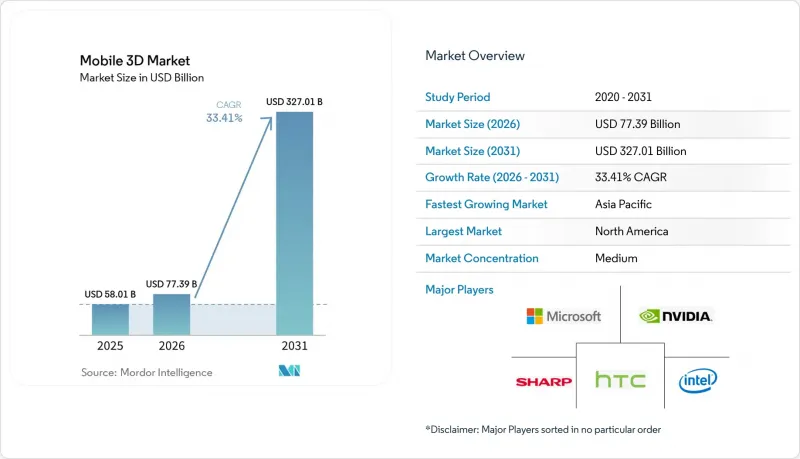
根據 Mordor Intelligence 估計,行動 3D 市場在 2026 年的價值將達到 773.9 億美元,高於 2025 年的 580.1 億美元,預計到 2031 年將達到 3,270.1 億美元。
預計 2026 年至 2031 年的複合年成長率將達到 33.41%。
本報告按以下類別進行分類:支援 3D 功能的行動裝置(智慧型手機、平板電腦等)、裝置組件(3D 影像感測器、3D GPU/ISP 等)、3D 技術(飛行時間 (ToF)、結構光等)、3D 應用程式(手機遊戲、地圖和導航、動畫和 3D 內容創作等)以及地區。
全球移動3D市場趨勢與洞察
3D感測相機模組(飛行時間/結構光)的快速普及
目前,飛行時間 (ToF) 和結構光陣列是人像攝影和擴增實境(AR) 疊加技術實現高精度深度捕捉的基礎。為了滿足不斷成長的市場需求,SONY於 2024 年擴建了其位於泰國的雷射二極體工廠,新增 2000 個就業崗位,以提高垂直腔面發射雷射 (VCSEL) 的產能。三星的「ISOCELL Vizion 33D」提升了測距精度,而蘋果 iPhone 15 Pro 的空間影片功能則凸顯了消費者對原生 3D 拍攝的強勁需求。 Meta 公司在間接 ToF 技術方面的專利能夠減少運動模糊、提高能源效率,並增強緊湊型機殼的反應速度。工業領域也受惠於物體測量精度的提升,從而推動了機器人和自動化技術的發展。
行動擴增實境遊戲和社群媒體濾鏡的激增
Instagram 上流行的 AR 遊戲和美顏濾鏡正在推動 3D 功能的日常使用。一項針對 42,000 個 Instagram 特效的學術研究發現,美顏濾鏡佔貼文總數的 20%,這表明用戶對即時臉部修正功能有著很高的需求。愛立信的一份報告顯示,由於頻寬穩定,5G用戶對 AR 的參與度顯著提高。高通的裝置內「穩定擴散」技術可在 15 秒內產生逼真的場景,為數百萬智慧型手機用戶提供創作工具。這些進步降低了用戶生成 3D 內容的門檻,並增強了社交平臺的網路效應。
3D硬體和內容創作高成本
Vision Pro 的製造成本高達 1519 美元,凸顯了微型 OLED 和感測器組件帶來的高昂成本。內容創作團隊也面臨陡峭的學習曲線,限制了小規模工作室的參與。儘管如此,Howden 的報告指出,雖然需要初步投資,但客製化的 AR 工作流程能夠顯著降低維護成本。隨著組件的量產化,價格雖然有所下降,但如何讓普通用戶負擔得起仍然是一個中期挑戰,尤其是在新興市場,這些市場仍在經歷從功能手機向擴增實境技術的過渡。
細分市場分析
到2025年,智慧型手機將佔據行動3D市場71.20%的佔有率。這反映了智慧型手機目前在市場佔有率和年度硬體更新周期方面的主導地位。旗艦機型現在標配ToF陣列、AI加速器和OLED顯示螢幕,構成了空間運算藍圖的基礎。三星Galaxy S25系列就是一個典型的例子,其AI驅動的「ProVisual」成像功能可以將日常照片轉換為具有深度圖的3D模型。折疊式設備正在引入多層介面以增強用戶沉浸感,而平板電腦和筆記型電腦則正在將3D協作擴展到更大的螢幕上。
AR/VR眼鏡產品雖然目前規模較小,但成長速度卻最快,複合年成長率高達34.85%。 Meta旗下的Reality Labs儘管累計44億美元的營運虧損,卻依然創下了銷售紀錄,這印證了消費者對AR/VR眼鏡的巨大需求。谷歌和三星宣布致力於平台層面的研發,計畫於2026年推出Android XR眼鏡。這些設備將彌合娛樂和企業應用之間的鴻溝,從身臨其境型遊戲到現場維護擴增實境技術,應用範圍十分廣泛。隨著出貨量的成長,預計在預測期內,穿戴式裝置的行動3D市場將逐漸縮小與智慧型手機的差距。
到2025年,3D影像感測器將佔據行動3D市場45.80%的佔有率,成為智慧型手機、平板電腦和頭戴式裝置深度捕捉功能的基礎。SONY在泰國的擴張將確保汽車LiDAR和移動飛行時間(ToF)模組所需二極體的產能,從而緩解短期供應瓶頸。由於垂直腔面發送器)仍然供應短缺,原始設備製造商(OEM)盡可能地尋求雙重採購。
OLED微顯示器產業蓬勃發展,年增率高達34.2%。隨著LG Display和一些新興的中國企業不斷擴大其沉積生產線,成本曲線呈下降趨勢,前置作業時間也在縮短。顯示技術的創新也推動了對專用3D GPU和ISP的需求,這些GPU和ISP能夠處理高像素密度,同時避免延遲大幅增加。組件產業正呈現出良性循環:組件成本的降低加速了技術的普及,而這反過來又為製程的進一步改進提供了資金,從而保持了行動3D市場的創新活力。
區域分析
預計到2025年,在企業投資和高可支配收入的推動下,北美將在行動3D市場佔據領先地位,市場佔有率將達到39.40%。 Meta在AR/VR領域的累計投資已超過1,000億美元,進一步加速了該地區的研發發展動能。工業企業透過AR賦能的工作流程提高了生產效率,而消費者也積極採用配備尖端3D功能的高階智慧型手機。
亞太地區是成長的主要驅動力,預計到2031年將以39.10%的複合年成長率成長。在中國,受機器人產業需求的推動,3D工業相機的銷售額在2024年將達到23.62億元人民幣(約3.34億美元)。該地區行動產業對GDP的貢獻高達8,800億美元,使其成為重要的供應中心和需求中心。韓國和日本的企業正在積極研發顯示器和全像處理器,而越南和印度的契約製造製造商則正在承接AR穿戴式裝置的新組裝訂單。
在歐洲,受汽車和航太領域「工業4.0」計畫的推動,移動3D技術正穩步普及。監管措施支援安全的資料處理,並鼓勵企業試用邊緣人工智慧3D工具。儘管中東、非洲和拉丁美洲的行動3D市場仍處於發展階段,但隨著5G普及率的提高和都市化進程的加快,硬體成本的降低也為加速普及奠定了基礎。
其他好處:
- Excel格式的市場預測(ME)表
- 3個月的分析師支持
目錄
第1章:引言
- 研究假設和市場定義
- 調查範圍
第2章:調查方法
第3章執行摘要
第4章 市場狀況
- 市場概覽
- 市場促進因素
- 智慧型手機普及率不斷提高以及向5G的過渡
- 3D感測相機模組(飛行時間/結構光)的快速普及
- 行動擴增實境遊戲和社群媒體的濾鏡數量激增。
- 降低用於創建空間內容的OLED微顯示器的成本
- 利用邊緣人工智慧進行設備內3D重建,實現離線擴增實境
- 折疊式和雙螢幕外形外形規格正在推動分層式 3D 使用者介面的發展。
- 市場限制因素
- 3D硬體和內容創作高成本
- 高負載3D處理中的電池消耗與熱限制
- VCSEL供應鏈中的瓶頸限制了感測器的產量。
- 缺乏開放的、跨平台的3D文件標準
- 價值鏈分析
- 監理情勢
- 技術展望
- 波特五力分析
第5章 市場規模與成長預測
- 支援3D的行動裝置
- 智慧型手機
- 折疊式雙螢幕智慧型手機
- 藥片
- 筆記型電腦
- AR/VR眼鏡產品和頭戴式顯示器
- 其他相容3D的設備
- 按設備組件
- 3D影像感測器(飛行時間、結構光)
- 3D顯示器和OLED微型顯示器
- 深度感測模組和VCSEL
- 3D GPU/ISP
- 軟體 SDK 和中介軟體
- 透過3D技術
- 飛行時間(ToF)
- 結構光
- 立體視覺
- 光場/全像
- 其他新興技術
- 3D應用
- 手機遊戲
- 地圖和導航
- 動畫和3D內容製作
- 廣告和社群媒體過濾器
- AR在工業和企業應用的應用
- 其他用途
- 按地區
- 北美洲
- 美國
- 加拿大
- 墨西哥
- 南美洲
- 巴西
- 阿根廷
- 其他南美國家
- 歐洲
- 英國
- 德國
- 法國
- 義大利
- 俄羅斯
- 其他歐洲國家
- 亞太地區
- 中國
- 印度
- 日本
- 韓國
- ASEAN
- 其他亞太國家
- 中東和非洲
- 中東
- 沙烏地阿拉伯
- 阿拉伯聯合大公國
- 土耳其
- 其他中東國家
- 非洲
- 南非
- 奈及利亞
- 其他非洲國家
- 中東
- 北美洲
第6章 競爭情勢
- 市場集中度
- 策略趨勢
- 市佔率分析
- 公司簡介{包括全球整體概覽、市場概覽、主要細分市場、現有財務資訊、策略資訊、主要公司市場排名和佔有率、產品和服務以及近期發展動態}
- Apple Inc.
- Samsung Electronics Co. Ltd.
- Qualcomm Inc.
- LG Electronics Inc.
- Sony Corporation
- Google LLC
- Huawei Technologies Co. Ltd.
- Intel Corporation
- Nvidia Corporation
- AMS OSRAM AG
- Infineon Technologies AG
- STMicroelectronics NV
- pmdtechnologies ag
- MediaTek Inc.
- Xreal Technology(Formerly Nreal)
- Meta Platforms Inc.
- Xiaomi Corporation
- Oppo Mobile Telecommunications Corp.
- Vivo Communication Technology Co.
- Lenovo Group Limited
- Sharp Corporation
- HTC Corporation
- Hitachi Ltd.
- The 3M Company
第7章 市場機會與未來展望
According to Mordor Intelligence, mobile 3D market size in 2026 is estimated at USD 77.39 billion, growing from 2025 value of USD 58.01 billion with 2031 projections showing USD 327.01 billion, growing at 33.41% CAGR over 2026-2031.
This report is Segmented by 3D Enabled Mobile Devices (Smartphones, Tablets, and More), Device Components (3D Image Sensors, 3D GPUs/ISPs, and More), 3D Technology (Time-Of-Flight (ToF), Structured-Light, and More), 3D Applications (Mobile Gaming, Maps and Navigation, Animations and 3D Content Creation, and More), and Geography.
Global Mobile 3D Market Trends and Insights
Rapid Adoption of 3D Sensing Camera Modules (ToF / Structured-Light)
Time-of-Flight and structured-light arrays now underpin precise depth capture for portrait imaging and augmented-reality overlays. Sony expanded its Thai laser-diode plant in 2024 to meet surging demand, adding 2,000 jobs to scale VCSEL output.Samsung's ISOCELL Vizion 33D boosts range accuracy, and Apple's spatial-video feature on iPhone 15 Pro underlines consumer appetite for native 3D capture. Meta's indirect-ToF patent improves motion-blur mitigation and power efficiency, enhancing responsiveness in compact form factors. Industrial sectors gain from object measurement precision that supports robotics and automation.
Surge in Mobile AR Gaming and Social-Media Filters
AR games and face filters popularized by Instagram drive habitual use of 3D features. Academic review of 42,000 Instagram effects found beautification filters represented 20% of uploads, illustrating demand for real-time facial augmentation. Ericsson reports that 5G subscribers show materially higher AR engagement due to stable bandwidth. Qualcomm's on-device Stable Diffusion generates photorealistic scenes under 15 seconds, opening creator tools to millions of handsets. These developments lower barriers for user-generated 3D content and amplify network effects across social platforms.
High Cost of 3D Hardware and Content Creation
Vision Pro's manufacturing cost of USD 1,519 exposes the premium burden of micro-OLED and sensor assemblies. Content teams also face steep learning curves, limiting smaller studios. Howden nonetheless reports measurable maintenance savings from custom AR workflows despite upfront spend. Component scale-up is pushing prices lower, yet mainstream affordability remains a mid-term challenge, especially in emerging markets where feature-phone transitions still play out.
Other drivers and restraints analyzed in the detailed report include:
- Edge-AI on-Device 3D Reconstruction for Offline AR
- Cost Decline of OLED Micro-Displays Enabling Spatial Content
- Battery Drain and Thermal Limits in Intensive 3D Processing
For complete list of drivers and restraints, kindly check the Table Of Contents.
Segment Analysis
Smartphones captured 71.20% of the Mobile 3D market in 2025, reflecting the installed base advantage and annual hardware refresh cycles. Flagship handsets now bundle ToF arrays, AI accelerators, and OLED displays, forming the baseline for spatial computing roadmaps. Samsung's Galaxy S25 series exemplifies this with AI-powered ProVisual imaging that turns everyday photos into depth-mapped 3D assets. Foldables introduce layered interfaces that deepen user immersion, while tablets and notebooks extend 3D collaboration to larger canvases.
AR/VR eyewear commands a smaller numerator today but posts the fastest ascent at 34.85% CAGR. Meta's Reality Labs, despite USD 4.4 billion operating losses, booked record revenue, underscoring latent consumer pull. Google and Samsung will debut Android XR glasses in 2026, signaling platform-level commitment. These devices bridge entertainment and enterprise, from immersive games to on-site maintenance overlays. As volumes scale, the Mobile 3D market size for wearables will close the gap with smartphones over the forecast window.
3D image sensors held 45.80% of the Mobile 3D market size in 2025, serving as the cornerstone for depth capture across phones, tablets, and headsets. Sony's Thai expansion secures diode capacity for both automotive LiDAR and mobile ToF modules, easing short-term bottlenecks. VCSEL emitters remain supply-constrained, prompting OEMs to dual-source where possible.
OLED micro-displays are the momentum story, growing 34.2% annually. Cost curves bend downward as LG Display and Chinese entrants ramp deposition lines, shortening lead times. Display innovation also spurs demand for dedicated 3D GPUs and ISPs that manage higher pixel densities without latency spikes. The components segment illustrates a virtuous loop: lower part costs lift adoption, which in turn funds further process improvements, keeping the Mobile 3D market innovation cycle brisk.
Complete Report Scope:
- By 3D Enabled Mobile Devices
- Smartphones
- Foldable and Dual-Screen Phones
- Tablets
- Notebooks
- AR/VR Eyewear and Head-Mounted Displays
- Other 3D-Enabled Devices
- By Device Components
- 3D Image Sensors (ToF, Structured-Light)
- 3D Displays and OLED Micro-Displays
- Depth-Sensing Modules and VCSELs
- 3D GPUs / ISPs
- Software SDKs and Middleware
- By 3D Technology
- Time-of-Flight (ToF)
- Structured-Light
- Stereo Vision
- Light-Field / Holographic
- Other Emerging Technologies
- By 3D Applications
- Mobile Gaming
- Maps and Navigation
- Animations and 3D Content Creation
- Advertising and Social-Media Filters
- Industrial and Enterprise AR
- Other Applications
- By Geography
- North America
- United States
- Canada
- Mexico
- South America
- Brazil
- Argentina
- Rest of South America
- Europe
- United Kingdom
- Germany
- France
- Italy
- Russia
- Rest of Europe
- Asia Pacific
- China
- India
- Japan
- South Korea
- ASEAN
- Rest of Asia Pacific
- Middle East and Africa
- Middle East
- Saudi Arabia
- United Arab Emirates
- Turkey
- Rest of Middle East
- Africa
- South Africa
- Nigeria
- Rest of Africa
- Middle East
- North America
Geography Analysis
North America led with a 39.40% Mobile 3D market share in 2025, buoyed by enterprise investments and high discretionary income. Meta's cumulative AR/VR outlay topping USD 100 billion amplifies regional R&D momentum. Industrial firms report productivity gains from AR-enabled workflows, while consumers readily adopt premium smartphones that showcase bleeding-edge 3D features.
Asia Pacific is the growth pacesetter at a 39.10% CAGR through 2031. China's 3D industrial camera revenue reached CNY 2.362 billion (USD 334 million) in 2024 on the back of robotics demand. The region contributes USD 880 billion of mobile value-added to GDP, positioning it as both supplier and demand center. Korean and Japanese firms push display and holo-processor research, while contract manufacturers in Vietnam and India absorb new assembly mandates for AR wearables.
Europe records steady take-up driven by Industry 4.0 projects in automotive and aerospace. Regulation supports secure data handling, encouraging enterprises to trial edge-AI 3D tools. Middle East and Africa and Latin America remain nascent Mobile 3D markets, yet rising 5G penetration and urbanization lay groundwork for accelerated adoption once hardware costs dip.
- Apple Inc.
- Samsung Electronics Co. Ltd.
- Qualcomm Inc.
- LG Electronics Inc.
- Sony Corporation
- Google LLC
- Huawei Technologies Co. Ltd.
- Intel Corporation
- Nvidia Corporation
- AMS OSRAM AG
- Infineon Technologies AG
- STMicroelectronics N.V.
- pmdtechnologies ag
- MediaTek Inc.
- Xreal Technology (Formerly Nreal)
- Meta Platforms Inc.
- Xiaomi Corporation
- Oppo Mobile Telecommunications Corp.
- Vivo Communication Technology Co.
- Lenovo Group Limited
- Sharp Corporation
- HTC Corporation
- Hitachi Ltd.
- The 3M Company
Additional Benefits:
- The market estimate (ME) sheet in Excel format
- 3 months of analyst support
TABLE OF CONTENTS
1 INTRODUCTION
- 1.1 Study Assumptions and Market Definition
- 1.2 Scope of the Study
2 RESEARCH METHODOLOGY
3 EXECUTIVE SUMMARY
4 MARKET LANDSCAPE
- 4.1 Market Overview
- 4.2 Market Drivers
- 4.2.1 Rise in smartphone penetration and 5G upgrades
- 4.2.2 Rapid adoption of 3D sensing camera modules (ToF / Structured-Light)
- 4.2.3 Surge in mobile AR gaming and social-media filters
- 4.2.4 Cost decline of OLED micro-displays enabling spatial content
- 4.2.5 Edge-AI on-device 3D reconstruction for offline AR
- 4.2.6 Foldable and dual-screen form-factors driving layered 3D UI
- 4.3 Market Restraints
- 4.3.1 High cost of 3D hardware and content creation
- 4.3.2 Battery drain and thermal limits in intensive 3D processing
- 4.3.3 VCSEL supply-chain bottlenecks limiting sensor output
- 4.3.4 Lack of open, cross-platform 3D file standards
- 4.4 Value Chain Analysis
- 4.5 Regulatory Landscape
- 4.6 Technological Outlook
- 4.7 Porter's Five Forces Analysis
- 4.7.1 Bargaining Power of Suppliers
- 4.7.2 Bargaining Power of Buyers/Consumers
- 4.7.3 Threat of New Entrants
- 4.7.4 Threat of Substitute Products
- 4.7.5 Intensity of Competitive Rivalry
5 MARKET SIZE AND GROWTH FORECASTS (VALUE)
- 5.1 By 3D Enabled Mobile Devices
- 5.1.1 Smartphones
- 5.1.2 Foldable and Dual-Screen Phones
- 5.1.3 Tablets
- 5.1.4 Notebooks
- 5.1.5 AR/VR Eyewear and Head-Mounted Displays
- 5.1.6 Other 3D-Enabled Devices
- 5.2 By Device Components
- 5.2.1 3D Image Sensors (ToF, Structured-Light)
- 5.2.2 3D Displays and OLED Micro-Displays
- 5.2.3 Depth-Sensing Modules and VCSELs
- 5.2.4 3D GPUs / ISPs
- 5.2.5 Software SDKs and Middleware
- 5.3 By 3D Technology
- 5.3.1 Time-of-Flight (ToF)
- 5.3.2 Structured-Light
- 5.3.3 Stereo Vision
- 5.3.4 Light-Field / Holographic
- 5.3.5 Other Emerging Technologies
- 5.4 By 3D Applications
- 5.4.1 Mobile Gaming
- 5.4.2 Maps and Navigation
- 5.4.3 Animations and 3D Content Creation
- 5.4.4 Advertising and Social-Media Filters
- 5.4.5 Industrial and Enterprise AR
- 5.4.6 Other Applications
- 5.5 By Geography
- 5.5.1 North America
- 5.5.1.1 United States
- 5.5.1.2 Canada
- 5.5.1.3 Mexico
- 5.5.2 South America
- 5.5.2.1 Brazil
- 5.5.2.2 Argentina
- 5.5.2.3 Rest of South America
- 5.5.3 Europe
- 5.5.3.1 United Kingdom
- 5.5.3.2 Germany
- 5.5.3.3 France
- 5.5.3.4 Italy
- 5.5.3.5 Russia
- 5.5.3.6 Rest of Europe
- 5.5.4 Asia Pacific
- 5.5.4.1 China
- 5.5.4.2 India
- 5.5.4.3 Japan
- 5.5.4.4 South Korea
- 5.5.4.5 ASEAN
- 5.5.4.6 Rest of Asia Pacific
- 5.5.5 Middle East and Africa
- 5.5.5.1 Middle East
- 5.5.5.1.1 Saudi Arabia
- 5.5.5.1.2 United Arab Emirates
- 5.5.5.1.3 Turkey
- 5.5.5.1.4 Rest of Middle East
- 5.5.5.2 Africa
- 5.5.5.2.1 South Africa
- 5.5.5.2.2 Nigeria
- 5.5.5.2.3 Rest of Africa
- 5.5.5.1 Middle East
- 5.5.1 North America
6 COMPETITIVE LANDSCAPE
- 6.1 Market Concentration
- 6.2 Strategic Moves
- 6.3 Market Share Analysis
- 6.4 Company Profiles {includes Global level Overview, Market level overview, Core Segments, Financials as available, Strategic Information, Market Rank/Share for key companies, Products and Services, and Recent Developments}
- 6.4.1 Apple Inc.
- 6.4.2 Samsung Electronics Co. Ltd.
- 6.4.3 Qualcomm Inc.
- 6.4.4 LG Electronics Inc.
- 6.4.5 Sony Corporation
- 6.4.6 Google LLC
- 6.4.7 Huawei Technologies Co. Ltd.
- 6.4.8 Intel Corporation
- 6.4.9 Nvidia Corporation
- 6.4.10 AMS OSRAM AG
- 6.4.11 Infineon Technologies AG
- 6.4.12 STMicroelectronics N.V.
- 6.4.13 pmdtechnologies ag
- 6.4.14 MediaTek Inc.
- 6.4.15 Xreal Technology (Formerly Nreal)
- 6.4.16 Meta Platforms Inc.
- 6.4.17 Xiaomi Corporation
- 6.4.18 Oppo Mobile Telecommunications Corp.
- 6.4.19 Vivo Communication Technology Co.
- 6.4.20 Lenovo Group Limited
- 6.4.21 Sharp Corporation
- 6.4.22 HTC Corporation
- 6.4.23 Hitachi Ltd.
- 6.4.24 The 3M Company
7 MARKET OPPORTUNITIES AND FUTURE OUTLOOK
- 7.1 White-space and Unmet-need Assessment

 3D地圖繪製和3D建模:市場佔有率分析、行業趨勢和統計數據、成長預測(2026-2031年)
 3D地圖繪製與建模市場-2026-2032年全球市場預測
 行動3D市場規模、佔有率和成長分析:按技術、應用、設備、通路和地區分類-2026-2033年產業預測
 全球3D地圖和建模市場:依產品、部署模式、組織規模、產業和地區分類-預測至2031年
 3D地圖建模市場 - 全球產業規模、佔有率、趨勢、機會、預測:按類型、組件、應用、產業垂直領域、地區和競爭格局分類,2021-2031年
 2026年全球行動3D市場報告2026年全球3D地圖繪製與建模市場報告
 3D地圖繪製和建模市場規模、佔有率、趨勢和預測:按組件、應用、最終用戶行業和地區分類,2026-2034年
 遊戲領域3D地圖和建模市場規模、佔有率和成長分析:按組件、技術、部署模式、平台、應用、企業規模和地區分類 - 產業預測 2026-2033
 2026-2030年全球3D地圖繪製與建模市場