


 |
市場調查報告書
商品編碼
2073413
中東油田服務:市場佔有率分析、產業趨勢與統計、成長預測(2026-2031)Middle East Oilfield Services - Market Share Analysis, Industry Trends & Statistics, Growth Forecasts (2026 - 2031) |
||||||

※ 本網頁內容可能與最新版本有所差異。詳細情況請與我們聯繫。
根據 Mordor Intelligence 預測,中東油田服務市場規模將從 2025 年的 293.4 億美元成長到 2026 年的 310.8 億美元,然後在 2031 年達到 405.6 億美元,2026 年至 2031 年的複合年成長率為 5.47%。
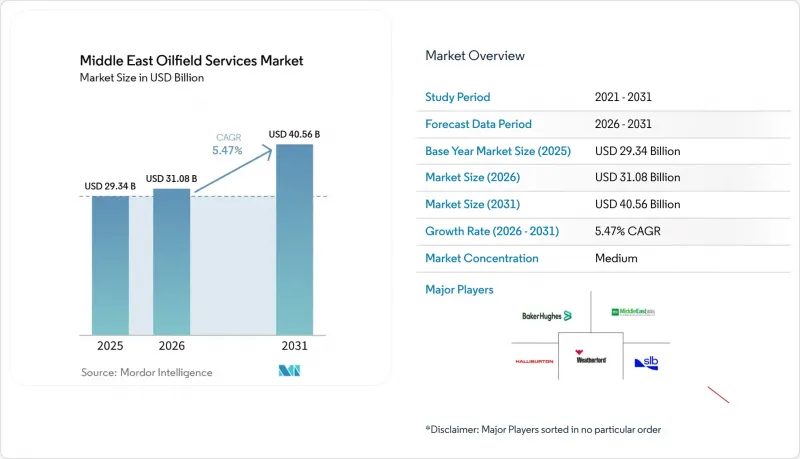
本報告按服務類型(鑽井服務、完井服務、生產和乾預服務以及其他服務)、位置(陸上和海上)、井型(傳統型和傳統型)以及地區(沙烏地阿拉伯、阿拉伯聯合大公國、卡達、科威特、阿曼、伊朗和其他中東國家)進行細分。市場規模和預測均以美元計價。
中東油田服務市場趨勢與洞察
海灣合作理事會國家油田鑽探活動增加
到2025年,運作中鑽機的數量將達到數年來的最高水平,其中沙烏地阿拉伯運作超過100座鑽機,阿拉伯聯合大公國將擁有超過60座。兩國國有石油公司承諾將總產能維持在每日1,200萬桶以上,這為上述趨勢提供了支撐。鑽井活動的增加主要集中在加密井位和先前被忽視的區域,這需要先進的旋轉井系統和即時資訊服務。光是卡達的北方液化天然氣開發案就將新增20座海上鑽機,增加對自升式鑽機和海底完井作業的需求。科威特正在提高重油蘊藏量區的井密度,以改善蒸氣分佈,這需要耐腐蝕管道和高溫測井技術。以中國海工集團(COSL)為首的中國承包商已與沙烏地阿拉伯簽訂了五年合約,參與了沙烏地阿拉伯的海上鑽井項目,這將對現有供應商的日租金構成下行壓力。這一擴張,加上鑽井量的增加和油井複雜性的提高,凸顯了它正在支持中東油田服務市場的直接成長。
新冠疫情後原油價格的回升提振了資本投資。
預計2025年布蘭特原油均價將達到每桶82美元,這將恢復沿岸地區主要石油公司的現金流,並使2020年暫停的計畫得以重啟。沙烏地阿美預計2025年的資本支出將增加至500億美元,而阿布達比國家石油公司(ADNOC)承諾在五年內投資1,500億美元,其中大部分資金將用於鑽井、完井和生產解決方案。油價上漲也促使服務密集非常傳統天然氣專案以及長週期海上開發專案恢復。然而,歐佩克+的供應控制仍然導致油價季度波動,迫使營運商協商基於績效的定價模式,將更多風險轉移給承包商。由服務公司負責儲存生產的綜合專案管理模式正日益受到關注,斯倫貝謝為阿曼緻密氣資產開發的框架就是一個例子。總體而言,布蘭特原油價格的強勁表現繼續提振中東油田服務市場,即使在價格波動需要更靈活的商業結構的市場中也是如此。
原油價格波動
2025年前油價在每桶70美元至90美元之間的波動導致投資模式多元化,並迫使部分服務合約在有效期限內進行價格調整。沙烏地阿美和阿布達比國家石油公司(ADNOC)採用的績效掛鉤結構將收入風險轉移至承包商,並收窄了現金流預期。科威特和阿曼的小規模獨立公司在布蘭特原油價格走軟時暫停運營,對船隊運轉率造成負面影響。此外,不確定性導致新鑽機建造合約的簽訂猶豫不決,造成供應緊張,並在需求復甦時推高現貨日租金。多元化服務供應商目前提供將年度維護合約與數位訂閱相結合的服務,以在價格低迷時期平滑收入,這有助於減輕價格波動對中東油田服務市場的負面影響,但並不能完全消除這種影響。
細分市場分析
預計到2031年,生產和介入服務將以7.5%的複合年成長率成長,超過鑽井產業的擴張速度。鑽井產業在2025年將佔據中東油田服務市場34.9%的佔有率。目前,業者傾向採用連續油管洗滌、酸化增產和人工採油系統維修等方式,從成熟油田開採更多原油。數位化油井監測工具能夠及早識別低產油井並立即採取糾正措施。在傑夫拉和魯卜哈利油田作業專案的推動下,完井服務,特別是緻密氣層的多級水力壓裂,也不斷擴大規模。雖然鑽井作業規模保持不變,但水平井的設計正在減少每英尺鑽機運作天數,將資金轉移到更高附加價值的地下工具和遙測技術上。在這些相互交織的趨勢中,以生產為導向的細分市場正在擴大其合約佔有率,這表明資本效率優先因素正在重塑中東油田服務市場。
為了應對這項挑戰,鑽井承包商正在整合鑽內測量(MWD)分析、自主旋轉鑽井系統和壓力控制套件,以保持競爭力。干預服務供應商則透過結合光纖診斷和高溫封隔器的專用強化採油(EOR)方案,進一步提升自身競爭力。固井作業者透過引入自癒漿液來應對高壓高溫油井,從而提高單次作業的平均收入。地震探勘和退役等其他輔助服務呈現穩定但適度的成長,而生產最佳化仍然是關注的重點,因為它是無需大規模新投資即可快速實現國家產量目標的最佳途徑。
其他好處:
- Excel格式的市場預測(ME)表
- 3個月的分析師支持
目錄
第1章:引言
- 研究假設和市場定義
- 調查範圍
第2章:調查方法
第3章執行摘要
第4章 市場狀況
- 市場概覽
- 市場促進因素
- 海灣合作理事會國家油田鑽探活動增加
- 新冠疫情後原油價格的回升提振了資本投資。
- 國營石油公司對非傳統資源的投資
- 在地採購義務正在促進區域合約的簽訂。
- 熱力採油計畫旨在最大限度地提高成熟油田的產量。
- 引入數位化油田以彌補人手不足
- 市場限制因素
- 原油價格波動
- 加強各地區的二氧化碳排放法規
- 制裁導致採購延誤(主要針對伊朗)
- 水資源短缺限制了大規模水力壓裂法的開發。
- 供應鏈分析
- 監理情勢
- 技術展望
- 波特五力模型
第5章 市場規模與成長預測
- 按服務類型
- 鑽井服務
- 完井服務(注水泥、水力壓裂)
- 生產和乾預服務
- 其他服務(海上支援船、地震探勘、退役、航空)
- 按位置
- 陸上
- 離岸
- 按井類型
- 傳統的
- 傳統型
- 按地區
- 沙烏地阿拉伯
- 阿拉伯聯合大公國
- 卡達
- 科威特
- 阿曼
- 伊朗
- 其他中東國家
第6章 競爭情勢
- 市場集中度
- 策略趨勢(併購、聯盟、購電協議)
- 市場佔有率分析(主要公司的市場排名和佔有率)
- 公司簡介
- Schlumberger Limited
- Halliburton Company
- Baker Hughes Company
- Weatherford International plc
- National Energy Services Reunited Corp(NESR)
- ADNOC Drilling
- KCA Deutag
- OiLServ Ltd
- Welltec A/S
- Anton Oilfield Services Group
- Swire Energy Services
- Denholm Oilfield Services
- Saipem SpA
- Expro Group
- Petrofac Limited
- China Oilfield Services Limited(COSL)
- Vallourec
- Nabors Industries Ltd
- Shelf Drilling
- Arabian Drilling Company
- Arabian Oilfield Services
第7章 市場機會與未來展望
According to Mordor Intelligence, the middle east oilfield services market size is expected to grow from USD 29.34 billion in 2025 to USD 31.08 billion in 2026 and is forecast to reach USD 40.56 billion by 2031 at 5.47% CAGR over 2026-2031.
This report is Segmented by Service Type (Drilling Services, Completion Services, Production and Intervention Services, and Other Services), Location (Onshore and Offshore), Well Type (Conventional and Unconventional), and Geography (Saudi Arabia, United Arab Emirates, Qatar, Kuwait, Oman, Iran, and Rest of Middle East). The Market Sizes and Forecasts are Provided in Terms of Value (USD).
Middle East Oilfield Services Market Trends and Insights
Rising Drilling Activity Across GCC Fields
Active rig counts climbed to multi-year highs in 2025 as Saudi Arabia operated more than 100 rigs and the UAE exceeded 60, sustained by national oil companies determined to keep collective capacity above 12 million barrels per day. Increased drilling is targeting infill locations and bypassed zones, which demand advanced rotary-steerable systems and real-time data services. Qatar's North Field LNG build-out alone added 20 offshore rigs, sharpening demand for jack-up units and subsea completions. Kuwait is increasing well density in heavy-oil acreage to improve steam distribution, requiring corrosion-resistant tubulars and high-temperature logging. Chinese contractors, led by COSL, have entered Saudi offshore campaigns with five-year contracts, putting downward pressure on established providers' day rates. The expansion underscores how drilling volume and well complexity together underpin the immediate growth of the Middle East oilfield services market.
Post-COVID Oil-Price Recovery Fueling CAPEX
Brent crude averaged USD 82 per barrel in 2025, restoring cash flow for Gulf majors and unfreezing projects that had been deferred during 2020. Saudi Aramco's 2025 capital expenditure rose to USD 50 billion, while ADNOC committed USD 150 billion across five years, channeling much of that sum into drilling, completion, and production solutions. Higher prices have reactivated long-cycle offshore developments along with unconventional gas projects that carry larger service intensity. Yet OPEC+ supply management still introduces quarterly swings, pushing operators to negotiate performance-based pricing that shifts more risk to contractors. Integrated project-management models, where service companies assume reservoir delivery responsibility, are gaining traction, illustrated by Schlumberger's framework in Oman's tight-gas assets. Collectively, resilient Brent levels continue to lift the Middle East oilfield services market, even as volatility demands flexible commercial structures.
Volatile Crude-Oil Prices
Price swings between USD 70 and USD 90 per barrel through 2025 produced uneven investment patterns and forced mid-contract repricing on several service agreements. Performance-linked structures adopted by Saudi Aramco and ADNOC transfer revenue risk to contractors, shrinking cash visibility. Smaller independents in Kuwait and Oman pause work when Brent softens, weighing on fleet utilization. Uncertainty also deters rig-new-build commitments, tightening supply and elevating spot day rates when demand rebounds. Diversified service providers now bundle maintenance annuities and digital subscriptions to smooth earnings during price troughs, helping mitigate but not eliminate volatility drag on the Middle East oilfield services market.
Other drivers and restraints analyzed in the detailed report include:
- National-Oil-Company Investment in Unconventional Resources
- Local-Content Mandates Boosting Regional Contracts
- Water-Scarcity Limits on Large-Scale Hydraulic Fracturing
For complete list of drivers and restraints, kindly check the Table Of Contents.
Segment Analysis
Production and intervention services are projected to grow at a 7.5% CAGR to 2031, eclipsing the expansion pace of drilling despite drilling's 34.9% Middle East oilfield services market share in 2025. Operators now favor coiled-tubing cleanouts, acid stimulations, and artificial-lift retrofits that squeeze additional barrels from mature assets. Digital well surveillance tools flag underperforming producers sooner, triggering immediate remedial activity. Completion services, especially multi-stage fracturing for tight-gas horizons, are also scaling, supported by Jafurah and Rub al Khali work programs. Drilling retains scale, yet horizontal well designs demand fewer rig days per foot, reallocating spend toward high-value downhole tools and telemetry. Layering these trends, the production-oriented segment accounts for rising contract share, illustrating how capital efficiency priorities shape the Middle East oilfield services market.
Drilling contractors respond by integrating measurement-while-drilling analytics, autonomous rotary-steerable systems, and managed-pressure kits to preserve relevance. Intervention providers further differentiate through fit-for-purpose EOR packages that combine fiber-optic diagnostics with high-temperature packers. Cementing players introduce self-healing slurries to cope with high-pressure, high-temperature wells, expanding average revenue per job. While other ancillary services, such as seismic or decommissioning, deliver steady but modest growth, the spotlight stays on production optimisation as the quickest route to uphold national output targets without massive greenfield outlays.
Complete Report Scope:
- By Service Type
- Drilling Services
- Completion Services (Cementing, Hydraulic Fracturing)
- Production and Intervention Services
- Other Services (OSV, seismic, decomm., aviation)
- By Location
- Onshore
- Offshore
- By Well Type
- Conventional
- Unconventional
- By Geography
- Saudi Arabia
- United Arab Emirates
- Qatar
- Kuwait
- Oman
- Iran
- Rest of Middle East
List of Companies Covered in this Report:
- Schlumberger Limited
- Halliburton Company
- Baker Hughes Company
- Weatherford International plc
- National Energy Services Reunited Corp (NESR)
- ADNOC Drilling
- KCA Deutag
- OiLServ Ltd
- Welltec A/S
- Anton Oilfield Services Group
- Swire Energy Services
- Denholm Oilfield Services
- Saipem SpA
- Expro Group
- Petrofac Limited
- China Oilfield Services Limited (COSL)
- Vallourec
- Nabors Industries Ltd
- Shelf Drilling
- Arabian Drilling Company
- Arabian Oilfield Services
Additional Benefits:
- The market estimate (ME) sheet in Excel format
- 3 months of analyst support
TABLE OF CONTENTS
1 Introduction
- 1.1 Study Assumptions & Market Definition
- 1.2 Scope of the Study
2 Research Methodology
3 Executive Summary
4 Market Landscape
- 4.1 Market Overview
- 4.2 Market Drivers
- 4.2.1 Rising drilling activity across GCC fields
- 4.2.2 Post-COVID oil-price recovery fueling CAPEX
- 4.2.3 National-oil-company investment in unconventional resources
- 4.2.4 Local-content mandates boosting regional contracts
- 4.2.5 Thermal EOR projects to maximize mature-field output
- 4.2.6 Digital-oilfield adoption to offset manpower shortages
- 4.3 Market Restraints
- 4.3.1 Volatile crude-oil prices
- 4.3.2 Tighter regional CO2-emission regulations
- 4.3.3 Sanctions-driven procurement delays (Iran focus)
- 4.3.4 Water-scarcity limits on large-scale hydraulic fracturing
- 4.4 Supply-Chain Analysis
- 4.5 Regulatory Landscape
- 4.6 Technological Outlook
- 4.7 Porter's Five Forces
- 4.7.1 Bargaining Power of Suppliers
- 4.7.2 Bargaining Power of Buyers
- 4.7.3 Threat of New Entrants
- 4.7.4 Threat of Substitutes
- 4.7.5 Intensity of Competitive Rivalry
5 Market Size & Growth Forecasts
- 5.1 By Service Type
- 5.1.1 Drilling Services
- 5.1.2 Completion Services (Cementing, Hydraulic Fracturing)
- 5.1.3 Production and Intervention Services
- 5.1.4 Other Services (OSV, seismic, decomm., aviation)
- 5.2 By Location
- 5.2.1 Onshore
- 5.2.2 Offshore
- 5.3 By Well Type
- 5.3.1 Conventional
- 5.3.2 Unconventional
- 5.4 By Geography
- 5.4.1 Saudi Arabia
- 5.4.2 United Arab Emirates
- 5.4.3 Qatar
- 5.4.4 Kuwait
- 5.4.5 Oman
- 5.4.6 Iran
- 5.4.7 Rest of Middle East
6 Competitive Landscape
- 6.1 Market Concentration
- 6.2 Strategic Moves (M&A, Partnerships, PPAs)
- 6.3 Market Share Analysis (Market Rank/Share for key companies)
- 6.4 Company Profiles (includes Global level Overview, Market level overview, Core Segments, Financials as available, Strategic Information, Products & Services, and Recent Developments)
- 6.4.1 Schlumberger Limited
- 6.4.2 Halliburton Company
- 6.4.3 Baker Hughes Company
- 6.4.4 Weatherford International plc
- 6.4.5 National Energy Services Reunited Corp (NESR)
- 6.4.6 ADNOC Drilling
- 6.4.7 KCA Deutag
- 6.4.8 OiLServ Ltd
- 6.4.9 Welltec A/S
- 6.4.10 Anton Oilfield Services Group
- 6.4.11 Swire Energy Services
- 6.4.12 Denholm Oilfield Services
- 6.4.13 Saipem SpA
- 6.4.14 Expro Group
- 6.4.15 Petrofac Limited
- 6.4.16 China Oilfield Services Limited (COSL)
- 6.4.17 Vallourec
- 6.4.18 Nabors Industries Ltd
- 6.4.19 Shelf Drilling
- 6.4.20 Arabian Drilling Company
- 6.4.21 Arabian Oilfield Services
7 Market Opportunities & Future Outlook
- 7.1 White-space & Unmet-Need Assessment

 2026-2030年全球油田服務市場
 非洲油田服務:市場佔有率分析、產業趨勢與統計及成長預測(2026-2031 年)
 油田服務市場機會、成長要素、產業趨勢分析及2026-2035年預測
 油田服務市場:2026-2032年全球市場預測(依服務類型、油井類型、生命週期階段、營運環境與應用分類)中東和北非油田服務:市場佔有率分析、行業趨勢和統計數據以及成長預測(2026-2031 年)
 油田服務市場-全球產業規模、佔有率、趨勢、機會、預測(依服務類型、地點、區域和競爭格局分類,2021-2031年)
 油田服務市場:全球產業分析、市場規模、市場佔有率及按服務、應用、類型、國家和地區分類的預測-2026-2033年
 全球油田服務市場:按應用、服務、類型和地區分類
 2026-2034年全球油田生產和運輸化學品市場規模、佔有率、趨勢和成長分析報告全球油田服務市場規模、佔有率、趨勢和成長分析報告(2026-2034年)