


 |
市場調查報告書
商品編碼
2073333
商用SPC(石塑複合材料)地板:市場佔有率分析、產業趨勢與統計、成長預測(2026-2031年)Commercial Stone Plastic Composite (SPC) Flooring - Market Share Analysis, Industry Trends & Statistics, Growth Forecasts (2026 - 2031) |
||||||

※ 本網頁內容可能與最新版本有所差異。詳細情況請與我們聯繫。
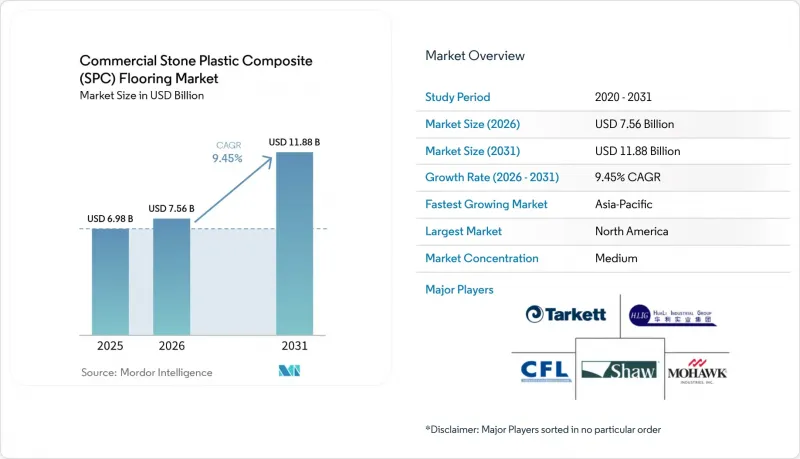
據 Mordor Intelligence 稱,2025 年商業 SPC(石塑複合)地板市場價值為 69.8 億美元,預計到 2031 年將從 2026 年的 75.6 億美元成長至 118.8 億美元,預測期(2026-2031 年)的複合成長率為 9.45%。
本報告依產品類型(磁磚、板材)、厚度(4.0–5.0 毫米、5.1–6.0 毫米、6.1–6.5 毫米、6.5 毫米以上)、安裝方式(自黏式、黏合劑、卡扣式、其他)、分銷通路(直銷/安裝商、批發商、零售商、電商)和地區細分(北美、其他)、亞太地區進行細分。市場預測以美元計價。
全球商用SPC(石塑複合材料)地板市場趨勢與洞察
在商業設施內部裝修中,由於維修需求的增加,對剛性芯材的需求也在增加,這種芯材可以快速安裝並最大限度地減少停機時間。
專案業主在維修計畫中傾向於選擇SPC剛性芯材,以便在運作的正常運作中。根據供應商的安裝指南,與膠合安裝相比,卡扣式系統能夠顯著加快浮動安裝速度。安裝後即可通行,無需等待24-48小時的黏合劑固化時間,從而降低人事費用,並最大限度地減少飯店和辦公室的停工時間。這種浮動結構無需進行大規模的表面處理即可彌補輕微的表面不平整,與需要更長固化時間和更徹底表面處理的黏合劑安裝相比,降低了返工的可能性。在公共設施中,低排放氣體認證是優先考慮的,以鼓勵維修後儘早重新使用。因此,基於加州01350揮發性有機化合物(VOC)限值進行測試的「FloorScore」是醫療保健和教育機構在申請LEED、WELL或CHPS認證時所採用的採購標準。供應商的維修工程記錄突顯了其製程的清潔性、能夠承受日常擦拭和液體潑濺的防水芯材,以及因商業室內濕度而導致延誤風險低的特點。
兼具耐用性和防水性的硬質芯材(SPC)正在擴大其在LVT市場的市場佔有率。
與傳統的軟性LVT相比,硬芯SPC結構能更有效解決尺寸穩定性問題。製造商的規格說明和產品比較強調了其低膨脹率(通常低於0.05%,部分產品甚至報告收縮率低於0.02%)和在溫度變化下的穩定性能。它具有高密度芯材和厚實的商用耐磨層(0.5毫米/20密耳或以上),能夠承受腳輪椅的測試(通常在90公斤的負載下通過25,000次循環),適用於走廊和大廳等滾動荷載和人流量大的區域。 SPC的防水芯材可防止因日常水洗和醫療機構消毒室、廚房和公共衛生間等場所的液體潑濺而導致的膨脹和表面變形。相比之下,軟性LVT邊緣長時間受潮可能會受到影響。該產品通常交付卡扣系統,並簽訂正式的授權合約,以確保在大範圍內實現一致的鎖定性能和可重複的品質。這些產品特性結合起來,將推動商業領域在 2026 年前從軟性乙烯基產品轉向硬芯產品。
PVC樹脂和添加劑的價格波動會影響競標競爭力。
複合地板主要使用聚氯乙烯(PVC)樹脂和碳酸鈣,多家製造商指出,樹脂和添加劑的價格波動會對交貨前置作業時間長的專案的利潤率帶來壓力。根據製造商的配方和生產數據,PVC樹脂通常佔芯材的25-30%,而石灰石(碳酸鈣)佔60-75%。其價格與全球原油和原料價格的波動密切相關;例如,2026年初PVC樹脂價格上漲了每磅3-5美分。石化市場報告解釋了上游業務週期如何反映在樹脂價格波動中,以及這些影響如何滯後地波及地板材料報價,從而使競標和採購變得更加複雜。區域價格差異也會影響每年的供應商選擇,迫使買家仔細權衡樹脂價格較低的地區與貿易措施和物流風險之間的平衡。許多批發商和進口商正從準時制生產系統轉向更為寬鬆的庫存管理模式,以在原料價格飆升的情況下也能維持供應的連續性。由於其石灰石含量高,SPC(聚氯乙烯)與柔軟性乙烯基產品相比,可以部分緩解價格波動的影響,但無法完全消除價格波動。然而,與完全依賴PVC(聚氯乙烯)的結構相比,SPC可以降低風險。
細分市場分析
2025年,SPC板材佔據了68.30%的市場。這主要得益於其大尺寸設計、逼真的木紋以及高效的安裝方式,使其在走廊、客房和開放式辦公室等場所得到廣泛應用。設計師通常選擇長條板材,以減少接縫,在大空間內實現視覺上的連續性,同時保持商業設施所需的耐用性。 SPC地磚正成為成長最快的產品形式,預計到2031年將以9.82%的複合年成長率成長,這主要得益於人們對大廳、接待區和品牌公共空間中模組化和幾何圖案的日益成長的興趣。各公司的設計指南均展示了人字形、V形和大尺寸石材紋理設計,並採用授權的鎖扣系統,確保圖案安裝的精準對齊。板材和地磚的功能性能相當。兩款產品均採用防水硬質芯材和商用級耐磨層;因此,決定性因素並非本質區別,而是設計理念和安裝流程。
在以美觀為首要考慮的項目中,大尺寸石材複合材料(SPC)地磚正日益受到關注,因為其維護性、防滑性和輕量化優勢比陶瓷材料更為重要。供應商強調,與傳統的陶瓷安裝材料相比,卡扣式安裝方式能夠顯著降低圖案和大尺寸設計現場安裝的複雜性。隨著採購團隊在商業SPC地板市場中逐步規範室內空氣品質(IAQ)和環境產品聲明(EPD)文件,在特定區域採用地磚與在背景和人流區域採用木板相得益彰,後者更具實用性。採用同一系列地磚和木板的負責人可以統一顏色、紋理和裝飾細節,同時保持維護程序的一致性。隨著設計意圖和可預測性能在2026年決策中日益融合,這種組合將有助於商業SPC地板市場實現均衡的銷售量策略。
2025年,厚度在5.1-6.0毫米範圍內的產品需求佔比達42.75%。這反映出買家在輕度至中度使用走廊和多功能房間中,既考慮了單價,也兼顧了商業性能。在這些中等厚度的結構中預先安裝隔音泡沫,有助於滿足許多建築規範中的基本隔聲目標,並且與使用單獨的襯墊相比,可以減少採購和調整工作量。預計到2031年,厚度超過6.5毫米的產品將以9.65%的複合年成長率成長,這反映了多用戶住宅和生活空間對隔音標準的日益嚴格以及居住者對舒適度的更高期望。供應商文件顯示,採用具有更高IIC和STC值的更厚芯材,可以在保持防水性和商業耐磨性的同時,避免在許多建築系統中增加二次隔音墊的成本和複雜性。這些趨勢正在推動商業石塑複合材料 (SPC) 地板市場向更高品質的安裝方式轉變,因為長期生命週期成本和保固風險超過了初始材料成本的節省。
那些仍然堅持選擇較薄規格的買家,通常設想的是預算有限的維修項目,或是承重較小的零售和辦公場所,這些場所的滾動荷載和聲波傳播都微乎其微。然而,在建築規範或品牌標準要求更高聲學性能的情況下,採用整合發泡層的較厚結構,無需改變施工方法,即可顯著提升聲學性能。此外,商用SPC(石塑複合)地板產業也擴大採用較厚的型材,以增強卡扣連接的強度,並方便在大型開放式空間中組裝。這縮短了安裝工期,並降低了返工風險。這些優勢已納入公共部門採購團隊分發的許多室內和維修項目標準規格範本中。因此,較厚型材的吸引力不僅限於聲學性能,也反映了商用SPC(石塑複合)地板產業所服務的嚴苛、耐磨環境中對穩定性的更普遍需求。
區域分析
到2025年,北美將佔據全球商用石塑複合材料(SPC)地板市場32.90%的佔有率。這主要得益於酒店、醫療和教育等機構設施的翻新改造。美國和加拿大的買家重視室內空氣品質(IAQ)認證和公開的環境性能文件,這進一步提升了與LEED、WELL及相關框架相關的正式認證的重要性。製造商和認證機構會公開列出符合排放標準並持有有效認證的SPC產品,為採購團隊和設計師提供通用規標準。該地區還受益於多元化的籌資策略,這些策略結合了本地和國際供應,以滿足專案進度和庫存計劃的需求。因此,在2026年的產品規範制定過程中,市場傾向選擇文件清晰、鎖扣系統穩固、隔音性能達到或超過基準隔音目標的SPC產品系列。
在歐洲,成熟的維修市場環境以及高標準的環保和健康文件要求,共同塑造了品牌的產品定位和合規投資。產業協會正積極回應,為PVC SPC地板材料製定經檢驗的EPD(環境產品聲明),以簡化建築師和總承包商的文件編制工作。歐洲產品線也強調使用不含鄰苯二甲酸酯的塑化劑,並根據區域標準檢驗排放分類認證,同時輔以易於審核的企業永續發展資訊。本地倉儲和快速服務支援緊湊的施工進度,企業還設有歐洲支援團隊,以滿足採購標準和語言要求。這些措施將有助於商業買家在2026年將設計、性能和合規性與更廣泛的脫碳和健康優先事項相結合,從而推動大規模維修的製定。
亞太地區是成長最快的地區,預計到2031年將以10.47%的複合年成長率成長,這主要得益於都市化趨勢和各種硬質芯材產能的持續擴張。越南已成為全球SPC(石塑複合材料)供應的關鍵樞紐,在其深水港附近投資興建了大規模工廠,以滿足出口和國內需求。根據該公司資訊披露,這些工廠生產的SPC產品具有極佳的隔音和耐刮擦性能,與美國和中國的產能形成互補,構成了一個強大的多站點網路。來自區域供應商的比較指南概述了從中國和越南採購SPC的實際注意事項,包括貿易協定以及運往北美和歐洲的運輸情況。這些因素使亞太地區成為SPC(石塑複合材料)地板製造中心和需求不斷成長的中心。
其他好處:
- Excel格式的市場預測(ME)表
- 3個月的分析師支持
目錄
第1章:引言
- 研究假設和市場定義
- 調查範圍
第2章:調查方法
第3章執行摘要
第4章 市場狀況
- 市場概覽
- 市場促進因素
- 受商業設施內部維修需求的推動,對可快速安裝且停機時間最短的剛性芯材的需求日益成長。
- 由於其耐用性和防水性,硬質芯材(SPC)在LVT市場中獲得了越來越多的市場佔有率。
- 放寬了醫療和教育產業對 IAQ 認證的低波動性 SPC(FloorScore/Greenguard Gold)的規格要求。
- 在辦公室、旅館、醫療保健和教育等領域的商業用途不斷擴大。
- 核心技術的創新,既實現了聲學性能,又實現了輕量化設計,同時確保符合建築規範並提升了居住者的舒適度。
- 近岸外包/透過區域內SPC工廠降低關稅和前置作業時間風險
- 市場限制因素
- PVC樹脂和添加劑的價格波動正在影響市場競爭。
- 對廢舊產品回收的限制以及對PVC規格的嚴格審查。
- 在承受較大滾動負荷的環境中,浮動卡扣連接是某些應用中需要黏合劑黏接的原因。
- 智慧財產權/透過貿易執法提高點擊系統合規性/進口風險
- 產業價值鏈分析
- 波特五力分析
- 洞察最新產業趨勢與創新
- 近期產業趨勢分析(新產品發布、策略性舉措、投資、合作、合資、業務擴張、併購等)
第5章 市場規模與成長預測
- 依產品類型
- SPC磁磚
- SPC板材
- 產品厚度(依類別)
- 4.0~5.0 mm
- 5.1~6.0 mm
- 6.1~6.5 mm
- 6.5毫米或以上
- 透過安裝方法
- 自黏式
- 黏牢
- 互鎖/卡扣
- 其他
- 透過商業最終用戶
- 飯店業
- 醫療機構
- 教育機構
- 零售業(購物中心、展示室、商店)
- 辦公室和企業工作空間
- 其他商業終端用戶
- 透過分銷管道
- 直銷
- 線下專案和直接向承包商銷售
- 線上D2C
- 間接銷售/經銷商
- 銷售代理商/批發商
- 專業零售商和家居裝修商店
- 電子商務/B2B市場
- 直銷
- 按地區
- 北美洲
- 加拿大
- 美國
- 墨西哥
- 南美洲
- 巴西
- 秘魯
- 智利
- 阿根廷
- 其他南美國家
- 歐洲
- 英國
- 德國
- 法國
- 西班牙
- 義大利
- 比荷盧經濟聯盟(比利時、荷蘭、盧森堡)
- 北歐國家(丹麥、芬蘭、冰島、挪威、瑞典)
- 其他歐洲國家
- 亞太地區
- 印度
- 中國
- 日本
- 澳洲
- 韓國
- 東南亞
- 其他亞太國家
- 中東和非洲
- 阿拉伯聯合大公國
- 沙烏地阿拉伯
- 南非
- 奈及利亞
- 其他中東和非洲國家
- 北美洲
第6章 競爭情勢
- 市場集中度
- 策略趨勢
- 市佔率分析
- 公司簡介
- CFL Flooring
- Huali Group(Huali Floors)
- Novalis Innovative Flooring(AVA)
- Mohawk Industries(SolidTech)
- Shaw Industries(Floorte Pro)
- Tarkett(ProGen)
- Mannington Mills(ADURA Rigid)
- Karndean Designflooring(Korlok/Art Select Rigid)
- AHF Products(AHF Contract)
- Gerflor(Creation 55 Rigid Acoustic)
- BerryAlloc(Rigid/SPC LVT)
- Metroflor/HMTX(Inception SPC;Aspecta Contract)
- LX Hausys(HFLOR PRESTG DECORIGID 55)
- Zhejiang Kingdom Plastics(SPC OEM)
- Decno Group(SPC OEM)
- Beauflor/Beaulieu International Group(Rigid LVT)
- NOX Corporation(Rigid Core LVT)
- Power Dekor(Rigid Core SPC)
- Zhejiang Walrus New Material(SPC)
- Zhejiang GIMIG Technology(SPC)
第7章 市場機會與未來展望
According to Mordor Intelligence, the commercial stone plastic composite flooring Market size was valued at USD 6.98 billion in 2025 and is estimated to grow from USD 7.56 billion in 2026 to reach USD 11.88 billion by 2031, at a CAGR of 9.45% during the forecast period (2026-2031).
This report is Segmented by Product Type (Tiles, Planks), Thickness (4. 0-5. 0 Mm, 5. 1-6. 0 Mm, 6. 1-6. 5 Mm, >6. 5 Mm), Installation Method (Self Adhesive, Glue Down, Click Lock, Others), Distribution Channel (Direct/Contractors, Distributors, Retail, E Commerce), and Geography (North America, South America, Asia-Pacific, and More). Market Forecasts are in Value (USD).
Global Commercial Stone Plastic Composite (SPC) Flooring Market Trends and Insights
Renovation Driven Demand for Fast, Low Downtime Rigid Core in Commercial Interiors
Project owners favor SPC rigid core for renovation schedules that keep facilities operational while construction moves zone by zone. According to supplier installation guides, click lock systems enable floating installation that is significantly faster than glue-down alternatives, with immediate walk-on access and no 24-48 hour adhesive curing time, resulting in reduced labor and minimal business downtime in occupied hospitality and office spaces. These floating assemblies bridge minor subfloor irregularities without extensive surface preparation, lowering callbacks compared with glue-down options that require longer adhesive curing and more intensive prep work. Institutional environments prioritize low-emission certifications to speed re-occupancy after renovation, which is why FloorScore, testing to California Section 01350 VOC limits, has become standard for procurement in healthcare and education facilities seeking LEED, WELL, or CHPS compliance. Suppliers' renovation references highlight cleaner execution, waterproof cores that tolerate daily wet cleaning and spills, and lower risk of moisture-related delays in commercial interiors.
Rigid Core (SPC) Gaining Share Within LVT for Durability and Waterproofing
Rigid core SPC constructions address dimensional stability issues more effectively than traditional flexible LVT. Manufacturer specifications and product comparisons emphasize low expansion rates (typically <=0.05%, with some reporting shrinkage <=0.02%) and stable performance in temperature swings, with high-density cores and thicker commercial wear layers (0.5 mm / 20 mil or more) supporting castor chair tests (often passing 25,000 cycles under 90 kg load) for rolling loads and high footfall zones such as corridors and lobbies. SPC's waterproof core eliminates swelling and surface deformation after daily wet cleaning and spills in healthcare sterile processing, kitchens, and public restrooms, unlike flexible LVT, which can be affected by prolonged moisture exposure around edges. The format is often delivered with click systems under formal license agreements for consistent locking integrity and repeatable quality across large footprints. These product attributes, together, are driving substitution from flexible vinyl toward rigid-core choices within the commercial segment in 2026.
PVC Resin and Additive Price Volatility Impacting Bid Competitiveness
SPC relies on PVC resin alongside calcium carbonate, and several producers flag resin and additive volatility as pricing risks that compress margins on long-lead projects. According to manufacturer formulations and production references, PVC resin typically accounts for 25-30% of the core, while limestone (calcium carbonate) accounts for 60-75%, with prices closely linked to global oil and feedstock fluctuations, such as the documented 3-5¢/lb increases in PVC resin in early 2026. Petrochemical market reports explain how upstream cycles translate into resin price changes that flow through flooring price quotes with timing lags that complicate bidding and procurement. Regional differentials also shape sourcing choices in a given year, prompting buyers to weigh lower-resin-price zones against trade actions and logistics exposures. Many wholesalers and importers have shifted from just-in-time to more buffered inventories to sustain supply continuity during feedstock spikes. The partial mitigation of SPC versus flexible vinyl, due to its higher limestone content, does not eliminate volatility but can moderate exposure relative to fully PVC-dependent constructions.
Other drivers and restraints analyzed in the detailed report include:
- IAQ Certified Low Emitting SPC Easing Specs in Healthcare and Education
- Expanding Commercial Adoption Across Office, Hospitality, Healthcare, Education
- End of Life Recycling Limits and PVC Scrutiny in Specifications
For complete list of drivers and restraints, kindly check the Table Of Contents.
Segment Analysis
SPC planks captured 68.30% share in 2025, as large-format visuals, realistic wood textures, and efficient installation supported scale across corridors, guest rooms, and open offices. Designers often select long boards to reduce seam frequency and to deliver continuous lines of sight across expansive spaces while maintaining commercial durability. SPC tiles are advancing as the fastest-growing format, with a 9.82% CAGR through 2031, driven by increased interest in modular and geometric patterns for lobbies, reception areas, and branded public spaces. Company design guides show herringbone, chevron, and large-format stone looks implemented via licensed locking systems that support reliable alignment across patterned installations. The functional performance of planks and tiles is comparable because both formats share waterproof rigid cores and commercial wear layers, so selection pivots on design language and installation workflows rather than core differences.
In projects with high aesthetic stakes, stone-look SPC tiles in larger dimensions are gaining traction where maintenance, slip performance, and weight reduction are priorities relative to ceramics. Vendors outline how click-lock assemblies reduce job-site complexity for patterned or large-format designs compared with traditional ceramic-setting materials. As procurement teams standardize on IAQ and Environmental Product Declaration (EPD) documentation for the commercial stone plastic composite flooring market, the adoption of tiles in signature zones complements the broad utility of planks in background and circulation spaces. Specifiers who rely on a single family across both tile and plank formats can consolidate colorways, textures, and trim details while preserving consistent maintenance protocols. This mix supports a balanced volume strategy across the commercial stone plastic composite flooring market as 2026 decisions blend design intent with predictable performance.
The 5.1-6.0 mm band accounted for 42.75% of 2025 demand as buyers balanced unit costs with commercial performance in light-to-mid-duty corridors and multipurpose rooms. Factory-attached acoustic foams in these mid-thickness builds help projects meet baseline impact-isolation targets in many codes, reducing procurement and coordination steps compared with separate underlayment. Above 6.5 mm, products are projected to grow at a 9.65% CAGR through 2031, reflecting tighter acoustic targets and occupant comfort expectations in multifamily and senior living spaces. Supplier documentation points to thicker cores with higher IIC and STC ratings that can avoid the cost and complexity of secondary sound mats in many assemblies, while maintaining waterproof performance and commercial wear layers. These dynamics support a tilt toward premium construction in the commercial stone plastic composite flooring market when long-term lifecycle costs and warranty risk outweigh initial material savings.
Buyers who continue to specify thinner formats usually do so for budget-constrained refreshes or lighter-duty retail and office applications where rolling loads and acoustic transmission are minimal. Where code or brand standards direct higher acoustic values, thicker constructions with integrated foam layers deliver measurable performance benefits without introducing different installation methods across a project. The commercial stone plastic composite flooring industry has also adopted thicker profiles to increase click-joint strength and ease fit-up on large, open floors, thereby shortening installation schedules and reducing rework risk. These advantages now appear in many standard spec templates that institutional procurement teams distribute for fit-outs and renovations. The appeal of thicker profiles, therefore, extends beyond acoustics and reflects a more general desire for stability in heavy wear environments served by the commercial stone plastic composite flooring industry.
Complete Report Scope:
- By Product Type
- SPC Tiles
- SPC Planks
- By Product Thickness
- 4.0-5.0 mm
- 5.1-6.0 mm
- 6.1-6.5 mm
- Above 6.5 mm
- By Installation Method
- Self-Adhesive
- Glue-Down
- Interlocking/Click-lock
- Others
- By Commercial End Users
- Hospitality
- Healthcare Facilities
- Educational Institutes
- Retail (malls, showrooms, stores)
- Offices & Corporate Workspaces
- Other Commercial End Users
- By Distribution Channel
- Direct Sales
- Offline Direct to Projects/Contractors
- Online D2C
- Indirect/Dealers
- Distributors/Wholesalers
- Specialty Retail & Home Improvement
- E-commerce/B2B Marketplaces
- Direct Sales
- By Geography
- North America
- Canada
- United States
- Mexico
- South America
- Brazil
- Peru
- Chile
- Argentina
- Rest of South America
- Europe
- United Kingdom
- Germany
- France
- Spain
- Italy
- BENELUX (Belgium, Netherlands, Luxembourg)
- NORDICS (Denmark, Finland, Iceland, Norway, Sweden)
- Rest of Europe
- Asia-Pacific
- India
- China
- Japan
- Australia
- South Korea
- South-East Asia
- Rest of Asia-Pacific
- Middle East & Africa
- United Arab Emirates
- Saudi Arabia
- South Africa
- Nigeria
- Rest of Middle East & Africa
- North America
Geography Analysis
North America accounted for 32.90% of the global market share for commercial stone plastic composite flooring in 2025, driven by institutional renovations in hospitality, healthcare, and education. U.S. and Canadian buyers give weight to IAQ credentials and public documentation of environmental performance, which has reinforced the importance of formal certifications linked to LEED, WELL, and related frameworks. Manufacturers and certification bodies publicly list SPC products that meet emissions standards and maintain active certificates, providing procurement teams and designers with a common language for compliance. This region also benefits from diversified sourcing strategies that combine regional and overseas supply to address project schedules and inventory planning. As a result, specification flow in 2026 favors SPC lines with clear documentation, strong locking systems, and acoustic packages that meet or exceed baseline isolation targets.
Europe combines mature renovation activity with a high bar for environmental and health documentation, which shapes brand assortments and compliance investments. Industry associations have responded by producing verified EPDs that cover vinyl SPC floor coverings to simplify documentation for architects and general contractors. European portfolios also emphasize phthalate-free stabilizers and emission classifications validated under regional schemes, supported by corporate sustainability content that is readily auditable. Localized warehousing and faster service responses support tight construction timelines, and firms maintain European support teams to align with procurement norms and language expectations. These moves help commercial buyers in 2026 align design, performance, and compliance against the broader decarbonization and health priorities that drive large renovation budgets.
Asia-Pacific is the fastest-growing region, with a 10.47% CAGR through 2031, driven by urbanization dynamics and the continued buildout of diversified rigid-core capacity. Vietnam has become a pivotal node in global SPC supply with large factory investments near deepwater ports to serve both exports and domestic demand. Company disclosures indicate that these factories produce advanced acoustic SPC and scratch-resistant variants that complement capacity in the U.S. and China, forming resilient multi-site networks. Comparative guidance from regional suppliers outlines the practical considerations of sourcing SPC from China versus Vietnam, including trade agreements and shipping profiles into North America and Europe. These factors position Asia-Pacific as both a manufacturing anchor and an expanding demand center for the commercial stone plastic composite flooring market.
- CFL Flooring
- Huali Group (Huali Floors)
- Novalis Innovative Flooring (AVA)
- Mohawk Industries (SolidTech)
- Shaw Industries (Floorte Pro)
- Tarkett (ProGen)
- Mannington Mills (ADURA Rigid)
- Karndean Designflooring (Korlok/Art Select Rigid)
- AHF Products (AHF Contract)
- Gerflor (Creation 55 Rigid Acoustic)
- BerryAlloc (Rigid/SPC LVT)
- Metroflor / HMTX (Inception SPC
- Aspecta Contract)
- LX Hausys (HFLOR PRESTG DECORIGID 55)
- Zhejiang Kingdom Plastics (SPC OEM)
- Decno Group (SPC OEM)
- Beauflor / Beaulieu International Group (Rigid LVT)
- NOX Corporation (Rigid Core LVT)
- Power Dekor (Rigid Core SPC)
- Zhejiang Walrus New Material (SPC)
- Zhejiang GIMIG Technology (SPC)
Additional Benefits:
- The market estimate (ME) sheet in Excel format
- 3 months of analyst support
TABLE OF CONTENTS
1 Introduction
- 1.1 Study Assumptions & Market Definition
- 1.2 Scope of the Study
2 Research Methodology
3 Executive Summary
4 Market Landscape
- 4.1 Market Overview
- 4.2 Market Drivers
- 4.2.1 Renovation-driven demand for fast, low-downtime rigid core in commercial interiors
- 4.2.2 Rigid core (SPC) gaining share within LVT for durability and waterproofing
- 4.2.3 IAQ-certified low-emitting SPC (FloorScore/Greenguard Gold) easing specs in healthcare and education
- 4.2.4 Expanding commercial adoption across office, hospitality, healthcare, education
- 4.2.5 Acoustic and lightweight core innovations enabling code compliance and occupant comfort
- 4.2.6 Nearshoring/regional SPC plants reducing tariff and lead-time risk
- 4.3 Market Restraints
- 4.3.1 PVC resin and additive price volatility impacting bid competitiveness
- 4.3.2 End-of-life recycling limits and PVC scrutiny in specifications
- 4.3.3 Floating click joints under heavy rolling loads prompting glue-down specs in some applications
- 4.3.4 IP/trade enforcement on click systems raising compliance/import risks
- 4.4 Industry Value Chain Analysis
- 4.5 Porter's Five Forces Analysis
- 4.5.1 Threat of New Entrants
- 4.5.2 Bargaining Power of Suppliers
- 4.5.3 Bargaining Power of Buyers
- 4.5.4 Threat of Substitutes
- 4.5.5 Competitive Rivalry
- 4.6 Insights into the Latest Trends and Innovations in the Industry
- 4.7 Insights on Recent Developments (New Product Launches, Strategic Initiatives, Investments, Partnerships, JVs, Expansion, M&As, etc.) in the Industry
5 Market Size & Growth Forecasts (Value in USD Billion)
- 5.1 By Product Type
- 5.1.1 SPC Tiles
- 5.1.2 SPC Planks
- 5.2 By Product Thickness
- 5.2.1 4.0-5.0 mm
- 5.2.2 5.1-6.0 mm
- 5.2.3 6.1-6.5 mm
- 5.2.4 Above 6.5 mm
- 5.3 By Installation Method
- 5.3.1 Self-Adhesive
- 5.3.2 Glue-Down
- 5.3.3 Interlocking/Click-lock
- 5.3.4 Others
- 5.4 By Commercial End Users
- 5.4.1 Hospitality
- 5.4.2 Healthcare Facilities
- 5.4.3 Educational Institutes
- 5.4.4 Retail (malls, showrooms, stores)
- 5.4.5 Offices & Corporate Workspaces
- 5.4.6 Other Commercial End Users
- 5.5 By Distribution Channel
- 5.5.1 Direct Sales
- 5.5.1.1 Offline Direct to Projects/Contractors
- 5.5.1.2 Online D2C
- 5.5.2 Indirect/Dealers
- 5.5.2.1 Distributors/Wholesalers
- 5.5.2.2 Specialty Retail & Home Improvement
- 5.5.2.3 E-commerce/B2B Marketplaces
- 5.5.1 Direct Sales
- 5.6 By Geography
- 5.6.1 North America
- 5.6.1.1 Canada
- 5.6.1.2 United States
- 5.6.1.3 Mexico
- 5.6.2 South America
- 5.6.2.1 Brazil
- 5.6.2.2 Peru
- 5.6.2.3 Chile
- 5.6.2.4 Argentina
- 5.6.2.5 Rest of South America
- 5.6.3 Europe
- 5.6.3.1 United Kingdom
- 5.6.3.2 Germany
- 5.6.3.3 France
- 5.6.3.4 Spain
- 5.6.3.5 Italy
- 5.6.3.6 BENELUX (Belgium, Netherlands, Luxembourg)
- 5.6.3.7 NORDICS (Denmark, Finland, Iceland, Norway, Sweden)
- 5.6.3.8 Rest of Europe
- 5.6.4 Asia-Pacific
- 5.6.4.1 India
- 5.6.4.2 China
- 5.6.4.3 Japan
- 5.6.4.4 Australia
- 5.6.4.5 South Korea
- 5.6.4.6 South-East Asia
- 5.6.4.7 Rest of Asia-Pacific
- 5.6.5 Middle East & Africa
- 5.6.5.1 United Arab Emirates
- 5.6.5.2 Saudi Arabia
- 5.6.5.3 South Africa
- 5.6.5.4 Nigeria
- 5.6.5.5 Rest of Middle East & Africa
- 5.6.1 North America
6 Competitive Landscape
- 6.1 Market Concentration
- 6.2 Strategic Moves
- 6.3 Market Share Analysis
- 6.4 Company Profiles (includes Global level Overview, Market level overview, Core Segments, Financials as available, Strategic Information, Market Rank/Share for key companies, Products & Services, and Recent Developments)
- 6.4.1 CFL Flooring
- 6.4.2 Huali Group (Huali Floors)
- 6.4.3 Novalis Innovative Flooring (AVA)
- 6.4.4 Mohawk Industries (SolidTech)
- 6.4.5 Shaw Industries (Floorte Pro)
- 6.4.6 Tarkett (ProGen)
- 6.4.7 Mannington Mills (ADURA Rigid)
- 6.4.8 Karndean Designflooring (Korlok/Art Select Rigid)
- 6.4.9 AHF Products (AHF Contract)
- 6.4.10 Gerflor (Creation 55 Rigid Acoustic)
- 6.4.11 BerryAlloc (Rigid/SPC LVT)
- 6.4.12 Metroflor / HMTX (Inception SPC; Aspecta Contract)
- 6.4.13 LX Hausys (HFLOR PRESTG DECORIGID 55)
- 6.4.14 Zhejiang Kingdom Plastics (SPC OEM)
- 6.4.15 Decno Group (SPC OEM)
- 6.4.16 Beauflor / Beaulieu International Group (Rigid LVT)
- 6.4.17 NOX Corporation (Rigid Core LVT)
- 6.4.18 Power Dekor (Rigid Core SPC)
- 6.4.19 Zhejiang Walrus New Material (SPC)
- 6.4.20 Zhejiang GIMIG Technology (SPC)
7 Market Opportunities & Future Outlook
- 7.1 Spec-grade SPC with verified acoustic assemblies (E90/E492) for office and multifamily
- 7.2 Circular SPC (EPD-backed, take-back) aligned to LEED v5 procurement

 實木地板:市場佔有率分析、產業趨勢與統計、成長預測(2026-2031)
 網球場維護服務市場分析及預測(至2035年):依類型、產品、服務、技術、應用、材料類型、製程、最終用戶、設備及解決方案分類
 陶瓷地板材料市場-2026-2032年全球市場預測地板材料市場:2026-2032年全球市場預測(依產品類型、安裝類型、地板材料、應用、安裝方法及分銷通路分類)
 夾層樓市場規模、佔有率和成長分析:按類型、材料、應用、最終用戶和地區分類-2026-2033年產業預測
 夾層樓市場 - 全球產業規模、佔有率、趨勢、機會、預測:按樓板類型、建築類型、應用、地區和競爭格局分類,2021-2031年
 美國地板市場規模、佔有率和趨勢分析報告:按產品、顏色、紋理、圖案、最終用途、分銷管道、板材寬度、板材厚度和細分市場預測(2026-2035 年)
 實木地板市場報告:按應用、原料和地區分類(2026-2034 年)
 2026年全球全鋁防靜電地板市場報告2026年全球地板材料安裝服務市場報告