


 |
市場調查報告書
商品編碼
2073295
內部人才市場平台:市場佔有率分析、產業趨勢與統計、成長預測(2026-2031)Internal Talent Marketplace Platform Market - Market Share Analysis, Industry Trends & Statistics, Growth Forecasts (2026 - 2031) |
||||||

※ 本網頁內容可能與最新版本有所差異。詳細情況請與我們聯繫。
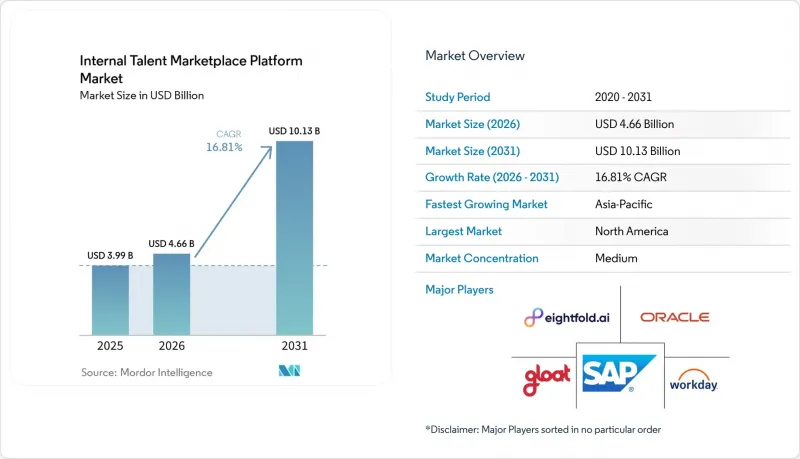
據 Mordor Intelligence 稱,內部人才市場平台的市場規模預計將從 2025 年的 39.9 億美元成長到 2026 年的 46.6 億美元,到 2031 年達到 101.3 億美元,預計 2026 年至 2031 年的複合年成長率為 16.81%。
本報告按功能(職位匹配、人才規分類析等)、交付模式(獨立內部人才市場平台等)、部署模式(雲端等)、公司規模(大型企業等)、產業(IT和電信等)以及地區進行分類。市場預測以美元計價。
企業內部人才市場平台市場的全球趨勢與洞察。
基於技能的人才規劃
企業正透過打破僵化的職位架構,採用基於檢驗能力分配任務的靈活人才庫,來縮短應對不斷變化的優先事項所需的時間。實施內部人才市場平台,可利用專案成果、同事推薦和課程完成情況自動檢驗技能,從而創建企業能力的“動態清單”,供財務和戰略團隊在資本預算中加以利用。世界經濟論壇 (WEF) 預測,到 2030 年,39% 的核心技能將會發生變化,這進一步凸顯了持續技能提升的迫切性。將學習路徑融入職業提案的平台,使員工能夠在不離開現有生態系統的情況下彌補技能差距,從而將能力發展與價值創造直接聯繫起來。
員工對靈活職涯發展路徑的需求
透明的內部調動正成為人才保留的關鍵因素,尤其是在職涯初期的專業中。他們期望消費者層級的建議引擎能夠為他們提供具有挑戰性的任務,從而最大限度地發揮自身能力。大規模實施的數據顯示,當引入演算法匹配而非靜態招聘網站時,內部申請的參與度指標實現了三位數的成長。市場分析使多種跨職能的職涯發展路徑清晰可見,促使員工在公司內部建立跨領域技能組合,而不是尋求外部晉升,從而鼓勵他們延長在職時間。面臨需求激增的零售商、物流供應商和飯店連鎖企業也正在利用同樣的機制重新部署季節性員工,並在無需大規模招聘的情況下平衡勞動力利用率。
與傳統人力資源資訊系統整合面臨的挑戰
許多公司仍然依賴批次系統運行核心人力資源業務,而這些系統並非為即時技能更新而設計,這迫使市場平台供應商依賴平面文件傳輸,導致資料延遲和品質問題。使用本地部署 SAP 或 Oracle 系統的公司必須權衡:是容忍糟糕的使用者體驗,還是投資昂貴的中間件專案。 Workday 收購 Sana 將市場平台功能原生整合到其雲端套件中,避免了現有平台客戶在整合過程中遇到的摩擦。然而,使用其他人力資源系統的企業則面臨著專案週期延長和投資回報率降低的風險。
細分市場分析
技能推論引擎是企業內部人才市場平台的一個細分領域,預計到2031年將以18.71%的複合年成長率成長。這是因為雇主逐漸意識到,配對的品質並非取決於職位清單的數量,而是取決於本體資訊的豐富程度。到2025年,機會匹配將佔企業內部人才市場平台市場規模的36.12%,但隨著功能趨於同質化,差異化的重點正轉向能夠從非結構化資料中識別新技能的引擎。生成式人工智慧減少了整理個人資料所需的時間,並提供了相關能力的可見性,使財務團隊能夠在無需外部招聘的情況下將員工重新部署到成長計畫中。學習整合模組也遵循同樣的原則,允許職位透過將技能提升與空缺職位直接關聯來即時填補技能差距。勞動力規分類析對需要進行產能情境規劃的營運經理極具吸引力,這些附加元件也為供應商提供了合理的提升銷售。
繼任計畫和校友網路等輔助功能目前仍屬於小眾領域,但隨著企業不僅關注現有員工,也關注退休專家和回聘人員(回巢式招募),這些功能展現出策略潛力。 2026年推出的互動式介面透過回答簡單的英語查詢來減少搜尋阻力,這種設計選擇有助於非技術人員接受該技術。歐盟人工智慧法律的透明度要求減緩了一些歐洲跨國公司的採用速度,因為這些要求需要對公開的推理鏈進行額外檢驗。然而,一旦獲得認證,這些可審計性特徵將成為向受監管客戶提案的競爭優勢。
到2025年,整合到大型人力資源套件中的模組將貢獻56.44%的收入,這得益於現有的客戶關係和統一的資料模型。然而,在企業內部人才市場平台市場,那些能夠縮短引進週期並避免供應商鎖定的一流供應商,正以19.04%的複合年成長率成長。採購團隊重視能夠在不中斷核心人力資源系統的情況下協商更短的合約期限和組件更換。套件供應商意識到了這一差距,並正在收購專業公司以加速其產品藍圖,Workday以11億美元收購Sana就是一個典型的例子。
儘管小規模的企業的 IT 團隊仍然傾向於在現有套件上運行模組,但對季度升級週期的日益不滿正促使即使是風險規避型的買家也轉向那些推崇 API 優先方法的專業供應商。中型企業尤其青睞獨立供應商提供的 8-12 週部署承諾,這使他們能夠在全公司推廣之前透過試點營運來驗證投資報酬率。在整個預測期內,由專業供應商負責映射、套件負責管理合規工作流程的混合方法可能會成為主流。
區域分析
預計到2025年,北美將佔據企業內部人才市場平台37.21%的市場佔有率,這得益於成熟的供應商生態系統和監管支持,例如強制要求對自動化招聘決策工具進行年度偏見審計的144號地方法律。雖然全球500強企業已廣泛採用該平台,但隨著大型企業滲透率接近飽和,成長重點正轉向中型企業和公共部門。總部位於該地區的套件供應商正尋求透過併購來鞏固市場佔有率,而獨立的專業供應商則透過快速發布專注於人工智慧透明度的功能來保持競爭力。
在歐洲,人們對GDPR的理解不斷加深,這增強了買家實施系統性合規的信心,從而推動了監管主導的穩定應用。將於2025年最終生效的歐盟人工智慧法案延長了採購週期,因為買家在簽署多年合約前需要提供書面解釋。德國和法國在製造業和金融服務業引領GDPR的應用,這些產業迫切需要對老齡化勞動力進行技能再培訓。歐盟內部人才市場平台正受惠於泛歐技能聯盟,這些聯盟促進了跨國人才流動,而人才市場正是推動人才流動的重要力量。
預計到2031年,亞太地區的複合年成長率將達到18.45%,位居全球之首。印度IT外包公司正在採用市場平台,以便讓高離職率的工程師能夠在客戶專案間隙繼續參與內部專案。同時,中國國有企業正在試行相關平台,以使人才重新部署與產業政策目標一致。在東南亞,雲端原生中型企業正在採用市場平台,以在不擴大招募團隊的情況下解決區域技能短缺問題。波灣合作理事會(GCC)成員國由於其採用市場平台的促進因素與亞太地區類似,因此也被歸類為更廣泛的亞太成長趨勢範疇,但它們採用的是包含沙烏地阿拉伯和阿拉伯聯合大公國政策規定的本地化指標的專用平台。
其他好處:
- Excel格式的市場預測(ME)表
- 3個月的分析師支持
目錄
第1章:引言
- 研究假設和市場定義
- 調查範圍
第2章:調查方法
第3章執行摘要
第4章 市場狀況
- 市場概覽
- 市場促進因素
- 向基於技能的人才規劃轉型
- 員工對敏捷職涯發展的需求日益成長
- 將生成式人工智慧整合到技能推論中
- 降低外部招募成本的壓力
- 人們越來越關注多元化、股權和包容性(DEI)的目標。
- 遠端和混合工作模式的擴展
- 市場限制因素
- 整合傳統人力資源資訊系統面臨的挑戰
- 資料隱私和安全問題
- 現場管理人員對變革管理的抵制
- 企業技能分類體系的模糊性
- 產業價值鏈分析
- 監理情勢
- 技術展望
- 宏觀經濟因素對市場的影響
- 波特五力分析
第5章 市場規模與成長預測
- 按功能
- 機會匹配
- 技能分類與推理
- 學習與技能發展的融合
- 人員規分類析
- 內部專案和專案管理
- 其他功能
- 按型號提供
- 獨立內部人才市場平台
- 整合式人力資源套件模組
- 部署模式
- 雲
- 現場
- 按公司規模
- 大公司
- 中小企業
- 按行業分類
- IT/通訊
- 銀行業、金融服務業及保險業
- 衛生保健
- 製造業
- 零售與電子商務
- 政府
- 其他工業部門
- 按地區
- 北美洲
- 美國
- 加拿大
- 墨西哥
- 南美洲
- 巴西
- 阿根廷
- 其他南美國家
- 歐洲
- 德國
- 英國
- 法國
- 義大利
- 西班牙
- 俄羅斯
- 其他歐洲國家
- 亞太地區
- 中國
- 印度
- 日本
- 韓國
- 澳洲和紐西蘭
- 其他亞太國家
- 中東
- 沙烏地阿拉伯
- 阿拉伯聯合大公國
- 土耳其
- 其他中東國家
- 非洲
- 南非
- 奈及利亞
- 其他非洲國家
- 北美洲
第6章 競爭情勢
- 市場集中度
- 策略趨勢
- 市佔率分析
- 公司簡介
- Gloat Ltd.
- Fuel50 Ltd.
- Eightfold AI, Inc.
- Workday, Inc.
- Oracle Corporation
- SAP SE
- Cornerstone OnDemand, Inc.
- Degreed, Inc.
- Hitch Works, Inc.
- SkyHive Technologies, Inc.
- Phenom People, Inc.
- Beamery Ltd.
- Avature, LLC
- iCIMS, Inc.
- ServiceNow, Inc.
- SeekOut II Corporation
- Pymetrics, Inc.
- HireRoad Holdings Pty Ltd
- Tandemploy GmbH
- Guild Education, Inc.
第7章 市場機會與未來展望
According to Mordor Intelligence, the internal talent marketplace platform market size is expected to increase from USD 3.99 billion in 2025 to USD 4.66 billion in 2026 and reach USD 10.13 billion by 2031, growing at a CAGR of 16.81% over 2026-2031.
This report is Segmented by Capability (Opportunity Matching, Workforce Planning Analytics, and More), Delivery Model (Standalone Internal Talent Marketplace Platforms, and More), Deployment Mode (Cloud, and More), Enterprise Size (Large Enterprises, and More), Industry Vertical (IT and Telecommunications, and More), and Geography. The Market Forecasts are Provided in Terms of Value (USD).
Global Internal Talent Marketplace Platform Market Trends and Insights
Skills-Based Workforce Planning
Organizations are dismantling rigid job architectures in favor of fluid talent pools that allocate work according to verified competencies, shortening reaction times when priorities shift. Internal talent marketplace platform market deployments automate skills validation with project outcomes, peer endorsements, and course completions, creating a living inventory of enterprise capabilities that finance and strategy teams can model alongside capital budgets. The World Economic Forum projects that 39% of core skills will change by 2030, amplifying the urgency of continuous reskilling. Platforms that weave learning paths into opportunity suggestions ensure workers close gaps without leaving the ecosystem, linking development directly to value creation.
Employee Demand for Agile Career Paths
Transparent internal mobility is becoming a decisive factor in retention, especially among early-career professionals who expect consumer-grade recommendation engines to surface stretch assignments. Engagement metrics from large deployments show triple-digit growth in internal applications once algorithmic matching replaces static job boards. Employees stay longer because marketplace analytics illuminate multiple progression routes, even across functions, giving them reasons to build cross-domain portfolios instead of seeking advancement elsewhere. Retailers, logistics providers, and hospitality chains that experience demand spikes use the same mechanics to redeploy seasonal labor, smoothing workforce utilization without mass hiring.
Legacy HRIS Integration Challenges
Many corporations still run core HR on batch-oriented systems that were never designed for real-time skill updates, forcing marketplace vendors to rely on flat-file transfers that create latency and data-quality gaps. Enterprises locked into on-premises SAP or Oracle must decide whether to endure suboptimal user experiences or fund costly middleware projects. Workday's acquisition of Sana embeds marketplace functions natively within its cloud suite, sidestepping integration friction for customers already on its platform, but organizations tied to other HR stacks face longer project timelines and diluted ROI.
Other drivers and restraints analyzed in the detailed report include:
- Generative AI Skill Inference
- Recruiting Cost Reduction Pressure
- Data Privacy and Security Concerns
For complete list of drivers and restraints, kindly check the Table Of Contents.
Segment Analysis
Skill inference engines, a subset of the internal talent marketplace platform market, are set to grow at an 18.71% CAGR through 2031 as employers learn that match quality hinges on ontology richness rather than volume of listings. While opportunity matching accounted for 36.12% of the internal talent marketplace platform market size in 2025, feature parity is narrowing and differentiation is shifting to engines that detect emerging skills from unstructured artifacts. Generative AI reduces time spent curating profiles and surfaces adjacent capabilities, allowing finance teams to redeploy staff into growth programs without external hires. Learning-integration modules follow closely, linking upskilling directly to open roles so workers can bridge gaps in real time. Workforce-planning analytics appeal to operations leaders who need to scenario-plan capacity, making these add-ons a logical upsell path for vendors.
Second-tier functions, including succession planning and alumni networks, remain niche yet demonstrate strategic potential as organizations look beyond active employees to retired specialists and boomerang hires. Conversational interfaces launched in 2026 compress search friction by answering plain-English queries, a design choice that is lifting adoption among non-technical staff. The EU AI Act's transparency mandate slows rollouts in some European multinationals because exposed reasoning chains require additional validation, but the same auditability features, once certified, become competitive differentiators when bidding for regulated clients.
Integrated modules within broad HR suites held 56.44% of revenue in 2025 thanks to incumbent relationships and uniform data models. Yet the internal talent marketplace platform market is witnessing a 19.04% CAGR for best-of-breed vendors that deliver shorter implementation cycles and avoid vendor lock-in. Procurement teams value the ability to negotiate shorter contracts and swap components without disrupting the HR core. Suite providers, recognizing the gap, are buying specialists to accelerate road maps, evident in Workday's USD 1.10 billion Sana purchase.
Organizations with lean IT teams still gravitate toward modules that run on their existing suite, but growing dissatisfaction with quarterly upgrade windows is pushing even risk-averse buyers toward API-first specialists. Mid-market firms, in particular, prize the 8- to 12-week deployment promise that standalone vendors present, allowing pilots to prove ROI before an enterprise-wide roll-out. Over the forecast horizon, hybrid approaches, where a specialist handles matching while the suite manages compliance workflows, are likely to become mainstream.
Complete Report Scope:
- By Capability
- Opportunity Matching
- Skill Taxonomy and Inference
- Learning and Development Integration
- Workforce Planning Analytics
- Internal Gigs and Projects Management
- Other Capabilities
- By Delivery Model
- Standalone Internal Talent Marketplace Platforms
- Integrated HR Suite Modules
- By Deployment Mode
- Cloud
- On-Premises
- By Enterprise Size
- Large Enterprises
- Small and Medium Enterprises (SMEs)
- By Industry Vertical
- IT and Telecommunications
- Banking, Financial Services and Insurance
- Healthcare
- Manufacturing
- Retail and E-Commerce
- Government
- Other Industry Verticals
- By Geography
- North America
- United States
- Canada
- Mexico
- South America
- Brazil
- Argentina
- Rest of South America
- Europe
- Germany
- United Kingdom
- France
- Italy
- Spain
- Russia
- Rest of Europe
- Asia-Pacific
- China
- India
- Japan
- South Korea
- Australia and New Zealand
- Rest of Asia-Pacific
- Middle East
- Saudi Arabia
- United Arab Emirates
- Turkey
- Rest of Middle East
- Africa
- South Africa
- Nigeria
- Rest of Africa
- North America
Geography Analysis
North America maintained 37.21% of internal talent marketplace platform market revenue in 2025, buoyed by a mature vendor ecosystem and regulatory catalysts like Local Law 144, which requires annual bias audits of automated employment decision tools. Adoption is deep among Global 500 enterprises, yet growth is shifting to mid-market organizations and the public sector as large-enterprise penetration approaches the ceiling. Suite vendors headquartered in the region are using M&A to defend share, but independent specialists remain competitive through rapid feature launches focused on AI transparency.
Europe delivers steady, regulation-driven uptake, as GDPR familiarity gives buyers confidence in structured compliance roll-outs. The EU AI Act, finalized in 2025, extends procurement cycles because buyers demand documented explainability before signing multiyear contracts. Germany and France lead deployments in manufacturing and financial-services organizations that must reskill aging workforces. The internal talent marketplace platform market size in the bloc benefits from pan-European skills alliances, which encourage cross-border talent mobility that marketplaces facilitate.
Asia-Pacific is projected to record the highest CAGR at 18.45% through 2031. India's IT outsourcers deploy marketplaces to keep attrition-prone engineers engaged on internal gigs between client projects, while China's state-owned enterprises pilot platforms to align talent redeployment with industrial policy objectives. In Southeast Asia, cloud-native mid-caps adopt marketplaces to plug regional skill shortages without expanding recruiting teams. Gulf Cooperation Council economies, classified here under the broader Asia-Pacific growth narrative due to similar adoption drivers, install specialized platforms that embed localization metrics mandated by Saudisation and Emiratisation policies.
- Gloat Ltd.
- Fuel50 Ltd.
- Eightfold AI, Inc.
- Workday, Inc.
- Oracle Corporation
- SAP SE
- Cornerstone OnDemand, Inc.
- Degreed, Inc.
- Hitch Works, Inc.
- SkyHive Technologies, Inc.
- Phenom People, Inc.
- Beamery Ltd.
- Avature, LLC
- iCIMS, Inc.
- ServiceNow, Inc.
- SeekOut II Corporation
- Pymetrics, Inc.
- HireRoad Holdings Pty Ltd
- Tandemploy GmbH
- Guild Education, Inc.
Additional Benefits:
- The market estimate (ME) sheet in Excel format
- 3 months of analyst support
TABLE OF CONTENTS
1 INTRODUCTION
- 1.1 Study Assumptions and Market Definition
- 1.2 Scope of the Study
2 RESEARCH METHODOLOGY
3 EXECUTIVE SUMMARY
4 MARKET LANDSCAPE
- 4.1 Market Overview
- 4.2 Market Drivers
- 4.2.1 Shift to Skills-Based Workforce Planning
- 4.2.2 Rising Employee Demand for Agile Career Development
- 4.2.3 Integration of Generative AI for Skill Inference
- 4.2.4 Pressure to Reduce External Recruiting Spending
- 4.2.5 Increasing Focus on Diversity, Equity and Inclusion Goals
- 4.2.6 Expansion of Remote and Hybrid Work Models
- 4.3 Market Restraints
- 4.3.1 Legacy HRIS Integration Challenges
- 4.3.2 Data Privacy and Security Concerns
- 4.3.3 Change Management Resistance from Line Managers
- 4.3.4 Ambiguity in Enterprise Skill Taxonomies
- 4.4 Industry Value Chain Analysis
- 4.5 Regulatory Landscape
- 4.6 Technological Outlook
- 4.7 Impact of Macroeconomic Factors on the Market
- 4.8 Porter's Five Forces Analysis
- 4.8.1 Threat of New Entrants
- 4.8.2 Bargaining Power of Suppliers
- 4.8.3 Bargaining Power of Buyers
- 4.8.4 Threat of Substitutes
- 4.8.5 Competitive Rivalry
5 MARKET SIZE AND GROWTH FORECASTS (VALUE)
- 5.1 By Capability
- 5.1.1 Opportunity Matching
- 5.1.2 Skill Taxonomy and Inference
- 5.1.3 Learning and Development Integration
- 5.1.4 Workforce Planning Analytics
- 5.1.5 Internal Gigs and Projects Management
- 5.1.6 Other Capabilities
- 5.2 By Delivery Model
- 5.2.1 Standalone Internal Talent Marketplace Platforms
- 5.2.2 Integrated HR Suite Modules
- 5.3 By Deployment Mode
- 5.3.1 Cloud
- 5.3.2 On-Premises
- 5.4 By Enterprise Size
- 5.4.1 Large Enterprises
- 5.4.2 Small and Medium Enterprises (SMEs)
- 5.5 By Industry Vertical
- 5.5.1 IT and Telecommunications
- 5.5.2 Banking, Financial Services and Insurance
- 5.5.3 Healthcare
- 5.5.4 Manufacturing
- 5.5.5 Retail and E-Commerce
- 5.5.6 Government
- 5.5.7 Other Industry Verticals
- 5.6 By Geography
- 5.6.1 North America
- 5.6.1.1 United States
- 5.6.1.2 Canada
- 5.6.1.3 Mexico
- 5.6.2 South America
- 5.6.2.1 Brazil
- 5.6.2.2 Argentina
- 5.6.2.3 Rest of South America
- 5.6.3 Europe
- 5.6.3.1 Germany
- 5.6.3.2 United Kingdom
- 5.6.3.3 France
- 5.6.3.4 Italy
- 5.6.3.5 Spain
- 5.6.3.6 Russia
- 5.6.3.7 Rest of Europe
- 5.6.4 Asia-Pacific
- 5.6.4.1 China
- 5.6.4.2 India
- 5.6.4.3 Japan
- 5.6.4.4 South Korea
- 5.6.4.5 Australia and New Zealand
- 5.6.4.6 Rest of Asia-Pacific
- 5.6.5 Middle East
- 5.6.5.1 Saudi Arabia
- 5.6.5.2 United Arab Emirates
- 5.6.5.3 Turkey
- 5.6.5.4 Rest of Middle East
- 5.6.6 Africa
- 5.6.6.1 South Africa
- 5.6.6.2 Nigeria
- 5.6.6.3 Rest of Africa
- 5.6.1 North America
6 COMPETITIVE LANDSCAPE
- 6.1 Market Concentration
- 6.2 Strategic Moves
- 6.3 Market Share Analysis
- 6.4 Company Profiles (includes Global Level Overview, Market Level Overview, Core Segments, Financials as available, Strategic Information, Market Rank/Share, Products and Services, Recent Developments)
- 6.4.1 Gloat Ltd.
- 6.4.2 Fuel50 Ltd.
- 6.4.3 Eightfold AI, Inc.
- 6.4.4 Workday, Inc.
- 6.4.5 Oracle Corporation
- 6.4.6 SAP SE
- 6.4.7 Cornerstone OnDemand, Inc.
- 6.4.8 Degreed, Inc.
- 6.4.9 Hitch Works, Inc.
- 6.4.10 SkyHive Technologies, Inc.
- 6.4.11 Phenom People, Inc.
- 6.4.12 Beamery Ltd.
- 6.4.13 Avature, LLC
- 6.4.14 iCIMS, Inc.
- 6.4.15 ServiceNow, Inc.
- 6.4.16 SeekOut II Corporation
- 6.4.17 Pymetrics, Inc.
- 6.4.18 HireRoad Holdings Pty Ltd
- 6.4.19 Tandemploy GmbH
- 6.4.20 Guild Education, Inc.
7 MARKET OPPORTUNITIES AND FUTURE OUTLOOK
- 7.1 White-Space and Unmet-Need Assessment


