


 |
市場調查報告書
商品編碼
2073250
中東地區飼料用黴菌毒素解毒劑:市場佔有率分析、產業趨勢與統計及成長預測(2026-2031)Middle East Feed Mycotoxin Detoxifiers - Market Share Analysis, Industry Trends & Statistics, Growth Forecasts (2026 - 2031) |
||||||

※ 本網頁內容可能與最新版本有所差異。詳細情況請與我們聯繫。
據 Mordor Intelligence 稱,中東地區飼料用黴菌毒素解毒劑市場預計將從 2025 年的 5,911 萬美元和 2026 年的 6,062 萬美元成長到 2031 年的 6,875 萬美元,2026 年至 2031 年的年複合成長率(CAGR)為 2.55%。
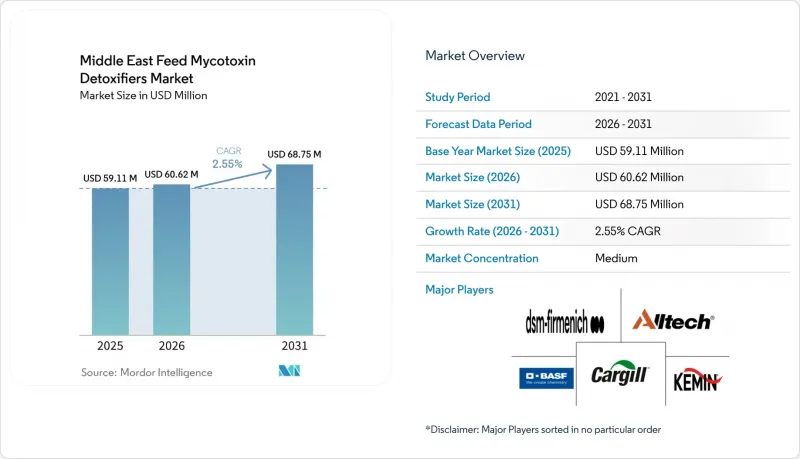
本報告按添加劑(粘合劑和生物轉化劑)、目標動物(水產養殖、家禽、反芻動物、豬和其他動物)以及地區(沙烏地阿拉伯、伊朗和其他中東國家)進行細分。市場預測以價值(美元)和數量(公噸)表示。
中東地區飼料用黴菌毒素解毒劑的市場趨勢與洞察
極端高溫條件下家禽和乳牛生產的密集化
家禽和乳牛生產的擴張為中東市場對飼料黴菌毒素解毒劑的需求創造了穩定的基礎。這是因為高產量農場飼料品質的反覆下降將造成無法估量的損失。沙烏地阿拉伯的糧食安全政策持續推動國內家禽生產的擴張。 2025/26銷售年度,飼料玉米的使用量達到460萬至490萬噸,高於2024/25年度的470萬噸,反映出沙烏地王國對複合飼料需求的快速成長。在高溫環境下,穀物和成品飼料的安全儲存期縮短,因此,大規模家禽和酪農擴大將解毒作為預防措施,而不是等到明顯的生產損失才採取行動。此外,酪農產業也面臨殘留風險,因為飼料中的黃麴毒素B1會在牛奶中轉化為黃麴毒素M1,凸顯了風險管理的重要性。在有組織的酪農產業鏈中,正式的檢查正變得越來越普遍。這種商業性合理性在垂直整合的系統中更為突出,因為一次污染事件可能同時影響飼料轉換率、牲畜健康、牛奶品質和品牌聲譽。這種情況在中東市場催生了對飼料黴菌毒素解毒劑的需求,這種需求不僅與污染程度相關,也與現代畜牧養殖模式密切相關。
高溫氣候和進口依賴導致飼料供應鏈中存在黴菌毒素風險
中東地區對飼料中黴菌毒素解毒劑的需求受益於該地區對進口飼料原料的結構性依賴。這是因為長途運輸、重複處理以及抵達後的高溫儲存條件都會增加污染風險。 2025年1月發表在《毒素》(Toxins)雜誌上的一項研究檢測了從利雅得、哈薩、卡西姆和吉達採集的100份家禽飼料原料樣本,發現所有樣本均受到多種黴菌毒素的污染,其中84%的樣本檢出黃麴毒素,56%的樣本Fumonisins。研究報告稱,在分離出的產黃麴毒素細菌中,黃麴菌是優勢菌種,凸顯了儲存條件、處理方法以及原產地污染的重要性。這一點意義重大,因為在市售飼料中同時檢測到多種毒素的案例日益增多,削弱了僅針對單一毒素的有限解決方案的效用。因此,中東市場對飼料用黴菌毒素解毒劑的採購者正逐漸從被動購買轉向常規添加到成品飼料配方中,尤其是在家禽養殖普遍的地區。這種轉變意義重大,因為它將對解毒劑的需求從偶爾的糾正措施轉變為持續的營運成本。
價格敏感度以及對未加工或本地採購飼料的偏好
在中東地區,飼料用黴菌毒素解毒劑市場價格敏感度是限制商業性的一大因素。這是因為小規模畜牧養殖戶往往認為解毒劑並非必需品。這項挑戰在伊朗以及全部區域的小規模企業中尤為突出,因為在這些企業中,飼料的即時成本往往優先於避免後續損失的採購決策。在快速檢測手段有限的地區,污染通常只有在動物生產力下降的徵兆出現時才會被發現。即便如此,問題也常被歸咎於其他營養或管理因素,導致解毒劑的引入延誤。由於缺乏常規診斷和全面的記錄保存,預防性解毒劑的經濟效益難以充分體現。這造成了生物風險與解毒劑商業性化應用之間的差距,使得市場成長速度的放緩程度超過了污染普遍程度所預期的水平。除非檢測手段得到改善,監管力度得到加強,否則低成本的未經處理的飼料將繼續限制市場滲透。
細分市場分析
到2025年,吸附劑將佔據中東飼料黴菌毒素解毒劑市場66.3%的佔有率,成為家禽、乳牛和反芻動物飼料配方中最大的添加劑細分市場。這一主導地位反映了長期以來人們對粘土基解決方案的偏好,這些解決方案為負責人所熟知,成本效益高,且無需對工藝進行重大更改即可輕鬆添加到飼料中。在許多商業系統中,黃麴毒素控制仍然是一項至關重要的經濟和監管優先事項,因此粘合劑成為主要的防禦機制。這在那些買家尋求適用於大批量飼料且技術複雜性低的低成本解決方案的國家尤其重要。因此,中東飼料黴菌毒素解毒劑市場繼續高度依賴礦物基吸附劑,將其作為常規黴菌毒素控制的基本方法。
在中東飼料黴菌毒素解毒劑市場,生物轉化劑市場預計到2031年將以2.6%的複合年成長率成長。儘管其基數較小,但預計它將成為添加劑細分市場中成長最快的領域。這一成長源於該地區複雜的污染情況,在該地區,對於某些鐮刀菌毒素,粘合劑的有效性不如酶解或生物分解方法。帝斯曼-菲美意公司(DSM-Firmenich AG)於2024年對土耳其和中東地區的成品飼料進行的一項調查顯示,93%的抽樣批次中檢測到了伏Fumonisins,83%的抽樣批次中檢測到了玉米赤Zearalenone,這凸顯了除礦物質吸附之外,還需要其他解決方案。由於多種毒素的暴露已成為商業飼料採購中普遍存在的挑戰,營養團隊正擴大採用混合和多機制方案。儘管吸附劑的重要性預計還會繼續保持,但中東飼料黴菌毒素解毒劑市場的成長將越來越受到能夠應對更廣泛毒素頻譜和具有更高技術精度的產品的影響。
其他好處:
- Excel格式的市場預測(ME)表
- 3個月的分析師支持
目錄
第1章:引言
- 研究假設和市場定義
- 調查範圍
- 調查方法
第2章:本報告的內容
第3章:執行摘要和主要發現
第4章:主要產業趨勢
- 飼養的動物數量
- 家禽
- 反芻動物
- 豬
- 飼料生產
- 水產養殖
- 家禽
- 反芻動物
- 豬
- 法律規範
- 中東
- 價值鍊和通路分析
- 市場促進因素
- 在極端高溫條件下集約化發展家禽和酪農
- 飼料供應鏈中高溫和進口帶來的黴菌毒素暴露風險
- 加強海灣合作理事會市場飼料安全和殘留物的監測。
- 工業飼料生產和商業性畜牧業的擴張
- 多種黴菌毒素污染需要廣泛的應對措施。
- 使用替代飼料原料會增加污染風險
- 市場限制因素
- 價格敏感度以及對未加工或本地採購飼料的偏好
- 小規模市場中診斷方法和製劑的供應有限
- 複雜毒素混合物譜下的療效差異
- 紅海和波斯灣的航運中斷正在影響添加劑的供應鏈。
第5章 市場規模與成長預測
- 次要添加劑
- 粘合劑
- 生物變壓器
- 目標動物
- 水產養殖
- 動物物種
- 魚
- 蝦
- 其他養殖物種
- 動物物種
- 家禽
- 動物物種
- 肉雞
- 產蛋母雞
- 其他家禽
- 動物物種
- 反芻動物
- 動物物種
- 牛
- 牛
- 其他反芻動物
- 動物物種
- 豬
- 其他動物
- 水產養殖
- 國家
- 沙烏地阿拉伯
- 伊朗
- 其他中東國家
第6章 競爭情勢
- 市場集中度
- 關鍵策略趨勢
- 市佔率分析
- 公司簡介。
- DSM-Firmenich AG
- Kemin Industries, Inc.
- Alltech, Inc.
- Cargill, Incorporated
- BASF SE
- Bluestar Adisseo Company
- Archer Daniels Midland Company
- EW Nutrition GmbH
- Clariant AG
- Nutreco NV
- Novus International, Inc.
- Phibro Animal Health Corporation
- Special Nutrients, LLC
- Impextraco NV
- Bentoli, Inc.
第7章:執行長面臨的關鍵策略問題
According to Mordor Intelligence, the middle east feed mycotoxin detoxifiers market size is projected to expand from USD 59.11 million in 2025 and USD 60.62 million in 2026 to USD 68.75 million by 2031, registering a CAGR of 2.55% between 2026 and 2031.
This report is Segmented by Sub-Additive (Binders and Biotransformers), by Animal (Aquaculture, Poultry, Ruminants, Swine, and Other Animals), and by Geography (Saudi Arabia, Iran, and the Rest of the Middle East). The Market Forecasts are Provided in Terms of Value (USD) and Volume (Metric Tons).
Middle East Feed Mycotoxin Detoxifiers Market Trends and Insights
Poultry and Dairy Intensification Under Extreme Heat Conditions
Poultry and dairy expansion is creating a steady volume base for the Middle East feed mycotoxin detoxifiers market, as high-output farms cannot absorb repeated disruptions to feed quality without measurable losses. Saudi Arabia's food security agenda continues to drive increased local poultry production. Corn usage in feed has reached a range from 4.6 to 4.9 million metric tons in the marketing year 2025/26, compared to 4.7 million metric tons in 2024/25, reflecting the rapid growth in ration demand within the kingdom. In hot environments, grain and finished feed face a shorter safe storage window, so larger poultry and dairy operators are more willing to include detoxifiers on a preventive basis rather than wait for visible production losses. Dairy also introduces residue risk, as aflatoxin B1 in feed can be converted to aflatoxin M1 in milk, underscoring the importance of risk management. Formal testing in organized dairy chains is becoming more common. The commercial logic is stronger in vertically integrated systems, where a single contamination event can simultaneously affect feed conversion, flock health, milk quality, and the branded product's reputation. That dynamic gives the Middle East feed mycotoxin detoxifiers market a demand base that is tied not only to contamination levels but also to the operating model of modern livestock production.
Hot-Climate and Import-Driven Mycotoxin Risk in Feed Supply Chains
The Middle East mycotoxin detoxifiers market also benefits from the region's structural dependence on imported feed materials, as contamination burdens are shaped by long transit times, repeated handling, and warm storage conditions after arrival. A January 2025 study in Toxins examined 100 poultry feedstuff samples from Riyadh, Al-Hassa, Qassim, and Jeddah and found multi-mycotoxin contamination in every sample, with aflatoxins detected in 84% and fumonisins in 56%. The same study reported that Aspergillus flavus was the dominant aflatoxigenic species isolated, underscoring the importance of storage conditions and handling practices, not just contamination at origin. This matters because commercial feed lots increasingly exhibit multiple toxin classes simultaneously, which undermines the usefulness of narrow, single-target solutions. As a result, buyers in the Middle East feed mycotoxin detoxifiers market are gradually moving from event-based purchases toward more routine inclusion programs for finished feed, especially in poultry-heavy systems. The shift is important because it turns detoxifier demand into a recurring operating cost instead of an occasional corrective response.
Price Sensitivity and Preference for Untreated or Locally Sourced Feed
Price sensitivity is the primary commercial restraint in the Middle East feed mycotoxin detoxifiers market, as smaller livestock operators often view detoxifiers as non-essential. This challenge is particularly evident in Iran and among smaller-scale operations across the region, where purchasing decisions prioritize immediate feed costs over the potential to prevent downstream losses. In areas with limited rapid testing, contamination is frequently identified only after signs of reduced animal performance emerge. Even then, the issue is often attributed to other nutritional or management factors, delaying the adoption of detoxifiers. The lack of regular diagnostics and comprehensive recordkeeping makes it difficult to demonstrate the economic benefits of preventive detoxification. This creates a gap between biological risks and the commercial adoption of detoxifiers, slowing market growth beyond what contamination prevalence would suggest. Without improved testing access or more consistent regulatory enforcement, low-cost, untreated feed will continue to limit market penetration.
Other drivers and restraints analyzed in the detailed report include:
- Stronger Feed Safety and Residue Oversight Across GCC Markets
- Expansion of Industrial Feed Milling and Commercial Livestock Farming
- Red Sea and Gulf Shipping Disruptions Affecting Additive Supply Chains
For complete list of drivers and restraints, kindly check the Table Of Contents.
Segment Analysis
Binders accounted for 66.3% of the Middle East feed mycotoxin detoxifiers market share in 2025, making them the largest sub-additive segment across poultry, dairy, and ruminant feed programs. This dominance reflects a long-standing preference for clay-based solutions, which are familiar to formulators, cost-effective, and easy to incorporate into feed without significant process modifications. In many commercial systems, binders serve as the primary defense mechanism, as aflatoxin control remains a critical economic and regulatory priority. This is particularly significant in countries where buyers require low-cost solutions that can be applied across large feed volumes with minimal technical complexity. Consequently, the Middle East feed mycotoxin detoxifiers market continues to rely heavily on mineral adsorbents as the foundational approach for routine mycotoxin management.
The Middle East feed mycotoxin detoxifiers market size for biotransformers is projected to grow at a 2.6% CAGR through 2031, making them the fastest-growing sub-additive segment despite starting from a smaller base. This growth is driven by the region's diverse contamination profile, as binders are less effective against certain Fusarium-derived toxins compared to enzymatic or biological degradation methods. A 2024 survey by DSM-Firmenich AG of finished feed in Turkey and the Middle East revealed fumonisins in 93% of sampled lots and zearalenone in 83%, highlighting the need for solutions beyond mineral adsorption. As multi-toxin exposure becomes a common challenge in commercial feed procurement, nutrition teams are increasingly adopting hybrid and multi-mechanism programs. While binders are expected to remain relevant, the growth of the Middle East feed mycotoxin detoxifiers market is increasingly influenced by products capable of addressing a broader toxin spectrum with enhanced technical precision.
Complete Report Scope:
- Sub Additive
- Binders
- Biotransformers
- Animal
- Aquaculture
- By Sub Animal
- Fish
- Shrimp
- Other Aquaculture Species
- By Sub Animal
- Poultry
- By Sub Animal
- Broiler
- Layer
- Other Poultry Birds
- By Sub Animal
- Ruminants
- By Sub Animal
- Beef Cattle
- Dairy Cattle
- Other Ruminants
- By Sub Animal
- Swine
- Other Animals
- Aquaculture
- Country
- Saudi Arabia
- Iran
- Rest of Middle East
List of Companies Covered in this Report:
- DSM-Firmenich AG
- Kemin Industries, Inc.
- Alltech, Inc.
- Cargill, Incorporated
- BASF SE
- Bluestar Adisseo Company
- Archer Daniels Midland Company
- EW Nutrition GmbH
- Clariant AG
- Nutreco N.V.
- Novus International, Inc.
- Phibro Animal Health Corporation
- Special Nutrients, LLC
- Impextraco NV
- Bentoli, Inc.
Additional Benefits:
- The market estimate (ME) sheet in Excel format
- 3 months of analyst support
TABLE OF CONTENTS
1 INTRODUCTION
- 1.1 Study Assumptions & Market Definition
- 1.2 Scope of the Study
- 1.3 Research Methodology
2 REPORT OFFERS
3 EXECUTIVE SUMMARY & KEY FINDINGS
4 KEY INDUSTRY TRENDS
- 4.1 Animal Headcount
- 4.1.1 Poultry
- 4.1.2 Ruminants
- 4.1.3 Swine
- 4.2 Feed Production
- 4.2.1 Aquaculture
- 4.2.2 Poultry
- 4.2.3 Ruminants
- 4.2.4 Swine
- 4.3 Regulatory Framework
- 4.3.1 Middle East
- 4.4 Value Chain & Distribution Channel Analysis
- 4.5 Market Drivers
- 4.5.1 Poultry and dairy intensification under extreme heat conditions
- 4.5.2 Hot-climate and import-driven mycotoxin exposure risk in feed supply chains
- 4.5.3 Stronger feed safety and residue oversight across GCC markets
- 4.5.4 Expansion of industrial feed milling and commercial livestock farming
- 4.5.5 Multi-mycotoxin contamination requiring broader-spectrum solutions
- 4.5.6 Use of alternative feed ingredients raising contamination risks
- 4.6 Market Restraints
- 4.6.1 Price sensitivity and preference for untreated or locally sourced feed
- 4.6.2 Limited diagnostic and formulation availability in smaller markets
- 4.6.3 Efficacy variability under complex toxin co-contamination profiles
- 4.6.4 Red Sea and Gulf shipping disruptions affecting additive supply chains
5 Market Size and Growth Forecasts (Value and Volume)
- 5.1 Sub Additive
- 5.1.1 Binders
- 5.1.2 Biotransformers
- 5.2 Animal
- 5.2.1 Aquaculture
- 5.2.1.1 By Sub Animal
- 5.2.1.1.1 Fish
- 5.2.1.1.2 Shrimp
- 5.2.1.1.3 Other Aquaculture Species
- 5.2.1.1 By Sub Animal
- 5.2.2 Poultry
- 5.2.2.1 By Sub Animal
- 5.2.2.1.1 Broiler
- 5.2.2.1.2 Layer
- 5.2.2.1.3 Other Poultry Birds
- 5.2.2.1 By Sub Animal
- 5.2.3 Ruminants
- 5.2.3.1 By Sub Animal
- 5.2.3.1.1 Beef Cattle
- 5.2.3.1.2 Dairy Cattle
- 5.2.3.1.3 Other Ruminants
- 5.2.3.1 By Sub Animal
- 5.2.4 Swine
- 5.2.5 Other Animals
- 5.2.1 Aquaculture
- 5.3 Country
- 5.3.1 Saudi Arabia
- 5.3.2 Iran
- 5.3.3 Rest of Middle East
6 COMPETITIVE LANDSCAPE
- 6.1 Market Concentration
- 6.2 Key Strategic Moves
- 6.3 Market Share Analysis
- 6.4 Company Profiles (Includes Global Level Overview, Market Level Overview, Core Business Segments, Financials, Headcount, Key Information, Market Rank, Market Share, Products and Services, and Analysis of Recent Developments).
- 6.4.1 DSM-Firmenich AG
- 6.4.2 Kemin Industries, Inc.
- 6.4.3 Alltech, Inc.
- 6.4.4 Cargill, Incorporated
- 6.4.5 BASF SE
- 6.4.6 Bluestar Adisseo Company
- 6.4.7 Archer Daniels Midland Company
- 6.4.8 EW Nutrition GmbH
- 6.4.9 Clariant AG
- 6.4.10 Nutreco N.V.
- 6.4.11 Novus International, Inc.
- 6.4.12 Phibro Animal Health Corporation
- 6.4.13 Special Nutrients, LLC
- 6.4.14 Impextraco NV
- 6.4.15 Bentoli, Inc.


