


 |
市場調查報告書
商品編碼
2073245
肉雞飼料添加劑:市場佔有率分析、行業趨勢和統計數據、成長預測(2026-2031)Broiler Feed Additives - Market Share Analysis, Industry Trends & Statistics, Growth Forecasts (2026 - 2031) |
||||||

※ 本網頁內容可能與最新版本有所差異。詳細情況請與我們聯繫。
根據 Mordor Intelligence 預測,肉雞飼料添加劑市場規模將從 2025 年的 110.8 億美元成長到 2026 年的 116.4 億美元,到 2031 年將達到 151.5 億美元,2026 年至 2031 年的複合年成長率為 5.42%。
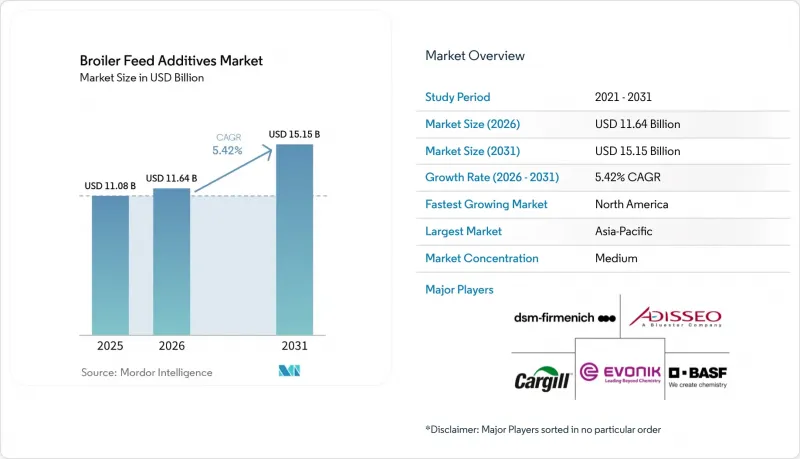
本報告按添加劑類型(酸化劑、抗生素、胺基酸、酵素、植物來源成分、益生菌等)、形態(乾粉和液體)、肉雞生產階段(幼畜飼料、育成雞飼料、育肥飼料)和地區(北美、南美、歐洲、亞太、中東和非洲)進行細分。市場預測以價值(美元)和數量(公噸)表示。
全球肉雞飼料添加劑市場趨勢及洞察
無抗生素肉雞養殖計畫正在加速優生學的應用。
在肉雞飼料添加劑市場,隨著抗生素監管的日益嚴格以及更多生產商推行「無抗生素」養殖項目,益生菌的應用正在加速。 2026年2月,美國食品藥物管理局(FDA)發布了“行業指南273”,要求藥品申請人對先前在食用動物中未設定使用限制的具有重要醫療價值的抗生素,增加使用限制。美國國家家禽和蛋品協會(USPOULTRY)發布的一份2025年報告(基於截至2024年的數據)強調,肉雞生產中具有重要醫療價值的抗生素的使用量持續下降。這一趨勢表明,商業性家禽養殖中抗生素的合理使用正在取得進展。因此,益生菌、有機酸、植物來源成分和飼料酵素等替代品在改善腸道健康、提高營養利用效率和提升生產性能方面的重要性日益凸顯。能夠提供靈活產品線,同時滿足傳統養殖系統和減少抗生素使用系統的供應商,在滿足市場需求方面佔據了有利地位。
在飼料成本壓力下最佳化飼料轉換率
由於飼料仍然是肉雞生產中最大的成本組成部分,提高飼料轉換率的需求持續推動肉雞飼料添加劑的使用。贏創工業集團指出,家禽營養計畫的重點在於提高營養物質利用效率和雞群生產力,因此胺基酸和酵素與農場層面的投資報酬率 (ROI) 決策密切相關。 2025 年發表在《動物科學前沿》(Frontiers in Animal Science) 上的一項研究表明,在商業性養殖條件下,蛋白酶、植酸酶和木聚醣酶的組合可以改善肉雞的體重、飼料轉換率、髂骨消化率和腸道形態。這項發現支持了從最佳化單一產品轉向最佳化能夠為整個雞群帶來可衡量的經濟效益的複雜添加劑方案的趨勢。因此,肉雞飼料添加劑市場不僅受益於配方添加率的提高,也受益於更全面的產品線,這賦予了供應商更大的定價權。
濃縮維生素和胺基酸的供應基地增加了採購風險。
肉雞飼料添加劑市場極易受到採購風險的影響,因為幾種關鍵原料的生產基地有限。維生素和胺基酸尤其如此,價格波動和供應中斷會迅速改變預混合料的獲利能力,並可能迫使配方進行調整。安迪蘇宣布,其SmartLine甲硫胺酸將於2026年5月1日起在全球調價,理由是原料、能源、生產和物流成本持續上漲。對於生產商和飼料配製商而言,問題不僅在於成本上漲,還在於供不應求的風險,這可能會擾亂現有的配方方案。這實際上限制了高階產品方案在肉雞飼料添加劑市場的擴張速度,尤其是在這些方案嚴重依賴進口活性成分的情況下。
細分市場分析
胺基酸是最大的添加劑類型,預計到2025年將佔肉雞飼料添加劑市場佔有率的22.1%。這一地位反映了離胺酸、甲硫胺酸、蘇氨酸和色氨酸在商業性肉雞養殖項目中蛋白質合成、生長性能和胴體品質方面發揮的基礎性作用。甲硫胺酸尤其重要,因為它是許多玉米和大豆粕基飼料中的第一個限制性氨基酸,並且幾乎普遍用於集約化肉雞養殖系統。植酸酶、碳水化合物消化酶和蛋白酶等酵素製劑在肉雞飼料添加劑市場中也扮演著重要角色,因為它們有助於生產者在成本壓力下從飼料原料中獲得更多價值。維生素、酸味劑、礦物質、抗氧化劑和抗生素的作用則取決於地區法規、飼料成分和生產模式,並保持穩定或持續。
益生菌預計將成為肉雞飼料添加劑市場中成長最快的類別,2026年至2031年的複合年成長率預計為6.6%。這一成長反映了市場對非抗生素腸道健康維護方式的需求不斷成長,以及益生菌菌株在商業家禽營養領域地位的提升。 2025年,諾維賽斯(Novonesys)以16.2億美元(15億歐元)的價格完成了對帝斯曼-菲美尼奇股份公司(DSM-Firmenich AG)旗下飼料酶聯盟(Feed Enzyme Alliance)股份的收購,從而鞏固了企業發展。 2026年,該公司還同意以5,000萬美元的價格收購位於泰國羅勇府的一家生產工廠,以擴大供給能力。在肉雞飼料添加劑產業,植物性添加劑、益生元、酵母萃取物、黴菌毒素解毒劑和著色劑仍然是重要的類別,儘管規模較小。這些因素有助於維持相關生產系統中的腸道健康、壓力反應、飼料安全和產品品質。
區域分析
2025年,亞太地區佔肉雞飼料添加劑市場佔有率的34.1%,並將持續維持最大區域市場地位至2026年。根據Alltek發布的《農業食品展望》,2025年中國肉雞飼料商業產量將達到1.01億噸,印度為2,030萬噸,印尼為870萬噸。亞太地區肉雞飼料添加劑市場正受惠於養殖模式從農場自配轉向採用更規範添加劑方案的商業性飼料系統。這種轉變推動了大規模一體化家禽養殖場對胺基酸、酵素、維生素和益生菌的需求成長,同時也逐步改善了中型生產商的營運結構。 Novonesys公司於2026年達成協議,收購位於泰國羅勇府的一家生產工廠,進一步印證了供應商對該地區日益成長的興趣。
預計北美將成為肉雞飼料添加劑市場成長最快的地區,2026年至2031年的複合年成長率將達到6.3%。這一成長與營養方案的優質化密切相關,尤其是在一體化生產商推行「無抗生素」或「減少抗生素使用」計畫的情況下。美國食品藥物管理局(FDA)於2026年2月發布的指導意見,旨在加強肉類用動物抗生素的合理使用,預計將持續推動對益生菌和功能性營養產品的強勁需求。 Archer Daniels Midland和Alltech於2026年第一季成立的飼料合資企業,擴大了預混合料和添加劑解決方案的區域供應平台。肉雞飼料添加劑市場這一細分領域的成長,更多是由每隻雞添加劑價值的提高和客戶更專業化的需求所驅動,而非養殖動物數量的增加。
由於巴西龐大的國內家禽生產和出口能力,南美洲仍然是肉雞飼料添加劑市場強勁的成長區域。根據巴西動物蛋白協會(ABPA)預測,到2025年,巴西雞肉產量將達到1,530萬噸,出口量將達到530萬噸(價值98億美元),這充分展現了該國商業家禽產業鏈的規模。儘管歐洲市場已趨於成熟,但由於長期禁止使用抗生素生長促進劑、嚴格的動物福利法規以及詳盡的添加劑核准體系,歐洲市場對技術的要求依然很高,因此創新活動依然活躍。根據Alltech Agri-Food Outlook的預測,德國肉雞飼料產量預計在2025年達到410萬噸,證實了即使在監管嚴格的歐洲環境下,飼料需求仍然強勁。雖然中東和非洲的絕對規模較小,但隨著沙烏地阿拉伯、土耳其、南非、埃及和奈及利亞等國家商業飼料的普及,肉雞飼料添加劑市場正從低水準擴張。
其他好處:
- Excel格式的市場預測(ME)表
- 3個月的分析師支持
目錄
第1章:引言
- 研究假設和市場定義
- 調查範圍
第2章:調查方法
第3章執行摘要
第4章 市場狀況
- 市場概覽
- 市場促進因素
- 無抗生素肉雞養殖計畫正在加速優生學的應用。
- 在飼料成本壓力下最佳化飼料轉換率
- 利用胺基酸的低蛋白配方正引起人們的注意。
- 由於抑制腸道疾病和黴菌毒素,添加劑的使用正在增加。
- 具有優異造粒穩定性的精密添加劑的商業應用正在不斷擴大。
- 提高胴體產量和腿部產量是推動優質混合飼料生產的關鍵因素。
- 市場限制因素
- 由於飼料基質和群體條件不同,田間反應有差異。
- 維生素和胺基酸來源的集中化增加了採購風險。
- 監管方面的舉證負擔延緩了新型微生物和植物來源產品的市場推廣。
- 一些注重成本的生產商會在某些系統中保留傳統的添加劑程序。
- 監理情勢
- 技術展望
- 波特五力分析
第5章 市場規模與成長預測
- By Additive
- 酸味劑
- 乳酸
- 丙酸
- 富馬酸
- 其他酸味劑
- 抗生素
- 四環黴素抗生素
- 青黴素
- 泰樂菌素
- 巴氏桿菌
- 其他抗生素
- 抗氧化劑
- 丁基Hydroxyanisole(BHA)
- 二丁基羥基甲苯(BHT)
- 乙氧喹
- 沒食子酸丙酯
- 生育酚
- 檸檬酸
- 其他抗氧化劑
- 胺基酸
- 離胺酸
- 色氨酸
- 甲硫胺酸
- 蘇胺酸
- 其他胺基酸
- 活頁夾
- 天然黏合劑
- 合成黏合劑
- 酵素
- 碳水化合物消化酶
- 植酸酶
- 其他酵素
- 調味劑和甜味劑
- 香味
- 甜味劑
- 礦物
- 主要礦物
- 微量礦物質
- 黴菌毒素清除劑
- 粘合劑
- 生物轉化劑
- Phytogenics
- 香草和香辛料
- 精油
- 其他植物源性物質
- 顏料
- 類胡蘿蔔素
- 薑黃素和螺旋藻
- 益生元
- 菊糖
- 果寡糖
- 半乳寡糖
- 木寡糖
- 乳果糖
- 甘露聚醣
- 其他益生元
- 益生菌
- 乳酸菌
- 雙歧桿菌
- Streptococcus
- 片球菌
- 腸球菌
- 其他益生菌
- 維他命
- 維生素A
- 維生素B
- 維生素C
- 維生素E
- 其他維生素
- 東方
- 新鮮酵母
- 用過的酵母
- 托魯拉乾酵母
- 硒酵母
- 乳清酵母
- 酵母衍生成分
- 酸味劑
- 按形式
- 乾燥
- 液體
- 肉雞生產階段
- 幼畜飼料
- 生長階段的飼料
- 育肥魚飼料
- 按地區
- 北美洲
- 美國
- 加拿大
- 墨西哥
- 其他北美國家
- 南美洲
- 巴西
- 阿根廷
- 其他南美國家
- 歐洲
- 德國
- 法國
- 英國
- 西班牙
- 義大利
- 俄羅斯
- 其他歐洲國家
- 亞太地區
- 中國
- 印度
- 日本
- 泰國
- 印尼
- 澳洲
- 其他亞太國家
- 中東
- 沙烏地阿拉伯
- 土耳其
- 伊朗
- 其他中東國家
- 非洲
- 南非
- 埃及
- 其他非洲國家
- 北美洲
第6章 競爭情勢
- 市場集中度
- 策略趨勢
- 市佔率分析
- 公司簡介
- DSM-Firmenich AG
- Evonik Industries AG
- Bluestar Adisseo Company
- Cargill, Incorporated
- BASF SE
- Archer Daniels Midland Company
- Nutreco NV(SHV Holdings NV)
- Novus International, Inc.(Mitsui & Co., Ltd.)
- Kemin Industries, Inc.
- International Flavors & Fragrances Inc.
- Novonesis A/S
- Alltech, Inc.
- Elanco Animal Health Incorporated
- Phibro Animal Health Corporation
- Lesaffre
第7章 市場機會與未來展望
According to Mordor Intelligence, the broiler feed additives market size is projected to grow from USD 11.08 billion in 2025 to USD 11.64 billion in 2026 and is forecast to reach USD 15.15 billion by 2031 at 5.42% CAGR over 2026-2031.
This report is Segmented by Additive (Acidifiers, Antibiotics, Amino Acids, Enzymes, Phytogenics, Probiotics, and More), by Form (Dry and Liquid), by Broiler Production Phase (Starter Feed, Grower Feed, and Finisher Feed), and by Geography (North America, South America, Europe, Asia-Pacific, Middle East, and Africa). The Market Forecasts are Provided in Terms of Value (USD) and Volume (Metric Tons).
Global Broiler Feed Additives Market Trends and Insights
Antibiotic-Free Broiler Programs Accelerate Eubiotic Adoption
The broiler feed additives market is seeing faster adoption of eubiotics as antibiotic rules tighten and more producers maintain no-antibiotics-ever programs. The Food and Drug Administration (FDA) issued Guidance for Industry 273 in February 2026, requiring drug sponsors to add duration limits to medically important antibiotics that lacked them in food-producing animals. The report, published by the United States Poultry & Egg Association (USPOULTRY) in 2025 using data through 2024, emphasizes the ongoing decline in the use of medically important antibiotics in broiler production. This trend demonstrates advancements in antibiotic stewardship within commercial poultry operations. As a result, alternatives such as probiotics, organic acids, phytogenics, and feed enzymes are gaining significance for improving gut health, nutrient utilization, and production performance. Suppliers offering flexible portfolios that cater to both conventional and reduced-antibiotic systems are well-positioned to meet market demand.
Feed Conversion Ratio Optimization Under Feed-Cost Pressure
The use of feed additives for broilers continues to be driven by the need to improve feed conversion ratios, as feed remains the largest cost component in broiler production. Evonik Industries AG states that poultry nutrition programs center on improving nutrient use and flock performance, which keeps amino acids and enzymes closely tied to return-on-investment decisions at the farm level. A 2025 study in Frontiers in Animal Science found that a protease, phytase, and xylanase combination improved body weight, feed conversion ratio, ileal digestibility, and gut morphology in broilers under commercial conditions. This evidence supports a move away from single-product optimization toward stacked additive programs that deliver measurable economic gains across the flock. The broiler feed additives market, therefore, gains not only from higher inclusion rates but also from a richer product mix with better pricing power for suppliers.
Concentrated Vitamin and Amino-acid Supply Base Raises Sourcing Risk
The broiler feed additives market is exposed to sourcing risk because several core inputs depend on a narrow production base. This matters most for vitamins and amino acids, where price movements and supply disruptions can quickly shift premix economics and force reformulation. Adisseo announced a worldwide price increase for SmartLine methionine effective May 1, 2026, and linked it to sustained raw material, energy, manufacturing, and logistics cost increases. For producers and feed formulators, the problem is not only cost inflation but also the risk of supply gaps that interrupt established inclusion programs. This creates a practical ceiling on how quickly premium programs can scale in the broiler feed additives market when they rely heavily on imported active ingredients.
Other drivers and restraints analyzed in the detailed report include:
- Amino-Acid-Enabled Low-Protein Formulations Gain Traction
- Enteric Disease and Mycotoxin Control Raise Additive Intensity
- Regulatory Proof Burden Slows Novel Microbial and Phytogenic Launches
For complete list of drivers and restraints, kindly check the Table Of Contents.
Segment Analysis
Amino acids were the largest additive type, and accounted for 22.1% of the broiler feed additives market share in 2025. Their position reflects the basic role of lysine, methionine, threonine, and tryptophan in protein synthesis, growth performance, and carcass quality across commercial broiler feeding programs. Methionine remains especially important because it is the first-limiting amino acid in many corn and soybean meal diets, which keeps its use close to universal in intensive broiler systems. Enzymes also play a significant role in the broiler feed additives market, as phytase, carbohydrase, and protease products help producers extract greater value from feed ingredients under cost pressure. Vitamins, acidifiers, minerals, antioxidants, and antibiotics play stable or residual roles depending on local regulations, dietary structure, and production model.
Probiotics are projected to be the fastest-growing additive category in the broiler feed additives market, with a 6.6% CAGR over 2026-2031. This growth reflects stronger demand for non-antibiotic gut health tools and better strain-level positioning in commercial poultry nutrition. Novonesis completed the acquisition of DSM-Firmenich AG's share in the Feed Enzyme Alliance in 2025 for USD 1.62 billion (EUR 1.5 billion), thereby strengthening its reach across enzyme and probiotic applications. In 2026, the company also agreed to acquire a production facility in Rayong, Thailand, for USD 50 million, expanding supply capacity closer to Asian demand centers. Within the broiler feed additives industry, phytogenics, prebiotics, yeast derivatives, mycotoxin detoxifiers, and pigments remain smaller but important categories because they support gut health, stress response, feed safety, and product quality in targeted production systems.
Complete Report Scope:
- By Additive
- Acidifiers
- Lactic Acid
- Propionic Acid
- Fumaric Acid
- Other Acidifiers
- Antibiotics
- Tetracyclines
- Penicillins
- Tylosin
- Bacitracin
- Other Antibiotics
- Antioxidants
- Butylated Hydroxyanisole (BHA)
- Butylated Hydroxytoluene (BHT)
- Ethoxyquin
- Propyl Gallate
- Tocopherols
- Citric Acid
- Other Antioxidants
- Amino Acids
- Lysine
- Tryptophan
- Methionine
- Threonine
- Other Amino Acids
- Binders
- Natural Binders
- Synthetic Binders
- Enzymes
- Carbohydrases
- Phytases
- Other Enzymes
- Flavors & Sweeteners
- Flavors
- Sweeteners
- Minerals
- Macrominerals
- Microminerals
- Mycotoxin Detoxifiers
- Binders
- Biotransformers
- Phytogenics
- Herbs & Spices
- Essential Oil
- Other Phytogenics
- Pigments
- Carotenoids
- Curcumin & Spirulina
- Prebiotics
- Inulin
- Fructo Oligosaccharides
- Galacto Oligosaccharides
- Xylo Oligosaccharides
- Lactulose
- Mannan Oligosaccharides
- Other Prebiotics
- Probiotics
- Lactobacilli
- Bifidobacteria
- Streptococcus
- Pediococcus
- Enterococcus
- Other Probiotics
- Vitamins
- Vitamin A
- Vitamin B
- Vitamin C
- Vitamin E
- Other Vitamins
- Yeast
- Live Yeast
- Spent Yeast
- Torula Dried Yeast
- Selenium Yeast
- Whey Yeast
- Yeast Derivatives
- Acidifiers
- By Form
- Dry
- Liquid
- By Broiler Production Phase
- Starter Feed
- Grower Feed
- Finisher Feed
- By Geography
- North America
- United States
- Canada
- Mexico
- Rest of North America
- South America
- Brazil
- Argentina
- Rest of South America
- Europe
- Germany
- France
- United Kingdom
- Spain
- Italy
- Russia
- Rest of Europe
- Asia-Pacific
- China
- India
- Japan
- Thailand
- Indonesia
- Australia
- Rest of Asia-Pacific
- Middle East
- Saudi Arabia
- Turkey
- Iran
- Rest of Middle East
- Africa
- South Africa
- Egypt
- Rest of Africa
- North America
Geography Analysis
Asia-Pacific accounted for 34.1% of the broiler feed additives market in 2025 and remained the largest regional base entering 2026. As per Alltech's Agri-Food Outlook, China's total commercial broiler feed output reached 101.0 million metric tons in 2025, while India reached 20.3 million metric tons, and Indonesia's output was 8.7 million metric tons. The broiler feed additives market in Asia-Pacific benefits from the ongoing shift from on-farm mixing to more commercial feed systems that adopt more consistent additive programs. That shift supports greater demand for amino acids, enzymes, vitamins, and probiotics across large integrated poultry operations and is gradually formalizing mid-scale producers. Supplier interest in the region also remained visible when Novonesis agreed in 2026 to acquire a production facility in Rayong, Thailand.
North America is anticipated to be the fastest-growing region in the broiler feed additives market, with a 6.3% CAGR over 2026-2031. The region's growth is tied to premiumization in nutrition programs, especially where integrators operate under no-antibiotics-ever or reduced-antibiotic commitments. The Food and Drug Administration (FDA) guidance issued in February 2026 supported tighter antibiotic stewardship in food-producing animals, which is anticipated to keep demand favorable for eubiotics and functional nutrition tools. The Archer Daniels Midland Company and Alltech, Inc. feed joint venture launched in the first quarter of 2026 and added scale to the regional supply platform for premix and additive solutions. In this part of the broiler feed additives market, growth comes less from flock expansion and more from higher additive value per bird and more specialized customer requirements.
South America remains a strong growth geography for the broiler feed additives market, as Brazil combines large domestic poultry output with export discipline. According to the Brazilian Association of Animal Protein (ABPA), Brazil produced 15.3 million metric tons of chicken meat in 2025 and exported 5.3 million metric tons, valued at USD 9.8 billion, which shows the scale of the country's commercial poultry chain. Europe remains mature, but innovation remains active because its long-standing ban on antibiotic growth promoters, welfare rules, and detailed additive approvals keep technical requirements high. Germany's broiler feed production reached 4.1 million metric tons in 2025, according to the Alltech Agri-Food Outlook, which confirmed steady underlying feed demand in a regulated European setting. The Middle East and Africa are smaller in absolute size, but the broiler feed additives market there is expanding from a lower base as commercial feed adoption rises in countries such as Saudi Arabia, Turkey, South Africa, Egypt, and Nigeria.
- DSM-Firmenich AG
- Evonik Industries AG
- Bluestar Adisseo Company
- Cargill, Incorporated
- BASF SE
- Archer Daniels Midland Company
- Nutreco N.V. (SHV Holdings N.V.)
- Novus International, Inc. (Mitsui & Co., Ltd.)
- Kemin Industries, Inc.
- International Flavors & Fragrances Inc.
- Novonesis A/S
- Alltech, Inc.
- Elanco Animal Health Incorporated
- Phibro Animal Health Corporation
- Lesaffre
Additional Benefits:
- The market estimate (ME) sheet in Excel format
- 3 months of analyst support
TABLE OF CONTENTS
1 Introduction
- 1.1 Study Assumptions and Market Definition
- 1.2 Scope of the Study
2 Research Methodology
3 Executive Summary
4 Market Landscape
- 4.1 Market Overview
- 4.2 Market Drivers
- 4.2.1 Antibiotic-free broiler programs accelerate eubiotic adoption
- 4.2.2 Feed conversion ratio optimization under feed-cost pressure
- 4.2.3 Amino-acid-enabled low-protein formulations gain traction
- 4.2.4 Enteric disease and mycotoxin control raise additive intensity
- 4.2.5 Pelleting-stable precision additives widen commercial use
- 4.2.6 Carcass yield and footpad outcome optimization drive premium blends
- 4.3 Market Restraints
- 4.3.1 Inconsistent field response across diet matrices and flock conditions
- 4.3.2 Concentrated vitamin and amino-acid supply base raises sourcing risk
- 4.3.3 Regulatory proof burden slows novel microbial and phytogenic launches
- 4.3.4 Cost-sensitive producers retain legacy additive programs in some systems
- 4.4 Regulatory Landscape
- 4.5 Technological Outlook
- 4.6 Porter's Five Forces Analysis
- 4.6.1 Threat of New Entrants
- 4.6.2 Bargaining Power of Suppliers
- 4.6.3 Bargaining Power of Buyers
- 4.6.4 Threat of Substitutes
- 4.6.5 Intensity of Competitive Rivalry
5 Market Size and Growth Forecasts (Value and Volume)
- 5.1 By Additive
- 5.1.1 Acidifiers
- 5.1.1.1 Lactic Acid
- 5.1.1.2 Propionic Acid
- 5.1.1.3 Fumaric Acid
- 5.1.1.4 Other Acidifiers
- 5.1.2 Antibiotics
- 5.1.2.1 Tetracyclines
- 5.1.2.2 Penicillins
- 5.1.2.3 Tylosin
- 5.1.2.4 Bacitracin
- 5.1.2.5 Other Antibiotics
- 5.1.3 Antioxidants
- 5.1.3.1 Butylated Hydroxyanisole (BHA)
- 5.1.3.2 Butylated Hydroxytoluene (BHT)
- 5.1.3.3 Ethoxyquin
- 5.1.3.4 Propyl Gallate
- 5.1.3.5 Tocopherols
- 5.1.3.6 Citric Acid
- 5.1.3.7 Other Antioxidants
- 5.1.4 Amino Acids
- 5.1.4.1 Lysine
- 5.1.4.2 Tryptophan
- 5.1.4.3 Methionine
- 5.1.4.4 Threonine
- 5.1.4.5 Other Amino Acids
- 5.1.5 Binders
- 5.1.5.1 Natural Binders
- 5.1.5.2 Synthetic Binders
- 5.1.6 Enzymes
- 5.1.6.1 Carbohydrases
- 5.1.6.2 Phytases
- 5.1.6.3 Other Enzymes
- 5.1.7 Flavors & Sweeteners
- 5.1.7.1 Flavors
- 5.1.7.2 Sweeteners
- 5.1.8 Minerals
- 5.1.8.1 Macrominerals
- 5.1.8.2 Microminerals
- 5.1.9 Mycotoxin Detoxifiers
- 5.1.9.1 Binders
- 5.1.9.2 Biotransformers
- 5.1.10 Phytogenics
- 5.1.10.1 Herbs & Spices
- 5.1.10.2 Essential Oil
- 5.1.10.3 Other Phytogenics
- 5.1.11 Pigments
- 5.1.11.1 Carotenoids
- 5.1.11.2 Curcumin & Spirulina
- 5.1.12 Prebiotics
- 5.1.12.1 Inulin
- 5.1.12.2 Fructo Oligosaccharides
- 5.1.12.3 Galacto Oligosaccharides
- 5.1.12.4 Xylo Oligosaccharides
- 5.1.12.5 Lactulose
- 5.1.12.6 Mannan Oligosaccharides
- 5.1.12.7 Other Prebiotics
- 5.1.13 Probiotics
- 5.1.13.1 Lactobacilli
- 5.1.13.2 Bifidobacteria
- 5.1.13.3 Streptococcus
- 5.1.13.4 Pediococcus
- 5.1.13.5 Enterococcus
- 5.1.13.6 Other Probiotics
- 5.1.14 Vitamins
- 5.1.14.1 Vitamin A
- 5.1.14.2 Vitamin B
- 5.1.14.3 Vitamin C
- 5.1.14.4 Vitamin E
- 5.1.14.5 Other Vitamins
- 5.1.15 Yeast
- 5.1.15.1 Live Yeast
- 5.1.15.2 Spent Yeast
- 5.1.15.3 Torula Dried Yeast
- 5.1.15.4 Selenium Yeast
- 5.1.15.5 Whey Yeast
- 5.1.15.6 Yeast Derivatives
- 5.1.1 Acidifiers
- 5.2 By Form
- 5.2.1 Dry
- 5.2.2 Liquid
- 5.3 By Broiler Production Phase
- 5.3.1 Starter Feed
- 5.3.2 Grower Feed
- 5.3.3 Finisher Feed
- 5.4 By Geography
- 5.4.1 North America
- 5.4.1.1 United States
- 5.4.1.2 Canada
- 5.4.1.3 Mexico
- 5.4.1.4 Rest of North America
- 5.4.2 South America
- 5.4.2.1 Brazil
- 5.4.2.2 Argentina
- 5.4.2.3 Rest of South America
- 5.4.3 Europe
- 5.4.3.1 Germany
- 5.4.3.2 France
- 5.4.3.3 United Kingdom
- 5.4.3.4 Spain
- 5.4.3.5 Italy
- 5.4.3.6 Russia
- 5.4.3.7 Rest of Europe
- 5.4.4 Asia-Pacific
- 5.4.4.1 China
- 5.4.4.2 India
- 5.4.4.3 Japan
- 5.4.4.4 Thailand
- 5.4.4.5 Indonesia
- 5.4.4.6 Australia
- 5.4.4.7 Rest of Asia-Pacific
- 5.4.5 Middle East
- 5.4.5.1 Saudi Arabia
- 5.4.5.2 Turkey
- 5.4.5.3 Iran
- 5.4.5.4 Rest of Middle East
- 5.4.6 Africa
- 5.4.6.1 South Africa
- 5.4.6.2 Egypt
- 5.4.6.3 Rest of Africa
- 5.4.1 North America
6 Competitive Landscape
- 6.1 Market Concentration
- 6.2 Strategic Moves
- 6.3 Market Share Analysis
- 6.4 Company Profiles (Includes Global Level Overview, Market Level Overview, Core Segments, Financials as Available, Strategic Information, Market Rank/Share for Key Companies, Products and Services, and Recent Developments)
- 6.4.1 DSM-Firmenich AG
- 6.4.2 Evonik Industries AG
- 6.4.3 Bluestar Adisseo Company
- 6.4.4 Cargill, Incorporated
- 6.4.5 BASF SE
- 6.4.6 Archer Daniels Midland Company
- 6.4.7 Nutreco N.V. (SHV Holdings N.V.)
- 6.4.8 Novus International, Inc. (Mitsui & Co., Ltd.)
- 6.4.9 Kemin Industries, Inc.
- 6.4.10 International Flavors & Fragrances Inc.
- 6.4.11 Novonesis A/S
- 6.4.12 Alltech, Inc.
- 6.4.13 Elanco Animal Health Incorporated
- 6.4.14 Phibro Animal Health Corporation
- 6.4.15 Lesaffre
7 Market Opportunities and Future Outlook

 飼料用微生物碳水化合物分解酵素市場:全球市場預測,2026-2032年醫藥和飼料添加劑市場:依添加劑類型、劑型、成分、功能和動物類型分類-2026-2032年全球市場預測飼料油和蛋白質市場:2026-2032年全球市場預測(按產品類型、形態、目標動物、加工技術和應用分類)
 家禽飼料添加劑市場規模、佔有率和成長分析:依產品類型、形態、應用、家禽品種、銷售管道和地區分類-2026年至2033年產業預測
 飼料脂肪和蛋白質:市場佔有率分析、行業趨勢和統計數據、成長預測(2026-2031 年)
 家禽飼料添加劑市場-策略分析與預測(2026-2031)
 2025-2031年全球及中國飼料市場現況及預測
 全球飼料微生物蛋白市場