


 |
市場調查報告書
商品編碼
2073090
範圍 3 供應鏈排放透明度平台:市場佔有率分析、行業趨勢和統計數據、成長預測(2026-2031 年)Scope 3 Supply Chain Emissions Transparency Platform - Market Share Analysis, Industry Trends & Statistics, Growth Forecasts (2026 - 2031) |
||||||

※ 本網頁內容可能與最新版本有所差異。詳細情況請與我們聯繫。
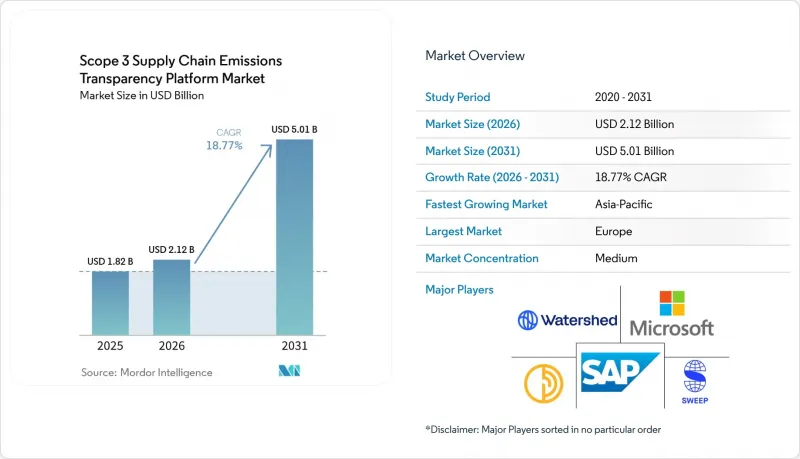
根據 Mordor Intelligence 的數據,2025 年範圍 3 供應鏈排放透明度平台市場價值為 18.2 億美元,預計到 2031 年從 2026 年的 21.2 億美元成長至 50.1 億美元,預測期(2026-2031 年)複合年成長率為 18.77%。
本報告按元件(軟體和服務)、部署類型(雲端、本地部署、混合部署)、企業規模(大型企業、其他)、應用(供應商排放資料收集、其他)、最終用戶產業(IT與電信、能源與公共產業、銀行、金融服務和保險、製造業、其他)以及地區進行細分。市場預測以美元計價。
全球範圍 3 供應鏈排放透明度平台市場趨勢與洞察
擴大監理資訊揭露要求
目前,監理揭露要求是推動範圍3供應鏈排放透明度平台市場採購的直接驅動力。這是因為大型企業需要能夠以可重複的方式收集、建構和記錄價值鏈資料的系統。 《企業永續性報告指令》(CSRD) 將範圍3報告置於大型企業氣候變遷揭露的核心地位,即使在綜合指令一 (Omnibus I) 修訂之後,在既定的報告框架內收集價值鏈資訊的需求依然存在。這一點至關重要,因為報告的挑戰不再局限於年度排放計算,而是需要維護能夠經得起保證要求和內部審計的證據鏈。歐盟委員會也明確了價值鏈排放上限的適用方式,並強調了平台的必要性,這些平台能夠在不違反對報告公司施加的新法律限制的情況下收集適當的供應商數據。因此,範圍3供應鏈排放透明度平台市場正受益於一個有利於具有穩健的供應商工作流程、可追溯的計算和文件功能的系統的合規週期。
從基於支出的估算過渡到供應商特定數據
第三類供應鏈排放透明度平台市場也不斷發展。這是因為企業面臨著盡可能用供應商特定資訊取代基於支出的寬泛替代指標的壓力。麻省理工學院史隆管理學院和CSCMP的一項研究發現,供應商數據的可用性是許多組織準確測量第三類排放的最大障礙。這解釋了為什麼買家正在尋找能夠促進與供應商互動和資料交換的平台。這種轉變也在改變產品需求,因為企業現在需要的是供應商入口網站、產品碳足跡管理工作流程和結構化模板,而不僅僅是獨立的計算文件。 WBCSD PACT調查方法v3.0透過為貿易夥伴提供通用平台來支援這一趨勢,從而使大規模自動化資料傳輸更加可行。隨著買家開始在其正常的採購和報告週期中要求提供原始數據,能夠以標準化格式回應的供應商更容易被留住,並有助於跨產品類型進行比較。因此,範圍 3 供應鏈排放透明度平台市場正在從單純的碳核算擴展到包括供應商參與和產品級資料準備。
多階段供應鏈中資料品質差和可追溯性低
在範圍3供應鏈排放透明度平台市場中,多層供應鏈的數據品質低落仍是最大的營運限制因素。這是因為企業仍然難以超越直接供應商關係。 SBTi指出,如果沒有供應商的積極參與,供應鏈資訊揭露專案的供應商回應率往往有限,導致隨著報告企業深入供應鏈,一手數據的可用性下降。即使在2026年發表的關於多層範圍3計算的學術論文中也指出,儘管溫室氣體核算體系提供了概念指南,但並未規定追蹤複雜上游關係的具體演算法,迫使供應商開發自己的方法。這可能導致兩個平台對供應商缺口、共用輸入和週期性依賴的處理方式不同,損害了可比性。從商業角度來看,買家需要一個能讓他們在不影響報告一致性的前提下,整合一手數據、部分估計值和替代方法的系統。即使需求強勁,除非供應商的參與度和可追溯性得到改善,否則範圍3供應鏈排放透明度平台市場也無法將這種需求完全轉化為可操作的實施方案。
細分市場分析
預計到2025年,軟體平台將佔範圍3供應鏈排放透明度平台市場68.74%的佔有率,這表明買家仍然優先考慮核心系統而非配套支援服務。原因很簡單:企業需要一個能夠整合排放計算、供應商溝通、報告邏輯和審計證據的單一平台。歐洲的報告要求進一步強調了這種整合模式,因為企業需要的是可重複的工作流程,而不是一次性的手動流程。 SAP和IBM的產品策略也支援這一趨勢,因為這兩家公司都在擴展其功能,以便將碳相關工作流程直接與業務和財務系統整合。因此,即使服務需求強勁,軟體仍是範圍3供應鏈排放透明度平台市場的核心。
服務仍然至關重要,因為在大多數實施方案中,平台必須在實際揭露週期中正常運作之前,完成配置、供應商入駐、資料檢查和報告支援等工作。隨著專案越來越融入採購和財務流程,而非僅僅由獨立的永續發展團隊負責,這個細分市場正在不斷成長。此外,隨著企業努力使供應商特定的資料交換與世界永續發展工商理事會 (WBCSD) 的 PACT 方法論和產品碳足跡要求保持一致,對服務的需求也在增加。實際上,對服務的需求往往與軟體功能的深度相關,因為功能更豐富的平台需要在內部系統和供應商網路中進行更多配置。簡而言之,範圍 3 供應鏈排放透明度平台產業正從獨立的軟體和服務模式轉向捆綁式交付模式,其中服務層支援軟體的大規模實用化。
到2025年,雲端服務將佔銷售額的65.12%。這反映出供應商資料收集通常需要在多個工廠、合作夥伴和地區同時進行。雲端模式非常適合範圍3供應鏈排放透明度平台市場,因為透過共用介面存取供應商入口網站、工作流程核准和公司間資料交換可以更順暢地運作。 WBCSD PACT的技術開發也支持這一點,因為標準化的產品碳足跡交換旨在支援系統間的傳輸,而不是孤立的本地檔案。隨著企業對跨類別和跨地區的產品級排放資料需求日益成長,這種互通性變得越來越重要。此外,當揭露法規或客戶要求發生變化時,雲端模式還允許快速修改範本。
混合解決方案預計到2031年將以18.92%的複合年成長率成長。這是因為許多大型企業仍在其內部系統中保留核心ERP環境和敏感資料管理,同時利用外部介面與供應商合作。 SAP的最新發展表明了這種設計的吸引力所在:它允許將碳排放計算更靠近交易記錄,同時利用更廣泛的因子庫和整合工作流程。因此,混合解決方案解決了範圍3供應鏈排放透明度平台市場中企業通用關注的問題:如何在不削弱資料管治的情況下實現供應商協作。本地部署系統在高度敏感的環境中仍然發揮作用,但它們並不適合大規模供應商參與和頻繁的資料交換。因此,市場並非在遠離雲,而是在向更靈活的部署模式組合擴展。
區域分析
2025年,歐洲在範圍3供應鏈排放透明度平台市場佔有主導地位。這得益於該地區正式的資訊揭露要求以及緊密的跨境供應商關係。 《企業永續性報告指令》(CSRD)將範圍3資訊揭露納入大型企業的報告框架,從而支持了持續的軟體需求,而非一時興起的合規浪潮。明確價值鏈上限也至關重要,因為這決定了企業如何向供應商索取數據,進而影響平台的工作流程設計。歐洲的重要性還在於,產品碳足跡交易和數位產品數據正與企業的報告需求同步發展。這種組合確保了該地區在市場合規需求和產品功能開發方面始終保持核心地位。
預計到2031年,亞太地區將成為範圍3供應鏈排放透明度平台市場成長最快的地區。這主要得益於出口主導供應鏈,這些供應鏈越來越需要產品和供應商的排放資料才能與全球買家進行貿易。儘管各地法規不盡相同,但該地區的製造商仍然受到跨國公司客戶的報告預期和產品數據要求的影響。跨境關係為資料交換提供了切實可行的基礎,這在供應商集中的製造走廊中至關重要。亞太地區的重要性也體現在其業務已擴展到數百個消費品類別,因為該地區的許多供應商服務於需要全面了解產品層面排放資訊的品牌。供應商網路模式正在推動這一趨勢,使大規模買家更容易從分散在不同行業和地區的供應商收集標準化資訊。因此,該地區的成長主要受其在供應鏈中的地位以及當地報告法規的驅動。
北美仍然是最大的需求中心之一。這是因為該地區的跨國公司通常需要能夠同時滿足國內永續發展項目和國際報告義務的系統。企業解決方案正透過將碳排放工作流程與財務和採購數據相結合的產品來滿足這一需求,這與北美主要買家的需求相契合。南美洲和中東及非洲在範圍3供應鏈排放透明度平台市場仍處於發展階段,但它們仍然是重要的市場,因為出口商、產業組織和供應商網路都可能收到來自跨國公司的資料要求。在所有地區,平台的採用與其說是取決於當地品牌的實力,不如說是取決於平台能否收集供應商數據、整合營運記錄,並以足夠的一致性支持產品級可追溯性,從而滿足大型企業買家的需求。
其他好處
- Excel格式的市場預測(ME)表
- 3個月的分析師支持
目錄
第1章:引言
- 研究假設和市場定義
- 調查範圍
第2章:調查方法
第3章執行摘要
第4章 市場狀況
- 市場概覽
- 市場促進因素
- 擴大資訊揭露義務
- 從基於支出的估算過渡到供應商特定數據
- 將採購業務整合到ERP和P2P工作流程中
- 人工智慧驅動的因子匹配和異常檢測
- 與供應商協作和能力建構的工作流程
- 對產品和 SKU 等級的碳排放可追溯性的需求。
- 市場限制因素
- 多層資料品質和可追溯性差
- 高昂的變更管理與實施成本
- 供應商隱私、保密協議 (NDA) 和反壟斷摩擦
- 跨框架的調查方法細分
- 宏觀經濟因素對市場的影響
- 產業價值鏈分析
- 監理情勢
- 技術展望
- 波特五力分析
第5章 市場規模與成長預測
- 按組件
- 軟體
- 服務
- 按實現類型
- 雲
- 現場
- 混合
- 按公司規模
- 大公司
- 小型企業
- 透過透明度功能
- 收集供應商排放數據
- 資料驗證與檢驗
- 產品碳足跡的透明度
- 供應鏈可追溯性
- 報告揭露
- 與供應商合作
- 按最終用途行業分類
- 製造業
- 零售與電子商務
- 運輸/物流
- 能源與公共產業
- IT/通訊
- BFSI
- 建設基礎設施
- 政府/公共部門
- 其他
- 按地區
- 北美洲
- 加拿大
- 墨西哥
- 南美洲
- 巴西
- 阿根廷
- 其他南美國家
- 歐洲
- 德國
- 英國
- 法國
- 義大利
- 西班牙
- 荷蘭
- 俄羅斯
- 其他歐洲國家
- 亞太地區
- 中國
- 日本
- 印度
- 韓國
- 澳洲和紐西蘭
- 印尼
- 其他亞太國家
- 中東和非洲
- 中東
- 沙烏地阿拉伯
- 阿拉伯聯合大公國
- 其他中東國家
- 非洲
- 南非
- 奈及利亞
- 其他非洲國家
- 其他非洲地區
- 中東
- 北美洲
第6章 競爭情勢
- 市場集中度
- 策略趨勢
- 市佔率分析
- 公司簡介
- Persefoni AI Inc.
- Watershed Technology, Inc.
- Sweep SAS
- Normative AB
- Emitwise Limited
- CarbonChain Ltd
- Greenly SAS
- SINAI Technologies, Inc.
- Climatiq GmbH
- Plan A Software GmbH
- Carbon Analytics Limited
- Dcycle Sustainability Solutions, SL
- Novata, Inc.
- EcoVadis SAS
- Sphera Solutions, Inc.
- IBM Corporation
- SAP SE
- Microsoft Corporation
- Salesforce, Inc.
- Diligent Corporation
第7章 市場機會與未來展望
According to Mordor Intelligence, the scope 3 supply chain emissions transparency platform market size was valued at USD 1.82 billion in 2025 and estimated to grow from USD 2.12 billion in 2026 to reach USD 5.01 billion by 2031, at a CAGR of 18.77% during the forecast period (2026-2031).
This report is Segmented by Component (Software, and Services), Deployment (Cloud, On-Premise, and Hybrid), Enterprise Size (Large Enterprises, and More), Application (Supplier Carbon Emissions Tracking, and More), End-Use Industry (IT and Telecom, Energy and Utilities, BFSI, Manufacturing, and More), and Geography. The Market Forecasts are Provided in Terms of Value (USD).
Global Scope 3 Supply Chain Emissions Transparency Platform Market Trends and Insights
Expanding Regulatory Disclosure Mandates
Mandatory disclosure rules are now a direct buying trigger for the scope 3 supply chain emissions transparency platform market because large companies need systems that can gather, structure, and document value chain data in a repeatable way. The Corporate Sustainability Reporting Directive keeps Scope 3 reporting at the center of climate disclosure for large companies, and the Omnibus I changes still preserve the need to collect value chain information within a defined reporting framework. This matters because the reporting challenge is no longer limited to calculating emissions once a year; it now involves maintaining evidence trails that can withstand assurance requirements and internal review. The European Commission also clarified how the value chain cap should be applied, underscoring the need for platforms that can collect the right supplier data without crossing the new legal boundaries imposed on reporting companies. As a result, the scope 3 supply chain emissions transparency platform market is benefiting from a compliance cycle that favors systems with strong supplier workflows, traceable calculations, and documentation controls.
Shift From Spend-Based Estimates to Supplier-Specific Data
The scope 3 supply chain emissions transparency platform market is also advancing, as companies are under pressure to replace broad, spend-based proxies with supplier-specific information wherever possible. MIT Sloan and CSCMP found that supplier data availability was the single largest obstacle to accurate Scope 3 measurement for many organizations, which explains why buyers are looking for platforms that make supplier outreach and data exchange easier. This shift changes the product requirement because enterprises now need supplier portals, product carbon footprint workflows, and structured templates rather than standalone calculation files. WBCSD PACT Methodology v3.0 supports this move by providing trading partners with a common basis for exchanging product carbon footprint data across systems, thereby making automated data transfer at scale more practical. Once buyers start requesting primary data within normal sourcing and reporting cycles, suppliers that can respond in a standard format are easier to retain and compare across product categories. That is why the scope 3 supply chain emissions transparency platform market is expanding beyond carbon accounting alone to include supplier participation and product-level data readiness.
Poor Multi-Tier Data Quality and Traceability
Poor data quality across multi-tier supply chains remains the largest operational restraint on the scope 3 supply chain emissions transparency platform market because companies still struggle to move beyond direct supplier relationships. SBTi noted that supplier response rates in supply chain disclosure programs often remain limited without active engagement, leading to a decline in the availability of primary data as reporting companies move deeper into the supply chain. A 2026 academic paper on multi-tier Scope 3 accounting also noted that the GHG Protocol provides conceptual guidance but does not prescribe algorithms for tracing complex upstream relationships, leaving vendors to develop their own methods. That weakens comparability because two platforms may handle supplier gaps, shared inputs, and circular dependencies differently. The commercial effect is that buyers want systems that can mix primary data, partial estimates, and fallback methods without breaking reporting consistency. Even when demand stays strong, the scope 3 supply chain emissions transparency platform market cannot fully convert that demand into usable deployments unless supplier participation and traceability improve.
Other drivers and restraints analyzed in the detailed report include:
- AI-Enabled Factor Matching and Anomaly Detection
- Procurement Integration Into ERP And P2P Workflows
- High Change Management and Implementation Cost
For complete list of drivers and restraints, kindly check the Table Of Contents.
Segment Analysis
Software platforms accounted for 68.74% of the scope 3 supply chain emissions transparency platform market in 2025, confirming that buyers still prioritize core systems over adjacent support services. The reason is straightforward: enterprises need a single platform to handle emissions calculation, supplier communication, reporting logic, and audit evidence in a connected way. European reporting requirements have made that integrated model even more important, as companies need repeatable workflows rather than one-time manual exercises. SAP and IBM product direction also support this pattern because both companies are expanding features that tie carbon workflows directly to operational and financial systems. That makes software the anchor layer of the scope 3 supply chain emissions transparency platform market, even when service demand remains healthy.
Services still matter because most deployments need configuration, supplier onboarding, data checks, and reporting support before a platform can work well in live disclosure cycles. This part of the market grows as projects become more embedded in procurement and finance processes rather than staying inside stand-alone sustainability teams. The need for services also rises when companies try to align supplier-specific data exchange with WBCSD PACT methods and product carbon footprint requirements. In practice, service demand tends to follow software depth, as more capable platforms often require more setup across internal systems and supplier networks. This means the scope 3 supply chain emissions transparency platform industry is not splitting into separate software and service lanes; it is moving toward bundled delivery models where the service layer helps software become usable at scale.
Cloud accounted for 65.12% of revenue in 2025, reflecting that supplier data collection often spans multiple facilities, partners, and geographies simultaneously. The cloud model fits the scope 3 supply chain emissions transparency platform market because supplier portals, workflow approvals, and cross-company data exchange work better when they are accessible through shared interfaces. WBCSD PACT technical development reinforces this point because standardized product carbon footprint exchange is designed to support system-to-system transfers rather than isolated local files. That interoperability matters more as enterprises request product-level emissions data across categories and geographies. The cloud model also supports faster template changes when disclosure rules or customer requests evolve.
Hybrid is projected to grow at a 18.92% CAGR through 2031 because many large companies still keep core ERP environments and sensitive data controls inside internal systems while using external interfaces for supplier engagement. SAP's updates show why this design is attractive, since carbon calculations can sit close to transaction records while still drawing on wider factor libraries and connected workflows. Hybrid, therefore, addresses a common enterprise concern in the scope 3 supply chain emissions transparency platform market: how to enable supplier collaboration without weakening data governance. On-premises systems still hold a place in sensitive environments, but they are less aligned with large-scale supplier participation and frequent data exchange. For that reason, the market is not moving away from cloud; it is expanding toward more flexible deployment combinations.
Complete Report Scope:
- By Component
- Software Platforms
- Services
- By Deployment Mode
- Cloud
- On-Premises
- Hybrid
- By Enterprise Size
- Large Enterprises
- Small And Medium Enterprises
- By Transparency Function
- Supplier Emissions Data Collection
- Data Validation and Verification
- Product Carbon Footprint Transparency
- Supply Chain Traceability
- Reporting and Disclosure
- Supplier Collaboration
- By End-Use Industry
- Manufacturing
- Retail and E-Commerce
- Transportation and Logistics
- Energy and Utilities
- IT and Telecom
- BFSI
- Construction and Infrastructure
- Government and Public Sector
- Other End-User Industries
- By Geography
- North America
- Canada
- Mexico
- South America
- Brazil
- Argentina
- Rest of South America
- Europe
- Germany
- United Kingdom
- France
- Italy
- Spain
- Netherlands
- Russia
- Rest of Europe
- Asia-Pacific
- China
- Japan
- India
- South Korea
- Australia and New Zealand
- Indonesia
- Rest of Asia-Pacific
- Middle East and Africa
- Middle East
- Saudi Arabia
- United Arab Emirates
- Rest of Middle East
- Africa
- South Africa
- Nigeria
- Rest of Africa
- Rest of Africa
- Middle East
- North America
Geography Analysis
Europe held the leading position in the scope 3 supply chain emissions transparency platform market in 2025 because the region combines formal disclosure requirements with dense cross-border supplier relationships. The Corporate Sustainability Reporting Directive has kept Scope 3 disclosures in the reporting framework for large companies, which supports sustained software demand rather than a one-off compliance rush. Clarification on the value chain cap also matters because it shapes how companies request data from suppliers, thereby affecting platform workflow design. Europe is also important because product carbon footprint exchange and digital product data are advancing in parallel with corporate reporting needs. That combination keeps the region at the center of both compliance demand and product feature development for the market.
Asia-Pacific is projected to be the fastest-growing region in the scope 3 supply chain emissions transparency platform market through 2031, supported by export-led supply chains that increasingly need product and supplier emissions data to work with global buyers. Even where local rules vary, manufacturers in the region are still affected by the reporting expectations and product data requests coming from multinational customers. Cross-border relationships gain a practical basis for data exchange, which is important in supplier-heavy manufacturing corridors. Expansion across hundreds of consumer goods categories also reflects why Asia-Pacific matters, because many regional suppliers serve brands that need broad product-level emissions coverage. Supplier network approaches add to this dynamic by making it easier for large buyers to collect standardized information from distributed suppliers across sectors and locations. The regional growth story, therefore, comes from supply chain position as much as from local reporting rules.
North America remains one of the largest demand centers because multinational companies in the region often need systems that can serve both domestic sustainability programs and international reporting obligations. Enterprise solutions support this demand with products that connect carbon workflows to finance and procurement data, which matches the needs of large North American buyers. South America, the Middle East, and Africa are earlier-stage regions in the scope 3 supply chain emissions transparency platform market, but they remain relevant where exporters, industrial groups, and supplier networks are being pulled into multinational data requests. Across all regions, adoption still depends less on local branding and more on whether platforms can collect supplier data, integrate operational records, and support product-level traceability with enough consistency to satisfy large enterprise buyers.
- Persefoni AI Inc.
- Watershed Technology, Inc.
- Sweep SAS
- Normative AB
- Emitwise Limited
- CarbonChain Ltd
- Greenly SAS
- SINAI Technologies, Inc.
- Climatiq GmbH
- Plan A Software GmbH
- Carbon Analytics Limited
- Dcycle Sustainability Solutions, S.L.
- Novata, Inc.
- EcoVadis SAS
- Sphera Solutions, Inc.
- IBM Corporation
- SAP SE
- Microsoft Corporation
- Salesforce, Inc.
- Diligent Corporation
Additional Benefits:
- The market estimate (ME) sheet in Excel format
- 3 months of analyst support
TABLE OF CONTENTS
1 INTRODUCTION
- 1.1 Study Assumptions and Market Definition
- 1.2 Scope of the Study
2 RESEARCH METHODOLOGY
3 EXECUTIVE SUMMARY
4 MARKET LANDSCAPE
- 4.1 Market Overview
- 4.2 Market Drivers
- 4.2.1 Expanding Regulatory Disclosure Mandates
- 4.2.2 Shift From Spend-Based Estimates To Supplier-Specific Data
- 4.2.3 Procurement Integration Into ERP And P2P Workflows
- 4.2.4 AI Enabled Factor Matching And Anomaly Detection
- 4.2.5 Supplier Engagement And Capacity Building Workflows
- 4.2.6 Product And SKU Level Carbon Traceability Demand
- 4.3 Market Restraints
- 4.3.1 Poor Multi-Tier Data Quality And Traceability
- 4.3.2 High Change Management And Implementation Cost
- 4.3.3 Supplier Privacy, NDAs, And Antitrust Friction
- 4.3.4 Methodology Fragmentation Across Frameworks
- 4.4 Impact of Macroeconomic Factors on the Market
- 4.5 Industry Value-Chain Analysis
- 4.6 Regulatory Landscape
- 4.7 Technological Outlook
- 4.8 Porter's Five Forces Analysis
- 4.8.1 Bargaining Power of Buyers
- 4.8.2 Bargaining Power of Suppliers
- 4.8.3 Threat of New Entrants
- 4.8.4 Threat of Substitutes
- 4.8.5 Competitive Rivalry
5 MARKET SIZE AND GROWTH FORECASTS (VALUE)
- 5.1 By Component
- 5.1.1 Software Platforms
- 5.1.2 Services
- 5.2 By Deployment Mode
- 5.2.1 Cloud
- 5.2.2 On-Premises
- 5.2.3 Hybrid
- 5.3 By Enterprise Size
- 5.3.1 Large Enterprises
- 5.3.2 Small And Medium Enterprises
- 5.4 By Transparency Function
- 5.4.1 Supplier Emissions Data Collection
- 5.4.2 Data Validation and Verification
- 5.4.3 Product Carbon Footprint Transparency
- 5.4.4 Supply Chain Traceability
- 5.4.5 Reporting and Disclosure
- 5.4.6 Supplier Collaboration
- 5.5 By End-Use Industry
- 5.5.1 Manufacturing
- 5.5.2 Retail and E-Commerce
- 5.5.3 Transportation and Logistics
- 5.5.4 Energy and Utilities
- 5.5.5 IT and Telecom
- 5.5.6 BFSI
- 5.5.7 Construction and Infrastructure
- 5.5.8 Government and Public Sector
- 5.5.9 Other End-User Industries
- 5.6 By Geography
- 5.6.1 North America
- 5.6.1.1 Canada
- 5.6.1.2 Mexico
- 5.6.2 South America
- 5.6.2.1 Brazil
- 5.6.2.2 Argentina
- 5.6.2.3 Rest of South America
- 5.6.3 Europe
- 5.6.3.1 Germany
- 5.6.3.2 United Kingdom
- 5.6.3.3 France
- 5.6.3.4 Italy
- 5.6.3.5 Spain
- 5.6.3.6 Netherlands
- 5.6.3.7 Russia
- 5.6.3.8 Rest of Europe
- 5.6.4 Asia-Pacific
- 5.6.4.1 China
- 5.6.4.2 Japan
- 5.6.4.3 India
- 5.6.4.4 South Korea
- 5.6.4.5 Australia and New Zealand
- 5.6.4.6 Indonesia
- 5.6.4.7 Rest of Asia-Pacific
- 5.6.5 Middle East and Africa
- 5.6.5.1 Middle East
- 5.6.5.1.1 Saudi Arabia
- 5.6.5.1.2 United Arab Emirates
- 5.6.5.1.3 Rest of Middle East
- 5.6.5.2 Africa
- 5.6.5.2.1 South Africa
- 5.6.5.2.2 Nigeria
- 5.6.5.2.3 Rest of Africa
- 5.6.5.3 Rest of Africa
- 5.6.5.1 Middle East
- 5.6.1 North America
6 COMPETITIVE LANDSCAPE
- 6.1 Market Concentration
- 6.2 Strategic Moves
- 6.3 Market Share Analysis
- 6.4 Company Profiles (includes Global Level Overview, Market Level Overview, Core Segments, Financials as available, Strategic Information, Market Rank/Share, Products and Services, Recent Developments)
- 6.4.1 Persefoni AI Inc.
- 6.4.2 Watershed Technology, Inc.
- 6.4.3 Sweep SAS
- 6.4.4 Normative AB
- 6.4.5 Emitwise Limited
- 6.4.6 CarbonChain Ltd
- 6.4.7 Greenly SAS
- 6.4.8 SINAI Technologies, Inc.
- 6.4.9 Climatiq GmbH
- 6.4.10 Plan A Software GmbH
- 6.4.11 Carbon Analytics Limited
- 6.4.12 Dcycle Sustainability Solutions, S.L.
- 6.4.13 Novata, Inc.
- 6.4.14 EcoVadis SAS
- 6.4.15 Sphera Solutions, Inc.
- 6.4.16 IBM Corporation
- 6.4.17 SAP SE
- 6.4.18 Microsoft Corporation
- 6.4.19 Salesforce, Inc.
- 6.4.20 Diligent Corporation
7 MARKET OPPORTUNITIES AND FUTURE OUTLOOK
- 7.1 White-Space and Unmet Need Assessment

 2026年全球人工智慧(AI)模型評估平台市場報告
 人工智慧平台服務市場:按組件、部署模式、技術、應用、最終用戶和地區分類2026年全球空間分析平台市場報告
 全球搜尋增強生成平台市場:按產品、部署、搜尋方法、應用、組織規模和最終用戶產業分類-市場規模、產業動態、機會分析和預測(2026-2035 年)
 人工智慧加速器叢集:市場佔有率分析、產業趨勢與統計、成長預測(2026-2031)
 2034年全球一體化城市智慧平台市場預測:按組件、部署模式、應用、最終用戶和地區分類的全球分析AI驅動的資料處理歷程解決方案市場預測至2034年:按組件、部署模式、技術、應用、最終用戶和地區分類的全球分析2026年全球集群管理應用市場報告人機互動(HITL)市場:按類型、應用、技術、國家和地區分類-全球產業分析、市場規模、市場佔有率及2026年至2033年預測2026年全球地址自動補全人工智慧(AI)市場報告