


 |
市場調查報告書
商品編碼
2073047
高純度檸檬酸:市佔率分析、產業趨勢與統計、成長預測(2026-2031)High-Purity Citric Acid - Market Share Analysis, Industry Trends & Statistics, Growth Forecasts (2026 - 2031) |
||||||

※ 本網頁內容可能與最新版本有所差異。詳細情況請與我們聯繫。
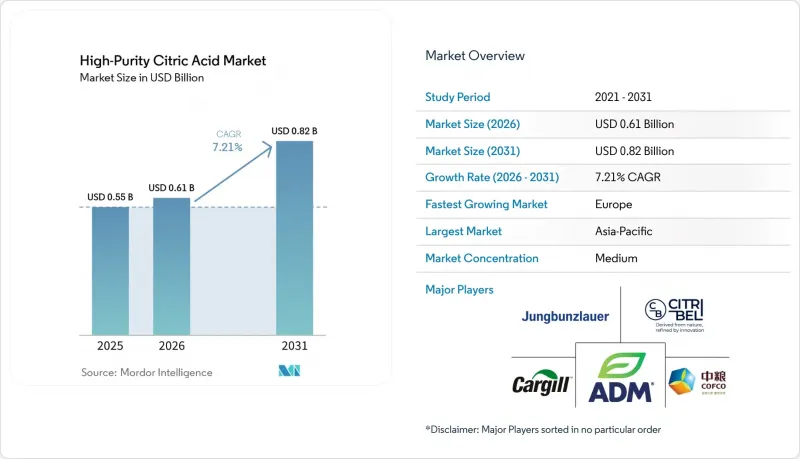
根據 Mordor Intelligence 預測,高純度檸檬酸的市場規模預計將從 2025 年的 5.5 億美元成長到 2026 年的 6.1 億美元,到 2031 年達到 8.2 億美元,2026 年至 2031 年的複合年成長率為 7.2%。
本報告按純度等級(醫藥等級、食品級、工業級)、形態(粉末/晶體、液體)、應用領域(食品飲料、藥品、化妝品及個人護理、分析及實驗室、其他)及地區(北美、歐洲、亞太、南美、其他)進行細分。市場預測以美元計價。
全球高純度檸檬酸市場趨勢及洞察
擴大藥用輔料和口服製劑的使用
在製藥業,檸檬酸已從單純的酸味劑發展成為具有更廣泛重要功能的物質。如今,它被廣泛用作螯合劑,有效保護片劑、糖漿和口服溶液中敏感的活性成分免受金屬離子的劣化。這一不斷擴展的作用凸顯了檸檬酸在確保藥物穩定性和療效方面的重要性。此外,主要監管市場要求在藥物應用中使用符合美國藥典(USP)和歐洲藥典(EP)標準的原料,從而明確區分了經認證的高純度產品和低純度替代品。由於檸檬酸在改善難溶性藥物製劑方面的應用,其市場需求正在成長。基於檸檬酸鹽的系統正被擴大用於提高生物利用度,這是藥物研發的關鍵挑戰。檸檬酸既能支持監管合規性,又能改善製劑性能,這種雙重功能確保了製藥領域對高純度檸檬酸的穩定需求。
生物技術領域中發酵培養基和細胞培養應用的不斷擴展。
依賴嚴格控制的原料的生物技術工藝在推動高純度檸檬酸市場成長方面發揮著至關重要的作用。在發酵培養基和細胞培養系統中,檸檬酸發揮多種重要作用,包括作為碳源、螯合劑和穩定pH值。這種多功能性使得替代品難以使用,因為在生物製藥生產的上游和下游製程中,保持製程一致性和成本控制至關重要。此外,對非常規酵母的持續研究以及有機酸生物生產技術的進步,正在拓展能夠有效利用檸檬酸鹽基添加劑的系統範圍。因此,即使通用檸檬酸的價格持續面臨下行壓力,高純度檸檬酸市場仍將繼續受益於生技領域的快速發展。
高昂的製造和提煉成本
由於醫藥級和高級食品級檸檬酸的生產要求極為嚴格,其生產成本高昂。這些等級的檸檬酸需要採用先進的工藝,例如多級結晶、離子交換純化和全面的重金屬檢測,所有這些都顯著增加了生產成本,遠高於低等級檸檬酸。中國以外的生產商往往面臨更多挑戰,包括由於原料整合不足而導致的結構性高成本、不斷上漲的能源成本以及更嚴格的合規要求。因此,市場越來越青睞能夠透過大規模的產量分攤提純和檢測成本的大型一體化供應商,從而實現更高的成本效益。雖然小規模企業仍可在細分市場中參與競爭,但它們對價格形成的影響越來越取決於企業規模和認證範圍,而這些因素正成為保持競爭力的關鍵。
細分市場分析
到2025年,藥用級檸檬酸將佔據51.38%的市場佔有率,成為高純度檸檬酸市場中純度最高的細分市場。這一地位反映了受監管的藥品需要符合USP、EP、JP或類似標準的原料,從而導致市場需求相對穩定。高純度檸檬酸市場仍以醫藥應用為主導,因為輔料的性能和合規性對於口服和注射製劑至關重要。擁有多項藥典認證的供應商具有優勢,因為這可以降低全球買家合格評估的複雜性。
預計2026年至2031年間,食品級檸檬酸的複合年成長率將達到8.68%,成為高純度檸檬酸市場中成長最快的純度細分市場。儘管食品級檸檬酸市場成長迅速,但醫藥領域的領先地位並未因此減弱,因為其成長動力主要來自嬰幼兒配方奶粉、臨床營養和營養補充品等應用領域,這些領域的標準同樣嚴格。因此,高純度檸檬酸產業在食品應用和醫藥相關品質要求之間找到了更多通用。由於工業級檸檬酸的最終用途對純度和相關文件要求的敏感度較低,因此在本研究範圍內,工業級檸檬酸的市場佔有率仍然較小。從細分市場組成來看,雖然銷售成長正在擴大,但價值獲取仍然高度依賴認證的深度。
區域分析
到2025年,亞太地區將佔據42.64%的市場佔有率,引領高純度檸檬酸市場。該地區擁有大規模發酵生產能力,且下游醫藥和食品加工產業的需求強勁。中國憑藉其生產體系的優勢,包括便利的原料取得管道、發酵規模以及支持成本效益的一體化生產體系,仍是該地區的核心力量。印度憑藉大規模的藥品製劑市場以及對目標產品中認證輔料的持續需求,正在推動該地區的需求成長。因此,亞太地區高純度檸檬酸市場既體現了強大的生產能力,也反映了不斷成長的本地消費需求。
預計2026年至2031年間,歐洲高純度檸檬酸市場將以8.15%的複合年成長率成長,成為該市場成長最快的區域市場。醫藥、營養保健品、高階食品和個人護理領域的買家是推動市場需求的主要因素,他們重視嚴格的供應鏈記錄和認證等級。此外,近年來,由於運輸和供應中斷,該地區更加重視可靠的採購管道。因此,歐洲高純度檸檬酸市場的成長主要依賴品質保證和籌資策略,而非低成本生產。
由於北美擁有許多國內主要原料生產商以及在製藥和食品領域廣泛的基本客群,因此仍然是高純度檸檬酸的重要市場。戰略投資正在改變該地區的格局,尤其是榮邦勞爾公司於2025年完成對其伊利諾州工廠的收購,從而在美國建立起優質原料的製造地。南美洲以及中東和非洲地區雖然目前規模較小,但隨著食品加工業的擴張和區域醫藥貿易的蓬勃發展,這些地區的需求正在持續成長。儘管這些地區的高純度檸檬酸市場仍相對不成熟,但不斷成長的需求支撐著更廣泛的全球基本客群。
其他好處
- Excel格式的市場預測(ME)表
- 3個月的分析師支持
目錄
第1章:引言
- 研究假設和市場定義
- 調查範圍
第2章:調查方法
第3章執行摘要
第4章 市場狀況
- 市場概覽
- 市場促進因素
- 擴大藥用輔料和口服製劑的使用
- 生物技術領域中發酵培養基和細胞培養應用的擴展。
- 擴大在高檔糖果甜點和無糖糖果的應用
- 擴大在發泡和粉劑的應用
- 嬰兒配方奶粉和臨床營養產品的需求增加
- 營養保健軟糖和膳食補充劑的需求正在成長。
- 市場限制因素
- 高昂的製造和提煉成本
- 原料供應鏈中斷
- 與其他酸味劑的競爭
- 嚴格的監理合規要求
- 供應鏈分析
- 監理情勢
- 技術展望
- 波特五力模型
第5章 市場規模與成長預測
- 按純度等級
- 醫藥級
- 食品級
- 工業級
- 按形式
- 粉末/晶體
- 液體
- 透過使用
- 飲食
- 製藥
- 化妝品和個人護理
- 分析和實驗應用
- 其他
- 按地區
- 北美洲
- 美國
- 加拿大
- 墨西哥
- 其他北美國家
- 歐洲
- 德國
- 英國
- 法國
- 義大利
- 西班牙
- 荷蘭
- 瑞典
- 其他歐洲國家
- 亞太地區
- 中國
- 印度
- 日本
- 澳洲
- 韓國
- 其他亞太國家
- 南美洲
- 巴西
- 阿根廷
- 其他南美國家
- 中東和非洲
- 阿拉伯聯合大公國
- 南非
- 其他中東和非洲國家
- 北美洲
第6章 競爭情勢
- 市場集中度
- 策略趨勢
- 市場排名分析
- 公司簡介
- Jungbunzlauer Suisse AG
- Cargill, Incorporated
- Archer Daniels Midland Company
- COFCO BIoTechnology Co., Ltd.
- TTCA CO., LTD.
- Shandong Ensign Industry Co., Ltd.
- Citribel NV
- Gadot Biochemical Industries Ltd.
- RZBC Group Co., Ltd.
- Huangshi Xinghua Biochemical Co., Ltd.
- Foodchem International Corporation
- Merck KGaA
- Brenntag SE
- Roquette Freres
- Tate and Lyle PLC
- Corbion NV
- Xitrical Co., Ltd.
- ECSA Chemicals AG
- Hubei Xingfa Chemicals Group Co., Ltd.
- Jiangsu Guoxin Union Energy Co., Ltd.
第7章 市場機會與未來展望
According to Mordor Intelligence, the high-purity citric acid market size is expected to increase from USD 0.55 billion in 2025 to USD 0.61 billion in 2026 and reach USD 0.82 billion by 2031, growing at a CAGR of 7.2% over 2026-2031.
This report is Segmented by Purity Grade (Pharma Grade, Food Grade, and Industrial Grade), Form (Powder/Crystalline and Liquid), Application (Food and Beverages, Pharmaceuticals, Cosmetics and Personal Care, Analytical and Laboratory Use, and Others), and Geography (North America, Europe, Asia-Pacific, South America, and More). The Market Forecasts are Provided in Terms of Value (USD).
Global High-Purity Citric Acid Market Trends and Insights
Growing Use in Pharmaceutical Excipients and Oral Drug Formulations
In the pharmaceutical industry, citric acid has transitioned from being merely an acidulant to serving a broader range of critical functions. It is now widely utilized as a chelating agent, effectively protecting sensitive active ingredients in tablets, syrups, and oral liquid formulations from degradation caused by metal ions. This expanded role highlights its importance in ensuring the stability and efficacy of drug products. Additionally, major regulated markets mandate the use of USP and EP-compliant materials in pharmaceutical filings, creating a clear distinction between certified high-purity supplies and lower-grade alternatives. The high-purity citric acid market is also experiencing growth due to its application in reformulating low-solubility drugs. Citrate-based systems are increasingly employed to enhance bioavailability, addressing a key challenge in drug development. This dual capability of supporting regulatory compliance and improving formulation performance ensures a steady and durable demand for high-purity citric acid in the pharmaceutical sector.
Rising Use in Biotechnology Fermentation Media and Cell Culture Applications
Biotechnology processes, which depend on tightly controlled raw materials, play a significant role in driving the high purity citric acid market. In fermentation media and cell culture systems, citric acid performs multiple critical functions, including serving as a carbon source, acting as a chelation aid, and stabilizing pH levels. This multifunctionality reduces the likelihood of substitution, as maintaining process consistency is as crucial as managing costs in both upstream and downstream biologics operations. Furthermore, ongoing research into non-conventional yeasts and advancements in organic acid bioproduction are expanding the range of systems that can effectively utilize citrate-based supplementation. As a result, the high purity citric acid market continues to benefit from the rapid expansion of the biotechnology sector, even in scenarios where commodity citric acid prices remain under pressure.
High Production and Purification Costs
Producing high-purity citric acid involves high costs due to the stringent requirements for pharmaceutical and premium food grades. These grades necessitate advanced processes such as multi-stage crystallization, ion exchange purification, and comprehensive heavy metals testing, all of which substantially increase production expenses compared to lower-grade citric acid. Producers outside China often face additional challenges, including higher structural costs stemming from weaker feedstock integration, elevated energy expenses, and stricter compliance requirements. Consequently, the market increasingly favors larger, integrated suppliers capable of spreading purification and testing costs across higher production volumes, thereby achieving greater cost efficiency. Although smaller players can still compete in niche segments, their ability to influence pricing is progressively determined by their scale of operations and the breadth of their certifications, which are becoming critical factors in maintaining competitiveness.
Other drivers and restraints analyzed in the detailed report include:
- Increasing Use in Premium Confectionery and Sugar-Free Candies
- Growing Use in Effervescent Tablets and Powders
- Supply Chain Disruptions for Feedstocks
For complete list of drivers and restraints, kindly check the Table Of Contents.
Segment Analysis
Pharma Grade held 51.38% of the market in 2025, which made it the largest purity segment in the high-purity citric acid market. This position reflects the fact that regulated drug products require material aligned with USP, EP, JP, or similar standards, which keeps demand relatively captive. The high-purity citric acid market continues to rely on pharmaceutical use as an anchor because excipient performance and compliance are both essential in oral and parenteral formulations. Suppliers with multi-compendial certification hold an advantage because they reduce qualification complexity for global buyers.
Food Grade is projected to grow at an 8.68% CAGR from 2026 to 2031, which makes it the fastest-growing purity segment in the high-purity citric acid market. This rise does not weaken the pharmaceutical premium because much of the momentum comes from applications such as infant formula, clinical nutrition, and nutraceutical products, where specification standards are also strict. The high-purity citric acid industry is therefore seeing more overlap between advanced food applications and pharma-linked quality expectations. Industrial Grade remains smaller within this report's scope because its end uses are less sensitive to the purity and documentation requirements that define premium demand. The segment mix shows that volume growth is broadening, while value capture still depends heavily on certification depth.
Complete Report Scope:
- By Purity Grade
- Pharma Grade
- Food Grade
- Industrial Grade
- By Form
- Powder/Crystalline
- Liquid
- By Application
- Food and Beverages
- Pharmaceuticals
- Cosmetics and Personal Care
- Analytical and Laboratory Use
- Others
- By Geography
- North America
- United States
- Canada
- Mexico
- Rest of North America
- Europe
- Germany
- United Kingdom
- France
- Italy
- Spain
- Netherlands
- Sweden
- Rest of Europe
- Asia-Pacific
- China
- India
- Japan
- Australia
- South Korea
- Rest of Asia-Pacific
- South America
- Brazil
- Argentina
- Rest of South America
- Middle East and Africa
- United Arab Emirates
- South Africa
- Rest of Middle East and Africa
- North America
Geography Analysis
Asia-Pacific held 42.64% of the market in 2025, giving it the leading position in the high-purity citric acid market. The region combines large-scale fermentation capacity with strong downstream demand from pharmaceuticals and food processing. China remains central because its production system benefits from feedstock access, fermentation scale, and integrated manufacturing structures that support cost efficiency. India strengthens the regional demand picture through its large pharmaceutical formulation base and continuing need for certified excipients in regulated products. The high-purity citric acid market in Asia-Pacific therefore reflects both production strength and expanding local consumption.
Europe is projected to grow at an 8.15% CAGR from 2026 to 2031, making it the fastest-growing regional segment in the high-purity citric acid market. Demand is being supported by pharmaceutical, nutraceutical, premium food, and personal care buyers who value tightly documented supply and certified grades. The region also places a higher premium on dependable sourcing after recent years of freight and supply disruption. The high-purity citric acid market in Europe is therefore growing on quality assurance and sourcing strategy rather than on low cost production.
North America remains an important part of the high purity citric acid market because it has major domestic ingredient producers and a large base of pharmaceutical and food customers. Strategic investment is reshaping the region, as Jungbunzlauer closed its Illinois facility acquisition in 2025 to establish a U.S. manufacturing footprint for premium ingredients. South America and the Middle East and Africa are smaller in current scale, but they continue to add demand through food processing expansion and regional pharmaceutical trade flows. The high purity citric acid market across these regions remains less mature, yet their incremental demand supports a broader global customer base.
- Jungbunzlauer Suisse AG
- Cargill, Incorporated
- Archer Daniels Midland Company
- COFCO Biotechnology Co., Ltd.
- TTCA CO., LTD.
- Shandong Ensign Industry Co., Ltd.
- Citribel NV
- Gadot Biochemical Industries Ltd.
- RZBC Group Co., Ltd.
- Huangshi Xinghua Biochemical Co., Ltd.
- Foodchem International Corporation
- Merck KGaA
- Brenntag SE
- Roquette Freres
- Tate and Lyle PLC
- Corbion N.V.
- Xitrical Co., Ltd.
- ECSA Chemicals AG
- Hubei Xingfa Chemicals Group Co., Ltd.
- Jiangsu Guoxin Union Energy Co., Ltd.
Additional Benefits:
- The market estimate (ME) sheet in Excel format
- 3 months of analyst support
TABLE OF CONTENTS
1 INTRODUCTION
- 1.1 Study Assumptions and Market Definition
- 1.2 Scope of the Study
2 RESEARCH METHODOLOGY
3 EXECUTIVE SUMMARY
4 MARKET LANDSCAPE
- 4.1 Market Overview
- 4.2 Market Drivers
- 4.2.1 Growing Use in Pharmaceutical Excipients and Oral Drug Formulations
- 4.2.2 Rising Use in Biotechnology Fermentation Media and Cell Culture Applications
- 4.2.3 Increasing Use in Premium Confectionery and Sugar-Free Candies
- 4.2.4 Growing Use in Effervescent Tablets and Powders
- 4.2.5 Increasing Demand from Infant Formula and Clinical Nutrition Products
- 4.2.6 Nutraceutical Gummies and Dietary Supplements Facing Stronger Demand
- 4.3 Market Restraints
- 4.3.1 High Production and Purification Costs
- 4.3.2 Supply Chain Disruptions for Feedstocks
- 4.3.3 Competition from Alternative Acidulants
- 4.3.4 Stringent Regulatory Compliance Requirements
- 4.4 Supply Chain Analysis
- 4.5 Regulatory Landscape
- 4.6 Technological Outlook
- 4.7 Porter's Five Forces
- 4.7.1 Bargaining Power of Suppliers
- 4.7.2 Bargaining Power of Buyers
- 4.7.3 Threat of New Entrants
- 4.7.4 Threat of Substitutes
- 4.7.5 Competitive Rivalry
5 MARKET SIZE AND GROWTH FORECASTS (VALUE)
- 5.1 By Purity Grade
- 5.1.1 Pharma Grade
- 5.1.2 Food Grade
- 5.1.3 Industrial Grade
- 5.2 By Form
- 5.2.1 Powder/Crystalline
- 5.2.2 Liquid
- 5.3 By Application
- 5.3.1 Food and Beverages
- 5.3.2 Pharmaceuticals
- 5.3.3 Cosmetics and Personal Care
- 5.3.4 Analytical and Laboratory Use
- 5.3.5 Others
- 5.4 By Geography
- 5.4.1 North America
- 5.4.1.1 United States
- 5.4.1.2 Canada
- 5.4.1.3 Mexico
- 5.4.1.4 Rest of North America
- 5.4.2 Europe
- 5.4.2.1 Germany
- 5.4.2.2 United Kingdom
- 5.4.2.3 France
- 5.4.2.4 Italy
- 5.4.2.5 Spain
- 5.4.2.6 Netherlands
- 5.4.2.7 Sweden
- 5.4.2.8 Rest of Europe
- 5.4.3 Asia-Pacific
- 5.4.3.1 China
- 5.4.3.2 India
- 5.4.3.3 Japan
- 5.4.3.4 Australia
- 5.4.3.5 South Korea
- 5.4.3.6 Rest of Asia-Pacific
- 5.4.4 South America
- 5.4.4.1 Brazil
- 5.4.4.2 Argentina
- 5.4.4.3 Rest of South America
- 5.4.5 Middle East and Africa
- 5.4.5.1 United Arab Emirates
- 5.4.5.2 South Africa
- 5.4.5.3 Rest of Middle East and Africa
- 5.4.1 North America
6 COMPETITIVE LANDSCAPE
- 6.1 Market Concentration
- 6.2 Strategic Moves
- 6.3 Market Ranking Analysis
- 6.4 Company Profiles (Includes Global-level Overview, Market-level Overview, Core Segments, Financials, Strategic Info, Market Rank/Share, Products & Services, Recent Developments)
- 6.4.1 Jungbunzlauer Suisse AG
- 6.4.2 Cargill, Incorporated
- 6.4.3 Archer Daniels Midland Company
- 6.4.4 COFCO Biotechnology Co., Ltd.
- 6.4.5 TTCA CO., LTD.
- 6.4.6 Shandong Ensign Industry Co., Ltd.
- 6.4.7 Citribel NV
- 6.4.8 Gadot Biochemical Industries Ltd.
- 6.4.9 RZBC Group Co., Ltd.
- 6.4.10 Huangshi Xinghua Biochemical Co., Ltd.
- 6.4.11 Foodchem International Corporation
- 6.4.12 Merck KGaA
- 6.4.13 Brenntag SE
- 6.4.14 Roquette Freres
- 6.4.15 Tate and Lyle PLC
- 6.4.16 Corbion N.V.
- 6.4.17 Xitrical Co., Ltd.
- 6.4.18 ECSA Chemicals AG
- 6.4.19 Hubei Xingfa Chemicals Group Co., Ltd.
- 6.4.20 Jiangsu Guoxin Union Energy Co., Ltd.
7 MARKET OPPORTUNITIES AND FUTURE OUTLOOK

 全球聚氨基酸聚合物市場規模、佔有率、趨勢和成長分析報告(2026-2034)
 2026-2030年全球檸檬酸市場
 檸檬酸:市場佔有率分析、產業趨勢與統計、成長預測(2026-2031)
 伊康酸市場:2026-2032年全球市場預測(依等級、形態、生產流程、應用及通路分類)檸檬酸市場:2026-2032年全球市場預測(依產品種類、等級、形態、原料、應用及通路分類)
 聚氨基酸聚合物市場規模、佔有率和趨勢分析報告:按產品類型、應用、地區和細分市場預測(2026-2033 年)
 伊康酸市場規模、佔有率和成長分析:按應用、製造方法、等級、最終用途和地區分類-2026-2033年產業預測
 伊康酸市場:依衍生物、應用及地區分類
 檸檬酸市場報告:趨勢、預測及競爭分析(至2035年)
 檸檬酸市場報告:按應用、形態和地區分類(2026-2034 年)