


 |
市場調查報告書
商品編碼
2072991
酵素:市場佔有率分析、產業趨勢和統計數據、成長預測(2026-2031)Enzymes - Market Share Analysis, Industry Trends & Statistics, Growth Forecasts (2026 - 2031) |
||||||

※ 本網頁內容可能與最新版本有所差異。詳細情況請與我們聯繫。
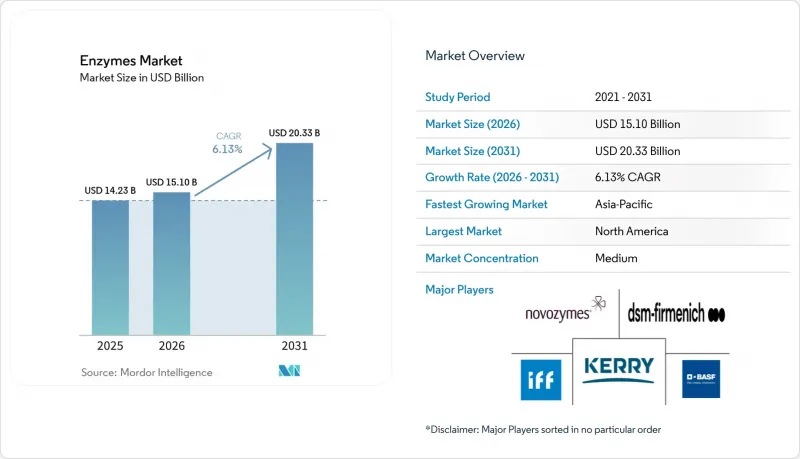
根據 Mordor Intelligence 估計,2025 年酵素市值為 142.3 億美元,2026 年將擴大到 151 億美元。
此外,預計從 2026 年到 2031 年,該產業將以 6.13% 的複合年成長率成長,到 2031 年將達到 203.3 億美元。
本報告按產品類型(工業酵素和特殊酵素)、原料來源(植物來源、微生物來源、動物來源)、酵素類型(碳水化合物消化酶、蛋白水解酶等)、應用領域(食品飲料、醫藥和生物技術等)以及地區(北美、歐洲、亞太、南美、中東和非洲)進行細分。市場預測以價值(美元)和數量(噸)兩種單位呈現。
全球酵素市場趨勢及洞察
健康意識日益增強
消費行為正在推動酵素製劑市場的成長。消費者尋求能夠改善營養、促進健康和提升生活品質的產品。這種對健康生活方式日益成長的認知促使人們採用酵素製劑解決方案,以增強產品功能、提高營養價值並支持天然加工方法。消費者對潔淨標示、天然來源和低加工產品的偏好不斷成長,也推動了對酵素製劑的需求,將其作為傳統加工方法的有效生物替代方案。酵素製劑有助於提高消化率、增強功能性,並促進產品開發,以適應不斷發展的健康趨勢。此外,人們對預防醫學、原料透明度和永續生產實踐的日益關注,也促使製造商將酵素製劑技術融入其創新策略。
潔淨標示和天然成分趨勢的擴展
消費者對潔淨標示和天然成分的日益偏好,源自於他們對透明、天然來源且採用永續解決方案生產的產品的需求。酶的應用日益廣泛,因為它們有助於減少對合成添加劑和有害化學過程的依賴,同時保持產品的品質、功能和性能。消費者對成分透明度、簡單配方和天然來源加工產品的日益關注,推動了酶基技術作為有效生物替代方案的應用。例如,國際食品資訊理事會 (IFIC) 預測,到 2024 年,36% 的美國人會將「天然」或「有機」標籤作為選擇食品的重要因素,這凸顯了消費者對標有「天然來源」產品的日益成長的偏好。這一趨勢正促使製造商採用酵素解決方案,以實現更清潔的生產方法、改善產品特性並採用永續的加工技術。
嚴格且分散的法規核准流程
繁瑣且分散的法規核准流程限制了酵素市場的成長。製造商必須應對複雜的安全評估、遵守品質標準並滿足區域核准要求才能商業化。不同市場法規結構的差異在文件編制、測試程序、標籤標準和核准時間表等方面都帶來了挑戰,使酵素產品的全球上市變得更加複雜。企業需要透過廣泛的評估來證明酵素的安全性、純度、生產一致性和潛在影響,這導致研發週期延長,合規工作量增加。此外,有關生物技術衍生酶、基因改造生產系統和新型酵素製劑的監管變化也為製造商帶來了不確定性,並可能延遲產品上市。
細分市場分析
到2025年,工業酵素領域將佔據全球酵素市場64.52%的佔有率,這主要得益於永續、高效和生物基加工解決方案的持續發展。酵素能夠提高製程效率、改善產品品質、縮短加工時間並減少對傳統化學方法的依賴,從而推動了這一成長。人們對環保生產方式的日益青睞進一步加速了酵素的應用,因為酵素在溫和條件下即可發揮作用,降低能耗並最大限度地減少廢棄物產生。酵素工程、蛋白質修飾和發酵技術的進步提高了酵素的穩定性、特異性和性能,使其能夠應用於更廣泛的商業性領域。對高性能生物催化劑、更高生產效率和客製化酵素解決方案日益成長的需求,正在推動該領域的創新和大規模生產。
預計特種酵素領域將成為成長最快的產品類型,2026年至2031年的複合年成長率將達到7.23%。這一成長主要得益於對高特異性和先進酶解決方案日益成長的需求。酶修飾、蛋白質工程和生物技術的持續進步正在提高酶的效率、選擇性和功能性能。對精準生物解決方案的日益青睞正在加速開發針對特定製程和最佳化結果而設計的客製化酵素。重組和酵素最佳化技術的創新使得開發出穩定性更高、活性持續時間更長、且在各種運作條件下更適用的酵素成為可能。
到2025年,微生物酶將佔據全球酶市場61.23%的佔有率,這主要得益於其高生產效率、擴充性和穩定的酶品質。該領域的成長歸功於微生物的諸多優勢,包括其快速的生長週期、易於培養以及透過可控制程大規模生產酵素的能力。微生物菌株改良、發酵技術和基因工程的進步顯著提高了酵素的產量、純度、穩定性和功能性能,使微生物酵素成為商業酵素生產的首選。此外,微生物酵素在耐熱性、活性和操作穩定性等方面的改進也進一步擴展了其在各種應用領域的應用。同時,對永續生產方法的日益重視以及經濟高效的酵素生產技術的開發,也提高了微生物酶生產的可靠性和效率。
預計2026年至2031年間,動物性酵素市場將以6.58%的複合年成長率成長,主要受市場對具有高催化效率和獨特功能特性的天然酵素的需求不斷成長的推動。動物源性酵素獨特的生化特性,例如高特異性、可靠性和在目標製程中的高效性,支撐了該市場的成長。萃取、純化和穩定化技術的進步提高了酵素的品質、均勻性和性能,從而促進了其更廣泛的市場接受度。此外,加工方法的改進提高了酵素的回收效率,同時保持了生物活性和功能完整性。同時,高純度酵素製劑的開發以及旨在提高酵素在各種條件下的穩定性、安全性和性能的創新,也進一步推動了該市場的成長前景。
區域分析
預計到2025年,北美將佔據全球酶市場31.87%的佔有率,這得益於其成熟的酶生產和利用生態系統、生物技術的進步以及酶基解決方案在工業流程中的廣泛應用。該地區的成長主要由成熟的工業酵素生態系統驅動,特別是大規模玉米銑床、大豆加工和乙醇生產,這些都支撐著對高效生物催化劑的需求。根據美國農業部(USDA)預測,2025/2026年度大豆總產量預計將達到1.1599億噸,這將確保酶驅動加工活動所需的農業原料的穩定供應。此外,對酵素工程、發酵技術和永續加工方法的投資不斷增加,進一步鞏固了北美在全球酵素市場的主導地位。
預計亞太地區在2026年至2031年間將以7.06%的複合年成長率成長,成為成長最快的地區。這一成長主要得益於生物技術能力的快速擴張、各工業領域對酵素法製程的日益普及,以及對永續高效生產技術日益成長的需求。歐洲仍然是酵素市場最大的地區之一,這得益於其對永續性的嚴格監管、先進的研究基礎設施以及創新酶技術的開發。該地區致力於生物基解決方案、循環生產方法以及酶性能的持續提升,為其市場穩步擴張奠定了基礎。歐洲對永續性和創新的重視鞏固了其在全球酵素市場的持續主導地位。
受酵素技術認知度不斷提高、工業產能提升以及永續加工方法日益普及的推動,南美洲、中東和非洲正崛起為全球酵素市場的新興區域。在南美洲,生物加工活動的擴張以及酵素解決方案在提高生產效率方面的廣泛應用,推動了市場成長。在中東和非洲,先進酵素技術的應用正逐步推進,這得益於生產流程的現代化以及對永續替代方案日益成長的興趣。
其他好處:
- Excel格式的市場預測(ME)表
- 3個月的分析師支持
目錄
第1章:引言
- 研究假設和市場定義
- 調查範圍
第2章:調查方法
第3章執行摘要
第4章 市場狀況
- 市場概覽
- 市場促進因素
- 健康意識日益增強
- 潔淨標示和天然成分的趨勢日益成長
- 酵素工程技術進步
- 擴大生質燃料生產和推動可再生能源計劃
- 擴大精準發酵能力
- 向低能耗、低廢棄物處理過渡
- 市場限制因素
- 嚴格且分散的法規核准流程
- 下游製程純化和配製成本高昂
- 對原料等級發酵投入的依賴性
- 替代化學處理方案的可用性
- 供應鏈分析
- 監理情勢
- 技術展望
- 波特五力分析
第5章 市場規模與成長預測
- 依產品類型
- 工業酵素
- 特殊酵素
- 來源
- 植物
- 微生物來源
- 動物
- 按類型
- 碳水化合物消化酶
- 蛋白酶
- 脂肪酶
- 其他
- 透過使用
- 食品/飲料
- 製藥和生物技術
- 診斷和臨床測試
- 清潔劑和家用護理產品
- 生質燃料和工業製程
- 動物飼料
- 紡織品和皮革
- 紙漿和紙漿
- 其他
- 按地區
- 北美洲
- 美國
- 加拿大
- 墨西哥
- 其他北美國家
- 歐洲
- 英國
- 德國
- 法國
- 義大利
- 西班牙
- 荷蘭
- 波蘭
- 比利時
- 瑞典
- 其他歐洲國家
- 亞太地區
- 中國
- 日本
- 印度
- 澳洲
- 印尼
- 韓國
- 泰國
- 新加坡
- 其他亞太國家
- 南美洲
- 巴西
- 阿根廷
- 哥倫比亞
- 智利
- 秘魯
- 其他南美國家
- 中東和非洲
- 南非
- 沙烏地阿拉伯
- 阿拉伯聯合大公國
- 奈及利亞
- 埃及
- 摩洛哥
- 土耳其
- 其他中東和非洲國家
- 北美洲
第6章 競爭情勢
- 市場集中度
- 策略趨勢
- Market Positioning Analysis
- 公司簡介
- Novozymes A/S
- International Flavors and Fragrances Inc.
- DSM-Firmenich AG
- BASF SE
- Kerry Group plc
- Associated British Foods plc
- Amano Enzyme Inc.
- Advanced Enzyme Technologies Ltd.
- AB Enzymes GmbH
- Codexis, Inc.
- Biocatalysts Ltd.
- Enzyme Development Corporation
- Chr. Hansen Holding A/S
- Merck KGaA
- Thermo Fisher Scientific Inc.
- Promega Corporation
- Takara Bio Inc.
- F. Hoffmann-La Roche Ltd.
- Sanofi SA
- Enzyme Solutions Inc.
第7章 市場機會與未來展望
According to Mordor Intelligence, the enzymes market was valued at USD 14.23 billion in 2025 and is estimated to grow to USD 15.1 billion in 2026, with projections indicating it will reach USD 20.33 billion by 2031, registering a CAGR of 6.13% during 2026-2031.
This report is Segmented by Product Type (Industrial Enzymes and Specialty Enzymes), Source (Plant, Microbial, and Animal), Type (Carbohydrase's, Proteases, and More), Application (Food and Beverages, Pharmaceuticals and Biotechnology, and More), and Geography (North America, Europe, Asia-Pacific, South America, Middle East and Africa). The Market Forecasts are Provided in Both Value (USD) and Volume (Tons).
Global Enzymes Market Trends and Insights
Rising health-conscious consumer behaviour
The increasing focus on health-conscious consumer behavior is driving growth in the enzymes market. Consumers are seeking products that promote better nutrition, wellness, and an improved quality of life. Greater awareness of healthier lifestyles has led to the adoption of enzyme-based solutions that enhance product functionality, improve nutritional value, and support natural processing methods. There is a growing preference for clean-label, naturally derived, and minimally processed products, which has boosted the demand for enzymes as effective biological alternatives to traditional processing methods. Enzymes contribute to improved digestibility, enhanced functional benefits, and the development of products that align with changing wellness trends. Furthermore, rising interest in preventive health, ingredient transparency, and sustainable production practices is motivating manufacturers to integrate enzyme technologies into their innovation strategies.
Growth of clean-label and natural ingredient trends
The growing preference for clean-label and natural ingredients is driven by consumer demand for products made with transparent, naturally derived, and sustainable solutions. Enzymes are increasingly adopted as they help manufacturers reduce reliance on synthetic additives and harsh chemical processes while maintaining product quality, functionality, and performance. The rising consumer focus on ingredient transparency, simpler formulations, and naturally processed products has promoted the use of enzyme-based technologies as effective biological alternatives. For example, according to the International Food Information Council (IFIC), in 2024, 36% of Americans identified "natural" or "organic" labels as important factors when choosing food, unde rscoring the increasing preference for naturally positioned products . This trend is encouraging manufacturers to adopt enzyme solutions that enable cleaner production methods, enhanced product characteristics, and sustainable processing practices.
Stringent and fragmented regulatory approval paths
The stringent and fragmented regulatory approval processes are limiting the growth of the enzymes market. Manufacturers must navigate complex safety assessments, adhere to quality standards, and meet region-specific approval requirements before commercialization. Differences in regulatory frameworks across various markets pose challenges in areas such as documentation, testing procedures, labeling standards, and approval timelines, complicating the global launch of enzyme-based products. Companies are required to provide evidence of enzyme safety, purity, production consistency, and potential impacts through extensive evaluations, resulting in longer development cycles and increased compliance efforts. Furthermore, evolving regulations related to biotechnology-derived enzymes, genetically modified production systems, and novel enzyme formulations create uncertainty for manufacturers and may delay product launches.
Other drivers and restraints analyzed in the detailed report include:
- Technological advancements in enzyme engineering
- Expansion of biofuel production and renewable energy initiatives
- High cost of downstream purification and formulation
For complete list of drivers and restraints, kindly check the Table Of Contents.
Segment Analysis
The industrial enzymes segment accounted for 64.52% of the global enzymes market share in 2025, driven by the growing shift toward sustainable, efficient, and bio-based processing solutions. This growth is attributed to enzymes' ability to enhance process efficiency, improve product quality, reduce processing time, and decrease reliance on conventional chemical methods. The increasing preference for environmentally friendly production practices has further accelerated enzyme adoption, as they operate under mild conditions, reduce energy consumption, and minimize waste generation. Advancements in enzyme engineering, protein modification, and fermentation technologies have enhanced enzyme stability, specificity, and performance, enabling broader commercial applications. The rising demand for high-performance biological catalysts, improved manufacturing productivity, and customized enzyme solutions has fostered innovation and large-scale production in this segment.
The specialty enzymes segment is projected to be the fastest-growing product type, with a CAGR of 7.23% during 2026-2031. This growth is driven by increasing demand for highly specific and advanced enzyme solutions. Continuous advancements in enzyme modification, protein engineering, and biotechnology are improving enzyme efficiency, selectivity, and functional performance. The rising preference for precision-based biological solutions has accelerated the development of customized enzymes tailored for targeted processes and optimized outcomes. Innovations in recombinant technologies and enzyme optimization techniques are enabling the creation of enzymes with enhanced stability, extended activity duration, and improved compatibility across diverse operating conditions.
The microbial-sourced enzymes segment accounted for 61.23% of the global enzymes market share in 2025, driven by their high production efficiency, scalability, and consistent enzyme quality. The segment's growth is attributed to the advantages of microorganisms, such as faster growth cycles, ease of cultivation, and the ability to produce large quantities of enzymes through controlled processes. Advancements in microbial strain improvement, fermentation technologies, and genetic engineering have significantly enhanced enzyme yield, purity, stability, and functional performance, making microbial sources a preferred choice for commercial enzyme production. Their adaptability for modifications, including improved temperature tolerance, enhanced activity, and extended operational stability, has further increased their adoption across various applications. Additionally, the growing emphasis on sustainable production methods and the development of cost-effective enzyme manufacturing techniques have bolstered the reliability and efficiency of microbial enzyme production.
The animal-sourced enzymes segment is expected to grow at a CAGR of 6.58% during 2026-2031, fueled by the rising demand for naturally derived enzymes with high catalytic efficiency and specialized functional properties. The segment's growth is supported by the unique biochemical characteristics of animal-derived enzymes, such as strong specificity, reliability, and effectiveness in targeted processes. Advances in extraction, purification, and stabilization technologies have improved enzyme quality, consistency, and performance, facilitating broader commercial acceptance. Enhanced processing methods have also increased enzyme recovery efficiency while preserving biological activity and functional integrity. Furthermore, the focus on developing highly purified enzyme formulations and innovations aimed at improving stability, safety, and performance under diverse conditions is driving the segment's growth prospects.
Complete Report Scope:
- By Product Type
- Industrial Enzymes
- Specialty Enzymes
- By Source
- Plant
- Microbial
- Animal
- By Type
- Carbohydrases
- Proteases
- Lipases
- Others
- By Application
- Food and Beverages
- Pharmaceuticals and Biotechnology
- Diagnostics and Clinical Testing
- Detergents and Household Care
- Biofuels and Industrial Processing
- Animal Feed
- Textiles and Leather
- Paper and Pulp
- Others
- By Geography
- North America
- United States
- Canada
- Mexico
- Rest of North America
- Europe
- United Kingdom
- Germany
- France
- Italy
- Spain
- Netherlands
- Poland
- Belgium
- Sweden
- Rest of Europe
- Asia-Pacific
- China
- Japan
- India
- Australia
- Indonesia
- South Korea
- Thailand
- Singapore
- Rest of Asia-Pacific
- South America
- Brazil
- Argentina
- Colombia
- Chile
- Peru
- Rest of South America
- Middle East and Africa
- South Africa
- Saudi Arabia
- United Arab Emirates
- Nigeria
- Egypt
- Morocco
- Turkey
- Rest of Middle East and Africa
- North America
Geography Analysis
North America accounted for 31.87% of the global enzymes market share in 2025, supported by a well-established enzyme production and utilization ecosystem, advancements in biotechnology, and widespread adoption of enzyme-based solutions in industrial processes. The region's growth is driven by a mature industrial enzyme ecosystem, particularly in large-scale corn wet milling, soy processing, and ethanol production, which sustain the demand for efficient biological catalysts. According to the United States Department of Agriculture (USDA), total soy bean production for 2025/2026 is projected at 115.99 million metric tons, ensuring a steady supply of agricultural feedstocks for enzyme-driven processing activities . Additionally, increasing investments in enzyme engineering, fermentation technologies, and sustainable processing practices continue to reinforce North America's leadership in the global enzymes market.
Asia-Pacific is expected to be the fastest-growing region, with a projected CAGR of 7.06% during 2026-2031. This growth is fueled by the rapid expansion of biotechnology capabilities, increasing industrial adoption of enzyme-based processes, and rising demand for sustainable and efficient production technologies. Europe remains one of the largest regions in the enzymes market, supported by a strong regulatory emphasis on sustainability, advanced research infrastructure, and the development of innovative enzyme technologies. The region's commitment to bio-based solutions, circular production practices, and continuous improvements in enzyme performance underpins steady market expansion. Europe's focus on sustainability and innovation ensures its continued prominence in the global enzymes market.
South America and the Middle East and Africa are emerging regions in the global enzymes market, driven by increasing awareness of enzyme-based technologies, improving industrial capabilities, and growing adoption of sustainable processing methods. South America is experiencing growth due to the expansion of biological processing activities and the greater use of enzyme solutions to enhance productivity and efficiency. In the Middle East and Africa, the gradual adoption of advanced enzyme technologies is supported by the modernization of production processes and a growing interest in sustainable alternatives.
- Novozymes A/S
- International Flavors and Fragrances Inc.
- DSM-Firmenich AG
- BASF SE
- Kerry Group plc
- Associated British Foods plc
- Amano Enzyme Inc.
- Advanced Enzyme Technologies Ltd.
- AB Enzymes GmbH
- Codexis, Inc.
- Biocatalysts Ltd.
- Enzyme Development Corporation
- Chr. Hansen Holding A/S
- Merck KGaA
- Thermo Fisher Scientific Inc.
- Promega Corporation
- Takara Bio Inc.
- F. Hoffmann-La Roche Ltd.
- Sanofi S.A.
- Enzyme Solutions Inc.
Additional Benefits:
- The market estimate (ME) sheet in Excel format
- 3 months of analyst support
TABLE OF CONTENTS
1 INTRODUCTION
- 1.1 Study Assumptions and Market Definition
- 1.2 Scope of the Study
2 RESEARCH METHODOLOGY
3 EXECUTIVE SUMMARY
4 MARKET LANDSCAPE
- 4.1 Market Overview
- 4.2 Market Drivers
- 4.2.1 Rising health-conscious consumer behaviour
- 4.2.2 Growth of clean-label and natural ingredient trends
- 4.2.3 Technological advancements in enzyme engineering
- 4.2.4 Expansion of biofuel production and renewable energy initiatives
- 4.2.5 Expansion of precision fermentation capacity
- 4.2.6 Shift toward low-energy, low-waste processing
- 4.3 Market Restraints
- 4.3.1 Stringent and fragmented regulatory approval paths
- 4.3.2 High cost of downstream purification and formulation
- 4.3.3 Dependence on feedstock-grade fermentation inputs
- 4.3.4 Availability of alternative chemical-based processing solutions
- 4.4 Supply Chain Analysis
- 4.5 Regulatory Landscape
- 4.6 Technological Outlook
- 4.7 Porter's Five Forces Analysis
- 4.7.1 Threat of New Entrants
- 4.7.2 Bargaining Power of Buyers
- 4.7.3 Bargaining Power of Suppliers
- 4.7.4 Threat of Substitutes
- 4.7.5 Intensity of Competitive Rivalry
5 MARKET SIZE AND GROWTH FORECASTS (VALUE AND VOLUME)
- 5.1 By Product Type
- 5.1.1 Industrial Enzymes
- 5.1.2 Specialty Enzymes
- 5.2 By Source
- 5.2.1 Plant
- 5.2.2 Microbial
- 5.2.3 Animal
- 5.3 By Type
- 5.3.1 Carbohydrases
- 5.3.2 Proteases
- 5.3.3 Lipases
- 5.3.4 Others
- 5.4 By Application
- 5.4.1 Food and Beverages
- 5.4.2 Pharmaceuticals and Biotechnology
- 5.4.3 Diagnostics and Clinical Testing
- 5.4.4 Detergents and Household Care
- 5.4.5 Biofuels and Industrial Processing
- 5.4.6 Animal Feed
- 5.4.7 Textiles and Leather
- 5.4.8 Paper and Pulp
- 5.4.9 Others
- 5.5 By Geography
- 5.5.1 North America
- 5.5.1.1 United States
- 5.5.1.2 Canada
- 5.5.1.3 Mexico
- 5.5.1.4 Rest of North America
- 5.5.2 Europe
- 5.5.2.1 United Kingdom
- 5.5.2.2 Germany
- 5.5.2.3 France
- 5.5.2.4 Italy
- 5.5.2.5 Spain
- 5.5.2.6 Netherlands
- 5.5.2.7 Poland
- 5.5.2.8 Belgium
- 5.5.2.9 Sweden
- 5.5.2.10 Rest of Europe
- 5.5.3 Asia-Pacific
- 5.5.3.1 China
- 5.5.3.2 Japan
- 5.5.3.3 India
- 5.5.3.4 Australia
- 5.5.3.5 Indonesia
- 5.5.3.6 South Korea
- 5.5.3.7 Thailand
- 5.5.3.8 Singapore
- 5.5.3.9 Rest of Asia-Pacific
- 5.5.4 South America
- 5.5.4.1 Brazil
- 5.5.4.2 Argentina
- 5.5.4.3 Colombia
- 5.5.4.4 Chile
- 5.5.4.5 Peru
- 5.5.4.6 Rest of South America
- 5.5.5 Middle East and Africa
- 5.5.5.1 South Africa
- 5.5.5.2 Saudi Arabia
- 5.5.5.3 United Arab Emirates
- 5.5.5.4 Nigeria
- 5.5.5.5 Egypt
- 5.5.5.6 Morocco
- 5.5.5.7 Turkey
- 5.5.5.8 Rest of Middle East and Africa
- 5.5.1 North America
6 COMPETITIVE LANDSCAPE
- 6.1 Market Concentration
- 6.2 Strategic Moves
- 6.3 Market Positioning Analysis
- 6.4 Company Profiles (includes Global level Overview, Market level overview, Core Segments, Financials as available, Strategic Information, Market Rank/Share for key companies, Products and Services, and Recent Developments)
- 6.4.1 Novozymes A/S
- 6.4.2 International Flavors and Fragrances Inc.
- 6.4.3 DSM-Firmenich AG
- 6.4.4 BASF SE
- 6.4.5 Kerry Group plc
- 6.4.6 Associated British Foods plc
- 6.4.7 Amano Enzyme Inc.
- 6.4.8 Advanced Enzyme Technologies Ltd.
- 6.4.9 AB Enzymes GmbH
- 6.4.10 Codexis, Inc.
- 6.4.11 Biocatalysts Ltd.
- 6.4.12 Enzyme Development Corporation
- 6.4.13 Chr. Hansen Holding A/S
- 6.4.14 Merck KGaA
- 6.4.15 Thermo Fisher Scientific Inc.
- 6.4.16 Promega Corporation
- 6.4.17 Takara Bio Inc.
- 6.4.18 F. Hoffmann-La Roche Ltd.
- 6.4.19 Sanofi S.A.
- 6.4.20 Enzyme Solutions Inc.
7 MARKET OPPORTUNITIES AND FUTURE OUTLOOK

 清潔劑用酵素:市場佔有率分析、行業趨勢和統計數據以及成長預測(2026-2031 年)
 酵素市場報告:趨勢、預測和競爭分析(至2035年)
 多酶混合物市場規模、佔有率和成長分析:按酶類型、成分、應用、劑型、最終用戶和地區分類——2026年至2033年行業預測
 木瓜蛋白酶市場:2026-2032年全球市場預測(依產品等級、形態、性質、供應技術、包裝形式、最終用途產業、應用及分銷管道分類)
 海洋酵素市場規模、佔有率和成長分析:按原料、類型、應用、形態、最終用戶和地區分類-2026-2033年產業預測
 2026年全球即時檢測酵素穩定劑市場報告
 紡織酶市場機會、成長要素、產業趨勢分析及2026-2035年預測
 酵素工程市場:依產品類型、工程方法、原料、改質類型、最終用戶和地區分類紡織酶市場:按原料、類型、應用和地區分類酵素清潔劑市場:依配方、酵素的種類、酵素的原料、最終使用者、銷售管道和地區分類。