


 |
市場調查報告書
商品編碼
2119366
清潔劑用酵素:市場佔有率分析、行業趨勢和統計數據以及成長預測(2026-2031 年)Detergent Enzymes - Market Share Analysis, Industry Trends & Statistics, Growth Forecasts (2026 - 2031) |
||||||

※ 本網頁內容可能與最新版本有所差異。詳細情況請與我們聯繫。
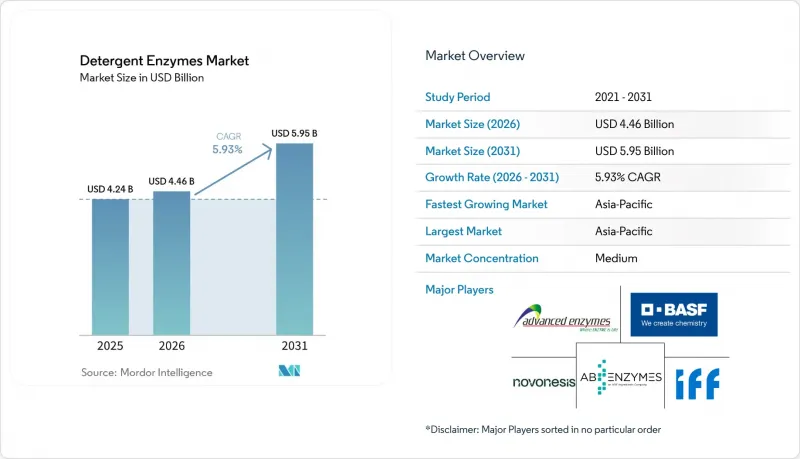
根據 Mordor Intelligence 估計,清潔劑酶市場在 2025 年的價值為 42.4 億美元,預計將從 2026 年的 44.6 億美元成長到 2031 年的 59.5 億美元,在預測期(2026-2031 年)內的複合年成長率為 5.93%。
本報告按酵素類型(例如蛋白酶)、形態(例如液體酵素)、清潔劑類型(例如洗衣精)、應用領域(例如家庭清潔)和地區(亞太地區、北美地區、歐洲地區、南美地區、中東和非洲)進行細分。市場預測以美元計價。
全球清潔劑酵素市場趨勢及洞察
冷水和短時洗滌程序的普及
冷水洗滌是家用洗衣產品的常見使用條件。低溫短時洗滌程序缺乏足夠的時間和熱能,無法讓傳統的化學清潔劑有效去除污垢。 Novonesis 於 2025 年對 12 個市場的 8,537 名受訪者進行的一項消費者調查發現,54% 的受訪者表示,短時洗滌後仍有頑固污漬殘留。這種性能差距促使人們開發即使在低溫短時洗滌程序下也能保持活性的酵素製劑產品。 2025 年 7 月,BASF推出了“Lavergy L Pace”,即使在低至 20 度C的溫度下也能去除油脂污漬。清潔劑酶市場將使那些需要在不讓消費者重新使用高溫長時洗滌程序的情況下恢復清潔性能的品牌受益。
濃縮型和一次性清潔劑
濃縮型和一次性清潔劑雖然減少了每次洗滌的用水量,並減少了包裝材料的使用,但對酵素的穩定性造成了不利影響。高濃度的界面活性劑、鹽和其他成分會導致產品在進入洗滌週期之前就失去活性。奧胡斯大學2025年的研究發現,陰離子界面活性劑對衣物洗滌酶有多種影響,包括促進蛋白酶在儲存過程中發生自裂解。包封技術可以將酵素從配方中分離出來,直到需要啟動時再使用。清潔劑酶市場也正在向穩定的液體混合物轉型,因為這些形式既有利於液體清潔劑的生產,又能減少處理過程中接觸灰塵的機會。
高離子強度液體配方中的酵素惰性
在液體產品中,酵素在儲存過程中會與陰離子活性劑、螯合劑和鹽類接觸。奧胡斯大學2025年的研究發現,與界面活性劑的相互作用會改變酵素的結構,在某些條件下可能導致蛋白酶的自裂解。提高酵素濃度可以改善冷水中的清潔性能,但也會增加儲存過程中性能下降的風險。在氣候溫暖的地區,這項挑戰更為嚴峻,因為儲存條件會對對儲存條件敏感的配方造成額外的負擔。擁有穩定化和包封技術的供應商在清潔劑酶市場,尤其是在液體和一次性產品領域,具有顯著優勢。
細分市場分析
由於蛋白酶能有效去除血漬、汗漬、蛋漬、草漬和奶漬等蛋白質類污漬,預計2025年,蛋白酶將佔清潔劑酶總需求的41.45%。蛋白酶在各種洗滌條件下均表現出良好的通用性,使其成為配方研發人員建構清潔劑系統的實用基礎。澱粉酶有助於去除澱粉污漬,並有助於保持織物亮白。纖維素酶、甘露聚醣酶和果膠酶則具有更專業的織物護理功效,例如保持衣物潔白度和減少起毛球。 2025年發表在《科學報告》(Scientific Reports)上的一項研究發現,來自副粘菌芽孢桿菌(Bacillus paramycoides)的耐熱鹼性蛋白酶在80 度C下保持10分鐘後仍能保持75%的活性,在pH值為12的條件下保持1小時後仍能保持89%的活性。這表明,儘管低溫洗滌在清潔劑酶市場中越來越普遍,但高溫商用仍需要強大的酶促性能。
脂肪酶是成長最快的酵素類,預計2026年至2031年間,該細分市場的清潔劑酶規模將以6.75%的複合年成長率成長。由於界面活性劑的去除能力下降,短時低溫洗滌循環難以去除皮脂、食用油和化妝品殘留。根據AMB Express 2025年的研究,一種源自土曲霉(Aspergillus terreus)的酵素在pH 8和40 度C條件下,其脂肪酶活性為3,867 U/mg,並證實其在相同條件下對玉米油和橄欖油污漬的去除效果也良好。多酶體系透過組合蛋白酶、脂肪酶、澱粉酶、纖維素酶、果膠酶和甘露聚醣酶,減少了添加劑的步驟。 2026年6月,AB Enzymes的多款清潔劑酶產品獲得了ECOCERT認證,反映出市場對永續酵素產品的興趣持續成長。
到2025年,液態酵素將佔清潔劑酶總需求的44.67%。這主要歸功於液態酵素易於添加到液體清潔劑系統中,以及其能夠創造低粉塵生產環境,從而保護工人安全。顆粒狀和粉狀洗滌劑在粉狀清潔劑零售需求強勁的地區,例如南亞和東南亞部分地區、撒哈拉以南非洲以及拉丁美洲,仍將佔據重要地位。洗滌劑形態的選擇取決於清潔劑本身的形態、生產過程、氣候條件以及所需的保存期限。
預計2026年至2031年間,包封酵素的複合年成長率將達6.32%。對於一次性高濃度清潔劑,酵素需要在使用前與配方保持隔離狀態。 2025年9月,IFF宣布其「設計酵素生物材料」平台首次大規模應用於洗衣精配方。該平台以可生物分解的生物基聚合物取代了不可生物分解的聚季銨鹽基成分。美國工業衛生協會(AIHA)指出,包封是減少工業環境中酵素粉塵暴露的有效控制方法。清潔劑酶產業正朝著包封方向發展,這就要求配方開發人員確保酵素的保存期限和暴露控制。
區域分析
亞太地區預計到2025年將佔全球清潔劑酶總需求的37.15%,並預計在2026年至2031年間以6.78%的複合年成長率成長。該地區受益於洗衣機普及率的提高、都市化的加快以及對高性能清潔劑需求的成長。中國仍然是該地區最大的市場,其龐大的家用清潔劑產量為酵素的應用提供了廣泛的基礎。印度透過提高洗衣機普及率和加強磷酸鹽監管措施,為市場做出了貢獻。日本和韓國是重要的高階市場,各大品牌在產品性能和配方技術方面競爭。 2026年3月,花王重新推出了「Attack ZERO」系列,該系列採用生物膜靶向技術,旨在對抗洗衣機滾筒在正常洗滌過程中滋生的細菌。
北美和歐洲在法規、配方研發和高階清潔劑需求方面仍然是重要的市場。洗衣機能源效率標準的提高以及消費者對冷水洗滌程序的日益青睞,正在推動對具有冷活性的酵素系統的需求。歐洲供應商必須依照 REACH 法規 (EC) No 1907/2006 的要求,維護相關文件並進行暴露控制。德國、法國和北歐國家已製定了與冷水洗滌產品標籤和生態標章相關的配方研發條件。國際肥皂、清潔劑和維護產品協會 (AISE) 發布的關於含酵素消費品的指南,為供應商提供了最新的風險評估指南。這些要求可能有利於在清潔劑酶市場中擁有應用專業知識、符合法規要求和穩定供應關係的製造商。
在南美洲、中東和非洲,零售網路發展、在地化生產和機構需求方面存在著獨特的商業機會。巴西和阿根廷是南美洲的主要市場,儘管液體清潔劑的分銷正在擴大,但價格敏感性可能會限制對高酵素含量產品的需求。沙烏地阿拉伯的產業多元化政策可望促進當地清潔劑生產及相關原料的需求。在中東,飯店和醫療保健產業的成長可能會增加對機構洗衣的需求。在南非,酵素的應用尚處於起步階段,主要集中在商業和機構洗衣領域。在全部區域,供應商需要提供符合當地價格預期、氣候條件、水質和清潔劑劑型偏好的產品。
其他好處:
- Excel格式的市場預測(ME)表
- 3個月的分析師支持
目錄
第1章:引言
- 研究假設和市場定義
- 調查範圍
第2章:調查方法
第3章執行摘要
第4章 市場狀況
- 市場概覽
- 市場促進因素
- 冷水洗滌和短時洗滌的普及
- 濃縮型和一次性清潔劑
- 由於有關使用高濃度化學品的清潔系統的規定,需要更換
- 機構和工業洗衣房的永續採購
- 精準發酵和蛋白質工程
- 根據各地區的污染程度和水質情況進行客製化。
- 市場限制因素
- 高離子強度液體配方中的酵素惰性
- 發酵及下游製程的成本波動
- 職業接觸和粉塵控制要求
- 合格鑑定和轉換成本
- 價值鏈分析
- 波特五力分析
第5章 市場規模與成長預測
- 依酶類型
- 蛋白酶
- 澱粉酶
- 脂肪酶
- 其他(纖維素酶、甘露聚醣酶、果膠酶、特殊酵素)
- 按形式
- 液體酵素
- 顆粒酵素
- 粉狀酶
- 酵素的封裝
- 按清潔劑類型
- 洗衣精
- 清潔劑
- 工業和商用清潔劑
- 其他(特殊清潔劑)
- 透過使用
- 家務清潔
- 工業清洗
- 商用清潔
- 其他(紡織加工及其他應用)
- 按地區
- 亞太地區
- 中國
- 印度
- 日本
- 韓國
- 東南亞國協
- 其他亞太國家
- 北美洲
- 美國
- 加拿大
- 墨西哥
- 歐洲
- 德國
- 英國
- 法國
- 義大利
- 北歐國家
- 其他歐洲國家
- 南美洲
- 巴西
- 阿根廷
- 其他南美國家
- 中東和非洲
- 沙烏地阿拉伯
- 南非
- 其他中東和非洲國家
- 亞太地區
第6章 競爭情勢
- 市場集中度
- 策略趨勢
- 市佔率和排名分析
- 公司簡介
- AB Enzymes
- Advanced Enzyme Technologies
- Amano Enzyme Inc.
- Antozyme Biotech
- Aum Enzymes
- Aumgene Biosciences
- BASF
- Bestzyme
- Biocatalysts
- Creative Enzymes
- International Flavors & Fragrances Inc.
- Kao Corporation
- Maps Enzymes Ltd.
- Novozymes A/S
- Sunson Industry Group Co., Ltd
第7章 市場機會與未來展望
According to Mordor Intelligence, the detergent enzymes market size is estimated at USD 4.24 billion in 2025 and is estimated to grow from USD 4.46 billion in 2026 to USD 5.95 billion by 2031, at a CAGR of 5.93% during the forecast period (2026-2031).
This report is Segmented by Enzyme Type (Proteases and More), Form (Liquid Enzymes and More), Detergent Type (Laundry Detergents and More), Application (Household Cleaning and More), and Geography (Asia-Pacific, North America, Europe, South America, and Middle-East and Africa). The Market Forecasts are Provided in Terms of Value (USD).
Global Detergent Enzymes Market Trends and Insights
Cold-Water and Short-Cycle Washing Adoption
Cold-water washing is a common operating condition for household laundry products. Lower temperatures and rapid cycles provide less time and thermal energy for conventional chemical cleaning systems to remove stains. A 2025 Novonesis consumer study covering 12 markets and 8,537 respondents found that 54% reported stubborn stains after rapid washes. This performance gap is directing product development toward enzymes that remain active at lower temperatures and during shorter wash periods. BASF introduced Lavergy L Pace in July 2025 for fat and oil stain removal at temperatures as low as 20°C. The detergent enzymes market benefits when brands need to restore cleaning performance without returning consumers to hotter, longer wash programs.
Concentrated and Unit-Dose Detergent Formats
Concentrated and unit-dose detergents reduce water use per wash and can lower packaging requirements, but they create demanding conditions for enzyme stability. High concentrations of surfactants, salts, and other ingredients can cause activity to be lost before the product reaches the wash. Research published by Aarhus University in 2025 found divergent effects of anionic surfactants on laundry enzymes, including conditions that promote protease self-cleavage during storage. Encapsulation separates the enzyme from the formulation until activation is needed. The detergent enzymes market is also shifting toward stabilized liquid blends, as these formats reduce dust exposure during handling while supporting liquid detergent production.
Enzyme Inactivation in High-Ionic-Strength Liquid Formulations
Liquid products keep enzymes in contact with anionic surfactants, chelating agents, and salts during storage. Research from Aarhus University in 2025 found that surfactant interactions can alter enzyme structure and lead to protease self-cleavage under relevant conditions. Higher enzyme loading can improve cold-water cleaning but also increases the risk of performance loss over shelf life. This challenge becomes more severe in warmer climates, where storage conditions can place added pressure on sensitive formulations. Suppliers with stabilization and encapsulation capabilities are better positioned to serve liquid and unit-dose applications in the detergent enzymes market.
Other drivers and restraints analyzed in the detailed report include:
- Institutional and Industrial Laundry Sustainability Procurement
- Precision Fermentation and Protein Engineering
- Fermentation and Downstream Processing Cost Volatility
For complete list of drivers and restraints, kindly check the Table Of Contents.
Segment Analysis
Proteases accounted for 41.45% of total detergent enzyme demand in 2025, owing to their ability to address protein-based stains such as blood, sweat, egg, grass, and milk. Their broad use across a range of wash conditions provides formulators with a practical foundation for detergent systems. Amylases provide starch-stain removal and help maintain fabric brightness. Cellulases, mannanases, and pectinases support more specialized fabric-care claims, including whiteness retention and pilling reduction. A 2025 Scientific Reports study found that a thermostable alkaline protease from Bacillus paramycoides retained 75% of its activity after 10 minutes at 80°C and 89% after 1 hour at pH 12. This indicates that high-temperature institutional applications require strong enzyme performance, even as lower-temperature laundry becomes more common in the detergent enzymes market.
Lipases represent the fastest-growing enzyme class, with the detergent enzymes market size for this segment projected to grow at a CAGR of 6.75% from 2026 to 2031. Sebum, cooking oil, and cosmetic residues are difficult to remove during short, cold wash cycles when surfactant performance is reduced. A 2025 AMB Express study reported lipase activity of 3,867 U/mg at pH 8 and 40°C for an Aspergillus terreus enzyme evaluated for use in laundry, including performance against corn and olive oil stains under those conditions. Multi-enzyme systems combine protease, lipase, amylase, cellulase, pectinase, and mannanase into fewer dosing steps. AB Enzymes received ECOCERT certification for several detergent enzyme products in June 2026, reflecting continued interest in sustainability-certified enzyme portfolios.
Liquid enzymes accounted for 44.67% of total detergent enzyme demand in 2025, as they are straightforward to incorporate into liquid detergent systems and support low-dust manufacturing environments relevant to worker protection. Granular and powder forms remain important in regions with strong retail demand for powder detergents, including parts of South and Southeast Asia, Sub-Saharan Africa, and Latin America. Form selection depends on the detergent format, manufacturing process, climate exposure, and required shelf life.
Encapsulated enzymes are forecast to grow at a CAGR of 6.32% from 2026 to 2031. Unit-dose and highly concentrated detergents require enzymes to remain isolated from the formulation until use. IFF announced the first large-scale deployment of its Designed Enzymatic Biomaterials platform in a laundry detergent formulation in September 2025, replacing non-biodegradable polyquaternium ingredients with a biodegradable, bio-based polymer alternative. The American Industrial Hygiene Association (AIHA) identifies encapsulation as a relevant control method for reducing exposure to enzyme dust in industrial settings. The detergent enzymes industry is moving toward encapsulated formats, in which formulators require both shelf-life protection and exposure control.
Complete Report Scope:
- By Enzyme Type
- Proteases
- Amylases
- Lipases
- Others (Cellulases, Mannanases, Pectinases, Specialty Enzymes)
- By Form
- Liquid Enzymes
- Granular Enzymes
- Powder Enzymes
- Encapsulated Enzymes
- By Detergent Type
- Laundry Detergents
- Dishwashing Detergents
- Industrial and Institutional Detergents
- Others (Specialty Cleaning Products)
- By Application
- Household Cleaning
- Industrial Cleaning
- Institutional Cleaning
- Others (Textile Processing and Other Applications)
- By Geography
- Asia-Pacific
- China
- India
- Japan
- South Korea
- ASEAN Countries
- Rest of Asia-Pacific
- North America
- United States
- Canada
- Mexico
- Europe
- Germany
- United Kingdom
- France
- Italy
- NORDIC Countries
- Rest of Europe
- South America
- Brazil
- Argentina
- Rest of South America
- Middle-East and Africa
- Saudi Arabia
- South Africa
- Rest of Middle-East and Africa
- Asia-Pacific
Geography Analysis
Asia-Pacific accounted for 37.15% of total detergent enzyme demand in 2025 and is forecast to grow at a CAGR of 6.78% from 2026 to 2031. The region benefits from rising washing machine ownership, urban growth, and increasing demand for higher-performing detergent formats. China remains the largest regional market, with high household detergent output providing a broad base for enzyme use. India is contributing by expanding washing machine adoption and regulatory action on phosphates. Japan and South Korea are important premium markets where brands compete on product performance and formulation technology. Kao relaunched its Attack ZERO series in March 2026 with biofilm-targeting technology designed to address bacteria in washing machine drums during regular cycles.
North America and Europe remain important markets for regulation, formulation research, and premium detergent demand. Washing machine efficiency standards and consumer use of colder wash cycles support demand for enzyme systems with low-temperature activity. European suppliers must maintain documentation and exposure controls under the REACH Regulation (EC) No 1907/2006. Germany, France, and Nordic countries present conditions for low-temperature product claims and Ecolabel-related formulation work. The International Association for Soaps, Detergents and Maintenance Products (A.I.S.E.) guidance on enzyme-containing consumer products provides suppliers with a current reference for risk assessment. These requirements can favor producers with expertise in applications, regulatory compliance, and stable supply relationships in the detergent enzymes market.
South America, the Middle-East, and Africa present distinct opportunities in retail development, local manufacturing, and institutional demand. Brazil and Argentina are the primary South American markets where liquid detergent distribution is expanding, although price sensitivity can limit premium enzyme loading. Saudi Arabia's industrial diversification agenda may support local detergent manufacturing and related demand for ingredients. Growth in hospitality and healthcare sectors may also increase institutional laundry demand in the Middle-East. South Africa represents an earlier stage of enzyme adoption, concentrated in commercial and institutional laundry settings. Across these regions, suppliers need products that meet local price expectations, climate conditions, water quality, and detergent format preferences.
- AB Enzymes
- Advanced Enzyme Technologies
- Amano Enzyme Inc.
- Antozyme Biotech
- Aum Enzymes
- Aumgene Biosciences
- BASF
- Bestzyme
- Biocatalysts
- Creative Enzymes
- International Flavors & Fragrances Inc.
- Kao Corporation
- Maps Enzymes Ltd.
- Novozymes A/S
- Sunson Industry Group Co., Ltd
Additional Benefits:
- The market estimate (ME) sheet in Excel format
- 3 months of analyst support
TABLE OF CONTENTS
1 Introduction
- 1.1 Study Assumptions and Market Definition
- 1.2 Scope of the Study
2 Research Methodology
3 Executive Summary
4 Market Landscape
- 4.1 Market Overview
- 4.2 Market Drivers
- 4.2.1 Cold-Water and Short-Cycle Washing Adoption
- 4.2.2 Concentrated and Unit-Dose Detergent Formats
- 4.2.3 Regulatory Substitution of High-Chemical Cleaning Systems
- 4.2.4 Institutional and Industrial Laundry Sustainability Procurement
- 4.2.5 Precision Fermentation and Protein Engineering
- 4.2.6 Regional Stain and Water-Condition Customization
- 4.3 Market Restraints
- 4.3.1 Enzyme Inactivation in High-Ionic-Strength Liquid Formulations
- 4.3.2 Fermentation and Downstream Processing Cost Volatility
- 4.3.3 Occupational Exposure and Dust-Control Requirements
- 4.3.4 Formulation Qualification and Switching Costs
- 4.4 Value Chain Analysis
- 4.5 Porter's Five Forces Analysis
- 4.5.1 Threat of New Entrants
- 4.5.2 Bargaining Power of Suppliers
- 4.5.3 Bargaining Power of Buyers
- 4.5.4 Threat of Substitutes
- 4.5.5 Competitive Rivalry
5 Market Size and Growth Forecasts (Value)
- 5.1 By Enzyme Type
- 5.1.1 Proteases
- 5.1.2 Amylases
- 5.1.3 Lipases
- 5.1.4 Others (Cellulases, Mannanases, Pectinases, Specialty Enzymes)
- 5.2 By Form
- 5.2.1 Liquid Enzymes
- 5.2.2 Granular Enzymes
- 5.2.3 Powder Enzymes
- 5.2.4 Encapsulated Enzymes
- 5.3 By Detergent Type
- 5.3.1 Laundry Detergents
- 5.3.2 Dishwashing Detergents
- 5.3.3 Industrial and Institutional Detergents
- 5.3.4 Others (Specialty Cleaning Products)
- 5.4 By Application
- 5.4.1 Household Cleaning
- 5.4.2 Industrial Cleaning
- 5.4.3 Institutional Cleaning
- 5.4.4 Others (Textile Processing and Other Applications)
- 5.5 By Geography
- 5.5.1 Asia-Pacific
- 5.5.1.1 China
- 5.5.1.2 India
- 5.5.1.3 Japan
- 5.5.1.4 South Korea
- 5.5.1.5 ASEAN Countries
- 5.5.1.6 Rest of Asia-Pacific
- 5.5.2 North America
- 5.5.2.1 United States
- 5.5.2.2 Canada
- 5.5.2.3 Mexico
- 5.5.3 Europe
- 5.5.3.1 Germany
- 5.5.3.2 United Kingdom
- 5.5.3.3 France
- 5.5.3.4 Italy
- 5.5.3.5 NORDIC Countries
- 5.5.3.6 Rest of Europe
- 5.5.4 South America
- 5.5.4.1 Brazil
- 5.5.4.2 Argentina
- 5.5.4.3 Rest of South America
- 5.5.5 Middle-East and Africa
- 5.5.5.1 Saudi Arabia
- 5.5.5.2 South Africa
- 5.5.5.3 Rest of Middle-East and Africa
- 5.5.1 Asia-Pacific
6 Competitive Landscape
- 6.1 Market Concentration
- 6.2 Strategic Moves
- 6.3 Market Share (%)/Ranking Analysis
- 6.4 Company Profiles (includes Global Overview, Market Overview, Core Segments, Financials as available, Strategic Information, Products and Services, and Recent Developments)
- 6.4.1 AB Enzymes
- 6.4.2 Advanced Enzyme Technologies
- 6.4.3 Amano Enzyme Inc.
- 6.4.4 Antozyme Biotech
- 6.4.5 Aum Enzymes
- 6.4.6 Aumgene Biosciences
- 6.4.7 BASF
- 6.4.8 Bestzyme
- 6.4.9 Biocatalysts
- 6.4.10 Creative Enzymes
- 6.4.11 International Flavors & Fragrances Inc.
- 6.4.12 Kao Corporation
- 6.4.13 Maps Enzymes Ltd.
- 6.4.14 Novozymes A/S
- 6.4.15 Sunson Industry Group Co., Ltd
7 Market Opportunities and Future Outlook
- 7.1 White-Space and Unmet-Need Assessment

 酵素市場報告:趨勢、預測和競爭分析(至2035年)
 多酶混合物市場規模、佔有率和成長分析:按酶類型、成分、應用、劑型、最終用戶和地區分類——2026年至2033年行業預測
 木瓜蛋白酶市場:2026-2032年全球市場預測(依產品等級、形態、性質、供應技術、包裝形式、最終用途產業、應用及分銷管道分類)
 海洋酵素市場規模、佔有率和成長分析:按原料、類型、應用、形態、最終用戶和地區分類-2026-2033年產業預測
 酵素:市場佔有率分析、產業趨勢和統計數據、成長預測(2026-2031)
 2026年全球即時檢測酵素穩定劑市場報告
 紡織酶市場機會、成長要素、產業趨勢分析及2026-2035年預測
 酵素工程市場:依產品類型、工程方法、原料、改質類型、最終用戶和地區分類紡織酶市場:按原料、類型、應用和地區分類酵素清潔劑市場:依配方、酵素的種類、酵素的原料、最終使用者、銷售管道和地區分類。