


 |
市場調查報告書
商品編碼
2072846
動物消化:市場佔有率分析、產業趨勢與統計、成長預測(2026-2031)Animal Digest - Market Share Analysis, Industry Trends & Statistics, Growth Forecasts (2026 - 2031) |
||||||

※ 本網頁內容可能與最新版本有所差異。詳細情況請與我們聯繫。
根據 Mordor Intelligence 預測,動物消化肉市場規模將從 2025 年的 26.5 億美元和 2026 年的 28.5 億美元成長到 2031 年的 39 億美元,2026 年至 2031 年的複合年成長率為 6.47%。
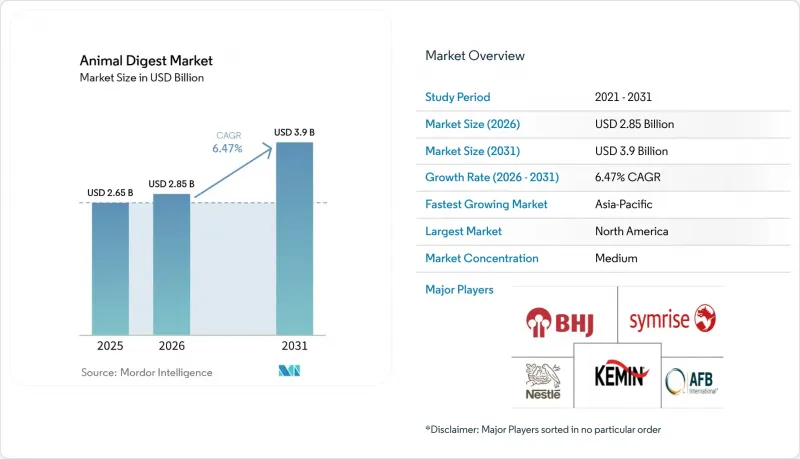
本報告按原料(禽肉、豬肉、牛、魚類及其他)、形態(粉末、液體、糊狀/漿狀)、應用(寵物食品、水產養殖飼料、牲畜飼料及其他)和地區(北美、南美、歐洲、亞太、中東和非洲)進行細分。市場預測以美元計價。
全球動物消化產品市場趨勢及洞察
隨著高階寵物食品的成長,動物消化物被定位為偏好增強劑。
隨著消費者在2025年後越來越願意為口味買單,寵物食品製造商正在重新思考配方,將動物消化物定位為功能性增味劑,而不僅僅是填充材。雀巢普瑞納寵物食品公司(雀巢公司)已投資超過1.5億歐元(約2億美元)對其位於英國威斯貝克的工廠進行現代化改造。該專案計劃於2025年初完成,旨在實現生產線現代化、提高自動化水準、提升能源效率並減少碳排放。 AFB國際公司(恩賽-比克福德工業公司)於2024年在喬治亞哥倫布市投資7,900萬美元,並於同年在泰國開設了一個中心,以服務亞太地區的高階市場。配方數據顯示,目前高階乾狗糧中動物消化物的含量為2%至4%,而經濟型狗糧中僅為0.5%至1.5%。這使得每公斤原料成本增加了 0.15 至 0.30 美元,但製造商已經證明,如果偏好的偏好能夠提升品牌忠誠度,他們就能承受更高的投入成本。
它在水產飼料中的應用正在迅速擴大。
蝦類和魚類養殖戶正在飼料中添加動物消化物,以消除因大豆和昆蟲粉含量增加而產生的異味。 Symrise AG公司銷售魚類和甲殼類動物水解物,例如“Actipal”,以提高密集水產養殖池的餵食率。美國穀物和生物製品委員會2026年檢驗太平洋白蝦進行的一項研究表明,與對照飼料相比,添加2%魚蛋白消化物的飼料可使採食量增加8%,增重增加5%。越南的VNF公司和法國的安迪蘇公司也供應蝦源胜肽,以達到類似的效果。凱敏公司於2025年在義大利設立總部,以加強其在水產養殖飼料的研發。亞太地區目前佔全球水產養殖產量的85%以上,預計對消化物的需求將持續強勁。
歐洲和北美對渲染產品有嚴格的特定規定
歐盟第1069/2009號法規強制要求實施第三類控制措施,以加強可追溯性、熱處理和檢驗,這將使合規成本每公斤增加0.05至0.12美元。歐洲食品安全局(EFSA)在2024年至2025年間發布的幾份意見中呼籲制定更嚴格的微生物標準並增加審核頻率。 2024年7月,加拿大食品檢驗局發布了更新的RG-4指南,加強了文件要求,這給小規模副產品加工企業帶來了沉重的攤銷負擔。 2025年1月,美國食品藥物管理局(FDA)發布了《動物食品配料條例》,擴大了對生產流程的審查範圍,並增加了對品管系統的資本投入。這些相互重疊的法規賦予了大型企業更大的權力,使它們能夠將固定的合規投資分攤到更大的產量上。
細分市場分析
預計到2025年,家禽消化物將佔動物消化物市場的46.0%,而全球肉雞產量預計將達到471億磅(2,355萬噸)。根據美國農業部經濟研究局(ERS)預測,這將確保每種產品的穩定供應。豬肉消化物因其氨基酸組成和犬類的高適口性而位居第二,但由於非洲豬瘟的影響,豬肉消化物會週期性出現供不應求。牛消化物用於強調特定胜肽範圍的小眾低敏飼料和某些水產養殖飼料。魚消化物是海水貓糧和高性能蝦飼料的必需成分,其富含的omega-3脂肪酸和鮮味可增強偏好。目前規模較小的昆蟲衍生消化物預計將成為成長最快的細分市場,年複合成長率達 10.9%,因為歐洲和亞洲的監管機構批准了果蠅和穀蟲的水解物,並且對新工廠的資本流入也恢復了。
家禽在動物消化物市場佔據主導地位,這得益於完善的加工網路,這些網路可以將內臟和淘汰母雞轉化為具有成本競爭力的水解物。美國加工企業採用自動化的溫度和時間控制系統,符合國內和出口的微生物標準,確保產品品質穩定。相較之下,昆蟲生產商需要建造專用水解生產線並投資下游噴霧乾燥設備,這阻礙了它們在成本上超越傳統原料。 2025年6月提交的一項昆蟲蛋白水解物專利申請表明該技術取得了進展,但商業化仍需提高產量和獲得穩定的資金籌措。一些標榜「潔淨標示」和「新型蛋白」的品牌已經開始在其產品中添加濃度為0.5%至1%的昆蟲蛋白水解物,隨著產能的擴大,預計這一領域將迎來爆發式成長。
區域分析
預計到2025年,北美將佔據動物消化物市場38.0%的佔有率,這主要得益於跨國寵物食品公司的總部所在地、先進的動物副產品加工設施以及較高的寵物擁有率。根據美國農業部估計,2024年牛、牛和豬的產量將達到3,922萬噸,為動物消化物提供了穩定的來源。雀巢普瑞納寵物食品公司(雀巢公司)、瑪氏寵物食品公司和JM Smucker公司都經營多家工廠,並配備了現場偏好增強噴灑生產線,從而推動了區域需求。疾病爆發仍然是一個風險因素,包括禽流感導致的家禽大規模撲殺以及來自加勒比地區的非洲豬瘟威脅。關於後者,聯邦政府於 2026 年頒布了一項限制生豬流動的命令。在北美,優質化的興起、對治療性食品需求的增加以及單一蛋白質來源產品的普及預計將推動成長,抵消市場成熟的影響。
預計亞太地區將成為2026年至2031年間成長最快的地區,複合年成長率(CAGR)達7.8%,主要驅動力來自中國和印度寵物飼養量的成長以及東南亞水產養殖業的蓬勃發展。預計到2026年,中國雞肉產量將達到1,730萬噸,出口量預計將達到140萬噸,這將擴大動物副產品原料的供應。 AFB International(Ensign-Bickford Industries, Inc.)於2024年在泰國設立總部,並開始在當地生產增偏好劑。同時,Symrise AG向該地區的蝦農銷售「ActITuna Oil」和「Actipal」產品。儘管印度市場規模較小,但都市區消費者正逐漸從食用剩飯剩菜轉向購買市售寵物食品,增加了對動物副產品的需求。在韓國和泰國,有關昆蟲蛋白質的法規正在逐步完善,為未來從黑水虻幼蟲加工商處獲取動物副產品原料鋪平了道路。
歐洲仍是主要的消費市場,這主要得益於德國、法國和英國大規模的寵物食品產業叢集。然而,1069/2009號法規帶來的額外成本限制了市場成長,也阻礙了小規模的市場進入者。凱利集團2024年的銷售額反映了其「口味與營養」部門的持續成長,該部門主要供應偏好增強劑。 2024年至2025年間,歐洲食品安全局(EFSA)發布了多項意見,確認水解鍬甲和穀蟲的安全性,從而促進了昆蟲消化物進入市場。儘管如此,東歐豬肉市場的波動以及第三類產品更嚴格的文件要求可能會影響短期供應的柔軟性。
其他好處:
- Excel格式的市場預測(ME)表
- 3個月的分析師支持
目錄
第1章:引言
- 研究假設和市場定義
- 調查範圍
第2章:調查方法
第3章執行摘要
第4章 市場狀況
- 市場概覽
- 市場促進因素
- 高階寵物食品市場的成長,以及動物消化物作為偏好增強劑的定位。
- 水產飼料應用領域的快速擴展
- 與合成香料替代品相比,具有成本優勢
- 伴侶動物單一蛋白質食品的需求激增
- 昆蟲源動物消化物生產的新興技術
- 培養肉生產過程中產生的廢棄物增值回收
- 市場限制因素
- 歐洲和北美對渲染產品有嚴格的規定
- 家禽和豬肉產品供應的波動性。
- 消費者對「文摘」標籤的負面看法。
- 來自潔淨標示植物水解物的競爭
- 監理情勢
- 技術展望
- 波特五力分析
第5章 市場規模與成長預測
- 按原料
- 家禽
- 豬
- 牛
- 魚
- 其他
- 按形式
- 粉末
- 液體
- 糊狀物/漿狀物
- 透過使用
- 寵物食品
- 水產飼料
- 牲畜飼料
- 其他
- 按地區
- 北美洲
- 美國
- 加拿大
- 墨西哥
- 其他北美國家
- 南美洲
- 巴西
- 阿根廷
- 其他南美國家
- 歐洲
- 德國
- 法國
- 英國
- 義大利
- 西班牙
- 其他歐洲國家
- 亞太地區
- 中國
- 印度
- 日本
- 澳洲
- 其他亞太國家
- 中東
- 沙烏地阿拉伯
- 阿拉伯聯合大公國
- 其他中東國家
- 非洲
- 南非
- 肯亞
- 其他非洲國家
- 北美洲
第6章 競爭情勢
- 市場集中度
- 策略趨勢
- 市佔率分析
- 公司簡介
- Kemin Industries, Inc.
- AFB International
- Symrise AG
- Nestle Purina PetCare Company
- BHJ A/S
- Darling Ingredients Inc.
- Nutriad International NV
- Alltech, Inc.
- Kerry Group plc
- Charoen Pokphand Foods Public Company Limited
- Olam Food Ingredients Holdings Pte. Ltd.
- Biorigin Solucoes em Ingredientes Naturais Ltda.
- Bioiberica SAU
- Wilbur-Ellis Nutrition, LLC
- Protix BV
第7章 市場機會與未來展望
According to Mordor Intelligence, the animal digest market size is projected to expand from USD 2.65 billion in 2025 and USD 2.85 billion in 2026 to USD 3.90 billion by 2031, registering a 6.47% CAGR over 2026-2031.
This report is Segmented by Source (Poultry, Porcine, Bovine, Fish, and Others), by Form (Powder, Liquid, and Paste/Slurry), by Application (Pet Food, Aquaculture Feed, Livestock Feed, and Others), and by Geography (North America, South America, Europe, Asia-Pacific, Middle East, and Africa). The Market Forecasts are Provided in Terms of Value (USD).
Global Animal Digest Market Trends and Insights
Growth in Premium Pet Food, Positioning Animal Digest as a Palatability Enhancer
Pet food manufacturers are redesigning recipes to elevate animal digest from a filler to a functional flavor driver, because consumer willingness to pay for taste has intensified since 2025. Nestle Purina PetCare Company (Nestle S.A.) is investing over EURO 150 million (approximately USD 200 million) to upgrade its Wisbech, United Kingdom, plant. Scheduled for completion by early 2025, the project aims to modernize production lines, enhance automation, improve energy efficiency, and reduce carbon emissions. AFB International (The Ensign-Bickford Industries, Inc.) deployed USD 79 million in Columbus, Georgia, in 2024 and opened a Thailand hub in 2024 to serve Asia-Pacific premium tiers. Formulation data show premium dry dog food now contains 2% - 4% digest, versus 0.5% - 1.5% in economy kibble, lifting raw-material costs per kilogram by USD 0.15-0.30 and proving manufacturers can absorb higher input costs when palatability drives brand loyalty.
Rapid Expansion of Aquaculture Feed Applications
Shrimp and finfish farmers are blending animal digest to overcome off-flavors associated with higher soy or insect meal inclusion rates. Symrise AG markets fish and crustacean hydrolysates such as Actipal that improve acceptance rates in intensive ponds. A 2026 US Grains and Bioproducts Council-reviewed trial on Pacific white shrimp showed 2% fish protein digest raised feed intake 8% and weight gain 5% versus a control diet. Vietnam's VNF and France's Adisseo supply shrimp-derived peptides that target the same outcome, while Kemin opened an Italy headquarters in 2025 to deepen aquafeed research and development. Asia-Pacific now delivers more than 85% of global aquaculture output, guaranteeing persistent demand tailwinds for digest inclusion.
Stringent Rendering By-product Regulations in Europe and North America
European Union Regulation 1069/2009 mandates Category 3 controls that heighten traceability, heat treatment, and testing, thereby lifting compliance costs by USD 0.05-0.12 per kilogram. The European Food Safety Authority tightened microbiological criteria in several 2024-2025 opinions, compelling more frequent audits. Canada's Food Inspection Agency introduced updated RG-4 guidance in July 2024 that intensified documentation requirements, a burden that smaller renderers find difficult to amortize. In January 2025 the United States Food and Drug Administration issued its Animal Food Ingredient Compendium, expanding process scrutiny and increasing capital outlays for quality systems. These overlapping rules consolidate power among scale operators, enabling them to spread fixed compliance investments across larger volumes.
Other drivers and restraints analyzed in the detailed report include:
- Cost Advantage Over Synthetic Flavor Alternatives
- Surge in Single-Protein Diets for Companion Animals
- Volatility in Poultry and Porcine By-product Supply
For complete list of drivers and restraints, kindly check the Table Of Contents.
Segment Analysis
Poultry digest is projected to account for 46.0% of the animal digest market in 2025, driven by global broiler production reaching 47.1 billion pounds (23.55 million metric tons) that year. This ensures a stable supply of by-products, according to the United States Department of Agriculture (USDA) Economic Research Service (ERS). Porcine digest ranks second because of its amino-acid profile and high canine acceptance, although African swine fever causes periodic shortages. Bovine digest serves niche hypoallergenic diets and certain aquaculture formulations that value specific peptide ranges. Fish digest is essential in marine cat food and high-performance shrimp feed, where omega-3 content and umami flavor boost palatability. Insect digest, while small today, is forecast to be the fastest-growing segment, with a 10.9% CAGR, as European and Asian regulators approve black soldier fly and mealworm hydrolysates and capital flows resume into new plants.
Poultry's dominance within the animal digest market size reflects integrated rendering networks that convert offal and spent hens into cost-competitive hydrolysates. United States renderers rely on automated temperature-time systems that meet both domestic and export microbiological standards, which supports consistent quality. In contrast, insect producers must build specialized hydrolysis lines and invest in downstream spray dryers, delaying cost parity with traditional sources. Patent activity filed in June 2025 for an insect protein hydrolysate demonstrates technical advances, yet commercialization awaits higher production volumes and stable financing. Brands focused on clean-label or novel-protein claims already formulate with insect digest at inclusion levels of 0.5% to 1%, positioning the segment for outsized growth once capacity expands.
Complete Report Scope:
- By Source
- Poultry
- Porcine
- Bovine
- Fish
- Others
- By Form
- Powder
- Liquid
- Paste/Slurry
- By Application
- Pet Food
- Aquaculture Feed
- Livestock Feed
- Others
- By Geography
- North America
- United States
- Canada
- Mexico
- Rest of North America
- South America
- Brazil
- Argentina
- Rest of South America
- Europe
- Germany
- France
- United Kingdom
- Italy
- Spain
- Rest of Europe
- Asia-Pacific
- China
- India
- Japan
- Australia
- Rest of Asia-Pacific
- Middle East
- Saudi Arabia
- United Arab Emirates
- Rest of Middle East
- Africa
- South Africa
- Kenya
- Rest of Africa
- North America
Geography Analysis
North America captured 38.0% of the animal digest market in 2025, driven by multinational pet food headquarters, sophisticated rendering operations, and high pet ownership rates. The United States Department of Agriculture measured cattle and calf plus hog and pig output at 39.22 million metric tons in 2024, a stable feedstock base for digests. Nestle Purina PetCare Company (Nestle S.A.), Mars Petcare, and The J.M. Smucker Company each operate multiple plants with on-site palatant spray lines, reinforcing regional demand. Disease outbreaks continue to pose risks, such as avian influenza leading to poultry depopulations and African swine fever threats from the Caribbean, which resulted in a 2026 Federal Order restricting hog movement. Growth in North America is expected, driven by increasing premiumization, therapeutic diets, and single-protein claims, which help counterbalance market maturity.
Asia-Pacific is projected to be the fastest-growing region at a 7.8% CAGR during 2026-2031, driven by rising pet adoption in China and India, and by converging aquaculture growth in Southeast Asia. China's chicken production is set to hit 17,300 thousand metric tons in 2026, with exports at 1,400 thousand metric tons, expanding rendering inputs. AFB International (The Ensign-Bickford Industries, Inc.) opened a Thailand headquarters in 2024 for local palatant production, while Symrise AG markets ActITuna Oil and Actipal to shrimp growers across the region. India, though smaller, is seeing urban consumers migrate from table scraps to commercial kibble, lifting digest demand. Regulatory clarity on insect proteins is advancing in South Korea and Thailand, opening the way for future digest supply from black soldier fly processors.
Europe remains a key consumer market, driven by large pet food clusters in Germany, France, and the United Kingdom. However, growth is constrained by Regulation 1069/2009, which imposes additional costs and discourages smaller market entrants. Kerry Group's 2024 revenue reflected continued growth in its Taste and Nutrition unit, which supplies palatants. In 2024-2025, the European Food Safety Authority issued several opinions confirming the safety of black soldier fly and mealworm hydrolysates, facilitating the introduction of insect digest products. Despite this, short-term supply flexibility may be affected by volatility in the pork market in Eastern Europe and by stricter Category 3 documentation requirements.
- Kemin Industries, Inc.
- AFB International
- Symrise AG
- Nestle Purina PetCare Company
- BHJ A/S
- Darling Ingredients Inc.
- Nutriad International NV
- Alltech, Inc.
- Kerry Group plc
- Charoen Pokphand Foods Public Company Limited
- Olam Food Ingredients Holdings Pte. Ltd.
- Biorigin Solucoes em Ingredientes Naturais Ltda.
- Bioiberica S.A.U.
- Wilbur-Ellis Nutrition, LLC
- Protix B.V.
Additional Benefits:
- The market estimate (ME) sheet in Excel format
- 3 months of analyst support
TABLE OF CONTENTS
1 Introduction
- 1.1 Study Assumptions and Market Definition
- 1.2 Scope of the Study
2 Research Methodology
3 Executive Summary
4 Market Landscape
- 4.1 Market Overview
- 4.2 Market Drivers
- 4.2.1 Growth in premium pet food, positioning animal digest as a palatability enhancer
- 4.2.2 Rapid expansion of aquaculture feed applications
- 4.2.3 Cost advantage over synthetic flavor alternatives
- 4.2.4 Surge in single-protein diets for companion animals
- 4.2.5 Emerging insect-based animal digest production technologies
- 4.2.6 Upcycling waste streams from cultured-meat production
- 4.3 Market Restraints
- 4.3.1 Stringent rendering by-product regulations in Europe and North America
- 4.3.2 Volatility in poultry and porcine by-product supply
- 4.3.3 Negative consumer perception of "digest" labeling
- 4.3.4 Competition from clean-label plant hydrolysates
- 4.4 Regulatory Landscape
- 4.5 Technological Outlook
- 4.6 Porter's Five Forces Analysis
- 4.6.1 Threat of New Entrants
- 4.6.2 Bargaining Power of Suppliers
- 4.6.3 Bargaining Power of Buyers
- 4.6.4 Threat of Substitutes
- 4.6.5 Intensity of Competitive Rivalry
5 Market Size and Growth Forecasts (Value)
- 5.1 By Source
- 5.1.1 Poultry
- 5.1.2 Porcine
- 5.1.3 Bovine
- 5.1.4 Fish
- 5.1.5 Others
- 5.2 By Form
- 5.2.1 Powder
- 5.2.2 Liquid
- 5.2.3 Paste/Slurry
- 5.3 By Application
- 5.3.1 Pet Food
- 5.3.2 Aquaculture Feed
- 5.3.3 Livestock Feed
- 5.3.4 Others
- 5.4 By Geography
- 5.4.1 North America
- 5.4.1.1 United States
- 5.4.1.2 Canada
- 5.4.1.3 Mexico
- 5.4.1.4 Rest of North America
- 5.4.2 South America
- 5.4.2.1 Brazil
- 5.4.2.2 Argentina
- 5.4.2.3 Rest of South America
- 5.4.3 Europe
- 5.4.3.1 Germany
- 5.4.3.2 France
- 5.4.3.3 United Kingdom
- 5.4.3.4 Italy
- 5.4.3.5 Spain
- 5.4.3.6 Rest of Europe
- 5.4.4 Asia-Pacific
- 5.4.4.1 China
- 5.4.4.2 India
- 5.4.4.3 Japan
- 5.4.4.4 Australia
- 5.4.4.5 Rest of Asia-Pacific
- 5.4.5 Middle East
- 5.4.5.1 Saudi Arabia
- 5.4.5.2 United Arab Emirates
- 5.4.5.3 Rest of Middle East
- 5.4.6 Africa
- 5.4.6.1 South Africa
- 5.4.6.2 Kenya
- 5.4.6.3 Rest of Africa
- 5.4.1 North America
6 Competitive Landscape
- 6.1 Market Concentration
- 6.2 Strategic Moves
- 6.3 Market Share Analysis
- 6.4 Company Profiles (Includes Global Level Overview, Market Level Overview, Core Segments, Financials as Available, Strategic Information, Market Rank/Share for Key Companies, Products and Services, and Recent Developments)
- 6.4.1 Kemin Industries, Inc.
- 6.4.2 AFB International
- 6.4.3 Symrise AG
- 6.4.4 Nestle Purina PetCare Company
- 6.4.5 BHJ A/S
- 6.4.6 Darling Ingredients Inc.
- 6.4.7 Nutriad International NV
- 6.4.8 Alltech, Inc.
- 6.4.9 Kerry Group plc
- 6.4.10 Charoen Pokphand Foods Public Company Limited
- 6.4.11 Olam Food Ingredients Holdings Pte. Ltd.
- 6.4.12 Biorigin Solucoes em Ingredientes Naturais Ltda.
- 6.4.13 Bioiberica S.A.U.
- 6.4.14 Wilbur-Ellis Nutrition, LLC
- 6.4.15 Protix B.V.
7 Market Opportunities and Future Outlook

 2026-2030年全球動物飼料添加劑市場
 合成飼料添加劑市場報告:趨勢、預測和競爭分析(至2035年)
 二丙酸鈣市場規模、佔有率和成長分析:按等級、形態、應用、最終用戶、分銷管道和地區分類-2026-2033年產業預測
 茶皂素市場規模、佔有率和成長分析:按產品類型、應用、純度、最終用戶、分銷管道和地區分類-2026-2033年產業預測
 動物消化物市場規模、佔有率和成長分析:按原料、形態、應用、最終用戶、分銷管道和地區分類-2026-2033年產業預測
 尼卡巴嗪市場規模、佔有率和成長分析:按產品類型、應用、劑型、最終用戶、分銷管道、用途和地區分類 - 產業預測,2026-2033年
 動物飼料防腐劑:市場佔有率分析、行業趨勢和統計數據、成長預測(2026-2031)
 合成飼料添加劑市場規模、佔有率和成長分析:依產品類型、牲畜種類、劑型、通路和地區分類-2026-2033年產業預測
 飼料添加劑市場:依產品類型、牲畜類型和地區分類
 藥用飼料市場規模、佔有率和成長分析:按產品類型、動物種類、配方、通路和地區分類-2026-2033年產業預測