


 |
市場調查報告書
商品編碼
2072806
動物飼料防腐劑:市場佔有率分析、行業趨勢和統計數據、成長預測(2026-2031)Animal Feed Preservatives - Market Share Analysis, Industry Trends & Statistics, Growth Forecasts (2026 - 2031) |
||||||

※ 本網頁內容可能與最新版本有所差異。詳細情況請與我們聯繫。
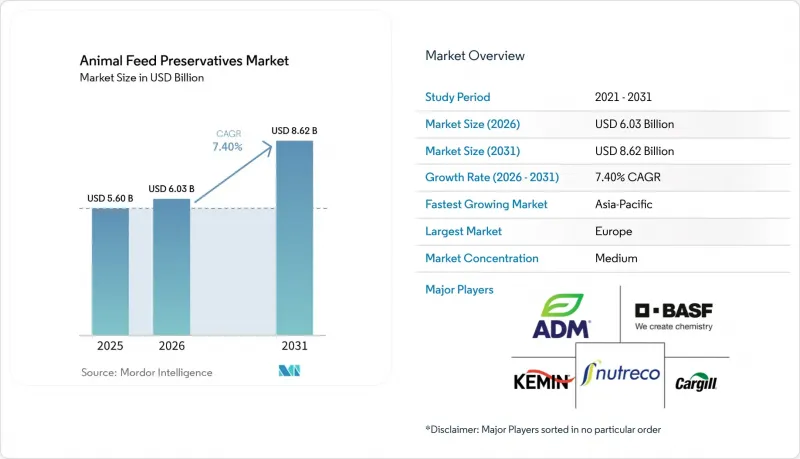
根據 Mordor Intelligence 預測,動物飼料防腐劑市場將從 2025 年的 56 億美元成長到 2026 年的 60.3 億美元,到 2031 年達到 86.2 億美元,2026 年至 2031 年的複合年成長率為 7.40%。
本報告按產品類型(酸化劑、殺菌劑、抗氧化劑、粘合劑及其他)、畜牧業(家禽、豬、反芻動物、水產養殖和伴侶動物)、劑型(乾粉和液體)以及地區(北美、南美、歐洲、亞太地區以及中東和非洲)進行細分。市場預測以美元計價。
全球動物飼料防腐劑市場趨勢及洞察
集約化畜牧業對複合飼料的需求增加
為了支持集約化畜牧養殖系統,集中式飼料廠正在生產更大批量的複合飼料,這使得長期儲存過程中有效保鮮的需求日益成長。根據Alltech發表的《2025年農業食品展望》,2024年全球飼料產量將成長1.2%,達到13.96億噸。如此大規模的工業化飼料生產增加了飼料在儲存和運輸過程中發生腐敗、黴菌滋生和黴菌毒素污染的風險。因此,飼料生產商擴大使用酸化劑和殺菌劑等防腐劑來維持飼料質量,並減少整個大規模供應鏈中的損失。
歐洲和北美對黴菌毒素和黴菌控制有嚴格的規定
為確保食品安全和保護動物健康,更嚴格的法規結構進一步提高了動物飼料中污染物的允許限值。例如,根據2024年飼料法規,加拿大食品檢驗局規定所有牲畜飼料中黃麴毒素的允許限值為20ppb(十億分之二十)。這反映了北美地區日益嚴格的黴菌毒素控制標準。這些監管要求迫使飼料生產商採取預防措施來控制儲存過程中的污染,例如使用有機酸和黴菌抑制劑等防腐劑,而不是依賴昂貴的污染後處理。
發酵原料衍生的有機酸價格波動
源自發酵原料的有機酸價格波動仍是動物飼料防腐劑市場的重大挑戰。 2025年,歐洲飼料製造商協會(FEFAC)報告稱,能源和原料價格的波動,尤其是有機酸和飼料添加劑價格的波動,加劇了成本的不穩定性,持續給歐洲各地的飼料配製商帶來壓力。由於丙酸和甲酸被廣泛用作飼料防腐劑,以抑制微生物生長並延長飼料的保存期限,因此這些物質的價格波動直接影響飼料製造商的配製成本和籌資策略。這種持續的成本波動繼續限制動物飼料防腐劑市場的利潤率和價格穩定性。
細分市場分析
至2025年,酸化劑將在動物飼料防腐劑市場佔據41%的最大市場。其主導地位源自於酸化劑廣泛的抗菌特性以及抑制儲存飼料中黴菌生長的有效性。酸化劑與多種飼料相容,並在不同的環境條件下保持穩定性,從而能夠在所有畜牧系統中得到穩定應用。此外,高濕度地區和大規模飼料儲存場所的積極應用進一步鞏固了酸化劑在飼料保藏策略中的主導地位。
預計2026年至2031年間,黴菌抑制劑市場將以10.3%的複合年成長率高速成長。這一成長主要得益於人們對飼料安全的日益重視以及對黴菌毒素污染風險的認知不斷提高。生產商正擴大採用針對性的保鮮方案來提高飼料品質並滿足監管標準。這種向預防性飼料管理實踐的轉變,正在推動全球已開發市場和新興市場對黴菌抑制劑的需求。
區域分析
到2025年,歐洲將佔動物飼料防腐劑市場29%的最大佔有率。這一主導地位歸功於其嚴格的飼料安全和污染控制法規結構。對黴菌毒素和添加劑使用的嚴格限制促使飼料生產系統穩步採用防腐劑解決方案。此外,該地區擁有完善的複合飼料生產基礎設施和高度的畜牧健康管理意識,確保了家禽、生豬和水產養殖業對保鮮技術的穩定需求。
預計亞太市場將在2026年至2031年間以9.9%的複合年成長率(CAGR)實現最高成長。這一成長主要得益於畜牧業和水產養殖業的快速擴張以及飼料生產的工業化。對動物性蛋白質需求的不斷成長和畜牧養殖方式的集約化正在推動複合飼料的消費。這些因素導致對防腐劑的需求強勁,尤其是在氣候溫暖、供應鏈較長的地區,防腐劑對於維持飼料品質至關重要。
在南美洲和其他新興地區,飼料生產系統的強化推動了對飼料保藏解決方案日益成長的需求。根據美國農業部海外農業局引用巴西國家飼料工業聯合會(Sindiracoes)的報告顯示,預計2026年,巴西的飼料產量將達到9,300萬噸,較去年同期成長3.4%。產量的成長推動了飼料防腐劑市場中有機酸類防腐劑和飼料穩定劑的廣泛應用。
其他好處:
- Excel格式的市場預測(ME)表
- 3個月的分析師支持
目錄
第1章:引言
- 研究假設和市場定義
- 調查範圍
第2章:調查方法
第3章執行摘要
第4章 市場狀況
- 市場概覽
- 市場促進因素
- 集約化畜牧業對複合飼料的需求增加
- 歐洲和北美對黴菌毒素和黴菌控制有嚴格的規定
- 天然和潔淨標示防腐劑化學品的快速商業化
- 擴大亞太地區水產養殖飼料的生產能力
- 數位品質感測技術可實現劑量最佳化。
- 從飼料到農場,獎勵減少碳足跡。
- 市場限制因素
- 發酵原料衍生的有機酸價格波動
- 對無抗生素生產的需求日益成長,限制了化學防腐劑的使用。
- 與特定合成抗氧化劑相關的有害物質分類
- 特種螯合劑的供應鏈中斷風險
- 監理情勢
- 技術展望
- 波特五力分析
第5章 市場規模與成長預測
- 依產品類型
- 酸味劑
- 殺菌劑
- 抗氧化劑
- 活頁夾
- 其他
- 畜牧業
- 家禽
- 豬
- 反芻動物
- 水產養殖
- 伴侶動物
- 按形式
- 乾燥
- 液體
- 按地區
- 北美洲
- 美國
- 加拿大
- 墨西哥
- 其他北美國家
- 南美洲
- 巴西
- 阿根廷
- 其他南美國家
- 歐洲
- 德國
- 法國
- 英國
- 荷蘭
- 其他歐洲國家
- 亞太地區
- 中國
- 印度
- 日本
- 澳洲
- 其他亞太國家
- 中東
- 沙烏地阿拉伯
- 阿拉伯聯合大公國
- 其他中東國家
- 非洲
- 南非
- 肯亞
- 其他非洲國家
- 北美洲
第6章 競爭情勢
- 市場集中度
- 策略趨勢
- 市佔率分析
- 公司簡介
- Cargill, Incorporated
- BASF SE
- Archer-Daniels-Midland Company
- Kemin Industries, Inc.
- Nutreco NV
- Novus International, Inc.
- DSM-Firmenich AG
- Alltech, Inc.
- Evonik Industries AG
- Lallemand Inc.
- Anpario plc
- Impextraco NV
- Norel, SA
- Orffa International Holding BV
- Bentoli, Inc.
第7章 市場機會與未來展望
According to Mordor Intelligence, the animal feed preservatives market size is projected to grow from USD 5.60 billion in 2025 to USD 6.03 billion in 2026 and is projected to reach USD 8.62 billion by 2031, registering a CAGR of 7.40% during 2026-2031.
This report is Segmented by Product Type (Acidifiers, Mold Inhibitors, Antioxidants, Binders, and Other Products), by Livestock (Poultry, Swine, Ruminants, Aquaculture, and Companion Animals), by Form (Dry and Liquid), and by Geography (North America, South America, Europe, Asia-Pacific, Middle East, and Africa). The Market Forecasts are Provided in Terms of Value (USD).
Global Animal Feed Preservatives Market Trends and Insights
Rising Demand for Compound Feed in Intensive Livestock Production
Centralized feed mills are producing larger volumes of compound feed to support intensive livestock systems, leading to a growing need for effective preservation during extended storage periods. According to the Alltech 2025 Agri-Food Outlook, global feed production increased by 1.2%, reaching 1.396 billion metric tons in 2024 . This scale of industrial feed production heightens the risk of spoilage, mold growth, and mycotoxin contamination during storage and transportation. As a result, feed manufacturers are increasingly utilizing preservative solutions, such as acidifiers and mold inhibitors, to maintain feed quality and reduce losses in large-scale supply chains.
Stringent Mycotoxin and Mold-Control Regulations in Europe and North America
Stringent regulatory frameworks are enforcing stricter contaminant limits in animal feed to ensure food safety and protect animal health. For instance, the Canadian Food Inspection Agency, under the Feeds Regulations, 2024, has set the maximum allowable level of aflatoxins in total livestock diets at 20 parts per billion . This reflects the increasing stringency of mycotoxin control standards in North America. These regulatory requirements drive feed manufacturers to implement preventive measures, such as using preservatives like organic acids and mold inhibitors, to manage contamination during storage instead of relying on expensive post-contamination treatments.
Price Volatility of Organic Acids Derived from Fermentation Feedstocks
Price volatility of organic acids derived from fermentation feedstocks remains a significant challenge for the animal feed preservatives market. In 2025, the European Feed Manufacturers' Federation (FEFAC) reported that increasing volatility in the costs of organic acids and feed additives continued to exert pressure on feed compounders across Europe, particularly due to fluctuating energy and raw material prices. As propionic acid and formic acid are extensively used as feed preservatives to inhibit microbial growth and prolong feed shelf life, fluctuations in their prices directly impact formulation costs and procurement strategies for feed manufacturers. This persistent cost instability continues to constrain profit margins and pricing consistency within the animal feed preservatives market.
Other drivers and restraints analyzed in the detailed report include:
- Rapid Commercialization of Natural and Clean-Label Preservative Chemistries
- Digital Quality-Sensing Technologies Enabling Dosage Optimization
- Growing Preference for Antibiotic-Free Production Limiting Chemical Preservatives
For complete list of drivers and restraints, kindly check the Table Of Contents.
Segment Analysis
Acidifiers accounted for the largest share of 41% of the animal feed preservative market in 2025. Their dominance is attributed to broad-spectrum antimicrobial properties and effectiveness in controlling mold growth in stored feed. Acidifiers are compatible with various feed types and remain stable under different environmental conditions, ensuring consistent use across livestock production systems. Additionally, their strong adoption in regions with high humidity and large-scale feed storage further solidifies their leading role in feed preservation strategies.
The mold inhibitors market is projected to grow at the fastest CAGR of 10.3% from 2026 to 2031. This growth is driven by an increasing emphasis on feed safety and heightened awareness of mycotoxin contamination risks. Producers are increasingly adopting targeted preservation solutions to enhance feed quality and meet regulatory standards. The shift toward preventive feed management practices is boosting demand for mold inhibitors in both developed and emerging feed across the global markets.
Complete Report Scope:
- By Product Type
- Acidifiers
- Mold Inhibitors
- Antioxidants
- Binders
- Others
- By Livestock
- Poultry
- Swine
- Ruminants
- Aquaculture
- Companion Animals
- By Form
- Dry
- Liquid
- By Geography
- North America
- United States
- Canada
- Mexico
- Rest of North America
- South America
- Brazil
- Argentina
- Rest of South America
- Europe
- Germany
- France
- United Kingdom
- Netherlands
- Rest of Europe
- Asia-Pacific
- China
- India
- Japan
- Australia
- Rest of Asia-Pacific
- Middle East
- Saudi Arabia
- United Arab Emirates
- Rest of Middle East
- Africa
- South Africa
- Kenya
- Rest of Africa
- North America
Geography Analysis
Europe accounted for the largest 29% share of the animal feed preservative market in 2025. This dominance is attributed to stringent regulatory frameworks governing feed safety and contamination control. Strict limits on mycotoxins and additive usage promote the consistent adoption of preservative solutions in feed manufacturing systems. Additionally, the region benefits from a well-established compound feed production infrastructure and high awareness of livestock health management, ensuring steady demand for preservation technologies across poultry, swine, and aquaculture sectors.
The Asia-Pacific market is projected to grow at the fastest CAGR of 9.9% from 2026 to 2031. This growth is driven by the rapid expansion of livestock and aquaculture production, coupled with increasing industrialization of feed manufacturing. Rising demand for animal protein and the intensification of farming practices are boosting the consumption of compound feed. These factors create a strong demand for preservatives to maintain feed quality, particularly in regions with warm climates and extended supply chains.
South America and other emerging regions are enhancing feed production systems, increasing the need for preservation solutions. According to the National Union of the Animal Feed Industry (Sindiracoes), as cited by the United States Department of Agriculture (USDA) Foreign Agricultural Service, Brazil's animal feed production is forecasted to reach 93 million metric tons by 2026, representing a 3.4% increase compared to the previous year . The rising production volumes are encouraging the increased use of organic acid-based preservatives and feed stability solutions within the animal feed preservatives market.
- Cargill, Incorporated
- BASF SE
- Archer-Daniels-Midland Company
- Kemin Industries, Inc.
- Nutreco N.V.
- Novus International, Inc.
- DSM-Firmenich AG
- Alltech, Inc.
- Evonik Industries AG
- Lallemand Inc.
- Anpario plc
- Impextraco N.V.
- Norel, S.A.
- Orffa International Holding B.V.
- Bentoli, Inc.
Additional Benefits:
- The market estimate (ME) sheet in Excel format
- 3 months of analyst support
TABLE OF CONTENTS
1 Introduction
- 1.1 Study Assumptions and Market Definition
- 1.2 Scope of the Study
2 Research Methodology
3 Executive Summary
4 Market Landscape
- 4.1 Market Overview
- 4.2 Market Drivers
- 4.2.1 Rising demand for compound feed in intensive livestock production
- 4.2.2 Stringent mycotoxin and mold-control regulations in Europe and North America
- 4.2.3 Rapid commercialization of natural and clean-label preservative chemistries
- 4.2.4 Expansion of aquaculture feed manufacturing capacity in Asia-Pacific
- 4.2.5 Digital quality-sensing technologies enabling dosage optimization
- 4.2.6 Feed-to-farm carbon-footprint reduction incentives
- 4.3 Market Restraints
- 4.3.1 Price volatility of organic acids derived from fermentation feedstocks
- 4.3.2 Growing preference for antibiotic-free production limiting chemical preservatives
- 4.3.3 Hazardous-substance classification for certain synthetic antioxidants
- 4.3.4 Supply-chain disruption risk for specialty chelating agents
- 4.4 Regulatory Landscape
- 4.5 Technological Outlook
- 4.6 Porter's Five Forces Analysis
- 4.6.1 Threat of New Entrants
- 4.6.2 Bargaining Power of Buyers
- 4.6.3 Bargaining Power of Suppliers
- 4.6.4 Threat of Substitutes
- 4.6.5 Intensity of Competitive Rivalry
5 Market Size and Growth Forecasts (Value)
- 5.1 By Product Type
- 5.1.1 Acidifiers
- 5.1.2 Mold Inhibitors
- 5.1.3 Antioxidants
- 5.1.4 Binders
- 5.1.5 Others
- 5.2 By Livestock
- 5.2.1 Poultry
- 5.2.2 Swine
- 5.2.3 Ruminants
- 5.2.4 Aquaculture
- 5.2.5 Companion Animals
- 5.3 By Form
- 5.3.1 Dry
- 5.3.2 Liquid
- 5.4 By Geography
- 5.4.1 North America
- 5.4.1.1 United States
- 5.4.1.2 Canada
- 5.4.1.3 Mexico
- 5.4.1.4 Rest of North America
- 5.4.2 South America
- 5.4.2.1 Brazil
- 5.4.2.2 Argentina
- 5.4.2.3 Rest of South America
- 5.4.3 Europe
- 5.4.3.1 Germany
- 5.4.3.2 France
- 5.4.3.3 United Kingdom
- 5.4.3.4 Netherlands
- 5.4.3.5 Rest of Europe
- 5.4.4 Asia-Pacific
- 5.4.4.1 China
- 5.4.4.2 India
- 5.4.4.3 Japan
- 5.4.4.4 Australia
- 5.4.4.5 Rest of Asia-Pacific
- 5.4.5 Middle East
- 5.4.5.1 Saudi Arabia
- 5.4.5.2 United Arab Emirates
- 5.4.5.3 Rest of Middle East
- 5.4.6 Africa
- 5.4.6.1 South Africa
- 5.4.6.2 Kenya
- 5.4.6.3 Rest of Africa
- 5.4.1 North America
6 Competitive Landscape
- 6.1 Market Concentration
- 6.2 Strategic Moves
- 6.3 Market Share Analysis
- 6.4 Company Profiles (Includes Global Level Overview, Market Level Overview, Core Segments, Financials as Available, Strategic Information, Market Rank/Share for Key Companies, Products and Services, and Recent Developments)
- 6.4.1 Cargill, Incorporated
- 6.4.2 BASF SE
- 6.4.3 Archer-Daniels-Midland Company
- 6.4.4 Kemin Industries, Inc.
- 6.4.5 Nutreco N.V.
- 6.4.6 Novus International, Inc.
- 6.4.7 DSM-Firmenich AG
- 6.4.8 Alltech, Inc.
- 6.4.9 Evonik Industries AG
- 6.4.10 Lallemand Inc.
- 6.4.11 Anpario plc
- 6.4.12 Impextraco N.V.
- 6.4.13 Norel, S.A.
- 6.4.14 Orffa International Holding B.V.
- 6.4.15 Bentoli, Inc.
7 Market Opportunities and Future Outlook

 2026-2030年全球動物飼料添加劑市場
 合成飼料添加劑市場報告:趨勢、預測和競爭分析(至2035年)
 二丙酸鈣市場規模、佔有率和成長分析:按等級、形態、應用、最終用戶、分銷管道和地區分類-2026-2033年產業預測
 茶皂素市場規模、佔有率和成長分析:按產品類型、應用、純度、最終用戶、分銷管道和地區分類-2026-2033年產業預測
 動物消化物市場規模、佔有率和成長分析:按原料、形態、應用、最終用戶、分銷管道和地區分類-2026-2033年產業預測
 尼卡巴嗪市場規模、佔有率和成長分析:按產品類型、應用、劑型、最終用戶、分銷管道、用途和地區分類 - 產業預測,2026-2033年
 動物消化:市場佔有率分析、產業趨勢與統計、成長預測(2026-2031)
 合成飼料添加劑市場規模、佔有率和成長分析:依產品類型、牲畜種類、劑型、通路和地區分類-2026-2033年產業預測
 飼料添加劑市場:依產品類型、牲畜類型和地區分類
 藥用飼料市場規模、佔有率和成長分析:按產品類型、動物種類、配方、通路和地區分類-2026-2033年產業預測