


 |
市場調查報告書
商品編碼
2072819
美國礦業物流:市場佔有率分析、行業趨勢和統計數據、成長預測(2026-2031 年)United States Mining Logistics - Market Share Analysis, Industry Trends & Statistics, Growth Forecasts (2026 - 2031) |
||||||

※ 本網頁內容可能與最新版本有所差異。詳細情況請與我們聯繫。
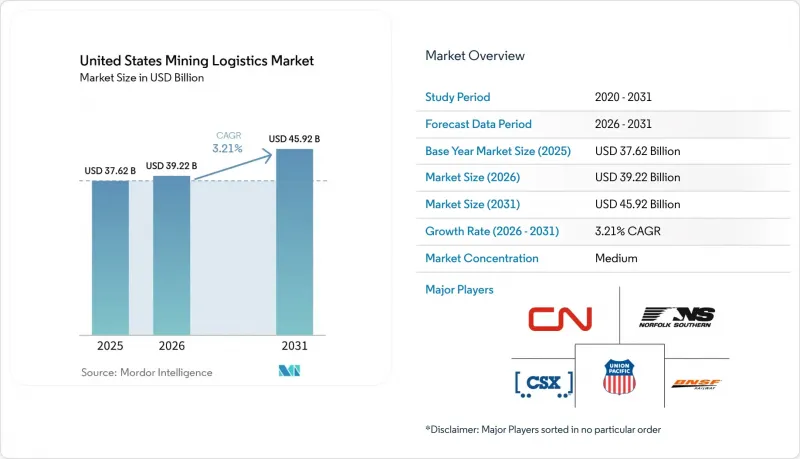
據 Mordor Intelligence 稱,2025 年美國礦業物流市場價值為 376.2 億美元,預計到 2031 年將達到 459.2 億美元,而 2026 年為 392.2 億美元,2026 年至 2031 年預測期內的複合年成長率為 3.21%。
聯邦政府的政策正在推高物流需求。這是由於「金庫計畫」(Project Vault)引入了價值120億美元的關鍵礦產儲備,需要在全面商業生產開始前規劃運輸路線、儲存容量和安全處理方案。本報告按服務(運輸(公路、鐵路、海運和內河航運、航空)、倉儲和庫存管理、附加價值服務)、商品(鐵礦石、冶金煤和動力煤、基底金屬(銅、鋅、鎳)、黃金以及其他礦物和金屬)和地區(東北部、西南部、西部、東南部、中西部)進行細分。市場預測以美元(USD)為單位。
美國礦業物流市場趨勢與洞察
國內回流及國內轉移重要礦產
聯邦政府從諮詢支援轉向直接採購,正在美國礦業物流市場創造更持久、專案驅動的需求。 「金庫計畫」(Project Vault)120億美元的蘊藏量將政策意圖轉化為全國範圍內安全運輸、倉儲和庫存管理的物流需求。 2026年1月,美國商務部與美國稀土公司(USA Rare Earth Corporation)簽署了德克薩斯州圓頂礦項目(Round Top project)的「礦山到磁鐵」供應鏈意向書。該項目計劃每天開採4萬噸稀土和關鍵礦物原料。這正在改變工作流程,因為物流供應商將從專案設計階段就參與其中,甚至在運輸數據中出現正常貨運量之前。能夠提供轉運、運輸、安全倉儲和長期運輸走廊支援的供應商,比在產量提升後才去追逐現貨運輸更有機會獲得多年期合約。 Watco 於 2025 年 6 月從 Duration Capital Partners 獲得了 6 億美元的投資,這表明私人資本已經在支持這種在分散的交通走廊中應用的方法。
鐵路和港口走廊現代化
走廊改善正在提升支撐美國礦業物流市場的基礎設施,涵蓋礦場、鐵路和出口路線。 BNSF鐵路公司宣布了一項2026年36億美元的資本支出計劃,旨在升級鐵軌、擴大碼頭並提高散裝礦物運輸網路的可靠性。聯邦鐵路管理局(FRA)的2025-2026年「危機應變計畫」(CRISIS)撥款超過20億美元,用於41個州的122個鐵路改善項目,有效緩解了貨運堵塞、維修了橋樑並改善了鐵路與港口的連通性。 CSX公司於2025年完成了霍華德街隧道雙層貨櫃高架延伸段的建設,使巴爾的摩走廊的線路選擇更加靈活,並解決了長期存在的網路瓶頸。此外,喬治亞亞州蓋恩斯維爾內陸港於2026年5月試運營,提供每日往返薩凡納的鐵路服務。這表明內陸鐵路和港口網路正在整合,以分散交通流量,並緩解沿海樞紐的擁塞狀況。由於大量公共資金與監管合規和多式聯運基礎設施發展掛鉤,走廊現代化正成為決定美國礦業物流市場運輸能力最快擴張方向的關鍵因素。
採礦許可證核准延誤和專案延期
由於新礦山物資必須等到工程獲得全面批准後才能運輸,因此許可證核准的延誤持續阻礙美國礦業物流市場的發展。美國內政部指出,美國新建硬岩礦的核准流程歷時7至10年,而從探勘到初步投產的整個過程耗時更長。這導致政策目標與物流規劃不匹配,因為礦場在投入商業生產之前通常需要對運輸走廊進行投資。核准進度的延誤可能導致與礦場直接相連的支線、碼頭或裝卸設施的初始投資長期閒置。這種不確定性也使得私人資本更難為未來礦山相關的早期物流資產提供融資。這種時間風險使得美國礦業物流市場無法像外部需求趨勢所顯示的那樣,迅速將政策支持轉化為貨運量的成長。
細分市場分析
到2025年,運輸業將占美國礦業物流市場佔有率的69.12%,成為最大的服務類別,遙遙領先。鐵路仍將是長途散貨運輸的核心,尤其是在煤炭、銅和鐵礦石運輸方面,這些運輸需要高噸位和低單位成本。卡車運輸將繼續承擔從偏遠礦區到鐵路轉運點的「首公里」和「末公里」運輸任務,並為鐵路網路未覆蓋地區的作業提供支援。海運和內河航道將繼續在煤炭出口、五大湖鐵礦石運輸以及與密西西比河相關的工業礦物運輸中發揮至關重要的作用。 LOGISTEC於2026年3月收購迪比克物流園,將加強連接中西部主要生產商與墨西哥灣沿岸出口門戶的內陸運輸路線。
預計到2031年,附加價值服務將以3.86%的複合年成長率成長,成為美國礦業物流市場成長最快的細分領域。在美國礦業物流業,隨著國內提貨合約的日益標準化,對礦品位檢驗、庫存可視性和數位化儲存歷史記錄的需求不斷成長。這些服務不再被視為特種礦產合約中的可附加服務,因為買家越來越要求在每個運輸環節提供原產地證書和受控處理流程。此外,隨著策略性庫存計畫和安全礦產儲存需要保稅且可審計的場所而非標準公共倉庫,倉儲和庫存管理的重要性日益凸顯。因此,美國礦業物流市場的利潤結構正在向那些除了實體運輸外還能提供合規性和資訊服務的供應商傾斜。
其他好處:
- Excel格式的市場預測(ME)表
- 3個月的分析師支持
目錄
第1章:引言
- 研究假設和市場定義
- 調查範圍
第2章:調查方法
第3章執行摘要
第4章 市場狀況
- 市場概覽
- 戰略物流走廊分析
- 基礎設施和交通配置分析
- 市場促進因素
- 國內重要礦產資源回流及國內需求
- 鐵路和港口走廊現代化
- 電池材料國內加工的本地化
- 煤炭和工業礦產出口的韌性
- 鐵路換乘樞紐可視化和控制塔數位化
- 戰略礦產儲備與安全儲存地點
- 市場限制因素
- 採礦許可證核准延誤和專案延期
- 長途貨車司機短缺和薪資上漲
- 礦山產量增加導致加工瓶頸
- 短程航線在批量交接節點互連中的摩擦。
- 價值供應鏈分析
- 監理情勢
- 技術展望
- 波特五力分析
- 地緣政治事件對市場的影響
第5章 市場規模與成長預測
- 按服務
- 運輸
- 路
- 鐵路
- 海路和內河航道
- 航空
- 倉儲和庫存管理
- 附加價值服務
- 運輸
- 依產品
- 鐵礦石
- 冶金用煤及一般用途煤
- 普通金屬(銅、鋅、鎳)
- 金子
- 其他礦物和金屬
- 按地區
- 東北
- 西南
- 西方
- 東南
- 中西部
第6章 競爭情勢
- 市場集中度
- 策略趨勢
- 市佔率分析
- 公司簡介
- Union Pacific Railroad
- BNSF Railway
- Norfolk Southern Railway
- CSX Transportation
- Canadian National Railway
- Watco
- OmniTRAX
- Patriot Rail Company
- Genesee and Wyoming
- Jaguar Transport Holdings
- Savage
- PLS Logistics Services
- Sheer Logistics
- Luminary Logistics Solutions
- Monarch Group International
- Gulf of America Logistics
- Creative Railcar Marketing Services(CRMS)
- BlackBridge Logistics
- RJ Corman Railroad Group
- LOGISTEC
第7章 市場機會與未來展望
According to Mordor Intelligence, the united states mining logistics market size was valued at USD 37.62 billion in 2025 and estimated to grow from USD 39.22 billion in 2026 to reach USD 45.92 billion by 2031, at a CAGR of 3.21% during the forecast period 2026-2031.
Federal action is pushing up logistics demand because Project Vault has introduced a USD 12 billion critical minerals reserve that requires corridor planning, storage capacity, and secure handling before full commercial output comes online. This report is Segmented by Service (Transportation (Road, Rail, Sea and Inland Waterways, Air), Warehousing and Inventory Management, Value-Added Services), by Commodity (Iron Ore, Metallurgical and Thermal Coal, Base Metals (Cu, Zn, Ni), Gold, Other Minerals/Metals), and by Geography (Northeast, Southwest, West, Southeast, Midwest). The Market Forecasts are Provided in Terms of Value (USD).
United States Mining Logistics Market Trends and Insights
Critical-Mineral Reshoring and Domestic Offtake
The federal shift from advisory support to direct procurement is giving the United States mining logistics market more durable project-linked demand. Project Vault's USD 12 billion reserve converts policy intent into a logistics requirement for secure movement, storage, and controlled inventory management at a national scale. In January 2026, the Department of Commerce issued a letter of intent with USA Rare Earth for a mine-to-magnet supply chain tied to the Round Top project in Texas, where the site is planned to extract 40,000 metric tons per day of rare earth and critical mineral feedstock. That changes the operating sequence because logistics providers are now being drawn into project design before normal freight volumes appear in shipment data. Operators that can combine switching, transloading, secure storage, and long-term corridor support are better positioned to win multi-year contracts rather than chasing spot moves after production ramps. Watco's June 2025 USD 600 million investment from Duration Capital Partners shows how private capital is already backing that approach in fragmented corridors.
Rail and Port Corridor Modernization
Corridor upgrades are improving the physical backbone that supports the United States mining logistics market across mine, rail, and export links. BNSF announced a USD 3.6 billion capital investment plan for 2026 that targets track renewal, terminal expansion, and network reliability improvements relevant to bulk mineral shippers. The Federal Railroad Administration's 2025-2026 CRISI cycle disbursed more than USD 2 billion across 122 rail improvement projects in 41 states, which materially supports freight congestion relief, bridge rehabilitation, and port rail access. CSX completed the Howard Street Tunnel double-stack clearance expansion in 2025, which opened more flexible routing on the Baltimore corridor and reduced one long-standing network constraint. The Gainesville Inland Port in Georgia also began its soft opening in May 2026 with daily rail service to Savannah, showing how inland rail-port links are being built to redistribute traffic away from congested coastal nodes. As more public funding is tied to compliance and intermodal readiness, corridor modernization is increasingly shaping where the United States mining logistics market can add capacity fastest.
Mine Permitting Delays and Project Slippage
Permitting delays continue to slow the United States mining logistics market because new mine supply cannot move until project approvals are fully in place. The Department of the Interior noted that the permitting phase for new United States hard-rock mines has historically taken 7 to 10 years, and the full path from exploration to first production has historically been far longer. That creates a mismatch between policy ambition and logistics planning, because corridor investment often needs to occur before a mine reaches commercial production. When approval schedules slip, early investments in branch lines, terminals, or mine-linked handling sites can sit underused for extended periods. The same uncertainty also makes private capital more selective when funding early-stage logistics assets tied to future mines. This timing risk keeps the United States mining logistics market from converting policy support into freight growth as quickly as headline demand signals might suggest.
Other drivers and restraints analyzed in the detailed report include:
- Domestic Processing Localization For Battery Materials
- Export Resilience In Coal And Industrial Minerals
- Remote-Haul Driver Scarcity and Wage Inflation
For complete list of drivers and restraints, kindly check the Table Of Contents.
Segment Analysis
Transportation held 69.12% of the United States mining logistics market share in 2025, making it the largest service category by a wide margin. Rail remains the structural backbone for long-haul bulk movements, especially on coal, copper, and iron ore corridors that favor high tonnage and lower unit costs. Trucking still handles first-mile and last-mile moves from remote mines to rail interchange points and serves operations outside rail-connected networks. Sea and inland waterways stay relevant for coal exports, Great Lakes iron ore flows, and Mississippi-linked industrial mineral traffic. LOGISTEC's March 2026 acquisition of Logistics Park Dubuque strengthened inland routing options between Midwest bulk producers and Gulf Coast export gateways.
Value-added services are projected to grow at a 3.86% CAGR, making it the fastest-expanding part of the United States mining logistics market size through 2031. The United States mining logistics industry is adding more demand for grade verification, inventory visibility, and digital chain-of-custody records as domestic offtake agreements become more formal. These services are no longer treated as optional extras in specialty mineral contracts because buyers increasingly want proof of origin and controlled handling across each transfer point. Warehousing and inventory management also gains relevance because strategic reserve programs and secure mineral storage need bonded, audit-ready sites instead of standard public warehouses. The margin structure of the United States mining logistics market is therefore shifting toward operators that can layer compliance and data services on top of physical transport.
Complete Report Scope:
- By Service
- Transportation
- Road
- Rail
- Sea and Inland Waterways
- Air
- Warehousing and Inventory Management
- Value-Added Services
- Transportation
- By Commodity
- Iron Ore
- Metallurgical and Thermal Coal
- Base Metals (Cu, Zn, Ni)
- Gold
- Other Minerals/Metals
- By Geography
- Northeast
- Southwest
- West
- Southeast
- Midwest
List of Companies Covered in this Report:
- Union Pacific Railroad
- BNSF Railway
- Norfolk Southern Railway
- CSX Transportation
- Canadian National Railway
- Watco
- OmnITRAX
- Patriot Rail Company
- Genesee and Wyoming
- Jaguar Transport Holdings
- Savage
- PLS Logistics Services
- Sheer Logistics
- Luminary Logistics Solutions
- Monarch Group International
- Gulf of America Logistics
- Creative Railcar Marketing Services (CRMS)
- BlackBridge Logistics
- R. J. Corman Railroad Group
- LOGISTEC
Additional Benefits:
- The market estimate (ME) sheet in Excel format
- 3 months of analyst support
TABLE OF CONTENTS
1 Introduction
- 1.1 Study Assumptions and Market Definition
- 1.2 Scope of the Study
2 Research Methodology
3 Executive Summary
4 Market Landscape
- 4.1 Market Overview
- 4.2 Strategic Logistics Corridor Analysis
- 4.3 Infrastructure and Modal Mix Analysis
- 4.4 Market Drivers
- 4.4.1 Critical-Mineral Reshoring and Domestic Offtake
- 4.4.2 Rail and Port Corridor Modernization
- 4.4.3 Domestic Processing Localization for Battery Materials
- 4.4.4 Export Resilience in Coal and Industrial Minerals
- 4.4.5 Rail-Interchange Visibility and Control-Tower Digitization
- 4.4.6 Strategic Mineral Stockpiling and Secure Storage Nodes
- 4.5 Market Restraints
- 4.5.1 Mine Permitting Delays and Project Slippage
- 4.5.2 Remote-Haul Driver Scarcity and Wage Inflation
- 4.5.3 Processing Bottlenecks after Mine Output Growth
- 4.5.4 Short-Line Interchange Friction at Bulk Handoff Nodes
- 4.6 Value / Supply-Chain Analysis
- 4.7 Regulatory Landscape
- 4.8 Technological Outlook
- 4.9 Porter's Five Forces Analysis
- 4.9.1 Threat of New Entrants
- 4.9.2 Bargaining Power of Suppliers
- 4.9.3 Bargaining Power of Buyers
- 4.9.4 Threat of Substitutes
- 4.9.5 Intensity of Rivalry
- 4.10 Impact of Geopolitical Events on the Market
5 Market Size and Growth Forecasts
- 5.1 By Service
- 5.1.1 Transportation
- 5.1.1.1 Road
- 5.1.1.2 Rail
- 5.1.1.3 Sea and Inland Waterways
- 5.1.1.4 Air
- 5.1.2 Warehousing and Inventory Management
- 5.1.3 Value-Added Services
- 5.1.1 Transportation
- 5.2 By Commodity
- 5.2.1 Iron Ore
- 5.2.2 Metallurgical and Thermal Coal
- 5.2.3 Base Metals (Cu, Zn, Ni)
- 5.2.4 Gold
- 5.2.5 Other Minerals/Metals
- 5.3 By Geography
- 5.3.1 Northeast
- 5.3.2 Southwest
- 5.3.3 West
- 5.3.4 Southeast
- 5.3.5 Midwest
6 Competitive Landscape
- 6.1 Market Concentration
- 6.2 Strategic Moves
- 6.3 Market Share Analysis
- 6.4 Company Profiles (Includes Global Level Overview, Market Level Overview, Core Segments, Financials as Available, Strategic Information, Market Rank/Share for Key Companies, Products and Services, and Recent Developments)
- 6.4.1 Union Pacific Railroad
- 6.4.2 BNSF Railway
- 6.4.3 Norfolk Southern Railway
- 6.4.4 CSX Transportation
- 6.4.5 Canadian National Railway
- 6.4.6 Watco
- 6.4.7 OmniTRAX
- 6.4.8 Patriot Rail Company
- 6.4.9 Genesee and Wyoming
- 6.4.10 Jaguar Transport Holdings
- 6.4.11 Savage
- 6.4.12 PLS Logistics Services
- 6.4.13 Sheer Logistics
- 6.4.14 Luminary Logistics Solutions
- 6.4.15 Monarch Group International
- 6.4.16 Gulf of America Logistics
- 6.4.17 Creative Railcar Marketing Services (CRMS)
- 6.4.18 BlackBridge Logistics
- 6.4.19 R. J. Corman Railroad Group
- 6.4.20 LOGISTEC
7 Market Opportunities and Future Outlook
- 7.1 White-space and unmet-need assessment

 移動式環保廁所市場:全球市場預測,2026-2032年
 城市採礦市場規模、佔有率和成長分析:按資源類型、回收材料、回收流程、最終用戶、應用和地區分類-2026-2033年產業預測
 材料產業現況:2026年第二季回顧
 2026-2034年全球工程機械和礦用車輛市場規模、佔有率、趨勢和成長分析報告
 2026年全球礦業重型設備租賃市場報告2026年全球鑽井服務市場報告
 中國礦業物流:市場佔有率分析、產業趨勢與統計及成長預測(2026-2031年)
 線索挖掘軟體市場-全球產業規模、佔有率、趨勢、機會、預測:按類型、組織規模、地區和競爭格局分類,2021-2031年
 阿根廷市場:依最終用途產業、萃取方法、銀含量、產品形式、應用和地區分類
 材料產業現況—2026年第一第一季回顧