


 |
市場調查報告書
商品編碼
2072818
德國植物生長調節劑:市場佔有率分析、產業趨勢與統計及成長預測(2026-2031)Germany Plant Growth Regulators - Market Share Analysis, Industry Trends & Statistics, Growth Forecasts (2026 - 2031) |
||||||

※ 本網頁內容可能與最新版本有所差異。詳細情況請與我們聯繫。
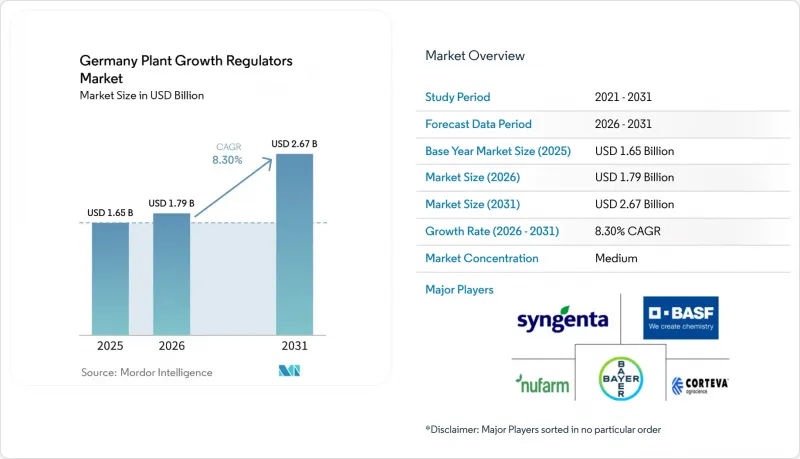
根據 Mordor Intelligence 預測,德國植物生長調節劑市場規模將從 2025 年的 16.5 億美元成長到 2026 年的 17.9 億美元,到 2031 年達到 26.7 億美元,2026 年至 2031 年的複合年成長率為 8.30%。
本報告按類型(生長素、細胞分裂素、吉貝素、乙烯及其他)、劑型(液體、水分散劑、乳化濃縮液、可溶性濃縮液、粉劑和顆粒劑)以及作物類型(穀物、水果和蔬菜、油籽和豆類、草坪和觀賞植物)進行分類。預測以美元計價。
德國植物生長調節劑市場的趨勢與洞察
擴大高附加價值作物的種植面積
為滿足糧食供應目標以及國內外市場對高品質產品溢價的不斷提高,德國的園藝和多年生作物生產基地正在不斷擴大。 2025年公佈的《園藝行動計劃》旨在將國內果蔬產量提升至自給自足水平,這直接推動了疏果、分揀和催熟劑使用量的增加。這一趨勢帶動了對吉貝素、細胞分裂素、乙烯利和丙環己酮鈣等促生劑的需求,尤其是在那些植物形態和收穫時間直接影響產量和價格的作物中。此外,德國植物生長調節劑市場的應用範圍正在從穀物防倒伏擴展到其他領域,尤其是在巴登-符騰堡州和下薩克森州,這兩個州的果蔬生產仍然具有重要的商業性價值。隨著種植面積向高價值作物轉移,產品需求也隨著應用情境的拓展而日益成長,並且在各種類型的農場中都變得更加穩定。
在糧食安全壓力下,提高作物產量的需求日益成長。
2025年,德國將種植286萬公頃冬小麥和121萬公頃冬大麥,這將繼續支撐大面積面積對三環唑乙酯和氯化氯甲膽鹼的需求。防倒伏仍然是德國植物生長調節劑市場中盈利驅動型應用最顯著的領域之一,尤其是在冬小麥種植方面。一旦糧食作物倒伏,農民將面臨產量下降、收割效率降低和糧食品質下降等問題,因此即使削減其他投入品的預算,植物生長調節劑的使用也往往得以維持。 2025年糧食價格的下跌加劇了保護可收穫產量的必要性,因為生產者一直在努力提高每公頃利潤的可預測性。因此,與其他較容易延後或減少投入的投入品類別相比,德國植物生長調節劑市場更為穩健。
歐盟的嚴格承認框架
歐盟第1107/2009號法規下的核准架構仍是德國植物生長調節劑市場面臨的結構性限制因素。在德國,聯邦消費者保護和食品安全局在聯邦風險評估研究所和聯邦環境署的支持下負責實施該框架,其核准流程在證據要件和審查深度方面仍然十分嚴格。 2024年,聯邦消費者保護和食品安全局指出,高合規要求和漫長的核准時間降低了德國作為新申請中心報告國的吸引力。這導致新分子上市延遲,並增加了產品組合維修成本。因此,監管准入以及農業化學品的性能已成為市場上的關鍵因素。
細分市場分析
2025年,細胞分裂素佔德國植物生長調節劑市場的38.2%。如此高的市佔率並非主要源自於其處理面積,而是德國果園、葡萄栽培和育苗領域對特定作物的需求。在德國商業水果生產中心巴登-符騰堡州的蘋果和梨園中,6-芐基腺嘌呤(6-BA)被用作標準的細胞分裂素疏果劑。當果實直徑達到10-12毫米時噴灑6-BA,既能疏除多餘果實,又能促進剩餘果實的細胞分裂,從而改善最終果實的直徑。這種雙重作用是其他化學成分所不具備的優點。此外,德國育苗業透過組織培養繁殖和母株分枝處理,對細胞分裂素的需求也十分穩定。在這些處理中,細胞分裂素的應用透過促進腋芽萌發來提高扦插產量。
在德國植物生長調節劑市場中,生長素是成長最快的細分市場,預計2026年至2031年將以7.2%的複合年成長率成長。這一成長主要得益於觀賞植物繁殖中傳統的生根應用,以及生物促效劑與生長素組合產品的日益普及。在德國,吲哚丁酸(IBA)基生根劑是觀賞植物幼苗和果樹砧木繁殖的標準用藥,繁殖率直接影響幼苗生產的盈利。此外,從合成生長素產品轉向海藻來源的生物促效劑配方也正在擴大市場。發表在《園藝前沿》(Frontiers in Horticulture,2024年5月)上的一項研究表明,與未處理的對照組相比,源自大片海帶(Ecklonia maxima)的“Kelpak”可使玫瑰插條的根鮮重增加62%,根長增加75%。這些結果表明合成處理劑的有效性,並突顯了生物促效劑和生長素之間日益模糊的界限,從而擴大了生長素類產品的整體潛在市場。
其他好處:
- Excel格式的市場預測(ME)表
- 3個月的分析師支持
目錄
第1章:引言
- 研究假設和市場定義
- 調查範圍
第2章:調查方法
第3章執行摘要
第4章 市場狀況
- 市場概覽
- 市場促進因素
- 擴大高附加價值作物的種植面積
- 在糧食安全壓力下,提高作物產量的需求日益成長。
- 人們對永續和資源高效利用的農業越來越感興趣。
- 生物促效劑和生長調節劑的融合
- 國家植物保護劑永續利用行動計劃
- 引進數位農業實現精準施肥
- 市場限制因素
- 歐盟嚴格的核准框架
- 農業收入波動和商品價格下跌
- 主要合成活性成分審查壓力的考量。
- 新活性成分的核准被推遲。
- 監理情勢
- 技術展望
- 波特五力分析
第5章 市場規模與成長預測
- 按類型
- 生長素
- 細胞分裂素
- 吉貝素
- 乙烯
- 其他
- 配方
- 液體
- 水分散配方
- 乳化濃縮液
- 可溶性濃縮液
- 粉末和顆粒
- 按作物類型
- 穀類和穀類食品
- 水果和蔬菜
- 油籽/豆類
- 草坪和觀賞植物
第6章 競爭情勢
- 市場集中度
- 策略趨勢
- 市佔率分析
- 公司簡介
- BASF SE
- Bayer AG
- Syngenta AG
- Nufarm Limited
- UPL Limited
- Certis Belchim BV
- Sumitomo Chemical Co., Ltd.
- Bergophor GmbH
- Stahler International GmbH and Co. KG
- Corteva, Inc.
- Gowan Company
- ABiTEP GmbH
- STAR Agro Handels GmbH
- AlzChem Group AG
- Fine Agrochemicals Ltd.
第7章 市場機會與未來展望
According to Mordor Intelligence, the germany plant growth regulators market size is projected to increase from USD 1.65 billion in 2025 to USD 1.79 billion in 2026 and reach USD 2.67 billion by 2031, growing at a CAGR of 8.30% over 2026-2031.
This report is Segmented by Type (Auxins, Cytokinin, Gibberellins, Ethylene, and Others), by Formulation (Liquid, Water-Dispersible, Emulsifiable Concentrate, Soluble Concentrate, and Powders and Granules), and by Crop Type (Cereals and Grains, Fruits and Vegetables, Oilseeds and Pulses, and Turf and Ornamentals). The Forecasts are Provided in Terms of Value (USD).
Germany Plant Growth Regulators Market Trends and Insights
Expansion of High-Value Crop Cultivation
Germany's horticulture and permanent crop base is expanding in response to food supply goals and stronger quality premiums in domestic and export channels. The Horticulture Action Plan announced in 2025 aimed to raise domestic fruit and vegetable production to a level of self-sufficiency, which directly supports greater use of thinning, sizing, and ripening products. This trend lifts demand for gibberellins, cytokinins, ethephon, and prohexadion-calcium in crops where plant architecture and harvest timing affect both yield and price realization. It also widens the application base of the Germany plant growth regulators market beyond cereal lodging control, especially in Baden-Wurttemberg and Lower Saxony, where fruit output remains commercially significant. As acreage shifts toward more value-dense crops, product demand becomes broader by use case and more resilient by farm type.
Rising Demand for Crop Yield Optimization Under Food Security Pressures
Germany planted 2.86 million hectares of winter wheat and 1.21 million hectares of winter barley in 2025, which keeps demand for trinexapac-ethyl and chlormequat chloride tied to a very large treated area. Lodging prevention remains one of the clearest return-driven use cases in the Germany plant growth regulators market, especially in winter cereals. When cereal crops lodge, farms face yield loss, harvest inefficiency, and grain quality downgrades, so plant growth regulation is often maintained even as other input decisions are tightened. Lower cereal prices in 2025 increased the need to protect harvestable output, as growers sought a more predictable return per hectare. That makes the Germany plant growth regulators market more durable than input categories that are easier to postpone or reduce.
Stringent European Union Approval Framework
The approval framework under European Union Regulation (EC) No 1107/2009 remains a structural restraint on the Germany plant growth regulators market. Germany applies this framework through the Federal Office of Consumer Protection and Food Safety, with support from the Federal Institute for Risk Assessment and the Federal Environment Agency, and the process has remained demanding in both evidence requirements and review depth. The Federal Office of Consumer Protection and Food Safety stated in 2024 that high compliance demands and long timelines had made Germany less attractive as a central rapporteur location for new files. That slows the entry of new molecules and raises the cost of maintaining portfolios. The result is a market where regulatory access can matter as much as agronomic performance.
Other drivers and restraints analyzed in the detailed report include:
- Greater Focus on Sustainable and Resource-Efficient Farming
- Convergence Between Biostimulants and Growth Regulators
- Variable Farm Income and Weaker Commodity Prices
For complete list of drivers and restraints, kindly check the Table Of Contents.
Segment Analysis
Cytokinins accounted for 38.2% of the Germany plant growth regulators market in 2025. This dominance is attributed to the crop-specific requirements of Germany's fruit orchards, viticulture, and nursery plant sectors, rather than the total treated area. In apple and pear orchards located in Baden-Wurttemberg, the hub of Germany's commercial fruit production (Obstbau), 6-Benzyladenin (6-BA) is the standard cytokinin thinning agent. It is applied at the 10-12 mm fruitlet stage to thin excess fruits while promoting cell division in retained fruits, thereby enhancing the final fruit diameter. This dual-action benefit is unmatched by other chemical classes. Additionally, Germany's nursery plant industry supports consistent demand for cytokinins through tissue culture propagation programs and stock plant branching treatments, where cytokinin applications increase cutting yields by stimulating axillary bud break.
Auxins are the fastest-growing segment in Germany plant growth regulators market share, with a projected CAGR of 7.2% from 2026 to 2031. This growth is driven by traditional rooting applications in ornamental propagation and the increasing adoption of biostimulant-auxin convergence products. Indole-3-butyric acid (IBA)-based rooting preparations are standard in Germany's ornamental nursery and fruit tree rootstock propagation sectors, where propagation rates directly impact nursery economics. Additionally, the shift from synthetic auxin products to seaweed-derived biostimulant formulations is expanding the market. A study published in Frontiers in Horticulture (May 2024) demonstrated that Kelpak, derived from Ecklonia maxima, increased root fresh weight by 62% and root length by 75% in rose cuttings compared to untreated controls. These results approach the efficacy of synthetic treatments, highlighting the growing overlap between biostimulants and auxins, which is broadening the total addressable market for auxin-type products.
Complete Report Scope:
- By Type
- Auxins
- Cytokinins
- Gibberellins
- Ethylene
- Others
- By Formulation
- Liquid
- Water-dispersible options
- Emulsifiable concentrates
- Soluble concentrates
- Powders and granules
- By Crop Type
- Cereals and grains
- Fruits and vegetables
- Oilseeds and pulses
- Turf and ornamentals
List of Companies Covered in this Report:
- BASF SE
- Bayer AG
- Syngenta AG
- Nufarm Limited
- UPL Limited
- Certis Belchim B.V.
- Sumitomo Chemical Co., Ltd.
- Bergophor GmbH
- Stahler International GmbH and Co. KG
- Corteva, Inc.
- Gowan Company
- ABITEP GmbH
- STAR Agro Handels GmbH
- AlzChem Group AG
- Fine Agrochemicals Ltd.
Additional Benefits:
- The market estimate (ME) sheet in Excel format
- 3 months of analyst support
TABLE OF CONTENTS
1 Introduction
- 1.1 Study Assumptions and Market Definition
- 1.2 Scope of the Study
2 Research Methodology
3 Executive Summary
4 Market Landscape
- 4.1 Market Overview
- 4.2 Market Drivers
- 4.2.1 Expansion of high-value crop cultivation
- 4.2.2 Rising demand for crop yield optimization under food security pressure
- 4.2.3 Greater focus on sustainable and resource-efficient farming
- 4.2.4 Convergence between biostimulants and growth regulators
- 4.2.5 National Action Plan for sustainable plant protection use
- 4.2.6 Digital agriculture adoption for precision application
- 4.3 Market Restraints
- 4.3.1 Stringent European Union approval framework
- 4.3.2 Variable farm income and weaker commodity prices
- 4.3.3 Review pressure on key synthetic active ingredients
- 4.3.4 Slow authorization of new active substances
- 4.4 Regulatory Landscape
- 4.5 Technological Outlook
- 4.6 Porter's Five Forces Analysis
- 4.6.1 Threat of new entrants
- 4.6.2 Bargaining power of suppliers
- 4.6.3 Bargaining power of buyers
- 4.6.4 Threat of substitutes
- 4.6.5 Intensity of competitive rivalry
5 Market Size and Growth Forecasts (Value, USD)
- 5.1 By Type
- 5.1.1 Auxins
- 5.1.2 Cytokinins
- 5.1.3 Gibberellins
- 5.1.4 Ethylene
- 5.1.5 Others
- 5.2 By Formulation
- 5.2.1 Liquid
- 5.2.2 Water-dispersible options
- 5.2.3 Emulsifiable concentrates
- 5.2.4 Soluble concentrates
- 5.2.5 Powders and granules
- 5.3 By Crop Type
- 5.3.1 Cereals and grains
- 5.3.2 Fruits and vegetables
- 5.3.3 Oilseeds and pulses
- 5.3.4 Turf and ornamentals
6 Competitive Landscape
- 6.1 Market Concentration
- 6.2 Strategic Moves
- 6.3 Market Share Analysis
- 6.4 Company Profiles (Includes Global Level Overview, Market Level Overview, Core Business Segments, Financials, Key Information, Market Rank, Market Share, Products and Services, and Analysis of Recent Developments)
- 6.4.1 BASF SE
- 6.4.2 Bayer AG
- 6.4.3 Syngenta AG
- 6.4.4 Nufarm Limited
- 6.4.5 UPL Limited
- 6.4.6 Certis Belchim B.V.
- 6.4.7 Sumitomo Chemical Co., Ltd.
- 6.4.8 Bergophor GmbH
- 6.4.9 Stahler International GmbH and Co. KG
- 6.4.10 Corteva, Inc.
- 6.4.11 Gowan Company
- 6.4.12 ABiTEP GmbH
- 6.4.13 STAR Agro Handels GmbH
- 6.4.14 AlzChem Group AG
- 6.4.15 Fine Agrochemicals Ltd.
7 Market Opportunities and Future Outlook

 植物生長調節劑市場:2026-2032年全球市場預測(依作物類型、品種、配方、原料、最終用途、銷售管道和應用方法分類)
 植物生長調節劑市場機會、成長促進因素、產業趨勢分析及2026-2035年預測
 植物生長調節劑市場規模、佔有率和趨勢分析報告:按形態、應用、最終用途、地區和細分市場預測(2026-2033 年)細胞分裂素市場商業機會、成長要素、產業趨勢分析及2026-2035年預測
 細胞分裂素全球市場規模、佔有率、趨勢和成長分析報告(2026-2034)植物生長調節劑市場規模、佔有率、成長及全球產業分析:按類型和應用、區域洞察及2026-2034年預測全球植物生長調節劑市場規模、佔有率、趨勢和成長分析報告(2026-2034年)
 2026年全球植物生長調節劑市場報告
 全球植物生長調節劑(PGR)市場預測至2032年:按類型、配方、作物類型、給藥方式、分銷管道、應用和地區分類
 植物生長調節劑市場規模、佔有率和成長分析(按作物類型、應用、產品類型、功能、配方和地區分類)—產業預測(2026-2033 年)