


 |
市場調查報告書
商品編碼
2061434
植物生長調節劑市場機會、成長促進因素、產業趨勢分析及2026-2035年預測Plant Growth Regulators Market Opportunity, Growth Drivers, Industry Trend Analysis, and Forecast 2026 - 2035 |
||||||

全球植物生長調節劑市場預計到 2025 年將價值 11 億美元,預計到 2035 年將以 7.1% 的複合年成長率成長至 22 億美元。
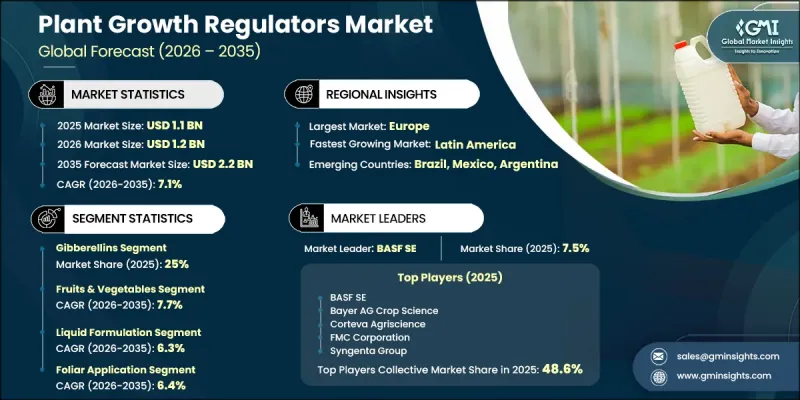
在不斷變化的環境條件下,提高農業生產力並維持作物品質的需求日益成長,推動了植物生長調節劑市場持續擴張。植物生長調節劑廣泛應用於現代農業,用於控制和調節植物的生理過程,例如生長速率、開花、果實發育和壓力反應機制。其日益成長的重要性與人口成長和耕地減少對全球糧食系統帶來的壓力密切相關。農民越來越依賴這些解決方案來提高產量效率,並增強作物對乾旱、鹽鹼化和溫度波動等非生物脅迫的抵抗力。向永續農業實踐的轉變也是市場成長的主要推動因素,因為植物生長調節劑有助於最佳化投入並減少對環境的影響。精密農業技術透過實現標靶施用方法,在最大限度地提高效果的同時最大限度地減少浪費,進一步促進了植物生長調節劑的應用。這些產品廣泛應用於穀物、水果、蔬菜和觀賞作物,應用技術包括葉面噴布、種子處理和土壤施用系統等。由於生物基配方、改進的輸送機制和環境友善化學品的不斷創新,植物生長調節劑在全球商業農業系統中的重要性日益擴大。
| 市場範圍 | |
|---|---|
| 開始年份 | 2025 |
| 預測期 | 2026-2035 |
| 起始金額 | 11億美元 |
| 預測金額 | 22億美元 |
| 複合年成長率 | 7.1% |
預計到2025年,吉貝素市佔率將達到25%,並在2035年之前以7.4%的複合年成長率成長。赤黴素在調控植物關鍵功能(如莖伸長、種子萌發、開花和作物整體發育)方面發揮著至關重要的作用,因此該細分市場仍然至關重要。隨著農民尋求提高不同農業系統的產量和作物均勻度,赤黴素在農田作物和園藝領域的應用不斷擴大,持續支撐穩定的需求。此外,不斷改進的配方研究也促進了該細分市場的蓬勃發展,這些配方能夠提高赤黴素的效率和施用精度。
預計到2025年,水果和蔬菜市場佔有率將達到41%,並在2026年至2035年間以7.7%的複合年成長率成長。此細分市場的需求成長主要受全球新鮮農產品消費量增加以及消費者對產品外觀品質、保存期限和抗病性的日益重視所驅動。農民正在採用植物生長調節劑來最佳化果實大小、改善色澤並確保果實均勻成熟,從而滿足嚴格的零售和出口標準。人們對永續和無殘留農業實踐的日益關注也推動了先進環保型植物生長調節劑的應用。此外,園藝生產的擴張和溫室種植的普及也進一步促進了該品類的市場成長。
預計到2025年,北美植物生長調節劑市場佔有率將達到27%,這主要得益於先進耕作方法和精密農業技術的廣泛應用。該地區擁有完善的農業生態系統,優先考慮生產力、效率和永續性。美國和加拿大的農民正擴大將植物生長調節劑納入作物管理策略,以提高產量、品質和穩定性。優先考慮環境安全和產品功效的法律規範正在推動生物基和環境友善配方的研發。對農業研發的大力投入,以及數位化農業工具的日益普及,進一步加速了該地區整個商業農業領域植物生長調節劑的創新和應用。
目錄
第1章:調查方法和範圍
第2章執行摘要
第3章 行業洞察
- 產業生態系分析
- 供應商情況
- 利潤率
- 每個階段增加的價值
- 影響價值鏈的因素
- 中斷
- 影響產業的因素
- 成長促進因素
- 產業潛在風險與挑戰
- 市場機遇
- 成長潛力分析
- 監理情勢
- 波特的分析
- PESTLE分析
- 價格趨勢
- 按地區
- 按類型
- 未來市場趨勢
- 技術與創新展望
- 最新科技趨勢
- 新興技術
- 專利趨勢
- 貿易統計
- 主要進口國
- 主要出口國
- 永續性和環境方面
- 永續計劃
- 減少廢棄物策略
- 生產中的能源效率
- 具有環保意識的舉措
- 考慮碳足跡
第4章 競爭情勢
- 介紹
- 企業市佔率分析
- 按地區
- 北美洲
- 歐洲
- 亞太地區
- 拉丁美洲
- 中東和非洲
- 按地區
- 企業矩陣分析
- 主要市場公司的競爭分析
- 競爭定位矩陣
- 主要進展
- 併購
- 夥伴關係和聯盟
- 新產品發布
- 業務拓展計劃
第5章 市場估計與預測:依活性成分類型分類,2022-2035年
- 生長素
- 吲哚-3-乙酸(IAA)
- 吲哚-3-丁酸(IBA)
- 萘乙酸(NAA)
- 2,4-二氯苯氧乙酸(2,4-D)
- 其他橡樹
- 細胞分裂素
- 激動素
- 澤廷
- 6-芐氨基嘌呤(6-BA/芐腺嘌呤)
- 其他細胞因子
- 吉貝素
- 吉貝素(GA3)
- GA4+7複合物
- 其他吉貝素(GA1、GA5、GA6)
- 乙烯和乙烯調節器
- 乙烯供體(Etephon/Etrel)
- 乙烯抑制劑(AVG、1-MCP)
- 脫落酸(ABA)
- 天然脫落酸
- 合成脫落酸(S-ABA)
- 生長抑制劑(抗吉貝素藥物)
- 氯化氯甲膽鹼
- 氯化甲哌鎓
- 多效唑
- 三甲胺乙酯
- 丙環己酮鈣
- 達米諾齊德
- 其他生長抑制劑
- 其他
第6章 市場估算與預測:依作物應用分類,2022-2035年
- 水果和蔬菜
- 果樹
- 柑橘
- 葡萄
- 仁果
- 核果
- 莓果
- 熱帶水果
- 其他水果
- 蔬菜作物
- 水果和蔬菜
- 綠葉蔬菜
- 根莖類
- 葫蘆科作物
- 其他蔬菜
- 穀類和穀類食品
- 小麥
- 米
- 玉米(僅限飼料玉米)
- 大麥
- 燕麥
- 高粱
- 其他穀物(黑麥、小米、小麥)
- 油籽/豆類
- 油籽
- 大豆
- 菜籽
- 向日葵
- 棉花(棉籽油)
- 其他油籽
- 豆子
- 扁豆
- 鷹嘴豆
- 乾豆
- 豌豆
- 其他豆類(蠶豆、木豆)
- 油籽
- 草坪和觀賞植物
- 草坪/草坪護理
- 高爾夫球場
- 運動場地和體育設施
- 住宅草坪
- 商業景觀設計
- 觀賞植物
- 鮮切花
- 盆栽植物
- 花卉幼苗
- 幼苗
- 庭園植物
- 草坪/草坪護理
第7章 市場估計與預測:依製劑類型分類,2022-2035年
- 液體
- 可溶性濃縮液(SL)
- 乳化濃縮液(EC)
- 濃縮懸浮液(SC)
- 水溶液(即用型)
- 固態劑型
- 可濕性粉劑(WP)
- 顆粒狀可濕性粉劑(WDG/WG)
- 可溶性顆粒(SG)
- 乾花粉(DF)
- 特殊配方
- 微膠囊製劑
- 緩釋和控釋製劑
- 氣霧配方
- 其他特殊劑型(凝膠、糊劑、錠劑)
第8章 市場估算與預測:依應用方法分類,2022-2035年
- 葉面噴布
- 土壤施用
- 種子處理
- 直接施用於植物
第9章 市場估計與預測:依最終用戶產業分類,2022-2035年
- 商業農業
- 特色作物和高價值作物生產商
- 草坪和景觀美化專家
- 機構和政府
- 零售與消費
第10章 市場估價與預測:依地區分類,2022-2035年
- 北美洲
- 美國
- 加拿大
- 歐洲
- 德國
- 英國
- 法國
- 西班牙
- 義大利
- 其他歐洲國家
- 亞太地區
- 中國
- 印度
- 日本
- 澳洲
- 韓國
- 其他亞太國家
- 拉丁美洲
- 巴西
- 墨西哥
- 阿根廷
- 其他拉丁美洲國家
- 中東和非洲
- 沙烏地阿拉伯
- 南非
- UAE
- 其他中東和非洲國家
第11章:公司簡介
- BASF SE
- Bayer AG Crop Science
- Corteva Agriscience
- Crop Care Australasia Pty Ltd.
- Fine Americas, Inc.
- FMC Corporation
- Nippon Soda Co. Ltd.
- Nufarm Limited
- Sipcam Oxon SpA
- Sumitomo Chemical Co. Ltd.
- Syngenta Group
- Tata Chemicals Ltd.
- UPL Limited
- Valent BioSciences LLC
- Xinyi Industrial Co. Ltd.
The Global Plant Growth Regulators Market was valued at USD 1.1 billion in 2025 and is estimated to grow at a CAGR of 7.1% to reach USD 2.2 billion by 2035.
The market is experiencing expansion driven by the increasing need to improve agricultural productivity while maintaining crop quality under changing environmental conditions. Plant growth regulators are widely used in modern agriculture to control and modify plant physiological processes such as growth rate, flowering, fruit development, and stress response mechanisms. Their growing importance is closely tied to the global pressure on food systems caused by rising population levels and shrinking arable land availability. Farmers are increasingly relying on these solutions to enhance yield efficiency and improve resilience against abiotic stresses such as drought, salinity, and temperature fluctuations. The shift toward sustainable farming practices is also contributing significantly to market growth, as plant growth regulators support optimized input use and reduced environmental impact. Precision agriculture technologies are further strengthening adoption by enabling targeted application methods that improve effectiveness while minimizing waste. These products are widely applied across cereals, fruits, vegetables, and ornamental crops using techniques such as foliar application, seed treatment, and soil-based delivery systems. Continuous innovation in bio-based formulations, improved delivery mechanisms, and environmentally friendly chemistries is further expanding the relevance of plant growth regulators in commercial farming systems worldwide.
| Market Scope | |
|---|---|
| Start Year | 2025 |
| Forecast Year | 2026-2035 |
| Start Value | $1.1 Billion |
| Forecast Value | $2.2 Billion |
| CAGR | 7.1% |
The gibberellins segment accounted for a share of 25% in 2025 and is projected to grow at a CAGR of 7.4% through 2035. This segment remains highly important due to its role in regulating key plant functions such as stem elongation, seed germination, flowering, and overall crop development. Increased adoption in both field crops and horticultural applications continues to support steady demand, as growers aim to improve productivity and crop uniformity across different agricultural systems. The segment is also benefiting from ongoing research into improved formulations that enhance efficiency and application accuracy.
The fruits and vegetables segment held a share of 41% in 2025 and is anticipated to grow at a CAGR of 7.7% during 2026 to 2035. Demand within this segment is being driven by the rising global consumption of fresh produce and the increasing emphasis on visual quality, shelf life, and disease resistance. Farmers are adopting plant growth regulators to optimize fruit size, improve coloration, and ensure uniform ripening, which helps meet strict retail and export standards. The growing focus on sustainable and residue-free farming practices is also supporting the use of advanced and environmentally compatible plant growth regulator solutions. Additionally, expanding horticultural production and greenhouse cultivation practices are further strengthening market growth in this category.
North America Plant Growth Regulators Market accounted for 27% share in 2025 supported by advanced agricultural practices and high adoption of precision farming technologies. The region benefits from a well-developed agricultural ecosystem that emphasizes productivity, efficiency, and sustainability. Farmers across the United States and Canada are increasingly integrating plant growth regulators into crop management strategies to improve yield quality and consistency. Regulatory frameworks that prioritize environmental safety and product efficacy are encouraging the development of bio-based and eco-friendly formulations. Strong investment in agricultural research, combined with the rising adoption of digital farming tools, is further accelerating innovation and usage of plant growth regulators across commercial farming operations in the region.
Key companies operating in the Global Plant Growth Regulators Industry include BASF SE, Bayer AG Crop Science, Corteva Agriscience, Syngenta Group, FMC Corporation, Nufarm Limited, Sumitomo Chemical Co. Ltd., Sipcam Oxon S.p.A., Tata Chemicals Ltd., Valent BioSciences LLC, Fine Americas, Inc., Crop Care Australasia Pty Ltd., Nippon Soda Co. Ltd., UPL Limited, and Xinyi Industrial Co. Ltd. Companies operating in the plant growth regulators market are focusing on product innovation, biological formulation development, and strategic expansion to strengthen their competitive position. A major priority is the development of bio-based and environmentally friendly solutions that align with sustainable agriculture practices and evolving regulatory standards. Market players are investing heavily in research and development to improve product efficiency, crop specificity, and application precision. Strategic partnerships with agricultural research institutions and distribution networks are also being used to expand geographic reach and improve product accessibility. Companies are increasingly leveraging precision agriculture technologies, including data-driven application systems, to enhance performance outcomes and farmer adoption rates.
Table of Contents
Chapter 1 Methodology & Scope
- 1.1 Market scope and definition
- 1.2 Research design
- 1.2.1 Research approach
- 1.2.2 Data collection methods
- 1.3 Data mining sources
- 1.3.1 Global
- 1.3.2 Regional/Country
- 1.4 Base estimates and calculations
- 1.4.1 Base year calculation
- 1.4.2 Key trends for market estimation
- 1.5 Primary research and validation
- 1.5.1 Primary sources
- 1.6 Forecast model
- 1.7 Research assumptions and limitations
Chapter 2 Executive Summary
- 2.1 Industry 360° synopsis
- 2.2 Key market trends
- 2.2.1 Regional
- 2.2.2 Active ingredients type
- 2.2.3 Crop application
- 2.2.4 Formulation type
- 2.2.5 Application method
- 2.2.6 End User Industry
- 2.3 TAM Analysis, 2026-2035
- 2.4 CXO perspectives: Strategic imperatives
- 2.4.1 Executive decision points
Chapter 3 Industry Insights
- 3.1 Industry ecosystem analysis
- 3.1.1 Supplier landscape
- 3.1.2 Profit margin
- 3.1.3 Value addition at each stage
- 3.1.4 Factor affecting the value chain
- 3.1.5 Disruptions
- 3.2 Industry impact forces
- 3.2.1 Growth drivers
- 3.2.2 Industry pitfalls and challenges
- 3.2.3 Market opportunities
- 3.3 Growth potential analysis
- 3.4 Regulatory landscape
- 3.4.1 North America
- 3.4.2 Europe
- 3.4.3 Asia Pacific
- 3.4.4 Latin America
- 3.4.5 Middle East & Africa
- 3.5 Porter's analysis
- 3.6 PESTEL analysis
- 3.7 Price trends
- 3.7.1 By region
- 3.7.2 By type
- 3.8 Future market trends
- 3.9 Technology and Innovation landscape
- 3.9.1 Current technological trends
- 3.9.2 Emerging technologies
- 3.10 Patent Landscape
- 3.11 Trade statistics (HS code)
- 3.11.1 Major importing countries
- 3.11.2 Major exporting countries
- 3.12 Sustainability and environmental aspects
- 3.12.1 Sustainable practices
- 3.12.2 Waste reduction strategies
- 3.12.3 Energy efficiency in production
- 3.12.4 Eco-friendly initiatives
- 3.13 Carbon footprint consideration
Chapter 4 Competitive Landscape, 2025
- 4.1 Introduction
- 4.2 Company market share analysis
- 4.2.1 By region
- 4.2.1.1 North America
- 4.2.1.2 Europe
- 4.2.1.3 Asia Pacific
- 4.2.1.4 LATAM
- 4.2.1.5 MEA
- 4.2.1 By region
- 4.3 Company matrix analysis
- 4.4 Competitive analysis of major market players
- 4.5 Competitive positioning matrix
- 4.6 Key developments
- 4.6.1 Mergers & acquisitions
- 4.6.2 Partnerships & collaborations
- 4.6.3 New Product Launches
- 4.6.4 Expansion Plans
Chapter 5 Market Estimates and Forecast, By Active Ingredient Type, 2022-2035 (USD Billion) (Kilo Tons)
- 5.1 Key trends
- 5.2 Auxins
- 5.2.1 Indole-3-Acetic Acid (IAA)
- 5.2.2 Indole-3-Butyric Acid (IBA)
- 5.2.3 Naphthaleneacetic Acid (NAA)
- 5.2.4 2,4-Dichlorophenoxyacetic Acid (2,4-D)
- 5.2.5 Other Auxins
- 5.3 Cytokinins
- 5.3.1 Kinetin
- 5.3.2 Zeatin
- 5.3.3 6-Benzylaminopurine (6-BA / Benzyl Adenine)
- 5.3.4 Other cytokinins
- 5.4 Gibberellins
- 5.4.1 Gibberellic acid (GA3)
- 5.4.2 GA4+7 complex
- 5.4.3 Other gibberellins (GA1, GA5, GA6)
- 5.5 Ethylene & ethylene modulators
- 5.5.1 Ethylene donors (Ethephon/Ethrel)
- 5.5.2 Ethylene inhibitors (AVG, 1-MCP)
- 5.6 Abscisic acid (ABA)
- 5.6.1 Natural abscisic acid
- 5.6.2 Synthetic abscisic acid (S-ABA)
- 5.7 Growth retardants (anti-gibberellins)
- 5.7.1 Chlormequat chloride
- 5.7.2 Mepiquat chloride
- 5.7.3 Paclobutrazol
- 5.7.4 Trinexapac-ethyl
- 5.7.5 Prohexadione calcium
- 5.7.6 Daminozide
- 5.7.7 Other growth retardants
- 5.8 Others
Chapter 6 Market Estimates and Forecast, By Crop Application, 2022-2035 (USD Billion) (Kilo Tons)
- 6.1 Key trends
- 6.1.1 Fruits & vegetables
- 6.1.1.1 Fruit crops
- 6.1.1.2 Citrus
- 6.1.1.3 Grapes
- 6.1.1.4 Pome fruits
- 6.1.1.5 Stone fruits
- 6.1.1.6 Berries
- 6.1.1.7 Tropical fruits
- 6.1.1.8 Other fruits
- 6.1.2 Vegetable crops
- 6.1.2.1 Fruiting vegetables
- 6.1.2.2 Leafy vegetables
- 6.1.2.3 Root vegetables
- 6.1.2.4 Cucurbits
- 6.1.2.5 Other vegetables
- 6.1.1 Fruits & vegetables
- 6.2 Cereals & grains
- 6.2.1 Wheat
- 6.2.2 Rice
- 6.2.3 Maize/corn (field corn only)
- 6.2.4 Barley
- 6.2.5 Oats
- 6.2.6 Sorghum
- 6.2.7 Other cereals (rye, millet, triticale)
- 6.3 Oilseeds & pulses
- 6.3.1 Oilseeds
- 6.3.1.1 Soybeans
- 6.3.1.2 Canola/rapeseed
- 6.3.1.3 Sunflower
- 6.3.1.4 Cotton (cottonseed oil)
- 6.3.1.5 Other oilseeds
- 6.3.2 Pulses
- 6.3.2.1 Lentils
- 6.3.2.2 Chickpeas
- 6.3.2.3 Dry beans
- 6.3.2.4 Peas
- 6.3.2.5 Other pulses (faba beans, pigeon peas)
- 6.3.1 Oilseeds
- 6.4 Turf & ornamentals
- 6.4.1 Turf/turfgrass management
- 6.4.1.1 Golf courses
- 6.4.1.2 Sports fields & athletic facilities
- 6.4.1.3 Residential lawns
- 6.4.1.4 Commercial landscapes
- 6.4.2 Ornamental plants
- 6.4.2.1 Cut flowers
- 6.4.2.2 Potted plants
- 6.4.2.3 Bedding plants
- 6.4.2.4 Nursery stock
- 6.4.2.5 Landscape plants
- 6.4.1 Turf/turfgrass management
Chapter 7 Market Estimates and Forecast, By Formulation Type, 2022-2035 (USD Billion) (Kilo Tons)
- 7.1 Key trends
- 7.2 Liquid Formulations
- 7.2.1 Soluble Concentrates (SL)
- 7.2.2 Emulsifiable Concentrates (EC)
- 7.2.3 Suspension Concentrates (SC)
- 7.2.4 Aqueous Solutions (Ready-to-Use)
- 7.3 Solid Formulations
- 7.3.1 Wettable Powders (WP)
- 7.3.2 Water-Dispersible Granules (WDG/WG)
- 7.3.3 Soluble Granules (SG)
- 7.3.4 Dry Flowable (DF)
- 7.4 Specialized Formulations
- 7.4.1 Microencapsulated Formulations
- 7.4.2 Slow-Release/Controlled-Release Formulations
- 7.4.3 Aerosol/Spray Formulations
- 7.4.4 Other Specialty Forms (Gels, Pastes, Tablets)
Chapter 8 Market Estimates and Forecast, By Application Method, 2022-2035 (USD Billion) (Kilo Tons)
- 8.1 Key trends
- 8.2 Foliar application
- 8.3 Soil application
- 8.4 Seed treatment
- 8.5 Direct plant application
Chapter 9 Market Estimates and Forecast, By End User Industry, 2022-2035 (USD Billion) (Kilo Tons)
- 9.1 Key trends
- 9.2 Commercial agriculture
- 9.3 Specialty & high-value crop producers
- 9.4 Turf & landscape professionals
- 9.5 Institutional & government
- 9.6 Retail / consumer
Chapter 10 Market Estimates and Forecast, By Region, 2022-2035 (USD Billion) (Kilo Tons)
- 10.1 Key trends
- 10.2 North America
- 10.2.1 U.S.
- 10.2.2 Canada
- 10.3 Europe
- 10.3.1 Germany
- 10.3.2 UK
- 10.3.3 France
- 10.3.4 Spain
- 10.3.5 Italy
- 10.3.6 Rest of Europe
- 10.4 Asia Pacific
- 10.4.1 China
- 10.4.2 India
- 10.4.3 Japan
- 10.4.4 Australia
- 10.4.5 South Korea
- 10.4.6 Rest of Asia Pacific
- 10.5 Latin America
- 10.5.1 Brazil
- 10.5.2 Mexico
- 10.5.3 Argentina
- 10.5.4 Rest of Latin America
- 10.6 Middle East and Africa
- 10.6.1 Saudi Arabia
- 10.6.2 South Africa
- 10.6.3 UAE
- 10.6.4 Rest of Middle East and Africa
Chapter 11 Company Profiles
- 11.1 BASF SE
- 11.2 Bayer AG Crop Science
- 11.3 Corteva Agriscience
- 11.4 Crop Care Australasia Pty Ltd.
- 11.5 Fine Americas, Inc.
- 11.6 FMC Corporation
- 11.7 Nippon Soda Co. Ltd.
- 11.8 Nufarm Limited
- 11.9 Sipcam Oxon S.p.A.
- 11.10 Sumitomo Chemical Co. Ltd.
- 11.11 Syngenta Group
- 11.12 Tata Chemicals Ltd.
- 11.13 UPL Limited
- 11.14 Valent BioSciences LLC
- 11.15 Xinyi Industrial Co. Ltd.

 植物生長調節劑市場:2026-2032年全球市場預測(依作物類型、品種、配方、原料、最終用途、銷售管道和應用方法分類)
 德國植物生長調節劑:市場佔有率分析、產業趨勢與統計及成長預測(2026-2031)
 植物生長調節劑市場規模、佔有率和趨勢分析報告:按形態、應用、最終用途、地區和細分市場預測(2026-2033 年)
 細胞分裂素市場商業機會、成長要素、產業趨勢分析及2026-2035年預測
 細胞分裂素全球市場規模、佔有率、趨勢和成長分析報告(2026-2034)植物生長調節劑市場規模、佔有率、成長及全球產業分析:按類型和應用、區域洞察及2026-2034年預測全球植物生長調節劑市場規模、佔有率、趨勢和成長分析報告(2026-2034年)
 2026年全球植物生長調節劑市場報告
 全球植物生長調節劑(PGR)市場預測至2032年:按類型、配方、作物類型、給藥方式、分銷管道、應用和地區分類
 植物生長調節劑市場規模、佔有率和成長分析(按作物類型、應用、產品類型、功能、配方和地區分類)—產業預測(2026-2033 年)