


 |
市場調查報告書
商品編碼
2072792
精準播種設備:市場佔有率分析、產業趨勢與統計、成長預測(2026-2031)Precision Planting Equipment - Market Share Analysis, Industry Trends & Statistics, Growth Forecasts (2026 - 2031) |
||||||

※ 本網頁內容可能與最新版本有所差異。詳細情況請與我們聯繫。
根據 Mordor Intelligence 預測,精準播種設備市場規模將從 2025 年的 55.1 億美元成長到 2026 年的 60.6 億美元,到 2031 年將進一步成長到 97.7 億美元,2026 年至 2031 年的年複合成長率(CAGR)。
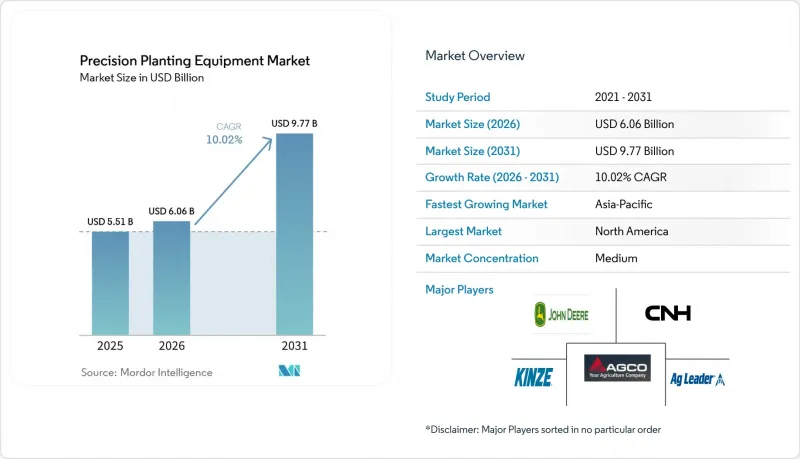
本報告按產品(硬體、軟體等)、設備類型(播種機、條播機、氣吸式播種機等)、驅動系統(電動和液壓)、應用領域(行栽作物等)、農場規模(400公頃以下和400公頃以上)以及地區(北美、南美等)進行細分。報告以美元計價,呈現市場規模和預測數據。
全球精準播種設備市場趨勢及洞察
為實現產量最大化和確保糧食安全而面臨的壓力
精準播種設備市場正受到糧食需求成長的衝擊,同時,農業生產者在擴大耕地面積方面卻面臨許多限制。美國農業部經濟研究局(USDA ERS)預測,到2035年,83個中低收入國家的糧食總需求將以每年2.2%的速度成長,預計這將使主要種植系統面臨持續的高生產壓力。評估顯示,亞洲和撒哈拉以南非洲的糧食缺口將從2025年的2.714億噸增加到2035年的3.943億噸,這意味著提高田間生產力將勢在必行。這種壓力在播種階段尤其關鍵,因為發芽率、種子位置和種子與土壤接觸的均勻性決定了後續作物生長表現的上限。 2025年發表於《農學前沿》(Frontiers in Agronomy)期刊的一項系統性綜述顯示,歐盟的試驗表明,精密農業可使作物產量提高10%至15%,同時減少25%的化肥用量和30%的用水量。因此,精準播種設備市場受益於結構性需求,而非僅受設備生命週期的影響。這在亞太和南美地區尤其重要,因為這些地區出口作物的生產和糧食安全目標的實現都在提升每英畝耕地的價值。隨著生產者日益面臨土地、水和養分方面的限制,精準播種已成為確保最終產量最早、最可控的手段之一。
透過提高種子和肥料的利用效率來降低投入成本。
此外,隨著漏播、重播或重疊播種等問題造成日益嚴重的經濟損失,精準播種設備市場持續發展。與傳統的機械系統相比,電動稱重系統能夠更好地控制播種密度,並減輕維護負擔,從而更有效地利用昂貴的種子。阿拉巴馬州合作推廣服務中心的報告顯示,與傳統的機械系統相比,電動驅動系統可將播種密度的精度提高高達20%,同時無需維護鏈條和軸。約翰迪爾公司表示,其「ExactShot」液體施肥系統能夠僅在種子所在位置施肥,從而將溝內養分用量減少高達60%,使逐行控制成為一種直接的成本節約手段。約翰迪爾公司還報告稱,其「AccuRate」計量器設計可將彎曲溝渠中的重播率降低23%,這表明分段控制和曲線校正如何保護不規則形狀田地中的種子經濟效益。即使在作物價格不穩定的情況下,這些操作優勢也足以證明投資高規格播種機和升級套件的合理性。精準播種設備市場正受惠於此因素,因為農民不再僅僅將精準播種視為提高產量的工具。精準播種作為投入成本管理工具的價值日益凸顯,因為它可以在一次作業中節省種子、肥料和人工時間。
高額的初始投資與資金籌措壓力
精準播種設備市場仍面臨巨大的資金障礙,尤其是在農業機械市場較成熟的地區之外。根據美國政府責任署 (US GAO) 的報告,相容變數施肥技術的噴霧器會增加 5,600 美元的成本,而產量監測器的更換成本約為 8,000 美元。這表明,即使是單一部件也會推高總擁有成本。如果播種機的全面升級包括電動驅動系統、監視器、控制器和下壓力部件,那麼總支出很快就會超出許多低收入生產者的資金籌措。在利率高、補貼不足的發展中市場,這個問題更為突出。即使是認知到精準播種設備農業價值的小規模農戶,也常常因為現金支出是即時的,而節省下來的成本卻需要幾個種植季才能實現而推遲採用。因此,精準播種設備市場在不同地區的成長並不均衡,在那些維修方案、經銷商融資和政策支援能夠降低准入門檻的地區,市場採用率更高。這種限制也影響產品配置,生產商往往更傾向於局部升級而非完全整合、精準的解決方案。只要農民收入持續週期性波動,資金籌措壓力就會持續減緩低階客戶群對科技的接受度。
細分市場分析
截至2025年,硬體將佔精準播種設備市場規模的46.5%,並持續維持其最大細分市場的地位。同時,服務將成為成長最快的細分市場,到2031年將以11.4%的複合年成長率成長。硬體的領先地位反映了播種單元、計量器、控制器、感測器和導航組件的重要性,這些組件仍然是精準播種設備市場的主要資本投資來源。然而,隨著種植者越來越希望機器本身就包含設定、校準、數據分析和軟體支援等服務,而不是售後服務,成長格局正在改變。 AGCO的目標是憑藉其PTx平台,到2029年在精密農業領域創造20億美元的收入。這表明,主要供應商正在建立大規模、更穩定的收入基礎。這一趨勢表明,未來的價值創造將不再主要取決於單一硬體單元的利潤率,而是更多地取決於供應商如何有效地將服務整合到田間作業中。
隨著連網設備部署數量的增加,服務業發展勢頭強勁,對經銷商主導的支援、數據處理和農業指導的需求也日益成長。生產者不再僅僅需要設備交付;他們還需要獲得處方箋施肥和播種、季節性最佳化以及多型號機械組合整合方面的幫助。這擴大了訂閱式軟體、季節性諮詢和播種管理方案在精準播種設備市場中的作用。服務層越強大,客戶維繫往往越高,因為客戶關係超越了最初的設備銷售。這也有利於擁有大規模經銷商網路和能夠跨多個季節為生產者提供支援的數位化平台的供應商。雖然硬體仍然是基礎,但該領域的組成顯然正在向捆綁式解決方案轉變,其中軟體和支援的成長速度超過了硬體部件。
預計到2025年,播種機將佔據精準播種設備市場58%的佔有率,證實了大部分支出仍集中在行間作物播種系統上。這種主導地位反映了播種機精準播種在玉米、大豆及類似作物種植系統中,在建立種植、確保均勻發芽和控制行間投入方面發揮的核心作用。 Kinze的5000系列現已全部採用電動驅動,這表明主要製造商已將電動稱重功能從一項高階配置轉變為核心規格。 Vaderstad AB也將其「Tempo」系列定位為採用獨立電動驅動和無線控制,這支持了精準播種機市場類似的研發方向。這種對播種機的關注解釋了為什麼OEM廠商的創新仍然強調行間架構、速度、單粒播種和升級相容性。
預計到2031年,無人機和自動播種機的複合年成長率將達到13.4%,儘管其基數較小,但仍將成為成長最快的設備類型。這一成長反映了人們對無人田間作業、更輕的部署模式以及曾經被視為實驗性技術的免耕播種應用場景日益成長的興趣。該領域的崛起並未降低傳統播種機的重要性,反而拓寬了精準播種設備市場的技術可能性。在勞動力短缺或地形複雜導致傳統作業區域難以保障的地區,基於無人機的自動播種系統尤其效用。這也與農業數位化政策的支持以及自動駕駛技術日益普及的趨勢相契合。從長遠來看,該領域的銷售額可能仍將小規模傳統播種機,但它將繼續影響製造商在播種、控制和設備配置方面的思考。
區域分析
到2025年,北美將佔據精準播種設備市場44%的佔有率,預計到2031年,該地區將以9.2%的複合年成長率成長。美國和加拿大仍然是該地區的核心需求國,因為大規模農民持續投資於電動播種機、即時監控和維修計畫。迪爾公司自2005年以來實施的播種機升級策略清楚地表明,該地區如何同時支援新設備的銷售和現有設備的商業化。規模優勢、廣泛的經銷商網路和升級應對力確保了北美在精準播種設備市場保持其中心地位。墨西哥雖然市場規模仍較小,但在灌溉玉米和高粱產區,精密農業的優勢日益凸顯,墨西哥的需求逐漸成長。
亞太地區是成長最快的區域市場,預計到2031年複合年成長率將達到12.5%,是精準播種設備市場的主要成長引擎。中國是該地區政策支持最大的國家,其智慧農業規劃中設定了明確的資訊化目標,並推動了整體主要作物數位化作業的普及。中國的「2025年農業機械更新補貼擴大計畫」進一步強化了數位化設備的應用環境。澳洲也擁有成熟的精準播種基礎,其大規模農場結構為高產能系統和廣泛的數位化整合提供了支撐。全部區域的成長模式是政策支持、糧食生產壓力和不斷擴大的商業化農業領域的共同作用的結果。
在南美洲,以巴西和阿根廷為首的市場呈現穩定成長態勢。由於大規模的大豆和玉米種植項目,這些國家對播種設備的需求仍然強勁。該地區作為精密農業市場的重要樞紐,使用著種類繁多的農機設備,因此持續吸引技術供應商的目光。歐洲市場也在持續擴張,這得益於永續性農業實踐以及對適用於小規模、分散農地的高度柔軟性的精密農業設備的需求。中東和非洲的發展速度相對較慢,成長主要集中在特定市場,並受到糧食安全計劃和機械化計畫的推動。然而,成本和溝通方面的挑戰仍然限制著精準播種設備的更廣泛應用。整體而言,精準播種設備市場在農業需求、扶持政策和完善的經銷網路相符的地區發展最為迅速。
其他好處:
- Excel格式的市場預測(ME)表
- 3個月的分析師支持
目錄
第1章:引言
- 研究假設和市場定義
- 調查範圍
第2章:調查方法
第3章執行摘要
第4章 市場狀況
- 市場概覽
- 市場促進因素
- 為實現產量最大化和確保糧食安全而面臨的壓力
- 透過提高種子和肥料的利用效率來降低投入成本。
- 人手不足和種植期縮短
- 政府支持和機械化與永續性密切相關
- 優質種子的成本效益促進了單粒播種和行級管理。
- 維修的成本效益將擴大現有種植池的規模。
- 市場限制因素
- 初始投資額大,且資金籌措壓力大
- 技術複雜性和缺乏培訓
- 混合式車輛車隊互通性和數據標準面臨的挑戰
- 對網路連接的依賴以及電子元件成本的不斷上漲
- 監理情勢
- 技術展望
- 波特五力分析
第5章 市場規模與成長預測
- 透過提供的內容
- 硬體
- 自動化和控制系統
- 感測和監測系統
- 軟體
- 農場管理和測繪軟體
- 處方和分析軟體
- 服務
- 系統整合和諮詢
- 託管和互聯服務
- 培訓和支援服務
- 硬體
- 依設備類型
- 播種機
- 播種機和氣吸式播種機
- 種植附件和附加元件
- 無人機和自動播種機
- 透過驅動系統
- 電動驅動
- 液壓驅動
- 透過使用
- 大田作物
- 穀物、油籽和豆類
- 林業
- 園藝
- 溫室和可控制環境農業
- 按農場規模
- 不足400公頃
- 超過400公頃
- 按地區
- 北美洲
- 美國
- 加拿大
- 墨西哥
- 其他北美國家
- 南美洲
- 巴西
- 阿根廷
- 哥倫比亞
- 其他南美國家
- 歐洲
- 德國
- 法國
- 英國
- 義大利
- 西班牙
- 俄羅斯
- 其他歐洲國家
- 亞太地區
- 中國
- 印度
- 日本
- 澳洲
- 韓國
- 其他亞太國家
- 中東
- 沙烏地阿拉伯
- 阿拉伯聯合大公國
- 土耳其
- 其他中東國家
- 非洲
- 南非
- 埃及
- 奈及利亞
- 其他非洲國家
- 北美洲
第6章 競爭情勢
- 市場集中度
- 策略趨勢
- 市佔率分析
- 公司簡介
- Deere and Company
- AGCO Corporation
- PTx Trimble LLC
- CNH Industrial NV
- Kinze Manufacturing, Inc.
- Ag Leader Technology
- Topcon Positioning Systems, Inc.
- Precision Planting LLC
- Kubota Corporation
- Vaderstad AB
- HORSCH Maschinen GmbH
- Great Plains Manufacturing, Inc.
- Bourgault Industries Ltd.
- Buhler Industries Inc.
- Morris Industries Ltd.
第7章 市場機會與未來展望
According to Mordor Intelligence, the precision planting equipment market size is projected to expand from USD 5.51 billion in 2025 to USD 6.06 billion in 2026, and to USD 9.77 billion by 2031, registering a CAGR of 10.02% between 2026 and 2031.
This report is Segmented by Offering (Hardware, Software, and More), by Equipment Type (Planters, Seed Drills and Air Seeders, and More), by Drive Type (Electric Drive and Hydraulic Drive), by Application (Row Crops, and More), by Farm Size (Below 400 Ha and Above 400 Ha), and by Geography (North America, South America, and More). The Report Offers the Market Size and Forecasts in Terms of Value (USD).
Global Precision Planting Equipment Market Trends and Insights
Yield Maximization and Food Security Pressure
The precision planting equipment market is influenced by the growing demand for food, while crop producers face limitations in expanding arable land. USDA ERS projected total grain demand across 83 low and middle-income countries to grow at 2.2% annually through 2035, which keeps output pressure elevated across major cropping systems. The same assessment showed the grain demand shortfall rising from 271.4 million metric tons in 2025 to 394.3 million metric tons by 2035 across Asia and Sub-Saharan Africa, which points to a sustained need for higher field productivity. That pressure matters at planting because emergence uniformity, seed placement, and seed-to-soil contact set the ceiling for later crop performance. A 2025 systematic review in Frontiers in Agronomy found that precision agriculture raised yields by 10% to 15% in European Union (EU) trials while reducing fertilizer use by 25% and water use by 30%. The precision planting equipment market, therefore, benefits from a structural demand signal rather than a short-lived equipment cycle. This is especially relevant in Asia-Pacific and South America, where export crops and food security goals both raise the value of each planted acre. As growers face tighter land, water, and nutrient constraints, planting accuracy becomes one of the earliest and most controllable ways to protect final yield.
Input Cost Reduction through Seed and Fertilizer Efficiency
The precision planting equipment market is also advancing because every missed seed, double drop, or overlap now carries a clearer financial penalty. Electric metering systems improve population control and reduce maintenance exposure compared with older mechanical layouts, which directly supports better use of expensive seed inputs. Alabama Cooperative Extension reported that electric drives can deliver population accuracy advantages of up to 20% over mechanical predecessors while removing chain and shaft maintenance. Deere states that its ExactShot liquid fertilizer system can reduce in-furrow nutrient use by up to 60% by applying fertilizer only where seed is present, which turns row-level control into a direct cost-saving tool. Deere also reported a 23% reduction in overpopulation on curved rows through its AccuRate meter design, which shows how section control and curve compensation protect seed economics in irregular field shapes. These operating gains support the case for higher-spec planters and upgrade kits even when crop prices are uneven. The precision planting equipment market gains from this driver because growers no longer view planting precision only as a yield tool. It is increasingly treated as an input cost control tool that protects seed, fertilizer, and operating time in the same pass.
High Upfront Investment and Financing Pressure
The precision planting equipment market still faces a basic capital barrier, especially outside the most mature farm machinery regions. The United States Government Accountability Office (US GAO) reported that variable-rate technology applicators carry a premium of USD 5,600, and replacement yield monitors cost around USD 8,000, demonstrating that even single components can raise the total ownership burden. When full planter upgrades include electric drive systems, monitors, controllers, and downforce components, total spending can quickly exceed what many growers can finance during a weak income cycle. This issue is more pronounced in developing markets, where interest costs are higher, and subsidy coverage is incomplete. Smaller farms may still see the agronomic value, but they often delay adoption because the savings arrive over several seasons while the cash outlay is immediate. The precision planting equipment market, therefore, grows unevenly across regions, with stronger uptake in areas where retrofit paths, dealer financing, or policy support reduce the entry hurdle. This restraint also affects product mix, since growers may favor partial upgrades over fully integrated precision packages. As long as farm incomes stay cyclical, financing pressure will continue to slow adoption at the lower end of the customer base.
Other drivers and restraints analyzed in the detailed report include:
- Labor Shortages and Compressed Planting Windows
- Government Support and Sustainability-Linked Mechanization
- Technical Complexity and Training Gaps
For complete list of drivers and restraints, kindly check the Table Of Contents.
Segment Analysis
Hardware accounted for 46.5% of the precision planting equipment market size in 2025, which kept it as the largest offering segment while services moved ahead as the fastest-growing segment at an 11.4% CAGR through 2031. The hardware lead reflects the continued importance of row units, meters, controllers, sensors, and guidance components that still define the main capital purchase in the precision planting equipment market. Even so, the growth profile is shifting because growers increasingly expect setup, calibration, data interpretation, and software support to come with the machine rather than after the sale. AGCO stated that its PTx platform is targeting USD 2 billion in precision agriculture revenue by 2029, which shows how major suppliers are building a larger recurring revenue layer around connected solutions. This pattern suggests that future value capture will depend less on standalone hardware margins and more on how effectively suppliers attach services to field operations.
The services segment is gaining momentum because the installed base of connected equipment now needs more dealer-led support, data handling, and agronomic guidance. Growers are asking for help with prescription execution, seasonal optimization, and mixed-fleet integration, not only with equipment delivery. That creates a larger role for subscription software, seasonal consulting, and managed planting programs within the precision planting equipment market. The stronger this service layer becomes, the more durable customer retention tends to be because the relationship extends beyond the original equipment sale. This also favors suppliers with large dealer networks and digital platforms that can support growers over multiple seasons. Hardware will remain foundational, but the segment mix is clearly moving toward bundled solutions where software and support rise faster than steel and iron.
Planters captured 58% of the precision planting equipment market share in 2025, which confirms that most spending still sits inside row-crop planting systems. That lead reflects the central role of planter accuracy in stand establishment, emergence uniformity, and row-level input control across corn, soybean, and similar cropping systems. Kinze's 5000 Series lineup is now electric-drive only, which shows how leading manufacturers have turned electric metering from a premium feature into a core specification. Vaderstad AB has also positioned its Tempo line around individual electric drives and wireless control, reinforcing the same design direction in the precision planting equipment market. This concentration around planters explains why OEM innovation still focuses so heavily on row-unit architecture, speed, singulation, and upgrade compatibility.
Drones and autonomous seeding equipment are forecast to grow at a 13.4% CAGR through 2031, which makes them the fastest-growing equipment type, even from a smaller base. Their growth reflects wider interest in unmanned field operations, lighter deployment models, and direct seeding use cases that were once treated as experimental. The rise of this segment does not reduce the importance of planters, but it does widen the technology ceiling for the precision planting equipment market. Autonomous and drone-enabled systems are especially relevant where labor availability is tight or terrain makes conventional coverage harder. They also fit well with policy support for agricultural digitization and the growing comfort level around autonomous operations. Over time, this segment is likely to stay smaller than conventional planters in revenue, but it will keep influencing how manufacturers think about seeding, control, and fleet design.
Complete Report Scope:
- By Offering
- Hardware
- Automation and Control Systems
- Sensing and Monitoring Systems
- Software
- Farm Management and Mapping Software
- Prescription and Analytics Software
- Services
- System Integration and Consulting
- Managed and Connected Services
- Training and Support Services
- Hardware
- By Equipment Type
- Planters
- Seed Drills and Air Seeders
- Planting Attachments and Add-Ons
- Drones and Autonomous Seeding Equipments
- By Drive Type
- Electric Drive
- Hydraulic Drive
- By Application
- Row Crops
- Cereals, Oilseeds, and Pulses
- Forestry
- Horticulture
- Greenhouse and Controlled Environment Farming
- By Farm Size
- Below 400 Hectares
- Above 400 Hectares
- By Geography
- North America
- United States
- Canada
- Mexico
- Rest of North America
- South America
- Brazil
- Argentina
- Colombia
- Rest of South America
- Europe
- Germany
- France
- United Kingdom
- Italy
- Spain
- Russia
- Rest of Europe
- Asia-Pacific
- China
- India
- Japan
- Australia
- South Korea
- Rest of Asia-Pacific
- Middle East
- Saudi Arabia
- United Arab Emirates
- Turkey
- Rest of Middle East
- Africa
- South Africa
- Egypt
- Nigeria
- Rest of Africa
- North America
Geography Analysis
North America held 44% of the precision planting equipment market share in 2025, and the region is projected to grow at a 9.2% CAGR through 2031. The United States and Canada remain the core of regional demand because large row-crop operations continue to invest in electric drive planters, real-time monitoring, and retrofit programs. Deere's upgrade strategy for planters dating back to 2005 illustrates how the region supports both new sales and installed-base monetization at the same time. This combination of scale, dealer depth, and upgrade readiness keeps North America at the center of the precision planting equipment market. Mexico remains smaller, but it adds incremental demand in irrigated corn and sorghum areas where precision gains are becoming more attractive.
Asia-Pacific is the fastest-growing regional block at a 12.5% CAGR through 2031, which makes it the main expansion engine for the precision planting equipment market. China is the largest policy anchor in the region because its smart agriculture plan set explicit informatization targets and backed wider use of digital operations across major crops. China's 2025 subsidy expansion for agricultural machinery replacement further strengthens the adoption environment for digitally enabled equipment categories. Australia also contributes a mature precision seeding base because large farm structures support high-capacity systems and wider digital integration. Across the region, the growth pattern combines policy support, food production pressure, and an expanding commercial-scale farming segment.
South America is experiencing steady growth, led by Brazil and Argentina, where large soybean and corn farming operations sustain strong demand for planting equipment. The region continues to attract technology providers due to its importance as a mixed-fleet precision agriculture market. Europe is also expanding, supported by sustainability-driven farming practices and demand for adaptable precision equipment suited to smaller and more fragmented fields. The Middle East and Africa are developing more gradually, with growth concentrated in specific markets supported by food security initiatives and mechanization programs. However, broader adoption remains constrained by cost and connectivity challenges. Overall, the precision planting equipment market is advancing most rapidly in regions where agronomic needs, supportive policies, and strong distribution networks align.
List of Companies Covered in this Report:
- Deere and Company
- AGCO Corporation
- PTx Trimble LLC
- CNH Industrial N.V.
- Kinze Manufacturing, Inc.
- Ag Leader Technology
- Topcon Positioning Systems, Inc.
- Precision Planting LLC
- Kubota Corporation
- Vaderstad AB
- HORSCH Maschinen GmbH
- Great Plains Manufacturing, Inc.
- Bourgault Industries Ltd.
- Buhler Industries Inc.
- Morris Industries Ltd.
Additional Benefits:
- The market estimate (ME) sheet in Excel format
- 3 months of analyst support
TABLE OF CONTENTS
1 Introduction
- 1.1 Study Assumptions and Market Definition
- 1.2 Scope of the Study
2 Research Methodology
3 Executive Summary
4 Market Landscape
- 4.1 Market Overview
- 4.2 Market Drivers
- 4.2.1 Yield maximization and food security pressure
- 4.2.2 Input cost reduction through seed and fertilizer efficiency
- 4.2.3 Labor shortages and compressed planting windows
- 4.2.4 Government support and sustainability-linked mechanization
- 4.2.5 Premium seed economics favor singulation and row-level control
- 4.2.6 Retrofit economics extend the installed planter base
- 4.3 Market Restraints
- 4.3.1 High upfront investment and financing pressure
- 4.3.2 Technical complexity and training gaps
- 4.3.3 Interoperability friction across mixed fleets and data standards
- 4.3.4 Connectivity dependence and electronics cost inflation
- 4.4 Regulatory Landscape
- 4.5 Technological Outlook
- 4.6 Porter's Five Forces Analysis
- 4.6.1 Bargaining Power of Suppliers
- 4.6.2 Bargaining Power of Buyers
- 4.6.3 Threat of New Entrants
- 4.6.4 Threat of Substitutes
- 4.6.5 Intensity of Competitive Rivalry
5 Market Size and Growth Forecasts (Value, USD)
- 5.1 By Offering
- 5.1.1 Hardware
- 5.1.1.1 Automation and Control Systems
- 5.1.1.2 Sensing and Monitoring Systems
- 5.1.2 Software
- 5.1.2.1 Farm Management and Mapping Software
- 5.1.2.2 Prescription and Analytics Software
- 5.1.3 Services
- 5.1.3.1 System Integration and Consulting
- 5.1.3.2 Managed and Connected Services
- 5.1.3.3 Training and Support Services
- 5.1.1 Hardware
- 5.2 By Equipment Type
- 5.2.1 Planters
- 5.2.2 Seed Drills and Air Seeders
- 5.2.3 Planting Attachments and Add-Ons
- 5.2.4 Drones and Autonomous Seeding Equipments
- 5.3 By Drive Type
- 5.3.1 Electric Drive
- 5.3.2 Hydraulic Drive
- 5.4 By Application
- 5.4.1 Row Crops
- 5.4.2 Cereals, Oilseeds, and Pulses
- 5.4.3 Forestry
- 5.4.4 Horticulture
- 5.4.5 Greenhouse and Controlled Environment Farming
- 5.5 By Farm Size
- 5.5.1 Below 400 Hectares
- 5.5.2 Above 400 Hectares
- 5.6 By Geography
- 5.6.1 North America
- 5.6.1.1 United States
- 5.6.1.2 Canada
- 5.6.1.3 Mexico
- 5.6.1.4 Rest of North America
- 5.6.2 South America
- 5.6.2.1 Brazil
- 5.6.2.2 Argentina
- 5.6.2.3 Colombia
- 5.6.2.4 Rest of South America
- 5.6.3 Europe
- 5.6.3.1 Germany
- 5.6.3.2 France
- 5.6.3.3 United Kingdom
- 5.6.3.4 Italy
- 5.6.3.5 Spain
- 5.6.3.6 Russia
- 5.6.3.7 Rest of Europe
- 5.6.4 Asia-Pacific
- 5.6.4.1 China
- 5.6.4.2 India
- 5.6.4.3 Japan
- 5.6.4.4 Australia
- 5.6.4.5 South Korea
- 5.6.4.6 Rest of Asia-Pacific
- 5.6.5 Middle East
- 5.6.5.1 Saudi Arabia
- 5.6.5.2 United Arab Emirates
- 5.6.5.3 Turkey
- 5.6.5.4 Rest of Middle East
- 5.6.6 Africa
- 5.6.6.1 South Africa
- 5.6.6.2 Egypt
- 5.6.6.3 Nigeria
- 5.6.6.4 Rest of Africa
- 5.6.1 North America
6 Competitive Landscape
- 6.1 Market Concentration
- 6.2 Strategic Moves
- 6.3 Market Share Analysis
- 6.4 Company Profiles (Includes Global Level Overview, Market Level Overview, Core Segments, Financials as Available, Strategic Information, Market Rank/Share for Key Companies, Products and Services, and Recent Developments)
- 6.4.1 Deere and Company
- 6.4.2 AGCO Corporation
- 6.4.3 PTx Trimble LLC
- 6.4.4 CNH Industrial N.V.
- 6.4.5 Kinze Manufacturing, Inc.
- 6.4.6 Ag Leader Technology
- 6.4.7 Topcon Positioning Systems, Inc.
- 6.4.8 Precision Planting LLC
- 6.4.9 Kubota Corporation
- 6.4.10 Vaderstad AB
- 6.4.11 HORSCH Maschinen GmbH
- 6.4.12 Great Plains Manufacturing, Inc.
- 6.4.13 Bourgault Industries Ltd.
- 6.4.14 Buhler Industries Inc.
- 6.4.15 Morris Industries Ltd.
7 Market Opportunities and Future Outlook

 精準播種市場-2026-2032年全球市場預測
 全球精準播種市場規模、佔有率、趨勢及成長分析報告(2026-2034年)
 精準播種市場-全球產業規模、佔有率、趨勢、機會及預測(依產品、系統類型、農場規模、應用、地區及競爭格局分類,2021-2031年)
 亞太精準播種市場:依作物類型、部署類型和國家分析和預測(2025-2035 年)
 歐洲精準播種市場:按作物類型、部署類型和國家分析和預測(2025-2035 年)
 精準種植市場 - 全球及區域分析:按作物類型、部署類型及區域 - 分析與預測(2025-2035)
 全球精準種植市場
 2032 年精準種植市場預測:按產品、設備類型、系統類型、驅動類型、農場規模、技術、應用和地區進行全球分析2030 年精密種植機市場預測:按設備類型、驅動類型、組件、技術、應用、最終用戶和地區進行的全球分析